















Frege's theory distinguishes between the reference (the actual object in the world that a term denotes) and the sense (the mode of presentation or way of thinking about that object), which solves identity puzzles like 'The Morning Star is the Evening Star' by showing that different senses can converge on the same reference, making such statements informative rather than trivial; however, this theory faces challenges with non-truth-functional contexts like indirect quotation and knowledge ascription, where substituting co-referential terms changes truth values, requiring Frege to propose that in certain contexts the reference is actually the sense rather than the object itself.
Frege on Sense and Reference: The Analytic Tradition Lecture
Added:Basic familiarity with the distinction between syntax and semantics in the philosophy of language.
An understanding of classical propositional logic and predicate calculus, which Frege helped establish.
The philosophical puzzle of identity statements (e.g., why 'a = a' is trivial but 'a = b' can be highly informative).
A foundational grasp of traditional theories of meaning, such as John Locke's ideational theory of language.
Bertrand Russell's Theory of Descriptions, which provides an alternative approach to definite descriptions and non-referring terms.
Saul Kripke's critique of Fregean descriptivism and the development of the causal theory of reference in 'Naming and Necessity'.
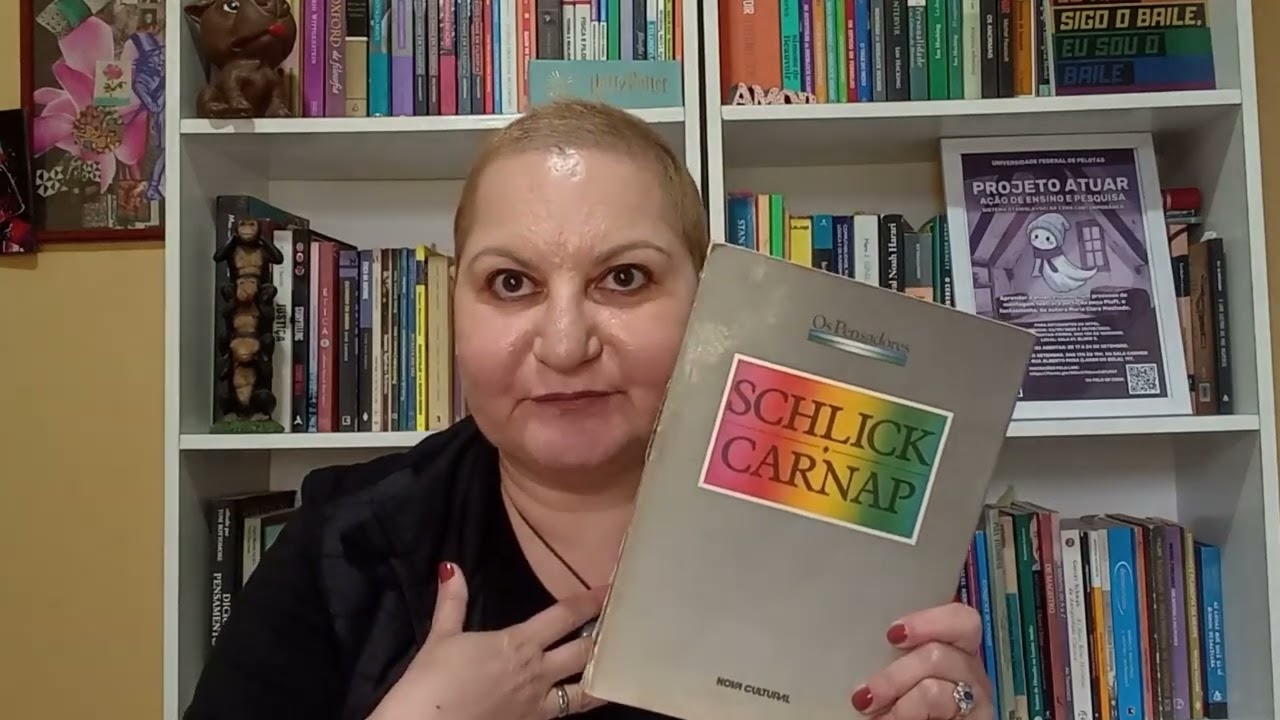
The distinction between extension and intension in modern formal semantics (e.g., Rudolf Carnap's work).
Direct Reference Theory and its implications for indexicals and proper names (as explored by David Kaplan and others).
53.2K views893likes50:07Original Release: 2017-01-27
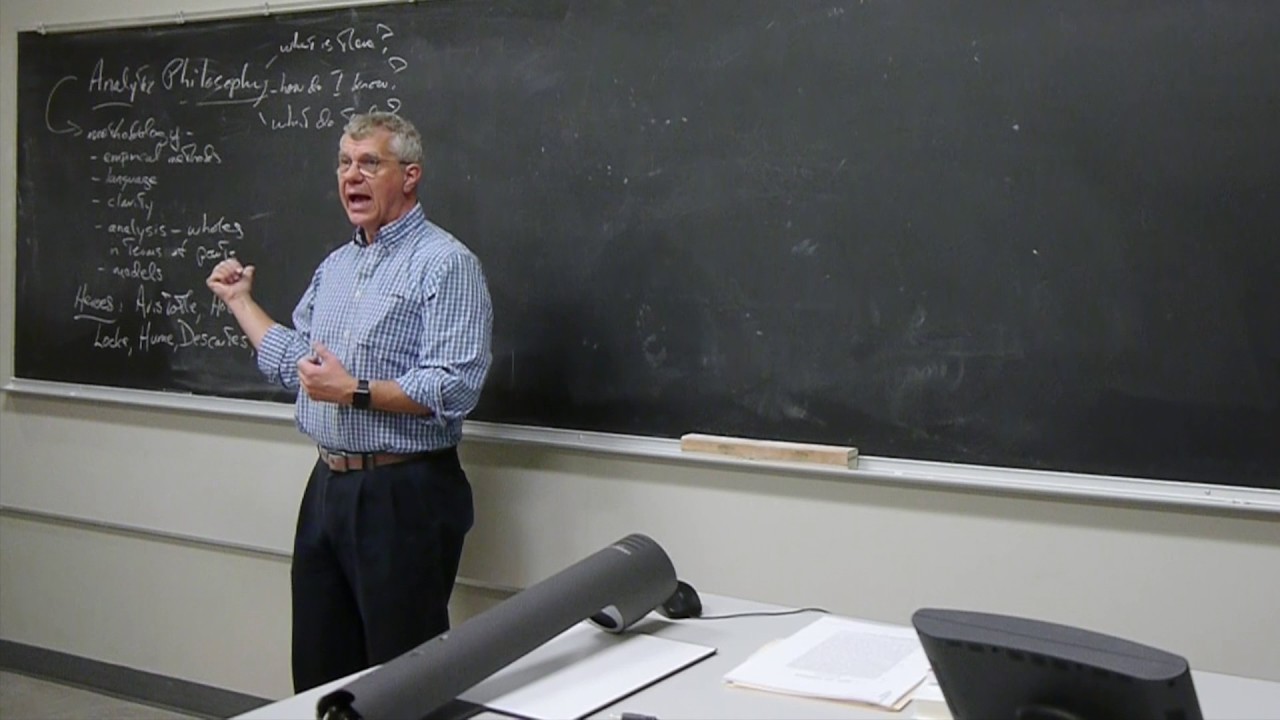
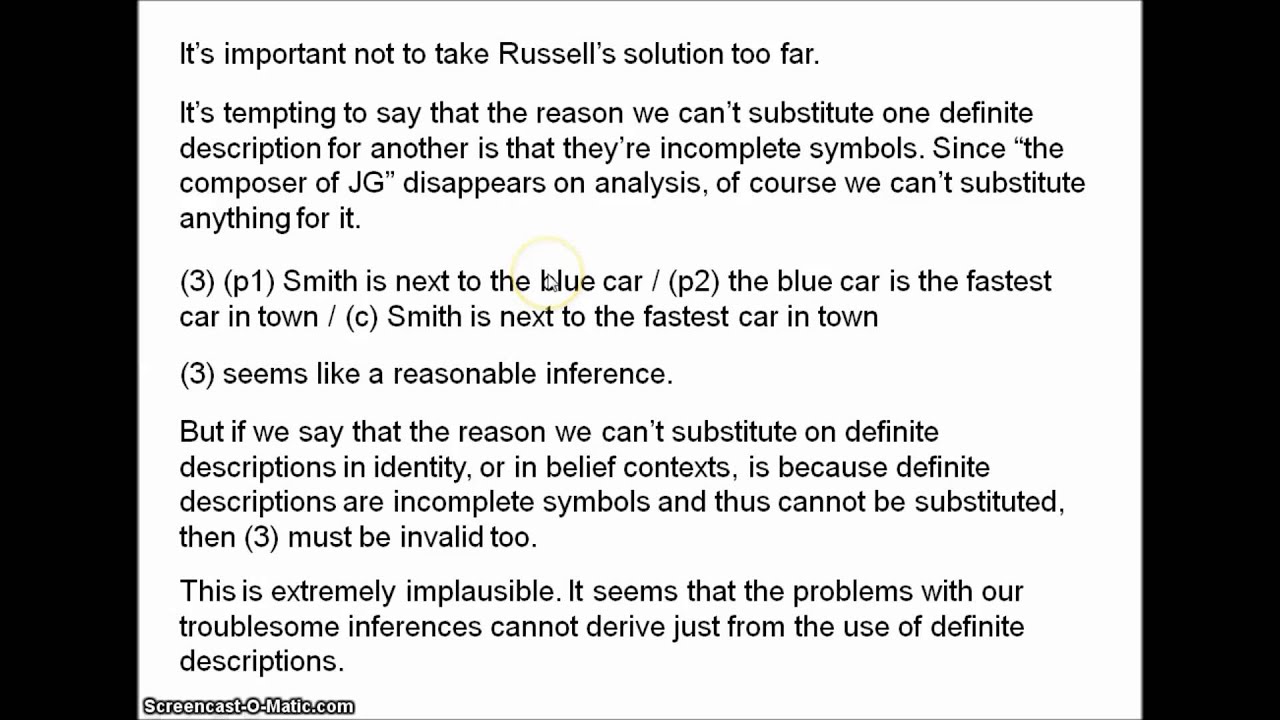
last time we were talking about the kinds of puzzles that start motivating fraa and today I want to try to be more precise about what his solution is last time we were talking about the general idea that in addition to the reference of a term something in the world that it corresponds to you've got a sense which is something like a way of picking out that reference a mode of presentation of that reference or or something that leads you some in some way to it uh and so the point of introducing the sense is that it's something outside of the mind you and I can share the same sense even though we have different concepts different concepts with different let's say definitions of what a triangle is um and different emotive content connected to whatever concept that is um a different tone you might say emotionally speaking now triangles it's unlikely that we have much of a tone but we could um other things we might have a much stronger um tone um and even triangle is the kind of thing that you know it might depend on uh the context a lot when we're thinking in terms of geometrical triangles it's unlikely that we have much of an a context um that supplies emotional content unless you for example either love or hate geometry I happen to love it so I see a triangle and it's like Yay you know geometry but in other context it might mean something different so in any event those things are all Inside the Mind those things are all subject but what fra is looking for is not just something where you and I might vary and have different ways of picking out the same object something that really constitutes something like the meaning of the term so triangle has a meaning is the idea and it's by virtue of that meaning of the term it sense that we're able to pick out triangles and the same thing is true of let's say blue blue is something that has a sense that is to say the word blue has a sense and that enables to pick out blue us to pick out blue things now you and I might have individual concepts of blue we might have different associations of blue all of that is subjective but there is something that is actually an objective meaning and so the sense is supposed to be something outside your head or my head a bit like Plato's forms well let's see how this idea helps him to solve the puzzles we were discussing last time remember we had these identity puzzles and so what they look like well classic one is the Morning Star is the evening star and we had a number of variants on that you might have proper names involved for example so one of the ones we considered was Bruce Wayne is Batman and so on now in general we've got then aals B where those are different signs different terms and that can seem informative in a way that aals a does not seem informable so how does that happen well here is the general idea we've got something like the sense of the term so let's let the sense of some term T be just represented as oh I don't know like s of T okay that'll be T's mean that will be its sense and that's something outside the head we can also talk about concepts of T associated with t and so on but then we would have to put an index for a person because then your concept might be different from my concept but we don't need that variable for a person when we think about senses it's just the sense of that term so we can talk about the sense of Batman the sense of BR Bruce Wayne the sense of the term the evening star and so forth now it won't just be terms sentences will have a sense as well as we'll see and then what about the reference well the reference of T we could let that be R of T so now the idea is that the sense picks out the reference so if we know the sense we have some way given the facts of figuring out what the referent is or if there is a reference at all as we'll see an interesting example comes up when there is no reference uh or when there's more than one reference there are many people running around calling themselves Batman let's say uh then we get special problems here but now if we think of it in these terms we can say okay so what's going on here well the idea is that the reference of a is equal to the reference of B and of course the reference of a is equal to the refer of a so in both cases we've got these being true because of that but on the other hand the sense we associate with a is not equal to the sense we associate with b and that's how it can be informative so we get information because we've got these two things with different senses and we find out they have the same reference okay we've got this sort of situation we have a here and B here and then the same thing the same object and it's informative to find out that they denote the same thing they have the same reference this is the reference of a which is equal to the reference of but of course they have different senses there different meanings attached to them now so far you might think well how does that really address anything well it tells us something important about really what it is to be informative okay why is it trivial to say the Morning Star is the morning star and not trivial to say the Morning Star is the evening star because in one case we're really just saying something that conveys no very useful information the Morning Star is the morning star that's true if and only if the reference of the Morning Star is the reference of the morning star and of course it is and so you might think look we get no information from that again we'll come back to this question of what if it doesn't exist but the Morning Star is the evening star we've got two different senses and so to be told the referent of those two terms with two different senses is the same gives us real information now if we look at what fragga says about senses we'll see some other interesting claims here okay a difference can arise only if the difference between the signs corresponds to a difference in the mode of presentation of that which is designated let ABC for example be the lines connecting the vertices of a triangle with the midpoints of the opposite sides the point of intersection of A and B is then the same as the point of intersection of B and C so we have different designations for the same point and those names likewise indicate the mode of presentation so his example here is a triangle we've got lines between each vertex vertex and the midpoint of the other side so let's see here's the midp point and then we do the same here if I draw it correctly we should get the same point there were all of those lines intersect and so we can refer to that point as the intersection of these two lines the intersection of those two lines the intersection of those two lines Etc and all of those end up being the same thing and that's a substantive mathematical theorem it's not a trivial thing and so we gain the information so he says there is in addition to the reference of the sign what I'd like to call the sense of the sign wherein the mode of presentation is contained so it's clear from the context that by sign a name I've here understood any designation representing a proper name but of course he also has descriptions like the Morning Star is the evening star as his example so we distinguish those from the conception so these are outside now there are two principles that frga yes go ahead um could there be any A and B such that uh the reference is the same but the sense is also the same oh sure so yes um let's think about the case where we've got two terms um that are different terms right but nevertheless you might say not only is the reference the same the sent is just the same what would be examples of that so here we've got yes if you want to think of it this way we've got the sense here which helps us to determine the uh denotation the reference and now imagine that we've got two terms Each of which have the same sense so it's not just that we have the same object here we've got two different terms here T1 and T2 let's say but they end up having exactly the same sense what would be an example of terms that just have exactly the same yeah like Firefly and lightning bug ah Firefly lightning bug yes um you might say the sense is just the same um there're two different words for the same thing um it's not really like evening star and Morning Star where those are as were two different ways of getting at the same thing lightning bug and Firefly just mean the same thing right um and it's not just that they refer to the same class of insects it's like oh wow now you could have different associations maybe as a child you called them lightning bugs and only later did you learn that term Firefly and then you saw the Miyazaki movie Grave of the fireflies and so now Firefly brings this you know overwhelming sense of pathos to you whereas lightning bug is like oh we used to run around the backyard and trap the M JS um and that's so there could be different emotional senses but on the other hand it looks like the meaning is just the same what are some other examples of that yeah wait for that example how do they have the same sense how yeah good how do they have the same sense maybe we're too quick um what is the sense the meaning we should attach to something like firly something that gives out light illumination something that gives out light well that's not a firefly but an insect that gives all light right as it flies around um suppose we try that out now like bug how would you describe the sense of it I would say the senses in the species right for the because it's the same thing the same bug ah okay good somebody who's thinking more biologically would say well wait there's a certain species here and uh the maybe the reference is the species but at any rate um you might think the sense is just the species so but on the other hand it's hard to sort of differentiate anyway yeah um but in your previous example you said the sense that you could have a different sense from Firefly and light blood based on your experience no no no that that's the concept so the conception is something that is going to be your particular way of thinking of it and that will have a cognitive component well I should be careful here actually he's using the conception for the cognitive component so that's going to be whatever you in particular have as a concept and that can vary from person to person in addition to this Con ception there are these emotional associations that go along so there's as it were this cognitive part of what is subjective in you and then this non-cognitive this additional Association emotive part and and incident we should be careful of to distinguish those too because there are certain associations you have and then certain emotional tones that go along with those and those are two different things um but those are different everyone has the same sense for a given word is that true does everyone have the same sense we've been saying you know we want to be something outside of the head so it's not strictly subjective but now are there ever times where people have different senses associated with the same word some of you are nodding yes what would be an example of that someone was confused about the meaning of the word like if they were wrong okay good somebody could just misunderstand the meaning right and I you see this in freshman papers all the time uh right where somebody thinks they know what a word means and they don't what it means um there are certain public figures who specialize in tell and there's certain comedians who make a big deal out of this scly using the wrong word and so forth um so you could just be using the word incorrectly um is are there other cases yeah philosophy o philosophy yes okay good um you mean the term itself yeah yeah it might be that people have different not only different concepts of philosophy but really attach different meanings to the terms and so what would be a way in which somebody might use it to deviates from most people's usage well actually there are there's this sort of technical usage we have in the Academia right the department of philosophy but then other people say you know oh yeah that's my philosophy and it's stuff that isn't exactly you know something you'd hear in a classroom like yeah get them before they get you that's my philosophy right where it's like well you know yeah I mean that's that's a different sense of philosophy from the so sometimes it's just an ambiguity of the term somebody is using it in one way and some somebody else is using it in another way U so somebody might be wrong there might be multiple usages it may be that some terms are just vague and the way in which you're using it your Zin your sense is different from mine because there's a certain vagueness and your as it were making the term precise in one way and somebody else is making it precise in a different way um there are court cases about this kind of thing you know where um the question in the contract is okay I I promise to deliver you some chickens and then I give you a bunch of old hens and you say what do you mean I I wanted chickens I can actually like fry up and serve to my customers and uh and so in short or I get give you a bunch of baby chicks and I said those are chickens you say no they're not and so in short yeah it might be that we attach different meanings to the term and among different people yeah so going back at the firly wouldn't like two different senses be like an insect that gives offly just like one sense and like the the whatever name it is I for what it's called but the biological name for the Firefly is different sense yeah I think the biological name would have different sense because it really says look it's this specific species and this specific genus and that presumably is going to have a different sense but on the other hand at least the way I use Firefly and lightning buug they just stand for exactly the same idea as it were in my head and exactly the same sense I would think because I attach the same meaning to both they're just linguistic variants I mean can you think of other cases where we have two terms for what is really the exactly the same thing I mean it what do what do you call terms that just have the same meaning synonms yeah synonyms so just think of synonyms what are some examples of synonyms soda and pop ah soda and pop yeah okay um I grew up in a place where it was called pop and then I moved and learned that I was now considered something between an alien and an imile for using that term sort of adapted um so so yeah that's something that um yeah look they just mean the same thing or other examples oh like a lot of crosscultural things like a live than an elevator o lift yes exactly the British have different terms for lots of things so lift and elevator bathroom and L etc etc those really just mean the same thing um it's sort of dying out now but for a long time refrigerator and ice box were like this ice box was kind of the oldfashioned term for a refrigerator now nobody remembers that they used to have just Big Blocks of ice at the top to keep everything cold and so that term is sort of gradually dying out but but yeah those are things where look the meaning is just the same um they're fully synonymous now we're going to consider later attacks on that idea of synonymy Quin is going to say what do you mean synonyms what do you mean they have the same meaning all this talk meanings synonomy and so doesn't make any sense at all so for now we'll just be naive and prequin and assume that that makes sense but yeah I think there are times when we just have two words that have exactly the same sense um also we can do this if we think cross linguistically right um think about the English term red and the German r or the French or whatever we might say those are just synonyms right that term in this language means the same thing as that term in that language and there we'll have two different words that have exactly the same meaning yeah is it that they mean the same thing to a specific person or they mean something like to the same thing to everyone uh yeah yeah yeah good um in the case of something cross linguistic presumably lots of people won't know that means because they don't speak that language and so it won't be for everyone for sure um and in fact and yet we don't want to say oh it's just this one person you know here's this one person who speaks both French and English and that person uses these attaches the same meaning so there's synonymous um it becomes complicated actually in those kinds of cases and often there are shades of meaning that seem to get lost in translation for example so so yeah what you're raising is a really good question it's not a simple matter now sometimes I think it really is sometimes there's a word and you say oh it just is the equivalent of the English and and the linguistic roles they play match up precisely but often they don't match up precisely and then yeah so the idea of sentence is that two people can but not necessarily have the same sense about a specific word right right yeah absolutely um so yeah anyway I think that's possible um how often it happens is a real question and whether there's any sense to this idea of sense at all of course is a different kind of question that Quine will raise later all right now here is frager's idea about the way this all works he says how do we figure out the meaning of a sentence not just a term like uh Batman or the Morning Star but a sentence like the Morning Star is the evening star or Bruce Wayne is Batman we need to talk about the meanings of sentences the sense of a sentence as well as the reference and so he has principles that are generally called principles of compositionality in this particular article he doesn't actually articulate those though they're hovering in the background and they drive some of the things he says so what are these principles well the sense of the whole is a function of the senses of the parts so let's call that the first principle the sense version of that principle so how do I figure out the meaning of something like the Morning Star is the evening star I think about the meaning of the Morning Star is evening uh and I put them together in this way so now they're going to be you know what kind of function it depends really on the form of the sentence so The Logical form will determine the particular function we use to put those together it depend on how those words are combined we take those meanings of words basically and combine them to get meanings of sentences and now he thinks the same thing is true of the reference so the reference of the whole is a function of the reference of the parts maybe I should really say referent here reference the parts now this it turns out is going to tell us some interesting things and also lead to some problems and we can already get a sense of the problems but well why do I say that we can already get a sense of problems yeah yeah with firefly and lightning bug if you just take it into parts and they mean very different things oo good good good because we'll get the meaning of lightning and the meaning of bug right and how do we combine those to get the meaning of lightning bug you'll think lightning I know what that is Boom you know well I'm making the sound with thunder but it's really the flash of light right so flash of light insect now there's a way of putting flash of light and insect together to get the meaning of light and bug but on the other hand it's not the first thing you would think of right um and so actually you would think uh yeah they're going to be certain things like that that are problems so we're going to have um yeah a number of things that arise as issues here and one will be it lightning bug is an example of one of those where you might think you combine the meaning of lightning and bug and you don't really exactly end up with lightning bug uh and the meaning of that so and and with the reference too think insects you know massive electrical discharges and put them together and there's no overlap there right so it's not clear how that's going to work um so idioms like that or you know kick the bucket for dying um I know what buckets are I know what kicking is in fact I know one meaning of kicking the bucket you know can walk over I was painting and I made a mess cuz I kicked the bucket and the face SP all um but that's not going to keep you dying and so that's something that is going to be and that's one of the things that's farest in a way about learning other languages they're all these idiots I I was in Costa Rica a few years ago and Costa Ricans really know how to party I mean they they put me to shame anyway we were out at some comedy Cloud you know 2: in the morning or and it was B there was this game called um yeah no mism um it's not the same okay and people would get up and say you know this is not the same as that and the it was an audience participation thing people would get up from the audience and go up to microphone and say this is not the same as that and everyone would laugh and and I knew enough span to understand most of the words but it was all based on idiomatic meanings and so I had no idea why any of it was funny uh you know and well I I won't give you examples because they're sort of flued I found out later a lot of this was LW that's why everybody was laughing the way they were these were sort of sexual inuendos but at the time I was like telescopes I I'm sorry I I don't get it you know so uh I I could it was interesting because when other Americans spoke Spanish I understood them perfectly when real native Costa Rican spoke Spanish I could understand most of it but I didn't get the idioms and so frequently I didn't understand jokes I by the end of my stay people said oh your Spanish has improved so much you now understand so much you're laughing at all the jokes well it was just a question of I realized I don't get any any of this so when everybody else laughs laugh that was my rule and it made looked like I was really a good Spanish speaker but in fact it was just like you know I had no idea what was going on okay so there are idioms that are a problem are there other kinds of problems that are going to arise as a result of these principles I mean they're natural enough right you think how do we understand the meanings of sentences we take the meanings of the words and somehow combine them how do we figure out whe there are sentences true or false well we look at the various things that are referred to what's the refer of Bruce Wayne what's the refer of Batman and we said oh did the same and that tells us that actually now that's interesting what does it tell us the reference of Bruce Wayne is the same as the referent of Batman so the sentence is way is Batman well yes the sentence is Bruce way Batman but I mean the what I was looking for is the sentence is true by virtue of that and so one thing that we'll look at his argument in a minute to see whether it works but here's the idea that Fran think follows from this the referent of all true sentences is the true and similarly all false sentences refer to the false okay um we'll see why he thinks that in a moment are there other problems here's the one that really buds him and that forces him to do some things that have led to a large literature um and he thinks of it in terms of indirect discourse um but we can already see the problem arising when we say this sentence is informative or this sentence is informative even though um Batman is Batman is not informed right now why well think about what this means the s of the whole is a function of the senses of the parts so if we substitute for some part of a sentence something that has the same sense we should preserve the sense right so this is going to imply that substituting uh terms and really I should just be saying Expressions I'm mean sloppy and saying terms but imagine this could be a whole sentence as well as an indiv idual expression like Batman or morning star or something so substituting expressions with the same sense preserves sense the sense of the whole and also of course well the second one is going to imply that substituting terms or expressions with the same reference preserves reference and in the case of sentences of course that's going to mean truth value now in part that looks good if we substitute Bruce Wayne for Batman in Batman is Batman we get Bruce Wayne as Batman it's still true right um the morning star has the same reference as the evening star and so the Morning Star is the Morning Star true substitute the evening star for the Morning Star yet the Morning Star is the evening star still true um on the other hand if we substitute things with the same sense we preserve sense so ah we trapped uh a lightning bun we trapped a firefly those should agree in truth value um and it's fine to have these have the different senses but now that means the Morning Star is the morning star that will typically expected to have a different sentence from The Morning Star is the evening star it's not guaranteed here but it is something that we would ordinarily expect so all that looks good but now are there cases where substituting something with the same truth value for example a sentence with the same truth value leads to a failure uh produces a different truth value in the compound sense for example or we're substituting something with the same referent actually leads to a different truth value Bruce Wayne is Batman that looks like a case where it works but could we make it fake what about this Commissioner Gordon knows that Bruce Wayne is Bruce Wayne he studied intro he knows things are self-identical and so he says know ask Commissioner Gordon hey Bruce Wayne you know that that very rich guy is is he Bruce Wayne yeah Bruce Wayne is Bruce Wayne right that's a stupid question but now we've said Bruce Wayne is equal to Batman so does it follow that Commissioner Gordon knows that Bruce Wayne equals that plainly not right we've substituted something with the same referent in a sentence and we don't get the same referent we've changed truth that oo well now once you start thinking about that you realize this happens all the time okay um and it happens in all sorts of contexts let's go back to these examples over here remember a puzzle from the start was this is informative right and this is informative but now look at the problem um it's yeah well maybe we could just say it's informative that the Morning Star is the evening star star right that represents a real Discovery but if I substitute something with the same reference it's informative that the Morning Star is the Morning Star no that's not right right or you know it's a priori that a soul is a soul to steal the example from lock but now imagine that you've got something that has the same reference has the soul what would this what would that be I don't know tell me your favorite it doesn't matter if you really believe it or not what would somebody suppose somebody says what is a soul what would be one possible answer Spirit Consciousness okay let's just say Consciousness that so it's a priori that a soul is off Consciousness ooh that's not so clear right or I mean you might you might think this is in the end a sort of Discovery or let's take something that's not so spiritually loaded um it's AR priori that a firefly is a firefly but now it's O prior that Firefly is well now I don't know what the biological designation of firefly is but you know a where that's the biological name for it that's not o prior that's something that has to be discovered right and you have to say ah this insect is of a certain genus and and it's this specific species and so forth and that can be complicated um if I mean think it's a priori that a human being is a human being but that a human being is hos Homo sapiens that's something that represents some kind of empirical Discovery it's not just op priority I think so it's priori that it's informative that those are going to be problems in general indirect quotation is what starts Bing train so uh the logic teacher said that Batman is [Music] Batman but now Batman is Bruce Wayne we've said so the logic teacher said that Bruce Wayne is Batman right looks like this is true maybe and this is false and so something weird goes on in these cases now if you've taken logic you're probably seeing a certain pattern here right we say that a connective a way of linking sentences to form compound sentences is truth functional if and only if the TR value of the compound formed by means of connective I'll just shorten that the compound um is a function is completely determined by the truth values of the components and we give examples in logic of Truth functional connectives where to find out whether the compound sentence is true for example you just have to know the truth values of the component sentences so what's an example of a truth functional connective Junction good conjunction like and okay I say it's Wednesday and I'm teaching fraa that's true if and only if it is Wednesday and I'm teaching FR so p and Q is true if only if p is true and Q is true if either one is false the thing is false um other examples of true functional connectives good negation um it is Wednesday today right so if I say it is not Wednesday that's false if I say yeah it's not Thursday so if I say it is not Thursday what I'm saying is true if and only if today is Thursday is false so not is a truth functional sentence connected what's an example of one that doesn't appear to be the truth function substitute something with the same truth value in the larger compound sentence and you can tra change the truth value of the whole something about causation or necessity excellent so necessity um is it a necessary truth that Batman is Batman sure is it a necessary truth that Bruce Wayne is Batman well maybe we're going to debate that later in the course um but if we say yeah think about something that's purely contingent like I am the professor of philosophy 327 this term um that's something that's true um but if you say you know it's unnecessary truth that Dan bonack is Dan bonac true it's unnecessary truth that Dan bonac is the professor in philosophy 327 this term that's surely not true that could easily have turned out not to be the case if I were teaching some other course somebody else were teaching this course this course weren't even offered Etc and so yeah that's an example go back to your causation example um what's a good causal claim that's true um we're here because it's Wednesday okay maybe that's true now substitute some other true sentence um Thailand is in Asia okay we're here because Thailand is in Asia that's not right and so substituting true sentences for True sentences in causal claims doesn't preserve truth now what does fre say about this sort of thing after all here the claim is that the reference of the whole is determined by the reference of the parts but we've also said and the reference of a sentence as a truth value it looks like that should imply that actually every connected is truth function but that doesn't seem to be the case so what do we do about that what do we do about the fact that in indirect quotation context for example or in the context of it is informative that or Commissioner Gordon knows that it looks like something else is going on right it looks like we can make substitutions of things with the same reference and we screw things up we change truth values so it looks like we have counter examples to fr's principles of compositionality yeah was that Russell's complaint uh Russell has many complaints uh but yeah this almost immediately becomes a problem now as we'll see Russ Russell's main worry throughout all of this is what if these things don't denote at all um so for example what if there is no Morning Star what if Batman doesn't exist um then what do we say about these sentences U his example is the present King of France and we'll talk about that next week so the thing that mostly bothers Russell is the non-existence problem but there is also this other problem of Truth functionality and he's much more aware that wa there are these nontruth functional things and he doesn't very much like the solution that FR proposes um throughout the 20th in fact in this book that's recently appeared sa kryy has an essay on FR God sense and denotation um talking about the history of debates about this particular question what you do about this and it's something we'll see in Quin we'll see in kryy again we'll see in a variety of places throughout the semester well there are a number of options we could say yeah this principle is false okay and in fact we could do what Quin and others later do they say there are contexts there are sentences parts of language where this is true and those are called extensional contexts or transparent context but there are other contexts that are referred to as oblique um or intentional where this principle just fails and so you could say this is right for a certain part of the language it's not right for the entire language and then you might feel very exp about that Quin basically says add to those other parts of the language where this fails boo you're unscientific get out of here okay there's something wrong with you now in on the other hand later people say oh we have new tools and know how to deal with these so now we're happy about them we're all excited about them but you might also think no no no there's another option and that's what fga pursues here he says I want to hang on to this principle but how can he do it what happens in something like an indirect quotation context like the logic teacher said that the logic teacher said that Batman was Batman Okay as an illustration let's say of The Logical principle that a equals a the reflexivity by D but it doesn't follow the logical teacher said that Bruce Wayne is Batman no why not what is h what's going on with these terms this is indirect quot quotation but what if it were direct quotation right we'd say the logic teacher said Batman is b or the logic teacher said you know brce way Batman and now what do we do about a case like that where the sentence is quoted what is the reference of that quote Batman is Batman it's the words themselves it's the words themselves okay okay so you might think look indirect quotation is just another way of doing the same thing what is the referent there well indirect quotation it seems to be just the signs themselves and in indirect quotation Frank could have said that but he didn't what he ends up saying is the referent is the sense so there are going to be direct reference and indirect reference and we'll say now fraga's view is this basically in some contexts in these indirect contexts we'll say the reference is the sense and one of the ways that she gives you this is to say look um it's very easy to generate a phrase an expression that refers to the sense of a term you can just say the sense of the term right so for example you say how would I possibly refer to the sense of firly just say the sense of firefly okay and the idea is that in these contexts Commissioner Gordon knows that the logic teacher said that or for that matter it's informative that um it's analytic that it's a prior that and so on what's really going on is that the referent is the sense now how is that as a solution notice let's take a look and just see what happens with something like these sentences our worry was this we had something like well yeah let's just call the logic teacher L okay so L said that Batman is Batman how do we determine the reference of that sentence in other words whether it's true or false well we think about some function of the reference of L the logic teacher now the reference of said that the reference of B and then presumably the reference of is or equals and it's a function there but now if we have wait a minute the reference of Bruce Wayne is just equal to the reference of Batman then whatever that is it's going to have to be equal to the function which is the determined by the reference of L um the reference of said that um the referent of Bruce Wayne the referent of Batman and the referent of eagles because after all those will turn out to be just the same thing so the function will treat them the same and so we'll get the same truth Val and it looks like that's the problem but now if inside this context the reference of B is not not actually what it would normally be but it's instead the sense of being then we can say aha this is the wrong picture what we have to say is actually in this special context we don't take the reference there in the normal sense the reference is in that context the sense but then since the sense of Bruce Wayne is different from the sense of Batman we no longer get these have to be now writing down these I realize that looks a little bit messy writing down these symbols is the kind of thing that either helps your understanding or ruins your understanding I'm the sort of person who as soon as it's like all vague and so then the moment you put it into symbols it's like I get right you know I I read Hegel the self is the relation that Rel itself to its own self I think what and then somebody says oh it's just the r such that R holds between got okay now if for you writing down these symbols makes it frightening and freaky instead of helpful then the whole idea is very simple it's really just a bunch of so let me simplify you've just got this function of a bunch of stuff and then the reference of Batman and in the same place here you've got the function with a bunch of stuff and then the sense of bab uh and Bruce Wayne and so on and well actually just take the first sentence we've got the sense then instead of this and now you can see oh when I substitute here the referent of Bruce Wayne is the same so if I substitute in this I've got to of course get the same value but if I substitute here since the sense of Bruce Wayne is different it is not the same as the sense of Batman and so there's no reason to expect the same value here okay so oh that's still symbols but I've tried to simplify a little if that freaks you out then don't worry the whole idea is they don't have the same sense right so substituting one for the other you wouldn't expect that to preserve anything but on the other hand um they do have the same reford so you should be able to substitute get the same reford now the meaning of the sentence of course will be different um but the idea here is the the truth value that reference will end up being just the same yeah so does he believe that causation works the same way that um I know he says it about indirect uh quotation yeah yeah okay good um yeah in fact I never actually said yeah I never articulated this did I problem three was this indirect business but now I think you're pointing to problem four which is okay this is all fine and good up to a certain point and in fact what said that knows that it's informative that and so all those do feel like they have something to do with a sign right the mode of presentation so it's sort of plausible to say this but what about other things that are nontruth functional so in general we've got nontruth functional connectic that do not seem to have anything to do with that sort of representation so for example CS um necessary it's necessary that it's possible that can you think of others like that it ought to be the case those are not going to be truth functional and yet they don't feel in any sense representation so fr's move has a certain kind of intuitive plausibility when you're talking about said that thought that knew that Etc but as soon as we're not talking about representation and things that seem in some way mental it's hard to see why the sense U should be involved inste of the reference so anyway that is one problem we're left with I don't think there's any solution to this in fra that makes much sense um why would this depend on senses um it doesn't seem to have anything to do with representation now one way there's another problem and I'll I'll just mention it very briefly in the last seconds that is you might say the sense is what determines the refer right but but if in these indirect contexts the referent is the sense then don't we have to have an indirect sense that determines that indirect referent as the sense but then can't we go up one level after all we might say look John said that Fred knew that blah blah blah and you can keep going right Commissioner Gordon knew that the Joker believed that Batman was so and so and so right I can keep going with all of this and so do I need a whole hierarchy of an infinite hierarchy of indirect Senses at level n um Alonzo Church thought yes and developed such a theory um but a lot of people objected and said no one could to learn a language like that uh you're in Latin class and the teacher says you know um gosh Agricola means farmer and you say well I know that's the sense but what is the indirect sense at level 12 you'll get that in fourth year lad no it's not like that right I mean that so something weird is going on if you end up with an infinite hierarchy all right next time we'll look at the thought a logal
Up Next
111:11
Consciousness Research Tutorial: Philosophical Problems for Scientists
@pooneil68
189 views•2019-02-02

164:01
John of Damascus on Holy Images: A Theological Defense
@BannedBooks
139 views•2026-04-25

49:55
Wittgenstein's Tractatus Logico-Philosophicus | Analytic Tradition Lecture
@PhiloofAlexandria
103K views•2017-02-11
4:57
The Myth of Sisyphus: A Greek Legend of Eternal Punishment
@TEDEd
8.6M views•2018-11-13
Related Study Plans & Knowledge Roadmaps
Structured learning paths in Philosophy
philosophy
Frankfurt School: Critical Theory & Culture
01Foundations of the Frankfurt School and Critical Theory
02Horkheimer & Adorno: The Critique of Instrumental Reason
03The Culture Industry and Mass Deception
+ 2 more learning modules
12h5 modules
Explore Roadmap
philosophy
Philosophy of Language: From Frege to Austin
01The Linguistic Turn: An Introduction to Language in Philosophy
02Gottlob Frege: Sense and Reference
03Early Wittgenstein: The Picture Theory of Meaning
+ 3 more learning modules
15h6 modules
Explore Roadmap
philosophy
Feminist Epistemology: Standpoint & Injustice
01Introduction to Epistemology and Feminist Critiques
02Sandra Harding and Standpoint Theory
03Donna Haraway and Situated Knowledges
+ 2 more learning modules
12h5 modules
Explore Roadmap
philosophy
Environmental Philosophy: Ethics & Deep Ecology
01Foundations of Environmental Ethics & Anthropocentrism
02Biocentric Individualism and Animal Liberation
03Ecocentric Holism and Deep Ecology
+ 1 more learning modules
10h4 modules
Explore Roadmap