Parallel fifths are forbidden in voice leading not because they are dissonant, but because the perfect fifth interval is so consonant that it causes two independent voices to sound like a single unified voice, thereby diminishing the polyphonic nature of the music; this same reasoning applies to parallel octaves, which similarly sound like a doubling of one voice rather than two separate voices.
Why Are Parallel Fifths Forbidden? Music Theory Explained
Added:Deep Dive
Understanding of musical intervals, specifically how to identify and construct a Perfect Fifth (P5).
The Easy Method to Work Out Intervals - Music Theory
112.3K
To identify a perfect fifth, work within the major scale of the lower note. The fifth note of the major scale determines the perfect fifth interval. For example, C to G is a perfect fifth because G is the fifth note of C major.
Click to watch →
How to build major and minor chords // Piano music theory for beginners
14.8K
After the major third, add another three half steps to reach the perfect fifth. From C, this gives G. The interval is called a perfect fifth because it spans five letters of the scale (C-D-E-F-G). The term 'perfect' indicates a very stable, solid sound in music.
Click to watch →

What are perfect fifths at the piano - Piano basics
428
A perfect fifth is a musical interval spanning five scale degrees, named for counting five elements including both notes. It represents the standard distance between two pitches. Intervals are classified into three types based on key distances: perfect (standard), diminished (one semitone smaller), and augmented (one semitone larger). On a piano, perfect fifths typically consist of notes of the same color (both white or both black), except when the lower note is B flat or B, which create mixed-color intervals. This systematic approach allows musicians to identify and locate perfect fifths across the keyboard efficiently.
Click to watch →
即、コード弾きをする裏ワザ【初心者以外は見ないでください!】
232.5K
A perfect fifth is an interval consisting of five notes in the musical scale. For example, if you start on C, the perfect fifth is G (C-D-E-F-G). The perfect fifth creates a consonant, stable sound that is fundamental to Western music. This interval is the basis for many chord structures and is essential for understanding how chords are built and how they create different emotional effects in music.
Click to watch →

O Intervalo POWER CHORD - Quinta Justa com Exemplos!
12.3K
The perfect fifth is the seventh interval in music theory, consisting of 7 semitones. On guitar, it forms the Power Chord shape: index finger on 2nd fret of low E, then 4th fret of A, 5th fret of D, and 5th fret of G, with pinky on 7th fret of B. On piano, count 7 keys from any starting note. The interval has a mathematical frequency ratio of 3:2 (1.5), making it highly consonant and stable. This ratio explains why the perfect fifth sounds so harmonious to the human ear and is considered one of the most fundamental intervals in Western music.
Click to watch →
Deep Dive
Basic knowledge of four-part harmony and the SATB (Soprano, Alto, Tenor, Bass) vocal ranges.
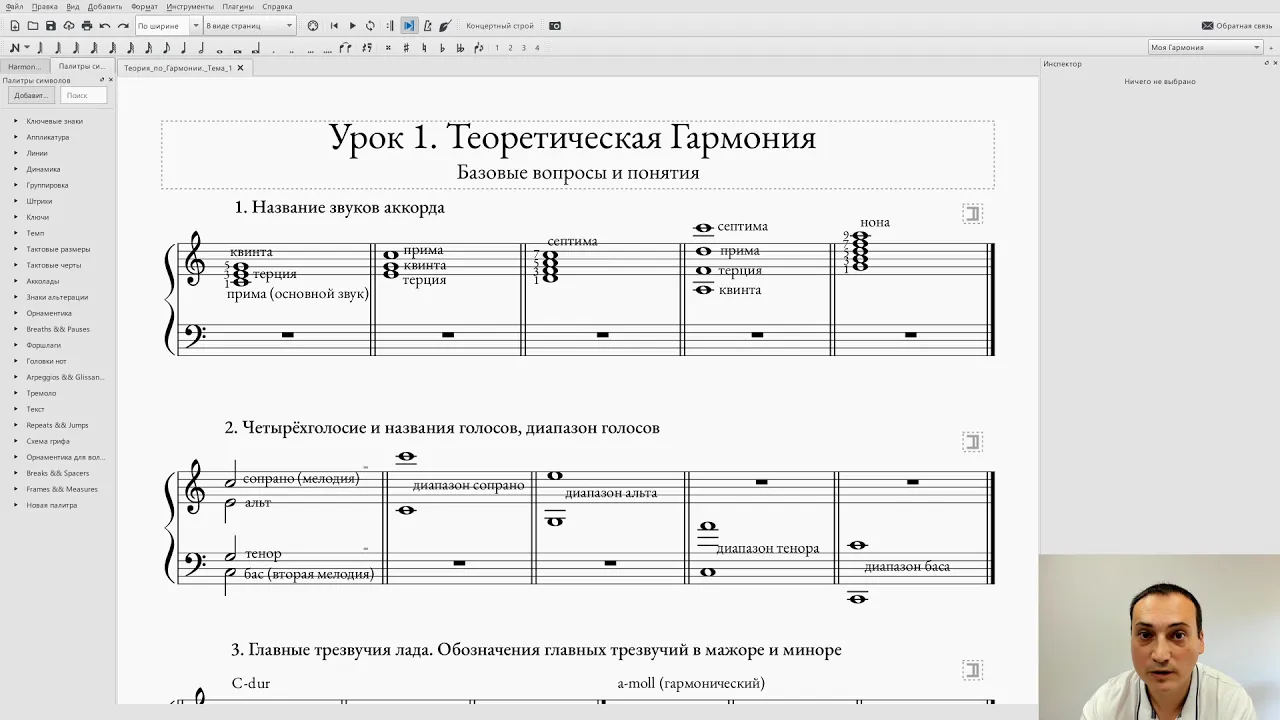
Гармония. Теоретический урок №1
13.2K
Four-part harmony uses four voices: Soprano (melody), Alto, Tenor, and Bass. Recommended ranges are: Soprano up to first octave, Alto up to octave plus fifth, Tenor up to octave plus fifth, Bass up to first octave. The melodic position of a chord is determined by which tone appears in the soprano: root position (prima), third position (tercia), or fifth position (quinta).
Click to watch →

A Complete Guide to Writing Four-Part Harmony (Counterpoint)
14K
In four-part harmony, each voice has a specific range to ensure singability. Sopranos typically range from middle C up to G above the staff (occasionally reaching A or B-flat). Altos usually range from G below middle C up to D an octave and a half above. Tenors have an octave range below sopranos. Basses typically range from E below the staff up to D above the staff, though occasionally they may sing as low as C or even lower. Staying within these ranges ensures melodies and parts are playable by real instruments and avoids extreme vocal demands.
Click to watch →
How Bill Evans Practiced Harmony
95.6K
Bill Evans' approach to practicing harmony involves creating four-part SATB (Soprano, Alto, Tenor, Bass) voicings by placing the melody in the soprano voice and adding inner voices (alto and tenor) with the third and seventh of each chord, while keeping the bass as the root; this method develops voice leading skills, ear training, and inner voice awareness, and can be expanded to five or six voices by adding different bass inversions and practicing the voicings slowly to ensure each voice moves logically and singably.
Click to watch →

Analyzing "Psychic Island Enhanced" My Singing Monsters OST | Basterd's LFA
4.3K
Vocal arrangements use the SATB system (Soprano, Alto, Tenor, Bass) covering approximately 90% of the population. Soprano and Alto are female ranges, Tenor and Bass are male ranges. Between Soprano and Alto lies Mezzo Soprano, and between Tenor and Bass lies Baritone. Rare vocal types like Countertenor make up about 0.1% of the population. In this track, the cello motif is replaced by layered vocals filling all four ranges, creating a full chorus arrangement that provides harmonic richness and emotional depth.
Click to watch →

How to Sing Hymns in Harmony (Soprano, Alto, Tenor, Bass)
5.1K
Harmony occurs when multiple singers perform different musical notes simultaneously that sound pleasing together; in church hymns, four distinct vocal parts work together: Soprano (highest voice, carries the main melody), Alto (lower female voice blending with soprano), Tenor (higher male voice adding layers), and Bass (lowest male voice providing foundation). To participate, identify your vocal range by trying different parts—higher voices may suit soprano or tenor, while lower voices may fit alto or bass. When following sheet music, the grand staff uses G-clef (treble clef) for soprano and alto parts and F-clef (bass clef) for tenor and bass parts; locate your notes by finding the appropriate position on your clef and follow the vertical cursor. Lyrics appear between the clefs, with verses stacked vertically and choruses typically appearing as single lines. Practice by listening first, humming along, then gradually attempting your part when comfortable.
Click to watch →
Deep Dive
Familiarity with the concept of voice leading and the ideal of voice independence in classical music.
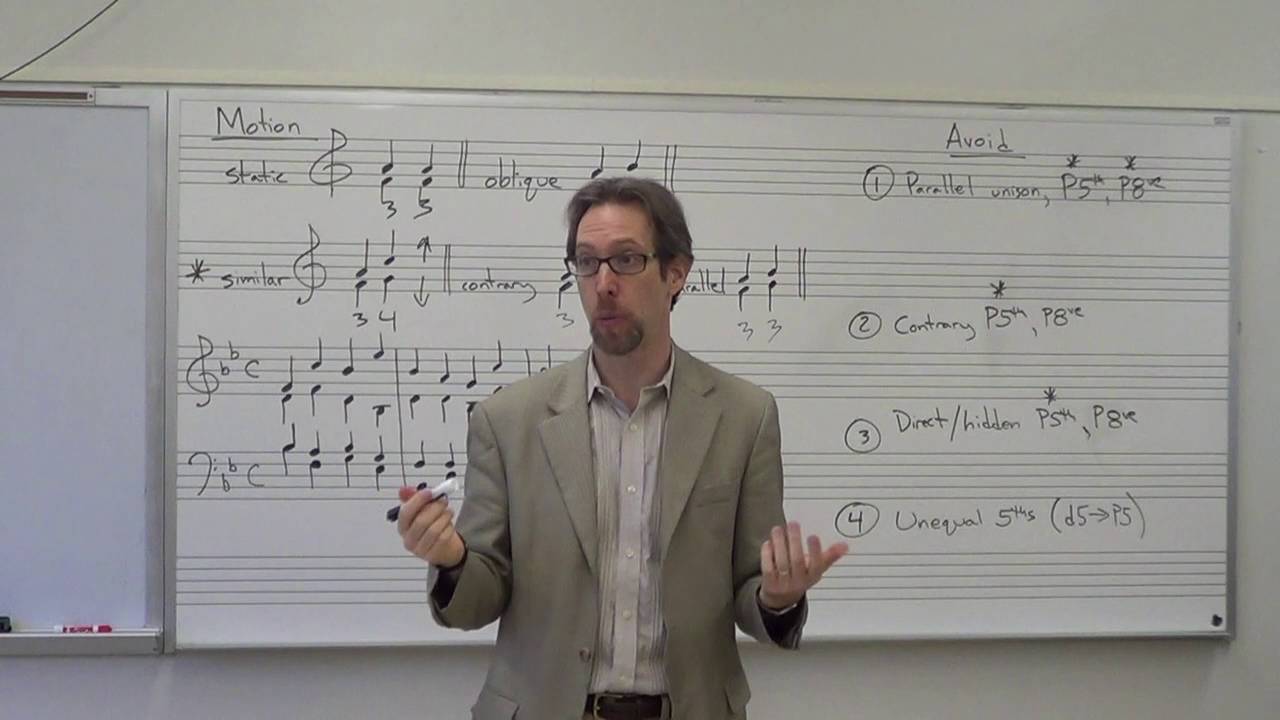
Dr. B Music Theory Lesson 12 (Voice Leading 102)
46K
Voice leading aims to create four independent melodies that form chords. Static motion (no movement) and oblique motion (one voice stationary, one moving) are always acceptable because they preserve melodic independence. Similar motion (both voices moving same direction by different intervals) is generally acceptable. Contrary motion (opposite directions) is acceptable but can become problematic with fifths and octaves. Parallel motion (same direction, same interval) is problematic because it eliminates melodic independence.
Click to watch →

Três Maneiras de Tratar Uma Melodia | Live 135
501
Voice leading requires avoiding parallelism (parallel octaves and fifths) during training to develop voice independence, though this is not inherently wrong in actual musical practice. The goal is to develop the ability to write voices that move independently while maintaining harmonic coherence. In counterpoint, voices should be independent both melodically and rhythmically. Unlike voice leading where one voice is predominant, counterpoint gives equal importance to all voices. The bass voice should be conceived first, followed by the other voices. Each voice should contribute to the overall rhythmic texture while maintaining its own independent melodic identity.
Click to watch →

Classical musician reacts -- LOCOMOTIVE BREATH -- Jethro Tull -- FIRST TIME LISTENING
91.1K
Voice leading refers to the way individual melodic lines (voices) move between chord changes in a piece of music. In classical music, voice leading involves carefully directing each voice (such as soprano, alto, tenor, and bass) to appropriate note choices so that the resulting harmony sounds stable and comfortable. Good voice leading creates smooth transitions between chords, while poor voice leading can make music sound jarring or uncomfortable to trained ears.
Click to watch →

First steps to understand Voice Leading in Music
132
Voice leading is a fundamental concept in Western classical music (1650-1910) that describes how each voice (soprano, alto, tenor, bass) moves from one note to the next; good voice leading occurs when voices move stepwise or to the same note, creating parallel motion, while bad voice leading involves large leaps between notes, and good voice leading results in higher quality, more pleasing, and harmonically robust music.
Click to watch →
¿Por Qué las Quintas Paralelas Están PROHIBIDAS? | Voice Leading Ep.1
48K
The key to voice leading is perceptual independence. It is not about arbitrary rules but about helping the brain hear multiple voices as separate lines rather than a mass of sound. When the brain achieves this separation, it experiences a specific type of pleasure. This principle explains why certain musical combinations work while others do not.
Click to watch →
Deep Dive
Understanding the types of harmonic motion, including parallel, similar, contrary, and oblique motion.
Contrapuntal Expansions
422
Voice motion types describe how independent melodic lines interact: (1) Contrary motion - voices move in opposite directions (soprano up while bass down); (2) Oblique motion - one voice stays while the other moves; (3) Parallel motion - both voices move in the same direction while preserving the generic interval (e.g., both move up a third); (4) Similar motion - both voices move in the same direction but the generic interval changes (e.g., third becomes fourth). Understanding these motion types is essential for analyzing and composing contrapuntal music.
Click to watch →

Voice Leading in Four Parts and Parallel Intervals, Book 2, Ch. 5
963
Motion in music refers to pitch level changes in melodic lines. Four classifications exist: parallel motion (lines move same direction), similar motion (same direction with changing intervals), contrary motion (opposite directions), and oblique motion (one line stationary). No motion occurs when pitches remain unchanged despite rhythmic movement. In four-part harmony, analyze motion between any two voices, focusing on outer voices (soprano-bass) first. Most motion between outer voices is typically contrary motion.
Click to watch →
How to Write in Parallel, Contrary, Oblique and Similar Motion - Voice Leading
4.4K
This video introduces the four fundamental types of voice leading in music composition: parallel motion, contrary motion, oblique motion, and similar motion. It explains how these techniques govern the movement between musical parts—whether sung, played by instruments, or performed on a keyboard—to create harmonious and cohesive textures. Parallel motion occurs when two voices move in the same direction by the same interval; contrary motion involves voices moving in opposite directions; oblique motion features one voice moving while the other remains static; and similar motion describes voices moving in the same direction but by different intervals. The lesson provides clear examples and practical tips for applying these motions effectively in composition. It is presented as the first of a 12-part series designed to deepen understanding of voice leading, a core concept in harmonic writing. The video includes timestamps marking each motion type’s section, from 0:00 to 4:36, ensuring structured learning. Additional resources are available via a downloadable file link, and viewers are directed to Music Matters’ online courses for further study in music theory and composition. The content is framed as essential for composers and musicians seeking to enhance their harmonic writing skills.
Click to watch →
Tres tipos de MOVIMIENTO para cambiar de acorde: CONTRARIO, SEMEJANTE, OBLICUO
28.9K
When moving between chords, the relationship between the outer notes (lowest and highest) can change in three basic ways. First, contrary movement occurs when notes move in opposite directions, which can be expansion (notes separate) or contraction (notes come together). Second, similar movement occurs when both notes move in the same direction, either toward the bass (downward) or toward the treble (upward). Third, oblique movement occurs when one note stays stationary while the other moves.
Click to watch →

4 Types of Motion - Music Theory - Hans Zimmer, Faithless, Deadmau5
3.2K
This comprehensive framework covers four essential motion types in music composition. Parallel motion moves all voices identically, creating unity. Similar motion maintains direction but varies intervals for harmonic color. Oblique motion keeps one voice stationary while another moves, producing unfolding textures. Contrary motion moves voices oppositely, creating counterpoint tension. Each technique serves distinct purposes—from providing clarity in complex arrangements to adding emotional depth in sparse compositions. Strategic selection based on track context transforms basic musical ideas into compelling works.
Click to watch →
Prerequisite Knowledge
- Concept 01Understanding of musical intervals, specifically how to identify and construct a Perfect Fifth (P5).
- Concept 02Basic knowledge of four-part harmony and the SATB (Soprano, Alto, Tenor, Bass) vocal ranges.
- Concept 03Familiarity with the concept of voice leading and the ideal of voice independence in classical music.
- Concept 04Understanding the types of harmonic motion, including parallel, similar, contrary, and oblique motion.
Subsequent Learning
- Step 01Exploring other key voice-leading rules of the Common Practice Period, such as the prohibition of parallel octaves and direct/hidden fifths.
- Step 02Studying species counterpoint, particularly how to write independent melodic lines against a cantus firmus.
- Step 03Analyzing the stylistic shift in the late 19th and 20th centuries, such as Claude Debussy's use of parallel chords (planing) in Impressionism.
- Step 04Investigating the usage of parallel fifths in modern music genres, such as power chords in rock and metal music.
- Step 05Practicing four-part chorale writing and harmonization in the style of J.S. Bach to apply voice-leading rules in composition.
Parallel Fifth Sins
Consonance Trap
Polyphony Loss
Rock Music Example
Parallel Fifth Sins
0:00Playing Section
- 1
Parallel fifths violate voice leading due to excessive consonance.
- 2
They blur independence, merging into a single perceived voice.
- 3
This rule parallels the prohibition of parallel octaves.
Planing and the Liberation of Parallelism
While the ban on parallel fifths is central to Common Practice voice leading (aimed at preserving the independence of individual voices), it is a culturally and historically specific convention rather than an absolute acoustic rule. In early Western polyphony, such as medieval parallel organum, parallel fifths were actually the standard method of harmonization. This restriction was later dismantled by late 19th- and 20th-century Impressionist composers like Claude Debussy, who introduced 'planing'—moving entire chords in parallel motion to achieve a cohesive, atmospheric tonal color. Today, parallel fifths are foundational in many global music traditions and form the backbone of modern rock and pop music through guitar 'power chords.' Rather than being an objective error, parallel fifths are treated in these contexts as a powerful stylistic tool.
Deep Dive
Exploring other key voice-leading rules of the Common Practice Period, such as the prohibition of parallel octaves and direct/hidden fifths.

Aula 6, Curso USP de Harmonia/Contraponto I (Regras de Contraponto), Rubens Russomanno Ricciardi
5.9K
Parallel fifths and octaves are prohibited between soprano-contralto, soprano-bass, and tenor-bass. Parallel fifths can be direct (both voices move to arrive at a fifth) or hidden (one voice moves while the other remains stationary, then both move to arrive at a fifth). Hidden fifths are detected by revealing the implied parallel motion. Hidden fifths between contralto and tenor are acceptable because these voices are not adjacent in texture. Hidden octaves are permitted at phrase endings between contralto and bass, but must be hidden (not direct). These exceptions allow flexibility while maintaining the prohibition for adjacent voice pairs. Voice crossing (cruzamento entre as vozes) is prohibited, as is the use of rests in four-voice counterpoint exercises. Unisons between two voices are permitted only when entered by oblique or contrary motion; unisons entered by parallel motion are prohibited.
Click to watch →
The Weirdest Music Fight I've Ever Caused
117.5K
In Common Practice voice-leading rules, parallel octaves are forbidden. When two voices are an octave apart on one chord, they cannot remain an octave apart on the next chord if they are moving. This rule exists because parallel octaves cause voices to blend into a single sound, losing their melodic independence. The solution is to approach the target note from below instead of above.
Click to watch →
Dr. B Music Theory Lesson 12 (Voice Leading 102)
46K
Direct and hidden fifths/octaves occur in similar motion between outer voices (soprano and bass). A direct fifth/hide requires three conditions: similar motion, a perfect fifth/octave interval, and a leap in the soprano voice. This creates a jarring effect because the highly consonant interval stops melodic forward motion. These errors are particularly common with excessive soprano leaps. Inner voices (tenor and alto) can tolerate more irregularities because they're less prominent.
Click to watch →
Voice-leading Basics Lecture 7
2.1K
Three types of prohibited intervals exist in voice leading: parallel fifths and sixths (when voices move in parallel motion creating these intervals), parallel octaves (which create doubling rather than independent voices), and direct octaves/fifths (when voices move in similar motion into these intervals). Parallel octaves are particularly problematic when voices move by step, as it is easy to accidentally create them. Direct octaves/fifths are acceptable when the melody moves by step and bass leaps, but prohibited when the melody leaps into the interval while bass moves by step. These prohibitions ensure four independent voices rather than doubled lines.
Click to watch →

Video 13a Parallel and hidden octaves and fifths
3.6K
In four-part harmony, parallel octaves and fifths occur when two voices move in the same direction to form consecutive perfect octaves or fifths, creating a single melodic line instead of distinct voices; hidden octaves and fifths occur specifically between soprano and bass when both leap into a perfect fifth or octave in the same direction, and all these should be avoided to maintain proper voice independence and harmonic richness.
Click to watch →
Deep Dive
Studying species counterpoint, particularly how to write independent melodic lines against a cantus firmus.
Contraponto - Cantus Firmus e as 5 espécies
10.7K
Counterpoint is a musical technique where independent melodic lines are combined, with the cantus firmus serving as the fixed melody base. The five species of strict counterpoint progress in complexity: species 1 uses one note against each note of the cantus firmus; species 2 uses two notes against each note; species 3 uses four notes against each note; species 4 uses syncopated rhythms and suspensions; and species 5 combines all previous techniques into florid counterpoint. This systematic approach, based on Fux's Gradus ad Parnassum, provides a structured method for learning contrapuntal composition rules.
Click to watch →
First Species Counterpoint Explained: Music Theory Foundations
15.4K
Species counterpoint is a foundational music theory topic rooted in Renaissance and Baroque traditions, particularly associated with Palestrina. Developed in 1725 through Fux's 'Gradus ad Parnassum,' it provides systematic training for writing independent melodic lines (counterpoint) above or below a pre-existing melody called the cantus firmus, originally derived from Gregorian chant. First species specifically uses 'note against note' technique. Only consonances are allowed: perfect consonances (unison, perfect fifth, octave) and imperfect consonances (major third, minor sixth), with more imperfect consonances required than perfect ones. Starting options include unison, fifth, or octave, though unisons are restricted to beginning and end. The penultimate measure must contain a sixth interval. Students must avoid augmented, diminished, and chromatic intervals, with particular caution against the tritone. Leaps larger than a perfect fifth are prohibited except for octaves and ascending minor sixths. Notes may be repeated once but should not occur consecutively. After leaps of a fourth or larger, students must step back in the opposite direction. Direct motion into perfect consonances is forbidden, but contrary motion and oblique motion are always acceptable. Voice crossing is permitted for voice-leading purposes.
Click to watch →
Beethoven's Hidden Composition Lesson in the Pathétique Sonata
68.7K
Francis Lodowick York identified that Beethoven employed the cantus firmus technique with strict species counterpoint in measures 79-83 of the Pathétique Sonata finale. York documented various treatments: first species counterpoint in the lower part with cantus in the upper voice; then the cantus transferred to the lower voice with counterpoint above in fourth species; followed by two new voices creating fourth species counterpoint; then the cantus in the lowest voice with tenor in first species and upper voices in fourth species; finally returning to two voices with counterpoint in third species. This represents an 'inside joke' for those trained in species counterpoint, similar to Mozart's earlier use in his G major string quartet finale, though Beethoven's implementation is more extreme with harsher dissonances.
Click to watch →

Contraponto 01 - Introdução
66.1K
Counterpoint is a musical composition technique where two or more melodic voices are composed simultaneously, considering both the melodic profile of each voice and the intervallic/harmonic quality generated by their superposition. The given melody is called 'cantus firmus' (fixed song), and the student's task is to compose a complementary melody. There are five species of counterpoint: First species uses one note per cantus firmus note (semibreves); Second species uses two notes per cantus firmus note; Third species uses four notes per cantus firmus note; Fourth species introduces suspensions and resolutions; Fifth species combines all previous species, allowing for creative application. Mastery of intervals is essential before studying counterpoint, as it provides excellent training for piano and keyboard and ensures better melodic results.
Click to watch →

TEORÍA DE LA MÚSICA 22: El Contrapunto
15.8K
The Cantus Firmus is a restricted Gregorian chant-based melody with strict rules: no scales, chords, or dissonant leaps. It begins and ends on the same note with consonant peaks. The First Species involves writing counterpoint against this fixed melody where both voices move at the same value (whole notes). Both voices must maintain consonance throughout and follow the same structural characteristics as the Cantus Firmus. This species teaches fundamental voice management at uniform tempo.
Click to watch →
Deep Dive
Analyzing the stylistic shift in the late 19th and 20th centuries, such as Claude Debussy's use of parallel chords (planing) in Impressionism.
Peter Bernstein Chord Melody Snippets
2.3K
Chord planing is an impressionist harmony technique pioneered by Debussy and Ravel, involving voice-leading non-functional chord sequences using parallel motion as if they were a single melodic line. The technique allows reharmonizing dominant or 2-5 progressions with non-functional chord sequences as long as the final chord resolves. Quartal harmony (using fourths instead of thirds) creates distinctive parallel motion. The E7 sus4 chord creates tension that resolves to the tonic, including notes from B flat 7 sharp 9 (D, G sharp, C sharp) with E as sharp 11. This creates resolution through voice-leading rather than traditional functional harmony.
Click to watch →
How Radiohead Works | Paranoid Android
163.8K
Planing harmony, also called parallel harmony or constant construction harmony, involves taking a chord shape and shifting it up and down while maintaining the same structure. Unlike diatonic chords that change quality (major to minor to diminished) within a scale, planing chords maintain their quality (such as staying major) as they move. This technique creates a mysterious, chromatic sound because the chords drift in and out of the key. It was extensively used by impressionist composers like Debussy and Ravel to create washes of sound and specific moods. On guitar, this works well because a single hand shape can be moved around without changing form.
Click to watch →

Grade 10 MUSIC Q1 Ep1: Impressionism
286.5K
Impressionism is a French musical movement from the late 19th to early 20th century (1890-1920) that emerged as a reaction against Romanticism, characterized by three key elements: tone color (timbre), atmospheric mood, and unusual chords such as the whole tone scale; the movement was pioneered by Claude Debussy, known as the father of the modern school of composition, and Maurice Ravel, who created extended chordal works requiring technical virtuosity.
Click to watch →

「フジ子・ヘミング プラチナリサイタル」 (2004.4.25 OA) HD.
179.6K
This segment introduces Claude Debussy as a pivotal composer of the late 19th and early 20th centuries who profoundly influenced subsequent musical development. Debussy is identified as a representative figure of Impressionism, and the video presents his famous work 'Clair de Lune' (Moonlight) from the Préludes suite. This provides historical context about one of the most influential figures in Western classical music and his innovative approach to harmony and tone color.
Click to watch →
Let's be Franck I Hershey Symphony Orchestra I October 17, 2025
241
The conductor explains that Debussy in the late 1800s was a dividing point between music that came before and music that would come after. The French were not interested in writing symphonies in the style of German composers like Haydn, Mozart, and Beethoven; instead, beginning with Debussy, they became interested in pieces influenced by works of art or literature. Debussy explored harmonies that today would be called 'jazz chords'—chords with no real function that sound pretty in themselves but do not direct the music toward a specific destination. His piece 'Prélude à l'après-midi d'un faune' is based on a poem by symbolist poet Mallarmé, depicting a faun (half-man, half-goat) who wakes in a meadow and is unsure whether he had a beautiful afternoon with nymphs or if it was just a dream. The piece uses the tritone interval and the whole tone scale (which contains no half steps), creating a sense of keylessness and ambiguity. Debussy was the first composer to use the whole tone scale systematically, and his music is sectional, giving listeners glimpses of imagery rather than a continuous narrative. This represents a fundamental shift from functional harmony to atmospheric, impressionistic soundscapes.
Click to watch →
Deep Dive
Investigating the usage of parallel fifths in modern music genres, such as power chords in rock and metal music.

Q+A #31 - Parallel fifths are OK!
231.8K
Parallel fifths are traditionally avoided in Western classical music because they cause voices to blend too much and remove harmonic distinction, but in modern music genres like jazz and rock, parallel fifths are essential for achieving specific sounds such as jazz harmony arrangements and rock power chords; the rule against parallel fifths is not absolute but depends on the desired musical aesthetic and context.
Click to watch →
Power Chords | Parallel Fifths?
548
Power chords are essentially consecutive fifths, which were prohibited in classical music from the 14th-15th centuries because parallel fifths cause voices to blend into one, defying polyphony; however, this rule became less strict with equal temperament's popularity, and power chords in rock music use the fifth to add harmonics rather than create independent voice movement.
Click to watch →
![Of Course PARALLEL 5ths Are Fine! (If You Do This) [Music Theory]](https://i.ytimg.com/vi_webp/DzeAsD99FBA/maxresdefault.webp)
Of Course PARALLEL 5ths Are Fine! (If You Do This) [Music Theory]
47.2K
Parallel fifths occur when two voices maintain a perfect fifth interval across consecutive chords, which classical composers avoided because it creates a thinning texture and sounds old-fashioned; however, in modern music like rock power chords and jazz harmony, parallel fifths are acceptable because they create thicker, unified lines rather than independent voices, and can even be used intentionally for ethnic or non-Western harmonization effects.
Click to watch →
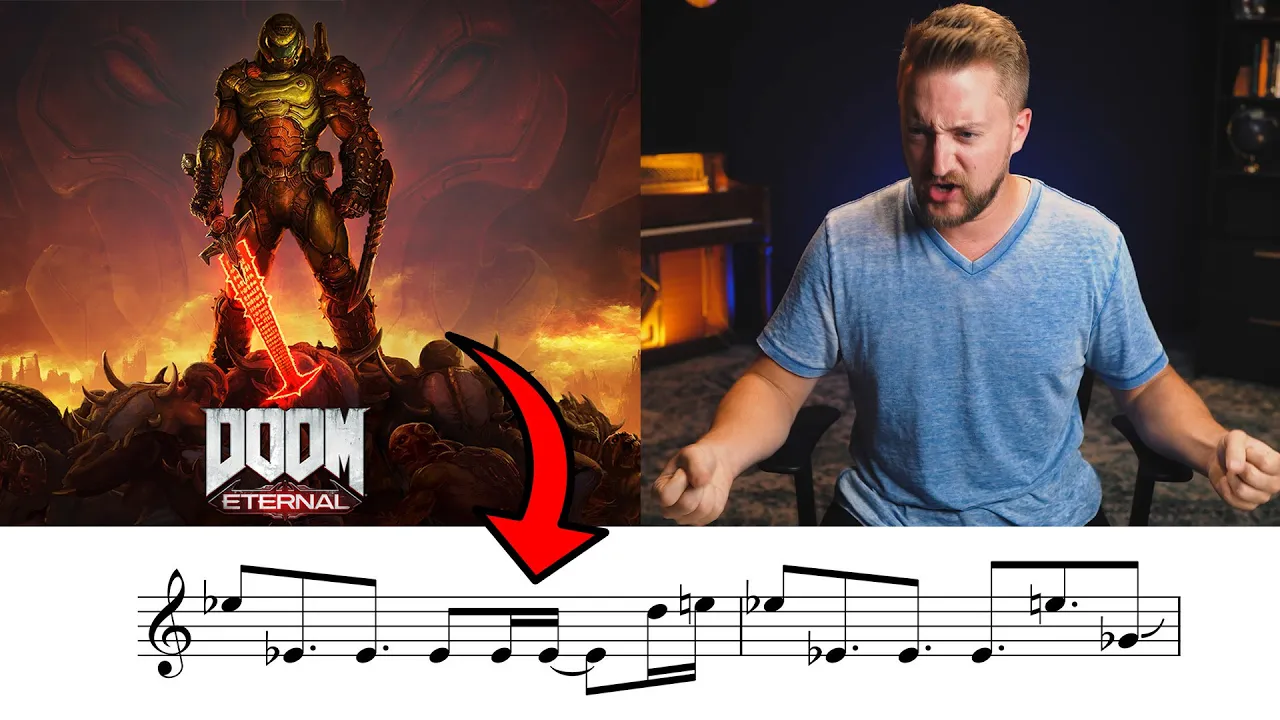
The INSANE Rhythms of Doom Eternal | Jazz Pianist Reacts
1.5M
This segment explains why power chords (fifths) are preferred in distorted guitar music. Full chords with thirds become muddy with high distortion, but fifths produce clean, resonant sounds due to smooth frequency interactions. Parallel fifth motion involves moving all chord tones together by fifths, creating powerful, unified sounds. Combined with chromatic movement, this technique exploits guitar string harmonics and overtones, producing rich, daunting sonic textures characteristic of heavy metal and game soundtracks.
Click to watch →
![POWERFUL Electric Parts with Only TWO NOTES [Electric Guitar] - THE POWER OF FIFTHS](https://i.ytimg.com/vi_webp/6USjC7Y7VU4/maxresdefault.webp)
POWERFUL Electric Parts with Only TWO NOTES [Electric Guitar] - THE POWER OF FIFTHS
114.4K
Modern worship music does not play straight triads. Instead, chords are 'colored up' with additional notes. The 1 chord is often played as a power chord. The 4 chord is typically ornamented with the 7th or 9th note. The 6 chord is usually played as a minor7 chord. The 5 chord is often played as a sus4 chord. The power of fifths technique works because it aligns with how modern worship music voices its chords. Playing the root note and fifth note over a 1-4-5-6 progression creates sophisticated chord voicings without requiring you to change notes.
Click to watch →
Deep Dive
Practicing four-part chorale writing and harmonization in the style of J.S. Bach to apply voice-leading rules in composition.
Harmonising a Bach Chorale - Writing Four-Part Harmony
205.5K
This video demonstrates how to harmonize a chorale melody in the style of Bach by first analyzing the key structure (D major), identifying cadences, and constructing chords using Roman numeral notation; then plotting the bassline, adding passing notes for melodic interest, and filling in the alto and tenor parts while applying rules of voice leading such as avoiding consecutive fifths and octaves, and using suspensions and passing notes to enhance harmonic texture.
Click to watch →
Bach's Four-Part Chorale Writing - Music Composition
35.7K
Bach's four-part chorale writing follows systematic principles including: (1) analyzing key signatures and initial notes to determine the tonic key; (2) planning cadences and modulations before writing, often using perfect cadences (V-I) more frequently than plagal cadences; (3) employing II7 in first inversion followed by V to create sophisticated harmonic movement; (4) maintaining proper voice spacing with no more than an octave between neighboring parts (except tenor-bass); (5) using pivot chords for smooth modulations between keys; (6) incorporating secondary dominants for added harmonic color; (7) balancing inversions and avoiding parallel fifths and octaves; (8) utilizing common notes between consecutive chords for smooth part writing; and (9) adding passing notes and inessential notes to enhance melodic integrity while maintaining homophonic texture.
Click to watch →

Basic Rules of Part Writing
150K
In four-part voice leading, chord construction follows specific rules: use the middle range of each voice for balance, double the root in root-position triads but avoid doubling tendency tones (leading tones and sevenths); every chord needs a root and third to define its quality, though fifths can occasionally be omitted; maintain no more than an octave between upper voices and avoid voice crossing, while distinguishing between close position (no space between chord tones) and open position (space exists between chord tones).
Click to watch →
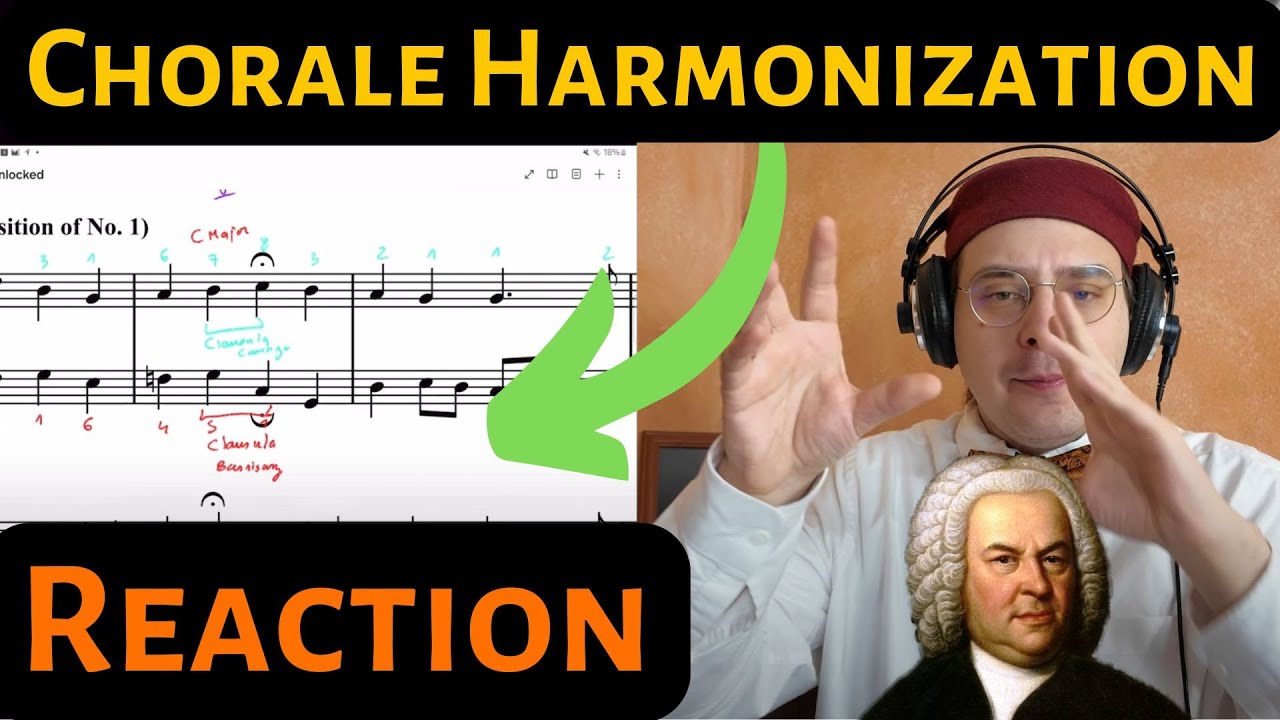
Chorale 4 Part Harmonization - Counterpoint and Composition Reaction
493
When harmonizing a four-part chorale in the Baroque style, one should first analyze the melody using hexachordal solmization to understand the harmonic function of each note, then use multiple color-coding systems to track different harmonic perspectives simultaneously, and finally apply voice-leading rules such as avoiding diminished fifths unless implied in the melody and using parallel fifths only when stylistically appropriate, while recognizing that passages with similar cadence-like patterns are not necessarily true modulations.
Click to watch →

Figured Bass in Music: Chorale Style
19.3K
This section demonstrates how to realize figured bass in four-part chorale style. Key principles include: avoid composing chord-by-chord to maintain melodic line; maintain common tones when possible; avoid doubling the fifth of chords (except cadential 64 where doubling the fifth is desired); parallel sixths are acceptable but parallel perfect fifths and octaves are forbidden; the seventh of a seventh chord must resolve down by step; if the seventh cannot resolve, maintain it as a common tone until it can resolve; the leading tone must resolve upward. The soprano part should have interesting leaps and contrary motion with other voices. The tenor should carry the seventh of seventh chords. The alto should avoid doubling the fifth of chords.
Click to watch →
Parallel Fifth Sins
Consonance Trap
Polyphony Loss
Rock Music Example
Parallel Fifth Sins
0:00- 1
Parallel fifths violate voice leading due to excessive consonance.
- 2
They blur independence, merging into a single perceived voice.
- 3
This rule parallels the prohibition of parallel octaves.
Planing and the Liberation of Parallelism
While the ban on parallel fifths is central to Common Practice voice leading (aimed at preserving the independence of individual voices), it is a culturally and historically specific convention rather than an absolute acoustic rule. In early Western polyphony, such as medieval parallel organum, parallel fifths were actually the standard method of harmonization. This restriction was later dismantled by late 19th- and 20th-century Impressionist composers like Claude Debussy, who introduced 'planing'—moving entire chords in parallel motion to achieve a cohesive, atmospheric tonal color. Today, parallel fifths are foundational in many global music traditions and form the backbone of modern rock and pop music through guitar 'power chords.' Rather than being an objective error, parallel fifths are treated in these contexts as a powerful stylistic tool.
Understanding of musical intervals, specifically how to identify and construct a Perfect Fifth (P5).
Basic knowledge of four-part harmony and the SATB (Soprano, Alto, Tenor, Bass) vocal ranges.
Familiarity with the concept of voice leading and the ideal of voice independence in classical music.
Understanding the types of harmonic motion, including parallel, similar, contrary, and oblique motion.
Exploring other key voice-leading rules of the Common Practice Period, such as the prohibition of parallel octaves and direct/hidden fifths.
Studying species counterpoint, particularly how to write independent melodic lines against a cantus firmus.
Analyzing the stylistic shift in the late 19th and 20th centuries, such as Claude Debussy's use of parallel chords (planing) in Impressionism.
Investigating the usage of parallel fifths in modern music genres, such as power chords in rock and metal music.
Practicing four-part chorale writing and harmonization in the style of J.S. Bach to apply voice-leading rules in composition.
328.5K views15.5Klikes1:07@MusicaUniversalisOriginal Release: 2026-04-15
How did they end up becoming one of the cardinal sins of voiceleading? The simple answer is not because parallel fifths are displeasing to the ear as is the case with dissonant intervals, but rather because the interval of the fifth is considered so consonant or perfect in nature that it sounds more like one note or voice instead of two separate ones. So thus two voices moving in fifths will sound like one voice and thus are not considered to be moving independent of one another. This reasoning applies to the similar rule of parallel octaves being forbidden which once again is because parallel octaves sound so consonant that they are no longer seen as independent voices and thus the polyhonic nature of the music is diminished as parallel fifths and octaves essentially sound like a doubling of one voice. Although I like to focus on classical music on this channel, I feel a great example of the phenomenon of parallel fifths sounding like one voice is audible in the opening rift of Black Sabbath's Iron Man. As an inattentive listener might assume this to be just one powerful voice when in fact it's a series of parallel fifths.
Up Next

5:55
Voice Leading Basics: Relative Motion in Four-Part Chorale Style
@kendallkennison6153
20.7K views•2014-09-02

10:20
Mozart's Musical Dice Game Explained: History, Rules, & Fun
@webpianoacademy
5K views•2023-03-13

47:36
Understanding Diatonic 7th Chords in Major Keys | Music Theory Tutorial
@GracieTerzian
54.7K views•2022-03-02
10:49
Understanding John Coltrane's Giant Steps: A Music Theory Analysis
@Vox
10.4M views•2018-11-12
Related Study Plans & Knowledge Roadmaps
Structured learning paths in Music Theory
music-theory
Composing Galant Music: Partimento & Schemata
01Foundations of Figured Bass and Keyboard Harmony
02The Rule of the Octave (Regola dell'Ottava)
03Galant Schemata: The Building Blocks of Form
+ 2 more learning modules
30h5 modules
Explore Roadmap
music-theory
Decoding Overtone Series: Tuning & Drone Music
01Acoustic Foundations: The Physics of the Overtone Series
02Tuning Systems: Equal Temperament vs. Just Intonation
03Microtonality and Spectralism: Beyond Standard Pitches
+ 2 more learning modules
24h5 modules
Explore Roadmap
music-theory
Impressionist Harmony: Scales, Planing & RPGs
01Foundational Music Theory: Keys, Intervals, and Seventh Chords
02Impressionist Color: Chord Planing and Parallel Harmony
03Whimsical Textures: Pentatonic Cascades and Whole-Tone Scales
+ 1 more learning modules
14h4 modules
Explore Roadmap
music-theory
Negative Harmony: Axis Reflection in Indie Pop
01Music Theory Foundations: Scales, Intervals, and Triads
02Functional Harmony and the Circle of Fifths
03Demystifying the Negative Harmony Axis Reflection
+ 2 more learning modules
16h5 modules
Explore Roadmap