




















Coral reefs function as complex underwater metropolises where millions of organisms depend on each other for survival through symbiotic relationships, mutualistic partnerships, and interconnected food webs, but human activities like blast fishing threaten these delicate ecosystems by destroying the very habitat that sustains countless marine species.
Coral Reef Ecology: Survival, Symbiosis, and Threats in the Pacific
Added:Basic biological classification of corals as living animal colonies (cnidarians) that form symbiotic relationships with photosynthetic algae (zooxanthellae).
The ecological concept of symbiosis, specifically the differences between mutualism, commensalism, and parasitism.
Fundamental marine trophic structures, including how energy flows from primary producers (phytoplankton, algae) to apex predators in reef food webs.
An introductory understanding of human-induced threats to marine ecosystems, such as overfishing and habitat destruction.
The physiological mechanisms of coral bleaching, focusing on how thermal stress and ocean acidification disrupt the coral-zooxanthellae partnership.
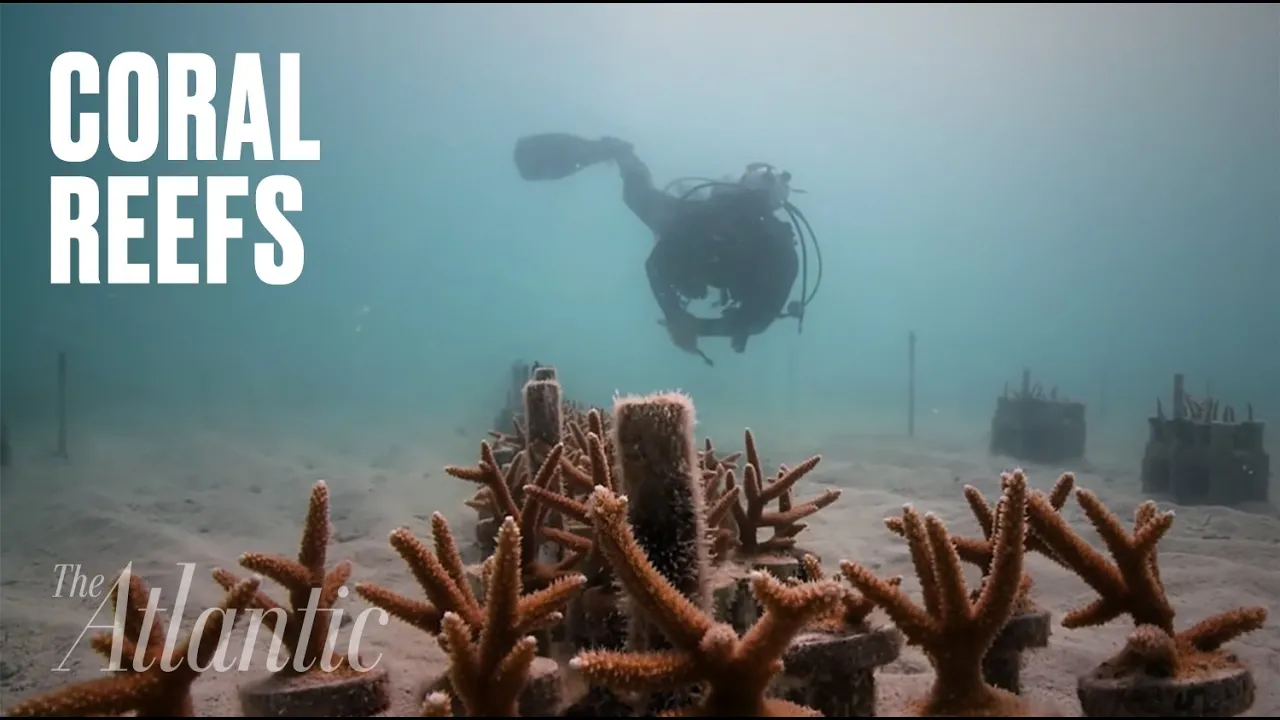
International marine conservation policies and local management strategies, such as the establishment and enforcement of Marine Protected Areas (MPAs).
Reef restoration ecology techniques, including coral micro-fragmentation, larval propagation, and the deployment of biorock/artificial reefs.
The study of trophic cascades in marine environments, analyzing the ecological collapse that occurs when key species are removed by destructive fishing practices.
65.7K views2.1Klikes58:53Original Release: 2022-04-17
In the middle of the Pacific Ocean lie thousands of islands surrounded by thousands of square miles of blue tropical water.
From the surface, we only see the islands and the waves, as we carry on the business of our daily lives.
For most people, the ocean is nothing more than a place to catch fish for dinner and we rarely give a second thought to the incredible world concealed beneath the waves.
This is a secret world full of color and beauty, and a world that is almost certainly just as complicated as our own.
Like an immense sprawling underwater city, the realm of the coral reef has its own daily life, a wide range of different citizens and it's own perils.
Sunrise.
Newly hatched sea turtles race to the sea.
Each baby turtle, born from an egg buried in the sand, must rush past a gauntlet of predators from land, sky and sea to reach the open ocean.
Odds are, only one of these baby sea turtles will survive.
On their journey, the sea turtles must fight their way through the surf, swim across the shallows and then pass over a magnificent city of coral, just offshore.
Like a big city, the densely populated coral reef bustles with the activity of thousands of different residents of all shapes and sizes.
They’re commuting, hunting down a meal, trying to get some sleep, or searching for a soul mate.
Each and every one of them is up to something important…at least to them.
This hermit crab is on a mission--searching for a new home.
She’s growing and her old conch shell just isn’t big enough anymore.
The shell has been a safe haven for several months; now she must give it up for a new one.
But finding a bigger and better shell could take a while.
The Hermit crab’s movement catches the eye of a Line-cheek wrasse, who comes over to investigate.
The wrasse is looking for something too—lunch.
Food isn't easy to catch, and this fish spends most of its time looking for any epicurean opportunities to present themselves.
Above the hermit crab and wrasse, a large male sea turtle, swims over the reef.
He has something else on his mind.
He must find a receptive female during the mating season or he will lose his chance to mate.
This is the story of three unlikely characters—each on a quest for their own survival, and for the survival of their species, in a fish-eat-fish coral metropolis.
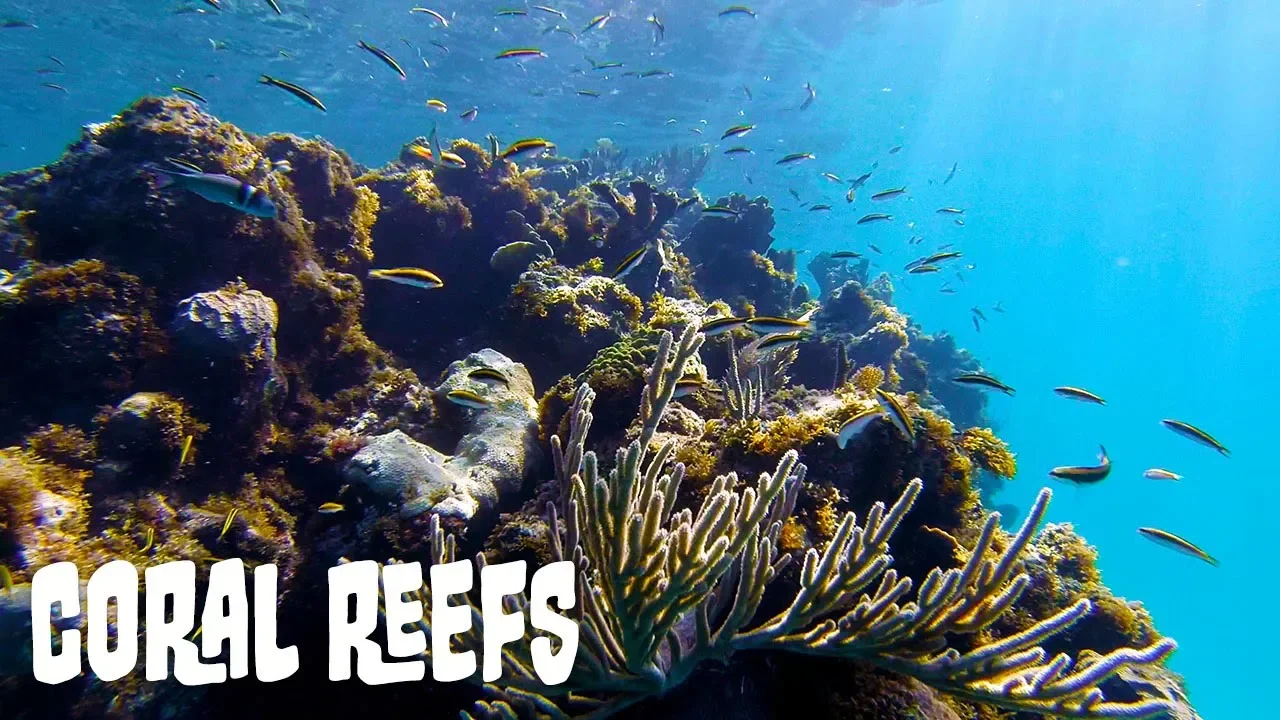
A coral reef may look like a bunch of colorful rocks, or perhaps some unusual-looking plants, but it's actually a strange primitive animal.
Each coral animal, called a polyp, is only about the size of a pearl.
It’s little more than a mouth with some tentacles around it.
Hundreds or thousands of polyps grow together in a colony, called a coral head.
Coral creates a limestone base that anchors the colony.
But it takes hundreds of years for a coral head to reach the size of this brain coral.
When many colonies grow together, the result is a reef.
Reefs can be hundreds of miles long, and visible from the air.
The reef provides nooks and crannies for everything from invertebrates to fish.
It's like the buildings in a city, providing housing and protection for thousands of animals….like turtles.
Coral overhangs provide cozy resting areas for sea turtles to nap.
Soft corals provide comfortable hammocks.
Actually, sea turtles seem to be able to snooze just about anywhere.
The various parts of a reef are like different neighborhoods, with a place for every inhabitant.
The frogfish is a lunge predator that hides using camouflage to look like a sponge with algae growing on it.
It doesn’t swim very much.
Instead, it walks on its foot-like fins.
It moves slowly so it doesn’t give itself away.
The frogfish is watching a group of tiny Anthias, waiting for one to come close enough to eat.
The frogfish hasn’t eaten in days.
But no matter how hungry she is, she must wait patiently for prey to come to her.
It may be hours before she gets a meal.
In another neighborhood, a gorgonian sea fan sways in the current.
At first glance it looks empty….
But closer inspection reveals tiny inhabitants.
They are pygmy seahorses, only the size of a fingernail.
Four of them live on this sea fan, safe in their perfect camouflage, feeding on passing plankton.
For their entire lives, these seahorses will never leave the safety of this one sea fan.
High above the Pygmy seahorses’ sea fan, thousands of basslets and anthias gather to feast on the clouds of plankton that float by in the current.
Everything here eats something else.
And everything here can be eaten by something else.
They keep an eye on a big school of jacks overhead that like to snack on small fish.
One false move and any one of these fish could be lunch in an instant.
The jacks in turn keep an eye on the big school of barracuda, numbering in the thousands.
Like a tornado, the swirling vortex of barracudas loop around themselves, forming an unending chain.
The school is so large they block out the sun when they pass by,and smaller animals on the reef duck and hide.
This enormous school of barracuda has to survive on something…and nobody wants to be that something.
At first glance, the residents of the reef appear carefree, as they flit back and forth, minding their own business.
But they are always paying attention.
Anything out of the ordinary alerts them.
A big school of barracuda is cause for concern….
But a sound like that is cause for alarm.
They have no way to know what the sound is, but they know its not natural.
Like every city, the coral reef has its suburbs, sections of rubble and sand in between the coral heads.
This suburbia might not be as busy as the big city, but there's plenty going on.
The hermit crab has wandered into this coral suburbia on her search for a shell.
She barely notices the Ribbon eel sticking his head out of his burrow.
The blue coloration indicates it’s a male eel.
He sees a damselfish venturing dangerously close to his home and he will take any opportunity to feed.
But this damselfish is just too big for the Ribbon eel.
The fish pays the eel no attention.
Like a bull in a china shop, the hermit crab ignores the eel and barges right across his yard.
The eel doesn’t seem to be getting much respect.
Soon, a smaller damselfish, just the right size for a snack, tempts the eel further and further out of his hole.
But the damselfish has seen the eel, and stays just out of reach.
The Ribbon eel’s enormous nostrils gather faint scents in the water But it’s the smell of frustration.
Just a short distance away, the line-cheek wrasse is watching another damselfish—and getting ready to make his move.
The damselfish will make a nice lunch.
But sensing danger, the damselfish moves away….
Right into the path of the Ribbon eel.
Who could've seen that coming?
That gives new meaning to the concept of losing your lunch.
It doesn't look like its coming back.
The coral suburbs are also home to a small fish about the size of a finger, called a jawfish.
Like the Ribbon eel, the jawfish is shy and hides in a burrow on the bottom, but when a nice piece of plankton floats by, the fish quickly jumps out to eat it, then hops back into the hole.
A lot of bigger fish would love to make a meal of the jawfish, and the jawfish knows it.
It’s enough to make a guy nervous.
Relentless in her quest for a new shell, the hermit crab makes a lousy neighbor.
A hopeless neatnick, the jawfish will spend a few minutes repairing the burrow.
Then a little housekeeping inside.
The hermit crab fearlessly marches on.
Besides her strong shell for protection, she carries a garden of anemones on top of the shell, like a fur coat.
These anemones are a special species found only on hermit crab shells.
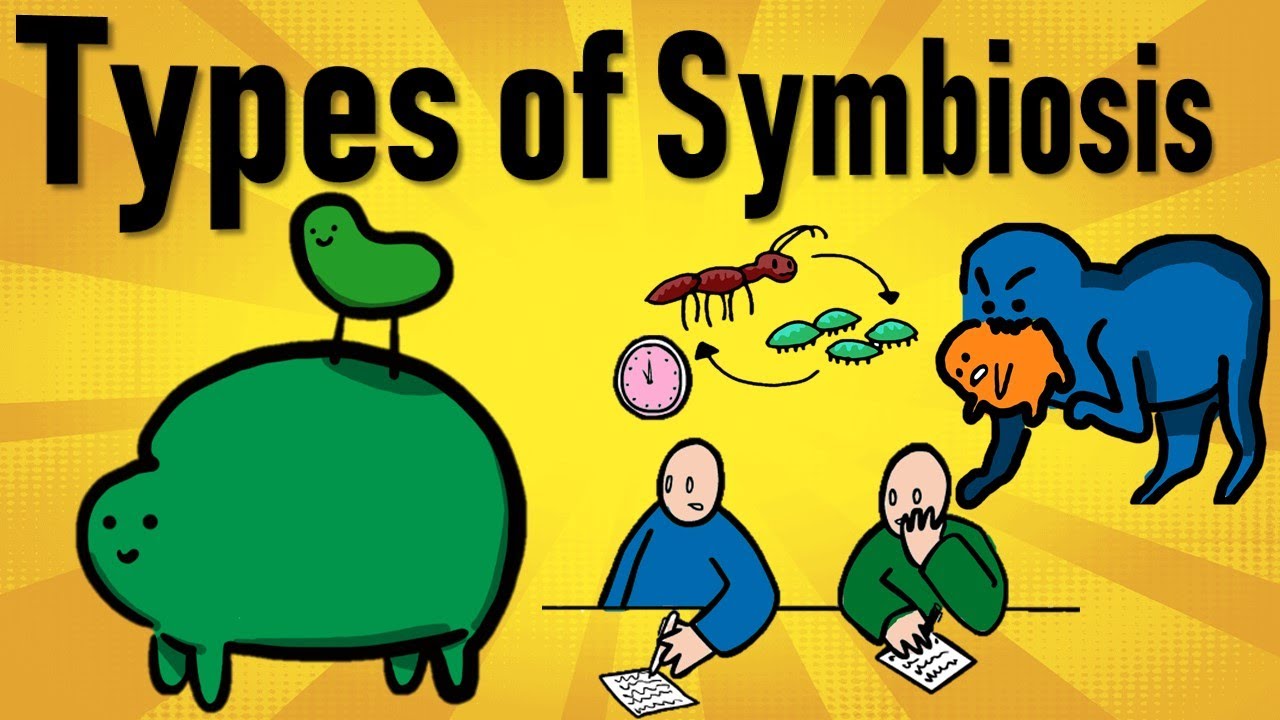
The hermit crab and the anemones have a symbiotic relationship—they help each other out.
The stinging tentacles of the anemones keep the hermit crab safe from certain predators, like octopus.
In exchange, the hermit crab provides food scraps and transportation to the anemones.
Working together often pays dividends, so symbiotic relationships are common around on the reef.
A resting sea turtle receives the attention of a surgeonfish which eats the algae from her shell.
In providing a meal to a hungry fish, the turtle rids herself of drag that can slow her down.
It's a great relationship.
Ah, this is the life—a day at the spa with a pedicure, and maybe a turtle wax.
The clownfish also has a great relationship—with a toxic anemone.
This lush carpet has venomous tentacles that sting most fish.
But the clownfish is covered in a special mucous that keeps the anemone from stinging it.
Because of this adaptation, the clownfish can live, protected by the anemone, happily frolicking in the very tentacles that would kill other creatures.
Clownfish are not the only animals that live in the anemone.
Some anemones have resident crabs.
The porcelain crab feeds on plankton by waving fan-like filters back and forth to catch the microscopic plants and animals.
Plankton is the life blood of the reef, like fast food in the city.
Tiny insect-like animals called copepods are one of the most common kinds of plankton.
They are smaller than a grain of rice and they are the most numerous animals on Earth.
Once a day, the outgoing tide brings murky, nutrient-rich water from nearby rivers--food for plankton.
The resulting influx of plankton becomes food for many of the smaller animals on the reef.
A barnacle waves its finger-like filters, to catch the tiny organisms in the water.
But not all plankton-eaters are small delicate invertebrates like the barnacle.
The whale shark is the biggest fish in the world, and it survives entirely on a diet of plankton and small fish.
Swimming through the water with its mouth open, it scoops in vast quantities of water and strains the food out using filters in its gills.
The whale shark is like a massive swimming pool skimmer.
This shark, reaching the length of two school buses, gorges itself when it finds sections of murky, plankton-rich water.
The shark will consume thousands of pounds of food in a day when the conditions are right.
Sometimes it swims right at the surface, mouth half out of the water, to swallow small crustaceans and jellyfish that gather right in the first few inches.
While the whale shark may be the largest animal on the reef that eats plankton, there is something that eats more: the reef itself.
Corals survive by actively plucking plankton from the water, using tiny tentacles to grab the prey.
The entire reef, for the most part, consists of millions of tiny mouths greedily grasping at plankton.
The struggle to survive in a fish-eat-fish city have resulted in some unlikely partnerships.
None are more clever than the goby and the blind shrimp.
The goby is a fish that lives in a burrow on the bottom.
But it never has to do any housework because it has a companion to maintain the home.
The shrimp works hard to keep the place clean and tidy, constantly arranging the rocks at the entrance and shoveling out the sand that gets inside.
Why do all this work for the goby?
The shrimp is blind, and needs the goby to stand guard.
While it works, the shrimp keeps one antenna in contact with the goby.
If the goby moves <pause> the shrimp retreats.
Back at the reef, the hungry wrasse is still looking for lunch.
He has few friends.
Everyone knows what he is up to.
The sea turtle is back to napping.
He has picked up a hitch-hiker though.
It's a remora—a suction-cup-equipped fish that hangs on for a free ride, and table scraps.
Some sea turtles have lots of remoras—but it doesn't seem to bother them.
The hermit crab has made her way down the rubble slope to an area that looks almost uninhabited.
This is a good place to hunt for snail shells for a new home.
But even this rural neighborhood has residents.
A fire urchin slowly makes its way across the bottom, feeding on algae.
The urchin’s venomous spines protect it from most predators.
On top of the urchin, a pair of Coleman shrimp ride like first class passengers.
The shrimp have used their claws to clear the spines off a little spot they call home.
A free ride is not without danger though.
Some fish like this puffer will risk getting skewered by the urchin for a chance to grab a delicious shrimp.
Nearby, a tiny octopus, barely larger than a bottle cap, is hunting for a meal.
It’s a Blue-ringed octopus, one of the most dangerous animals in the world, packing a venom 10,000 times more deadly than cyanide.
One bite from the Blue-ringed octopus will kill a grown man in only minutes.
Reaching into cracks and holes, the octopus hunts for shrimp or small fish to eat.
A brave goby boldly protects its burrow.
To a nearby scorpionfish, the octopus looks like a bite-sized snack.
The octopus doesn’t see the well-camouflaged scorpionfish.
The scorpionfish strikes….and gets more than he bargained for.
Within only a fraction of a second, the octopus bites back, and the scorpionfish spits it out.
The scorpionfish will have a sore mouth for days, if it survives at all.
It seems the blue ringed octopus does not make a very good snack after all.
Also out here in the coral boondocks, a pair of what are apparently leaves drift down-current.
But upon closer examination, they’re not leaves at all.
They’re Robust Ghost pipefish—cryptically shaped and hanging head-down in the water.
When the pipefish sees a shrimp, it nonchalantly floats up, and plucks the shrimp from the bottom before it can get away.
When a Robust Ghost pipefish floats among a few pieces of eelgrass, it’s nearly impossible to see.
Its relative, the Ornate Ghost pipefish, has taken a different approach to camouflage.
It mimics the appearance of a harmless –and not very tasty--feather star.
This fish is a poor swimmer, but it doesn’t have to swim well because potential predators just don’t see it.
Nearby, a juvenile razorfish emerges from its hiding spot in the sand.
It's a nervous fish with a unique and clever method of hiding from potential threats.
With impending danger, it dives into the sand.
The fish has no idea that the sand offers little protection from this impending threat.
Back at the reef, the sea turtle is still on the prowl.
He has found a female that might be interested and chases her down.
She allows him to grab on to her shell.
Mating is not easy for the female sea turtle.
She must swim—and rise to breathe—for both of them.
The male's long tail holds the female and fertilizes the eggs, while claws on his front flippers give him the ability to grasp the female's shell.
The commotion doesn't go unnoticed by other males in the area.
They flock to the mating pair which have drifted away from the reef.
In competition for a limited number of females, the other males look for ways to dislodge the suitor.
One challenger bites his flippers.
When that doesn't work, he tries a blast of air bubbles.
He tries sticking his head between the mating pair, hoping to wedge them apart.
Through it all, the mating male must hang on and tough it out.
Fighting back would mean losing his grip, and that's just what his rivals want.
Eventually, no less than four additional male turtles arrive to challenge the suitor.
They all try the same techniques and it is starting to wear him down.
Meanwhile the female is near exhaustion.
The male is only struggling to hold on….the female is struggling to survive.
Hours later, the male has outlasted his rivals.
He fertilizes the female's eggs and with luck his genes will continue on.
As if her job weren't hard enough already, the female now faces another tremendous task--to lay the eggs—but it must wait until nightfall.
In the world of sea turtles, being a female is a tough job.
Back at the big city, a damselfish is cleaning off a section of reef for a nest.
He too hopes to attract the attention of a female.
His neighbor is doing better than he is.
He and a female are already doing a mating dance.
The female is depositing thousands of eggs in his nest.
He follows by fertilizing the eggs.
Together they swim around in circles for more than an hour putting the eggs in place.
Although Damselfish are known for killing the coral in a small area to grow algae, this huge dead section of the reef cannot be blamed on the damselfish.
With the coral dead and algae taking over, the color is gone, the food is gone and the inhabitants are gone.
This used to be a vibrant reef city, but now it's a ghost town.
Few animals can survive here.
An imperial shrimp lives on a sea cucumber.
The shrimp normally stays near the bottom of the sea cucumber where it can’t easily be seen by predators.
Danger lurks around every corner.
Even the hermit crab poses a threat to the tiny shrimp.
But the line-cheek wrasse is a more serious problem.
He’s still hungry and has good eyesight.
Shrimp are one of his favorite foods.
The wrasse finally gets a meal!!
But in the process, he disturbs the sea cucumber, which eviscerates long, sticky defensive threads.
Getting tangled up in this gooey mess would be a big problem, so the wrasse moves on.
Coral might not look very appetizing, but these enormous bumphead parrotfish have grown to the size of a suitcase entirely on a diet of hard, crusty coral.
Coral is as hard as rock, so the parrotfish has a serious set of teeth—as hard as iron!
Chewing pulverizes the coral and later it emerges from the fish's digestive system as fine sand.
Large schools of Bumphead parrotfish move across the reef, grazing on healthy coral and leaving a silty haze of falling sand in their wake.
They create literally tons of sand that ends up on the beach.
Most people don't realize that a nice day at the beach is possible because of fish poop.
Lots of fish poop.
Sea turtles also munch on the reef.
They pluck out tasty sponges and invertebrates that hide in the coral, rather than eat much coral itself.
It takes a tough stomach to digest this stuff.
The coral provides hiding spots for a school of anthias, swimming hard to stay in place in the current, but enjoying a feast of plankton drifting right by their mouths.
A group of Yellowtailed Blue Damselfish hide near the base of the reef, ready to duck into a hole at any moment.
Between them all, watching and not moving a muscle, is a scorpionfish.
His perfect camouflage is the result of skin that can change color to match the surroundings.
On top of his body, his dorsal fin is covered in venomous spines –-the armor to back up the camouflage.
He is watching the damselfish--blissfully unaware of his presence.
The scorpionfish is so confident in its camouflage that almost nothing can frighten it.
Almost nothing.
On the rubble, another fish is using its incredible powers of camouflage to hunt.
The Spiny Devilfish is almost invisible if it doesn’t move.
But the hunting has not been so good here, so it’s off to a better spot.
The Devilfish crawls along the bottom using modified pectoral fin spines as feet.
The Devilfish sees a potential snack.
Unfortunately the Line-cheek wrasse saw it too.
That’s two meals in one day--the wrasses’ luck is changing!
The Devilfish is not pleased.
Not far away, a scorpionfish is doing its best to look like a rock.
A damselfish barely escapes—but not without injury.
The scorpionfish goes hungry… …but the Spiny Devilfish caught some luck.
The injured damselfish has taken a turn for the worse.
The hermit crab passes by--still looking for a shell--and the Line-cheek wrasse investigates, just in case.
You never know—today is his lucky day.
As the hermit crab continues, she passes a blue Linckia sea star on the rubble.
The sea star might not be the fastest animal in the ocean, but it gets around, using tiny suction-cupped feet on its underside.
When minutes are compressed into seconds with time lapse photography, Linckia sea stars appear very active, grazing the bottom for food.
They are also polite, restraining from walking on top of each other.
Like bumper cars, when one Linckia touches another, they each go the other direction.
It’s all very civilized.
In an hour, a Linckia on the move can travel several car lengths.
In contrast the sea turtle hasn't gone anywhere.
He is now rubbing himself on the reef.
As the sun sinks in the sky, the light levels on the reef get lower.
Some animals prepare to go to sleep.
But for others it’s all about the nightlife.
Dusk is a transition time between the animals of the daytime, and the masters of the night.
For many reef inhabitants, it’s a time to hunt.
The Basslets and anthias are frantically feeding before they must hide in the reef for the night.
They are so preoccupied that they miss something else.
The Frogfish is still waiting patiently for a meal.
With the light levels getting low, she waits in the shadows, practically invisible to the anthias.
And the feast begins.
A frogfish has the fastest mouth on the reef.
It can open its mouth so fast that it slurps up a fish in less than 1/60th of a second.
That's literally the blink of an eye.
Even in slow motion, the gulp is barely visible.
Once she has eaten her fill, the frogfish settles down to digest for the night.
As the sun finally drops below the horizon, dusk provides the right conditions for romance.
A colorful Mandarinfish peeks out to see if the coast is clear.
These reclusive fish stay hidden in the reef most of the time.
They only venture from the safety of their coral home to mate, and they only do it in a narrow window of time at dusk.
A male wanders from female to female, courting each one.
His goal is to spawn as many times as he can, with as many females as possible.
He's not particularly choosy about a partner.
The females size him up—they are a little more selective about a mate than he is.
He's not worried--if one female gets cold fins, another one will jump in at the last minute.
Then the male and female pair up and begin to make practice runs, rising up off the reef, cheek to cheek.
At last the pair spawns for real.
Rising well above the reef to keep the eggs from being eaten by the coral, the male and the female release their spawn at the same time.
The eggs are fertilized in the water column.
Over and over, the male spawns as many times as he can, perhaps as many as ten times in half an hour.
The fertilized eggs then drift off into open water to develop into tiny baby mandarinfish.
Most will not survive to adulthood.
Once darkness comes, the spawning ends.
The mandarinfish seek protection in the reef, safe for another day.
The reef is quiet.
The daytime fish hide, or sleep.
A goatfish sleeps on the sand.
A parrotfish sleeps in a mucous cocoon that it created to keep nighttime predators from detecting its scent.
But the female sea turtle is just beginning what will be a grueling ordeal for her.
She is hauling herself out of the water, painstakingly clawing her way up the beach to high ground.
Although sea turtles live their entire lives in the ocean, they lay their eggs in a nest on the beach.
After the sea turtle reaches an area well above the high tide line, she begins to throw sand around to create a pit.
She must stop frequently to catch her breath.
Her crushing weight on land literally asphyxiates her.
She's out of her element and vulnerable.
The slightest sound or light would frighten her back into the water.
She begins to dig a hole a meter deep with her rear flippers.
The hole doesn't just protect the eggs from predators.
The sex of the baby turtles is a function of the incubation temperature.
A shallow nest baking in the sun will be too warm and all the babies will be female.
A deep one will be too cold and the babies will all be male.
Digging to the right depth insures a good mix of males and females.
She can't see what she is doing—the hole must be dug entirely be feel.
Sand is caked under her eyes in the tears she sheds.
The tears keep her eyes from drying out.
Her eyes are designed to be submerged in sea water, not air.
At last she begins to lay as many as 100 squishy eggs about the size of ping pong balls into the nest.
In 2 months, these eggs will hatch and the baby turtles will emerge.
After she has finished laying her eggs, she carefully fills in the hole.
Then she cleverly disguises the exact location of the nest by flinging some sand around.
After two hours of effort, she plods her way laboriously back to the sea, completely exhausted.
For a sea turtle, fifty meters back to the water is like running a marathon.
It requires enormous effort.
Her body is just not designed for travel on land.
She needs the weightlessness of the ocean to catch her breath and cool down.
Finally, she heads back to the reef for a well-deserved rest.
Like any city, the reef has a nightlife.
The action doesn't stop when the sun sets.
It might be dark, but the hermit crab is still looking for a shell.
Not far away, a Flamboyant cuttlefish is hunting by mesmerizing its prey with rippling colors and patterns on its skin, like a neon sign.
It spots a small, transparent shrimp with tiny red claws and moves in.
Using two long tentacles to strike, it grabs the shrimp and devours it.
Within the circle of arms, the cuttlefish has a mouth with a sharp beak to bite the shrimp apart.
Still ravenous, the cuttlefish moves on for more.
It spies a fish hiding under a piece of coral rubble and assumes a karate-like pose as it prepares to pounce.
Before the fish knows what happened, the Kung-Fu cuttlefish has already struck.
Now the poor fish will be eaten alive, head first, with those terrible tentacles and beak.
Meanwhile, the hermit crab has finally happened upon a good looking shell.
She tries it out and it’s a perfect fit!
At last, a new home…and no financing!
But she is not done yet.
The hermit crab must move her anemones over to the new shell.
Without them, she is defenseless.
Slowly, with a combination of tapping on the anemones and peeling their edges, the hermit crab convinces them to release their grip.
Only the crab knows how to coax the anemones into letting go.
They will not submit to any other creature pulling on them.
Once the anemone lets go of the old shell, the hermit crab deposits it on her new shell.
She simply plops it in place and holds it until the anemone grabs on.
The anemone will then crawl around on the shell and find a good spot all on its own, while the hermit crab turns her attention to working on the next anemone.
Fifteen minutes later, with the anemones planted on her new shell, the hermit crab has completed her move.
She leaves her old shell for the next hermit crab a bit smaller than herself.
It will likely be taken by another hermit crab before dawn.
As dawn arrives, the sky begins to lighten, and so too does the reef.
Another nest of baby sea turtles hatches and scrambles to the sea.
On the reef, a Thresher shark, with a tail as long as its body, comes in from the open ocean to a cleaning station where it circles around to be cleaned by small fish that pluck the parasites from its skin.
Every morning, the sharks come here early for their cleaning.
Tiny cleaner wrasses swarm around them for a few minutes.
When the sharks are finished being cleaned, they leave the reef and swim back to the open sea.
Nobody knows where the Threshers go, but they will be back to this very cleaning station tomorrow morning to be cleaned again.
Until then, the cleaner fish switch to cleaning reef fish.
Almost all fish need the services of a cleaner fish to get rid of parasites.
And the cleaner fish need the parasites to eat.
It’s a great relationship.
One or two cleaner fish stake out an area of the reef to set up shop.
Like a beauty parlor downtown, the cleaning station is a popular place.
It keeps the cleaners busy from dawn to dusk with a steady supply of customers.
Cleaners are so important that even top predators like barracuda won't eat them, but line up and wait for service.
Morning also brings the return of the terrifying sounds, <boom> close enough that shock waves shudder through the reef community.
The commotion prompts a mantis shrimp to investigate.
He pokes his head out of his hole and looks around.
His compound eyes each have thousands of tiny eyelets that allow him to see in two directions at once.
Right now his eyes are on something big passing over his den.
It’s the sea turtle, again making his rounds, swimming over his home reef.
But things look different than yesterday.
Sections of the reef are dead and shattered.
Something is not right.
Above the reef, a blast fisherman is throwing home-made bombs into the water.
It’s a quick and easy way to catch some fish for dinner, but with dire consequences.
The death toll is unfathomable.
The bombs kill everything indiscriminately.
The line cheek wrasse, the damselfish, the clownfish, the anthias, even baby sea turtles.
But the bomb kills more than fish.
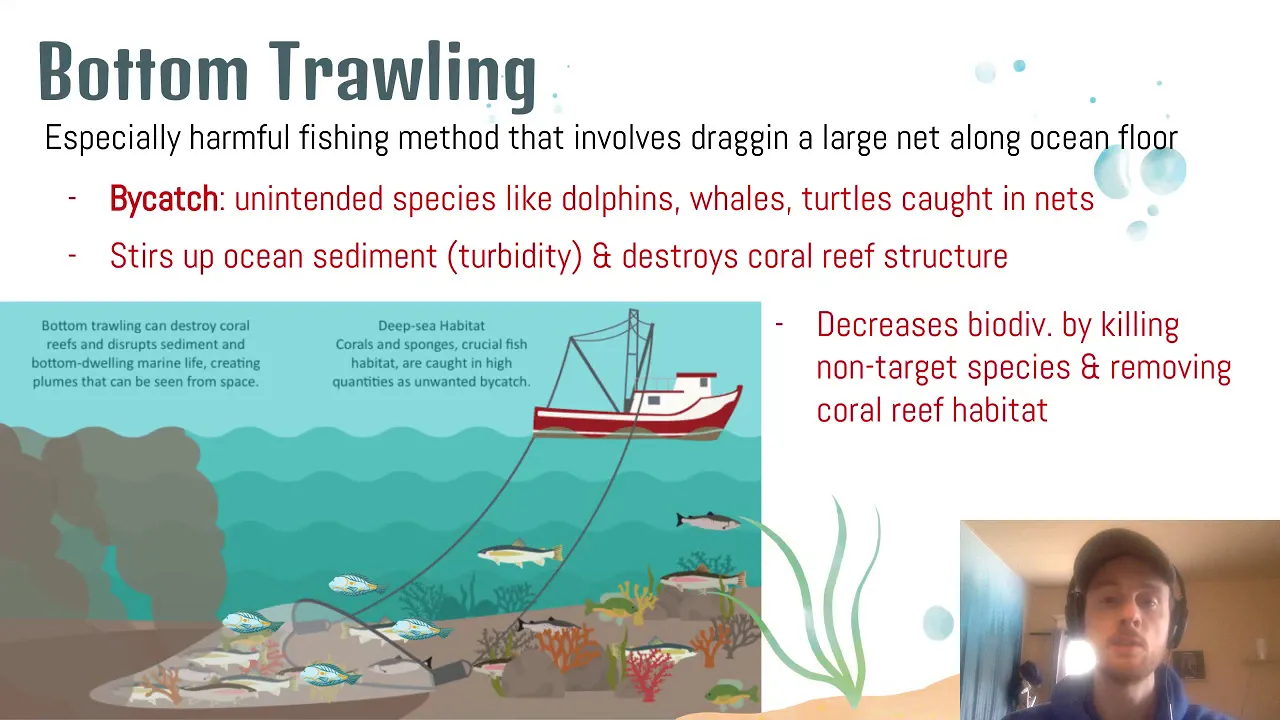
It destroys the coral itself, smashing it to pieces, and ruining the habitat for future generations of fish.
After the blast fisherman throws the bombs, he goes into the water with primitive diving gear to gather the dead and dying fish.
Hundreds or thousands of animals die to produce a few dozen marketable fish for the fisherman.
It's an incredibly irresponsible and destructive practice.
It might provide the fisherman a few fish to eat today, but it will not provide any tomorrow or the next day, or again for a decade or more.
This section of reef is dead.
The Mantis shrimp digs out from under the broken coral and surveys its surroundings.
Things do not look good.
The reef, now shattered, will soon be covered by a suffocating layer of algae.
This once vibrant city of coral becomes a desolate wasteland.
Blast fishing has ravaged many southeast Asian reefs.
Most countries have outlawed this practice, and in many places, the reefs are making a remarkable comeback.
But illegal blast fishing still occurs thousands of times a day, every day of the year.
Reefs are being destroyed at an astonishing pace.
Everything living in and around the metropolis of the coral reef has a place in the community—a niche where it plays a part in the survival of the coral ecosystem.
Ever since humans entered the ocean to fish, we have become unwitting participants in the marine ecosystem.
More than any other member of the reef community, our actions most directly affect the health of reef ecosystems.
We hold their fate in our hands, and blast fishing is by far the most direct and immediate threat facing Pacific coral reefs.
While reefs can sustain some fishing to provide food for people, they cannot provide sustenance to anyone if they are blasted to pieces.
Fortunately, more and more people are realizing that sustainable, non-destructive fishing practices are better in the long term.
But in remote areas where blasting still occurs, the reefs will take years to recover.
It’s a high price to pay for a fish dinner.
For some, life goes on.
The hermit crab, in her portable bomb-shelter, searches for breakfast.
The sea turtle has wisely learned to avoid human contact.
He moves down the reef.
This spot is safe—for now.
For most, safety will only be fully realized when blast fishing ceases once and for all.
That day will hopefully come soon, when people understand that life cannot thrive in these shallow tropical seas without the habitat provided by coral reefs.
That is the secret known to those who love coral reefs and the creatures that thrive here.
But it's a secret only to those who do not take the time to look.
The secret to life on the reef is the reef itself.
(credits)
Up Next

5:04
Coral Reefs 101: Why Protecting Them Matters for Our Ocean's Health
@ConservationInternational
7.6K views•2022-01-18

12:54
Triumph of Orthodoxy Icon: Byzantine Art & History Explained
@BenCallan
2.1K views•2024-08-06

9:49
FastAPI vs Flask vs Django: Choosing the Right Python Web Framework
@TechWithTim
302.5K views•2024-05-26

1:42
Game of Thrones Opening Credits: A Cinematic Analysis
@gameofthrones
46.3M views•2011-04-18
Related Study Plans & Knowledge Roadmaps
Structured learning paths in General & Interdisciplinary Studies
general-studies
Elevator Engineering: History, Physics & Cities
01From Hoists to Safety Brakes: The Dawn of Vertical Lift
02Hydraulic vs. Traction: The Engineering Physics of Elevators
03Modern Speed, Safety, and Algorithms
+ 2 more learning modules
12h5 modules
Explore Roadmap
general-studies
Rubber: Material Science, History & Geopolitics
01Origins of Natural Rubber & Mesoamerican History
02The Chemistry of Natural Rubber & Vulcanization
03The Geopolitics of the Rubber Boom & Colonization
+ 2 more learning modules
12h5 modules
Explore Roadmap
general-studies
Containerization: Evolution, Logistics & Trade
01Ancient Trade & Bulk Cargo: Amphorae to Barrels
02The Industrial Revolution & Cardboard Packaging
03The Containerization Revolution: Malcom McLean
+ 2 more learning modules
12h5 modules
Explore Roadmap
general-studies
Textile Tech: Evolution, Labor & Global Impact
01Pre-Industrial Textiles: Handloom & Cottage Industry
02Mechanization: The Spinning Jenny to the Power Loom
03The Factory System & Global Labor Transformation
+ 2 more learning modules
10h5 modules
Explore Roadmap