Metric modulation is a drumming technique that allows drummers to smoothly transition between different time signatures by maintaining a common pulse point, making complex rhythmic changes easier to execute.
Master Metric Modulation: Essential Drum Lesson Techniques
Added:Deep Dive
A strong grasp of basic rhythmic subdivisions, including quarter notes, eighth notes, triplets, and sixteenth notes.
Give me 21 Minutes. I'll save you 26 years
67.4K
Players should learn to count rhythmic subdivisions: whole notes (2 3 4 1 2 3 4), half notes (1 2 3 4), quarter notes (1 2 3 4), eighth notes (1 2 3 4 1 2 3 4), triplets (1 2 3 1 2 3 1 2 3), and 16ths (1 e and a 2 e and a 3 e and a 4 e and a). These are the essentials for feeling groove and locking into music.
Click to watch →
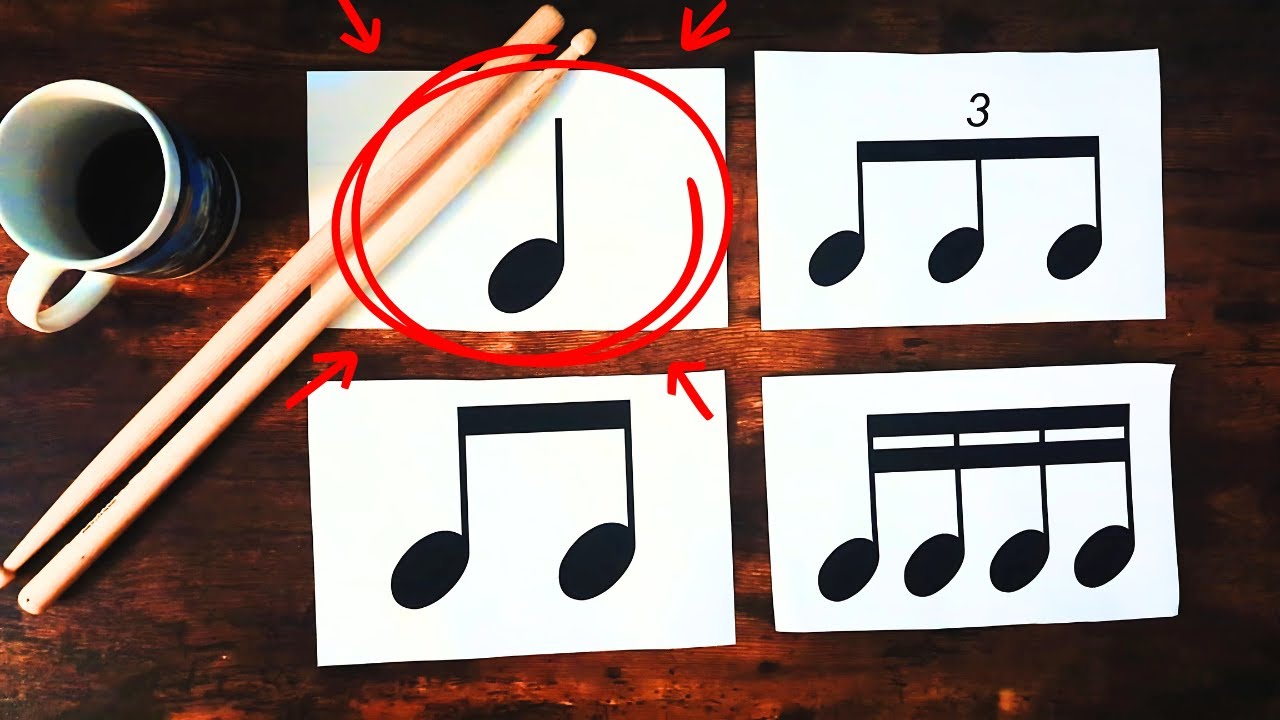
This is what you are missing - basic beat divisions
456
This section covers the four fundamental rhythmic subdivisions that divide a single beat. Quarter notes represent one note per beat, forming the basic pulse. Eighth notes divide each beat into two equal parts, creating two notes per beat. Eighth note triplets divide each beat into three equal parts, creating three notes per beat. 16th notes divide each beat into four equal parts, creating four notes per beat. The instructor emphasizes that the underlying beat tempo never changes; only the number of pulses within each beat varies. These even pulses form the foundation for understanding all rhythmic patterns in music.
Click to watch →
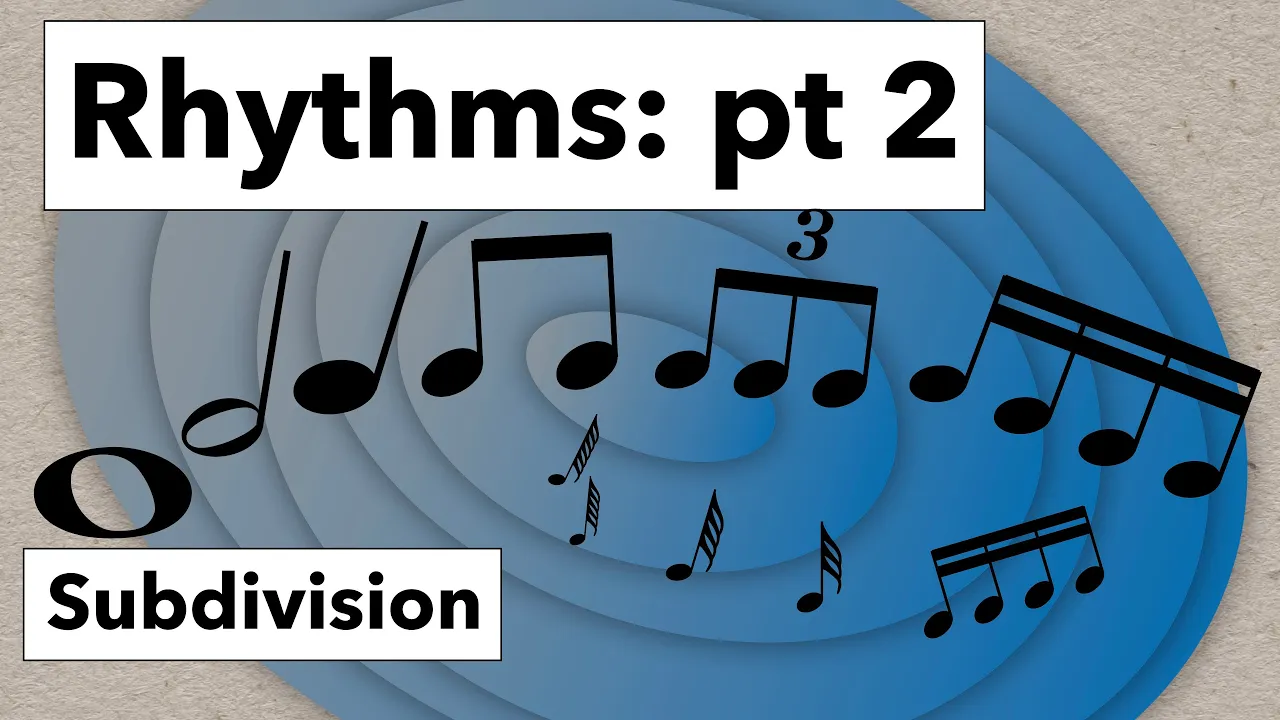
Eighth Notes, Triplets, & Sixteenths: Everything You Need to Know
95.4K
Musical rhythms are built by subdividing the beat into smaller equal parts—eighth notes divide a quarter note into two equal halves, sixteenth notes divide an eighth note into two, and triplets divide beats into three equal parts; these subdivisions allow musicians to create complex rhythmic patterns while maintaining the underlying pulse, with syncopation occurring when notes emphasize off-beat positions and ties helping clarify tricky rhythmic passages.
Click to watch →
![Figuras Rítmicas [Parte 1]](https://i.ytimg.com/vi/nn0XVBYI5uM/sddefault.jpg)
Figuras Rítmicas [Parte 1]
203.4K
Tempo subdivisions divide each main beat into smaller rhythmic units. Eighth notes (corcheas) divide each beat into two notes, creating a faster pattern. Triplets (trecillos) divide each beat into three notes, creating a distinctive three-part rhythm. Sixteenth notes (semicorcheas) divide each beat into four notes, creating an even faster pattern. These subdivisions allow musicians to create increasingly complex rhythmic patterns while maintaining the underlying pulse, essential for playing various musical styles.
Click to watch →
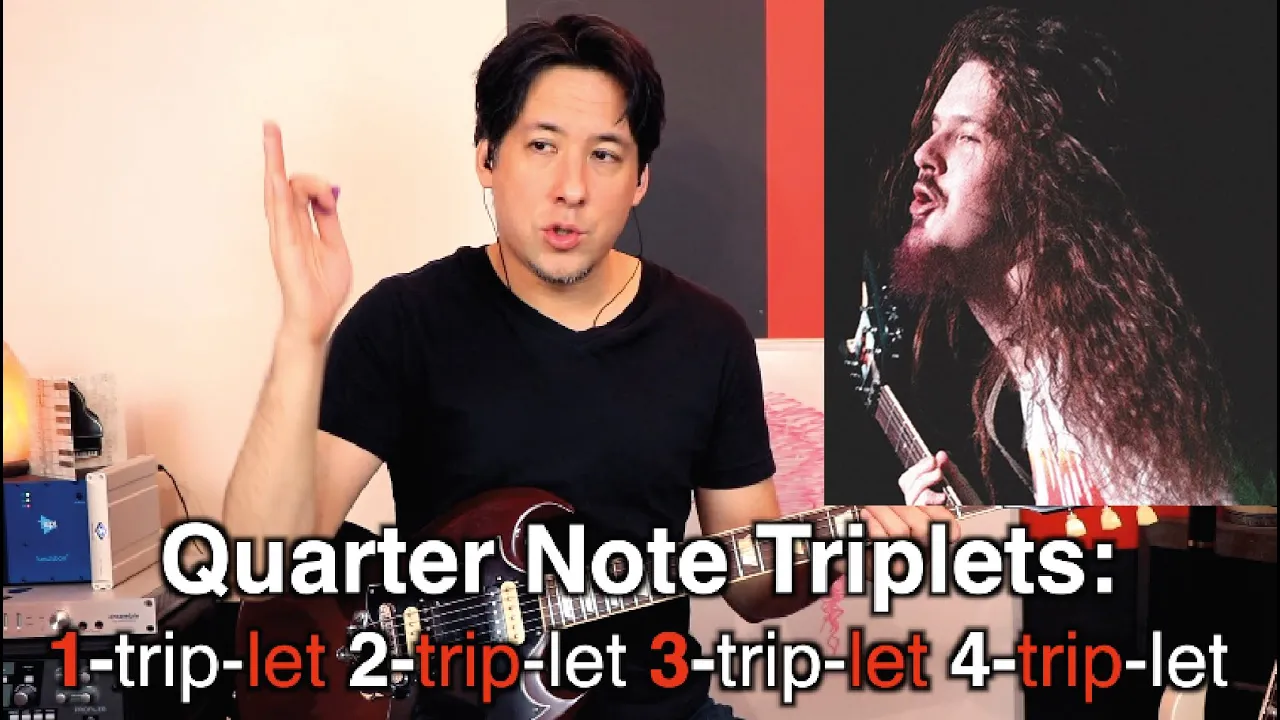
RIFF and GROOVE HARDER with TRIPLETS!
74.8K
The instructor reviews three basic note types: quarter notes (one beat per note, counted as 'one two three four'), eighth notes (two per beat, counted as 'one and two and three and four and'), and sixteenth notes (four per beat, counted as 'one E and a two E and a three E and a four E and a'). These notes represent different levels of subdivision within a beat.
Click to watch →
Deep Dive
The ability to maintain a steady internal pulse and practice effectively with a metronome in various time signatures (e.g., 4/4, 3/4, 6/8).
Mejora tu pulso con el "detestable" metrónomo
49.9K
Developing internal pulse requires systematic metronome practice. Set the metronome to a stable but low tempo (around 60 BPM) and disable the accent bell to remove external cues. Treat metronome clicks as kick drum beats, focusing on feeling beats 1 and 3 while mentally filling in beats 2 and 4. Practice subdividing beats into smaller units (eighth notes, sixteenth notes) to train the brain to feel the pulse internally. Increase difficulty by slowing the tempo to 30-45 BPM, which forces greater reliance on internal rhythmic awareness. This foundational skill enables musicians to maintain steady pulse independently.
Click to watch →
Master the Metronome Once and For All (it's worth it!)
13.2K
To develop an internal pulse, practice clapping, tapping, or counting aloud with the metronome at various tempos (60, 88 BPM, and faster/slower). This external pulse helps create an internal pulse from within. The second step applies structure by counting beats in a specific time signature (like 4/4) at a chosen tempo. This is essential because rhythm organizes complex information in the brain and aids recall. Without counting, players lack structure, leading to issues with hand coordination, finger independence, and accuracy.
Click to watch →
Bağlama Temel Beceri Egzersizleri - Bağlama İcrasında Arpej ve Akor Denemeleri
57.9K
The instructor demonstrates practicing with a metronome in different time signatures, specifically 3/4 and 4/4 time. The instructor shows how to maintain steady tempo while transitioning between different rhythmic patterns, emphasizing that practicing with a metronome in various time signatures helps develop comprehensive rhythmic understanding and adaptability.
Click to watch →
This is Why You Hate the Metronome
576
To develop predictive metronome skills, practice internalizing the steady pulse through structured exercises. First, let the metronome play and internalize the beat by clapping, snapping, or tapping your foot. Then turn the metronome off and continue your internal pulse, turning it back on to check your steadiness. Practice at various speeds and with different subdivisions (eighth notes, quarter notes). Use the Time Guru app, which randomly removes beats, forcing you to maintain your internal pulse and predict where the metronome will return. This develops a strong internal pulse and helps you enjoy practicing with the metronome as a helpful tool rather than an enemy that reveals rhythm problems.
Click to watch →
320 BPM - 6/4 & 6/8 Metronome
127
This video provides a 320 BPM metronome specifically designed for practicing 6/4 and 6/8 time signatures, with audio EQ optimized to be audible over musical playing, serving as a practice tool for musicians learning complex rhythmic patterns.
Click to watch →
Deep Dive
Understanding the concept of polyrhythms, particularly basic ratios like 3:2 and 4:3, which often serve as the foundation for modulation.

Polyrhythms
114.4K
A polyrhythm occurs when two fundamentally different rhythms are played simultaneously. The instructor demonstrates this by contrasting straight eighth notes (dividing each beat into two equal parts) with triplets (dividing each beat into three equal parts). Common polyrhythm ratios include 3:2 (triplets against eighth notes) and 3:4 (triplets against quarter notes). Not all layered rhythms qualify as polyrhythms - eighth notes and sixteenth notes actually align perfectly because they share the same underlying beat structure. True polyrhythms require fundamentally incompatible divisions that cannot be made to align through simple subdivision.
Click to watch →

Polyrhythms and Polymeters – NEVER make a boring loop again!
90.4K
Polyrhythms involve at least two different rhythms with evenly spaced notes but different counts within the same duration. A 3:4 polyrhythm uses three kick drums against four gembe hits, creating groove through offset timing. The technique involves hitting once, missing two sixteenths, repeating. Triplet polyrhythms (3:1) use triplet mode for three hits per kick, common in dance music for samba feels. Complex ratios like 7:4 require drawing extra beats then deleting to align properly. These techniques add groove and prevent boring loops.
Click to watch →
![Drumming with Polyrhythms [3:2 | 3:4 | 5:4] + musical examples](https://i.ytimg.com/vi_webp/73jEJ33YLq0/maxresdefault.webp)
Drumming with Polyrhythms [3:2 | 3:4 | 5:4] + musical examples
51.5K
Polyrhythms occur when two or more rhythmic patterns start and finish simultaneously, with the three most common types being 3:2 (three beats against two beats), 3:4 (three beats against four beats), and 5:4 (five beats against four beats); these can be mastered by multiplying the two numbers to establish a common grid (e.g., 3×4=12 for 3:4 polyrhythm) and practicing slowly until the pattern becomes internalized without conscious counting.
Click to watch →

Polyrhythms vs. Polymeters: A Music Theory Guide
406.3K
The most common polyrhythms are ratios of 3:2 and 4:3. These can be learned using spoken devices: the 3:2 ratio goes with the rhythm of 'hot cup of tea hot cup of tea,' while the 4:3 ratio uses the phrase 'pass the goddamn butter pass the goddamn butter.' These techniques are taught in some music schools as effective ways to internalize these complex rhythmic relationships.
Click to watch →
![Harmonic Polyrhythms Explained! [ AN's Bass Lessons #27 ]](https://i.ytimg.com/vi_webp/_gCJHNBEdoc/maxresdefault.webp)
Harmonic Polyrhythms Explained! [ AN's Bass Lessons #27 ]
354.3K
The same simple interval ratios used to describe musical intervals can be directly applied to rhythmic notation. The 3:2 ratio of a perfect fifth, when reinterpreted rhythmically, becomes a three-against-two polyrhythm (such as quarter notes against eighth-note triplets). This correspondence allows all basic interval ratios to be translated into rhythmic notation.
Click to watch →
Deep Dive
Intermediate limb independence and physical coordination to execute shifting rhythmic grid patterns across the drum kit.
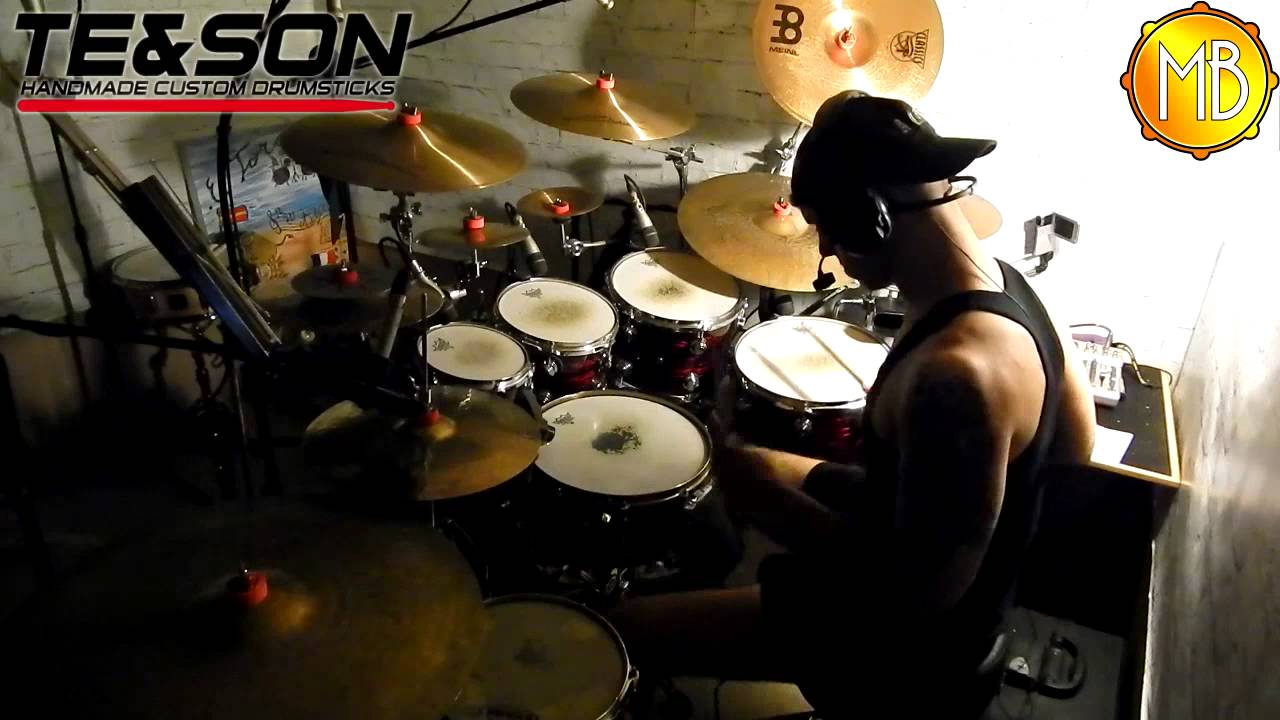
Ejercicio interdependencia Nivel Intermedio-Avanzado / intermediate-Advanced level
1.5K
This drum independence exercise teaches coordination between hands and feet through three progressive patterns: simple alternating hand patterns, double patterns, and complete triplets, first practiced with hands while feet maintain a steady ostinato, then inverted with feet playing the patterns while hands provide the ostinato, and finally combined into a complete sequence.
Click to watch →

Tomas Haake CLOCKWORKS drum playthrough REACTION and BREAKDOWN #meshuggah #drumcam #reaction
53.5K
Limb independence is the ability to play different rhythmic patterns simultaneously with each limb of the drum kit. In this section, Tomas mirrors the guitar's three-and-two pattern on the floor tom while maintaining a different pattern on the snare drum. This requires high-level limb independence as each limb is executing a different rhythmic pattern while maintaining overall musical coherence.
Click to watch →
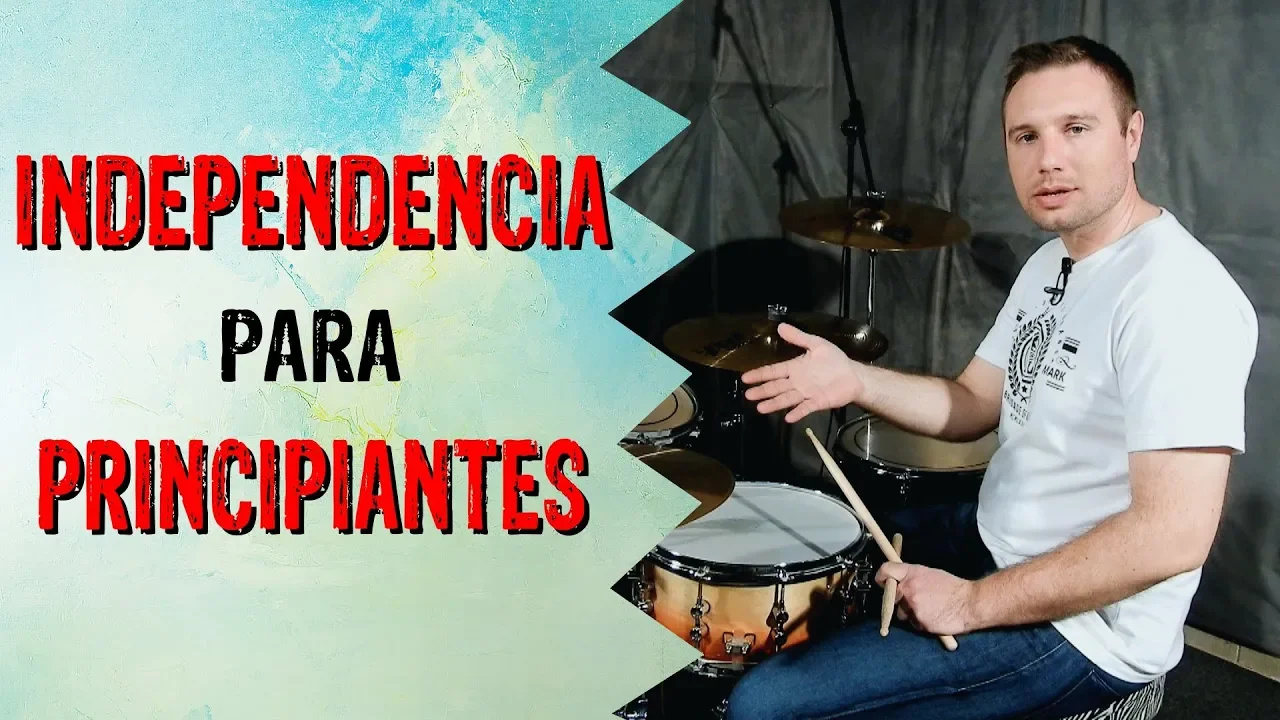
Independencia para principiantes - Clases de batería
63.1K
Drum independence is the ability to perform different patterns with one or more limbs while maintaining a steady ostinato with the remaining limbs, distinct from coordination which organizes patterns across limbs. To develop independence, practice a two-beat exercise where the hi-hat plays eighth notes and the bass drum plays on beat 1 as the fixed ostinato, then practice placing the snare drum on each individual beat (1, 2, 3, and 4) separately before combining them in random order to achieve total freedom in pattern execution.
Click to watch →

Este groove pondrá a prueba tu INDEPENDENCIA!
1.6K
This video teaches a drum groove that requires playing with all four limbs simultaneously (two hands and two feet), demonstrating how to develop independence and coordination through progressive practice of patterns like paradiddles, orquesting, and adding accents and dynamics.
Click to watch →
How to develop limb independence on the drum kit
858
Limb independence on the drum kit is developed through a progressive training method: first establish a repetitive ostinato pattern (such as eighth notes) that remains constant, then practice engaging in separate activities (like moving objects, drawing, or talking) with one limb while maintaining the ostinato; once this separation is achieved, progress to reading permutation charts at various tempos while playing the ostinato, then apply the same process to different limbs (such as the bass drum); finally combine limbs using short-long note patterns and alternate between different groove patterns to develop the ability to play any style with any limb.
Click to watch →
Prerequisite Knowledge
- Concept 01A strong grasp of basic rhythmic subdivisions, including quarter notes, eighth notes, triplets, and sixteenth notes.
- Concept 02The ability to maintain a steady internal pulse and practice effectively with a metronome in various time signatures (e.g., 4/4, 3/4, 6/8).
- Concept 03Understanding the concept of polyrhythms, particularly basic ratios like 3:2 and 4:3, which often serve as the foundation for modulation.
- Concept 04Intermediate limb independence and physical coordination to execute shifting rhythmic grid patterns across the drum kit.
Subsequent Learning
- Step 01Exploring advanced polyrhythms and polymeters, such as 5:4 or 7:4, to create more complex rhythmic illusions.
- Step 02Applying metric modulation techniques practically in musical genres like progressive rock, jazz fusion, and math rock.
- Step 03Studying transition cues to effectively guide an entire band or ensemble through a tempo change using metric modulation during live performances.
- Step 04Developing compositional and arranging skills to integrate metric modulation as a structural songwriting tool.
Start
Start
0:40Playing Section
- 1
Video commences with musical intro.
- 2
No substantive content presented yet.
The Supremacy of the Pocket: Prioritizing Groove Over Complex Modulation
While metric modulation is a celebrated advanced technique, many veteran educators and professional drummers argue that prioritizing mathematical complexity can be counterproductive, particularly for developing drummers. This counterpoint champions 'the pocket'—the ability to maintain a rock-solid, emotionally resonant groove that serves the song. Critics point out that overemphasizing metric modulation can lead to a sterile, intellectualized playing style that disrupts band cohesion and alienates listeners. For most musical genres, mastery of basic timekeeping, dynamics, and feel is infinitely more valuable and employable than complex rhythmic illusions.
Deep Dive
Exploring advanced polyrhythms and polymeters, such as 5:4 or 7:4, to create more complex rhythmic illusions.
Drumming with Polyrhythms [3:2 | 3:4 | 5:4] + musical examples
51.5K
The 5 over 4 polyrhythm involves counting five beats against four beats. Establish a 20-count grid (5×4=20). For fills, keep a quarter note pulse on pedal hat while playing 16th notes, accenting every fifth note (1, 5, 9, 13, 17). Strip back complexity to isolate the polyrhythm. Use one number for audience pulse (quarter notes) and another for ostinato. Apply strategically in grooves like 'Fire'—establish 5s against 4s, then isolate ride bell against pedal hat. Don't force polyrhythms; use them to enhance composition and groove establishment. Start slow, use metronome, build speed gradually.
Click to watch →
How King Gizzard use Odd Time Signatures, Polyrhythm & Polymeter
149.6K
Polymeter and polyrhythm are related but distinct rhythmic techniques. Polyrhythm involves dividing the same measure into different equal subdivisions simultaneously (e.g., 4 against 3), with both patterns at different tempos but perfectly synchronized. Polymeter layers entirely different time signatures at the same unified tempo, causing them to gradually fall out of sync before realigning. The video explains that polymeter creates chaotic weaving effects where repeated patterns interact differently each time they align. Examples include 7 against 4 polymeters and 11 against 5 polymeters, demonstrating how these techniques produce increasingly complex rhythmic textures throughout the album.
Click to watch →

Songs that use Polyrhythms & Polymeters
851.7K
A polyrhythm occurs when a bar of music features more than one regularly spaced pulse simultaneously, such as 4 beats against 3 beats. Polymeter involves only one pulse but multiple time signatures, like 4/4 against 3/4. Polyrhythms can serve as the foundation of a piece (cross rhythm) or appear occasionally for dramatic effect. Examples include The National's 'Fake Empire' (4-over-3), Radiohead's 'Daydreaming' (3-over-2), Tool's 'Lateralis' (8-over-6), and Jacob Collier's 'Hajanga' (3-against-4). Polymeter examples include Led Zeppelin's 'Kashmere' (4/4 against 3/4), Radiohead's 'Let Down' (5/8 against 4/4), and The Gorillas' '5/4' (5/4 against 4/4). The second number in polyrhythm notation represents the main beat or prevailing pulse. These techniques create tension, disorientation, and dramatic effect in progressive music genres.
Click to watch →

your polyrhythm 5
473.3K
This video demonstrates a polyrhythm exercise (Polyrhythm 5) through musical performance, showcasing complex rhythmic patterns that combine multiple simultaneous rhythms with different time signatures, a fundamental concept in advanced music theory and percussion education.
Click to watch →
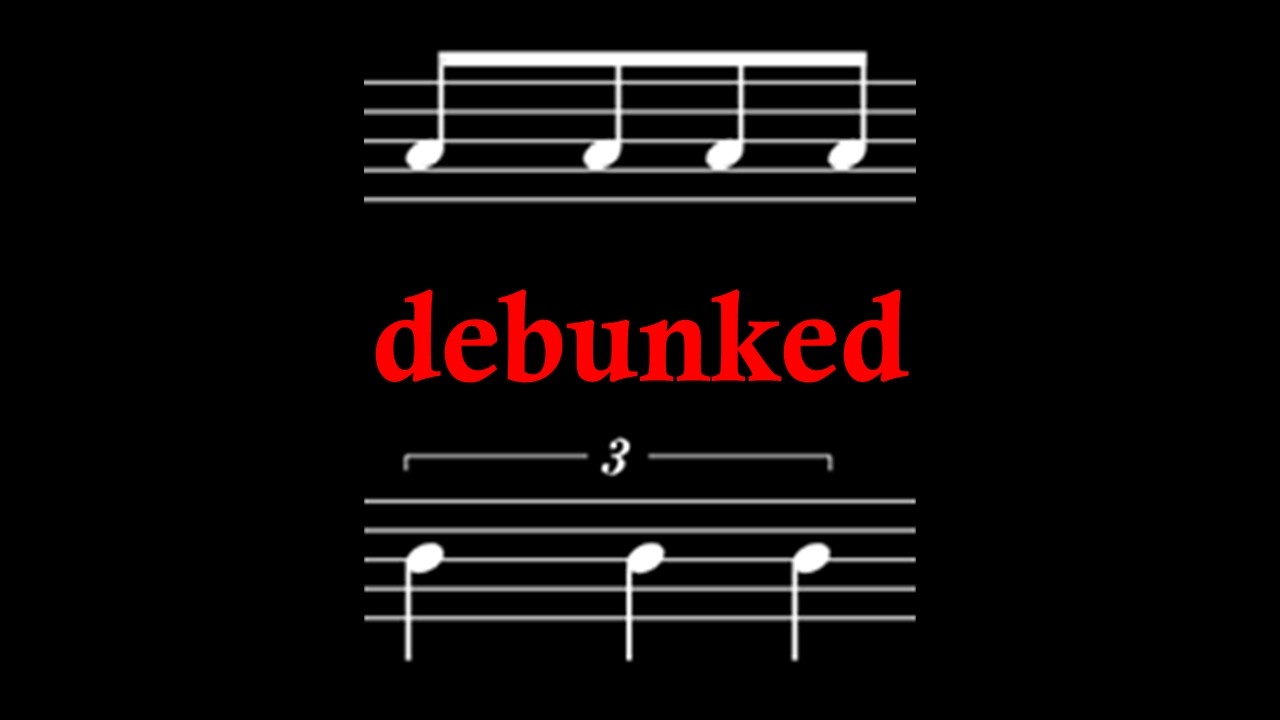
Polyrhythm Does Not Exist
334
Polyrhythm and polymeter are not separate concepts but rather the same phenomenon viewed from different perspectives. Polyrhythm emphasizes accents while polymeter emphasizes the underlying pulse. When focusing only on accents, what appears to be polyrhythm is actually just polymeter. This relationship holds true for various ratios including 3:2, 4:3, 5:3, 5:4, and 7:5. However, not all polymeters can be classified as polyrhythm, as note groupings can create rhythmic effects that cannot be viewed as polyrhythm regardless of perspective.
Click to watch →
Deep Dive
Applying metric modulation techniques practically in musical genres like progressive rock, jazz fusion, and math rock.
How to Horribly Confuse Your Guitarist and BEND TIME ITSELF
3.8K
Metric modulation is a technique for seamlessly changing tempo and time signatures by shifting the rhythmic center of music, commonly used in jazz fusion, progressive rock, and progressive metal. To execute smooth modulations, musicians must precisely switch between rhythmic rates and quickly center on new beats. A fundamental exercise involves superimposing a basic 4/4 groove into eighth note triplets, progressing from normal eighth notes to triplets on hi-hats while keeping kick and snare the same, then aligning kick and snare with every two triplet strokes. Musicians can then practice dropping into a halftime feel by superimposing the original beat into quarter note triplets. Time signature switching is achieved by grouping the underlying rhythmic denominator differently—for example, with 12 eighth note triplets per 4/4 measure, musicians can group them as four groups of three (4/4) or three groups of four (6/8). Implied metric modulation occurs when a loop contains elements suggesting different time signatures simultaneously, allowing seamless switching between feels by pivoting around the underlying triplet rate. Advanced experimentation involves grouping sixteenth notes into threes, triplets into fives, or quintuplets into fours.
Click to watch →
Adam "Nolly" Getgood: How to apply metric modulation.
57.1K
Notable examples include: 'Taste My Fist' by Free Kitchen (switching between triple and straight time), 'Icarus Lives' by Periphery (brief 5 against 4 polyrhythm accentuation), 'Nocturne' by Tesseract (triplet time shift around 1:45), 'Singularity' by Textures (quintuplet-based implied meter), and Planet X's version of 'Alien Hip-Hop' (Virgil Donati's complex rhythmic manipulations throughout).
Click to watch →

Metric Modulation Explained Through Jazz, Rock, and Classical Examples
72.8K
Metric modulation is a compositional technique for changing meters through mathematical relationships. Meter itself operates hierarchically with pulse groups, beats, and accents. The technique uses pivots—elements from the existing meter—to establish new rhythmic frameworks. Two main types exist: transitional modulations serve as navigational devices between sections (e.g., Lionel Richie's 'Say You Say Me'), while recontextual modulations exploit perceptual anticipation, creating musical illusions where listeners initially hear continuity before realizing they've entered different metric environments. Advanced applications include complex sequential modulations maintaining constant bar length while gradually changing tempo, as demonstrated in Winton Marsalis's 'Autumn Leaves' with six consecutive changes.
Click to watch →
МЕТРИЧЕСКАЯ МОДУЛЯЦИЯ: ПРИМЕРЫ ПЕСЕН
4K
Metric modulation (tempo modulation) is a compositional technique from the mid-20th century that enables smooth tempo transitions. Tempo is mathematically defined as the time distance between beats (e.g., 120 BPM means quarter notes equal half a second). When layers have mismatched tempos, they desynchronize. Metric modulation works by having durations smoothly transition from one tempo to another—similar to harmonic modulation where a note's function changes between keys. A duration perceived as triplet in one tempo becomes a quarter note in another. This technique appears across genres: The Beatles' 'We Can Work It Out' (half note equals quarter note), Sting's 'Hold On' (12/8 transitioning to paired rhythms), Kendrick Lamar's 'DNA.' (quarter notes to triplet grooves), and Red Hot Chili Peppers' 'Road Trippin' (eighth notes to dotted quarter pulses). Originally used by avant-garde composers, it now permeates pop, hip-hop, and progressive music, creating rhythmic complexity while maintaining coherence.
Click to watch →

Metric Modulation and Non-Dyadic Time Signatures Explained
121.4K
Metric modulation is the technique of changing the perceived beat at a given tempo through a mathematical ratio between two meters, typically using a pivot rhythm that functions in both meters; non-dyadic time signatures (those with bottom numbers not being powers of two like 3, 5, or 7) are primarily useful as relative time signatures during metric modulation rather than for entire compositions, as they create rhythmic ambiguity that can be confusing to read and interpret.
Click to watch →
Deep Dive
Studying transition cues to effectively guide an entire band or ensemble through a tempo change using metric modulation during live performances.

MUSIC DIRECTOR REACTS | Black Clover All Openings Full (1-13)
426.4K
The presenter describes a 'nice transition' where the tempo 'pulls way back' and explains that this is a 'modulation thing' where 'the half note became the quarter note for a little bit.' The presenter notes this is 'metric and more complicated' and describes it as 'cool' and 'nice the field change was effective in tossing it up to be like hey get your attention again.' This demonstrates how tempo changes and metric modulation (changing the underlying pulse) can create musical interest and re-engage listeners.
Click to watch →
Metric Modulation and Non-Dyadic Time Signatures Explained
121.4K
Metric modulation applies the concept of modulation (changing keys) to meter instead of harmony. It requires two rules: a mathematical ratio between meters and a pivot rhythm functioning in both. The simplest form keeps the pivot rhythm constant while changing the perceived beat value, as demonstrated in Metroid's drum patterns where eighth notes remain constant but the dotted quarter note beat creates a 3:2 ratio, making the beat feel slower despite no actual tempo change.
Click to watch →
Metric Modulation Explained Through Jazz, Rock, and Classical Examples
72.8K
Metric modulation is a compositional technique that changes the meter (time signature) of a piece by using a mathematical relationship between the old and new tempos, often through a pivot rhythm that serves as a bridge between the two meters; this technique can be used for smooth transitions between musical sections (transitional modulation) or to create perceptual illusions by making listeners feel they're hearing the same pattern in a completely different rhythmic context (recontextual modulation).
Click to watch →

Intro to Metric Modulation
28.8K
Metric modulation is a musical technique that changes tempo while maintaining a common duration between tempos, achieved by equating one rhythmic value from the old tempo to become the pulse of the new tempo; the tempo change can be calculated using the ratio formula: (old rhythmic value / new rhythmic value) = (old tempo / new tempo), allowing musicians to transition smoothly between tempos without listeners noticing the change.
Click to watch →
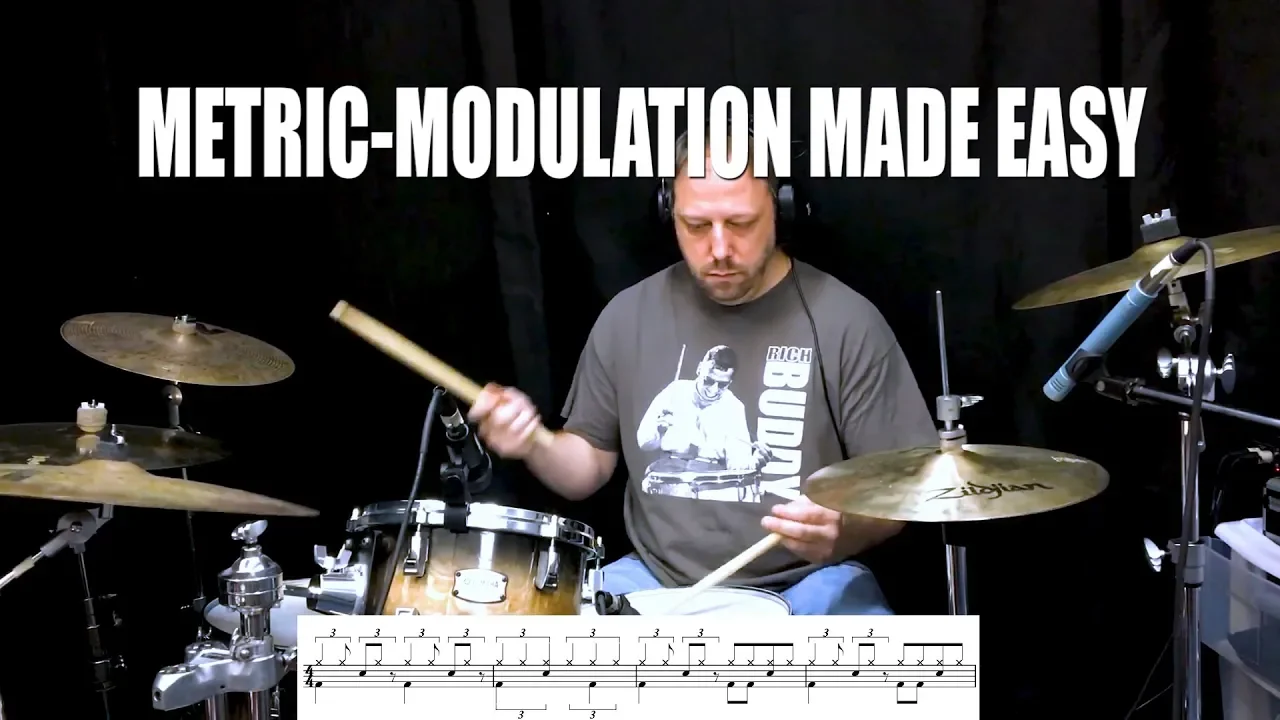
3 against 4 Metric Modulation Made Easy
48.5K
Metric modulation is a rhythmic technique where notes that originally fall on quarter notes are instead played on half-note triplets, creating a 'three against four' feel; to practice this, start by playing a basic groove in 4/4 time with quarter note triplets, then accent every other triplet to feel the modulation, and finally play only the half-note triplet while keeping the hi-hat going, which can be applied to jazz, blues, and shuffle grooves.
Click to watch →
Deep Dive
Developing compositional and arranging skills to integrate metric modulation as a structural songwriting tool.

The Uncompromising Elliott Carter
25.3K
Metric modulation (or tempo modulation) is a technique where a rhythmic value within a tempo is set across a bar line so that the duration of one note value equals a new one—such as old quarter notes becoming new triplets. Carter used this to divorce tempo from regular meter, with bar lines serving only for player alignment. The unusual form of the First String Quartet interpolates pauses at points where tempo is stable to highlight how metric modulation replaces harmonic modulation in traditional music. Structural polyrhythm involves large mathematical ratios determining relationships of all foreground elements in a piece. Carter's mature style features simultaneous layers where different instruments work at different tempos, creating total conflict while still lining up mathematically.
Click to watch →
Metric Modulation Explained Through Jazz, Rock, and Classical Examples
72.8K
Metric modulation is a compositional technique for changing meters through mathematical relationships. Meter itself operates hierarchically with pulse groups, beats, and accents. The technique uses pivots—elements from the existing meter—to establish new rhythmic frameworks. Two main types exist: transitional modulations serve as navigational devices between sections (e.g., Lionel Richie's 'Say You Say Me'), while recontextual modulations exploit perceptual anticipation, creating musical illusions where listeners initially hear continuity before realizing they've entered different metric environments. Advanced applications include complex sequential modulations maintaining constant bar length while gradually changing tempo, as demonstrated in Winton Marsalis's 'Autumn Leaves' with six consecutive changes.
Click to watch →

Myles Kennedy of Alter Bridge: Tea Time Interview with Elizabeth Zharoff
210.8K
Big band arranging skills translate to songwriting by teaching musicians to fill musical holes and understand where each instrument belongs. This creates more realized and complete demos where the song sounds fully formed.
Click to watch →
Metric Modulation and Non-Dyadic Time Signatures Explained
121.4K
Metric modulation is the technique of changing the perceived beat at a given tempo through a mathematical ratio between two meters, typically using a pivot rhythm that functions in both meters; non-dyadic time signatures (those with bottom numbers not being powers of two like 3, 5, or 7) are primarily useful as relative time signatures during metric modulation rather than for entire compositions, as they create rhythmic ambiguity that can be confusing to read and interpret.
Click to watch →

Angry Groove Writing Session
147
Metric modulation creates musical interest by changing rhythmic feel within a song. This technique involves shifting time signatures or rhythmic patterns to prevent songs from becoming generic. The session demonstrates how metric modulation can split up musical sections, create variation, and maintain listener engagement. Drummers use counting techniques (1-2-3-4-5), position markers, and internal rhythmic ticks to maintain complex patterns. The payoff for metric modulation is worth the additional complexity, as it creates unique rhythmic textures that distinguish a song.
Click to watch →
Start
Start
0:40- 1
Video commences with musical intro.
- 2
No substantive content presented yet.
The Supremacy of the Pocket: Prioritizing Groove Over Complex Modulation
While metric modulation is a celebrated advanced technique, many veteran educators and professional drummers argue that prioritizing mathematical complexity can be counterproductive, particularly for developing drummers. This counterpoint champions 'the pocket'—the ability to maintain a rock-solid, emotionally resonant groove that serves the song. Critics point out that overemphasizing metric modulation can lead to a sterile, intellectualized playing style that disrupts band cohesion and alienates listeners. For most musical genres, mastery of basic timekeeping, dynamics, and feel is infinitely more valuable and employable than complex rhythmic illusions.
A strong grasp of basic rhythmic subdivisions, including quarter notes, eighth notes, triplets, and sixteenth notes.
The ability to maintain a steady internal pulse and practice effectively with a metronome in various time signatures (e.g., 4/4, 3/4, 6/8).
Understanding the concept of polyrhythms, particularly basic ratios like 3:2 and 4:3, which often serve as the foundation for modulation.
Intermediate limb independence and physical coordination to execute shifting rhythmic grid patterns across the drum kit.
Exploring advanced polyrhythms and polymeters, such as 5:4 or 7:4, to create more complex rhythmic illusions.
Applying metric modulation techniques practically in musical genres like progressive rock, jazz fusion, and math rock.
Studying transition cues to effectively guide an entire band or ensemble through a tempo change using metric modulation during live performances.
Developing compositional and arranging skills to integrate metric modulation as a structural songwriting tool.
194.4K views12Klikes0:41@30SecondDrumLessonsOriginal Release: 2022-08-30
[Music] you
Up Next
6:38
Math Rock Guitar Riffs: Writing Techniques Explained
@LetsTalkAboutMathRock
34K views•2021-08-13

12:54
Triumph of Orthodoxy Icon: Byzantine Art & History Explained
@BenCallan
2.1K views•2024-08-06

9:49
FastAPI vs Flask vs Django: Choosing the Right Python Web Framework
@TechWithTim
302.5K views•2024-05-26

1:42
Game of Thrones Opening Credits: A Cinematic Analysis
@gameofthrones
46.3M views•2011-04-18
Related Study Plans & Knowledge Roadmaps
Structured learning paths in General & Interdisciplinary Studies
general-studies
Elevator Engineering: History, Physics & Cities
01From Hoists to Safety Brakes: The Dawn of Vertical Lift
02Hydraulic vs. Traction: The Engineering Physics of Elevators
03Modern Speed, Safety, and Algorithms
+ 2 more learning modules
12h5 modules
Explore Roadmap
general-studies
Rubber: Material Science, History & Geopolitics
01Origins of Natural Rubber & Mesoamerican History
02The Chemistry of Natural Rubber & Vulcanization
03The Geopolitics of the Rubber Boom & Colonization
+ 2 more learning modules
12h5 modules
Explore Roadmap
general-studies
Containerization: Evolution, Logistics & Trade
01Ancient Trade & Bulk Cargo: Amphorae to Barrels
02The Industrial Revolution & Cardboard Packaging
03The Containerization Revolution: Malcom McLean
+ 2 more learning modules
12h5 modules
Explore Roadmap
general-studies
Textile Tech: Evolution, Labor & Global Impact
01Pre-Industrial Textiles: Handloom & Cottage Industry
02Mechanization: The Spinning Jenny to the Power Loom
03The Factory System & Global Labor Transformation
+ 2 more learning modules
10h5 modules
Explore Roadmap