




















![[#4 EMC webinar] 10 błędów w projektach elektroniki pod kątem EMC #AkademiaEMConline](https://i.ytimg.com/vi/MBwwD3BkI_M/maxresdefault.jpg)


A buck converter is a switch-mode power supply that efficiently steps down higher input voltages to lower output voltages by using a switching transistor controlled with PWM, an LC low-pass filter to smooth the output, and a diode to prevent inductive voltage spikes; unlike linear regulators which waste energy as heat, buck converters achieve high efficiency (around 88% in this example) by rapidly switching the input voltage and averaging it through the filter, while closed-loop feedback continuously adjusts the duty cycle to maintain stable output voltage under varying load conditions.
DC-DC Buck Converters: Design and Build a 5V 5A SMPS
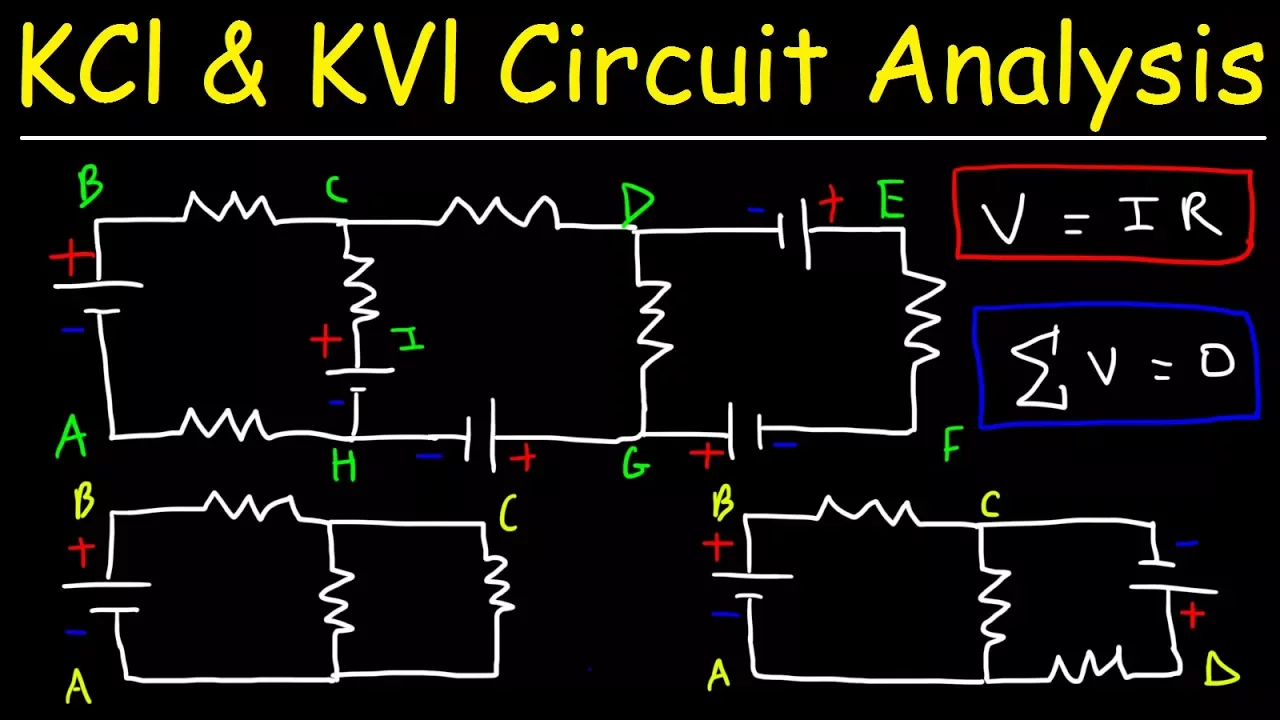
Added:Fundamental DC circuit theory, including Ohm's Law, Kirchhoff's Laws, and basic electrical power calculations.
The transient behavior of passive components, specifically how inductors and capacitors store and release energy.
The operational principles of semiconductor devices, particularly diodes (such as Schottky diodes) and transistors functioning as electronic switches.
The conceptual differences in efficiency and heat generation between linear voltage regulators (e.g., LM7805) and switching regulators.
The basic concept of Pulse Width Modulation (PWM) and how duty cycle determines average output voltage.
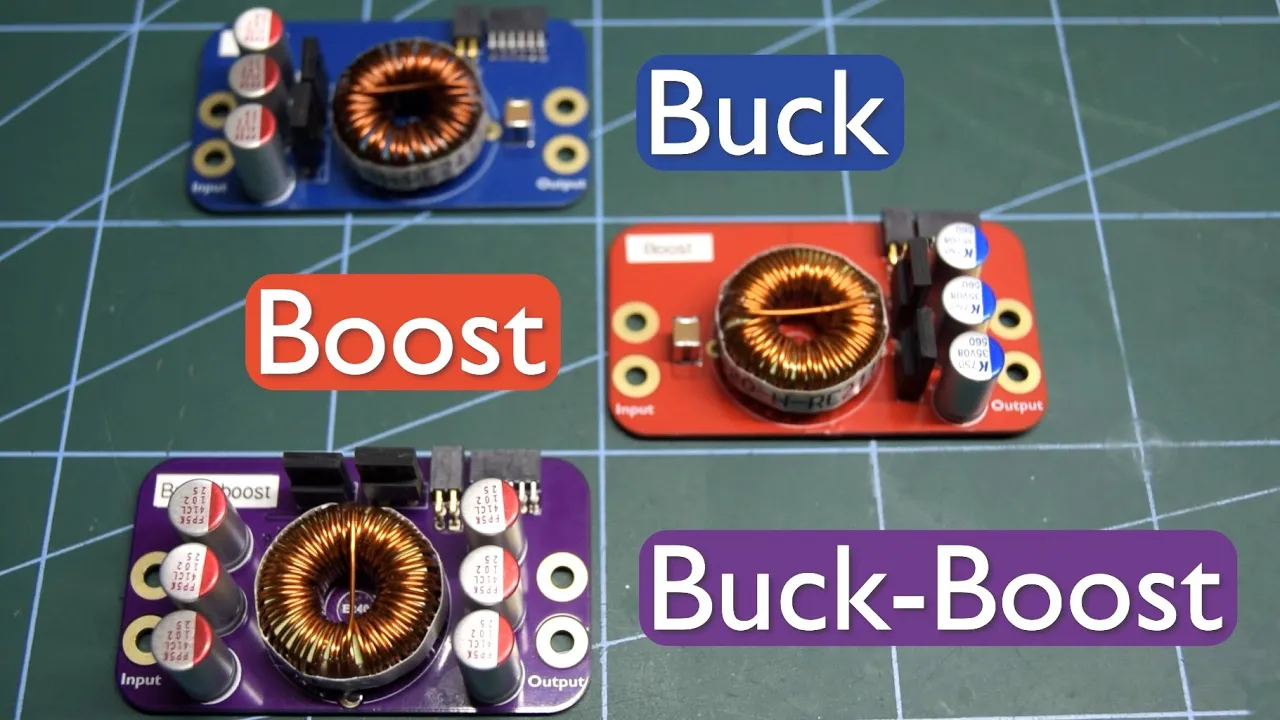
Design and analysis of other fundamental SMPS topologies, such as Boost (step-up) and Buck-Boost converters.
PCB layout design rules for high-frequency switching circuits, focusing on minimizing parasitic inductance, EMI, and ground loop noise.
Closed-loop feedback control theory, including compensator design (Type I, II, and III) to ensure converter stability and fast transient response.
Component selection criteria for high-power switching regulators, including inductor saturation current, capacitor Equivalent Series Resistance (ESR), and thermal management (heatsinking).
Understanding electromagnetic compatibility (EMC) standards and implementing input/output filters to comply with regulatory limits.
1M views18.6Klikes10:04Original Release: 2014-08-18
Today I'm going to teach you about "buck converters", and show you how to make a switch mode power supply that can work with input voltages between 8 and 30V, and it steps the output down to 5 volts. It can supply three amperes continuously and can handle peak currents of up to 5 amps for several minutes.
Let's start with why we need switch mode power supplies in the first place.
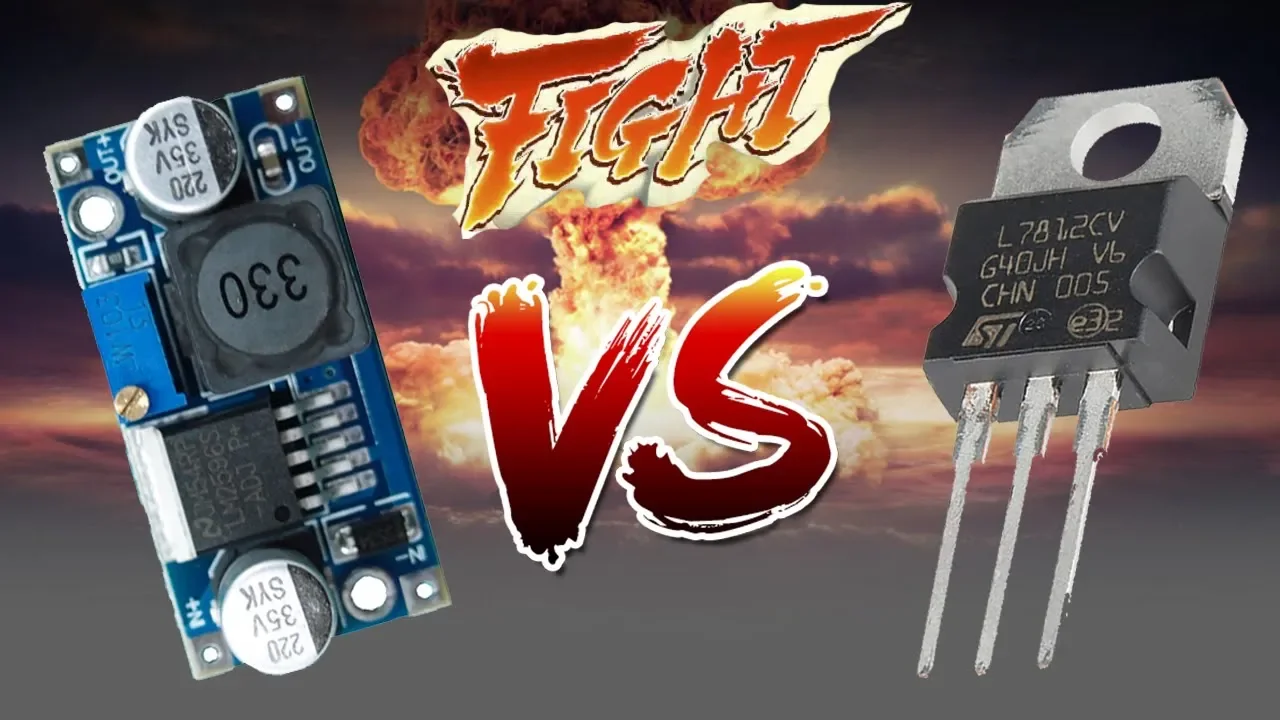
In previous videos I talked about linear voltage regulators like the LM7805 and LM317.
These are really easy to use, but they're very inefficient at high voltages.
For example, if you try to power a linear voltage regulator with 28 volts, and had by 5 volts and 3 amps on the output, you'd end up with 69 watts of heat produced.
And that might cause a few problems with your circuit. For high powered projects you want to be using what is called a switch mode power supply.
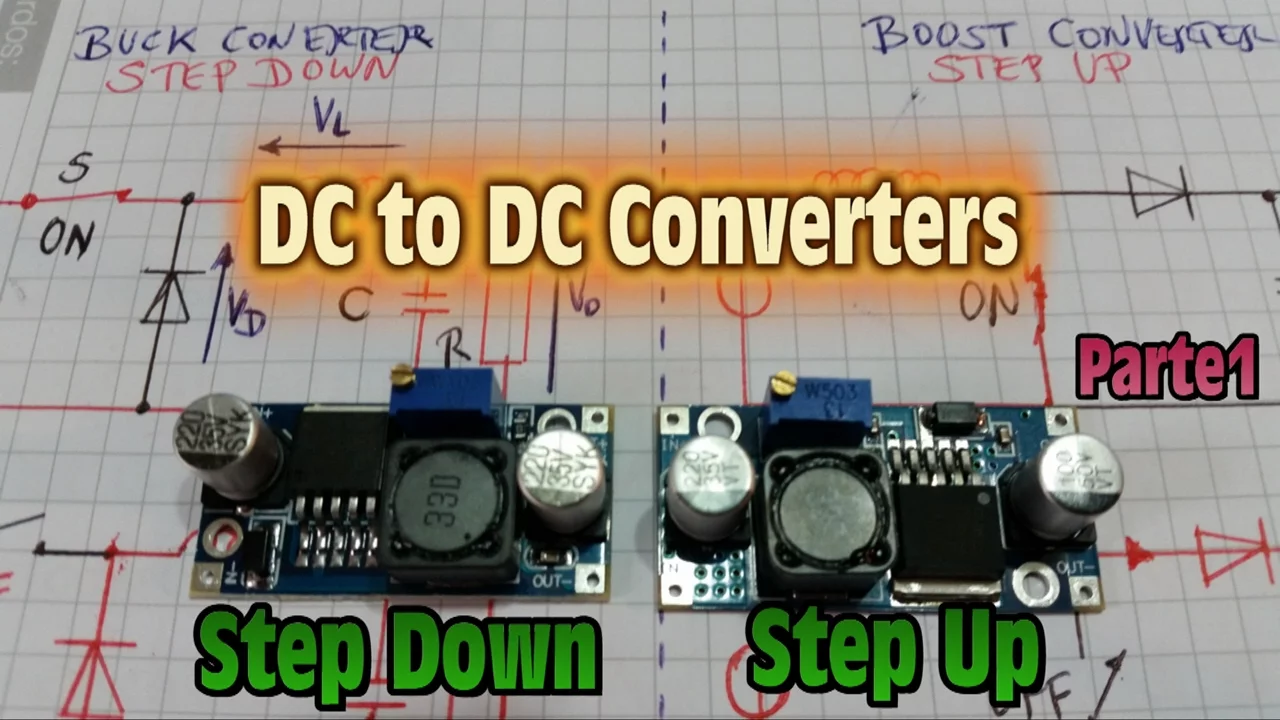
There are many different types of switch mode power supplies that can get you from one voltage to another. But today we're going to talk about buck converters which is a type of supply that can step higher voltages down to lower voltages.
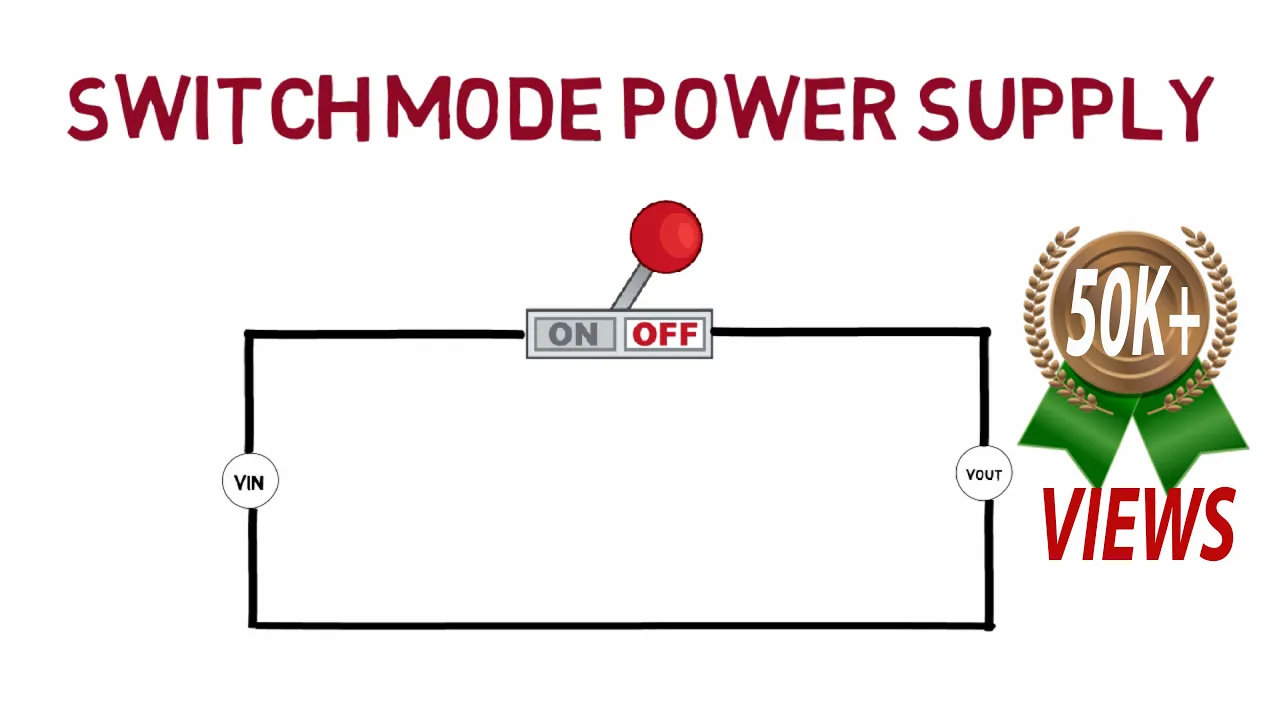
Let's start with an input voltage of 10V and let's put a switch in series with it.
It doesn't matter what the switch is... it could be a bipolar transistor, a MOSFET, even a crazy person pushing a mechanical switch. For efficiency reasons you should use a MOSFET but but let's just use a generic switch symbol for now.
Next, let's control the switch with a high frequency pulse width modulated signal with a duty cycle of fifty percent. This will give us a square wave that's 10V half the time and 0V half the time.
Now let's add an LC low-pass filter.
The inductor resists sudden changes in current, and the capacitor resists sudden changes in voltage.
The combined effect is that our LC low-pass filter averages out the square wave and we get 5 volts of relatively steady DC on the output.
Now unfortunately, if you build this in real life, this will happen.
But why? Well let's say the switch is closed... and our power supply is delivering some current. This means that current is flowing through this inductor.
Now let's open the switch. Since current in an inductor cannot instantly change this means that current is still flowing through the inductor.
But this side of the inductor isn't connected to anything. So you get this huge mass of electrons building up here, creating a massive negative voltage spike. This voltage spike can reach hundreds or even thousands of volts, enough to blow up any switch you connect here. If you want more detail about this phenomenon, check out my video on inductive spiking. In that video, you will learn that the solution to the problem is to add a diode.
With the diode in place, now whenever you open the switch, current can flow in a nice complete path and the voltage after the switch barely goes below zero.
This is the classic buck converter configuration.
And you can use this basic circuit to step high DC voltages down to lower DC voltages in a much more efficient way than linear regulators.
Now in school they might tell you that this formula will give you the duty cycle you need to get the output voltage you want. Unfortunately in the real world this is garbage.
As soon as you start drawing a few amps from your power supply, the various non-ideal parts of the circuit will complicate things.
You'll get power losses in your switch, your diode, and your inductor, and even your wires.
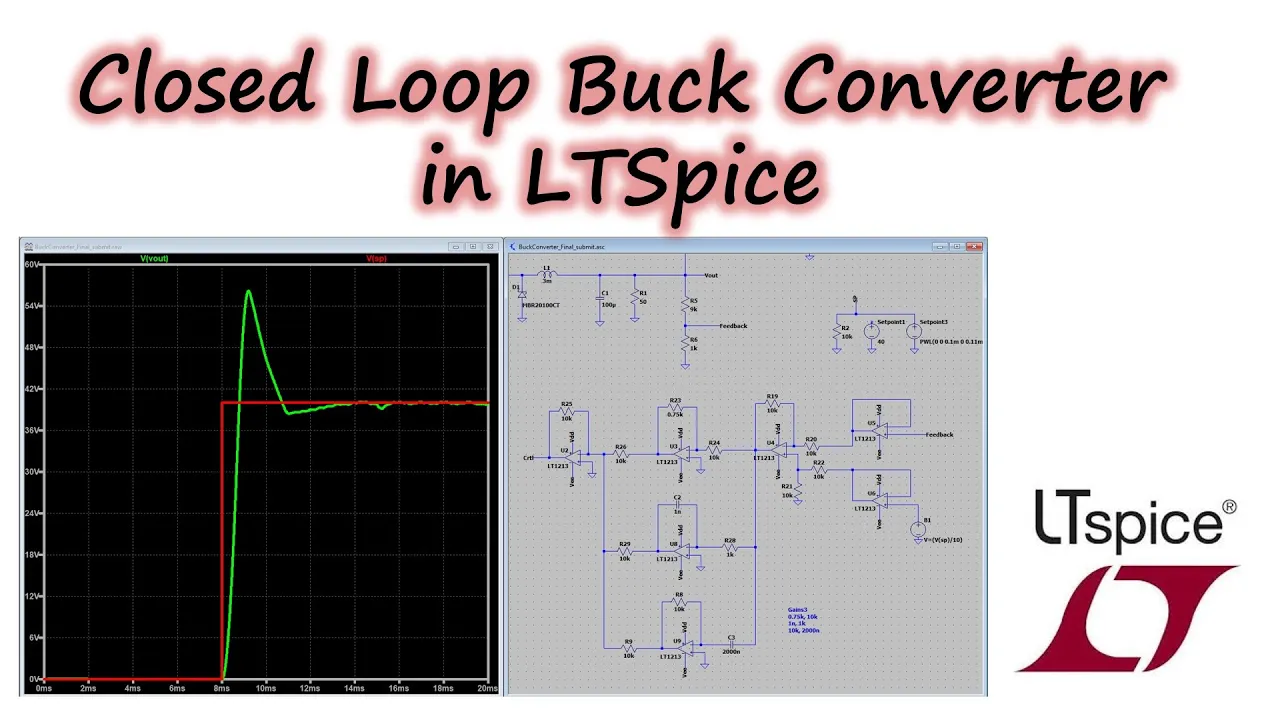
It's also highly unlikely that your output current will stay exactly the same. The more current your load draws, the more the voltage will drop. So what we need is a system that can continually monitor the output voltage and adjust the pulse width accordingly. If you draw more current on the output, and the output voltage drops too low, increase the pulse width.
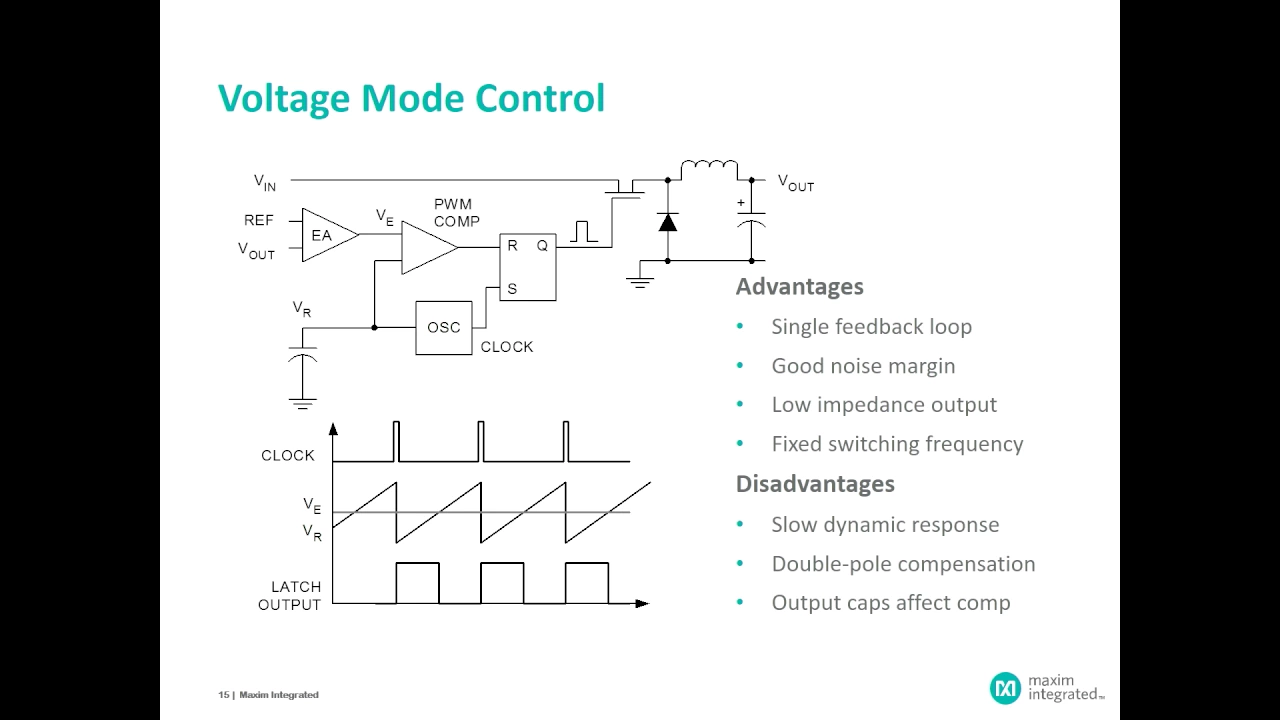
If the output voltage gets too high, decrease the pulse width. And we have to do this within a fraction of a second otherwise we could fry the thing we're trying to power! In other words we need a closed-loop control scheme with negative feedback.
We can accomplish this by adding a feedback resistor network at the output, a ramp oscillator and an error amplifier. We're also going to need a precision voltage reference and a suitable slope comp- (SHUT UP!)
Okay, how about we make things easy? Texas Instruments has a portfolio of products called "simple switchers".
All the simple switcher products are practically idiot proof and all you have to do is add a diode, an inductor and some capacitors.
They take care of the complicated control electronics inside the chip.
Let's use the adjustable version of the LM2678.
And here's the circuit diagram. On the input we have a large electrolytic capacitor in parallel with a ceramic capacitor and this is necessary to ensure that the LM2678 can easily switch current from the input at very high speeds.
If you don't have sufficient capacitance on the input, the parasitic inductance of your input power wires will limit the amount of current you can switch in every switching cycle and the regulator just won't work. For the diode, when you're designing switch mode power supplies you almost always want to use schottky diodes.
These have a lower forward voltage than regular silicon diodes so they produce less heat, which is something you always have to worry about when you're working with high currents.
I'll put links to the components in the video description section.
This is a bootstrap capacitor.
It is used to help drive the switching transistor inside the LM2678.
It can 10nF to 100nF and it should be a ceramic capacitor with at least a 50V rating. On the output we have a combination of capacitors that will smooth out the high frequency content of the switching waveform, leaving you with relatively clean and stable DC. These resistors configure the LM2678 to give you a 5 volt output. Try to use 1% resistors if you want an accurate 5 volt output.
Alright let's build this thing! You don't want to use a breadboard for this.
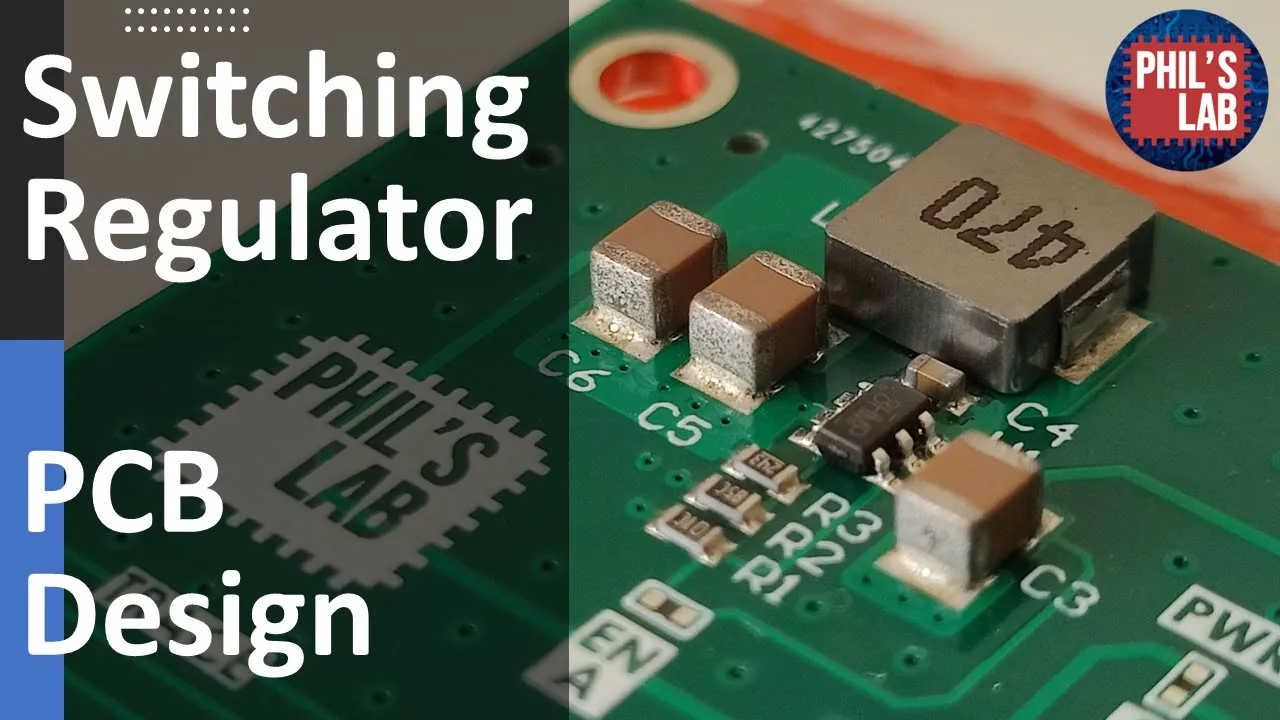
Use perfboard, or make your own PCB. Solder in in the LM2678 first leaving a large amount of space around it to fit the other components.
Solder in the input electrolytic capacitor within a centimeter or two of the controller.
And use short, thick lines of solder to make the connections.
Do the same with the diode and the output capacitor.
Keep the component leads short as possible.
When you solder the feedback resistors, try to keep the wire going back to the chip as short as possible.
The layout on the underside of the board is even more important than the topside!
Notice how my ground is one continuous straight line, and I arranged all the components on the top side around this.
I also soldered on a ground wire for oscilloscope probing later.
And look how I soldered the ceramic input and boost capacitors directly across the pins of the LM2678.
If these capacitors are even a few millimeters away from the chip, everything will perform a lot worse. Okay, now that everything soldered up, I'm going to power my buck converter with 10 volts, and I'm going to use my programmable electronic load to see how it performs delivering different amounts of current.
If you are doing this at home, you can just use 5 ohm 10 watt power resistors as a dummy load.
First, let's check the output voltage is what we want it to be. And it is! Perfect 5 volts DC!
Excellent. Now let's take a look at this node in the circuit which is called the switching node.
This is before the LC low-pass filter. You can see our familiar 0 to 10 volt square wave, and the switching frequency is 250 kHz.
But you can see the duty cycle is about 52 percent instead of the theoretical 50 percent. This is with a 0.5 ampere load on the supply.
If I increase the load to 3 amps, the duty cycle increases to 56%. And at five amps, the power losses are significant enough that the controller had to change the duty cycle to 61% to maintain the regulated 5 volt output.
Remember when I said we were getting a perfect 5 volts?
I lied! Let's change the coupling on the oscilloscope to AC coupling and zoom in. You can see that there's a small AC component on the output because our low pass filter is not perfect. We call this the output ripple of the power supply because it looks like little wave ripples. We have about 20 millivolts of ripple and noise with a 3 ampere load.
If I increase the load to 5 amperes, things get noisier.
If I increase the input voltage to 28 volts, the ripple waveform gets bigger, and it changes shape.
Ideally we want this ripple to be as small as possible.
For most applications, under 100 millivolts peak to peak will be fine.
But in general you don't want to use switch mode power supplies to power sensitive circuits like radio receivers.
If you want to learn more about measuring power supply ripple, enable video annotations and check out Dave Jones's excellent video on the subject. Now let's measure the efficiency of our supply and compare it to a linear voltage regulator. From a 28 volt input my bench power supply is supplying 0.61 amperes to the DC to DC converter.
My multimeter says the output of the converter is 5.019 volts.
and I have the load set to exactly 3 amperes.
If you're doing this at home with resistors as a load, make sure you use a multimeter to accurately measure the output current.
Here's the equation for power supply efficiency. Plugging in the values we measured earlier, we find that our power supply is around 88 percent efficient which is pretty good! This is why people usually use switch mode power supplies for currents higher than 1 ampere.
Alright, now you know how to make a high current power supply, and knowing is half the battle.
Thank you for watching, and if you liked this video please check out the video description section to see how you can support me.
Make sure you check out Patreon, which is kind of like an ongoing Kickstarter campaign to help fund the channel!
Up Next

2:51
Building a Rocker-Bogie Rover for Kids: Design and Control
@KrisTemmermanNP
151.3K views•2019-04-01
30:32
Ultrasonic Transducers: Resonant Frequency Measurement and Horn Design
@imajeenyus42
229.9K views•2017-02-22

54:16
Polymer Environmental Degradation: Mechanisms & Stabilization
@iit
1.8K views•2012-07-10

33:39
How a Student's Question Saved a NYC Skyscraper from Collapse
@veritasium
22.8M views•2025-04-26
Related Study Plans & Knowledge Roadmaps
Structured learning paths in Engineering
engineering
Building Acoustic Levitators: Physics & Arduino
01The Physics of Sound and Standing Waves
02Piezoelectric Transducers and H-Bridge Drivers
03Arduino Programming: Generating 40 kHz Signals
+ 2 more learning modules
14h5 modules
Explore Roadmap
engineering
Building Peltier Cloud Chambers: Particle Tracks
01Cosmic Rays & Cloud Chamber Physics
02Thermoelectric Cooling (TEC) Fundamentals
03Custom Liquid-Cooling Loop Design
+ 2 more learning modules
18h5 modules
Explore Roadmap
engineering
Yagi-Uda Antennas: Modeling, Build & VNA Test
01Introduction to RF and Antenna Fundamentals
02Yagi-Uda Antenna Design Principles
03Antenna Modeling and Simulation in 4NEC2
+ 2 more learning modules
18h5 modules
Explore Roadmap
engineering
ECG Monitor Design: Op-Amps, Filters & Noise
01Electronics & Breadboard Basics
02Op-Amps and Instrumentation Amplifiers
03Bioelectricity and ECG Fundamentals
+ 2 more learning modules
18h5 modules
Explore Roadmap