


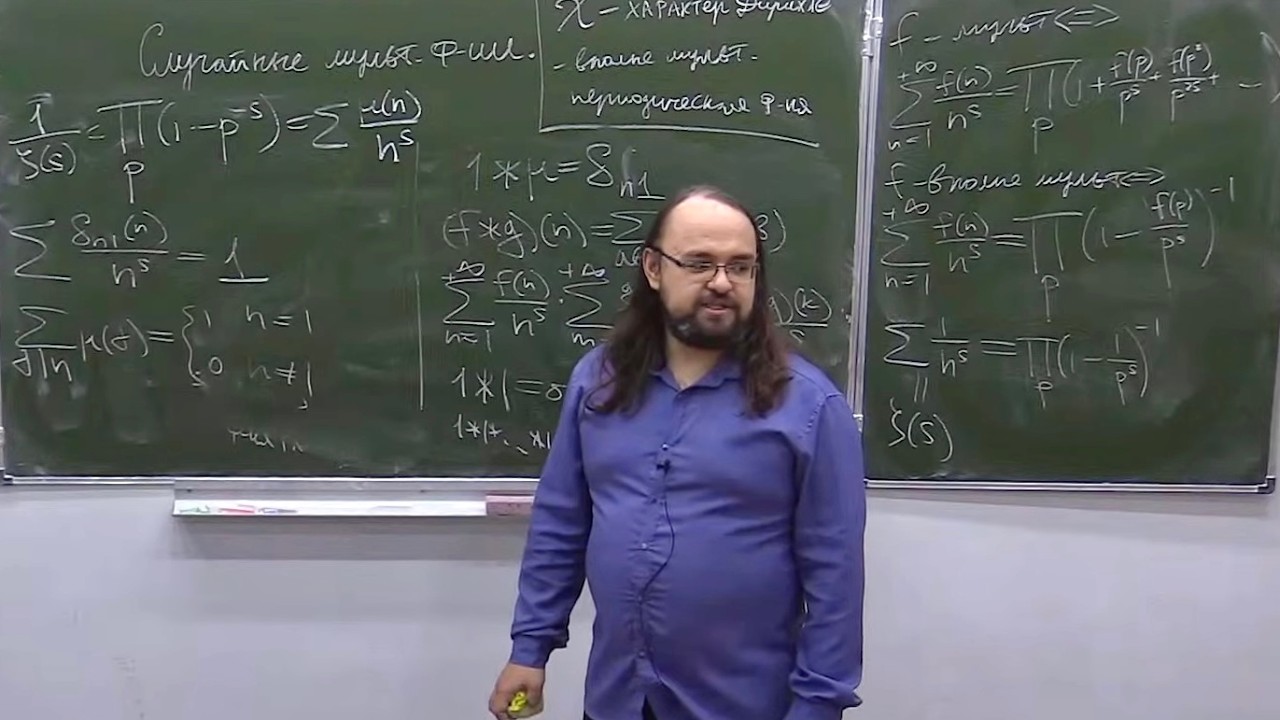














The convergence domain of a Dirichlet series ∑a_n/n^s is determined by its abscissa of convergence ρ and absolute convergence abscissa ρ'; for example, the Riemann zeta function ζ(s) = ∑1/n^s has ρ = ρ' = 1, while the alternating series ∑(-1)^n/n^s has ρ = 0 and ρ' = 1, demonstrating conditional convergence. A key proposition states that if coefficients a_n are bounded, the series converges absolutely for Re(s) > 1, ensuring holomorphicity in that region. Multiplicative functions, such as Dirichlet characters, yield L-functions that share similar convergence properties, while fully multiplicative functions satisfy f(mn) = f(m)f(n) for all m, n, unlike regular multiplicative functions which require m and n to be coprime.
Analytic Number Theory Lecture 3: Dirichlet Series Convergence
Added:Fundamentals of complex analysis, specifically uniform convergence of complex functions and properties of holomorphic functions.
Basic arithmetic functions and the concept of multiplicativity (e.g., multiplicative and completely multiplicative functions).
The theory of infinite series and infinite products, including absolute and conditional convergence criteria.
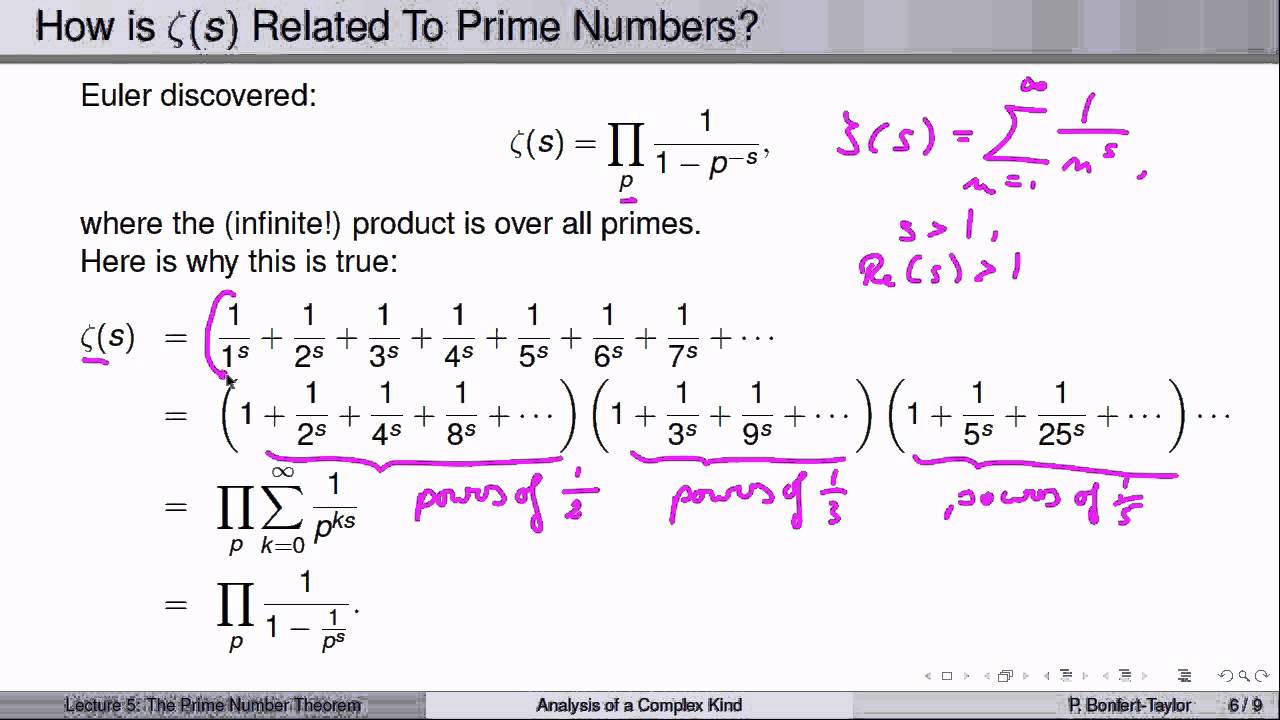
An introduction to the Riemann Zeta function defined as a Dirichlet series for Real(s) > 1.
Analytic continuation and the functional equation of the Riemann Zeta function and other Dirichlet series.
Dirichlet L-functions, Dirichlet characters, and their application in proving Dirichlet's Theorem on Arithmetic Progressions.
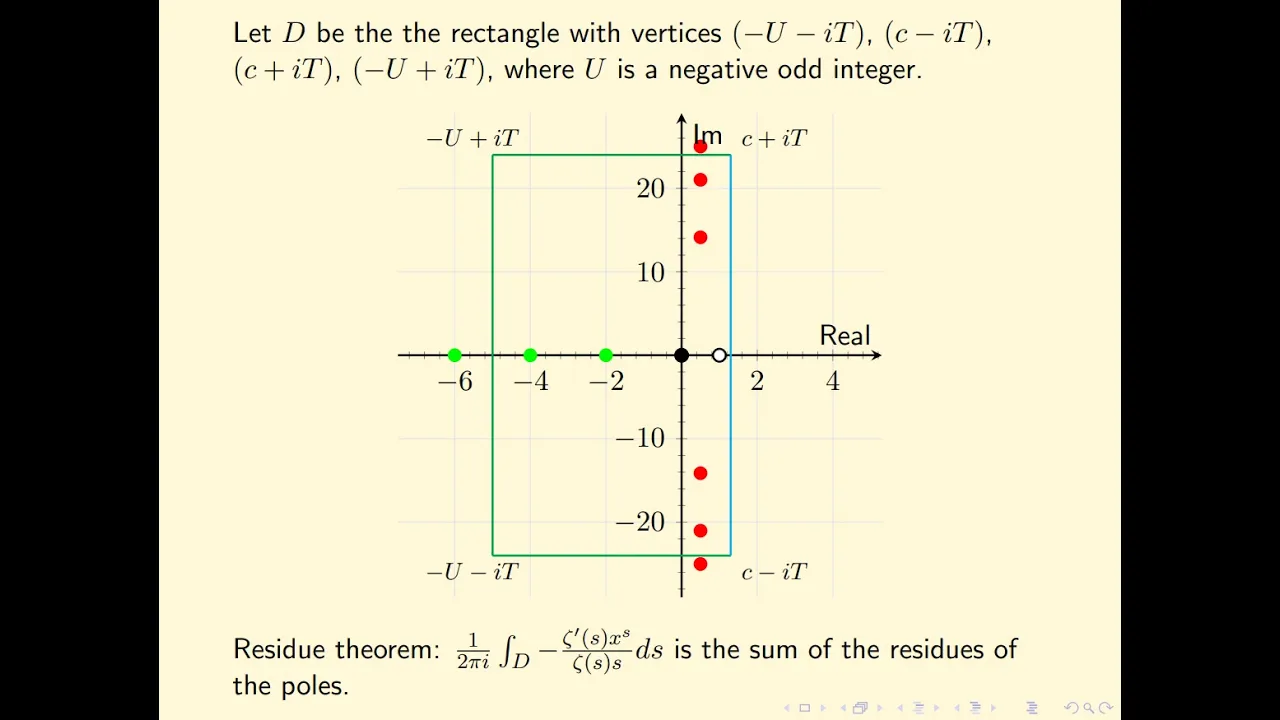
Perron's Formula and Tauberian theorems for extracting asymptotic estimates of arithmetic sums from Dirichlet series.
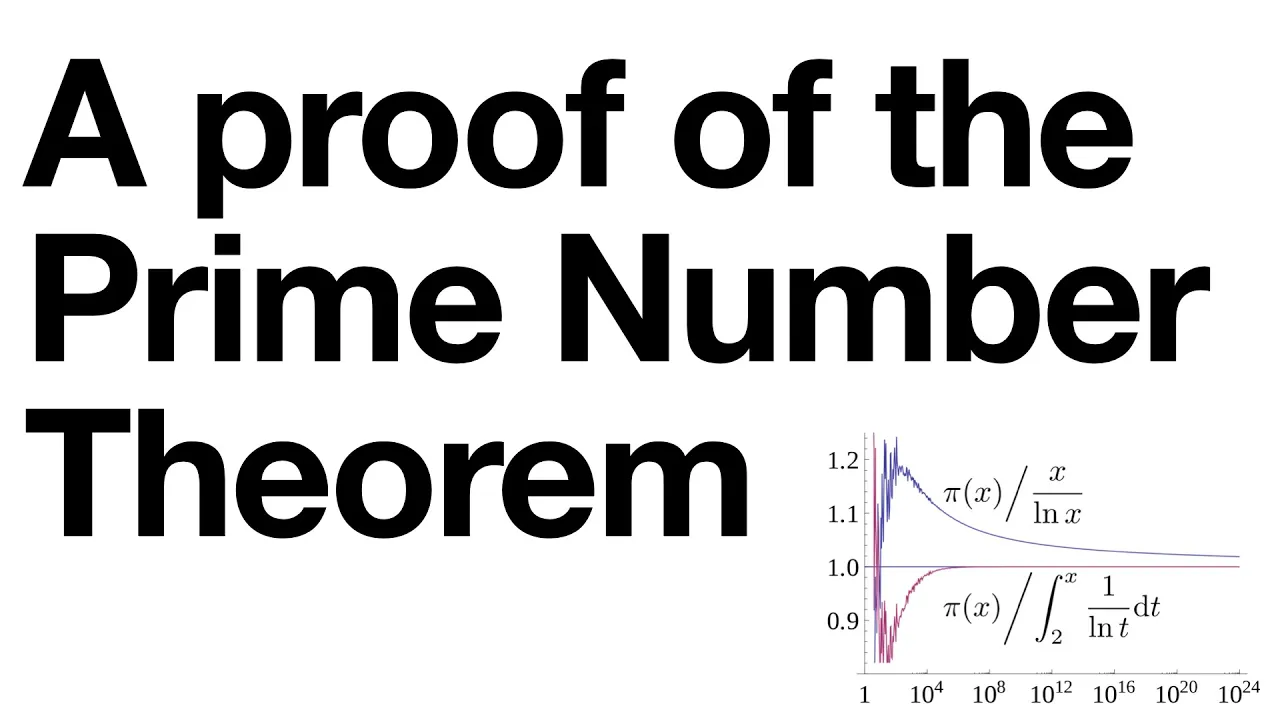
The analytic proof of the Prime Number Theorem using the non-vanishing of the Riemann Zeta function on the line Real(s) = 1.
744 views13likes32:24Original Release: 2023-05-18
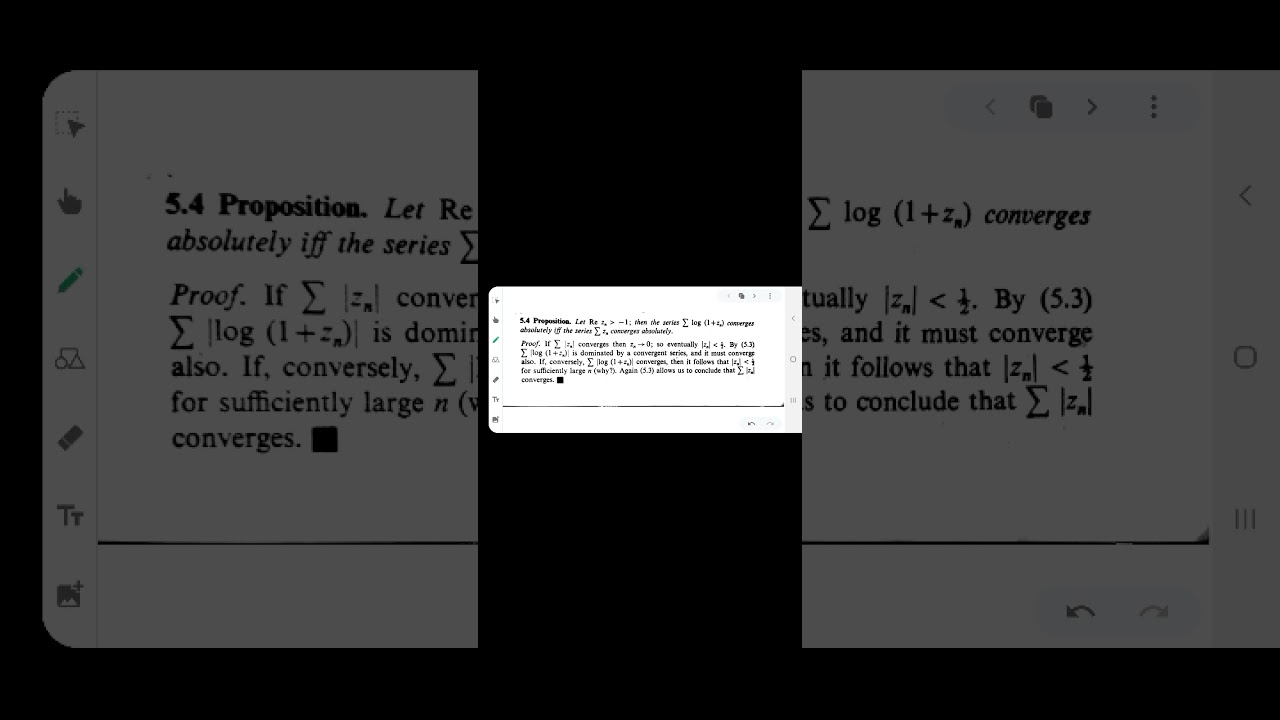
okay it's coming good yeah so now okay so this is the picture that we should have in mind about uh judicial Series this is the general picture but it's good to have some examples also Yeah question yeah okay yeah that's an excellent question I don't know the answer that's good why don't you explore the question and let me know next lecture I I don't have any answer to that that's an excellent question yeah it sounds like a question that has been answered to me but okay but that's that's that's a very excellent question yeah yeah now we will see actually an example of that series those Series right away that's our example one so eg1 so what's the most uh what's the simplest type of non-trivial or whatever uh British series if the simplest example of judicial series is a zeta function it's just that doesn't get as simple as that so Zeta s equal to sum one and to the S and from one please I mean I I you we wrote that but I I hate to write z for this analytic number two and stuff I really like to write S as Riemann wrote S I believe set of s equal to this one so this is obviously the original series uh now so what is rho and what is row Prime for this one what do you think is row and row prime or discount so the abscissa of convergence uh the vertical line ah yeah the other one is two yeah I know ah they're good after two yeah huh row is zero Prime is one okay so let me write these lists rho equal to two row Prime was not committed rho equal to one oh wait a minute uh yeah yeah rho equal to one or what was what was maybe you meant Row from equal to one rho is equal to zero is that what because row param is bigger than equal to zero Prime equal to one rho equal to zero is that what you said and any other vehicles yeah that's that's relevant yeah for sure ah and it gets post one yeah indeed both are equal to one let's yeah I mean this is as I said this is an example where actually the answer to your question is positive rho is equal to row Prime equal to one let's see why you see first of all this guy is convergent here right this guy's convergent here because of t-test in fact absolutely conversion because of it because now you have to deal with as complex also no but anyhow if you prove that it is conversion on real numbers you don't you don't have to worry about absolute if it is converging on real numbers here by the term be proof you know that it is conversion all the way up and down to the right so you don't have to worry about complex issues at all okay so here but now I claim that it cannot be conversion any point here not conversion if at any point here or less than I'm saying it is Divergent at all points where real part is less than one why is that so well the proof is very easy if it is conversion that sums at zero we're a real part of Z zero less than one okay like that then we know that there's going to be a real number that this guy is going to be convergent here or s real s bigger than a real part of Z zero it should be conversion but you see that this series cannot be converged for any real less than one P test that's it so rho is equal to rho Prime is equal to one that is simple observation proves it that's the power of the theorem you see it's really it frees you from this complex plane complications it really brings you down to checking on the real line so this is very useful for example two let's look at the alternating uh version of this maybe eight of s go to 1 over 1 to the S minus 1 over 2 to the S Plus 1 over 3 to the S minus 1 over 4 to the s so on so what is rho what is rho Prime in this case in this case so row Prime is about absolute values right let's take absolute value of these things I mean these negatives becomes positive and uh it's one so row Prime is definitely one and you take absolute value on the real s is real less than one does not converge because of P test again so rho is definitely one we know that now what about row Prime okay so sorry row Prime is one I meant what is rho now rho is zero yeah rho is equal to zero in fact and the reason for that is this famous alternating test the alternating test was that if the general term goes to zero is what was it what was the thing was it decreasing is decreasing and is alternating in so on is going to zero then it is conversion so I guess by alternating test Sigma minus 1 to the n to the s and from one to Infinity converges for at least s belonging to R and as bigger than zero that's what the alternating test tells us and it's certainly not convergent for S equal to zero and for S less than zero because for S less than zero the general term isn't even doesn't go to zero or S equal to zero you have one minus one plus one minus one plus one which is direct okay so you know that then as a result row is equal to zero so that has a very interesting thing so this is like zero this is one here is the thing and here is what we call conditional conversions I believe yeah in analysis conditional it's conditionally conversion only it means this conversion but it's not absolute so next question where this function is holomorphic where this function is holomorphic after rule Prime yeah it doesn't have to be after row oh you say I'm confusing row and row Prime I meant [Music] um yeah yeah the absolute convergence was not relevant for holomorphicity everywhere yeah yeah this function is holomorphic for real part of s bigger than zero okay but the zeta function originally is holomorphic only in real part of s bigger than one of course it's a question if the zeta function is conversion at these points or not because this is kind of critical line right we know that it is diversion that all other points below the line that's for sure that we know but on the line if it is conversion or diversion is a delicate matter we cannot answer it right now maybe in 10 minutes it needs some elaborate uh rather elaborate consideration it's not too bad but you just just pay attention same now if you look at here though at real part of s equal to zero this function is totally diversion everywhere here because you get what you get 1 minus one plus one minus one is so you see different types of course for Zeta you know that that s equal to one itself is not convergent because that's one that's harmonic Series right so that's but we don't know if it is conversion at all these funny points and what is your guess just some of them diverges yeah any other yes it's very hard to guess here really it's not a fair question I I agree I mean it's kind of how can we so it's like I have no clue just by looking at the question uh you know because these complex powers can be very very complicated arranging themselves like that and to the power one plus I so one plus t i for different values of T right that that and yeah that series over here I mean this series over here is uh it's like this series yeah I mean this is um here but what did this we know for sure that's the whole of the zeta function yeah s equal to one but what what happens yeah we'll see that actually it converges at all these points that's quite interesting oh my God yeah I think I'm what's that this point no no no it's not removable at all that's that's that that's a real Singularity we'll see we'll see okay I'm just teasing your appetite for things to come um now okay so now let's go back to generalities again you find some ordinary I think sir calls it ordinary the original series so this is what most people really consider when they think about the original series they think about such things and longing to see these are the type of delicious series are be um will be most be working with so so now the proposition is that if a n or bounded so here's a useful proposition so let's call it f of s if a n is less than equal to n for all n then F of s is convergent for real parts of sphere than one and of course holomorphic I don't even have to say that now oof okay well I mean if to see that you just use the absolute values right it's just uh what is it I mean Sigma absolute value of a n Over N to the s I mean this is less than equal to sum I mean this guy's m hmm and we know that this is of course convergent for a real part of s bigger than one why this is like the estimate the use for Zeta functions and all that so this is convergent so first series that has this condition that uh a ends are bounded you're always at least holomorphic in real part of a speed number one thank you okay so now we can introduce Zeta functions and L functions we have introduced already zeta function so this is deliciously L function or L series so let's Okay so again let's fix n bigger than equal to two let I be a character a modulo m so we are going back to the beginning of today's lecture so there's a character on GN right Etc so I mean this is a this is a judicially character modulo n then L of s and Chi let's define it to be sum Pi n divided by m to the S right and from one Infinity so this is the dirichlet L function or L Series attached to this character modulo n for any n you can do such things and of course by this thing that we proved this guy is holomorphic in a real part of s bigger than one at least right right okay so one thing that we have to recall is that this guy is fully multiplicative I.E Chi of NM is equal to y n for all and and in Z right this is what we I mentioned at least that they enjoy and the multiplicative condition was just one condition it was that Chi of an m is equal to cry and because I am only if n and M are relatively prime only for those pairs if and on um okay so so we have two concepts we have to be very careful to distinguish them fully multiplicative arithmetic functions and multiplicative audit functions multiplicative is a weaker condition fully multiplicative is the natural condition I would call it multiplicative the other one weekly marketed but some people so here are some examples uh let's look at the Euler's file function is this um multiplicative or fully multiplicative or none what can you say about this forever huh not fully multiplicative you're saying but multiplicative okay that's that's an answer any other answers no answers yeah indeed this is correct answer it's uh multiplicative but not fully multiplicative is more publicative but not fully so proves so what we want to show we want to show that Phi of MN is equal to Phi of M y of n if M and N or relatively prime how do you prove that okay oh yeah yeah well I mean so driving the general formula really depends on this also to show that it is multiplicative any so this is a basic algebra I thought algebra last semester so yeah last semester I think so I'm still fresh on that huh before last semester okay yeah so I already forgot what it is yes that's right yeah so how do you prove this though that there is an elementary proof for sure but a good proof is to use Chinese remainder theorem so what does Chinese Remain the term say you see so let's let's see we know that fireban okay is the order of the multiplicative group of Z mod and Z right is the order of multiplicative group of Discord but if n and M are relatively prime you can decompose uh Z over m z cross Z over NZ only if M and N or relatively prime not otherwise so what do we have then we have this isomorphism of rings this is emotional rings so what does it mean it means that if I want to take invertible elements there some element is invertible if and only if the first component is invertible and second component is immersible because they are just multiplying pairwise right so this is going to be this across that and then of course follows right and you can convince yourself that this is not fully multiplicative by just giving example like fire 4 is not equal to Phi of 2 squared you know that y of 2 is 1 but Phi of four is two it's not the square of five and so on um by the way you know that Phi of p is equal to a minus 1 and for this point of p n what you mean p n minus p n minus one yeah is that what that's yeah that's what I tried to say I don't know if that's what I did say oh yeah so I I almost heard you yeah the N minus p n minus 1. maybe it is correct but I don't know I have to check I can I can't is this correct okay so you are responsible for this you know if some bridges break down tomorrow you know based on this I don't know I won't be responsible so maybe I just put with some caution but that's I believe you this is correct so using that then we know everything right because so you can just write Phi of any number as P one and one p two and two so on you can write it as then E1 and 1 minus P1 and 1 minus 1 times using uh multiplicativity each multiplicity so that's basically now there is a result which is a Euler product formula for such things that I want to mention and then we are finishing in five minutes that's that's it yeah um the last thing we want to do today now that we are added oh there is another one which is uh maybe I mentioned so that's kind of interesting so this is another example this is ramanu Jones uh Tau function so it is it is defined from sum Tau and Q to the n from 1 to Infinity is equal to Q times product of 1 minus q and n squared and from 1 to Infinity so you might say okay what I mean okay so um first of all this right hand side is convergent or absolute value of Q less than one you know why the right hand side is conversion for absolute value of Q less than one it is an is an infinite product right so you have to use the theory of infinite products it's an infinite product so you better know some Criterion for convergence of infinite products that's important and uh what is that okay so I don't expect you to remember but from you can take yeah yeah indeed the proof of stars by taking log of these terms and writing estimates based on that but it's good to know the final result somehow right I mean yeah so the final result is that indeed this product of 1 minus alpha n it's convergent so imagine these guys are less than equal to one in absolute value so they're never never equal to one if and only if the sigma is conversion right oh no no that's not Sigma yeah yeah that's not what uh product yeah uh n equal to 1 to Infinity conversion if and only if sum alpha n this is uh something maybe you have seen in complex analysis by distress infinite products expansions this sort of thing so this is gonna so this is I believe this is correct and uh no it is correct and it's extremely useful because working with infinite products is kind of unintuitive it's uh yeah but the series you have humans have better understanding of series than products somehow okay so this is obviously then you can apply this criteria and the test this infinite product Sigma qn is conversion for absolute value of Q less than one so this is conversion so this conversion is a holomorphic function in Q so you can expand it perhaps the value of Q lesson in Taylor series and this is what so that's a roundabout way of defining these numbers Tau ends so ramonesian numbers there are other definitions for them but now the thing is this is a multiplicative function not fully multiplicative for this multiple I don't know I didn't check sir what he says maybe he just gives a proof I'm not sure uh maybe he just mentions it or maybe this is just I got it from in my notes from some other sources I'm not sure does sir say anything about it yeah I don't know because if he mentions it at one stage certainly I'm almost sure that he will he would he would give a proof otherwise he wouldn't talk about it just mentioned it okay so I think we can prove it at one stage yeah all right so I think it's a good time to stop now and I just stop the video let me get uh oh yeah
Up Next
17:04
The Euler Product Formula: A Beautiful Bridge Between Sums and Primes
@DrTrefor
60.3K views•2024-08-06

4:43
Elliptic Curve Cryptography Explained: ECC, ECDSA, ECDH
@PracticalNetworking
28.5K views•2024-10-21
10:44
Fourier Series Introduction: The Big Idea Explained
@DrTrefor
387K views•2021-05-03

6:00
The Mathematical Impossibility of Accurate World Maps
@Vox
23.3M views•2016-12-02
Related Study Plans & Knowledge Roadmaps
Structured learning paths in Mathematics
mathematics
Tensor Calculus: Vectors to Riemann Curvature
01Mathematical Foundations: Linear Algebra & Calculus
02Covectors, Dual Spaces, and Tensor Basics
03The Metric Tensor and Index Gymnastics
+ 2 more learning modules
40h5 modules
Explore Roadmap
mathematics
Gödel's Incompleteness: Logic, Proofs & Limits
01Introduction to Formal Systems & Hilbert's Dream
02Set Theory, Cardinality, and Cantor's Diagonal Argument
03Arithmetization and Gödel Numbering
+ 2 more learning modules
14h5 modules
Explore Roadmap
mathematics
Galois Theory: Fields, Groups & Solvability
01Foundations of Abstract Algebra: Groups & Fields
02Polynomials & Field Extensions
03Splitting Fields & Symmetries
+ 2 more learning modules
24h5 modules
Explore Roadmap
mathematics
Non-Euclidean Geometry: Models & Geodesics
01Euclid's Fifth Postulate and the Birth of New Geometries
02Hyperbolic Space and the Poincaré Disk Model
03Geodesics: Defining Straight Lines in Curved Spaces
+ 2 more learning modules
15h5 modules
Explore Roadmap