













![Measure Theory 11 | Proof of Lebesgue's Dominated Convergence Theorem [dark version]](https://i.ytimg.com/vi_webp/SayqD9B2vj4/maxresdefault.webp)




![[ОВиТМ] Основы вероятности и теория меры (продвинутый поток) 11.](https://i.ytimg.com/vi/e-H9fERXu00/maxresdefault.jpg)


The Monotone Convergence Theorem states that for a sequence of non-negative measurable functions $ f_n $ increasing pointwise to a function $ f $, the integral of the limit equals the limit of the integrals: $ \int f \, d\mu = \lim_{n \to \infty} \int f_n \, d\mu $. In contrast, for decreasing sequences, this equality may fail (as shown by the example $ f_n = \chi_{[n, \infty)} $ which decreases to zero but has integrals equal to infinity). Fatou's Lemma provides a weaker but always true inequality: $ \int \liminf_{n \to \infty} f_n \, d\mu \leq \liminf_{n \to \infty} \int f_n \, d\mu $, which is proven by applying the Monotone Convergence Theorem to the increasing sequence $ g_n = \inf_{m \geq n} f_m $.
Monotone Convergence Theorem & Fatou's Lemma | Measure Theory
Added:Definition of a measure space, sigma-algebras, and measurable sets.
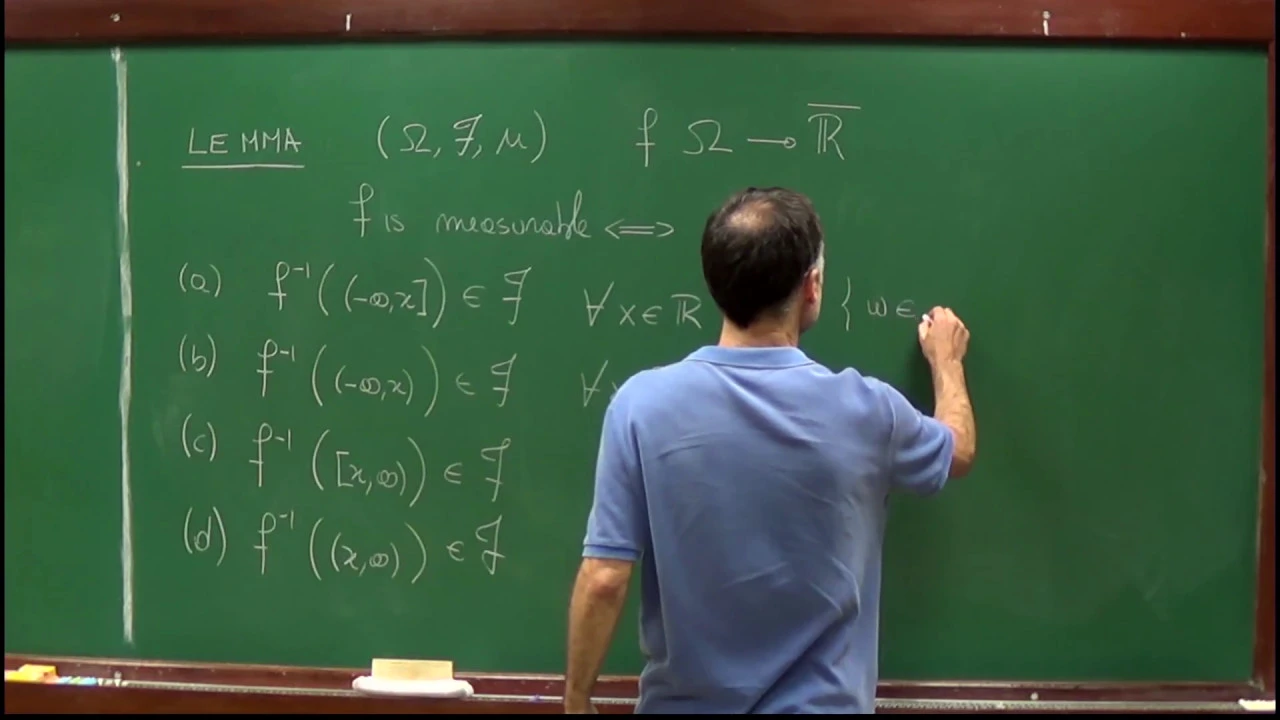
The concept of measurable functions and their basic pointwise properties.
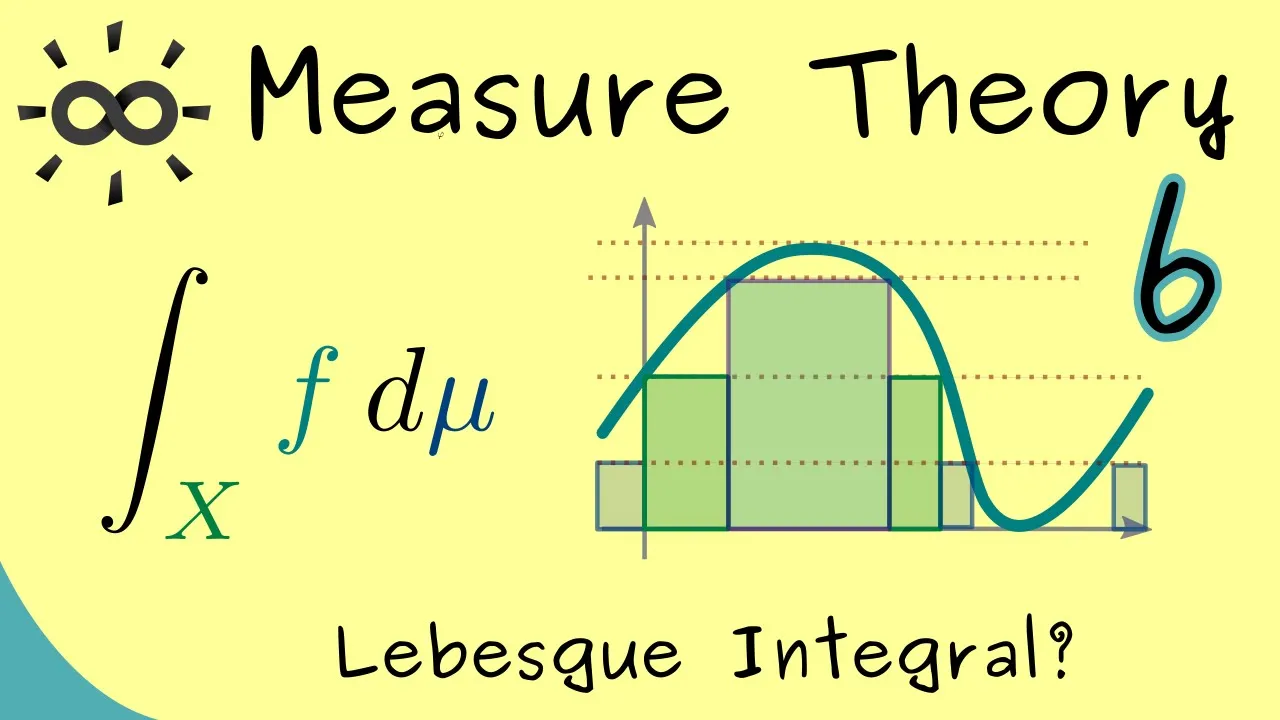
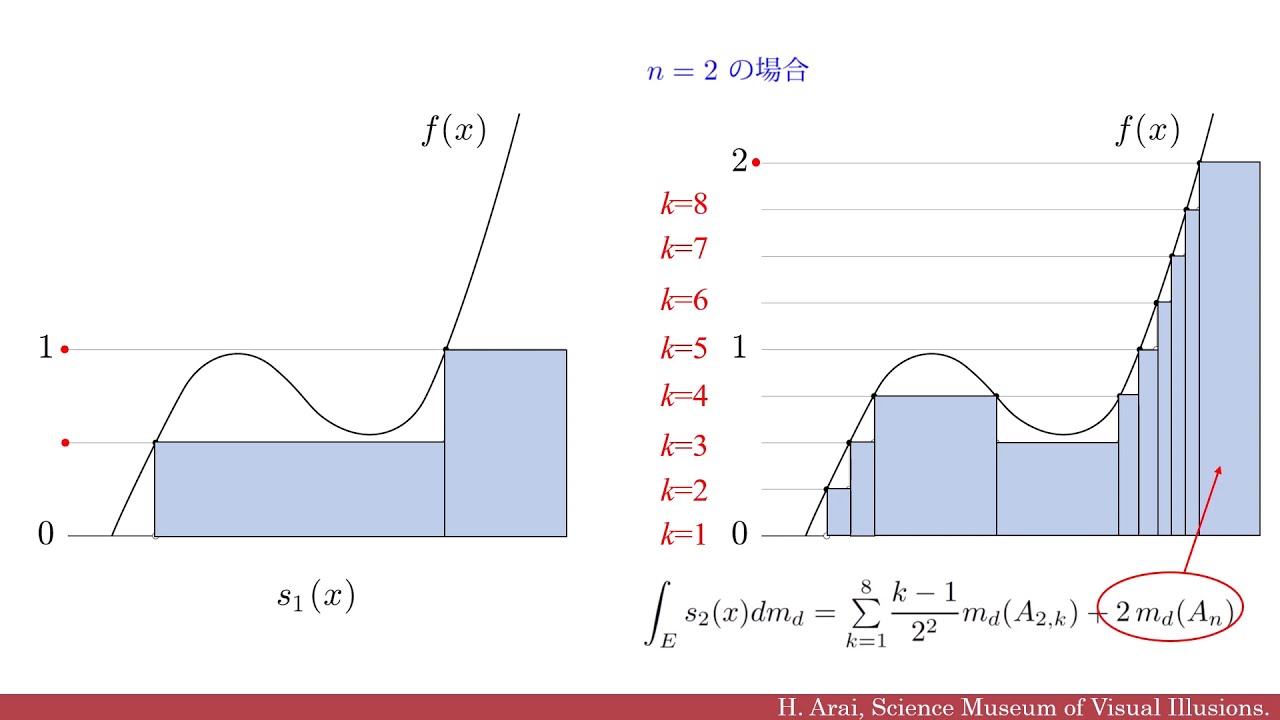
The definition and construction of the Lebesgue integral for non-negative simple functions.
Core real analysis concepts, specifically supremum, infimum, pointwise convergence of function sequences, and limit inferior (liminf).
Lebesgue's Dominated Convergence Theorem (DCT), which relaxes the monotonicity requirement using a dominating integrable function.
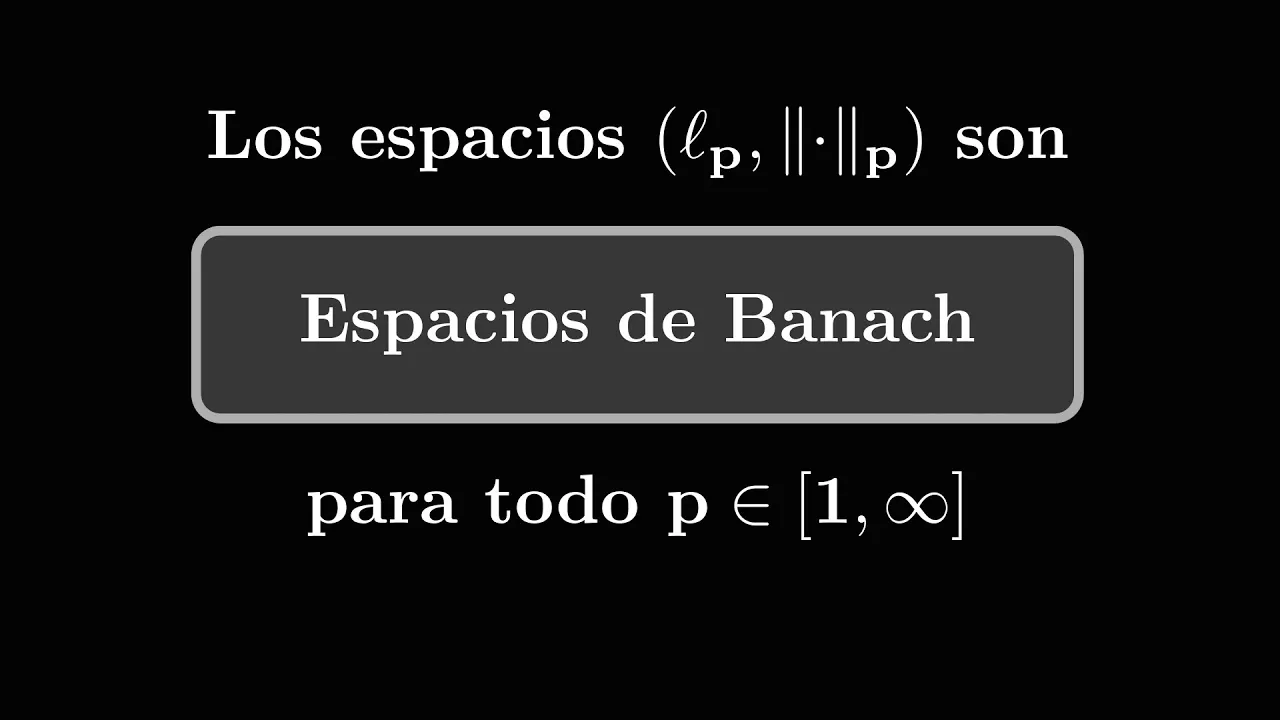
The definition and completeness of Lp spaces, exploring them as Banach spaces.
Product measures and the Fubini-Tonelli theorems for swapping the order of integration.
The Radon-Nikodym Theorem and its fundamental applications to probability theory, such as conditional expectation.
14.4K views134likes30:01Original Release: 2017-09-03
[Music] welcome to lecture number 19 on measure and integration in the previous lecture we had started looking at the properties of integral for non- negative measurable functions we had looked at um the linearity property of the integral for non- negative measurable functions and then uh we said we'll start looking at the limiting uh properties of functions which are non- negative measurable and integrals of them so today we will prove some important theorems we'll start with proving what is called monoton convergence theorem and then we'll prove F LMA and then go over to Define integral for General functions so let us look at what is called monotone convergence theorem monotone convergence theorem says that let FN be a sequence of functions in class l+ that means FN is a sequence of non- negative measurable functions increasing to a function f of x at every point that means f of x for every x in x is limit n going to Infinity of FN of X so we are given a sequence FN of non- negative measurable functions which is increasing Ing and the limit is f ofx then the claim is the function f belongs to l+ this we have already observed and the additional property is that the integral of the limit FD mu is same as limit of the integrals of FN D mu that means whenever a sequence FN of non- negative measurable functions increases to F then integral of the limit is equal to limit of the integrals so this is what the first important theorem about convergence of sequences of non- negative measurable functions and their integrals so let us prove this property so we are given FN is a sequence each FN belongs to l+ is a non- negative measurable function for every n bigger than or equal to 1 so that means that implies there exists a sequence will denoted by S and J uh of functions n bigger than or equal to 1 such that s and J are non- negative measurable simple functions for every n and for every J and S and J increases to F of uh so let us fix the notation which one we are going to vary so let us say that um the upper one uh will be fixed so this is going to FN as J goes to Infinity so for every n fix s andj is a sequence of non- negative simple measurable functions increasing to FN and FNS they increase to F so we want to uh show um we have already shown but we'll show it again that this implies F belongs to l+ is a non- negative measurable function and integral FD mu is equal to limit n going to Infinity integral FN D mu so to prove this we are going to use this sequence s sense and construct a new sequence of non- negative simple measurable functions out of it so what we'll do is the following so let us write that for n is equal to 1 okay that S11 S12 s uh 1 uh J uh S1 uh say J this converges to fub1 so the upper index is going to give you so S21 s22 S2 J this increases to FS2 and in general we'll have sn1 sn2 SN J will increase to FN okay and so on and this increases to F so uh let's uh observe that as we go from left to right as we go from left to right this is increasing so everywhere left to right it is increasing [Music] and down to up that also is increasing so every uh sequence if you look at the so this is a this is a array of non- negative simple measurable functions each row is increasing to the function on the right side and this is increasing uh upwards so let us uh U out of this I'm going to Define so let us look at um uh the function so let me Define from this a function so let us Define define GN to be the function which is maximum of s n j j between 1 and n so look at uh so uh in a sense what we am doing is in this picture uh look at uh the one so let us say here is s 1 n and here is S2 n and here is snn so I look at this column so S1 uh we are looking at the column uh sn1 SN uh so let us look at this column so and call that maximum of this to be GN okay so what is GN so GN is the so let me write again so GN is the maximum so Define GN equal to maximum of s j n J1 to n so um so let us observe that each GN is a maximum of non- negative simple measurable functions so each GN is a non- negative simple measurable function for every n and GN is increasing because at the next stage uh n + 1 so all this this is going to be bigger the next stage if we look at GN + 1 so that is going to be S1 n +1 S2 n + 1 and so on s n + 1 n + 1 n and s n + 1 n so all this this one is going to be bigger than everything on the left hand side okay and these are we looking at the maximum so in the in the maximum of this is going to be bigger than or equal to maximum of this because at each the right hand side function is bigger than the left hand side function so this is going to give us that is GN is a increasing sequence of functions so let us write let G be equal to limit n going to Infinity of GN so G is so all these gn's are increasing and they are going to increase to some function G so what we are going to show is G is equal to F okay so that is what we are going to check so let G be equal to so then clearly by definition G is a non- negative simple measurable function because it is a limit of a increasing sequence of of non- negative simple uh measurable functions so G belongs to l+ also let us observe also each GN okay is less than or equal to FN each GN is less than or equal to FN for every n right so that is because see GN is the maximum of this so and the maximum of this each one of them is less than fub1 is less than FS2 is less than FN so the maximum of these gn's is going to be less than or equal to this FN for every n and FN is increasing to F so that will imply that so GN is less than or equal to FN for every F and FN is less than or equal to F so implies that GN is less than or equal to FN and is less than or equal to F for every n so hence and GN is increasing to G so that implies G is less than or equal to F so that is one observation that the function G is less than or equal to F and we claim that the other way around is also true so claim is that f is also less than or equal to G so let us note note that for every J between 1 and N if I look at sjn GN is the maximum of this so this is less than or equal to uh GN for uh every n so this is less than or equal to uh GN for every n and J J between less than this so if we fix and GN is less than or equal to so so n this is less than or equal to G so sjn is less than or equal to GN is less than or equal to G for every J between one and n and for every n so let us now fix J and let N Go to Infinity so as n goes to Infinity what happens so this converges to FN so so note that as as as n goes to Infinity SJ n goes to FJ so from this and this these two observations s NJ is less than or equal to G for every so if we fix J and let N Go to Infinity then n is going to cross over J and S N JN as n goes to Infinity converges to F of J so this implies F of J is less than or equal to uh G for every J so this we so we get so implies that FJ is less than or equal to G for every J and FN fjs are increasing so this implies that f is also less than or equal to G so so we already shown G is less than or equal to F and now we're saying f is less than or equal to G so this implies that f is equal to G so hence so one observation from here is hence that g belongs to l+ so F belongs to l+ okay so we have once again proved that um if FN are increasing to a function f and FN are non- negative measurable then f is also non- negative measurable and now note that integral of f d mu is same as integral of g d mu because f is equal to G and this is equal to limit n going to Infinity of integral G and D mu because GN are non- negative simple measurable increasing to G so by definition this is so but each GN is less than or equal to F if you recall so each GN is less than or equal to F so integral of GN will be less than or equal to integral of f so limit of integrals of FN will be less than or equal to integral F so this is less than or equal to integral FD mu okay uh or we can even introduce in between so GN is less than or equal to FN so it is less than or equal to limit n going to Infinity integral FN D mu Which is less than or equal to integral FD mu so what does this imply integral FD mu is less than or equal to limit FN integral of FN D mu and that is less than or equal to FD mu so that implies that integral of FD mu is equal to limit n going to Infinity integral FN D mu so that proves the theorem completely namely integral of FD mu is equal to limit uh n going to Infinity integral of FN D mu so this is a construction which is um quite useful in U so this is the kind of analysis one has to carry out so let us go through the proof again so that we understand what we are doing each FJ or FN is a measurable function so I can look at a sequence S11 s S12 S1 J s1n which is going to increase to fub1 similarly the upper fix is fixed at two so S21 s22 s2j s2n that increases to F2 and so on so each row is increasing to the function on the right side and the functions F1 FS2 FNS are increasing to the function f so what we do we look at the maximum of of this column so what is this column this column is the maximum of the functions s1n s2n and snn so call this as GN so this function is called GN so the observation is each GN is a maximum of non- negative simple measurable function so it is non- negative simple measurable each GN is less than or equal to FN because we are going going up to this corner only okay so each GN is less than or equal to because s1n is less than FS1 s2n is less than FS2 fub1 is less than FS2 and so on so this says GN will be less than or equal to FN and each FN is less than or equal to F so each GN is less than or equal to FN is less than F so if we write the limit of G GN to be so we write the limit of this to be equal to G then G is less than or equal to F by this simple construction also for any fixed J let us look at s andj so let us look at s andj where J is fixed and N is going to vary so as n varies what happens to these functions so for every fix J this sequence of functions is going to um be S and J is less than or equal to GN okay and GN is less than or equal to F so uh we let G is less than or equal to F so s sorry s NJ is less than or equal to GN for J between for between one and N so that will give us that uh f is also less than or equal to G so that will prove the theorem that limit of increasing sequence of of non- negative measurable functions if FN is a sequence of non- negative measurable functions increasing to F then integral of FD mu is equal to limit of n going to Infinity integral FN D mu so this is called monoton convergence theorem monoton because we are looking at monotonically increasing sequences FN and convergence because we are looking at the convergence of the integrals of integral FN D mu so this proves monoton convergence theorem let us remark we have proved the theorem monoton convergence theorem for when FN is a increasing sequence so naturally the question arises will the similar result hold if I have a decreasing sequence FN of non- negative measurable functions uh that result unfortunately is not true so here is an example which says that if FN is a sequence of functions which are non- negative measure able and they decrease to a function f then integral of f need not be equal to integral of FN D mu and the example is on the lebc measurable space so look at X to be the real line the sigma algebra to be the sigma algebra of Leb measurable sets and mu to be the leag measure look at the function FN which is a indicator function of the interval n to Infinity so the claim is so this is actually a non- negative simple measurable function each FN and FN is decreasing and decreasing to the identity function identically equal to zero that's quite obvious to see so what is FN so we are looking at so here is n and we are looking at the interval n to Infinity so we are looking at this interval okay and we are looking at the indicator function of of n to Infinity so the function is zero and it is one here so the function is this height is one so this is the function FN it is zero here up to here and then it starts and goes so that is the function FN so um if we take n + 1 so this is n + 1 so n + 1 will be zero here but FN is equal to 1 here so clearly FN of x is bigger than or equal to FN + 1 of X for every X so FN is a sequence in l+ and FN is decreasing and the claim is FN decreases to f of x which is identically equal to zero for every X and that because if I take any point x on the real line then I can find some integer n say n not which is on the right side of it then um so for every X belonging to real line fix I can find a point n a positive integer n not of course it will depend on X such that n of X is bigger than x so that will imply that the indicator function of n to infinity or uh n not to Infinity uh let us even n to Infinity at X is going to be equal to zero for every n bigger than or equal to n and that is my FN of X so FN of X is equal to Zer for every n bigger than n so that means FN of X converges to F ofx which is equal to zero so FN is a sequence of non- negative measurable functions which is increasing to F identically zero but if we look at the integral of each FN so what is the integral of each FN so integral of FN D Lambda so this is integral of the indicator function n to Infinity D Lambda so that is equal to Lambda of n to plus infinity and that is equal to plus infinity for every n so integral of FN is equal to plus infinity for every n and integral of f d Lambda is equal to F is z so it is zero so this implies that integral FN D Lambda does not converge to integral f d Lambda whenever uh FN is a decreasing sequence of function non- negative simple uh non- negative even simple functions we have given example here so for decreasing sequences uh this result does not hold so that gives importance to the monotone convergence theorem that me means whenever a sequence F1 of non- negative measurable functions is increasing then integral f is equal to limit integral F and D mu for decreasing this uh need not hold so this is what we have shown just now by an example so however one can prove not inequality but some kind of inequality for a sequence of non negative measurable functions and that is also an important result so let us prove the result result which is called Fatu Lama it says let FN be a sequence of non- negative measurable functions then the integral of limit inferior of FN D mu is less than or equal to limit inferior of the integrals FN D mu so this is only an inequality and it need not be an equality so what we are saying is if FN is a sequence of non- negative measurable functions then it is always true that the integral of the limit inferior of FN is less than or equal to limit inferior of the uh integrals so let us give a proof of this theorem so to prove this theorem so let us just first recall what is so FN is a sequence of non- negative measurable functions so each FN is a non- negative measurable function and and we want to look at limit inferior of FN as n goes to Infinity this is a function so let us observe how this function is defined limit inferior of FN at a point x is defined as you take the infimum from some stage onwards so M bigger than or equal to n of FN of X so look at the numbers FN of x f m of X for M bigger than or equal to n so I'm looking at the tail of the sequence FN of x from M onwards so this number inum will depend on M so let me take the supremum of this overall M so first take the inum from some stage onwards and then take the supremum of these inum so uh let us observe that this primum let us put a bracket here so observe so let me call it as 5m to be the infimum from the stage n onward so infimum of M bigger than or equal to n of FN of x f n of x to be defined as the infimum from the stage n onwards of FM of x so then um because it is infimum of uh of a sequence of functions which are non- negative measurable so clearly so note so observation is that each f is also a non- negative measurable function so it is a non- negative measurable function that is one and secondly we are taking the infimum from some stage n onwards so if we increase so the claim is this 5 n is increasing this is a increasing sequence because five so f n from the infimum from the stage n onwards is going to be less than or equal to the infimum from the stage n+ one onwards because we'll have more numbers for which you're taking infimum so infimum can infimum when you take inum over more numbers then infimum can decrease so infimum from the stage n onwards and the infimum from the stage n Plus on n + one onwards so that says that the infimum from the stage n + 1 onwards will be bigger than or equal to the in primum so increasing that is 5 n + 1 is bigger than or equal to 5 n of X for every n so it is the increasing sequence of non- negative measurable functions and its limit is nothing but the limit inferior so it is increasing and so it is increasing and limit n going to Infinity of 5 n is equal to limit inferior of FN and going to Infinity so the stage is set perfect for an application of monoton convergence theorem FN is a sequence of non- negative measurable functions fn's are increasing so by monoton convergence theorem so we can apply implies by monoton convergence theorem monoton convergence theorem by monoton convergence theorem the that integral of limit n going to Infinity of f n d mu okay is equal to limit integral f n d mu n going to Infinity so this is nothing but so this side is nothing left hand side is nothing but integral of limit inferior n going to Infinity of FN D mu so that is equal to to limit of integral fn's now let us look at what is FN FN is the infimum from the stage n onwards so each FN is less than or equal to FN so that is the observation from here by the definition of finin we have that that each Finn is less than or equal to FN so integral of Finn will be less than or equal to integral of FN so it will be less than or equal to limit inferior of n going to Infinity so what we are observing here is because each FN is less than or equal to FN so this implies so this is what we are using here that if I is less than or equal to FN then the N limit and integrals of i n are increasing so it limit exists so limit n going to Infinity integral Finn D mu is less than or equal to however integral of Finn FN may not EX is so we can say that it will be less than or equal to limit inferior of uh integral FN D mu so this is what is being used in this conclusion and that proves the theorem what is called the fatos LMA c c and I I me [Music]
Up Next
14:48
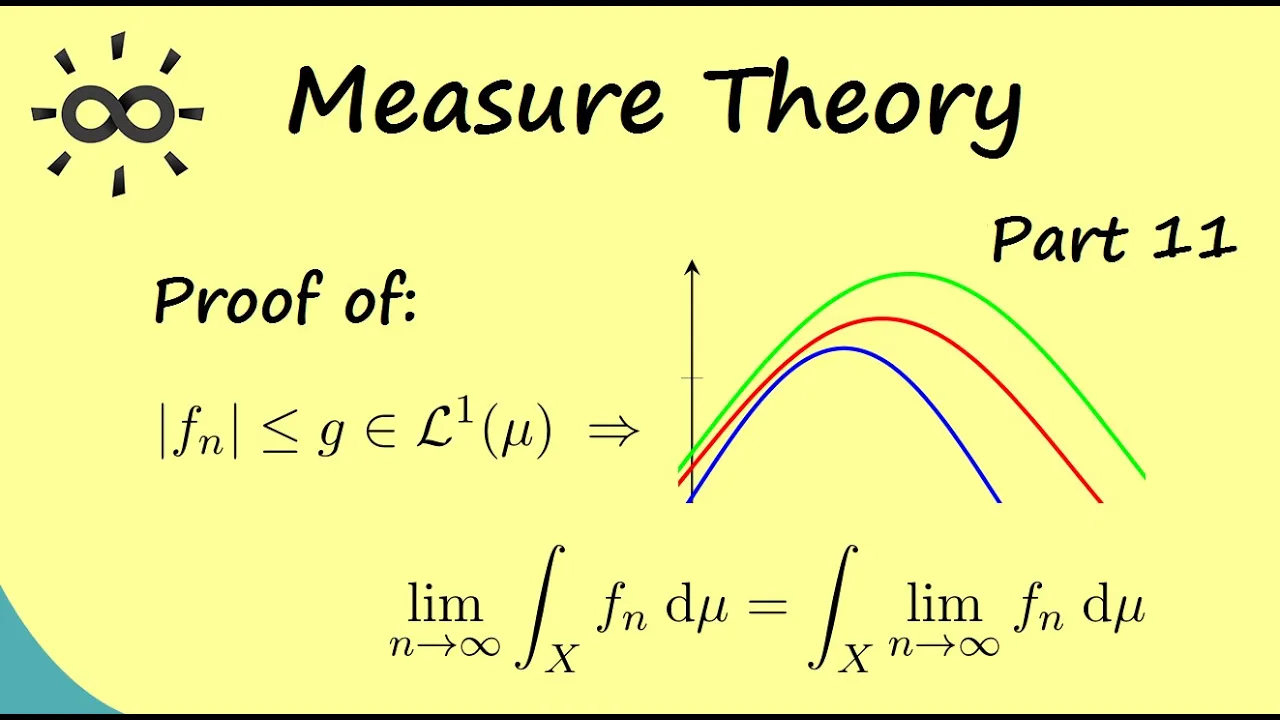
Measure Theory 11: Lebesgue's Dominated Convergence Theorem Proof
@brightsideofmaths
33.3K views•2019-11-05

4:43
Elliptic Curve Cryptography Explained: ECC, ECDSA, ECDH
@PracticalNetworking
28.5K views•2024-10-21
10:44
Fourier Series Introduction: The Big Idea Explained
@DrTrefor
387K views•2021-05-03

6:00
The Mathematical Impossibility of Accurate World Maps
@Vox
23.3M views•2016-12-02
Related Study Plans & Knowledge Roadmaps
Structured learning paths in Mathematics
mathematics
Tensor Calculus: Vectors to Riemann Curvature
01Mathematical Foundations: Linear Algebra & Calculus
02Covectors, Dual Spaces, and Tensor Basics
03The Metric Tensor and Index Gymnastics
+ 2 more learning modules
40h5 modules
Explore Roadmap
mathematics
Gödel's Incompleteness: Logic, Proofs & Limits
01Introduction to Formal Systems & Hilbert's Dream
02Set Theory, Cardinality, and Cantor's Diagonal Argument
03Arithmetization and Gödel Numbering
+ 2 more learning modules
14h5 modules
Explore Roadmap
mathematics
Galois Theory: Fields, Groups & Solvability
01Foundations of Abstract Algebra: Groups & Fields
02Polynomials & Field Extensions
03Splitting Fields & Symmetries
+ 2 more learning modules
24h5 modules
Explore Roadmap
mathematics
Non-Euclidean Geometry: Models & Geodesics
01Euclid's Fifth Postulate and the Birth of New Geometries
02Hyperbolic Space and the Poincaré Disk Model
03Geodesics: Defining Straight Lines in Curved Spaces
+ 2 more learning modules
15h5 modules
Explore Roadmap