



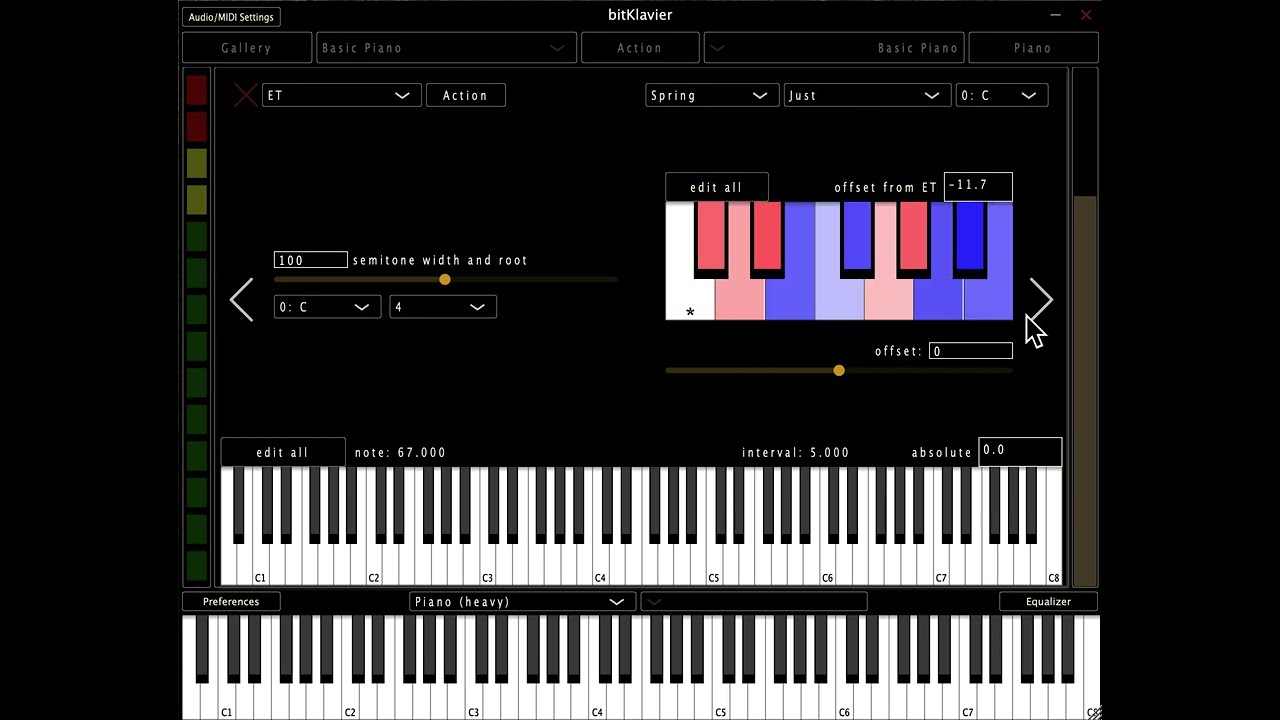















MTS-ESP is a messaging protocol that enables audio plugins to share tuning information, allowing one application to act as a server/master (like bitKlavier with its customizable and adaptive tunings) while other plugins act as clients and apply those tunings in real-time, facilitating collaborative tuning across multiple instruments in a DAW session.
Sharing bitKlavier Tunings to Other Plugins via MTS-ESP Tutorial
Added:Basic understanding of microtonality, temperament systems (e.g., Equal Temperament vs. Just Intonation), and pitch frequency relations.
Familiarity with the bitKlavier software environment, specifically its unique approach to prepared piano and tuning modification.
Standard competency in operating a Digital Audio Workstation (DAW), including MIDI routing and hosting virtual instrument plugins (VST/AU/AAX).
Conceptual knowledge of the difference between static tunings (fixed scale pitches) and adaptive/dynamic tunings (pitches that shift based on context).
Creating multi-instrument microtonal arrangements by distributing dynamic tunings from bitKlavier to third-party synthesizers.
Importing and managing custom tuning files (.scl, .kbm, .tun) within the MTS-ESP master suite.
Analyzing the mathematical and psychoacoustic implications of real-time adaptive tuning on harmonic consonance.
Integrating hardware MIDI instruments into the MTS-ESP microtuning workflow for hybrid studio production.
904 views22likes5:14Original Release: 2022-09-29
MTS ESP is a new messaging protocol that allows plugins and applications to share tuning information so you can have one application acting as a server or as a master as oddsound calls it serving up its tuning information and then other applications or plugins acting as clients and using that tuning information it's really exciting for bitcover because bitcover has some really wonderful tuning capabilities creating you know customizable tunings for particular compositions or using adaptive and dynamic tunings like spring tuning and so now those tunings can actually be applied outside of bid clavier to other plugins and you can see here there's a Client List here and there's quite a few developers who have been adding MTS ESP support to their to their plugins and instruments which is which is exciting and now we can add bitcover to that list now first before using MTS ESP you need to download it it's free you just install MTS ESP mini and that will install all the all the stuff that you need for it to work even if you aren't actually using their specific software it still needs some stuff installed in the background to make it work so if you want to do this go ahead and do this free download and then install it what I'm going to show today is a simple setup with big clavier and piano Tech this awesome physical modeling piano instrument loaded up together in a logic session here we can see one track has bit clippier here one track has piano Tech here and both of them are set to record so that we can hear them but I have a bitcover muted because we actually just want to be hearing piano Tech but we're playing through bitcover so that it's tuning information gets updated as needed so logic session two tracks both record enabled bitcover muted now how do we get this tuning information to be shared first of all we will go into the tuning preparation in bitcover and you'll notice there's this new button register MTS master and so we click that and we'll see you'll note over here that this is now switched to MTS ESP if I disconnect it'll go away so now this is telling me that piano Tech is listening to big clavier and following its tunings so we're in equal temperament let's put it in more of an overtone tuning so now we can see that that tuning of piano Tech which is all that we're hearing is actually following that's the basic idea it's pretty simple you could do this with lots of different plugins all at once even with multiple bitcoveres um so let's take a look at one other thing this is a static tuning right and so it just it never changes let's take a look at an Adaptive tuning and in order to create an Adaptive tuning in in bitcover we need to connect the tuning to a keyboard so that the tuning itself is actually following a keyboard and then I'm going to load up uh Standard Spring tuning and you'll notice sometimes when you change the tuning configuration the MTS disconnects and so you sort of have to disconnect and reconnect all right so now I have spring tuning attached here and I'm going to play some notes and you can actually hear the little wobble that confirms for us that piano Tech is following spring tuning and if we want to make it really obvious well we can turn down the drag and turn down the anchor stiffness in this thing [Music] aha interesting this also happens sometimes you'll notice this disconnected this is it's a little temperamental I'll be honest disconnect reconnect sometimes when you change parameters [Music] the MTS system seems to become disconnected but it's easy to reconnect [Music] I'm going to bring the anchor stiffness back up so that this unmoored system so that's the basic idea bitcover can also be a client like like a gut set piano Tech here so if you just want to have multiple big Club ears or if you're using something else as the server or the master bitcover can can do that as well so pretty simple pretty fun I'm excited have at it
Up Next
15:24
Creating Ambient Drones from Rain Samples in Ableton Live
@Taetro
60.1K views•2019-05-30

12:54
Triumph of Orthodoxy Icon: Byzantine Art & History Explained
@BenCallan
2.1K views•2024-08-06

9:49
FastAPI vs Flask vs Django: Choosing the Right Python Web Framework
@TechWithTim
302.5K views•2024-05-26

1:42
Game of Thrones Opening Credits: A Cinematic Analysis
@gameofthrones
46.3M views•2011-04-18
Related Study Plans & Knowledge Roadmaps
Structured learning paths in General & Interdisciplinary Studies
general-studies
Elevator Engineering: History, Physics & Cities
01From Hoists to Safety Brakes: The Dawn of Vertical Lift
02Hydraulic vs. Traction: The Engineering Physics of Elevators
03Modern Speed, Safety, and Algorithms
+ 2 more learning modules
12h5 modules
Explore Roadmap
general-studies
Rubber: Material Science, History & Geopolitics
01Origins of Natural Rubber & Mesoamerican History
02The Chemistry of Natural Rubber & Vulcanization
03The Geopolitics of the Rubber Boom & Colonization
+ 2 more learning modules
12h5 modules
Explore Roadmap
general-studies
Containerization: Evolution, Logistics & Trade
01Ancient Trade & Bulk Cargo: Amphorae to Barrels
02The Industrial Revolution & Cardboard Packaging
03The Containerization Revolution: Malcom McLean
+ 2 more learning modules
12h5 modules
Explore Roadmap
general-studies
Textile Tech: Evolution, Labor & Global Impact
01Pre-Industrial Textiles: Handloom & Cottage Industry
02Mechanization: The Spinning Jenny to the Power Loom
03The Factory System & Global Labor Transformation
+ 2 more learning modules
10h5 modules
Explore Roadmap