












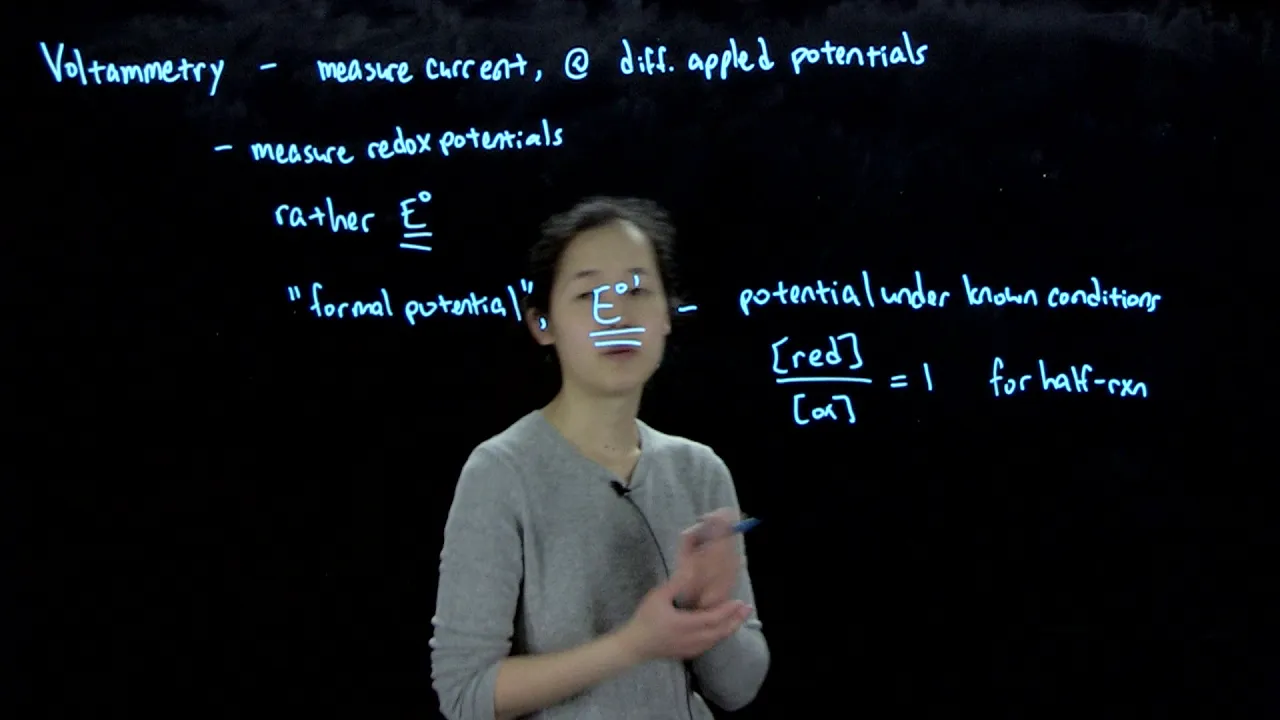
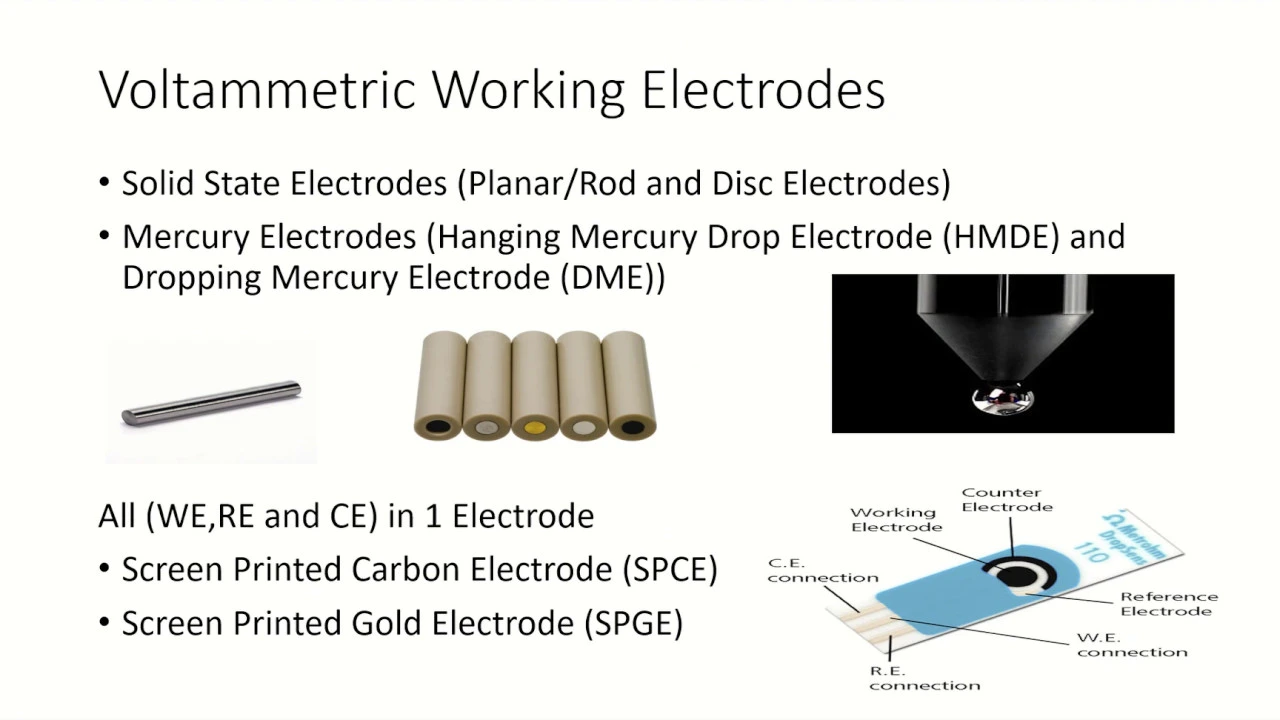













In electrochemistry, the electrode-electrolyte interface forms a double layer consisting of an inner Helmholtz plane (adsorbed ions) and an outer Helmholtz plane (diffuse ions), which can be modeled as a capacitor with typical values of 10-30 μF/cm²; since single electrode potentials cannot be measured directly due to the formation of double layers at measurement probes, a three-electrode system is essential, comprising a working electrode (where reactions occur), a reference electrode (providing stable potential reference), and a counter electrode (completing the circuit); supporting electrolytes are added to increase solution conductivity and minimize potential drops across the cell, ensuring that applied potential changes occur predominantly across the electrode-electrolyte interface rather than through the bulk solution.
Electrochemistry Basics: Double Layer & Three-Electrode Systems
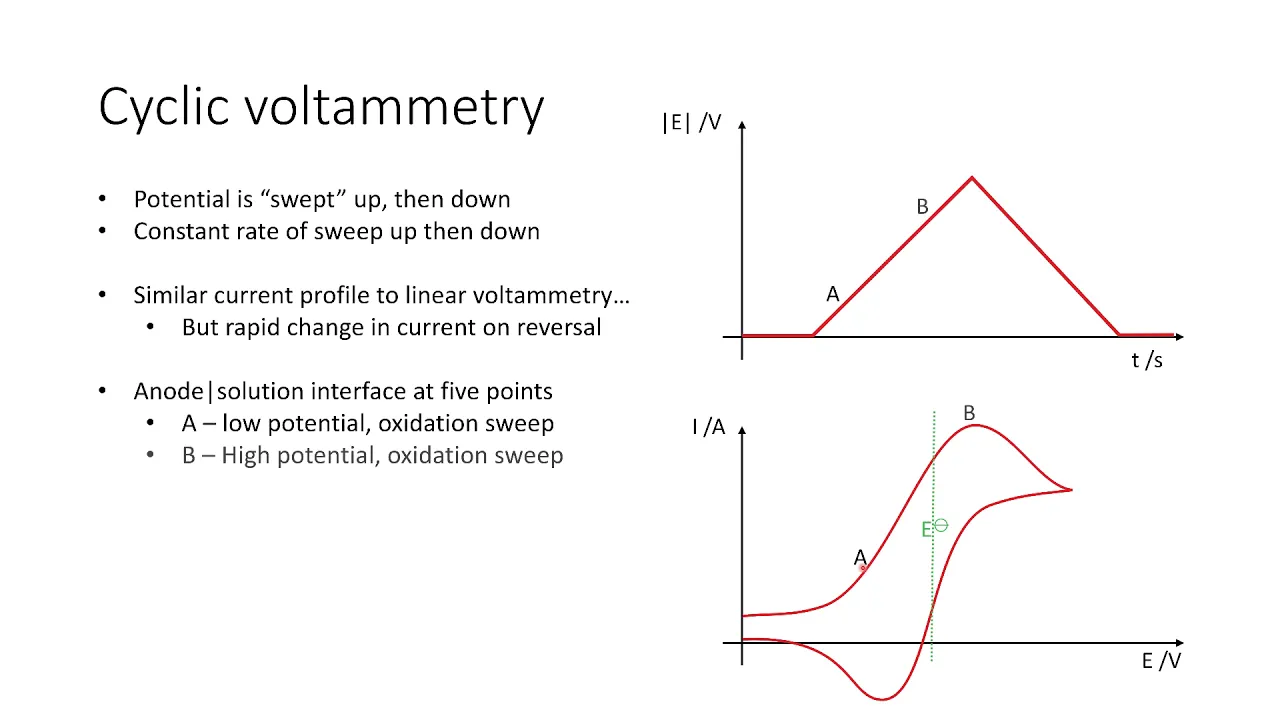
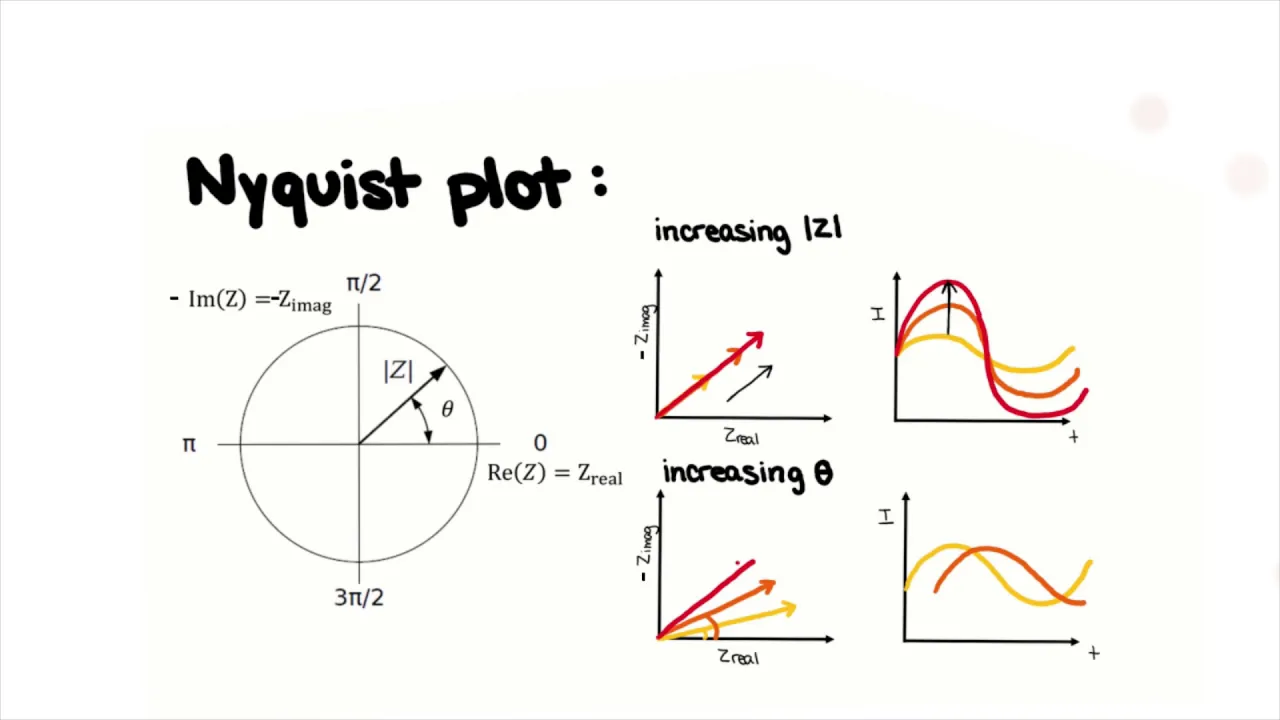
Added:[Music] so in this class first I want to describe electrode electrolyte interface it forms what's called double layer I want to describe that and then we also want to see why oftentimes we use a three electrode system and what's the role of what's called supporting electrolyte and if time permits we will see how the rate constant in an electrochemical system will vary with potential if you imagine you have metal electrode on one side and water based electrolyte on the other side the moment we put a metal into the liquid ions in the liquid will come and a job on the metal so this can be visualized as follows you have one layer of ions observed on this electrode and that forms what's called inner Helmholtz plane or ihp that's given by the green color line here once you have many ions or jobbed on the surface ions of the other polarity positive ions here for example would come close to this so this forms what's called double layer normally ions in the liquid or water will be solvated that means water dipoles will be surrounding those ions I am not showing them here for simplicity if you have a positive ion like sodium na+ that's a cation and chloride cl- is an anion normally you have sodium that loses an electron and becomes in a place that has a small volume it has unity charge so it is having a large charge density chloride on the other hand will have a small charge density compared to the NA plus by and large anions have small charge density cations have large charge density there are exception to this but by and large this is true so this is one description where within one nanometer you have one polarity for the metal adsorbed ions right next to that and then in the outer Helmholtz plane another set of ions this can be visualized like a capacitor and this is often called double layer capacitor and typical value is between 10 to 30 micro farad per unit area unit area here means per unit square centimeter if you visualize you may be supplying one volt across this interface one volt in one nano meter is about 1 Giga watts per meter so it's a very large electric field occurring in a very small or very short range there is another model called GUI Chapman model which says that from the electrode for about 10 nano meter or so the charge distribution occurs so it's not occurring in one nanometer but it actually occurs over a 10 nanometer distance and that is a model called stern model which combines the innermost plane out of her most plain and GUI Chapman model which says lot of discharges are lined up right next to the electrode but some charges are distributed further away from the electrode so it's a combination of the Helmholtz plane as well as the GUI Chapman model if you have electronic concentration in the range of 1 molar then pretty much all the charge separation or charge distribution occurs right next to the electrode and you don't have to use the GUI Chapman model if the concentration of the electrolyte in water is about 1 milli molar then probably it's better choice to use GUI Chapman model now if I have one electrode right next to that is the electrolyte I shown that you can describe that by a capacitor and we call that as a double layer capacitor and we represent that by CDL so on the left-hand side picture in the blue color diagram you got CDL but this assumes that there is no movement of electron or any material across the interface but at sufficient potential you may have a reaction happening that means you have metal here you have electrolyte here electrolyte may take an electron or give an electron the material can come out and dissolve or some material in the electrolyte can go and deposit if any of this happens this type of reaction is called electrochemical reaction there is a chemical reaction but in addition to that there is an electron transfer this reaction electrochemical reaction would also give rise to current and this gives rise to you can think of a resistance or a generalized resistance we call that as impedance I will give you a better description of impedance later but right now we can take impedance can be represented by the letter Z and we give a subscript F to indicate it's a faraday impedance that means it is associated with the electrochemical reaction so you have a capacitor if current passes because of the capacitor we call that as a capacitor based impedance if the current passes because of reaction we call that as a faraday impedance in one electrode you may have a reaction or you may not have a reaction if you don't have a reaction we just represent by the double layer capacitor if we have a reaction we say there is a capacitor in parallel we have an impedance given by the faraday process at the minimum in an electrochemical cell you will need two electrodes so you have one electrode described or model by the circuit on the top left called CDL one and ZF 1 you have another electrode which is given by the subscript 2 and in between you have the electrolyte we call it a solution and the resistance offered by the solution is called solution resistance R R solved here so this is a model for a simple two electrode system with electrode on one side electrode on the other side and electrolyte in between these two when we put an electrode or a metal in solution it develops a potential can we measure the potential there is a difficulty associated with that so I want to describe the key R we cannot measure the potential of a single electrode the moment we immerse the electrode it forms a double layer there is a potential we want to know the potential difference across the double layer across the electrode electrolyte interface in order to do that we'll connect it to a multimeter the other side of the wire which we call as ground normally call as ground we want to connect to the liquid the moment we connect to that liquid that probe will also form a double layer it's not going to have zero potential difference between the metal probe there's a ground probe and the liquid liquid or solid whatever electrolyte that's there so that potential let's say it's Y and let's call the actual potential between the metal and the liquid across this double layer as X all that we can measure is X minus y we cannot measure the exact value of X because the Y value is comparable to X it's not negligible compared to X value so we will always be able to measure only the potential drop across one electrode potential drop any potential drop that can occur in the solution it may be negligible it may not be negligible that's the separate issue but we will have to take into account that there is one more electrode we don't mean it as an electrode but the moment you insert a probe into this that becomes an electro so we can't measure the potential across a single electrode not just that there is an additional problem okay let's say we apply a voltage we apply one volt we have two electrodes we apply one volt and on the left side let's say it's point eight volts above meaning positive compared to the liquid on the right side electrode it may be point towards below that means I have total of one volt between these two terminals but 0.8 volt potential drop occurs in the first electrode liquid interface and in addition compared to the liquid this is point 2 volts below the metal is point 2 goes below so if you take the algebraic sum you will get 1 volt we do not know whether it's point 8 and minus point 2 but let's just imagine that this is the case if we increase the potential from one wall to 1.5 volt can I guarantee that increase will occur evenly can I guarantee that the increase will occur only near one electrode can I get anything about the distribution of the increase so I cannot measure the potential across one interface fine I don't know the potential but if I increase a little if I increase the applied potential a little can I at least say that increase will go into this or it will be going 5050 or in some given ratio can I guarantee that it may go like the example given here if I change from one wall to 1.5 the electrode on the left side can increase by point three voltage the potential on the electrode on the left side may go from 0.8 to 1.1 and the potential across the interface for the electrode on the right side may go from minus 0.2 to minus 0.4 that's a possibility it can also happen that for the same applied voltage on the left side the electrode might have changed slightly or the potential across the electrode might have gone from point A to point 9 and on the right side it might have dropped from minus point 2 to minus 0.6 this is just two examples there are many many possibilities so basically when I apply a potential I can't tell how much is the potential drop from the electrode to this liquid when they change it I can't tell how much increase has gone here so basically that means if you have an electrochemical system I can apply a voltage I can measure the current I can increase the voltage I can measure the current I can say this much is the increase or change in the current but I can't tell this is the potential change here this is the potential change here so you can imagine in this scenario it's very difficult to come up with any interpretation of the results so to overcome this difficulty we introduced something called the reference electrode the reference electrode is a particular type of electrode where the potential drop across the interface from the metal to the liquid it's a constant we still can't measure what the potential drop is but we know it's a constant so in that scenario it's beneficial to use the reference electrode let us say that c1 is the potential drop across the metal liquid interface it usually consists of multiple interfaces from the metal to the electrolyte liquid let's say the potential drop is c1 it is a fixed number that means if I apply 1 volt with the reference electrode here and with the other electrode that is of interest to us we call it as a working electrode if the potential is applied and if it's 1 volt I don't know what c1 is but I know the other electrode has one minus c1 as the potential drop now this is not very useful however if I apply a slightly different voltage if I change the voltage and make it 1.5 voltage across these two electrodes I can guarantee that the additional 0.5 voltage that drop will occur only at the working electrode so this is useful although I can't tell exactly how much is the potential drop across an electrode when they change the potential I can say this is the change in the potential across this electrode therefore any change in the current I can assign it to that change in potential so now I can make some sense out of this system a lot of times we use what's called lagoon capillary basically we want to minimize the resistance solution resistance between the working electrode and the reference electrode so if you are able to place the reference electrode close to this working electrode without affecting anything else in the system it's a well and good if you have some difficulty we can fill this fill this entire system with the normal electrolyte and then place the reference electrode within this Lagoon capillary system and place the tip of the capillary right next to the working electrode this way we always report the potential of the working electrode with respect to a reference electrode it's not correct to say potential of this electrode is 1 volt we had to say this is with respect to this reference electrode there are different types of reference electrodes available one is called standard hydrogen electrode SH e now that is called standard calomel electrode or se another is called silver silver chloride or AG agcl immersed in various concentrations of case here as long as you report it correctly you can translate from one reference electrode to another reference electrode so if you do experiment at one voltage with respect to AJ GCL to do the same experiment with another reference electrode you have to apply a constant offset these are available in literature now if we make the impedance of the reference electrode is very small so a reference electrode should have constant potential drop it should ideally also have very little impedance then I can describe the entire system that is two cells with this circuit on the other side the impedance of the reference electrode is very little then I can just look at the system and say only the working electrode has double air capacitance and the faraday impedance significant faraday impedance and you can possibly have solution resistance there is one more circuit to describe the reference electrode but that offers very little impedance so when I consider the total impedance I can neglect them but there is one difficulty in using the reference electrode if significant current passes through the reference electrode then it loses the property that it has a constant potential drop across this interface so that means if you apply voltage if current comes our current is taken up by this system then I have to put another electrode and supply that current to the system or take away the current from the system so that any current that comes from the working electrode is taken up by the other electrode and that is called auxilary or counter electrode rather than taking up the current or giving this current it should give minimum disturbance or minimum changes to the system that is one requirement of a counter electrode so we end up using three electrode system so that we can have control over the potential drop across the working electrode so the potential is measured between the reference electrode and the working electrode if we do the experiment correctly the current will go from working electrode to the counter electrode and the potential of the counter electrode will be controlled by the instrument it will be adjusted so that any current that comes through the working electrode is taken up by the counter electrode normally we want to have a large counter electrode area large area counter electrode there is a reason for them when we change the potential what's controlling the electrochemical system is the current density if you happen to have a large working electrode then for a given current density the current will be large now all the current generated here has to be taken up by the counter electrode in case you have a small area counter electrode the current density the requirement is high so compared to the working electrode if the counter electrode area is small the current density that is taken into the counter electrode or current density requirement for the counter electrode is high that means it has to be taken to a large potential and possibly you can have problems so it is better to have a large area counter electrode then the load on the equipment the potential on this counter electrode with respect to the reference electrode and the load on the equipment will be less so what we end up doing is to use platinum mesh platinum because it's inert mesh because it provides large area for a given geometric area when you buy an instrument or when you look at the specification of an instrument it gives you what's called applied voltage change and a compliance voltage range applied voltage tells the voltage between the reference and working the complains tells the voltage between counter and the working electrode now we can imagine if current comes through this the counter electrode potential has to be adjusted very fast that means you need a fast response system you need a closed loop system based on this the potential has to be adjusted it can't exceed a particular limit if it becomes too high then too much current will come from this if it's too little then sufficient current will not be taken up by this either case you want a fast response system you want a closed loop control and just accurately measure the current we want to measure currents in my clamps neurons possibly Pico amps and the instrument which controls three electrodes the three electrode system is much more expensive than a simple DC current or DC potential power supply DC potential power supply you can get it for less than 50,000 rupees that's less than thousand dollars very easily if you look at potential stats even a small potential start will probably cost both few legs that's few thousand dollars hey one that can supply large current will cost you a lot more money the main difference is that this can handle a three electrode system it has to have a fast response with a closed loop without any stability problem if you have a two electrode system it's very easy to get an instrumentation for that but then two electrode system is probably useful only in electrical and in some special cases electrical circuit analysis and special cases to electrode system is fine electrochemical system it is better to employ at 300 system so this is just a pictorial description to tell you what is the applied voltage where it is measured and what's the complaints voltage it's measured across the working electrode and the counter electrode next in a simple electrical circuit when you have a resistor you change the potential you will see a change in current and usually that relationship is linear that is V by I equal to R and that's a constant the R can vary with temperatures sometimes you would see a slight difference but by and large it is a constant there is a huge difference between electrical system response and the electrochemical system response this is one curve I just drawn it in the PPT here if we take water and let's say you put some salt to make it better conductor and then you control the potential and measure the current over a range you would find that for a wide range there is no current or there is very little current so you can go to one potential measure the current go to another potential measure the current so let us say you have a two electrode system to platinum measures are there immersed into salt water if you measure the current and potential you would find that for a large range large range here meaning about 1.8 volts you would see no current at all and after that if you go to very positive potential for one electrode obviously it means negative potential from the other electrode current will be higher and it's going to be positive because oxygen will come from this electrode and hydrogen will come from the other electrode if you go to very negative potential for a given electrode you would find hydrogen is evolving in that electrode and oxygen is evolving in the other electrode basically what a splitting happens and if you want to study any reaction other than water splitting other than hydrogen evolution or oxygen evolution reaction then you have to work within this window if I put water based system and then want to study a reaction then I have a limited window available for experiments it's possible to extend this window by using certain electrodes so for hydrogen evolution certain electrodes are good catalyst certain electrodes are poor catalyst so if we use zinc if I use mercury hydrogen evolution does not occur that easily so thermodynamics tells beyond this potential hydrogen evolution has to occur but kinetics does at what rate this occurs so in certain electrodes like platinum electrode it occurs at a good rate it's a good catalyst some electrodes like zinc lead or mercury hydrogen evolution does not occur that well so the rate of production of hydrogen is very low so I can extend the window and still study some of the reaction this is one trick another possibility is to use different electrolyte so I can use non water based or non aqueous solvents and extend the window but every solvent will have a breakdown voltage and beyond that window we cannot use it now I can increase the conductivity of this electrolyte by using what's called supporting electrolyte supporting electrolyte is basically a salt or acid which we can use without causing any change to the system except for change in conductivity that is it should not undergo any reaction it should just increase the conductivity if we have good conductivity if you have a lot of supporting electrolyte then you can take this model this is a good reference electrode the model and the orange color is given for a good reference electrode working electrode is given as CDL and ZF solution resistance is present if it is negligible when you have lot of supporting electrolyte supporting electorate for example can be sodium perchlorate then all the potential drop in the working electrode will occur just across the interface if you look at the potential I have drawn here it is going to go from a large voltage to a lower voltage in a very small space this is to indicate about one nanometer or so across the Helmholtz plane if the conductivity is low if it is just water with little bit of salt little bit meaning like milli molar micro molar of salt then when you have a reaction that you study current passes through this interface current also passes through the electrolyte and significant potential drop will occur across the electrolyte and whatever we imagine that we are applying this potential and we are changing the potential the additional potential is applied across this electrode we imagine that it's occurring across the electrode but a significant change may occur across them or between the two electrodes in the system so this is a description of how the potential will look like if we have high solution resistance so in order to avoid this many times we add add pretty much inert material inert material as far as the reaction is concerned but as was the conductivity is concerned it increases the conductivity and basically make sure that the electric field is such that all the potential drop occurs only across the interface [Music] you [Music]
Up Next
DNA Biosensors for Toxin Detection with Yi Lu | Beckman Institute
@BeckmanIllinois
13.3K views•2010-09-24

Biocatalysis and Catalysis in Islatravir Synthesis | Merck Webinar
@SCIwheresciencemeetsbusiness
675 views•2020-10-08
1H NMR: Determining Number of Peaks from Structure
@MSJChem
59.2K views•2017-04-06

Edible Water Bottles: A DIY Guide to Sodium Alginate Spherification
@ryan
10.5M views•2019-06-21
Related Study Plans & Knowledge Roadmaps
Structured learning paths in Chemistry