


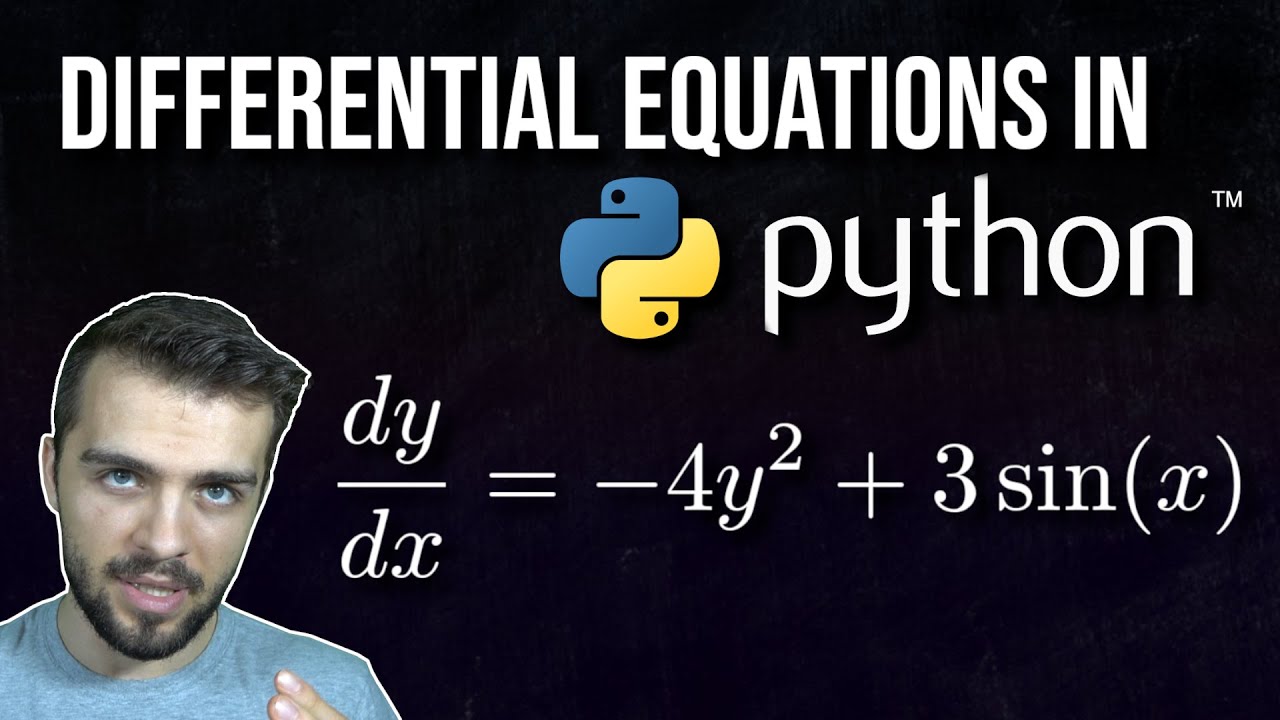





















The Lorenz attractor, discovered by Edward Lorenz in 1963 while studying atmospheric convection, is a system of three nonlinear differential equations that exhibits chaotic behavior characterized by extreme sensitivity to initial conditions—the famous butterfly effect—where small changes in starting values produce vastly different outcomes; unlike periodic systems, solutions to the Lorenz equations never repeat exactly but instead follow an unpredictable, non-repeating path that appears random yet is completely determined by the initial conditions, and the system's behavior dramatically changes depending on parameter values, transitioning from chaotic to periodic motion as parameters vary.
The Lorenz Attractor: Chaos Theory & Differential Equations
Added:Fundamentals of Ordinary Differential Equations (ODEs), including how to interpret systems of coupled, first-order differential equations.
The concept of phase space, state variables, and how trajectories represent the evolution of a system over time.
Basic stability analysis, including identifying equilibrium points (fixed points) and understanding the role of the Jacobian matrix.
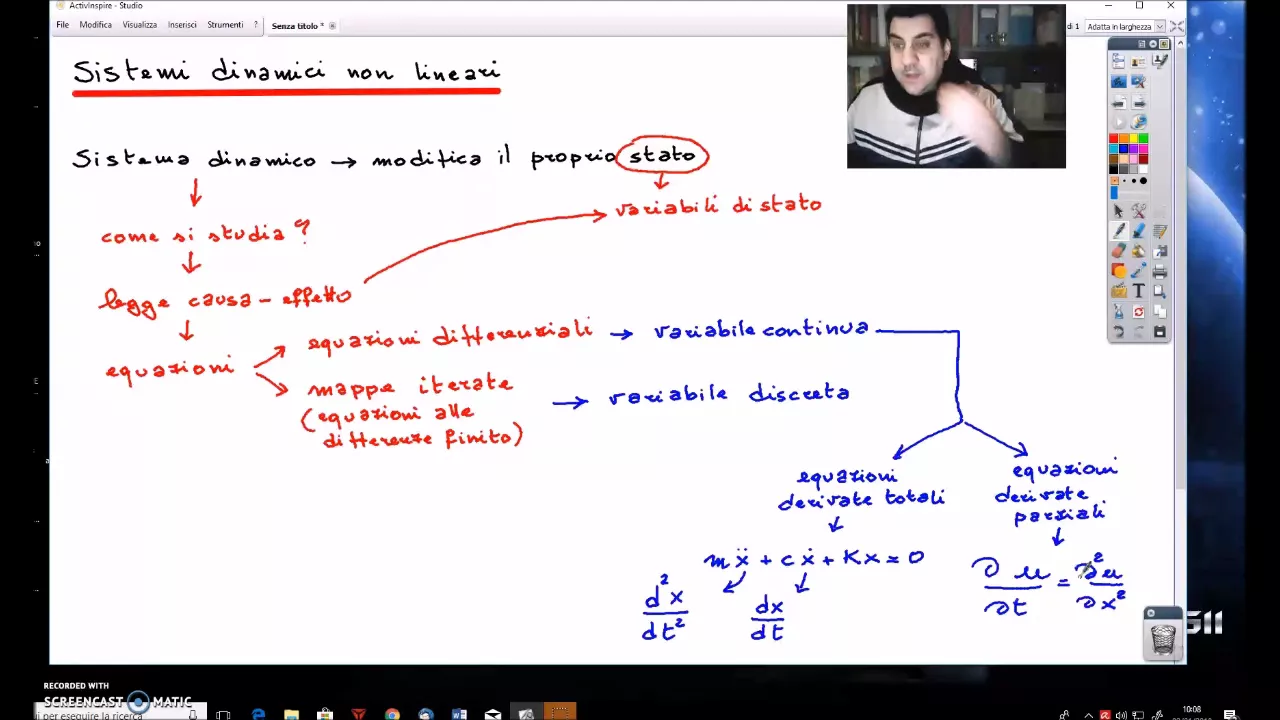
The distinction between linear and nonlinear systems, and why nonlinear equations often lack analytical (closed-form) solutions.
Bifurcation theory, to understand how varying system parameters (like the Rayleigh number) alters the qualitative behavior of the system.
Lyapunov exponents, which quantitatively measure the rate of divergence of nearby trajectories to define the limits of predictability.
Fractal geometry and Hausdorff dimension, exploring the fractional dimensional structure of strange attractors.
Practical applications of chaos theory in meteorology (the butterfly effect in weather forecasting), secure communications, and fluid dynamics.
32.6K views465likes10:24Original Release: 2016-07-28
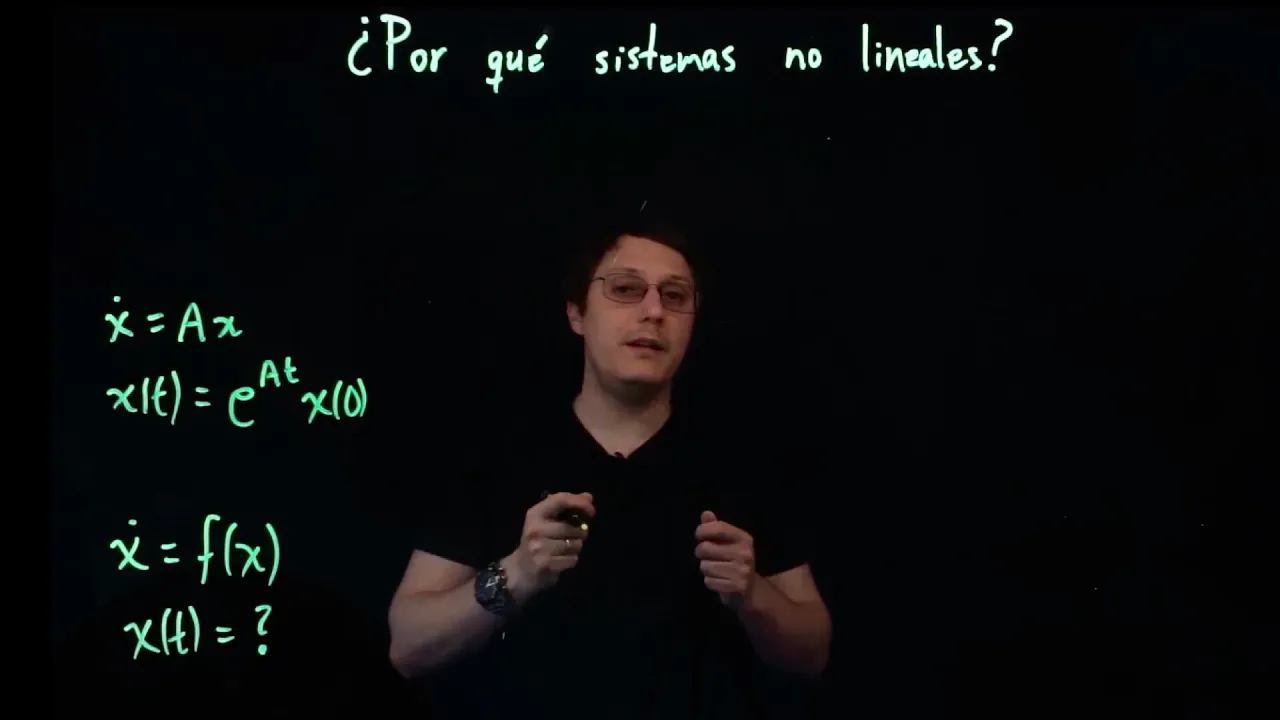
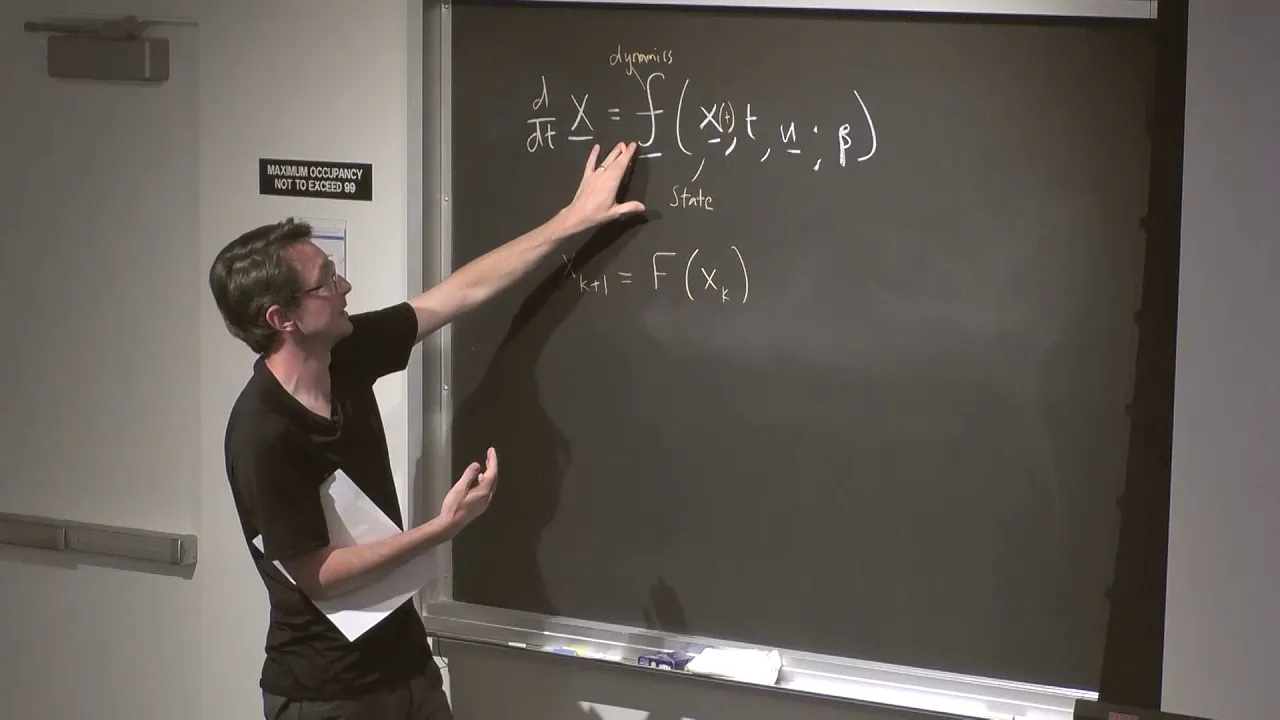
the lorence strange attractor perhaps the world's most famous and extensively studied ordinary differential equations they were discovered in 1963 by an MIT mathematician and meteorologist Edward lorence they started the field of chaos uh they're famous because they they're sensitive to the their initial conditions small changes in the initial conditions have a a big effect on the solution lorence is famous for talking about the butterfly effect how flapping of butterflies or Wings can affect the weather a butterfly wing butterfly flying in Brazil can cause a tornado in Texas is a flamboyant version of a talk he gave the uh the equations are almost linear there's two quadratic terms here the the equations come out of a model of fluid flow and the the at the Earth's atmosphere is a is a fluid but this range of parameters the three par Sigma row and beta these are outside the range that actually represents the Earth's uh Earth's atmosphere um we're going to take a look at these parameters these are the most commonly used prer parameters but we're going to be interested in other values of of um row as well but I'm a matrix guy so I like to write the equations in this form y doal a y it looks linear except a depends upon Y and so there's Y 2 the second component of Y appears in The Matrix a this helps uh helps me study the differential equations uh in this form this Matrix form makes it is convenient for finding the critical points put a parameter Ada in place of Y2 try to make the Matrix singular that happens when Ada is beta * the < TK row minus1 and then the null Vector is the uh critical point if we take this Vector as the starting value of the solution then then the solution stays there y Prime uh is zero this is an unstable uh critical point and um values near this solution uh deviate the solution won't won't stay at the won't stay near the solution in May of 2014 I wrote a series and blog post in my in C's Corner about the mat lab ordinary differential equation suite and I included a the I used the Loren attractor as a an example and I included a program called Loren plot that I'd like to use here here's luren plot set the parameters set the initial value of the Matrix a here's the critical here's the critical point here's an initial value near the critical point integrate from 0 to 30 use OD 23 uh give it give it a function called a lorence equation capture the values T and Y and then plot the solution I'm going to do a plot with the three um components offset from each other and here's an internal function lorence equation that is called by o23 and it continuously every time it called it modifies The Matrix matx a and updates it with the new values of Y2 so uh let's run that function and here's the output here's the three components of the Lorena trctor time series is functions of T it's pretty hard to see what's going on here except to say they start out with their initial values oscillate around them close them through for a little while and then begin to deviate and and it's hard to see what they're doing they're just oscillating in in an unpredictable uh fashion we need another graphic to see what's really going on here I want to run a program called lorence gooey Loren graphic user interface that's out of my uh old old book called uh this one is really out of numerical Computing with mat lab and CM okay I hit the start button here are the two critical points in green we started near the critical point we oscillate around the critical point and here here is the orbit this is just going back and forth it oscillates around one critical point then decides to go over and oscillate around the other for a while it continues around this like this forever this is not periodic it never repeats now the butterfly is associated with the Rin in two ways one is the butterfly effect on the on the weather also this plot looks like a butterfly now I can grab this with my mouse and rotate it in three dimensions so I can get different views of the orbit it's still being computed we're adding more and more to the the plot and I can look at it from different different points of view to uh get some some of notion of how this is uh proceeding in three dimensions it almost lives in two Dimensions but not quite earlier we've seen Solutions differential equations with periodic Solutions here this isn't periodic just going like this for other it's it's now this is perfectly um this isn't random this is completely determined by the initial conditions if I were to start it over again with those exact conditions i' with those exact initial conditions I'd get exactly this Behavior Uh but it's un but it's unpredictable we it's hard to say where this is going I can clear this out and see the see the orbit continue to develop press stop uh now I want to uh now I have a choice this um pull down menu here allows me to choose other values of row 28 is the value of row that is uh almost always studied but uh there's a book by colon sparrow that I've referenced in my uh in my blog about periodic solutions to lorence equations and let's take another value let me choose row equal to 160 and clear and restart now this is this settles down after this F initial transient um this is now periodic so uh this is not chaos this is a this is a periodic solution uh and these other values of row Bes and not row equals 28 that's chaotic but these other values of row give periodic utions with different character that's a long interesting story uh that I talk about in my blog uh following the work of sparrow
Up Next

8:08
What Is the Mandelbrot Set? Math's Famous Fractal Explained
@QuantaScienceChannel
309.3K views•2024-01-27

4:43
Elliptic Curve Cryptography Explained: ECC, ECDSA, ECDH
@PracticalNetworking
28.5K views•2024-10-21

20:22
Cantor's Theorem: Proof & Diagonal Argument | MIT 6.042J
@mitocw
33.1K views•2016-09-12

6:00
The Mathematical Impossibility of Accurate World Maps
@Vox
23.3M views•2016-12-02
Related Study Plans & Knowledge Roadmaps
Structured learning paths in Mathematics
mathematics
Tensor Calculus: Vectors to Riemann Curvature
01Mathematical Foundations: Linear Algebra & Calculus
02Covectors, Dual Spaces, and Tensor Basics
03The Metric Tensor and Index Gymnastics
+ 2 more learning modules
40h5 modules
Explore Roadmap
mathematics
Gödel's Incompleteness: Logic, Proofs & Limits
01Introduction to Formal Systems & Hilbert's Dream
02Set Theory, Cardinality, and Cantor's Diagonal Argument
03Arithmetization and Gödel Numbering
+ 2 more learning modules
14h5 modules
Explore Roadmap
mathematics
Galois Theory: Fields, Groups & Solvability
01Foundations of Abstract Algebra: Groups & Fields
02Polynomials & Field Extensions
03Splitting Fields & Symmetries
+ 2 more learning modules
24h5 modules
Explore Roadmap
mathematics
Non-Euclidean Geometry: Models & Geodesics
01Euclid's Fifth Postulate and the Birth of New Geometries
02Hyperbolic Space and the Poincaré Disk Model
03Geodesics: Defining Straight Lines in Curved Spaces
+ 2 more learning modules
15h5 modules
Explore Roadmap