








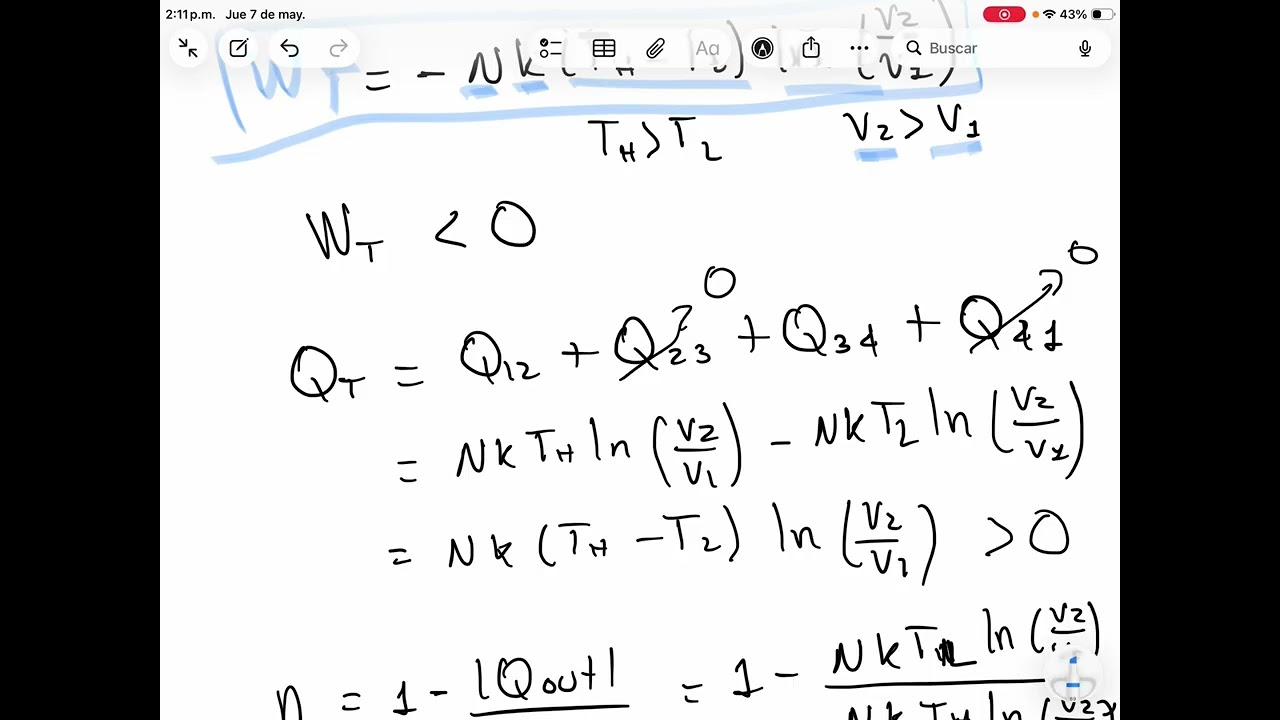


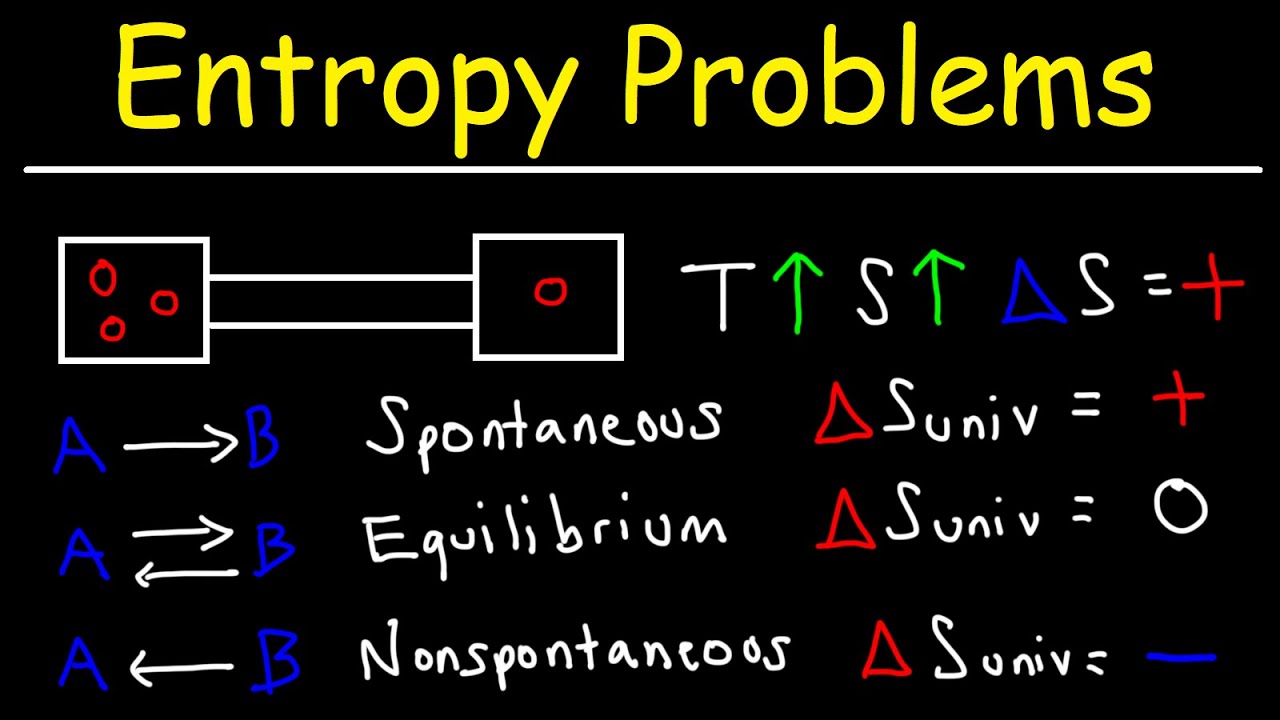
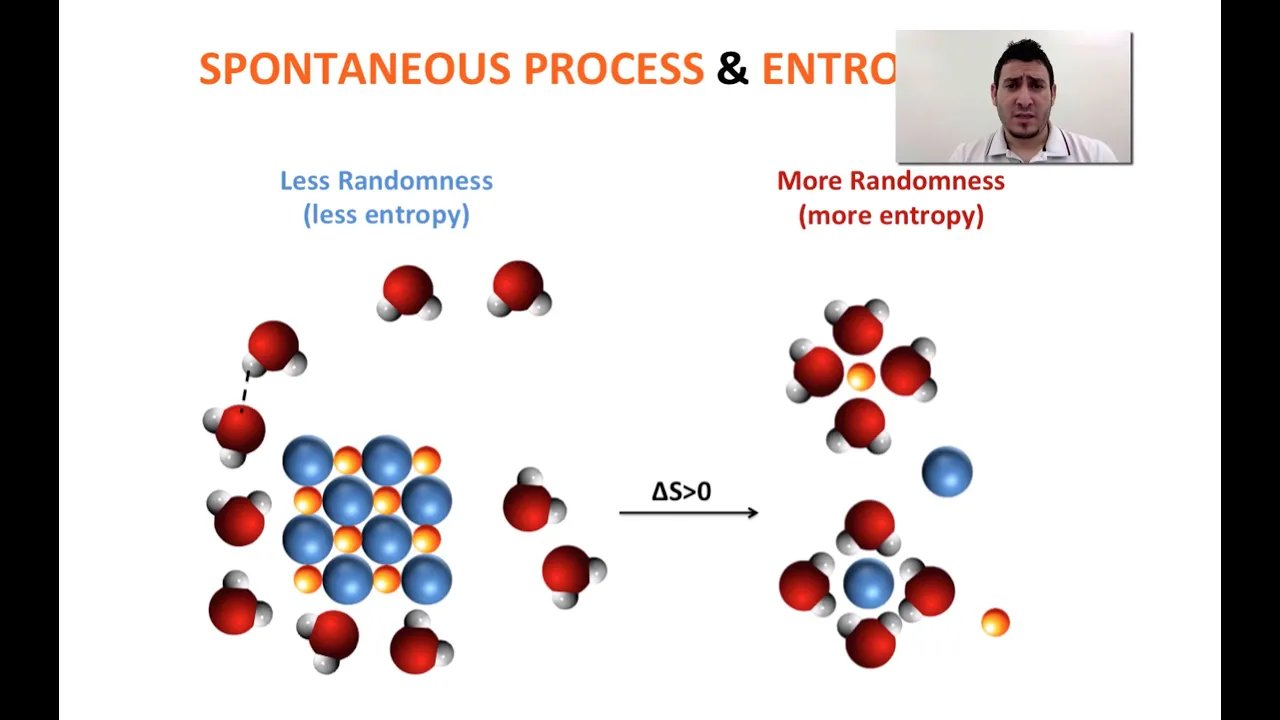












For an isolated system, entropy change (ΔS) is always greater than or equal to zero for any spontaneous process, with ΔS > 0 for irreversible processes and ΔS = 0 for reversible processes. This principle, derived from the Clausius inequality, determines the direction of spontaneous change. For non-isolated systems, the total entropy of the universe (system plus surroundings) never decreases. Entropy changes for common processes are calculated by constructing reversible paths: for heat transfer between bodies at different temperatures, ΔS = ∫dq/T; for ideal gas expansion, ΔS = nR ln(V2/V1); for mixing, ΔS = -nR(x_A ln x_A + x_B ln x_B); and for phase transitions, ΔS = ΔH/T at equilibrium.
Entropy and Irreversibility | MIT 5.60 Thermodynamics
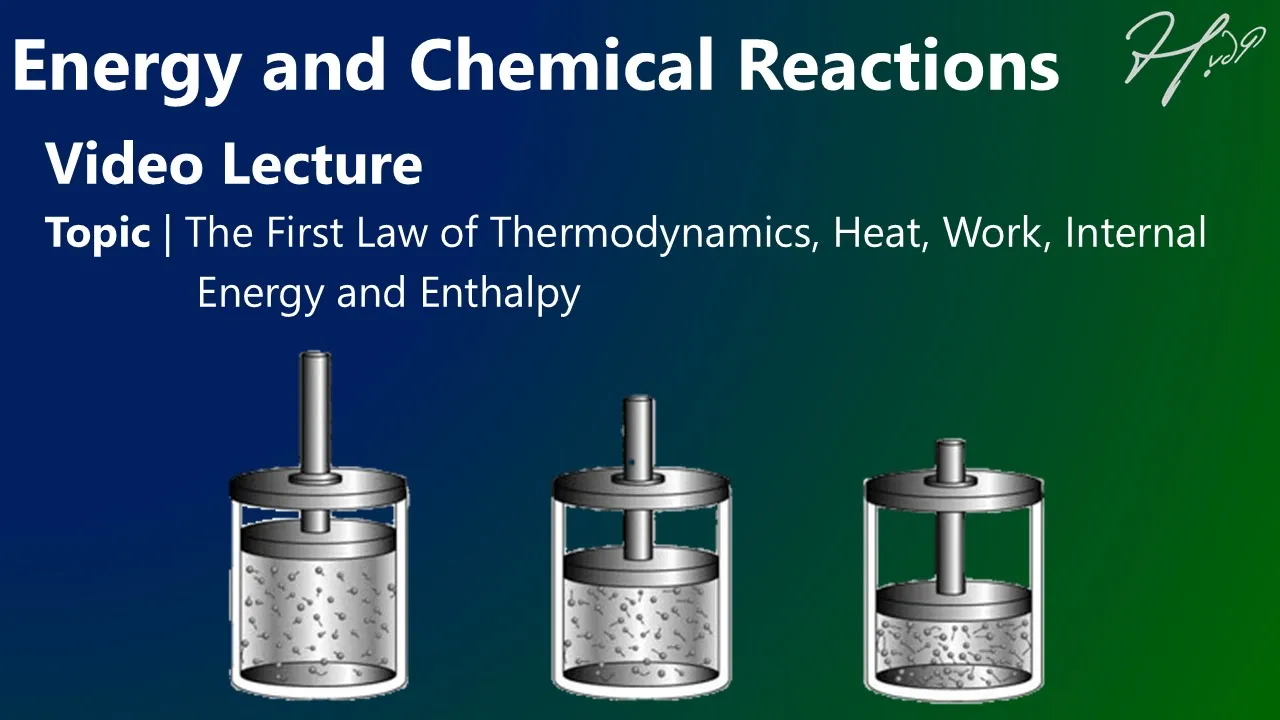
Added:The First Law of Thermodynamics, including the concepts of heat (q), work (w), internal energy (U), and enthalpy (H).
The conceptual distinction between thermodynamic reversibility (quasi-static processes) and irreversibility.
The mathematical definition of state functions (path-independence) versus path functions.
The Carnot Cycle and its efficiency, which establishes the foundation for the thermodynamic temperature scale.
The Second Law of Thermodynamics and the concept of entropy generation in the universe (spontaneity criteria).
Defining Helmholtz and Gibbs Free Energy as thermodynamic potentials to predict spontaneity at constant temperature and pressure.
Statistical Thermodynamics and Boltzmann's microscopic interpretation of entropy based on microstates.
The Third Law of Thermodynamics and the determination of absolute entropies.
Applying entropy and free energy calculations to chemical equilibria and physical phase transitions.
95.7K views424likes52:44Original Release: 2008-12-12
The following content is provided under a creative commons license.
Your support will help MIT OpenCourseWare continue to offer high-quality educational resources for free.
To make a donation or view additional materials from hundreds of MIT courses visit MIT OpenCourseWare at ocw.mit.edu.
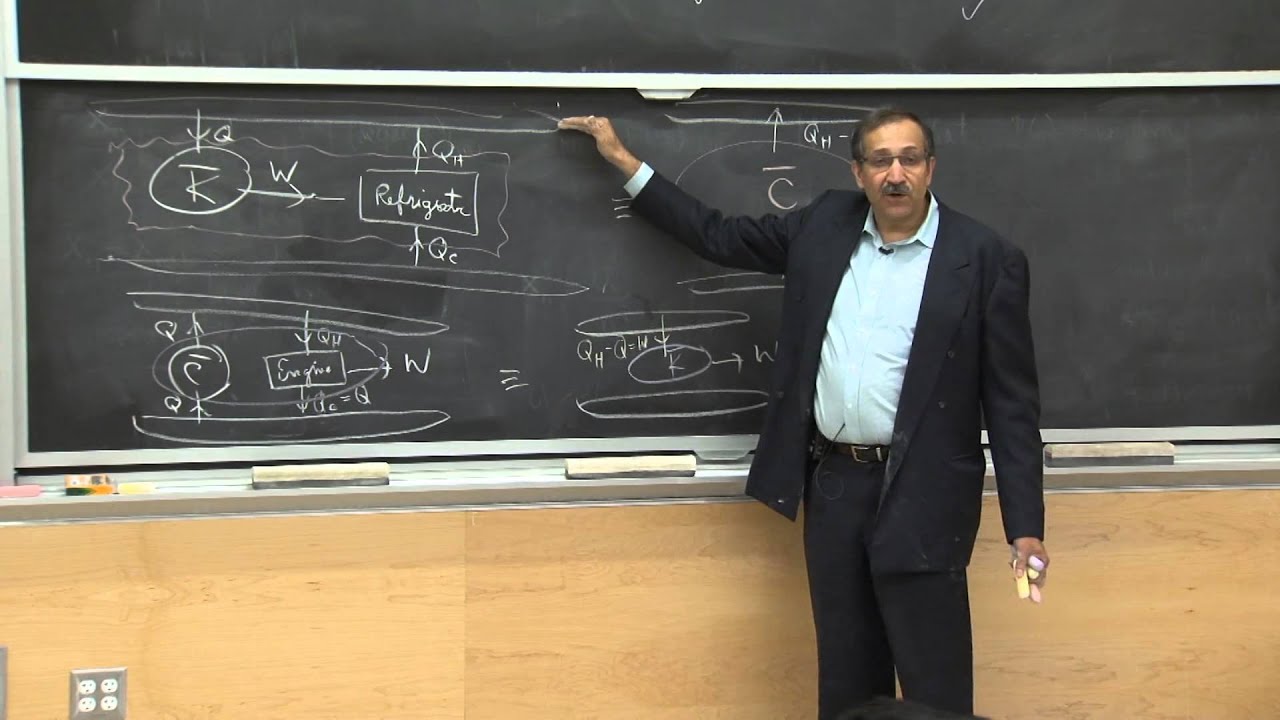
PROFESSOR NELSON: Over the last couple lectures through our consideration of a number of somewhat difficult topics, including these Carnot cycles and specific Carnot engine to represent them, we've tried to define and understand a little bit about this very special function, this entropy.
Where we've got our dS.
It's dq reversible over T. And our treatment of reversible and irreversible cyclic processes, what we saw is that if we go around a cycle and look at dq reversible over T, then this is zero.
Now go all the way around a cycle, of course, this is just delta S for the cycle.
And that's consistent with the idea that entropy is a state functions.
So if we go around cycle the cycle, we have the same ending point, the starting point, same state, then the change in the state function has to be zero.
But we saw that for an irreversible path around a cycle, then we have that, this gives something less than zero.
And so that was expressed in Clausius inequality that includes both these cases.
And now I just want to go through a number of calculations of entropy.
How entropy changes for a number processes, both to just learn more about it in general terms and also just to see how it's calculated and what sort of changes in undergoes for different sorts of changes in state.
So the first very general example that I want to show is the following.
Let's say we've got an isolated system, and it undergoes some irreversible change.
So we'll start at one, and we'll go irreversibly to some new state, two.
OK, now we can always return the system back to the initial state reversibly.
If we do that, then we can't keep the system isolated.
So it won't be isolated anymore.
In other words, in order to arrange things so that you could have a return along a reversible path, it can't be isolated.
In some sense you know that, because when it was isolated it spontaneously irreversibly went from one to two.
And example would be ice melting at some temperature that might be higher than the freezing point.
So you've got solid ice, but the temperature is above zero degrees Celsius, so irreversibly it'll melt.
Systems isolated, it'll melt.
Then you could put the system in contact with a cold reservoir reversibly re-freeze the water to form ice again.
But of course to do that you couldn't keep it isolated.
You need to have it in contact with a low temperature bath.
But again, this is just completely general at this point.
It's some irreversible process returned then along a reversible path.
So let's just look at what happens.
So here's our path B. Along path A, well it's an isolated system.
So the heat exchanged is zero.
And then, for the cycle based on the Clausius inequality expressed here, the integral around the cycle of dq over T in general, it's less than or equal to zero.
If there was an irreversible process involved, then in fact, it'll be less than zero.
I'll write it here in the more general case, but we know what it's really going to be with the irreversible step.
Well, so we can write this as the integral of dq irreversible over T, going from state one to state two.
Oh, let me rewrite this down here.
So around the cycle, dq over T, it's integral from state one to two of dq irreversible over T, plus the integral from two back to one of dq reversible over T. And of course, we know that that's less than or equal to zero.
But this, we know is zero, right, because this irreversible step is taken in isolation.
The system is isolated.
We've already seen that there's no heat crossing the boundary of the system.
So we just have this.
So of course this dq reversible over T from two to one, that's, what now we've a reversible path, so that's just the entropy at the delta S going from two to one.
It's S1 minus S2 it's delta S, we can write it as delta S backwards, right, we're going back along that reversible path.
Which is of course negative delta S forward.
Because around the whole cycle delta s has to be zero.
So what that says is delta S forward is greater than or equal to zero.
That's interesting.
What that's saying is -- remember, we didn't specify the process.
It's just for any completely general irreversible process.
For any such process, for any spontaneous process, this is going to be the case.
So in other words, for an isolated system, delta S tells us the direction of spontaneous change.
In particular, for the isolated system, delta S is greater than zero for something that's irreversible.
Delta S equals zero for something that's reversible, and delta S is never less than zero.
In a sense, this is a direct consequence of the Clausius inequality.
That's a pretty useful result.
So remember when we started this whole discussion, I tried to emphasize that the first law of thermodynamics told us about conservation of energy.
But it didn't tell us which way something would go spontaneously if you just left the system to its own devices under certain conditions.
This is telling us that.
We can tell which way the system will evolve in which direction it'll go.
This is for an isolated system and we'll generalize this in subsequent lectures.
Now, let's look at what happens if the system isn't isolated.
So now let's go from one to two not isolated.
So of course, delta S I'm going to specify for the system for reasons that'll soon be obvious is S2 for the system minus S1 for the system.
Of course it doesn't depend on the path, even though to calculate it, we need to find a reversible path.
Just to add emphasis to what we just did here, of course, it was the same thing.
In order to calculate delta S along that irreversible path for that irreversible process we needed to construct some reversible path.
And what we did is imagined the reversible path going backwards and then said, OK, fine then delta S for the irreversible process must be the opposite of delta S that we calculated along the reversible bath going backwards.
The point is that to calculate delta S in either direction, we needed to construct some reversible path.
All right, and of course it'll be the same here.
Now, in this case since the system isn't isolated, that means heat's going to flow across the boundary.
So that means heat is going between, it's being exchanged between the system and the surroundings.
So what's happening to the surroundings?
Generally, we've worry a lot about the system, but not much in recent discussions about the surroundings.
But delta S surroundings must be something.
We could calculate it.
And that's depends on the path.
Not because it isn't the state function in the surroundings, of course it is, but because depending on the path, the final state of the surroundings will be different.
After all, depending on how much heat got exchanged, the surroundings got more or less of that heat.
Work might have been done on the surroundings.
So the surroundings are going to respond, are going to change also, when the system changes in this way and it's not isolated.
And how the surroundings change will depend on what path was taken.
And you've seen that before in calculating things like pressure, volume, work along different paths.
Where you calculated delta u for the system and saw that it was the same for different paths but q and w were not the same for the system, and therefore, of course, not for the surroundings either.
So let's just consider an irreversible path.
And in order to think about what happens to the surroundings, let's take the entire universe which consists of the system and the surroundings -- that is a big isolated system, because it's everything.
So it's not somehow in contact with another additional body or universe.
We can treat the entire universe as an isolated system.
So, we're going to think about the entire universe.
We can think about it as an isolated system.
Great.
And we know that delta S for an isolated system, for a spontaneous process, is greater than zero.
That's right there.
So delta S for the universe which is delta S for the system plus delta S for the surroundings, and I'll specify since we're considering an irreversible process, specify that, it's greater than zero.
The whole thing happened spontaneously, and the whole universe is an isolated system.
So if we wanted to, we can write that delta S irreversible for the surroundings must be bigger than minus delta S for the system in order that there sum be positive.
All right?
Now, if we consider a reversible process, then of course we already know what happens for an isolated system in a reversible process, delta S is zero.
So delta S in this case of the whole universe, which is delta S for the system plus delta S for the surroundings in the reversible case must be equal to zero.
In other words, delta S of the surroundings in the reversible case is exactly the opposite of delta S of the system.
Delta S of the system is the same in either case because reversible or irreversible, we're specifying the system, goes between the same states, but what happens to the surroundings is different in the two cases.
So one way of recasting this statement or the Clausius inequality is the entropy of the whole universe never decreases.
Of course, in some sense, that's obvious from this statement, since we're considering the universe an isolated system.
So the entropy in any process can, it can, the change in entropy can either be zero or positive and never negative.
So entropy off the whole universe never decreases.
That's actually a really quite profound conclusion.
All sorts of philosophical and other consequences of it that are sometimes considered in things like evolutionary biology and other things.
And how things can change altogether an entire system of things.
Now, I'd like to just go through a few calculations of delta S for common processes.
We've seen a few general features of entropy.
Let's calculate it for a few things.
So calculations of delta S. And we know the general procedure.
Whatever the process is, we're going to need to find reversible paths, and along a reversible path then, we'll be able to calculate it.
One, let's just take two pieces of material at different temperatures.
The entire system is going to be isolated.
And then let's connect them.
And then let's connect them.
Put some material between them.
So now heat can flow from one to the other.
And you know what's going to happen which is if they start out at unequal temperatures, and you wait a little while, eventually they're going to wind up at the same temperature.
In other words, you know the direction of spontaneous change.
So let's just see what happens to delta S.
So isolated system, so there's no work being done.
There's no heat that's being exchanged.
So delta u is zero.
What's dS?
Well it's just the sum of the changes in entropy for the two sub-systems the two separate pieces.
So it's dq1 over T1 plus dq2 over T2, I think there's a type in your notes. it's plus not minus of course.
But in this case, dq1 is just the opposite of dq2.
Because whatever heat is flowing into T1, into this block, is coming out of this block, or vice versa, depending on which one is hotter.
So this is just equal to dq1 times one over T1 minus one over T2, which is T2 minus T1 over T1 times T2.
So that's dS, and then we could integrate it to get the delta S, but this is sufficient for what I'd like to illustrate, which is just the sign of things.
We know dS must be greater than zero for the spontaneous change that's going to occur.
So let's just make sure that common sense prevails here.
That says if T2 is greater than T1, right T2 is hotter.
Then dq must be positive, so this is positive, this is positive, dS we know has to be positive.
So, it says T2 is hotter.
This being positive means heat is flowing in from this one to this one, from the hotter to the colder body.
So it looks right.
If T2 is lower than T1, if this one is colder, then in order for dS to be positive, which it has to be, this better be negative.
In other words, again heat is going to flow from the hotter toward the colder, into the colder body.
So, as promised, the condition that dS must be greater than zero, guides us and tells us the direction that spontaneous change is going to occur.
We can tell just from this condition which way things have to evolve.
All right, let's try another pretty simple process.
Let's just take a gas in some volume V and over here is going to be vacuum of equal volume, and we're going to remove the barrier.
You know what's going to happen spontaneously, right?
The gas is going to fill the available volume once it becomes available.
So this, we'll make this a Joule expansion, and we'll make it an ideal gas.
So the process is one mole of gas at our initial volume and some temperature, and we'll make this adiabatic, and this goes to one mole of gas at a new volume, 2V and at the same temperature.
All right, so there's no work done.
It's adiabatic.
There's no heat exchanged.
Delta u is zero.
Everything's zero.
Almost everything is zero.
What isn't zero?
STUDENT: Entropy.
PROFESSOR NELSON: Entropy.
It's going to tell us which way this whole thing goes.
So this is an irreversible process.
In order to calculate delta S we need to construct a reversible path along which this can go.
So here's a way to do it.
We could compress it back, isothermally and reversibly.
Just like the example I gave, the general example, where I mentioned the ice melting.
In that case, it won't be adiabatic.
We'd have to put it in contact with a heat source of some sort.
So reversible process.
We could compress it back to volume V, isothermally, and reversibly.
Let me say, there's no -- we wouldn't have to consider this process in reverse.
Of course, we could also consider the forward process in the presence of some heat source with isn't isolated and do this, but let's just consider the compression.
So, OK, now we'll have the -- well, once again, delta u is zero.
It's an ideal gas.
There's no temperature change.
But this time q and w aren't going to be zero.
They're going to be some finite numbers that are opposites of each other.
Because we're no longer isolated.
So let's just write out delta S to go backward is dq reversible over T, and that's minus dw over T, not zero anymore.
And where we're going is from 2V to V, we're compressing, and it's an ideal gas.
So this is the same as p dV, but it's p dV over T which is the same thing as going from 2V to V. Now we're going to replace this with RT over V, and the T's will cancel.
So it's R dV over V going from 2V to one V. So it's just R times the log of 1/2.
So now we've just calculated the value of delta S by constructing this reversible path.
Now this is delta S backward.
To do the compression, so of course delta S forward is just the opposite of that.
So, delta S forward is R log 2.
Reassuringly, that's a positive number.
So this process that we considered originally, this irreversibly process in this isolated system, remember, for the irreversible expansion we considered the system isolated, Happened spontaneously, and of course you know that's the case.
Now, I'll just mention, and later on we'll go into this in considerably more detail, but I'll just mention at this stage through a little bit of sort of foreshadowing that everything we've discussed so far about entropy is with a macroscopic picture.
We started with heat engines and Carnot cycles and macroscopic processes, reversible and irreversible processes and so on.
But there's a, and that's certainly the way it was all formulated originally.
Part of the power of thermodynamics is that it doesn't depend on a specific microscopic model of matter.
That said though, we have a pretty good microscopic model of matter.
We know about atoms and molecules, and in fact there is an entirely microscopic formulation of entropy that has to do with disorder and the number of available states, microscopic states available to a system.
So I'll just state what we'll see in much more detail later on.
Which is in microscopic terms, it's going to turn out that the entropy of a system can be given by R over Avogadro's number times the log of the number of distinct microscopic states that are available to a system.
Right so in this isolated system, when we double that volume, each molecule suddenly has twice as many states available to it.
You could formulate that in a lot of ways.
You can sort of divide up the volume into tiny little molecule-sized cubes and realize well, now, there are twice as many of them.
Now if I have one molecule, the number of states doubles.
If I have n molecules, the number of states goes up by 2 to the n.
Because for each one of the molecules, I can select any one of those states, and then the next one I can select any one.
So you have this enormous increase in the number of states.
So delta S in this case looks like R over NA log of 2 to the power NA, it's Avogadro's number, for a mole of molecules.
This can come out and cancel this.
There's our R log 2 result.
But the point I'm making here is that could actually be derived from entirely microscopic consideration.
We haven't gone through that yet.
We've done entirely macroscopic thermodynamics so far, but we'll do a little bit of treatment of statistical mechanics, is what is called the whole microscopic formulation of entropy in thermodynamics.
And that's a really important fundamental result.
And we'll get to it in much more detail in a while.
But for now, I just want to continue calculating entropy changes for a few more kinds of processes.
So, how about if we have two different substances and we mix them, entropy of mixing.
So, we start with some number of moles of substance A in some volume VA, and some other number of moles of substance B in volume VB, separated.
And then we remove the barrier, of course we know they're going to mix.
So we'll have some total number of moles, nA plus nB, and they'll be filling some total volume, which is the sum of the two original volumes.
Certainly this is what we expect to happen spontaneously.
So are process is nA moles of A, gas, initial volume VA and T, plus nB of substance B, I think this is miswritten as A there in your notes.
Gas VB and T goes to nA moles of A plus nB moles of B. Gas, total volume and T. And we'll have constant temperature and pressure.
Well, there was no p v worked done.
The temperature didn't change and it's ideal gases, so delta u is zero, but what about delta S?
Well again, to calculate it, we need to find a reversible path.
This is irreversible if we just remove the barrier and let it all go.
But we could at least imagine a reversible path, and we could actually construct this for the right substances.
We could imagine that we can find some sort of piston here.
And we're going to prepare to push it inward, with a membrane that's permeable only to b.
And over here we could set up the exact same thing, but this one's permeable only to a.
And then we could just push them to recover this state.
And we can do it reversibly.
So we could construct a reversible process that does the reverse of this.
And in this case, it'll be isothermal still, constant pressure, reversible compression of the two gases.
So, reversible compression and demixing.
All right, so what happens?
Well, of course, our delta S of demixing is going to be minus delta S of mixing.
Delta u of demixing is still zero.
Temperature didn't change, ideal gases, and there's some reversible work and heat.
So dw in this reversible case, is just minus pA dVA minus pB dVB, the infinitesimal amount of work done as these things are gradually moved toward each other.
So delta S for demixing, of course it's dq reversible over T, but just like we did right there, of course, in this case that's just negative dw.
So it's integral from V to VA, right, were compressing.
So for substance a, we're going to go back to there.
It was occupying the whole volume, and then it's going to end up in only part of the volume, VA.
pA dVA over T. Same thing for B, going to volume B, pB dVB over T. And now we can substitute for pressure, right? pV is nRT, so it's nA times R log of VA over V plus nB of R log of VB over V.
Now, so this is a suitable answer, but I'm going to make if a little easier by putting in terms of mole fractions.
So, mole fractions, of course, XA is nA over n, and XB is nB over n and XA is also equal to VA over V and XB is equal to VB over V for ideal gases, right?
The molar volumes are the same.
We're at the same temperature and pressure.
So that immediately gives us the delta X of demixing is nR times XA log XA plus XB log XB.
And of course delta S of mixing is the opposite of this, minus nR XA log XA plus XB log XB.
Now XA and XB are mole fractions.
They are between zero and one, So their log rhythms are both negative.
There's a negative sign.
So delta S of mixing is positive.
That's reassuring.
That tells us as we expect that the mixing should happen spontaneously and irreversibly when we remove the barrier.
Any questions so far about how we're going about these calculations of delta S?
OK, let's just do a couple more examples.
Here's a really straightforward one.
What if we just heat stuff up or cool it down.
It happens all the time, but it's pretty important, right?
So let's just heat or cool at constant volume.
So, we're going to go from substance A at T1 and some volume going to substance A at T2 at some volume.
We can do this.
Delta S is integral of dq reversible over T. Going from T1 to T2, but we know how to do this, right?
It's the heat that we need.
It's just given by the constant volume heat capacity times the change in temperature.
So this is just T1 to T2, Cv dT over T. And that is just Cv times the log of T2 over T1 if Cv is temperature independent.
That's not always the case.
Usually if it's not too big an excursion of temperature then it's a reasonable approximation.
So that's straightforward.
By the way, notice that delta S is greater than zero if T2 is greater than T1.
1 In other words, if we heated it up, delta S is positive.
Notice also delta S is less than zero if T2 is less than T1.
Delta S is negative if we cooled it.
Now, under certain conditions we've seen that delta S can't be negative.
Why can it be negative here?
STUDENT: [UNINTELLIGIBLE].
PROFESSOR NELSON: Yes, I heard it.
It's because the system isn't isolated, right.
It was for the isolated system that delta S is always greater than or equal to zero.
And you know, for the whole universe entropy never decreases and so on.
In this case, though, you know we're taking a system and we're putting it in contact with a cold bath and cooling it down.
It's certainly not isolated.
Heat is being exchanged.
It's going from the system to the surroundings, to the bath.
So it's fine.
Delta S can be negative.
What would happen if we calculated delta S of a new entire system consisting of the original system plus the heat bath?
What would delta S be then?
We already kind of did that with those two blocks, T1 and T2 in an isolated systems.
What do you think is going to happen?
In other words, if we call our system the stuff that is put in contact with the heat bath, well OK, then we've seen delta S can be plus, can be positive or negative.
Now let's call our system the original system plus the heat bath, and we'll put them all in some isolating box, that's thermally isolating and so on.
And now we'll put our original system, which is now sort of a sub, part of the system, and it's now going to be in contact with the cold bath.
The bath that it's in contact with is colder than it is.
That's why its delta S is less than zero.
But what's delta S to be for the entire new system including the cold bath?
STUDENT: Wouldn't it greater than zero?
PROFESSOR NELSON: Yes, it's going to be positive, because it's an isolated system and something happened spontaneously in it, namely the original system got cooler and presumably the heat bath got at least a little bit warmer.
And it happened spontaneously, which immediately means delta S had to be positive for that entire assembly, of you know the original system plus the bath.
Here's another important sort of process.
Reversible phase change, we'll melt something or freeze it.
How about water -- liquid 100 degrees Celsius one bar goes to water.
Gas 100 degrees Celsius one bar.
Well in that case, you know what the heat is.
It's just the delta H of vaporization, right, at constant pressure.
So there's nothing really much to calculate here.
Delta S of vaporization for H2O at 100 degrees Celsius is just q of vaporization over the boiling temperature, which is delta H of vaporization over the boiling temperature.
So that was easy.
One last thing.
What if we want to calculate the entropy of melting or some phase transition not at equilibrium?
In this case it's at equilibrium because it's water and water vapor at 100 degrees Celsius and one atmosphere or one bar.
So it's at its boiling point.
But what if it isn't at its boiling point?
So what if instead, let's take H2O, liquid, at minus ten degrees Celsius and one bar so it's cold.
It's going to freeze.
So it's going to turn into solid water at minus 10 degrees Celsius and one bar, we're going to have it be isothermal.
Now you know that's going to happen spontaneously, and it's irreversible.
Irreversible, which means we can't just straight away calculate delta S along this path because it's irreversible.
But what we can do, just like we've done before for making cycles, we can make some other set of events that are all reversible.
We can construct a reversible pass that will get there.
How do we do it?
Well you know for the phase change, for the freezing to be reversible, it has to happen at zero degrees Celsius right.
You know that's where you have reversible, freezing and melting.
Reversible equilibrium between liquid and solid water.
So surely that's got to get involved here.
H2O liquid zero degrees Celsius, one bar, in equilibrium with H2O solid at zero degrees Celsius, one bar.
Whatever reversible path we construct that's going to go from liquid to solid water, somewhere along the set of steps, that better be one of them.
So now what we need to do is go from liquid at minus 10 degrees Celsius and one bar to liquid at zero degrees Celsius and one bar.
That's called heating.
We have to heat it.
And here we have to cool it.
And we've already seen all these three processes, right.
So for the phase change, it's reversible now.
This is just delta heat of fusion.
Great.
Because this is now reversible.
This is going to be reversible.
This is going to be reversible.
Great.
So dq reversible, it's going to be the heat capacity at constant pressure, the example we did before it was constant volume for the liquid dT.
Here, dq reversible is going to be Cp solid, dT.
Those won't be the same right?
It's one thing to say the heat capacity of something doesn't change over some small excursion in temperature, but it's another thing when the thing actually changes phase.
The heat capacity of the solid and the liquid won't be the same.
So this we can just finish up in a jiffy, because we're just going to add the three things.
So delta S is delta S of heating, minus, I think there's a plus that should be a minus there, minus delta S of fusion because it's going in the direction of freezing the way we've written it.
Plus delta S of cooling.
So integral from T1 to the melting point of Cp of the liquid dT over T, minus delta H of fusion over the melting temperature.
Plus the integral going from the heat of the temperature of melting to T1 of Cp of the solid dT over T.
That's it, all right?
So delta S is minus delta H of fusion over T. That's what it would be for just the reversible phase change happening at zero degrees Celsius.
And then there's this additional part which is, we can write it from T1 to melting point of Cp of the liquid, minus Cp of the solid, dT over T.
Now usually we can assume that these will be temperature independent in their own phases.
So we can usually write this as minus delta H of fusion over the melting temperature plus Cp of the liquid minus Cp of the solid log of T of fusion over T1.
Any questions?
What did we do?
We constructed a reversible path going from here to here and calculated delta S that way, and of course that has to be the same as delta S in the one irreversible step.
All right, more on entropy and its consequences for how to figure out what happened spontaneously next time.
Up Next

49:50
Gibbs Free Energy | MIT 5.60 Thermodynamics & Kinetics
@mitocw
78.2K views•2008-12-12
83:56
Biocatalysis and Catalysis in Islatravir Synthesis | Merck Webinar
@SCIwheresciencemeetsbusiness
675 views•2020-10-08
6:57
Ocean Acidification Chemistry | MIT Solid-State Chem
@mitocw
5.5K views•2020-12-07

17:31
Edible Water Bottles: A DIY Guide to Sodium Alginate Spherification
@ryan
10.5M views•2019-06-21
Related Study Plans & Knowledge Roadmaps
Structured learning paths in Chemistry
chemistry
Nuclear Chemistry: Decay, Meds & Fuel Cycle
01Introduction to Nuclear Structure and Radioactivity
02Decay Dynamics and Kinetics
03Radiation Interaction and Detection
+ 2 more learning modules
24h5 modules
Explore Roadmap
chemistry
Supramolecular Chemistry: Forces & Machines
01Foundations of Chemical Bonding and Intermolecular Forces
02Introduction to Host-Guest Chemistry
03Thermodynamics and Dynamics of Self-Assembly
+ 2 more learning modules
16h5 modules
Explore Roadmap
chemistry
Photochemistry: Excited States & Reactions
01Foundations of Light-Matter Interactions
02Molecular Orbitals and Electronic States
03Photophysical Processes and Jablonski Diagrams
+ 2 more learning modules
18h5 modules
Explore Roadmap
chemistry
Coordination Chemistry: Bonding & Properties
01Introduction to Transition Metals and Ligands
02Crystal Field Theory (CFT) and Geometry
03Magnetic Behavior and Spin States
+ 2 more learning modules
14h5 modules
Explore Roadmap