














John Mackie, a moral irrealist, argues that moral properties like rightness and wrongness are merely psychological or societal inventions rather than objective features of reality. His 'argument from queerness' contends that if moral values were objective, they would have to be strange entities containing motivation within facts themselves, which is implausible. His 'error theory' further argues that moral judgments fail to capture any actual moral dimensions because no moral facts exist in the universe, making moral claims false rather than merely subjective. This position differs from moral relativism by denying any moral framework exists, potentially leading to moral nihilism.
Mackie's Queerness Argument & Error Theory Explained
Added:The distinction between metaethics, normative ethics, and applied ethics.
The core tenets of Moral Realism (or Moral Objectivism), which is the primary target of Mackie's critique.
The metaethical debate between Cognitivism (the view that moral statements express beliefs capable of being true or false) and Non-cognitivism.
Basic metaphysical and epistemological concepts, particularly the nature of existence (ontology) and how humans acquire knowledge.
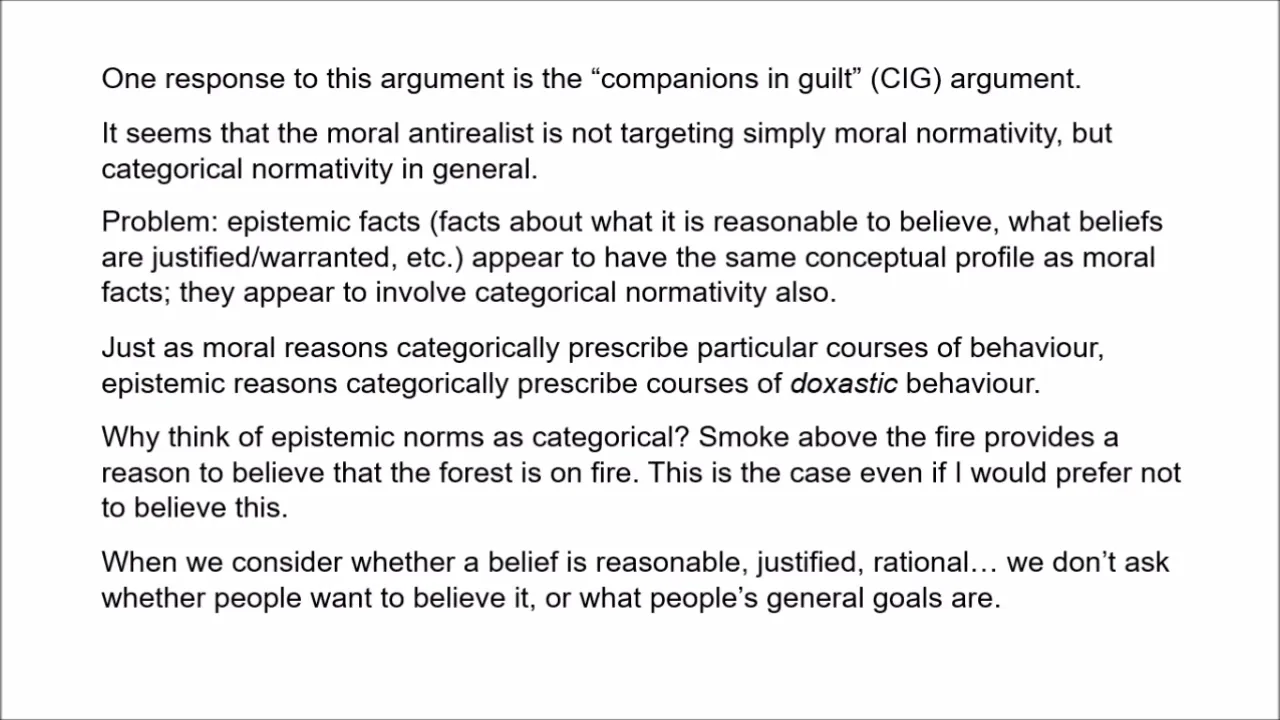
The 'Companions in Guilt' response, a major counterargument used by moral realists to challenge Mackie's premise of queerness.
Moral Fictionalism versus Moral Abolitionism, exploring the practical question of what we should do with moral language if error theory is correct.
Evolutionary Debunking Arguments in ethics, which build upon error theory using modern biological and psychological perspectives.
Alternative moral anti-realist theories, such as Simon Blackburn's Quasi-Realism and Allan Gibbard's Expressivism.
492 views17likes18:46Original Release: 2022-08-01
hello um in this lesson we are going to look at two ideas from john mackey's book inventing right and wrong the first is the argument from queerness and the second is his error theory and the two are very closely related in inventing right and wrong john mackie is pushing a moral irrealist position in other words he is saying that all our moral judgments are essentially subjective so in this sense he is similar to um aj air and his theory of emotivism and richard hare's theory of prescriptivism however the way in which he argues for a moral a realist conclusion is somewhat different okay and so that's what we're going to be looking at in this lesson so to begin with let's get clear about some terminology okay um mackie uses the terms first order claim and second order claim in his book now a first order claim is essentially a normative claim in other words it's a claim about what is right and wrong for example abortion is wrong it's a normative claim all right a second order claim by contrast is a meta-ethical claim so for example you might claim that moral value is just based on somebody's personal attitude towards an action or a situation all right so that is a second order claim it's not telling you what is right and wrong like a first order claim it's just telling you about the nature of a moral judgment or making a claim about it all right um so it's important although this um terminology is somewhat different and although mackie is essentially saying that first order claims normative claims and second order claims are meta ethical claims it is important to use this terminology when you're talking about mackie's book and making sure that you can explain it as i just have so mackie as i've said is a moral irrealist which means he doesn't believe that there are any moral facts all right however unlike um aj airs emotivism mackie does believe that there can be morally objective standards insofar as they can be derived from an agreed standard of judgment or an agreed framework so for example you know societies have agreed frameworks as what counts as right and wrong okay those frameworks themselves are obviously sets of rules they're not based on moral facts okay so it's still subjective but within that society you have a series of rules that you can appeal to when trying to show whether something is right or wrong and maki to demonstrate this uses an example of a sheepdog herding sheep in a sheepdog trial and he gives the example that we've got a sheepdog who scatters sheep all over a field but nonetheless the judges give it the prize for best sheepdog however if they do that they will have made an unjust decision all right so you have a set of standards that determines whether a sheepdog is good or bad and then you have to make a judgment in relation to that okay um and if you judge um that the sheepdog is good even though um it has proved to be absolutely terrible then you've made an unjust decision against the sheepdog all right however and this is macky's point it is still an open question as to whether there is an objective moral requirement to judge justly or to refrain from judging unjustly all right and he doesn't believe that there is such an objective requirement and so ultimately um there is not a realm of moral facts okay there is no objective moral value um and so to augment this argument to kind of deepen it and to strengthen it he develops what is called the argument from queerness and he suggests that moral values would have to be queer or strange forms of entity because knowledge of them would also have to give the agent the motivation to act okay a good way of putting this might be to imagine that you have six beers in the fridge all right and this is just a fact there are six bottles of beer in the fridge that only becomes um something relevant if you are thirsty or you want a beer okay so the motivation for you to go and get a beer is subjective that part is down to you there is nothing in the fact of there being six beers in the fridge itself right that um motivates you to go and get a beer from the fridge that motivation is entirely subjective and similarly macky says that the natural features of a situation the facts themselves are not motivated they don't contain any kind of motivation if they did that would have to be a very strange kind of thing all right so imagine i don't know you witness a theft all right and you think it's wrong and you want to go and intervene there is nothing in the theft itself all right that contains that motivation okay the motivation comes from you from your response to the theft all right and so macky's saying that if object if there really was an objective moral truth in this kind of case for example that stealing is wrong that that objectivity would have to be actually tied up in the facts itself or in the actions themselves and when we observe such things we don't see that all right so they would have to be very queer kinds of entity moral motivations would have to be tied up in the fact themselves and they would have they would need to be very strange kinds of entity in order to motivate they would have to sort of contain motivation in themselves all right and he says that this is a very strange idea it's pretty incoherent it's far better and more sensible and simple to suggest that the motivation comes from you rather than the facts themselves okay and that shows that morality is ultimately subjective in other words um that irrealism morally realism is true all right so he asked this question what objects in the world have moral motivation built into them the answer is that you can't find one all right and this shows morality to be subjective it's worth mentioning at this point um a formula if you like known as occam's razor and this was developed by the philosopher william of ockham who lived near ripley in surrey okay actually in a little village called occum that is next to ripley and he basically made the claim that you should never multiply entities beyond necessity in other words if you have two competing theories to explain the same thing choose the theory with the fewest number of complications or the fewest number of steps because uh that really reduces the risk of making an error okay the more complications that you have in an explanation the more likely it is that one or two of them are wrong okay and so mackie actually appeals to occam's razer in this respect he says look you've either got to suggest that there are these queer moral entities that exist in the facts themselves and that requires quite a complex theory um or you just accept that there are no moral facts and that your moral motivations come from within you okay so they are subjective and realist okay so it's simpler to suppose that ultimately moral action is a subjective response even if it is contextualized within a culture with agreed standards okay so mackie rejects a model of objectivity and that suggests moral value exists in the fabric of the universe all right he thinks it is false um to think of the think of um moral judgments in a realist sense all right so that is essentially macky's argument from queerness and he uses it to try to show that moral irrealism is the most sensible theory to adopt that morality is ultimately subjective this is closely related to what he calls his error theory all right now moral properties like rightness and wrongness obligation justice and so on he thinks are merely psychological or societal inventions all right say for example when we're in college or school we all have lanyards displaying our names all right and these names are attached to us and mackie kind of takes this model of language he says look pretty much all of language functions in a way where you have names attached to objects so for example if i say the um lamp shade is red i'm attaching the term red to the lampshade and that is independently verifiable if i get other people to come in and look at it right so the lamp shade is red is a fact all right that can be independently verified all right so the idea is that we associate a person with a particular name or associate an object with a particular color and this is a form of identification all right so it's an idea that language functions in terms of labels being attached to things all right and this gives us sort of facts but mackie says that we also do this in relation to moral claims and this is where we make a mistake okay this is where we fall into error hence the name error theory so let's compare the statement racism is wrong with this person is tom or perhaps this lampshade is red in terms of racism is wrong all right we may all agree that racism is unpleasant and something that should be eliminated as soon as possible right but we can't actually independently verify that as a fact all right it's just something that we may all agree on but it's not actually a fact in the world that can be verified or falsified i.e shown to be true or false whereas the lampshade is red can be shown to be true or false if the lamp trade is either red or not okay similarly this person is tom right can be shown to be true or false depending on i don't know the name in tom's passports and on his birth birth certificate and so on okay so mackie thinks that um language makes it look like we're doing the same thing okay in each case racism is wrong we're dressing up to look like a fact in the same way as the lampshade is red is a fact or this person is tom is a fact assuming those things are true okay but we can't say that racism is wrong is true or false in the same way or mackie thinks that we can't say um that it's true or false at all all right and so he thinks we fall into error okay so unlike names and facts there are no moral features in the external world to which our moral words for example right wrong righteous and shameful and so on correspond all right so we can't in the same way think of it in terms of a label attached to a particular thing and that that can be independently shown to be true or false so our moral judgments about right and wrong fail to capture the moral dimensions of things because there aren't any all right there aren't any actual moral facts in the fabric of the universe okay and so this is where mackie thinks we make an error okay that's why he calls it error theory so we fall into error when we use moral terms we think we are doing something that we are not we think we are making true statements but really we are making false statements all right so no moral facts exist with which moral facts or moral ideas can correspond so we make an error so some people take this to be quite a convincing argument but there are i think a couple of objections that you can make specific to this argument all right the first is that in order to make a false claim in relation to something it must be possible to make a true claim in relation to it also so for example in mathematics 2 plus 2 equals 7 is false because the possibility of truth exists also we can work out that two plus two equals four all right so it's import it's possible for anyone to have that independently all right similarly the sun is cold is false because it's possible to prove it otherwise through simple observation but that is macky's saying that moral statements are false because you can't prove it either way however this is the this is the fundamental aspect of the objection right if you cannot say in principle that something is true then you can't say in principle that it is false either okay so if it is not possible for a claim to be true such as giving to charity is right it is not possible for it to be false either and so it makes no sense for mackie to say that moral claims are false if at the same time he's saying that it is not possible for them to be true all right so his argument you could say is incoherent it assumes falsity where there is no possibility of having truth okay another objection is that mackey's position may need to lead to moral nihilism now moral nihilism also known as ethical narnism is the meta-ethical view that nothing is morally right or wrong there is no morality okay comes from the latin word nihil meaning nothing okay um so if you're a moral nihilist you do not believe that you can speak about right or wrong in any way you think that morality is essentially dead okay and it's important obviously to realize that moral nihilism is distinct from what is known as moral relativism okay now moral relativism is something that perhaps mackie would allow for okay that allows for actions to be right or wrong relative to a particular culture or society okay um so we can think about uh the rules uh the sheepdog trial example again all right uh there are certain standards that we invent okay that can then act as a kind of guide to say this is right or wrong but of course in the end whether we enact those standards or not is entirely a subjective judgment all right so there is a little difference there between relativism and nihilism although uh whereas nihilism said there's no such thing as morality at all all right relativism is the idea that you've got competing moral systems all of which are subjective but at least they provide societal frameworks all right so think about this question as a sort of discussion question is moral nihilism true or do you think that we do have a sense of morality even though it is subjective all right um that's all for now um in terms of mackie uh obviously it'd be really beneficial now if you look at the other two meta ethical theories um that i've made videos for that is aj airs emotivism and richard hare's prescriptivism and see how they compare okay that's the end of this video
Up Next
21:39
Sam Harris vs Emotivism: Moral Truth Debate
@AlexOConnorClips
211K views•2025-11-04

164:01
John of Damascus on Holy Images: A Theological Defense
@BannedBooks
139 views•2026-04-25

68:32
Should We Destroy the Machines? Big Tech Surveillance Critique
@TheStoriesWeTell303
167.9K views•2025-11-30
4:57
The Myth of Sisyphus: A Greek Legend of Eternal Punishment
@TEDEd
8.6M views•2018-11-13
Related Study Plans & Knowledge Roadmaps
Structured learning paths in Philosophy
philosophy
Frankfurt School: Critical Theory & Culture
01Foundations of the Frankfurt School and Critical Theory
02Horkheimer & Adorno: The Critique of Instrumental Reason
03The Culture Industry and Mass Deception
+ 2 more learning modules
12h5 modules
Explore Roadmap
philosophy
Philosophy of Language: From Frege to Austin
01The Linguistic Turn: An Introduction to Language in Philosophy
02Gottlob Frege: Sense and Reference
03Early Wittgenstein: The Picture Theory of Meaning
+ 3 more learning modules
15h6 modules
Explore Roadmap
philosophy
Feminist Epistemology: Standpoint & Injustice
01Introduction to Epistemology and Feminist Critiques
02Sandra Harding and Standpoint Theory
03Donna Haraway and Situated Knowledges
+ 2 more learning modules
12h5 modules
Explore Roadmap
philosophy
Environmental Philosophy: Ethics & Deep Ecology
01Foundations of Environmental Ethics & Anthropocentrism
02Biocentric Individualism and Animal Liberation
03Ecocentric Holism and Deep Ecology
+ 1 more learning modules
10h4 modules
Explore Roadmap