

![Semantics: Intro to Linguistics [video 8]](https://i.ytimg.com/vi/ycWDuU5eYv0/maxresdefault.jpg)






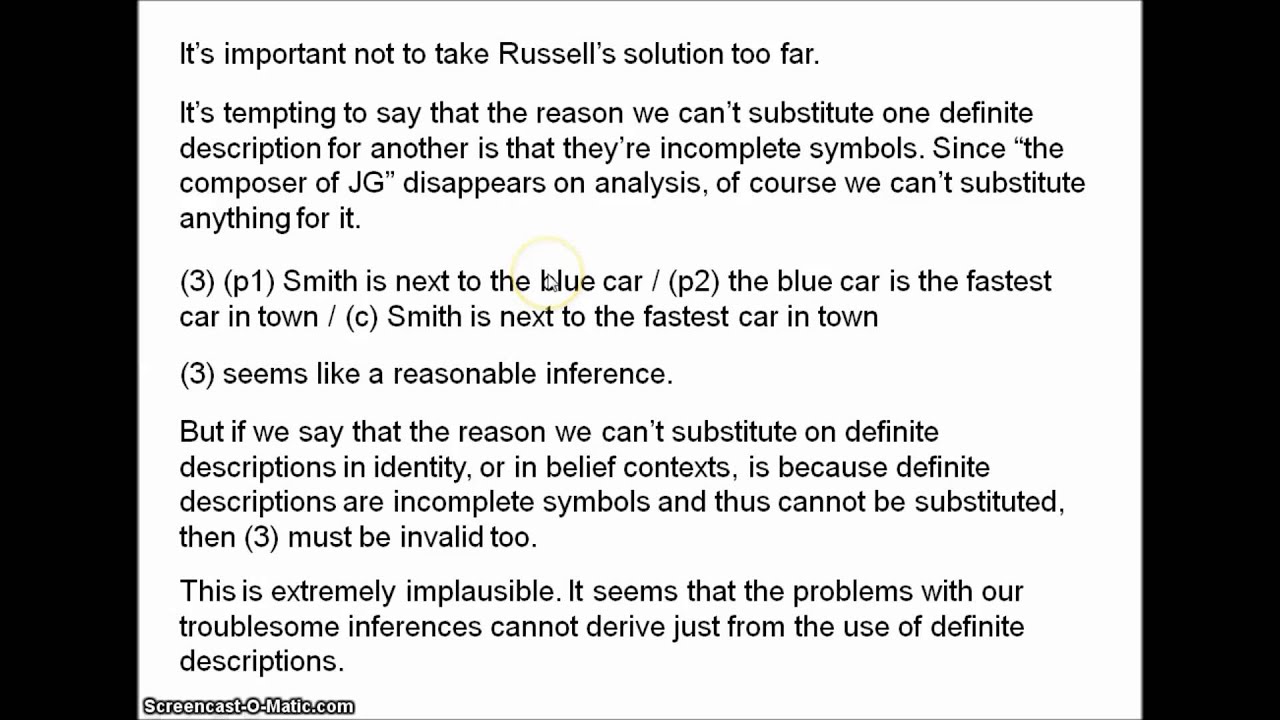






Gottlob Frege, the founder of analytic philosophy, developed a theory of language that distinguishes between the reference (the actual object or truth value a term points to) and the sense (the conceptual content or mode of presentation), arguing that truth resides in complete sentences expressing thoughts rather than in subjective mental states, thereby establishing a rigorous anti-psychological foundation for logic and mathematics.
Frege's Philosophy of Language | Logic, Sense & Reference Explained
Added:Basic principles of propositional and predicate logic, including how variables and constants function.
The historical distinction between semantics (the study of meaning) and syntax (the study of grammatical structure).
An understanding of early modern philosophical debates on the nature of ideas and mental representations (e.g., Locke or Descartes).
The concept of 'psychologism' and the historical attempts to base logical laws on psychological processes.
Bertrand Russell’s Theory of Definite Descriptions, which offers an alternative solution to the problem of empty names.
Saul Kripke's Direct Reference Theory and his critique of Fregean descriptivism in 'Naming and Necessity'.
The development of formal truth-conditional semantics, particularly the works of Alfred Tarski and Donald Davidson.
Ludwig Wittgenstein's picture theory of language in the 'Tractatus Logico-Philosophicus' and its connection to Frege's logicism.
10.2K views110likes45:35Original Release: 2011-03-17
I think frga is often praised for getting away from you know this style of writing philosophy where it's kind of unreadable and you have no idea what each sentence even means anymore but actually when you go back to frga I think it turns out that he does use a fair amount of jargon that might not be familiar to a newcomer to philosophy well it is the launching point for analytic philosophy the part of it where every other sentence is in some sort of unreadable symbolic logic that most people will just their eyes glaze over yeah unless their computer in which case they love it unless you've uh tried to translate your uh document to a uh Kindle or something readable format and it doesn't know those quantifier signs and things and so it's all even more gobble deg than it is W that sounds pretty horrific wasn't that bad here but anyway yes I found him not terribly unclear there are things about his theories that areas that he doesn't go into that would be nice that if if he went into but he has his little project who wants to say what that is approximately H let's put Matt on the spot okay we got mad because he's actually dealt with this stuff recently whereas for the rest of us this was like a bad dream that we had to get over and uh and now we don't pay any attention to it it was kind of fun for me to revisit it but anyway you're still in that in that land yes I think fga was sort of simultaneously involved in two different things maybe one thing was to put mathematics on firm foundations by coming up with a way of thinking of mathematical truths as logical truths and maybe another thing that FR was interested in was think thinking very precisely about the way that linguistic meaning Works in spoken language the different ways different languages can mean things not that he's doing comparative language he's not considered right interested in German versus English or anything like that that's right yeah sorry right so he's not doing what kind of linguish today do which is uh compare you know German versus Dutch versus English but thinking about it kind of more abstractly like if I were to design a language how would that language work and uh what are the different things you could design a language to do and he's specifically concerned with foundations of mathematics so assertions right not so much commands or it'll talk about artistic tone and things like that but that's really just to say this is not what I'm concerned with I'm concerned with what it is in a sentence that makes it tell me something that makes it State a fact right I shouldn't even use the word fact but you shouldn't right so I would call that the theory of Truth part with a theory of reference and to some extent meaning along the way yeah right I mean if the first thing we think of he's doing the trying to found arithmetic in logic the second thing at least for what we're discussing tonight I would see is this theory of Truth and then the third thing is his anti- psychologism right well it all came with this initial project to come up with a symbolic language to do mathematical proofs in right yeah so that means that every sentence has to be precise and know it has to be founded as an axiomatic system right yeah so I mean like a regular mathematical proof you know it's sort of written in half Pros half technical language and like basically people have to check it but the dream I think behind this project of fras was to be able to write mathematical proofs in this really strict really rigorous formal language that could be checked by a mechanical procedure and thereby putting the mathematical proof on firmer foundations we could be more certain about a proof If a computer could check it rather than having to rely on people who are fallible and something kind of like that right that they found that even these very wellestablished proofs you know some of them were corrected over time or they relied on some kind of intuitive leap or there just wasn't a lot of uniformity in the methods overall used for them so that was the point in coming up with this you know if you're trying to uh prove a true sentence there are specific ways to relate that to other sentences and that has to do with the structures of the terms involved right so that's where he's coming from and then if you try to apply that to ordinary language then you initially can I just give the sense and reference thing quick or is this jumping ahead go for it it's running into the idea that it seems like if we could have a one toone correspondence between these terms in this pseudo itical language and everyday language terms then if I say something about an individual and then I say another thing about that individual using a different name for that individual then it should be true right so if you say Mark is sitting in this room and you say Mr linen Meer is sitting in this room those both refer to the same person so they're both true but what if you put them in these contexts of talking about somebody's belief so let's just say Wes thinks Mark is sitting in this room well Wes thinks Mr Lind me is sitting in this room do those mean the same thing well what if he doesn't know my last name so he thinks Mark is sitting in this room but he doesn't think Mr Linden Meer is sitting in this room so that shows right there okay there's something imperfect about ordinary language that like if we're going to really make it purely symbolic we have to get rid of all those sort of ambiguities but well we want to give some kind of account of you know what can Wes conclude from his beliefs so he came up with this distinction between the reference of a term which is me in both these cases and the sense of the term which in these case each of these names for me has a different sense we've talked about his example a bunch of times of the morning star and the evening star and it was actually a scientific discovery that those both were the planet Venus or another favorite is the uh I can have beliefs about Clark Kent without having beliefs about Superman and vice versa so those are very intuitively obvious examples yeah so for us to discover that the Morning Star is in fact the evening star and for that to be something that's informative it has to be the case that the identity that we're asserting there is not simply a definitional identity like a equals a there have to be two things that are different we know the reference are the same Venus so the question is what's different there that makes that proposition informative in the way that it is and what's different brega will say must be the sense and those are the different descriptions under which we've come to understand the reference you know we've experienced one description the star rising in the morning and the other in the evening those are two different ways of experiencing the same things so those different ways are what reggo will call sense and he sees that as a solution to something which otherwise would be a very difficult Paradox to get around yeah I mean maybe another way to say that would be well it's just sort of repeating the same example but nonetheless if I told you Elvis Castello is Elvis Castello you'd be like great um duh you know but if I told you Elvis Castello is De mcmanis maybe you didn't know that there was the opportunity for you to learn something there because it's not just an empty statement right and before we dive too far into that maybe we can just sketch where the rest of this goes that once you introduce that then what are these things now we've said that there are these reference but then there are these senses so what are the ontological implications of this do we have to say you know if the reference is presumably in most cases in the cases we've talked about a physical thing out in the world well you know is that the case throughout you know if we talk about mathematical objects are those somehow objective things or those in the mind so there's that question even if we admit that all the reference are somehow objective things that we're referring to what about these senses I mean are these just things in my individual mind okay so that's an issue and then he uses this analysis again he's interested just like in the mathematical case in being able to give valid principles of deduction just like Aristotle was doing back you know when he founded logic in the first place but now by introducing not only the sense reference distinction but earlier in creating his mathematics I guess his big innovation was the introduction of uh the fact that you can have two quantifiers is that right so you could have sentences like everybody loves somebody right whereas Aristotle could deal with like all men men are mortal Socrates is a man therefore Socrates is Mortal so the all men that's one quantifier for all men but the everybody loves somebody that is for everybody there is somebody who he loves so the all and the there is some those are both quantifiers and they have special symbols and just the fact that you could put those together like that was a big deal right this is what Fraga basically invented this notation and this is what enabled him to deal with mathematics yeah so he invented mathematical logic or symbolic Logic the kind of that we all learn in introductory logic course that's frun he did that for the purpose of founding arithmetic in logic but it's had huge consequences otherwise and really it's a revolution in logic which logic really hadn't changed since Aristotle's time and Aristotle didn't really make a distinction between say the particular in the syllogism Socrates is a man and all men are mortal the quantifiers are all hidden there there's no real distinction which for fra will be critical between the all men is Mortal being a subject and Socrates being a subject well in fact the all men is not really a subject in the same way that Socrates is you really have to parse the structure the true structure of that I think Mark what you already mentioned is that for all x if x is a man then X is Mortal it's really a hypothetical proposition that's hidden that seems to be a statement on the same level as you know the Socrates being a subject I feel like you guys might have jumped in to the deep end of the pool a little bit so let's dial it back just a little bit fra had to do some conceptual work in order to articulate the system and for it to work properly and I think the key critical move that he made was sort of focusing on articulating the concept of the subject and a predicate and he talks a lot in the writings that we read about that way that functions in natural language but he has in mind The Logical structure of what he calls subjects and predicates so if you start with that concept the idea of a subject and the idea of a predicate you can think of the subject as a thing and the predicate as kind of a quality or a property of that thing so in the sentence Seth is in Austin oh no no don't do that one don't do that one okay the grass is green how's that good okay so in the sentence the grass is green the subject of that sentence is grass or the grass and the predicate is green and is the word is functions to connect the subject and the predicate in that sentence so you can say of the grass that it has the property of being green or that it has the quality of being green or it is green and that basic structure of subject and predicate is sort of the anchor for his entire system because basically what the formalization does is the formalization allows you to ascribe predicates to objects so if you've ever ever done formal logic and you see something that says like capital F small a or capital G small B what you're basically seeing there is a very simple subject object predication in notation essentially developed by frag it was modified because fr's original notation was hard to print yes predicate calculus predicate calculus what's important is that the subjects for frga are timately what you might call I hate to use this word but I don't really know how else to say it right now they're sort of singular or irreducible and predicates are typically something that can be applied to multiple subjects and they're what he calls Concepts so you have sort of objects and Concepts and those are associated with subjects and predicates and that's the conceptual work that he had to do in order for this whole mathematical system to make sense so the subject or proper name let's say will refer to an object and the predicate will refer to a concept under fraga's scheme y so the grass refers to an object a bunch of grass and the predicate green refers to well the concept green and we haven't really said what that is yet but maybe for now we can think of that as something like the property being green with the provisor that we say more about that later that's exactly what the whole difficulty is here that you know it sounds like we are analyzing the parts of a sentence but really it's not a matter of the parts of a sentence because we're interested in the you know again if everybody knows that Mark and and Mr Lind and might refer to the same thing if that's already established by definition or something like that then the fact that we're using one of those words and not the other doesn't matter or if we're using a word in German versus a word in English that doesn't matter that is not supposed to be reflected in the analysis so what we're concerned with is not those words themselves we were concerned with the meaning and so the question is well what is that meaning is that a object in the world somehow is that uh just something that's in my individual mind is it subjective that's where this whole anti psychologism thing that you mentioned West comes in yeah right the reason why this stuff is important is because he's trying to account for the logic of sentences they behave in certain counterintuitive ways in some circumstances which is one of the reasons he erects this ontology that some people might see as strange and one of those examples in the on sense and reference paper is that if you have a sentence that says say this patch of grass is green and that's true and you take that in what's called an intentional context or indirect discourse and you say that Seth believes that the grass is green you dramatically change the way the truth value of the particular sentence the grass is green relates to the truth value of the sentence as a whole and that's what frag as a logician and as a mathematician was he was concerned about how does the truth value of a whole relate to the truth value of a parts in some cases it's very simple if you take one true sentence and put an N next to it and then another true sentence the result is going to be true or a true sentence and a false sentence and the result for the whole will be false but in certain contexts those sort of easy rules simply don't work you guys have already mentioned examples like this but it's not the case that if I believe that Mark Twain wrote Huckleberry Finn that I also believe that Samuel Clemens wrote Huckleberry fin even though Mark Twain and Samuel Clemens refer to the same reference and it seems like I should be able to do a sort of substitution which might work in other circumstances yeah in math in algebra if you take any equivalent right if you have any term so if I have the number eight I can just put in 4 plus 4 at any point the number eight shows up and any equations that I had that in they'll still be true and so it seems like so that's what this whole why we're calling it a truth value as should have been obvious from what Wes was saying that just means is the sentence true or not does it has the truth value true or does it have the truth value false and we call it that just kind of on analogy to math that you should be able to substitute in if you're concerned with the truth of a complex sentence and it's let's just say A and B and C where a is a whole sentence that is true B is a whole sentence that is true and C is a whole sentence that is true then A and B and C is also true that's just the definition of The Logical operator and right yeah you know you can figure out whether the big sentence A and B and C is true without even really knowing what a and b and c mean necessarily all you'd have to know is that they're all true and then you can figure out that the whole big thing is true yep we probably don't want to go too much more into the basics of symbolic logic cuz we could spend the whole time talking about that so yeah if you really confused right now stop open Wikipedia or something like that and look up symbolic logic but we should say something about once we've got these analogies set up and we know he's trying to use math as the Prototype here then we can talk about we said why he talks about truth values but he also talks about truth functionality which is something a term we threw around on the Vicken Stein episode and people were like what is truth functionality well we just gave an example of that right a function is just you apply some operator to one or more individuals and you get some result and you can in fact look at any predicate one of fr's big arguments was that you could look at any predicate as a function so is green Maps the domain of everything so in other words I can ask is West Green is this grass green is my computer green you could apply it to anything and then it Maps it to a bunch of truth values so if I say is the computer green no that is mapped to false is grass green yes that is mapped to True etc etc and just to give you the mathematical background of that mapping since we can assume everyone's had high school algebra if we think of a typical equation like y = x^2 and that equation is on a certain domain where the domain really is just let's think of as things are are going to get plugged in and then the results going to come out on the other side so we map let's say 1: 1 and then 2: 4 because we're squaring everything and then what the map looks like algebraically is a parabola if we graph it out and assume that X's are on a horizontal axis and y's are on a vertical axis so fra is extending that idea of function to where here the function is the equals X2 part so instead of mapping numbers to numbers yal X2 takes one bunch of numbers and Maps it to another set of numbers it Maps 1: one Maps 2 to 4 3 to9 etc etc negative 1:1 -2 to 4 dot dot dot a concept as frig is thinking of it it's not going to map numbers to numbers but it's going to map things to truth values and that would be like the examples that Mark just gave that so the concept is green will be a function that Maps the shirt in my closet to true and my computer to false and you know anything that's green it'll map the true anything that's not green it'll map the false yeah yeah so the is green is analogous to the Y squared yes and why the hell would you want to do this and there we should say mapping the truth values just to fill in the onp ology there fragga you know as we seeing on sense and reference and elsewhere he's going to say that statements refer to truth values as a whole so we already talked about say a particular name is referring to an object but also having a sense and then that having a predicate which refers to a concept where a concept is a type of function well the whole thing taken Al together refers to a truth value for Fran and then the sense of the whole thing is what he calls a thought so you you can speak of reference and sense whether you're looking at and say an individual object or a predicate or the combination of the two into a sentence I think that's important before we it's confusing as it's going to be to listeners just to put that on the table well that's one of the crazy things about frga that it makes sense like oh the name grass refers to that stuff that is out there in the world and maybe the term green refers to a property or the fact that a bunch of things like the grass have something in common it refers to whatever that is so that we understand we should stick to proper names by the way for examples of naming objects that just makes it easier grass is a tricky case I think yeah for everything if it is grass so is grass could be interpreted as a as a predicate yeah a concept but then to say also reference oh this whole sentence my shirt is green because that's true the sentence as a whole refers to the true like that just seems that breaks away from what we think refer to means in ordinary language yeah listeners of you know like we've talked about competing theories like The Logical atomism of Russell and Vicken Stein which were a version of the correspondence theory of Truth where what those at least Atomic sentences not necessarily complex sentences but at least in a simple Atomic sentence will refer to a fact not to T right t meaning true yeah yeah so it is a very very strange result that fra is giving us yeah it's very strange and counterintuitive at first and uh you know he has very particular reasons for thinking this strange and counterintuitive thing and uh I definitely agree Yeah the more intuitive thing to say would be that a name stands for a thing you know like Matt stands for me and maybe a predicate stands for a property so is Happy stands for the property of being happy then but then you'd think that probably the sentence Matt is Happy stands for the situation of Matt being happy or the State of Affairs you know that Matt is happy or something like that rather than a truth value so yeah it's definitely weird you mentioned uh Russell maybe we should give the quick biography to make it clear how since I think we've given a good overview of the system at least some of the dangling pieces the Stanford article on fra which of course I looked at the biography part is just like four or five bullet points you know born and uh at such and such University dies blah blah blah you know it's like fra had no life is what the uh I certainly never learned about it when we learned him what we heard since you mentioned Russell is that this was a guy who was in Germany at the same University his academic life and didn't publish that much uh and a lot of it was in this you know very specialized mathematical logic area and the only reason that anybody has heard of him is because bertran Russell who is already famous discovered his work and wrote a lot about it and in fact contradicted a lot of it ruined it yes the mathematical logic in particular we don't have to go into the specifics but there was some key part of the overall theory about classes that Russell showed that there were some par Paradox in it and pointed this out to FR and the rest of f made him miserable he he got really depressed about it yeah the rest of fr's career was like seeing what could be salvaged now that sort of the overall system was blown and he tried to revise it a few times I guess but he really didn't participate in the next few rounds of Scholars revising this project which Russell went with it with the prinkipia Mathematica it was a very famous book which of course has itself been came along very quickly yeah so the specifics of the mathematical logic are sort of interesting for history you should say the quest to found arithmetic in logic failed although it failed in its ultimate intention of being a founding but the relationships are you know it's because founding anything always fails reasonable conclusion to draw it's maybe also worth saying that Vicken Stein was a big promoter of fra and um indicated that fro was the philosopher to whom he was most indented and vican of course has been a huge deal ever since his first in book right and that book was influenced by Russell like Russell actually worked with him to get it published and wrote the intro to it if you listen to our tractatus episode you'll hear all about that so there's this very direct chain from fragga to Russell to Vicken Stein and the other piece that we talked about in the HL episode was that uh HL started also trying to write on the philosophical foundations of arithmetic and wrote about it in a very different way in this more psychologistic way in this if you listen to that episode you'll see he's hust is all about analyzing experience so it's kind of giving an empirical account of math was where he started and it was interesting that I ran across you know I've on this podcast used a number of times the argument that uh I think we can give an account for the origin of our ideas of number just through abstraction which is the kind of thing that Hume would say right I see three kittens I see three gloves I see three this three that eventually I can abstract from all that and come up with the number three and uh fra came up with or at least was a popularizer I don't know of a pretty definitive argument against that that at least convinced Hil that that didn't work which is well what ises that abstraction process look like like if you take away okay so I've got three gloves take away everything about them that makes them gloves there's nothing left if you take away all the pieces and then you take away all the pieces of these three CDs and these three pencils there's nothing left to compare the only way you to be able to imagine that you could abstract in this way is because you already have the number three in the first place right that this pretense of abstracting is pure that we must be getting our numbers ideas from somewhere else yeah another point that fren makes too is that you can count abstract things like number of ways to beat somebody in chess there are three ways to beat my friend in chess and well what's going on with that you know yeah that can't work in the same way as abstracting the number three away from Three Hats or whatever exactly yeah that idea which is one element of psychologism it's not the whole story comes from John Stewart Mill this idea that in fact there AR simply necessary logical truths as opposed to empirical truths that in fact logical and arithmetic truths are also derive from experience and that was subsequently widely rejected fra railed against that for years years he railed against psychologism and various authors including Mill and you know he wasn't listened to until he criticized one of F's early Works which was psychologistic and then hu responded positively and became an immediate convert and the rest of his philosophical career argued against psychologism as well yeah right also might be interesting to mention that Mill anticipated a lot of fr's ideas for example he anticipated the sense reference distinction and a similar distinction he drew between what he called denotations and connotations a lot of very interesting back and forth yeah and Mill is actually complicated because he's both psychologistic in some ways and anti psychologistic in others yeah this is the same guy that we talked about in our utilitarianism episode if you look back to that but we didn't talk about any of that aspect of him but you could see his ethical idea that you have to talk about ethics in terms of happiness you have to talk about concrete things you know it's all a very empirical bent we did have two readers of our blog like debate this for more than 60 comments they one of them wanted to ground arithmetic and empirically and M the other and anyway hey I'm just curious did we read an article called on thoughts yes the one you did a PowerPoint I'm just curious I just checking in making sure I wasn't in the wrong podcast yeah Seth wants us to get back on topic yeah before we do that we want to make sure we have the sense and reference onology down and all that well I think it's important for us to at least talk about sense reference and what he means when he says the thought the sense of a sentence because that all ties into the concept of Truth value which gets you to all the weirdness that you talked about okay sure let's get concrete okay how about if I do a quick uh a quick little summary and you guys can let me know what you think so fra in the article the thought he says look we have this idea we want to say that we have ideas and that our ideas correspond to reality in some way and that's what truth means that's really kind of like what's implied and what's sort of assumed is this correspondence theory of Truth so I have an idea or a picture in my head of something in the world and if it maps in some appropriate way and it's an accurate representation or an accurate it corresponds to it some way that then my idea is true and what frga says is well that's not really the case it's not that ideas are true it's that sentences that express ideas can be true or false so he says true when you think about it correspondence is a relational thing you have to have an idea and you have to have a thing or a reality or an object or something to which it can correspond but when you think about the meaning of the word true it's not really a relation word like correspond X corresponds to Y you don't say x TRS Y what you say is X is true or X is false and so he says there's something weird about this truth is not really about correspondence in this sense and he says the reason why is that anytime you talk about truth what you end up talking about is a sentence specifically he mentions a spoken sentence but I think this applies to written sentences as well so you're not saying my idea of something is true what you're saying is quote this sentence that I'm saying right now my idea corresponds to the object what you're saying is that sentence itself is true not that the idea is true but that the sentence which expresses the relationship between the two things is true so what he says is really when we talk about truth what we're talking about is truth of the sentence and not truth of an idea or truth of an object in fact objects can't have truth you can't say the chair is true that doesn't make sense you can't say my idea is true because it's an object it just doesn't make sense to say that all you can do is say some declarative sentence expresses something that is true or false yeah just a thought I mean one of the weird things in fr's philosophy is that he draws this sort of technical distinction between thought and idea and normally we think of those two words as meaning the same thing yeah so what he calls a thought is much closer to what we would call a proposition Y and I think the best way to think of a proposition is something like what a sentence means Matt what word does he use specifically instead of meaning he uses what well the sense yeah the sense of a sentence is a thought you know gunka which is analogist to saying the meaning of the sentence is the proposition yeah so I mean for example Pittsburgh is to the west of Philadelphia and Philadelphia is to the east of Pittsburgh those will be two different sentences but you might think they kind of are saying the same thing so the thought is like what a sentence is saying so it's not like a thing it's not like a happening in my mind sometimes in everyday language we use the word thought to mean something like that but in Fr it really means something more like what the sentence is saying yeah it's informational content as opposed to its emotional tone as opposed to the different ways you could say the same thought the same proposition in active or passive voice you could use all you have all these different variations but those all express the same thought yeah or also another example might be sentences in two different languages Matt is happy in English and mat in French are saying the same thing so you might think they're yeah two different sentences but they express the same thought and then an idea that's really more like a mental happening that's more like a maybe a feeling you have in your mind at a given time or like a mental image or something like that yep ideas are what any one individual has the entirety of their inner life is ideas but a thought is somehow not exclusive or internal to one individual it can be shared not just by multiple sentences as you just described Matt but by multiple people and he says something to the effect of there would be no such thing as knowledge we would have no science we would have no history of humanity if there wasn't such a thing as a thought yep but also the idea right can refer to a specific belief at a particular time directed towards the proposition or thought right yes but it's still you can have a particular instance I'm just trying to get at what ideas can be so they're the subjective part of it even in apprehending a thought there's an idea in apprehending the thought it's just important that the thought not be conflated with my particular idea grasping it at a particular time otherwise we get the problems you're talking about yeah well I'd say it this way you and I can share a thought but we can't share an idea my idea is my your idea is your idea but we can share a thought and we can both have ideas about that thought and just to bring out one other distinction if you understand that a sentence expresses something that's propositional content or its meaning or what frig calls its sense the sense of the sentence is what he calls a thought he also says that proper names can have a sense as well but it's not quite the same thing the name can have a sense but not a thought cuz the name is not a whole proposition so he's going to talk about this is what was referred to earlier when you say Mark Twain is the author of Huckleberry Finn and Samuel Clemens is the author of Huckleberry Finn those sentences have the same sense or the same thought but the two different proper nouns Mark Twain and Samuel Clemens have different senses those are different thoughts as well actually they would also be different thoughts yeah they have the same reference they have the same references yeah cuz you could know one without knowing the other therefore they have to be different thoughts can I just make things more confusing by just talking about the term meaning for a second because meaning is a very intuitive one and we all kind of want to say oh the sense that's the meaning of it but the thought that's the meaning of what you're saying and that is almost okay and we use that in a lot of circumstances but again a lot of what he's doing as a preliminary work here he's trying to say what makes a sentence true in here is the thought involved as opposed to the tone as opposed to he has even another term called the force which has to do with like is it a command is it a declarative sentence is something else about it so the initial analysis in getting into this is to separate out sense which is what corresponds to thoughts if it's a full sentence and tone and force and really these are all components of meaning right what I mean by a sentence is not entirely just the thought but I mean it in a certain way I mean it in a sad way so I read in addition to the frga articles I found really inspiring this uh secondary source which was uh by Michael dummit it's called fragga philosophy of language and he criticizes Fraga frga is so not interested in the tone and the force he considers those things just to get rid of them just to say I'm only talking about declarative sentences their informational content the thoughts involved I don't care about this other stuff and he thinks like you were saying that everything else is the idea is subjective but really if all these things contribute to the meaning then they all actually have to be objective in some way right if I'm trying to convey not only that the cat is on the map but that there's something sad about the cat being on the mat just in my choice of of where the cat is you know the mangy Punk is uh whatever yeah yes if I'm trying to communicate some connotation to it then in order for you to understand that the tone can't just be something in my head it has to also rely on linguistic conventions and things just like anything else and of course the force the same thing if it's command you understand that it's command so all these aspects of meaning are objective they're shared but again fra only cares about the assertion part of it the thought yeah yep wow all right so what have we established we have subjects we have predicates we have sentences that have senses we have names that have senses the sense of a sentence is its thought and the thought is where truth resides yeah the thought actually refers to the true again that weird thing well right the sentence refers to the true and expresses the yeah there's terminology for this uh let's see how does It Go um so lays it out specifically yeah it's in sense and reference so the sentence refers to the referend or a truth value and it expresses a sense or in the case of a sentence a thought and then the thought determines the referent which is in this case a truth value so proper names have a sense but their referent is an actual thing the referent of Seth is the guy who's talking right now who's in Austin but sentences have a sense sense also but their reference isn't like a thing in the world isn't a fact as it is for isn't isn't a fact penstein right it's not a fact it's not a state of affairs it's not a regular physical thing that occupies space and time it's this special kind of thing that's outside of space and time namely a truth value okay yes but it's still a real thing even though it's outside of space in time it's just as real as the wall in front of me it's just a different kind of real thing and so are thoughts and so are senses individual senses of words yeah numbers are going to have something like this status as well so we get this sort of platonic realm of beings that are not physical beings but they must be there in order to give us the results wants here yeah he's called a platonist because he thinks that there's this Third Realm as he actually he actually uses that word in the thought there's this Third Realm of things that don't exist in space don't change over time it's impossible for them to change they're always necessarily the same isn't the term he uses that well they're not actual right yeah a thing caring in face in time is actual right you could actually encounter an experience but there are entities nonetheless yeah and that's a little bit confusing maybe cuz saying it's not actual you might think that sounds like he's saying it's not real which is definitely not what he's saying but by saying it's not actual he's saying that it couldn't be different from the way it is cuz normally if you say like you know actually you know my umbrella is in the umbrella stand now you're sort of implying well it could be somewhere else but that's not the way meanings are meanings are always for all time the way they are yeah which sounds very weird because doesn't it like oh well when we develop v a language we determine the references of we figure out what words mean we create new words but he's saying that when we're doing that we're actually hooking Words which of course words themselves are socially constructed to meanings which are these pre-existent objective entities yep who really yeah yeah yeah and that's the thing with thoughts even if nobody has thought it yeah which is which is why the English philosophers Russell always use the word propositions they don't use the word thoughts gonin that frga uses for this at all because that just suggests I mean and frga says oh I know it's really hard to not sound psychologistic about it but really you got to keep in mind that I me my thought something objective yeah so you might just want to not use that term thought just use propositions or something there still is dumm it was actually raising in this book some doubt of whether what Russell and the English philosophers meant by proposition is exactly what he means by thoughts so we might as well talk about thoughts in Fring context as well but really know that these are things that even if no humans existed these thoughts would still be there yeah so it seems like kind of a crazy thing to think but I think the motivation for it is something like in order for people to be able to communicate to each other and share Thoughts with each other there has to be a third thing that the communicator and the person being communicated to are both as it we're looking at are both grasping because otherwise there would be no way of ripping the ideas out of my head and somehow getting them into your head because ideas are privately own this didn't even occur to me while I was doing the reading but the way you guys are saying it makes it sound like these timeless attor interal thoughts are out there waiting for the right set of Social and linguistic circumstances to come into play for them to be yeah to be captured that is the picture just think of it as sort of a matrix of all possibilities right so yeah so he's responsible for that horeshit in the 20th century too huh yeah well but look at his reason I mean what do we think of his arguments and this gets us into the anti psychologism as well Matt you just mentioned one of them this idea that if you didn't say that you'd be stuck with Seth's thought and Wes's thought in their own private worlds and they really couldn't meet anywhere yeah you wouldn't be able to share them we may have our own particular idiosyncratic private ideas FR accepts that but they must be directed the intentionality part of it is that they're directed outside of us to something common to us I like the chain of reasoning that brings frga to this conclusion right and he even makes a distinction West between there's a point at which he says even when you say the words I smell violets what you're really saying is it's true that I smell violets right so he distinguishes between those kinds of things and things like the Pythagorean theorem because what that I smell violets really is it is true that I smell violets now the leaves on the tree are green now they're the kind of truths that you have an implicit qualifier that means something like here and now and they're the ones that don't require that implicit qualif like x^2 + y^2 = z^2 right so what I want to distinguish you know he's not doing metaphysics here he's not trying to outline an ontology but there's a difference between mathematical truths or truths of natural science or what have you and the truth that's in front of the four of us right now tonight about the temperature in our respective rooms or what have you that's going to change and that truth to me hasn't been sitting around since the beginning of time waiting to be discovered and captured in a thought the way that say for example the Pythagorean theorem has but can't any particular you know if I talk about the temperature in my room right now the idea is if you're getting at what the thought expressed in there is you're going to remove the indexical you're going to move the references to me in my situation so you're going to say in give the latitude and the longitude of where I am give the time you know we understand that the actual conventions of expressing the latitude and longitude and the time are arbitrary but they're getting at something that even if 100 years ago you're talking about this latitude and longitude and this time we would still be pointing at this moment in the room that I happen to be in right now so that really yeah okay there are these metaphysical questions about is the future unchangeable in things and really are there truths about the future that already exist in the past or something like that sort of putting those aside if you consider the world at temporally which is what he's trying to do right to get at The Logical structure of things he doesn't have a sophisticated enough logic to talk about these sort of modal ities of possible and necessary and the things that later logicians are going to get into seeing this sort of Gap in frga but if you think you can just State everything in objective terms like that then yes all of those thoughts are out there even if you want to say the truth value has yet to be set because that time hasn't occurred yet the thought itself is objective and out there yeah I could be sharing the thought it's 72 degrees in here with someone who lived 50 years ago and they had the same thought yeah I don't know I suppose that logically speaking the answer to that question is yes but since for Fraga until it's captured in a sentence there's no sense until there's a sentence expressing it part of me wants to say that well he's definitely saying that's not the case right he's not yeah I know I'm just saying that he didn't think this went all the way through cuz really what he's concerned about right all he cares about is the stuff that's Eternal and Timeless like mathematical truths I think that's what he's really focused on but I think he thinks he's cornered by these he thinks we're driven to this by the argument out of curiosity I'm wondering are you equally troubled by dated statements about the I agree the future is a little weird because that ra like is it true now that I will eat a sandwich tomorrow at 10:52 well that's a little weird because you know maybe if you say that it's objectively true or false right now then you're committing yourself to some kind of determinism you just say we don't know but it is true it is a false but we just can't know yeah but it seems to me that statements about the past are maybe less problematic so I'm wondering would you be equally troubled by saying it's true that Matt is wearing a blue shirt right now at 9:51 p.m. on February 20th that in the future sure nothing will be able to change that it will always be true that Matt is wearing a blue shirt at 9:51 p.m. on February 20th are you equally bothered by saying that I think what I'm bothered by is the fact that truth value is associated with the sense of sentences so part of me wants to say either all of the possible senses of all of the possible sentences that could ever be uttered are floating out there waiting for actual written or spoken sentences to capture them and then raise the question of Truth value well they they don't really have to wait cuz they're outside of time well seriously we're waiting to to grasp them yeah exactly we're the only ones waiting it is the Matrix from which we are pulling the Matrix possibilities I like well I like that Wes used that term right it's this Matrix of possibilities out there the realm of all possibilities yeah but I I think we're all bothered by the ontology right I mean I'm bothered by yeah yeah no that's exactly it is I'm saying his stepbystep progression to get to where he goes makes sense it's just very um like which comes first the sentence or the thought yeah could you have a thought that's not expressible in in a sentence these are just the things that I thought were somewhat odd by isn't the point that as a phenomenological point when we have a thought we are grasping something objective that's really all it comes down to he doesn't really care about the ontological implications of that no he doesn't what he wants to say is that truth is a matter for declarative sentences truth is not some abstract or ephemeral or mystical or or even metaphysical thing well he wants to say the laws of logic are not psychological laws they're not simply a matter of the way we happen to think about things that they're about at a more fundamental level the way the world is so he's and he's rebelling against a very very strong dominant tradition of psychologism where people when they thought of logic they thought of it as a branch of psychology and they thought of it as descriptive of the way we think about things so when you find a logical truth you're finding a sort of Quasi empirical fact about the way human beings think about things fragga says that can't be true it can't be true that a logical truth is simply a fact about the way human beings think about things otherwise you'd screw up objectivity Al together and Science and all that stuff you can't make a distinction between correct and incorrect that way you know logic has to study what the difference between a good chain of reasoning is and a bad chain of reasoning is but if we just looked at what chains of reasoning people happen to engage in and didn't even time well some of them might be wrong and some of them might be right yeah and we can blame at least he blames Hegel or at least the British hegelians again like this guy Bradley that we talked about that Russell and venin were arguing against and we've already just even thinking about Kant since we talked about Kant and more recently in choper Hower in this perspective if you talk about the laws of mathematics these things that we are unable to deny as somehow basic psychological laws you know we have to think in terms of space and time and we have to think in terms of these truths of reason you know then it's it's easy to think from there oh okay then these things are branches of the empirical science of psychology which is actually not cons point at all but you could see how one could make that leap yeah and actually Fraga became a conin at the end of his as a response to uh so one one of the reasons why he wants to ground arithmetic in logic is to say that it's in fact not as Kant thought founded in intuition the fact that it fails to be grounded logically and so under K in terms would be an analytic truth fragga towards the end of his life thought okay well I give it up then it's intuitive that arithmetic must have some intuitive ground after all
Up Next

36:39
Queer Theory Explained: History, Language, and Identity in Philosophy
@PhilosophyTube
1.6M views•2019-10-28

164:01
John of Damascus on Holy Images: A Theological Defense
@BannedBooks
139 views•2026-04-25

45:22
Marcuse's One-Dimensional Man | Philosophy Lecture 4
@ThePartiallyExaminedLife
245.5K views•2012-01-26
4:57
The Myth of Sisyphus: A Greek Legend of Eternal Punishment
@TEDEd
8.6M views•2018-11-13
Related Study Plans & Knowledge Roadmaps
Structured learning paths in Philosophy
philosophy
Frankfurt School: Critical Theory & Culture
01Foundations of the Frankfurt School and Critical Theory
02Horkheimer & Adorno: The Critique of Instrumental Reason
03The Culture Industry and Mass Deception
+ 2 more learning modules
12h5 modules
Explore Roadmap
philosophy
Philosophy of Language: From Frege to Austin
01The Linguistic Turn: An Introduction to Language in Philosophy
02Gottlob Frege: Sense and Reference
03Early Wittgenstein: The Picture Theory of Meaning
+ 3 more learning modules
15h6 modules
Explore Roadmap
philosophy
Feminist Epistemology: Standpoint & Injustice
01Introduction to Epistemology and Feminist Critiques
02Sandra Harding and Standpoint Theory
03Donna Haraway and Situated Knowledges
+ 2 more learning modules
12h5 modules
Explore Roadmap
philosophy
Environmental Philosophy: Ethics & Deep Ecology
01Foundations of Environmental Ethics & Anthropocentrism
02Biocentric Individualism and Animal Liberation
03Ecocentric Holism and Deep Ecology
+ 1 more learning modules
10h4 modules
Explore Roadmap