
















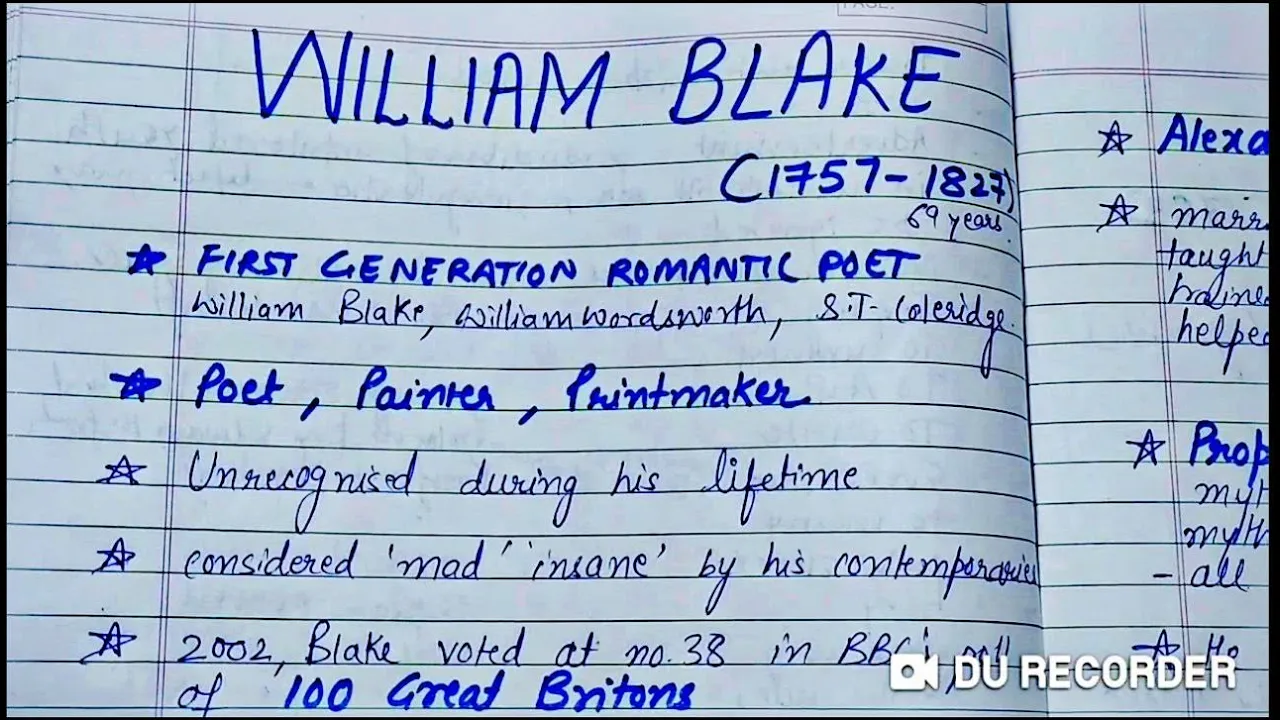
William Blake (1757-1827) was an English poet and visionary artist who developed a revolutionary philosophical framework centered on four levels of vision: single vision (cold, rational observation), twofold vision (subjective imagination), threefold vision (peaceful Beulah where contraries are equally true), and fourfold vision (glimpsing eternity). Blake believed imagination is the essence of human existence, not merely a state but the fundamental way to perceive reality. He rejected Enlightenment rationalism, arguing that our internal vision shapes how we experience the world. Through his prophetic books and illuminated poetry, Blake explored themes of human freedom, the fall of man as caused by lack of imaginative freedom, and the integration of opposites (good and evil, reason and energy) as essential to human experience. His work demonstrates that art can help us access deeper spiritual truths and that suffering and joy are complementary states necessary for human growth.
William Blake: The Visionary Poet and Artist Who Defied Reality
Added:William Blake was an English poet and visionary artist born in 1757 whose unique work gives us a glimpse into an entirely different world.
His art was ignored and neglected, and few people took his work seriously.
He was generally seen as a madman.
Today he is recognised as the most spiritual of artists, and an important poet in English literature.
While most artists sought to develop art based on the external world, Blake decided to develop the inner world.
Throughout his life he remained mostly in solitude.
He refused to compromise with society, and was known for his eccentric behaviour.
He wrote: “That I can alone carry on my visionary studies in London unannoy’d, & that I may converse with my friends in Eternity, See Visions, Dream Dreams & Prophecy & Speak Parables unobserv’d & at liberty from the Doubts of other Mortals.” His vivid imagination, visions and mystical experiences lead him to a spiritual task that was the exploration of his inner self.
We don’t live in reality, we live in what we think reality is.
At the age of 4, he saw God put his head to the window, which sent him screaming.
As a young boy he would read the Bible, which remained a key source of inspiration for his works.
He saw visions, mostly of angelic figures and told his parents about them.
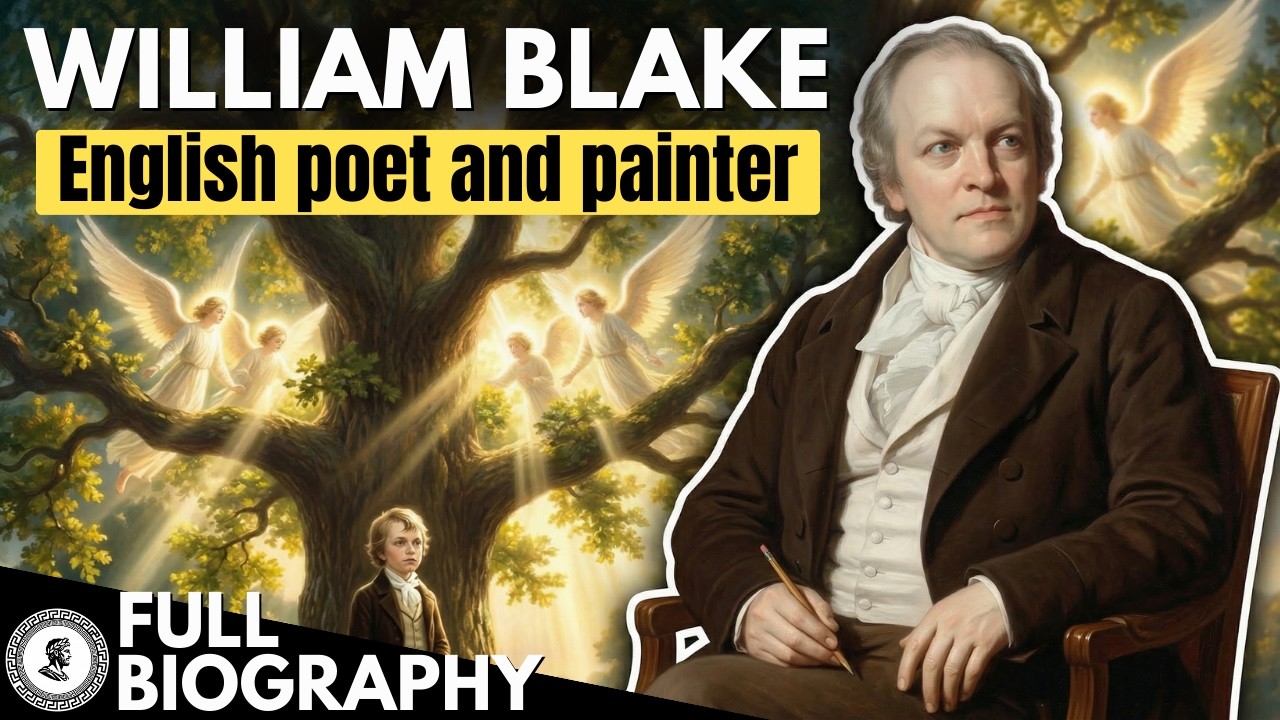
Such as: “[A] tree filled with angels, bright angelic wings bespangling every bough like stars.” Blake experienced visions throughout his life.
He had little formal education and was home-schooled by his parents.
He’d later write: “Thank God, I never was sent to school To be flogged into following the style of a fool!” He’d frequently read the Bible, the works of Shakespeare, Milton, Dante, etc. His artistic ability became evident, and his parents decided to send him to drawing school at the age of 10.
Here he became inspired by the works of Michelangelo and Raphael.
He started writing poetry between the ages of 11 and 12.
He needed to find a career and at the age of 14, Blake became an engraver’s apprentice for seven years, creating illustrations of other people’s work, and receiving a small sum of money in return.
After his apprenticeship had ended, he briefly attended the Royal Academy of Arts in London, but soon dropped out as he felt that his imagination was being weakened by academia, and his teachers showed little interest in his work.
He set out to follow his imaginative mind, while making a modest living from illustrating books, giving drawing lessons and engraving designs made by other artists.
In 1782, while speaking of his recovery from a relationship where his marriage proposal was rejected, a woman by the name of Catherine Boucher listened and pitied him from her heart.
He told her, “do you pity me?” – she responded in the affirmative, and he replied, “then I love you.” They married and began their lifelong relationship together.
He taught her how to read and write, arts which few uneducated women ever succeeded in attaining.
She proved to be an invaluable partner and supported him in his visions as well as helping him with his art.
Blake saw the effects of the Enlightenment take place.
The physical world became increasingly dominated by science and the inner world by rational thinking.
Rational empiricism was a philosophy that looked to the material world for evidence of God’s existence.
Blake calls this “single vision”, the world observed merely in a cold, calculated and unimaginative way.
There’s no room for subjectivity.
This is the poorest of visions, where we rely purely on our concrete physical senses.
Blake’s idea of the fall is different from Christianity, which understands the fall of man as Adam and Eve’s disobedience of God’s command not to eat of the fruit of the tree of knowledge.
Blake understands the fall as caused by us human beings, by our lack of imaginative freedom.
Twofold vision, on the other hand, is that of subjectivity and imagination – this is how Blake sees the world always.
He writes: “This life's dim windows of the soul Distorts the heavens from pole to pole And leads you to believe a lie When you see with, not through, the eye.” It is to play with fantasy, like looking at the night sky and seeing forms and animals in the stars.
This would occasionally lead him to higher visionary states.
Threefold vision, also referred to as “Beulah”, is the peaceful place where all worries, responsibilities and troubles vanish.
A place of restoration and reflection, where the contraries are equally true.
There is no life and death, they are both the same.
This occurs in the realm of dreams.
While in our conscious reality our relatives may have died, they are still very much alive in the realm of the unconscious.
You can step into these images at any time, to prove the being that you really are.
When we are dreaming, it is all very objective and real.
It is only after we awake, that we call it a subjective experience.
As the American transcendentalist Thoreau wrote: “Our truest life is when we are in dreams awake… in dreams we never deceive ourselves, nor are deceived.” Similarly, Carl Jung wrote: “Who looks outside dreams; who looks inside awakens.” Jung recounts a dream where he saw a yogi, sitting in a lotus position in deep meditation.
He realised that the yogi had his face.
Frightened, he awoke.
He writes: “[H]e is the one who is meditating me.
He has a dream, and I am it.
I knew that when he awakened, I would no longer be.” At times, one can experience the final state, fourfold vision, which is hard to describe.
It is a glimpse of eternity, making life so glorious and every moment is so delightful that every second makes life worth living.
The smallest things in the world holds the cosmic truth for those with the imagination for it.
Blake writes: "To see a World in a Grain of Sand And a Heaven in a Wild Flower, Hold Infinity in the palm of your hand And Eternity in an hour.” To summarise his four visions, Blake wrote in a letter: “Now I a fourfold vision see, And a fourfold vision is given to me; ‘Tis fourfold in my supreme delight And threefold in soft Beulah’s night And twofold Always.
May God us keep From Single vision & Newton’s sleep!” Newton is, of course, the embodiment of reason and science.
Our sensory perceptions limits us to the five senses, however, there are many more experiences beyond that.
“If the doors of perception were cleansed every thing would appear to man as it is, Infinite.
For man has closed himself up, till he sees all things thro' narrow chinks of his cavern.” English writer Aldous Huxley would later name his autobiography, The Doors of Perception, inspired by Blake, where he focuses on his psychedelic experiences.
Blake’s idea is that our internal vision changes how we perceive reality.
There are days where we find the world golden, though the world stays the same.
The change within changes the world.
He was practising what Jung calls “active imagination”.
Through our fantasies and imagination, we magnify our view of the world, that is, we expand and enrich consciousness by bringing unconscious contents into reality.
Blake wrote in a letter to a man who dismissed his visions and art as superstitious: “I feel that a man may be happy in this world, and I know that this world is a world of imagination and vision.
I see every thing I paint in this world, but everybody does not see alike…The tree which moves some to tears of joy is in the eyes of others only a green thing which stands in the way… As a man is so he sees.” A fool sees not the same tree that the wise man sees.
Romanticism was a movement that rejected this emphasis on the increasingly materialistic society and prioritised the inner reality of the individual.
Although Blake was entirely unique and not a typical Romantic poet, he did share the view of society as being something dark, repressive, evil and greedy.
Blake was a rebel of his time and was deeply aware of the social issues of his age.
He opposed slavery, racism, tyranny and all authority, including the established church, politicians and kings.
He criticised the Industrial Revolution which made man a machine, alienating him from nature, human relationships, imagination and God.
Blake saw how Christianity, the source of life and liberation, with the message of love and brotherhood, God being the principle of each person’s inner life, had become the source of social control, spreading revenge and obedience to society’s laws and rules.
He wrote: “And all must love the human form, In heathen, Turk, or Jew; Where Mercy, Love, and Pity dwell There God is dwelling too.” Though Blake was a Christian, he believed that all religions are one, the pantheon of different deities are part of the act of creation of what he calls the Poetic Genius.
If there is one true religion for Blake, it is the divine spark of the imagination.
“Thus men forgot that All deities reside in the human breast.” Some might find this as diminishing the importance of God.
However, for Blake the God within elevates our internal world, bringing that up to the level of the divine, which is something that we all can experience.
Blake strongly believed in the emancipation and freedom of the human spirit in a time where the tendency was to restrict human capacity and the freedom of the imagination.
He sought a spiritual truth, a truth that could only be achieved through introspection.
He believed that we originated from a spiritual realm, and were born as free spirits, but became imprisoned in the physical world.
The only way to be freed from it is by going beyond it through imagination, which for Blake is not just a state, but the essence of human existence itself.
In 1787, one of his most traumatic events took place, the death of his younger brother, Robert, the family member to whom he was most attached to.
He tended him in his illness, and stayed close to him for a fortnight.
As he watched him draw his last breath, he saw his brother’s spirit ascend heavenward, “clapping his hands for joy”, as he put it.
When his brother died, William’s exhaustion showed itself in an unbroken sleep of three nights of duration.
He wrote in a letter: “I know that our deceased friends are more really with us than when they were apparent to our mortal part.
Thirteen years ago I lost a brother, and with his spirit I converse daily and hourly in the spirit, and see him in my remembrance, in the region of my imagination.
I hear his advice, and even now write from his dictate.” In 1809, Blake put up an exhibition of his art, but hardly anyone attended.
A critic called him an “unfortunate lunatic whose personal inoffensiveness secures him from confinement.” “Some are born to sweet delight, Some are born to endless night.” One day we are delighted, another day we have a sleepless night.
Suffering and joy are complementary, we can’t have one without the other.
We can, however, strive for a joyful life in this world, and this is apparent in Blake’s work.
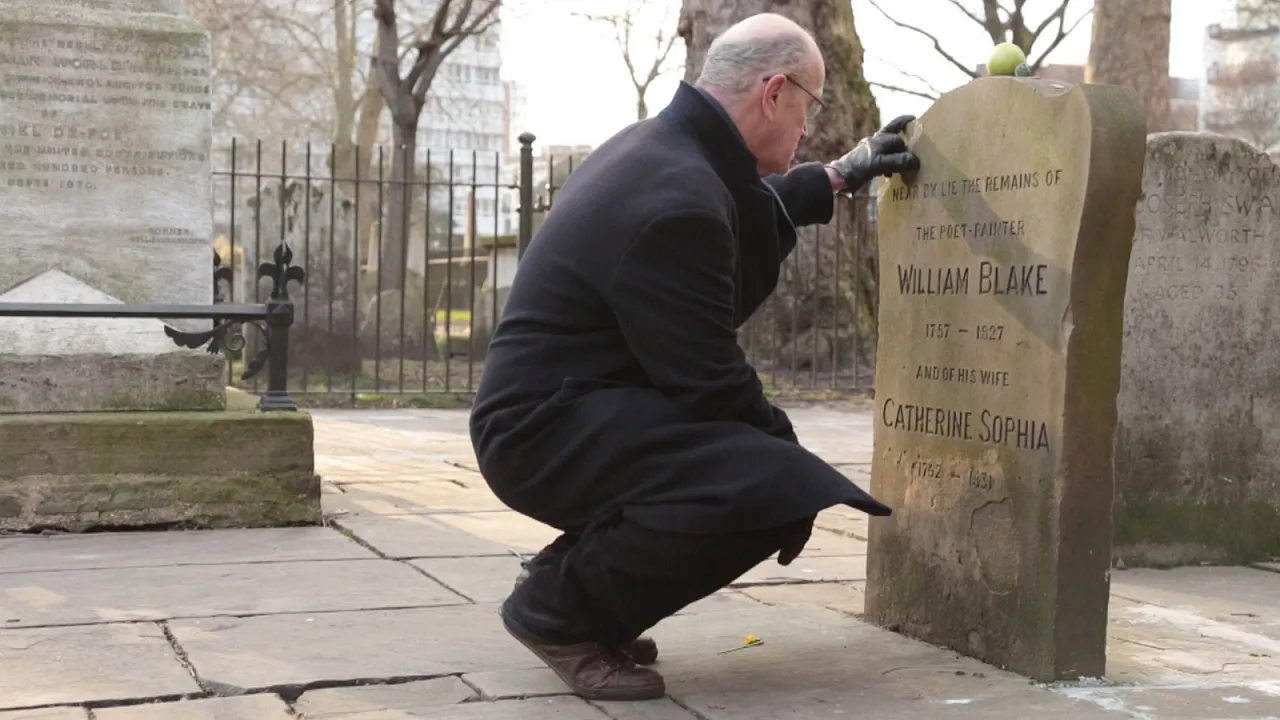
Blake died in 1827, while working on illustrations for Dante’s Divine Comedy, only managing to complete a few.
He stayed beside his wife, who he had been together with for 45 years, and he sang hymns and verses until his last breath.
Though he had gained a small recognition and group of followers known as “The Ancients”, he died penniless.
It may sound like he had a tragic life, but he didn’t.
He lived right into his death.
Blake had a real sense of joy about life and would often sing and recite poems.
He considered himself a bard, a poet-singer.
A fellow artist wrote: “He died… in a most glorious manner.
He said he was going to that country he had all his life wished to see, and expressed himself happy, hoping for salvation through Jesus Christ.
Just before he died his countenance became fair.
His eyes brightened and he burst out singing of the things he saw in Heaven.” Blake not only wrote poems but also illustrated them.
He published Songs of Innocence in 1789, which deals with the symbol of childhood and innocence, they are optimistic and celebratory.
In 1794, he published Songs of Experience, which are more pessimistic, and serve as a counterpart to his first work.
These are two contrary states of the human soul.
The world is innocence and experience, suffering and joy.
Seeing these views as complementary is crucial for Blake.
Here are a few lines of his poems: “I wander thro’ each charter’d street, Near where the charter’d Thames does flow.
And mark in every face I meet Marks of weakness, marks of woe.” Blake observed the suffocating atmosphere of London after the French Revolution.
Fearing a similar outcome, the freedom of individuals were oppressed and everything was covered with darkness, terror, misery and unhappiness.
“O Rose thou art sick.
The invisible worm, That flies in the night In the howling storm: Has found out thy bed Of crimson joy: And his dark secret love Does thy life destroy.” The beautiful rose (the symbol of love and femininity) is infected and corrupted by a secret night visitor, the worm (the symbol of death, decay and masculine destruction).
The poem may imply the constant tension between living and dying.
“I was angry with my friend; I told my wrath, my wrath did end.
I was angry with my foe: I told it not, my wrath did grow.
And I waterd it in fears, Night & morning with my tears: And I sunned it with smiles, And with soft deceitful wiles.
And it grew both day and night.
Till it bore an apple bright.
And my foe beheld it shine, And he knew that it was mine.
And into my garden stole, When the night had veild the pole; In the morning glad I see; My foe outstretched beneath the tree.” This poem gives a great psychological insight, the repressed feelings of anger creates a poison in us.
This is the Jungian shadow, if one represses the dark aspects of oneself, the shadow grows darker and denser, until one has no possibility of commanding or controlling it, and therefore it becomes autonomous and may suddenly burst forth in a moment of unawareness.
Blake’s most important written work are his “prophetic books”, which seek to express universal or eternal truths.
Some of them include: Vala, or The Four Zoas, Milton, and Jerusalem.
The works of William Blake contain a mythopoesis, an invented mythology springing from the depths of his psyche.
His prophetic books contain some of the most remarkable and least read poetry in the English language.
Vala, or The Four Zoas, is an uncompleted work begun in 1797 and abandoned after ten years.
He intended the book to be a summary of his mythic universe.
Blake’s psychic forces were so real that he used to converse with them.
Hence arose his special mythology, for these forces were living beings.
So novel was everything in this new world that no vocabulary was prepared for him, so he had to name them.
Albion (the ancient name of Britain) is a major character in Blake’s work.
He represents the Eternal Man, a fourfold being whose fallen state created the Four Zoas, reflections of the divine aspect.
These are: Urthona, Urizen, Luvah and Tharmas.
Together, they correspond to fourfold vision.
Urthona may derive from “earth owner” and is the imagination of the individual.
He is the deepest and most mysterious of the Zoas and is called “dark” several times, he has no manifestation in person, but rather takes the form of Los, the expression of creative imagination (he is the central figure for Blake).
Los is often compared with Enitharmon, the Great Mother who resembles spiritual beauty and the emotion of pity.
The second Zoa is Urizen (which may derive from “your reason”).
He symbolises law-making, and reason.
Luvah symbolises emotions, notably love, but also its contrary, hate.
The last Zoa is Tharmas, who represents the body.
Blake’s four Zoas bear a striking resemblance to Jung’s four functions of intuition, thinking, feeling and sensation.
The Fourfold Man is man in his complete or unfallen state, when he is identical with God, and with his four Zoas in harmony.
Blake’s model of the human psyche is complex and can be divided into four parts, he writes: “I see the Four-fold Man, The Humanity in deadly sleep And its fallen Emanation, the Spectre and its cruel Shadow.” Humanity is man’s innermost part, the image of God in which he was created, deadly sleep is his fall to single vision.
The Emanation is a crucial word for Blake, it refers to the feminine counterpart of the male (such as Enitharmon being the emanation of Los), and when it achieves a separate existence, it exhibits destructive behaviour.
However, in eternity, where the individual is complete again, there is neither marrying nor giving in marriage, as the sexual division no longer exists there.
The Spectre is the rational power of man, who is opposed to imagination and is focused on single vision, becoming self-centred and unable to sympathise with others.
The Shadow is the residue of one’s supressed desires, or a delusion, such as “this vegetable earth” being a shadow of the “eternal world”.
Again, one cannot help but see the similarities between Blake and Jung’s work, Blake’s emanation and spectre are closely analogous to Jung’s anima and persona.
There are also resemblances in Blake’s art in relation to Jung’s red book.
Nevertheless, they also have radically different views of the unconscious.
While Jung believes that ideas have people, Blake thinks that people create ideas.
It is known that Jung was aware of Blake’s work, and included some of his art in his books.
He wrote in a letter: “Blake’s picture is very interesting… I find Blake a tantalising study, since he has compiled a lot of half – or undigested knowledge in his fantasies.
According to my idea, they are an artistic production rather than an authentic representation of unconscious processes.” Milton is Blake’s epic poem based on John Milton’s Paradise Lost.
It is a journey of self-discovery, to rescue Albion with the power of the imagination.
The preface contains a well-known poem called “And did those feet in ancient time”.
Today it is best known as the hymn “Jerusalem”, which is considered by many to be the official hymn of England.
Here’s an excerpt: “Bring me my Bow of burning gold: Bring me my Arrows of desire: Bring me my Spear: O clouds unfold: Bring me my Chariot of fire!” Blake’s last and longest work is Jerusalem: The Emanation of the Giant Albion, not to be confused with the hymn.
Jerusalem for Blake meant the divine body of Jesus, the palace of the imagination.
He considered it his masterpiece and is an elaboration of his mythology.
It is an example of Blake putting into words his fourfold vision.
He wrote: “I must create a system, or be enslav'd by another man's.
I will not reason & compare: my business is to create.” This was his way of throwing the “mind-forg’d manacles” as he put it, our self-imposed limitations.
Though Blake wrote many poems, toward the end of his life he devoted himself entirely to his work as an artist.
Now that we have a sense of the life and works of William Blake, we can turn to his art.
As with all art, there are several ways to interpret them.
The following is just one such possible interpretation.
1. The Ancient of Days (1794) This is one of Blake’s most recognised painting, and a favourite of the artist himself.
Although he published it in 1794, he recoloured an impression of this work a few days before his death, calling it “the best I have ever finished”.
It depicts the mythological character of Urizen, who has won the power struggle between the four Zoas.
The spectre of Urizen is Satan and the power of reason.
He is the Age of Enlightenment, a new universe that traps the imagination.
He is seen as an old bearded god-like figure kneeling on a flaming disk and measuring out a dark void with a golden compass.
He resembles the Gnostic demiurge, who is typically a craftsman or the creator of the universe.
He represents the chains of reason that are imposed on the mind and the material world, as such, he is the opposite of imagination and creativity and is blind to the light behind him.
2. Albion Rose (1794 – 1796) Albion is the personification of humanity.
Blake describes the painting: “Albion rose from where he labourd at the Mill with Slaves, Giving himself for the Nation he danc’d the dance of Eternal Death.” At a time of repression, the dance of Albion symbolises the celebration of humanity freeing itself from the shackles of materialism into the colourful world of imagination, and the light of youth.
There is an aura of light that lifts him above the creatures of darkness which can be seen below, a worm and a bat.
Albion is seen as above conflict and struggle, and is wholly realised.
“He whose face gives no light, shall never become a star.” This painting has become an emblem of universal human values, of the value of resistance, of creativity, and of freedom.
3. Isaac Newton (1795 – 1805) Blake saw Newton as the representative of scientific inquiry and rationality, though it is unlikely that Blake knew that Newton also studied the bible and alchemy.
Nevertheless, he is seen with an aura of power and authority, as he draws on a scroll with a large compass (just like Urizen) on what appears to be at the bottom of the sea, though he remains dry.
He is surrounded by a void and entirely consumed by his thoughts, unaware of the marvellous corals on the rock in which he sits.
There is no imagination, only calculation.
For Blake, art is the tree of life and science the tree of death.
4. Nebuchadnezzar (1795 – 1805) "[The] mad king crawling like a hunted beast into a den among the rocks; his tangled golden beard sweeping the ground, his nails like vultures' talons, and his wild eyes full of sullen terror.
The powerful frame is losing semblance of humanity, and is bestial in its rough growth of hair, reptile in the toad-like markings and spottings of the skin, which takes on unnatural hues of green, blue, and russet."
This is an illustration of an event in the Book of Daniel of the Bible.
The King of Babylon, glorified himself for the great city that he had built.
Pride is one of the seven deadly sins.
To warn him of his impending danger, God sent him a dream prophesising that he will be driven out into the wilderness where he will “eat grass like an ox”.
The prophesy is fulfilled, and a hybrid of man and beast, crawls on the Earth on his hands and knees.
It is a warning to us all, those who walk with hubris, are abased to an animalistic level.
Evil acts deform a person.
Psychologically, the punishment of excessive pride is the death of the self.
5. The Night of Enitharmon's Joy (1795) Enitharmon is an important character of Blake’s mythology, who resembles Hecate, the Greek goddess of magic and the underworld.
The name may derive from the words zenith and harmony.
She is the Eternal Female, and her joy is to establish her view with its false religion of chastity and vengeance.
She stands out starkly against the whispering black of the darkness in the background, with nightmarish creatures.
The most bizarre of which is the bat with a furry face, who stares menacingly behind her in the unknown darkness.
Enitharmon is in fact a trio of characters, with a male and female outlined behind her, presumably emerging as she begins to read from her magical book.
6. Satan Exulting over Eve (1795) Satan is flying over Eve, who is strangled all around by the serpent of the Garden of Eden, Satan’s alter ego.
However, Satan himself is portrayed as a sublimely heroic character, with a shield and spear.
He has a melancholic countenance, and his wickedness is seen in the shape of the serpent.
Blake makes us contemplate upon the nature of good and evil.
7. The Good and Evil Angels (1795 – 1805) Two angels are seen.
An active evil angel who is strong, muscular, agile – but also in a state of despair and sorrow, with his ankle chained and flames behind him.
The other angel is fair and light.
Blake claimed that active evil is better than passive good, rendering the figures in this picture somewhat ambiguous.
Passive good is repressed and uncreative, it’s single vision.
Active evil is energetic and creative.
Perhaps the evil angel has been misguided and is desperately trying to find a way out, but is misunderstood as trying to grab the baby of the good angel.
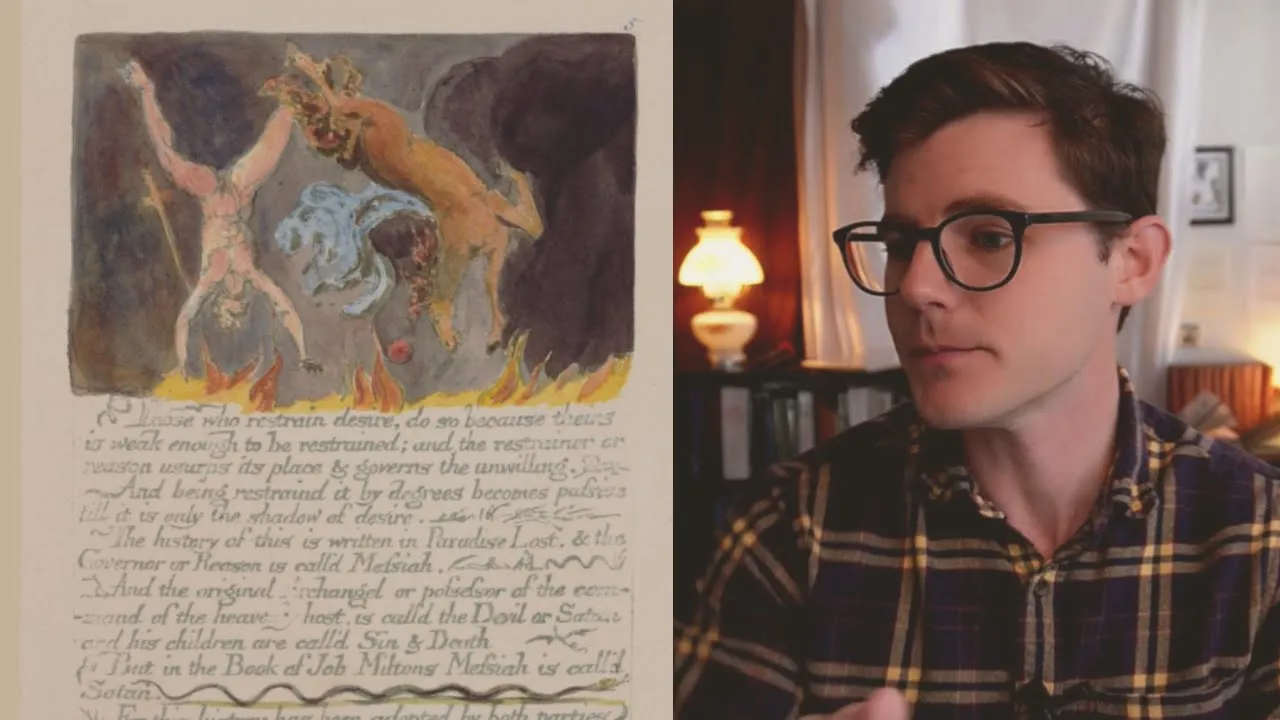
It may also suggest the title of his book, The Marriage of Heaven and Hell, where he writes: “Without contraries is no progression.
Attraction and repulsion, reason and energy, love and hate, are necessary to human experience.
From these contraries spring what the religious call good and evil.
Good is the passive that obeys reason.
Evil is the active springing from energy.” 8. The Angel of Revelation (1803 – 1805) A mighty luminous angel clothed with a cloud raises one hand up and holds a book in his other hand.
His light contrasts with the darkness from below.
This is an episode from the Book of Revelation in which Saint John describes the visions he experienced on the island of Patmos.
9. Los Enters the Door of Death (1804-1820) Los represents the imagination (the name derives from sol, Latin for sun), he is connected with Enitharmon, who is his emanation.
He is the Sun to Enitharmon’s Moon.
This is the character Blake himself is mostly connected to.
The soul of the animating principle of everything in this world.
Los has to enter many times into the door of death, taking his light (the sun of fourfold vision) into eternal death, in order to move out of “single vision”.
“Trembling I sit day and night, my friends are astonish’d at me.
Yet they forgive my wanderings, I rest not from my great task!
To open the Eternal Worlds, to open the immortal Eyes Of Man inwards into the Worlds of Thought: into Eternity Ever expanding in the Bosom of God.
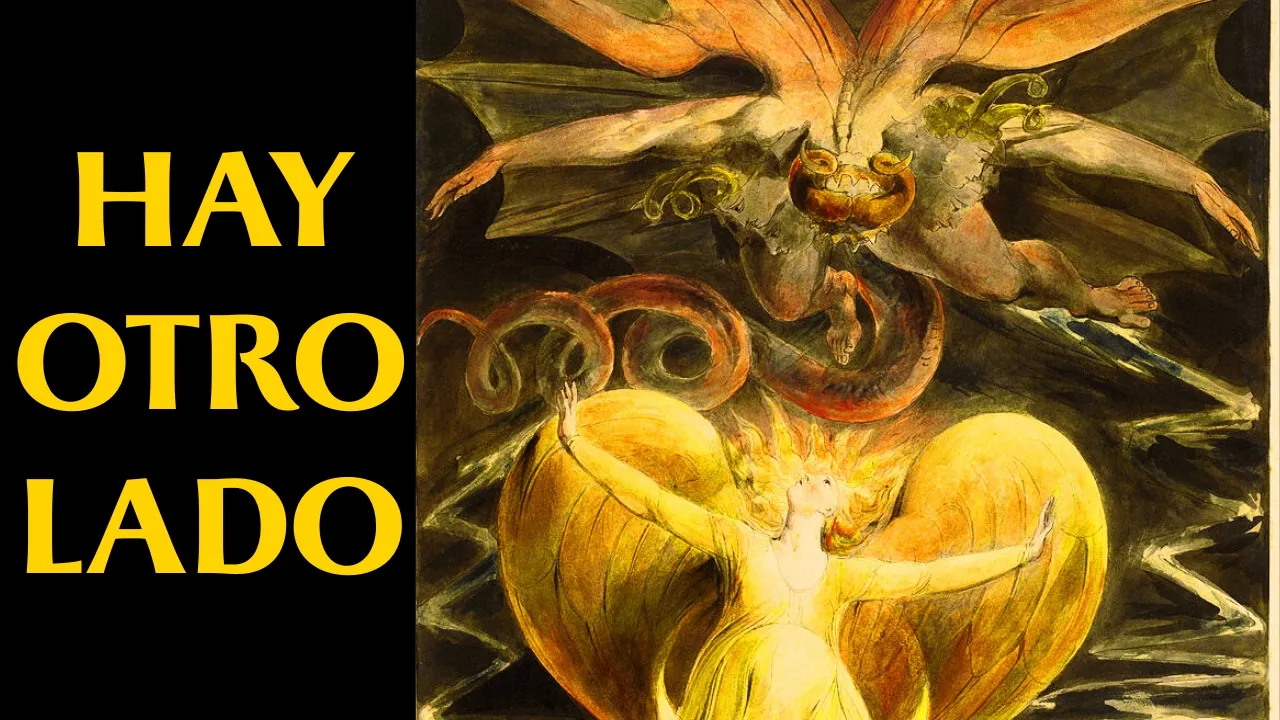
The Human Imagination.” 10. The Great Red Dragon Paintings (1805 – 1810) These are a series of paintings that depict a cosmic battle between good and evil.
The first one, The Great Red Dragon and the Woman Clothed in Sun, shows a woman bathed in sunlight with her feet resting in the crescent of the moon.
Above her, a dragon rises with his wings stirring a great wind, sweeping her hair upward, and creating a large flood that intends to engulf the woman.
As the dragon hovers to witness her demise, God grants her wings that carry her to safety.
This can be seen in the next painting, entitled slightly different as The Great Red Dragon and the Woman Clothed with the Sun.
The powerful image of the dragon’s outstretched arms and the woman’s arcing toward each other in mirror image suggest that good and evil are a duality, like the dark and light sides of the moon, rather than completely independent forces.
In the third painting of the series, The Great Red Dragon and the Beast from the Sea, we see a scene from the Book of Revelation (12:3–4): “And behold a great red dragon, having seven heads and ten horns, and seven crowns upon his heads.
And his tail drew the third part of the stars of heaven, and did cast them to the earth.” In the final painting of this series, The Number of the Beast is 666, we see a large creature offering a lamb as a sacrifice to the ferocious figure of Satan.
Below, people can be seen kneeling and praying in terror.
11. The Man Who Taught Blake Painting in his Dreams (1819 – 1820) In this simple yet bizarre sketch, we see the figure of a man that Blake encountered in his dreams and visions, giving him advice on how to paint.
It bears a resemblance to Blake himself, and may be showing the artist at the moment of inspiration or a superior self.
12. The Ghost of a Flea (1819 – 1820) This painting is quite different from Blake’s biblical or literary themes.
It takes on a darker vision, the stuff of delirium and nightmare taps into the unconscious.
Blake appeared to see this in a vision, crying out: “There he comes!
his eager tongue whisking out of his mouth, a cup in his hand to hold blood, and covered with a scaly skin of gold and green.” The figure appears to be staring into an empty cup with his tongue flicking, being the symbol for “blood-drinking”.
John Varley, a friend of Blake’s, was with him during his vision.
Blake explained that he had been visited by the ghost of a flea who explained to him that fleas were the resurrected souls of men prone to excess and overindulgence.
The figure appears to be pacing the boards of a stage, with the curtains open, and set against a backdrop decorated with stars.
This stage might be a metaphor for society and the horror or contempt of the crowd in seeing the animal side of the human being, our instinctual impulses must be limited to comply with socially appropriate behaviour.
13. Elisha In The Chamber On The Wall (1820) In this painting we see a poet in the palace of his imagination, writing to an angel’s dictation.
This is how Blake saw his own creative process.
Blake sought to free us from the single vision of this world and glimpse eternity.
This he was capable to do, because he felt himself part of a world that had been revealed to him in visions, he was at the extreme end of imagination.
For Blake, reality is spirituality.
14. The Spectre over Los (1821) Los is seen as a blacksmith who represents human imagination.
His spectre is above him, tormenting him and howling at him and does not want to take part in the effort of creating something in Los’s forge.
However, Los must find a way to work together with his spectre, and this is what happens in creativity.
As things are created, they go into the fire.
Error burns up and only truth survives the fire.
Los’s task is regeneration.
Blake experienced a liberation after making peace with his dark side.
He writes: “O Glory! and O Delight!
I have entirely reduced that spectrous fiend to his station, whose annoyance has been the ruin of my labours for the last passed twenty years of my life… I was a slave bound in a mill among beasts and devils.
These beasts and these devils are now, together with myself, become children of light and liberty, and my feet and my wife’s feet are free from fetters.” 15. The Inscription over the Gate (1824 - 1827) This is a painting illustrating a scene from Dante’s Divine Comedy.
Dante is being led by the Roman poet Virgil through Hell, Purgatory and Paradise.
Here they are shown entering the Gate of Hell.
Above the gate reads: “Abandon any hope you who enter.” This implies the horror of total despair, where all hope is lost.
Dante is moved to tears at this.
However, he is not yet dead, so this does not necessarily apply to him.
He enters Hell while alive, part of his learning process and character development throughout the poem.
Within the gate, one can see the tiny figures in torment on the hills, successive hills represent the different circles of hell, where the souls of people guilty of different sins are punished in an appropriate manner.
Those guilty of the sin of lust, for example, are buffeted about by the winds of passion and desire in the second circle.
Dante learns that sin is not to be pitied; however, this lesson takes him many circles of Hell to learn.
His descent into hell marks the beginning of the Hero’s Journey, where he must take advice from his tutelary figure.
It symbolises the psychological death of the self and transformation into a new self.
With the insights gained throughout hell and purgatory, one ascends to heaven.
As Jung wrote: “No tree, it is said, can grow to heaven unless its roots reach down to hell.” 16. Behemoth and Leviathan (1825) God tells Job, his most faithful servant, to look into the depths of the human psyche, to the most aggressive and blind areas that we all contain within us, whether we admit it or not.
Two mighty beasts can be seen, Behemoth, who dominates the land, and Leviathan, the ruler of the sea.
Blake’s images transmit universal truths of life.
When we channel our emotions into images, or put in another way, when we find the images that were concealed in our emotions, we feel tranquillity and reassurance.
If we leave the images hidden in the emotions, we may be torn to pieces by them.
Blake’s art helps to console us and calm us in turbulent times.
There is always something implied in the work of art, which is beyond thought; something lit up for a moment by the imagination, which is beyond words.
If we allow ourselves to enter fully into the experience of a work of art, we can become immediately aware of this ineffable quality.
“If the spectator could enter into these images in his imagination, approaching them on the fiery chariot of his contemplative thought… [If he] could make a friend and a companion of one of these images of wonder… then would he arise from his grave, then would he meet the Lord in the air, and then he would be happy.”
Up Next
John Locke's State of Nature and the Colonial Legacy in America
@PhilosophyTube
119.9K views•2017-06-30

John of Damascus on Holy Images: A Theological Defense
@BannedBooks
139 views•2026-04-25

Should We Destroy the Machines? Big Tech Surveillance Critique
@TheStoriesWeTell303
167.9K views•2025-11-30
The Myth of Sisyphus: A Greek Legend of Eternal Punishment
@TEDEd
8.6M views•2018-11-13
Related Study Plans & Knowledge Roadmaps
Structured learning paths in Philosophy