
























Mechanical ventilation delivers air to patients through an endotracheal tube, with the ventilator maintaining homeostasis of oxygen and carbon dioxide levels. The two fundamental approaches are volume control (setting tidal volume and letting pressure vary based on lung compliance) and pressure control (setting pressure and letting volume vary). In Assist Control (AC) mode, the patient triggers breaths by generating negative pressure, and the ventilator delivers a preset tidal volume (typically 500-600 cc or 8 ml/kg ideal body weight), with a backup rate ensuring minimum breathing frequency. Understanding the inverse relationship between pressure and volume (PV = nRT) and lung compliance (C = ΔV/ΔP) is essential for interpreting ventilator readings and detecting changes in pulmonary status.
Mechanical Ventilation Explained: Settings & Modes
Added:Welcome to another MedCram lecture.
We’re going to talk about mechanical ventilation.
This is meant to be an introduction to mechanical ventilation.
If you’ve never done mechanical ventilation before we’re going to introduce you to the basics so you can go in and actually feel competent about managing a patient on a ventilator.
This is often a daunting task because typically these patients are critical, but actually the basics are fairly graspable and we’re going to go through those now.
This is a series that’s going to actually go through a number of different lectures.
We’re going to start with the basics starting right now.
The first thing you’ve got to know is you’ve got to know the definition of some of these things.
You’ve got the patient.
That’s pretty easy.
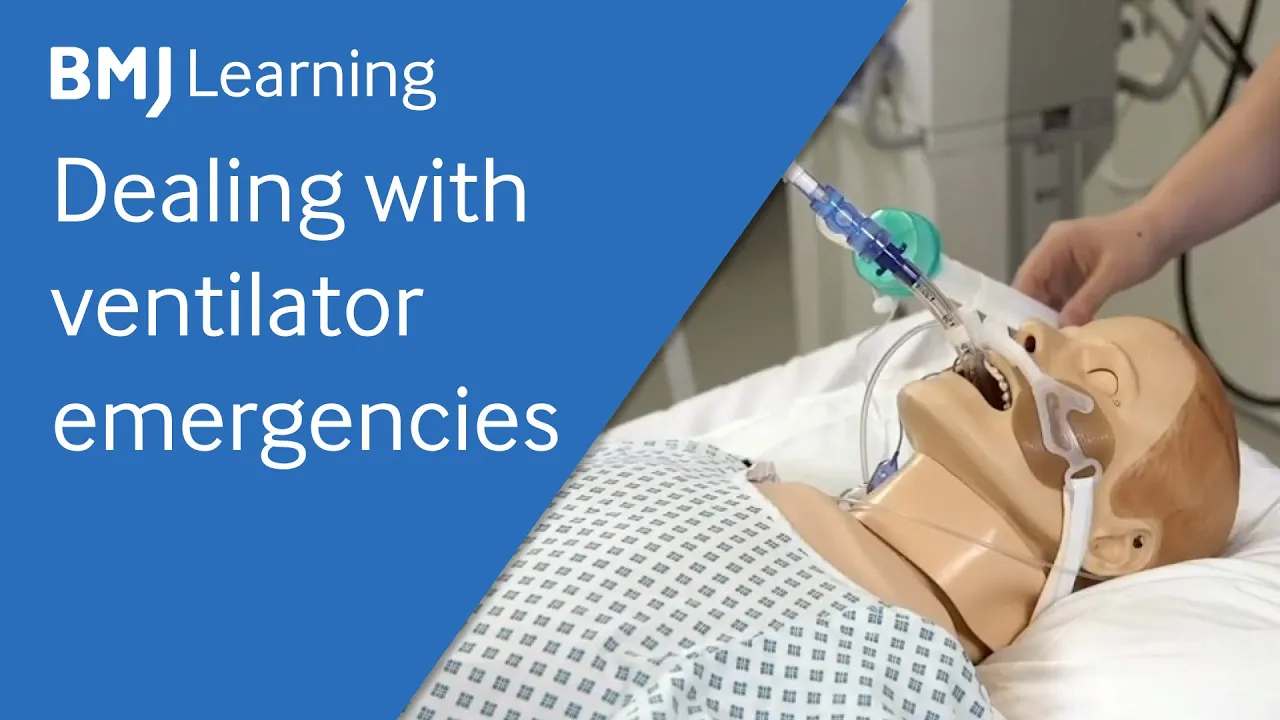
Then you’ve got this thing coming out of their mouth.
That’s the endotracheal tube.
We’re going to show this a little bit more later.
Then, you have it hooked up to a big machine with a bunch of knobs on it, and dials and output.
This is what we know as the ET tube.
That’s the endotracheal tube.
Then finally you’ve got the actual ventilator.
That’s important to know because sometimes people are intubated.
That means we put a tube down into their mouth because they need airway protection.
Sometimes we do it, in other words, because they can’t protect their airway.
They can’t protect stuff, liquids and solids, from going down their airway where that stuff shouldn’t go.
Needlessly because of this, it’s not too comfortable.
We’ve got to sedate them and when we sedate them, we’ve got to put them on a ventilator.
That might be one reason we would have to do this.
The other reason is because they can protect their airway okay but they just can’t breathe on their own.
They’re struggling to breathe so we help them out with the mechanical portion of breathing and that’s where the ventilator comes in.
The way we deliver that is through the endotracheal tube.
It’s kind of important to know what an endotracheal tube looks like.
The basic is pretty much the same all the way around.
It’s this long tube that kind of looks like this.
That’s the part that connects to the ventilator.
This is the part that goes inside the patient.
Actually, you’ll see that there is a balloon on the end of that endotracheal tube and the thing that allows you to blow it up is a little thing that goes up, called the pilot balloon.
It goes up.
Actually, the pilot part comes out and it looks like a little pilot balloon that you can kind of feel what the pressure is.
Then there’s a little part where you can inject air into it.
When this goes down and you intubate somebody it goes into their mouth past their vocal cord, specifically, and down into the trachea.
The vocal cords usually end up about right here so this is going down into somebody’s trachea.
Then usually it branches off.
You’ve got the left and the right main stem bronchus.
Here you have the endotracheal tube going down.
Now, this balloon gets inflated here so that stuff that might make it down here doesn’t go past and go into the lungs.
It’s called airway protection.
We blow up the balloon here after we intubate them to make sure that happens.
In some versions of this still have a little device right here that also comes out.
The purpose of that is to suck secretions that might come up and go out and that’s called subglottic suctioning.
That’s kind of an option.
This is the basic anatomy of an endotracheal tube.
Of course we just talked about the ventilator.
That’s got a bunch of buttons and whistles and things were going to talk about a little bit.
Going back to our patient again.
We’ve got our endotracheal tube.
We’ve got our ventilator.
What’s the purpose of this ventilator?
The purpose of the ventilator is to maintain homeostasis between the due gas concentrations that we’re talking about here, which is carbon dioxide and oxygen.
Oxygen is being put into the patient and carbon dioxide is coming out.
For the most part we want to keep those close to normal.
There’s some exceptions to that.
Here’s the point though.
There’s many different ways to put air into somebody.
We can say we’re going to put air into somebody based on volume.
We’re going to put a certain X amount of volume into somebody and then let it come back out.
That’s one way of doing it.
Another way of ventilating somebody is saying we’re going to inflate them to a certain pressure.
We’re going to have this ventilator put a certain amount of pressure into the patient and then when the pressure is released it’s going to come back out.
We can do that.
Now, we can do it at a certain rate.
We can do this fast and we can do it slow so in other words, how many breaths per minute.
We can also adjust the flow rate.
In other words, we can put a certain volume in but we can get that volume slowly or we can give that volume very quickly.
The other thing that we can do is we can decide how much pressure to leave in there at the end of when we put the air in and then we can decide how much pressure to leave in there after we’re done putting the air in.
Finally, we can decide how much oxygen we want to put in there.
How much?
We can put a lot or we can put a little.
Now, just to further complicate this just so you can kind of see where we’re going with this, we can have the ventilator be in charge of when the patient gets a breath or we can have the patient be in charge of when they want to get a breath.
Think about all of these different variabilities.
Now, you can quickly see how there are so many different ways that you can ventilate somebody and each one of these ways is a different mode of ventilation.
You may have heard of these before, like AC or SIMV or pressure support, or CPAP.
These are all different modes and we’re going to go through some of these modes and show you how it makes sense about how this is working.
Here’s our system.
Over here, we’ve got the ventilator.
Here, we’ve got the tubing that goes to the endotracheal tube down into the lungs and we’ve got our balloon here, filled with air to make sure nothing else gets down there.
We are ventilating our right lung and our left lung.
Let’s talk about the first mode of ventilation.
This will become important later.
The first mode that I want to talk about is AC.
The other way we call it is assist control.
The other name for it also is continuous mandatory ventilation or CMV.
This is the most common mode of ventilation that you’ll see, especially on a medicine floor or medicine unit.
The key here is that the patient triggers the vent.
How does that happen?
Well, the patient takes a breath in and therefore there is a negative pressure here, which causes a negative pressure to be sensed here, at the ventilator.
The other way you can sense it is by flow, if there is a flow that actually goes through here by the negative pressure.
As soon as the ventilator picks up on that negative pressure, it’s going to deliver a specific volume.
There is an actual dial on here where you can actually turn the knob to a specific volume or you can enter it in.
That volume can be anywhere from 500 CC’s all the way up to 600 CC’s, usually.
The ideal way of ventilating somebody would be around eight milliliters per kilogram, ideal body weight.
Anyway, whatever that volume is, it’s going to deliver that specific volume in AC mode ventilation.
Now, the patient can trigger it.
You could also set up a backup mode or a rate.
What does that mean?
If I set the rate to, for instance, twelve because there are twelve, five second intervals in one minute.
That means every five seconds the ventilator will give a breath to the patient of a specific volume, every five seconds only if the patient does not take a breath.
If the patient is breathing above twelve then the ventilator will only give breaths when the patient triggers it by trying to take a breath in.
In other words, if you set the mode to AC, set in a volume and set a rate of twelve, the patient can never breathe less than twelve times per minute.
Now there’s something you should understand about this, which is very important.
You may recall from chemistry and equation that says PV equals nRT.
In this system temperature is constant.
R, of course, is always a constant and is a constant.
The thing that you must realize is that pressure and volume are inverse in proportional to themselves.
In other words, as the volume of the gas goes up the pressure goes down, if you have the same amount of gas.
However, the other way of looking at this is compliance which I’ll abbreviate as a C. Compliance is equal to the change in volume over the change in pressure, which means to say that if the pressure changes a little bit and the volume changes a lot, then you have a very compliant lung.
If you don’t have a very compliant lung, it’s going to take a lot of pressure to make just a small amount of change.
Here’s the point.
The point is that these set of lungs have a specific compliance and if you are delivering a specific volume into these lungs, you are going to get a specific pressure after you deliver that volume.
That pressure can change depending on the compliance.
The point of this is that you need to have a readout that tells you what the pressure is in that lung so you can know what the compliance is.
In other words, in this mode of ventilation, you set the title volume and the ventilator will tell you what the pressure is so you’re setting the title volume.
You’re setting how much volume of gas is going to go into the lung and based on the compliance of the lung, it will tell you what the pressure is.
If the compliance of the lung goes down, then typically you’ll have higher pressures.
If the compliance of the lung is very high, in other words a very compliant lung, then your pressures are going to tend to be on the lower side.
Now, let’s make this converse to pressure control.
In pressure control what we’re doing is we’re setting a pressure.
In other words, we’re going to decide how much pressure we’re going to ventilate this patient with.
As you can imagine, if we’re setting a pressure, there is a specific compliance to this lung, depending on what state it is in, and if we set a certain pressure if the compliance of this lung is very low, then you can imagine we’re going to have lower volumes.
However, if the compliance of this lung is very high, then we’re going to have higher volumes because remember compliance is equal to the change in volume over the change in pressure.
In pressure control, you can also have the patient or time triggering a set change in pressure.
Depending on the compliance, the volume can change.
The key here is that you have to have alarms set up and you need to know and understand what those alarms mean.
What could happen here, let’s for instance say in a pressure control situation where you’re giving a specific pressure, if the compliance of these lungs somehow drop precipitously all of a sudden because of some pathology, which we’ll get into, you will notice the volumes will drop.
You would want to know that.
You could set an alarm on the lower side of the volume so that if the volumes did go down, an alarm would go off saying that you’re not ventilating.
Conversely, if you were back in our previous mode which was assist control and you’re setting a certain volume, if the compliance of the lung dropped in that situation then, as you would realize, the pressure would start to go up because you’re trying to put a set amount of volume into a low compliant lung.
When that happens, the pressure goes up.
The pressure would then trigger an alarm.
The point here is in pressure control, you’re setting a pressure and your output to read is your volume.
In AC, it’s the flip of this.
When we come back, we’ll talk about the pressure-volume relationship and a few more modes of mechanical ventilation.
Up Next

Modes of Mechanical Ventilation: Pressure Control Explained
@RespiratoryReview
37.6K views•2014-08-20

Graphic Medicine: Comics for Collaborative Healthcare Communication
@nationalpatientadvocate
189 views•2023-12-04

Neuroanatomy: Central and Peripheral Nervous System Divisions Explained
@AKLECTURES
136.2K views•2014-09-20
Stages of Labor and Vaginal Birth | Childbirth Animation
@nucleusmedicalmedia
52.1M views•2017-08-18
Related Study Plans & Knowledge Roadmaps
Structured learning paths in Medicine