





![[손해평가사 무료강의] 01강 - 보험의 원리 등](https://i.ytimg.com/vi_webp/g9kQE7kdkeE/maxresdefault.webp)



![(M3E9) [Microeconomics] Utility Maximization Problem with Linear Utilities (Perfect Substitutes)](https://i.ytimg.com/vi/NqQ8E73PKEU/hqdefault.jpg)

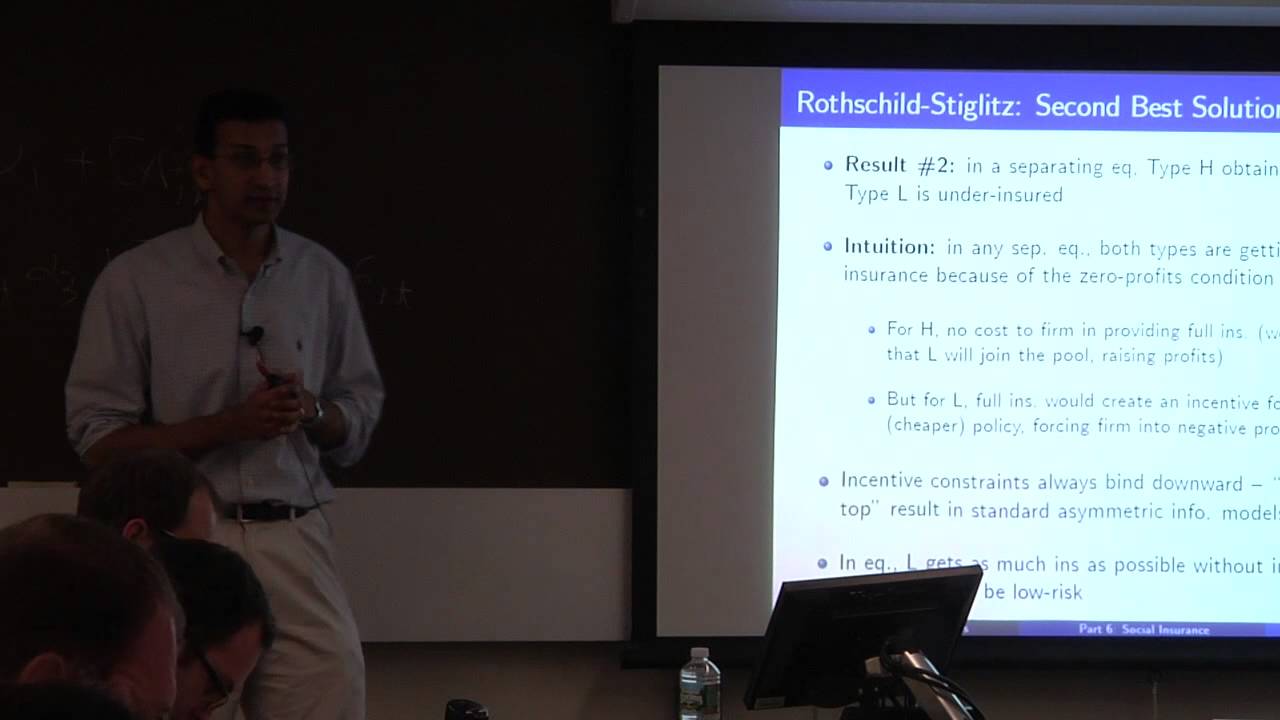









The Rothschild-Stiglitz model demonstrates that adverse selection in insurance markets creates two possible equilibria: pooling equilibrium (where a single contract serves both high-risk and low-risk groups, creating a hidden cross-subsidy from low-risk to high-risk individuals) and separating equilibrium (where different contracts serve different risk groups). However, pooling equilibrium is inherently unstable because low-risk individuals can be skimmed off by competing firms offering better terms, leading to a death spiral where remaining high-risk individuals face escalating premiums until the market collapses. This explains why real-world insurance markets require regulation to prevent death spirals, as demonstrated by the political debate between community rating (which promotes solidarity but risks death spirals) and experience rating (which reduces adverse selection but may erode the insurance base).
Adverse Selection in Insurance Markets: Rothschild-Stiglitz Death Spiral
Added:hello this is David bishai and this is our model of adverse selection lecture part two where we're going to use the model of the basic insurance contract to really dig into the model of how adverse selection happens in these Insurance markets this is going to be relevant to a classic debate on whether we should have experience rating or Community rating in the insurance industry remember experience rating different people pay different rates there might be discounts for non-smokers people like experience rating because it incentivizes self-protective behavior however we'll see in this lecture that experience rating could erode the base of the insurance cycle leading to an insurance system death spiral so this is the point where we'll describe discover what is this that spiral and how does the insurance contract make this happen in community rating everybody pays the same insurance rate it transfers money from the health be to the sick it requires people to say we're all in this together and some politicians find that that's an opportunity to challenge that we're all in this together because there's political gains to be made from saying they are not in it with you they're not like you follow me and let's not be like them so the community rating approach and insurance offers a little bit of opportunity to exploit some Humanity that says I I actually like hating other people or feeling different from them and I'll follow a politician who's running on that agenda so the model we're going to cover is called the Rothschild stiglitz model Joseph stiglitz won the 2001 Nobel Prize jointly with Spence Michael Spence and George akerloff for this their prize was for the analysis of markets with asymmetric information during our studies of economics you're gonna be a Nobel prize winning ideas are extremely beautiful and elegant and and they're a little bit difficult but I think when you see the the Rothschild stiglitz model of insurance markets I think you'll be impressed with the Elegance you'll have to dig in a little bit to do a little bit of work to grasp it but I think you'll really enjoy it and you'll probably understand why the Nobel committee thought that this was worthy of recognition so this is a model of adverse selection let's define that adverse selection occurs because of information asymmetry where uh one side of a trade uses their information advantage to exploit the other and ends up destroying the market so nobody will trade akerloth who also won the Nobel Prize with stiglitz wrote a paper about used car dealers who know more about the car they're selling than the customer and if they constantly rip off their customers nobody buys used cars and we get a vet spiral so same in buyers of health insurance a buyer of health insurance is selling a used car they're selling their risk and they're asking for an Indemnity from the insurance company in exchange for the premium but they know more about their health than their insurance so their their used cars dealers of their own health and they could have a problem of adverse selection on the other side insurance companies try to do the best they can to do the opposite of adverse selection and do advantageous selection also known as cherry picking we can see evidence of cherry picking when we see an insurance company in a Managed Care Organization or MCO find new enrollees who come into their system magically having low costs if you're able to go and pick out new customers who are cheaper than average good for you you're going to not have to pay as much out of your your insurance funds and you're going to have a great bottom line it turns out that if you are cherry picking looking at the customer's past Health their past claims and utilization that is the best predictor of next year's expenditure so historically insurance companies want to know how many claims you've made certainly in the car insurance company if you've ever applied for car insurance they are definitely going to check out uh how many crashes you've had and then quote you a rate the analogy in the health insurance Market is to ask you about your pre-existing conditions or give you a physical exam that helps the insurance company select individuals that don't look like they're making a lot of claims now cherry picking uh can be done sort of subtly beating around the bush you could advertise your health insurance product and fitness magazine you can put your health insurance Enrollment Office next to a gym where people are working out that would work or you can set the prices of your insurance products so that really only it's going to appeal to super healthy people you could set up a lot of hassles in your Managed Care Organization so that in order to get an appointment you have to to be put on hold for 20 minutes or you have to go through several referral processes and if everybody knows your insurance company is cheap but there's a hassle only healthy people are going to want that insurance so you're going to have people self-select to your company the way you design it all right so now that we've set up the idea of adverse selection and advantageous selection let's talk about how adverse selection happens we've got multiple Insurance firms competing for customers and insurance involves a transfer of money from healthy to the sick so if you affirm that could find a way to skim off patients who never got sick or rarely got sick you could do this if even without screening them for pre-existing conditions without blood tests genetic tests or medical exams you could give them really really low premiums but then you would combine those low premiums with very very low payouts you would offer lots of very high deductibles and lots of hassles and that would give you people who say I love the low premiums I'm not going to be sick so it doesn't bother me that I've got a super high deductible that leaves the other firms with medium sick and very sick patients and you've scooped off all the healthy ones by offering them this really cheap hassle written High deductible plan so in this idea let's take our insurance Market to a world where there's just two kinds of people and part of the The Genius of understanding the Rothschild digletts model is how simple it is in a world with just two kinds of people will have a thousand high-risk patients who know who they are and they know that they have a high probability of an accident we have an exactly the same number of low-risk patients who have a low probability of an accident P super l to each of these new customers is going to have a different Fair odds lines we know the formula for reference line and there'll be one for the high risk and one for the low risk the low risk patients they're going to need a bigger Indemnity offer because their preferences are going to be preferring the no accident state so you'll see this that when we see their utility curves they're going to be wanted to give themselves Assets in the horizontal dimension the people in the high-risk State they will want to go more towards the North and we're going to have to try to find an insurance product that would serve them both so here's a picture of the the two groups let's take a minute to see it we we know our our old model has wealth W wealth W minus D it has an endowment this dotted line is the average of the the probabilities it's half of the probability low and half of the probability high and if we average the probabilities we get an average Fair odds line on the dotted line and notice that it's halfway between the fair odds line of the the high risk people which has a slope of negative one minus pH over pH and it's halfway between the slope of the lowest people which has this slope negative 1 minus PL over PL if you think about it it makes sense that the low risk Fair odds line is rotated towards the right because they are going to have a lower risk which allows bigger payouts into the accident world and a higher vertical rise over horizontal run okay so that's the offers we have both types of people both the high and a low accident low risk people sitting at their endowment curve the market comes in and offers uh some product let's see what the products are so here's the model called the pooling model this is a version that at Point a we assert will appeal to both groups of people so there is a insurance contract right there at Point a that can be desired and be the best option if for both groups of people first off notice that it's not tangent to anybody's indifference anybody's Fair odds line rather it is anchored to the endowment of the low-risk people so what we've done in this pooling equilibrium we say that the lowest people I'm going to offer you product a which keeps you indifferent between you and your endowment and I'm just going to let all of the the high-risk people buy the product day that you're indifferent to so the definition of the pooling equilibrium a is it's the intersection between the indifference curve of the low-risk people and the average Fair odds line of the the community so it's we shouldn't have no trouble seeing that this product is making the low risk people the same and the high-risk people better off is it stable will this product uh stay stable in the market well here's the thing if I allow a competiting a competing firm being to come into the market what could happen is that competing firm B is going to appeal to the low-risk people and they would be better off at point B than point a think of the low risk person on a difference curve the blue indifference curve they're gonna get more utility moving out here to point B and so if if this Market allows an entrant B to come in there's no longer pooling equilibrium and the the low-risk customers leave point a going to point B an insurance firm selling insurance plan a is left holding the risks of only high-risk people and they ought to be back down here on the high-risk people's Fair ons line but they're not they're sitting up here at a place where they're going to make losses this is not the fair odds line you want to have when you're selling to high-risk people so if B enters and sells product B we've got trouble so this average Fair odds line is a slope which is a weighted average of the two slopes and any insurer selling at Point a has to make sure that they actually have a 50 50 mix of high risk and low-risk people so entrant B is very threatening to the market because it Scoops off the customers that have low risk and it will create a lot of trouble keeping the high-risk people insured in that old product so the condition for the pooling equilibrium is that it's going to occur at the intersection of the average Fair odds line and the indifference curve at the low risk group that intersects their endowment it's going to be on the average Fair offline and it's going to be on the indifference curve of the low risk group so let's go back to see it there it is uh point a it's a pulling equilibrium it will serve both customers if we want to have Community rating one product for everybody it can be designed and it can be found in the economy at Point a but it's unstable if we allow firms to enter at point B or any of these points uh on this Fair odds line below point a they will destabilize and kill wreck the market because the low-risk people will go to it and the high-risk people can't be insured by it so a is a pull equilibrium B is attractive to the low risk but not to the high risk quick quiz question for you so the implication of this model is that there is a hidden cross subsidy if there is to be a single insurance contract in the market what will be inside it is a cross subsidy from the low-risk people to the high-risk people and in the pool equilibrium the highest people are unequivocally better off with insurance and the low risk people are just indifferent they're absolutely exactly the same whether they buy insurance or don't they don't gain as much they don't gain anything so they might experience Envy again in competitive equilibrium we assume there is no Envy but the lowest people might experience it anyway because they're human beings and if any one of these low-risk people doesn't obey our assumption that they are all the same at risk and all the same risk aversion one or two of them might opt out and if one or two opt out the the there's instability and the premiums might start to go up and the more the premiums go up in that pool equilibrium the more the low risk people want to opt out and so we'll start the spiral of people leaving the pool equilibrium and making its premiums go up until it only appeals to the high risk group so the second implication is that the market is unstable the pool equilibrium is unstable against an entrant trying to skim off the low risk type we're going to require regulation to prevent these entrants uh it's unstable against low-risk people who are you know assumed to just be indifferent if they misperceive their risk as lower they opt out of the pool equilibrium or if some of the low-risk people just have heterogeneity about their risk aversion if they're just not as risk averse than other low-risk people say they're younger they feel more immortal Bell opt out and finally insurance at Point a is not profitable without the full participation of the low-risk people because as low-risk people move out it's no longer the average Fair odds line and it's above the fair odds line for the high-risk people so let's go over a different approach to solving this insurance Market let's talk about a separating equilibrium we've got two kinds of risk groups we've got the high-risk people and the low-risk people the model says that there can be uh two plans let's offer the high-risk people a plan called a sub h which is their point of tangency between this red curve and the their Fair odds line meanwhile we'll offer a separate product at Point C for the individuals on the on the low risk Fair odds line so this is a separating equilibrium where we have product a sub H point of tangency the best we could do to the the high-risk people they get product v a sub h and we look at where that indifference curve intersects the fair odds line for the low-risk people and we offer them product C now the high-risk people get the best possible insurance they can get on their indifference curve schedule but the lowest people are constrained to product C and let's talk about why they're constrained if a firm tries to offer product C plus to the market and saying oh this will be great I'll get well these low-risk people will come to product C plus and I'll make a lot of money unfortunately that doesn't work out because C plus will also attract all of the high-risk people and if you get all the high-risk people at C plus and all of the low-risk people at C plus you are going to pay out too much you've got high risk people on the fair odds line of the low-risk people so C plus is going to lose money because the higher risk customers are going to come and sync it with all of their claims if you try to offer C minus well then the lowest people don't want it because it's not better than c for them the lowest people the indifference curve use the Bell is here and they'd be better off staying at Point C so these entrants for the low risk Market can't do better than Point C uh and so C is where the market ends up okay so let's take another moment for a quick quiz about the premiums if we start offering uh these plans this plan for the high risk and this plan to the low risk in a separating equilibrium all right so the conditions for separating equilibrium in the separated equilibrium we have a plan for the high risk agents that is defined as the point of tangency between their highest indifference curve and their Fair odds line and we have a plan for the low risk agents that is where the high risk agents and difference curve intersects the low risk agents Fair odds line and you've seen that companies trying to get low-risk business can't offer something better because then it would be sunk and they can't offer something lower on the fair odds line of the low-risk people because it's just not preferred it's at a lower indifference point so in the separating equilibrium there are two contracts a sub H appeals to the high risk only the lowers people can do better at Point C and C appeals to the low risk only the high-risk people are indifferent between point C and Ace of H and entrance can't come in and destabilize it all right so if an entrant tried to offer C plus that couldn't sustain if an entering tried offer C minus it wouldn't sustain how about the real world well this artificial world had two risk groups and so in this artificial world two separate risk pools made sense but in the real world unfortunately there's not just two in the real world there are an unlimited number of risk groups aren't there there are super high and medium high and super low and medium low there's a hundred risk groups honestly there's a thousand risk groups so insurance companies in the real world can keep cherry picking off more and more and more low-risk pools there are so many so many uh Fair odds lines about hundreds or thousands of them so entrance can come in and cherry pick more and more of the lower and lower and lower risks they can keep entering and they they enter and cherry pick by offering lower premiums uh and higher payouts in this uh accident world so it's way easier to cherry pick if you can deny coverage to to pre-existing conditions and it's way easier to cherry pick if the regulations were not in place so that you could keep on cherry picking more and more of the lowest people out we would leave behind the high-risk groups those high-risk groups would have higher and higher premium as their low risk components began to leave risk pools would get smaller and smaller and in the end of the death spiral the risk pool is size n equals one one person per insurance company which is basically no pool risk no insurance so the death spiral is a problem pointed to in our models of insurance markets by Rothschild and stinklitz let's summarize so the summary of what we've learned about in adverse selection is that there's going to be information asymmetry firms that gain information about risk types could use it to partition the market they can Partition by offering higher priced but more generous benefits Market segmentation can undermine the cross subsidy from the low risk to the high risk and ultimately if we segment enough we'll have the end of all Insurance markets so which is better we covered two different versions of the model uh pool equilibrium and separating equilibrium which is better it depends on one's ethical assumptions in the philosophy of John Rawls there's a belief that institutions should protect the least well-off and their rawlsian ethicists would prefer a pooling equilibria which is designed to protect the high-risk individuals however there are softcore Libertarians that really believe in property rights and say that there should not be cross subsidies between groups if you own property you should not have to give it up to anybody for anything that you don't want to and so they would prefer separating equilibrium where you are taking your your hard-earned property and using it to protect yourself a hardcore libertarian says no government intrusion in a failed Market period And if there's no government intrusion in the market then you have to reject all health insurance because all Insurance markets will death spiral without regulation they cannot pool and they cannot separate both pooling and separating equilibrium would give way to death spirals so a hardcore libertarian must say uh I guess guess I've just got to have no health insurance in my life because I believe that governments should never intervene in markets that's what a hardcore libertarian is left with no no option for health insurance and we have to live life under full exposure to risk so the libertarian both the softcore and the hardcore are engaged in what I would say is a little bit of myopia they'd be right if the high risk and the low risk types were fixed for life and everybody is born a permanent low risk and everybody is born of permanent high risk however the Libertarians both hardcore and softcore are myopic the fact is that 99 of humans who live long enough are going to spend time in a high risk group and time in a low risk group age 20 to 50 you're going to be a human who's low risk age 50 to 80. guess what bodies Decline and you're going to be a high risk person if you're lucky enough to be that long so the libertarian is not engaged in holding back their property from other people they are really out of transfer payment from their healthy self to their sick self and they're being unkind to themselves by rejecting the the pooling equilibrium or in the most severe case of the hardcore libertarian rejecting the existence of health insurance and their myopility condemning everybody uh to to have a life where low premiums when young and high premiums and old if they insist on separating equilibrium all right so these political concerns and ethical concerns are important in understanding what actually happens in attempts to to regulate Insurance markets and to solve them and that's what we'll be discussing in part three of this lecture thank you
Up Next
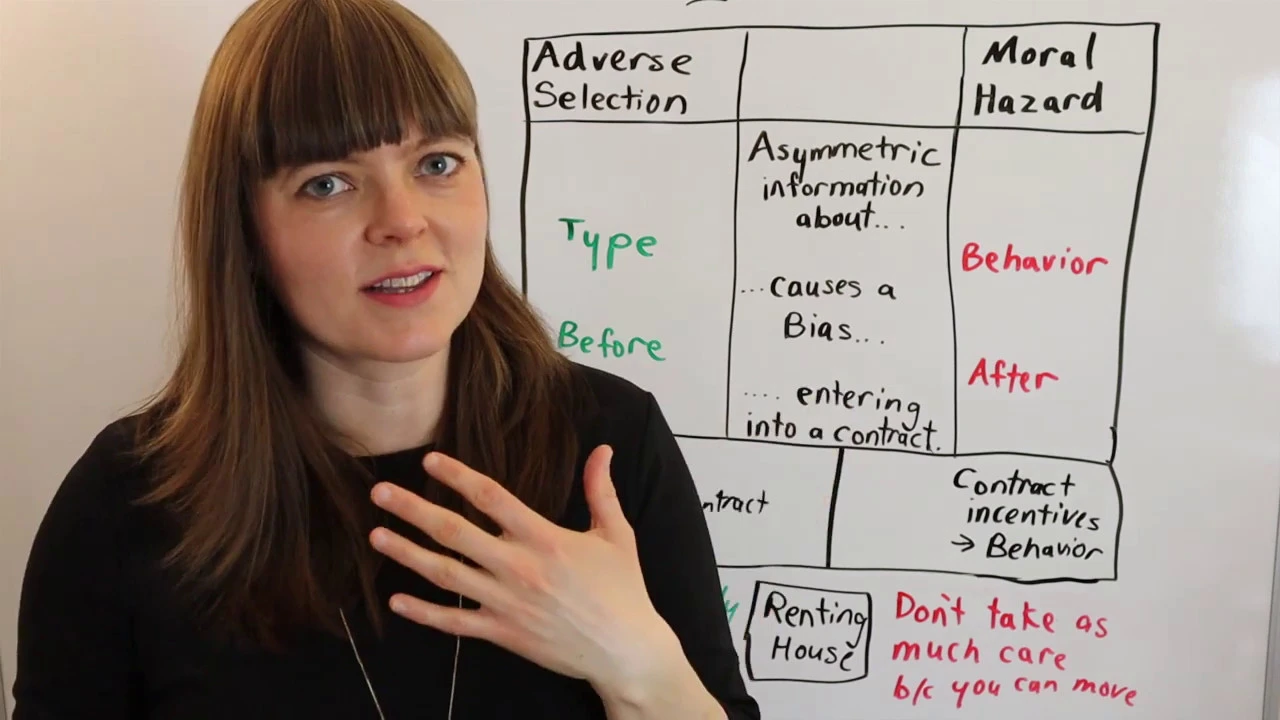
Adverse Selection vs. Moral Hazard Explained (Economics)
@AshleyHodgson
51.3K views•2020-05-02
Impact of Yuan in Indo-Russian Trade Amid Sanctions
@WION
261.9K views•2022-07-01
Behavioral Economics Explained: Rationality, Nudges, and Risk
@crashcourse
1.1M views•2016-03-12

The Age of Easy Money: Fed & Inflation | Full Documentary
@frontline
21.2M views•2023-03-15
Related Study Plans & Knowledge Roadmaps
Structured learning paths in Economics