















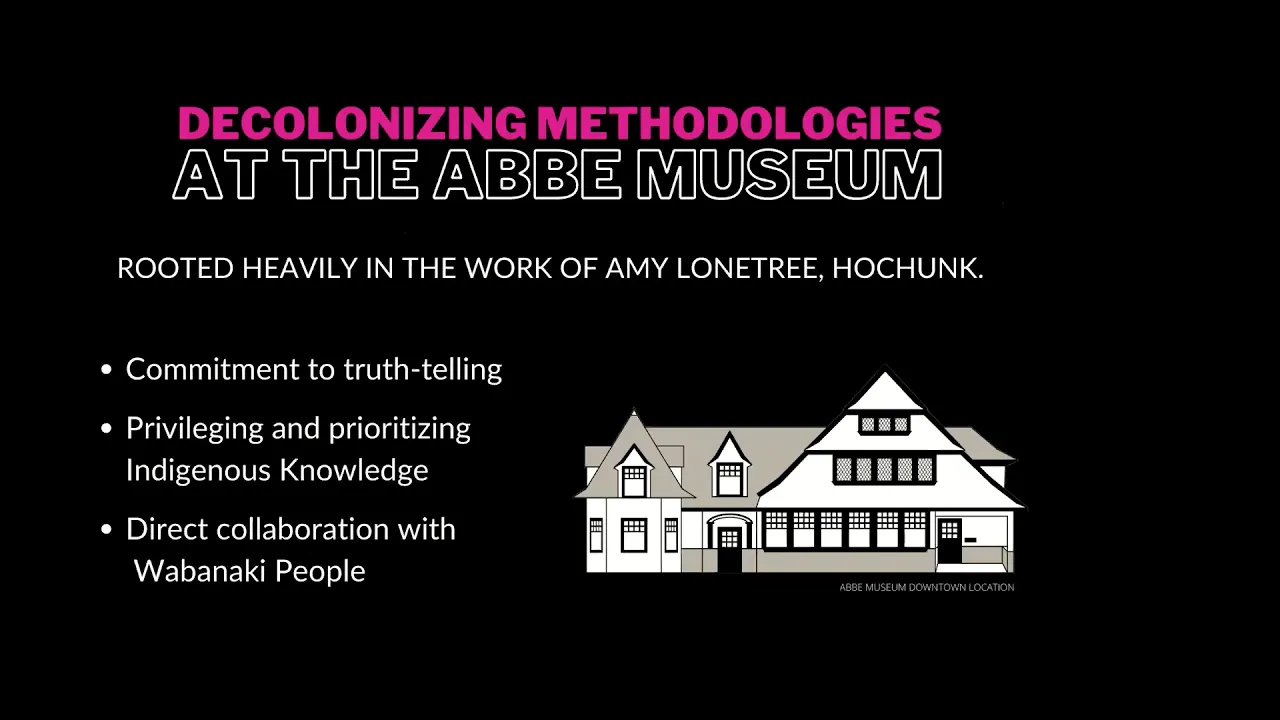

Museums historically perpetuated colonization by collecting artifacts and human remains from indigenous peoples, classifying them through Western scientific categories that dehumanized and homogenized diverse indigenous nations; decolonizing museums requires three key practices: collaborating with indigenous advisers from project inception, prioritizing indigenous voices and perspectives over colonial narratives, and truth-telling about the full measure of history including colonial harms, thereby shifting museum narratives from colonial perspectives to authentic indigenous representations.
Decolonizing Museums: Collaborative Practice and Indigenous Voice
Added:The historical relationship between Western imperialism and the rise of public museums as repositories of colonial wealth.
The conceptual distinction between 'colonialism' (political control) and 'coloniality' (pervasive cultural and epistemic power structures).
The fundamental principles of Indigenous sovereignty, self-determination, and cultural intellectual property rights.
Standard museum curatorial practices, specifically the traditional role of the curator as the singular, authoritative voice.
Legal and ethical frameworks for the repatriation and restitution of cultural artifacts (e.g., NAGPRA, UNDRIP).
Case studies of successful co-curation and shared authority between museums and Indigenous community consultants.
Decolonizing archival classification systems and library metadata standards to reflect non-Western ontologies.
Critical analysis of institutional funding, board governance, and policy reforms necessary for systemic museum decolonization.
34K views521likes9:24Original Release: 2016-12-06
Translator: Ana Cecelia Barajas Reviewer: Denise RQ For as long as I can remember, I have been in love with museums.
I was a kid raised on public television, and on vacations, we traveled to museums and historic sites.
I think my parents enjoyed a good dinosaur exhibit just as much as my brother and I did.
On summer vacations in Colorado, we visited old mining towns and traced disappearing rail lines, wondering what life was like back then.
We'd even take it a step further and visit public libraries and archives looking for photos to see what life was like back then.
My parents filled our home with art, antiques, and American art.
We never met a museum we didn't love.
As I entered the college years, I knew I wanted to work with precious collections, reveal the stories history has to offer, and help audiences consider the human condition.
I believe in museums.
I believe they have the power to change lives, inspire movements, and challenge authority.
But all is not right with my beloved museum world; museum history and modern practice is terribly problematic.
Museums were historically built as temples of art and culture, reflecting Europe as the ideal image.
Natural History museums use classification systems to organize the contents: the Hall of African Peoples, the Hall of North American Tribes; I think you get the picture.
While classification systems are convenient, they also contribute to a troubling practice of "othering" by museum professionals, who are predominantly white, like me.
In this historic pattern, non-indigenous people are collecting artifacts, the belongings, and the human remains of other cultures; collecting the authentic.
Amy Lonetree, a Ho-Chunk scholar, writes, "Museums can be painful institutions for native people as they are intimately tied to the colonization process."
Let's take a minute and unpack colonization.
Colonization occurs when a population of invaders plants colonies in the homeland of other people.
It's probably a familiar word to all of you.
American colonialism is driven by economic, political, and religious reasons.
People whose lives are colonized do not fare well; it leads to war, massacres, enslavement, and other atrocities.
The real work of colonization is an extraction of resources, and during that extraction, individuals and cultures are often destroyed and are always harmed; always.
Today, the US remains in a colonial relationship with tribal communities.
And museums?
They hold the spoils of colonization, the artifacts and the human remains of native people.
The history of representation of native people in museums begins with anthropology developing as an academic field.
Our representation today in museums stems from the late 19th and early 20th centuries.
It hasn't changed to too much.
When we look at our collective memories, and we think about the evidence of this, we often can look to natural history museums informing our perceptions of native peoples.
Let me take a moment just to explore the evidence with you; certainly, it's not all of our memories, but it's some of them.
Museums often depicted native people as static, unchanging.
Dioramas often serve that purpose by showing native people frozen in time, and then placing those dioramas next to dinosaurs and extinct animals.
Another piece of evidence is the use of western scientific categories to describe information, to describe histories, instead of using indigenous perspective about meaning and world view.
What happens in this type of strategy is you see artifacts displayed as static, alone, isolated, without a human story.
We also see a homogenization of native histories, of native peoples, stripping away the complexity and difference of over 500 indigenous nations today.
These systems of classification dehumanize native history.
Many of our perceptions have been informed by colonizers, trained anthropologists, and museum workers just like me.
In those museum spaces, physical and spiritual harm is caused.
It makes sense native people would find museums to be harmful institutions.
What is to be done?
Simply put, we need to decolonize museums; it seems easy.
Decolonization is the focus of my work, at the Abbe Museum in Bar Harbor, Maine, developing practices to undo the harm.
There are three ways we can look at this, three ways to break it down if you will.
One: decolonizing museum practices are collaborative; this means at the very beginning of a project, an idea, an activity.
We work with native advisers.
We make sure it's a story that we have the right to tell, to share, to do.
We make sure native advisers are involved as much as we can all the way through the project; they're at the beginning and threaded throughout the life of a project.
We don't get halfway down the planning timeline and then think to ask somebody if we should be doing this.
It's at the beginning.
A second hallmark of decolonizing museum practice is prioritizing native voice and perspective.
I even go so far to say privileging native voice and perspective.
The vast writings of human history are written by white academics and observers.
When we begin to prioritize indigenous perspective, the narrative broadens, it shifts, it becomes more accurate, and we have a narrative that is clear and unoppressed.
(Applause) To that point, I have indigenous voices to credit: Jamie Bissonnette Lewey, Darren Ranco, Amy Lonetree, Susan Miller, Taté Walker, George Neptune.
(Applause) I think a few of you know him.
Their words have informed my talk today, and motivate me on a regular basis.
The third hallmark of decolonizing museum practice is truth-telling, ensuring that the full measure of history is told.
Histories of Wabanaki people are connected to the challenges of today; issues regarding water quality, hunting and fishing rights, and mascots are connected to the past and the present.
When we present the full measure of history, tell the truth, we can identify painful comments, painful decisions, and make change.
At the Abbe Museum, we work daily to question our operational choices, our strategic choices, to ask what we can and should do that is of service for Wabanaki people.
Decolonization means at a minimum to share authority and governance for the interpretation and representation of native people.
I know that I won't always get this right, and I know we won't always get this right.
I know that we won't be able to work as urgently as we need to, but I also know the work will never be done so long as the US remains a colonizing force.
(Applause) To my fellow museum workers who might be here but also abroad, it's time to challenge our internal processes and ask why we build colonizing gallery spaces.
Why do we do it over and over again?
To museum leaders: how are you setting the tone, how are you setting the pace for decolonization?
Who's missing at the table?
And to all of you, who I hope are museum visitors, take these thoughts, these lessons, and go visit a museum, question the artifacts on display, ask museum management what their ideas are, what their motivation is.
Museums exist in the public trust, and we are the people; all of us.
At the Abbe Museum, we've made the decision to no longer be complicit, we've made the decision to begin.
Thank you.
(Applause)
Up Next
13:22
The Dark History and Repatriation of Museum Artifacts
@TEDx
34.9K views•2017-08-22

33:02
The Great Schism of 1054: Causes and Consequences
@SacredCathedrals
113.5K views•2026-02-19

14:06
Space Archaeology: Uncovering Heritage in Orbit | Alice Gorman TEDx
@TEDx
16.8K views•2013-05-09
17:05
Understanding the Cold War: Superpower Conflicts and the Road to Détente
@OverSimplified
46.1M views•2019-01-24
Related Study Plans & Knowledge Roadmaps
Structured learning paths in History
history
Byzantine Iconoclasm: Theology, Art & Politics
01Foundations of Byzantium and Early Christian Images
02The First Iconoclasm: Leo III and the Crisis of Images
03Empress Irene, Nicaea II, and the Second Iconoclasm
+ 2 more learning modules
9h5 modules
Explore Roadmap
history
Iranian Revolution (Causes, Events & Legacy)
01The Pahlavi Dynasty and the Roots of Discontent
02The Spark of Rebellion and the Rise of Khomeini
031979: The Fall of the Shah and the Climax of the Revolution
+ 2 more learning modules
8h5 modules
Explore Roadmap
history
Mali Empire: Mansa Musa, Trade & Timbuktu
01Foundations of the Mali Empire
02The Trans-Saharan Gold and Salt Trade
03The Reign and Pilgrimage of Mansa Musa
+ 1 more learning modules
6h4 modules
Explore Roadmap
history
1947 Partition: Politics, Borders & Legacies
01Foundations of British India and the Divide
02The Political Negotiations and the Mountbatten Plan
03Drawing the Boundary: The Radcliffe Line
+ 2 more learning modules
8h5 modules
Explore Roadmap