22edo (22-tone equal temperament) is a microtonal tuning system that divides the octave into 22 equal parts, producing a distinctive sound that differs from traditional 12edo while sharing audible similarities with 24edo; this system allows musicians to explore complex chords and scales that create unique harmonic textures and atmospheric qualities in ambient electronic music.
Exploring Complex Chords in 22-Tone Equal Temperament
Added:Deep Dive
Fundamentals of 12-Tone Equal Temperament (12-TET), including basic interval arithmetic and standard Western scale construction.

【1本で全部わかる】弾き語りの音楽理論、完全ロードマップ
36.9K
Western music uses a system where the octave is divided into 12 equal semitones. The notes are arranged in a specific pattern of whole tones and half tones (whole tone, whole tone, half tone, whole tone, whole tone, whole tone, half tone). This specific pattern creates the major scale and is the foundation of Western music. The same pattern can be applied to any starting note to create a major scale in any key.
Click to watch →
Bas Gitarda Armoniye Giriş 1 (Nota,aralık,kromatik ve diyatonik dizi)
42K
Modern Western music uses a 12-tone equal temperament system where an octave divides into 12 equal semitones. The chromatic scale contains all 12 notes within an octave: C, C#, D, D#, E, F, F#, G, G#, A, A#, B. This system allows playing in any key without retuning, though it involves slight compromises in pure interval ratios.
Click to watch →

The even tempered 12 tone scale, irrationality, and a Pythagorean coincidence | N J Wildberger
3.1K
The modern 12-tone equal temperament scale, which forms the basis of Western music, is constructed using a geometric progression where each semitone is separated by the twelfth root of two (approximately 1.05946), creating a system of 12 equally spaced notes per octave. This system remarkably approximates the fundamental Pythagorean musical intervals (octave 2:1, perfect fifth 3:2, perfect fourth 4:3, major third 5:4, minor third 6:5, and major sixth 5:3) that were originally defined by simple ratios of small natural numbers. The close correspondence between these approximate equal temperament notes and the pure Pythagorean intervals—such as N7 ≈ 1.4983 approximating the perfect fifth at 1.5, and N5 ≈ 1.3348 approximating the perfect fourth at 1.333—explains why this system became the standard for Western musical instruments like guitars and pianos, despite the inherent irrationality involved in the twelfth root of two.
Click to watch →
TET for Tat: Why Do We Use 12 Notes?
105.7K
The 12-note equal temperament system (12TET) is widely used in modern Western music because it provides excellent approximations of the most important harmonic intervals (octave, perfect fifth, perfect fourth, and major third) while maintaining practicality with a manageable number of notes per octave; although other TET systems like 19TET, 31TET, or 53TET may offer superior approximations for specific intervals, 12TET strikes the optimal balance between accuracy, playability, and historical tradition.
Click to watch →

Angine de Poitrine: ¿PAYASOS O GENIOS? 🤨
86.9K
The 12-tone equal temperament system is the standard musical system used in Western music, where an octave is divided into exactly 12 equally spaced notes. Starting from a reference note (such as C), the notes progress as C, C#, D, D#, E, F, F#, G, G#, A, A#, and B, before returning to C at the octave. This system allows for consistent tuning across all keys and is the foundation of most Western music, including guitar tuning.
Click to watch →
Deep Dive
The acoustic concept of Just Intonation (JI) and how division-of-the-octave systems approximate pure integer frequency ratios.

Why are there 12 notes in an Octave? - Part 1 - Just Intonation
21.8K
The octave is divided into 12 notes because of the mathematical relationship between frequencies: when one note has twice the frequency of another (2:1 ratio), they sound pure together. Using simple frequency ratios between 1 and 2 (such as 3/2, 5/4, 4/3, 5/3, 6/5, and 8/5), we can derive 6 consonant notes that sound harmonious with the base note. When these 6 notes plus the 2 octave notes are combined, they create a 12-note scale called just intonation, where consonant notes have exact frequency ratios and sound smooth, while dissonant notes have awkward ratios and sound harsh.
Click to watch →

Microtuning - Exploring new frequencies // Novation Live
5.7K
Just intonation uses simple whole-number frequency ratios for pure intervals: octave (2:1), perfect fifth (3:2), perfect fourth (4:3), major third (5:4), minor third (6:5), major sixth (8:5), and minor sixth (5:3). The Lima software allows users to create custom tuning systems by inputting these ratios. Equal temperament approximates these intervals but with deviations: the major third is about 14 cents flat, and the minor third is about 14 cents sharp. By adjusting notes by small amounts (cents), musicians can achieve purer-sounding intervals, demonstrating that equal temperament is an approximation.
Click to watch →

The sound of "JUST INTONATION"
36.5K
Just intonation is a tuning method where fret positions are determined by listening to where harmonics naturally occur on a string, resulting in more stable and musically resonant chords compared to equal temperament, which divides the octave into equal segments as an approximation.
Click to watch →
Music Theory: Intervals as Ratios (Just Intonation)
11.6K
In just intonation, musical intervals are defined by their frequency ratios derived from the overtone series, where the most harmonious intervals have the simplest ratios: the perfect fifth is 3:2 (1.5), the perfect fourth is 4:3 (1.333), the major third is 5:4 (1.25), and the minor third is 6:5 (1.2); as intervals become more complex with larger numbers in their ratios, they become progressively less harmonious and more dissonant, which is why equal temperament was developed to divide the octave into twelve equal semitones using the twelfth root of 2 (~1.05946) for consistent tuning across all keys.
Click to watch →

Just Intonation vs Equal Temperament: A Comparative Analysis
377.6K
Just intonation produces pure, resonant harmonic intervals by using natural frequency ratios, while equal temperament slightly detunes intervals to allow modulation between keys; modern technology now enables musicians to restore pure harmony that composers like Bach could only approximate, eliminating the 'rough and restless' beating heard in tempered tuning.
Click to watch →
Deep Dive
An introduction to the concept of microtonality and xenharmonic music, specifically how 'cents' are used to measure interval sizes.

Xen Music Theory - Episode 1: Pilot - Some Quick Basics
504
Xenharmonic music explores tuning systems beyond the standard 12EDO (12 Equal Division of Octave), where the octave is divided into equal parts using ratios from the harmonic series; key concepts include just intonation (using pure harmonic ratios), equal temperament (dividing intervals into equal parts like 19EDO or 100cET), and cents as a measurement unit where one semitone equals 100 cents.
Click to watch →

Intro to Microtonal and Xenharmonic Theory
3.9K
Microtonal and xenharmonic theory explores how all musical harmony originates from the harmonic series, where every sound wave consists of harmonics at integer multiples of the fundamental frequency; when notes are played together, they construct the harmonic series of a note at half the frequency, creating consonance or dissonance based on how closely their frequency ratios match ideal harmonic intervals like 2:1 (octave), 3:2 (perfect fifth), and 5:4 (major third); temperaments like 12-tone equal temperament approximate these ratios by dividing the octave into equal steps, introducing small errors called commas that affect how chords sound, beat, and behave under distortion, making understanding prime number approximations essential for composing in alternative tunings.
Click to watch →

Cent (music)
4.9K
The cent is a logarithmic unit used to measure musical intervals, where twelve-tone equal temperament divides the octave into 12 semitones of 100 cents each; an octave spans 1200 cents with a frequency ratio of 2:1, and the ratio between frequencies one cent apart is precisely 2^(1/1200) ≈ 1.0005777895, allowing precise comparison of interval sizes across different tuning systems.
Click to watch →

Microtonal Music Tutorial (Xenharmonic)
24.6K
Xenharmonic or microtonal music explores tunings, scales, and chords beyond the standard 12-tone equal tempered scale used by most Western musicians. This approach opens new musical possibilities ranging from strange and alien sounds to fresh interpretations of familiar chords and scales. Two primary approaches exist: just intonation using intervals derived from the harmonic series, and equal temperaments dividing the octave into equal steps (such as 22-tone equal temperament). The harmonic series reveals that when an instrument plays a note, we actually hear a chord of multiple frequencies (partials or harmonics) occurring simultaneously. The fundamental frequency determines perceived pitch, while partials create timbre. Harmonic sounds follow integer multiples of the fundamental, while inharmonic sounds have chaotic structures. Just intonation derives intervals from frequency ratios like 5:4 (major third, 14 cents flatter than equal temperament) and 7:4 (minor seventh, 31 cents lower). These ratios represent simple mathematical relationships, with simpler ratios generally producing more consonant intervals. This foundation enables creation of microtonal tunings that sound consonant and natural, reflecting inherent acoustic relationships.
Click to watch →

Cents
324
Musical intervals can be measured in cents, a logarithmic unit where one octave (2:1 frequency ratio) equals 1200 cents; to convert a frequency ratio to cents, multiply 1200 by the base-2 logarithm of the ratio, or equivalently multiply 3986 by the base-10 logarithm of the ratio, and to convert cents back to frequency, multiply the base frequency by 2 raised to the power of cents divided by 1200.
Click to watch →
Deep Dive
Basic chord theory, including triads, seventh chords, and extensions, to provide a basis of comparison for complex microtonal chords.

Chord Tone Studies | TRIADS vs 7TH CHORDS |#chordtones
5.2K
All chords, including seventh chords and extended chords, are built upon triadic structures. Complex chords with four or more notes can be understood as combinations of triads. For example, an F# minor 11 chord in the key of E contains seven sets of triads: E major, F# major, G# minor, A major, B major, C# minor, and E flat/D# diminished. This triadic foundation has been central to every great style of music including rock, funk, R&B, soul, heavy metal, and reggae. Understanding triads provides a fundamental framework for understanding all chord structures in music.
Click to watch →

The 4 MOST IMPORTANT Chords #musictheory
28.4K
All chords in music are built using tertian intervals (major and minor thirds), and there are four fundamental triad types: major triads (major third + minor third), minor triads (minor third + major third), diminished triads (two minor thirds), and augmented triads (two major thirds); these basic triads form the foundation for all more complex chords like seventh chords and extended chords.
Click to watch →
lophiile (chords and theory) Twitch Stream
18.3K
Seventh chords are four-note chords that add depth to basic triads. A major seventh chord is built by adding the seventh note of the scale to a major triad. For example, C major seventh is C-E-G-Bb. Minor seventh chords are built by adding the seventh note to a minor triad (C-Eb-G-Bb). Extensions are the ninth (2nd), eleventh (4th), and thirteenth (6th) of the scale. For a C major chord, these are D (9th), F (11th), and A (13th). Playing these extensions transforms a simple chord into a rich, professional-sounding chord. The basic extensions are the 9th, 11th, and 13th. Advanced extensions include flatting the ninth (b9) and sharpening the ninth (#9) for dominant seventh chords. You can only change the ninth in dominant seventh chords, not in major or minor seventh chords. You can also flatten or sharpen the fifth in chords. Chords with extensions are named by adding the extension numbers to the chord name. For example, a C major chord with the 9th is called Cmaj9.
Click to watch →

Chord Labels – What Do They All Mean?
270
This section covers the foundational chord types and their labeling conventions. Triads include major (note name only), minor (m, min, or -), diminished (dim or °), and augmented (aug or +). Power chords (common in rock) omit the third and are labeled with '5' or left unmarked. Suspended chords replace the third with a perfect fourth (sus4) or major second (sus2). Sixth chords come in major (note+6) and minor (m6, min6, -6) varieties. Seventh chords include dominant (7), minor (m7, min7, -7), major (Maj7, △7), half-diminished (m7♭5, ø7), and fully diminished (dim7, °7). These basic chord types form the building blocks for more complex extended chords.
Click to watch →
Aulão sobre acordes em tétrades
21K
Sophisticated chords are complex chords with more than three notes, and their sophistication is context-dependent. The foundation of all chords lies in triads, which have four basic qualities: major (tonic, major third, perfect fifth), minor (tonic, minor third, perfect fifth), augmented (tonic, major third, augmented fifth), and diminished (tonic, minor third, diminished fifth). Seventh chords are formed by adding a seventh note to triads, with the main qualities being major seventh, minor seventh, and dominant seventh. Understanding these basic building blocks is essential before moving to more complex chord structures.
Click to watch →
Prerequisite Knowledge
- Concept 01Fundamentals of 12-Tone Equal Temperament (12-TET), including basic interval arithmetic and standard Western scale construction.
- Concept 02The acoustic concept of Just Intonation (JI) and how division-of-the-octave systems approximate pure integer frequency ratios.
- Concept 03An introduction to the concept of microtonality and xenharmonic music, specifically how 'cents' are used to measure interval sizes.
- Concept 04Basic chord theory, including triads, seventh chords, and extensions, to provide a basis of comparison for complex microtonal chords.
Subsequent Learning
- Step 01In-depth analysis of 22-EDO scale structures, such as decatonic scales, and how they map to specific historical temperaments like superjust.
- Step 02Practical application of microtonal software tools (such as Scala and MTS-ESP) to configure synthesizers for alternative tuning systems.
- Step 03Comparative study of other equal division systems, such as 19-EDO and 31-EDO, to analyze their respective harmonic and melodic characteristics.
- Step 04The psychoacoustics of consonance and dissonance, specifically exploring how synthesizer timbre design can be tailored to match 22-EDO tuning to reduce sonic beating.
Opening
Intro
Main Topic
Details
Examples
Summary
Opening
0:52Playing Section
- 1
Video starts with music.
- 2
No clear content yet.
The Case for Pure Just Intonation (JI) over Equal Temperaments
While 22-tone equal temperament (22edo) offers a unique microtonal palette by approximating various non-standard intervals, proponents of Just Intonation (JI) argue that equal temperaments inherently compromise acoustic purity. Just Intonation utilizes whole-number frequency ratios based on the natural harmonic series, producing perfectly consonant chords free of the acoustic 'beating' or phase interference caused by tempered approximations. In electronic and ambient music, where synthesizers can achieve precise frequency control, critics argue that utilizing dynamic Just Intonation is superior to imposing another rigid, tempered grid like 22edo. From this perspective, rather than dividing the octave into equal, artificial steps, composers should embrace the natural physics of sound to achieve ultimate harmonic clarity and psychoacoustic resonance.
Deep Dive
In-depth analysis of 22-EDO scale structures, such as decatonic scales, and how they map to specific historical temperaments like superjust.

An Intro to the Majestic Microtonal Universe of 22EDO
3.8K
22EDO (22 Equal Divisions of the Octave) is a super Pythagorean temperament where the perfect fifth is approximately 7 cents sharp, allowing for the construction of a Lydian major scale with 9:7 major thirds and 7:6 minor thirds, and enabling a complete cycle of 22 fifths before returning to the original key, unlike 26EDO which has a flat perfect fifth.
Click to watch →
Now and Xen Podcast: 087 Chris Kline
176
In projective tuning space, temperament quality depends on generator position relative to just intonation—the red dot. Generators nestled within dense regions (near large numbers) produce better temperaments, while sparser outer regions produce worse results. For mean tone, 31-EDO is excellent, 19-EDO is good, but moving further out creates increasingly deformed intervals. The scale tree diagram shows how scales relate through generator addition/subtraction, with branches extending infinitely—for mean tone, the branch includes 12, 19, 31, 43, 55... Moment of symmetry (MOS) scales are generated by a single generator, creating scales with two distinct step sizes. As generator counts increase, MOS scales converge on specific equal temperaments. The schisma (≈1.95 cents) is the difference between three Pythagorean commas; temperaments like 12-EDO, 17-EDO, 41-EDO, and 53-EDO temper it out. Projective tuning space can use any prime bases—not just 2, 3, 5. Using 3, 5, 7 creates different landscapes where 13-EDO becomes prominent for approximating 3:5:7 ratios.
Click to watch →
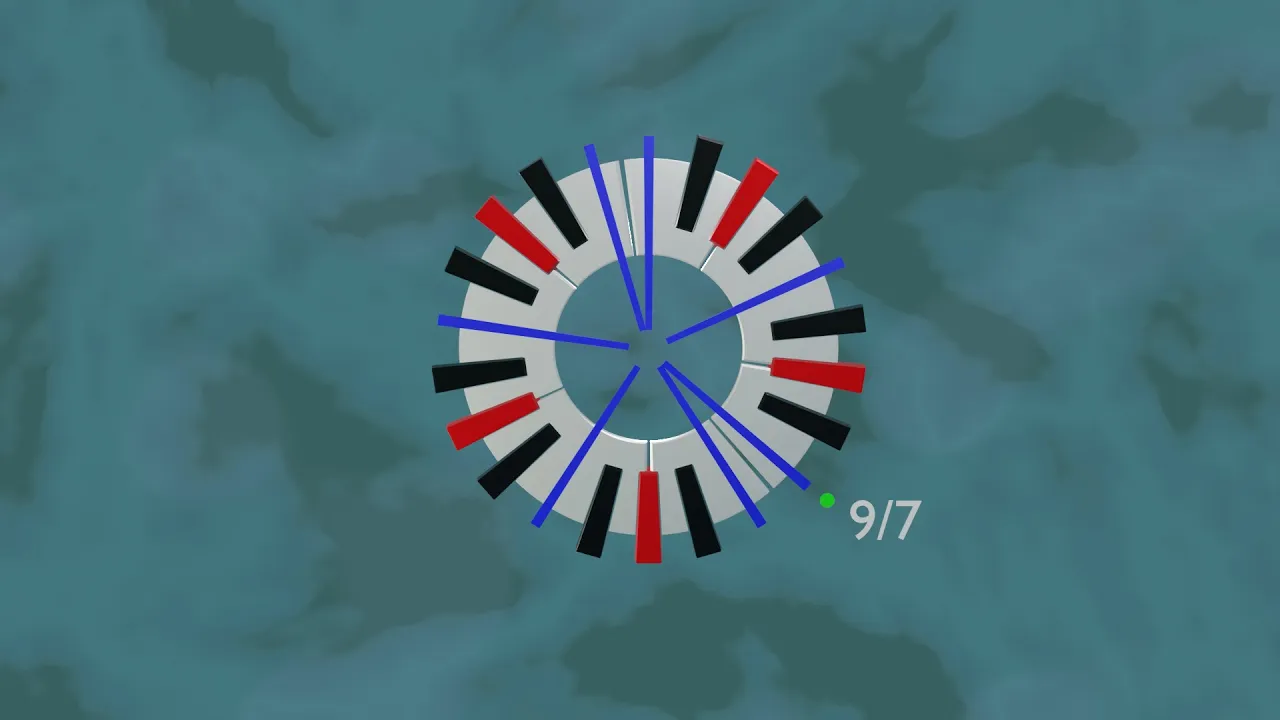
Making Sense of Microtones by Stacking Fifths
45.6K
This section examines advanced equal divisions of the octave. Super-pythagorean tunings use fifths sharper than Pythagorean: 17edo creates diatonic structures with distinct flats and sharps; 22edo approximates the septimal supermajor third (9/7) closely using four fifths, while still approximating 5/4 with nine fifths (an augmented second). 31edo provides meantone-like qualities without comma-drift by flattening fifths until three small steps equal two large ones. 19edo balances accessibility with expanded harmonies, providing extra pitch classes including harmonic seventh chords while maintaining most familiar musical concepts. These tunings demonstrate how generator size fundamentally transforms interval relationships and harmonic possibilities.
Click to watch →

Scale 4047: Decatonic Chromatic 7
131
Scale 4047 is a decatonic (10-tone) chromatic scale with pitch class set 0,1,2,3,6,7,8,9,10,11 and structure [1,1,1,3,1,1,1,1,1], which has a binary representation of 1111110011111 (decimal 4047); it possesses the Myhill property (each generic interval has exactly two specific interval sizes), contains 10 modes including decatonic chromatic 8 through 6, exhibits reflective symmetry at 4.5 semitones, has 9 hemitones and 8 coherence points, and features a coherence quotient of 0.728 and sameness quotient of 0.593, making it suitable for musical use despite having imperfections and not being perfectly even.
Click to watch →

hyper-analyzing nearly identical chords {453}
110
Microtonal tunings vary dramatically in playability and temperament. Some tunings are temperamental - intervals not tuned purely either sound great or terrible (like 41 EDO). Others are forgiving (like 53 EDO). 22 EDO is easygoing with only the 9-7 interval problematic. 19 EDO is highly temperamental, producing sounds ranging from excellent to dissonant. These characteristics affect compositional approach: temperamental tunings require careful harmonic attention, while forgiving tunings allow experimental freedom. The choice of tuning fundamentally shapes musical possibilities and creative constraints.
Click to watch →
Deep Dive
Practical application of microtonal software tools (such as Scala and MTS-ESP) to configure synthesizers for alternative tuning systems.
Microtuning - Exploring new frequencies // Novation Live
5.7K
The Lima software exports tuning systems as Scala files (.scl format). The Base Station 2 has MIDI Tuning System (MTS) support, allowing users to upload custom tuning tables. The Peak synthesizer has 16 built-in tuning tables that can be saved and recalled. Users can create custom tuning systems in Lima by adding notes at arbitrary frequencies, then export the Scala file and upload it to the Base Station 2. This enables musicians to implement custom microtonal tunings on hardware synthesizers, demonstrating the practical application of microtonal theory.
Click to watch →
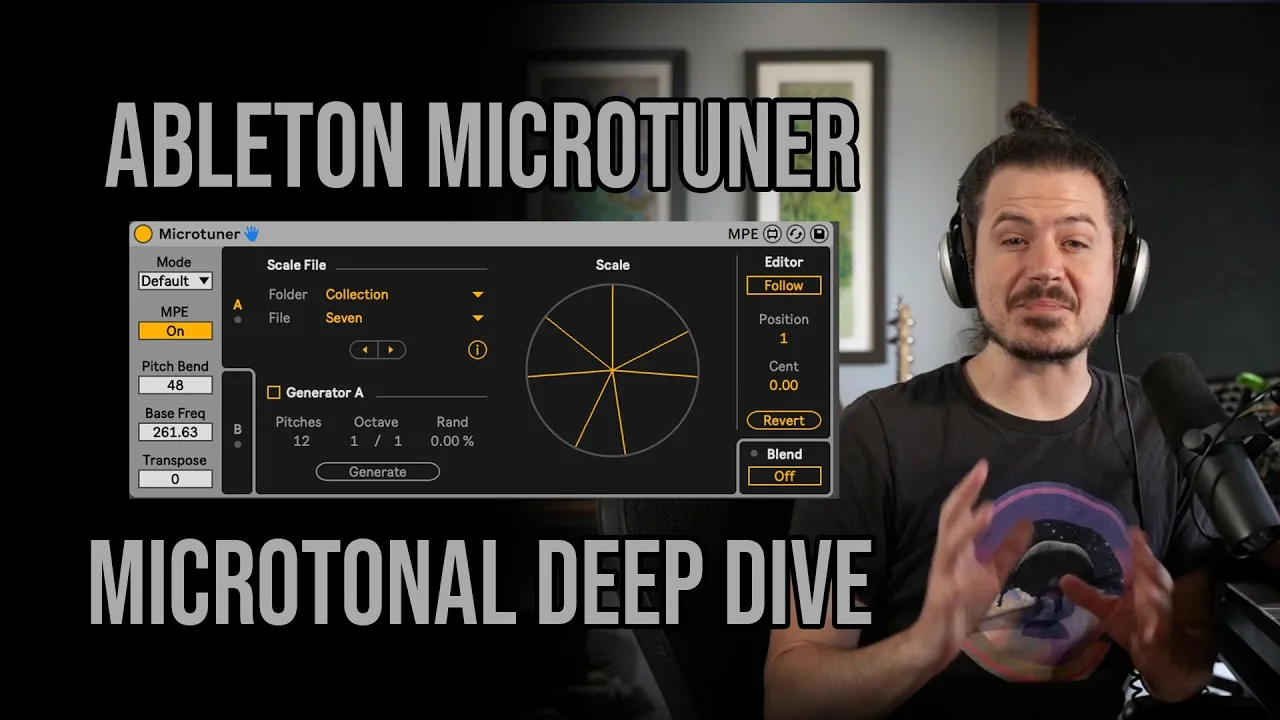
Ableton Microtuner - Microtonal Music with Ableton Live
44.6K
Microtuner includes access to 5,000 Scala tuning files through the help view. These files can be downloaded and dragged directly into microtuner. When multiple microtuners are connected, dragging one scale file tests it across your entire set, allowing you to quickly audition different tunings on all tonal sounds.
Click to watch →
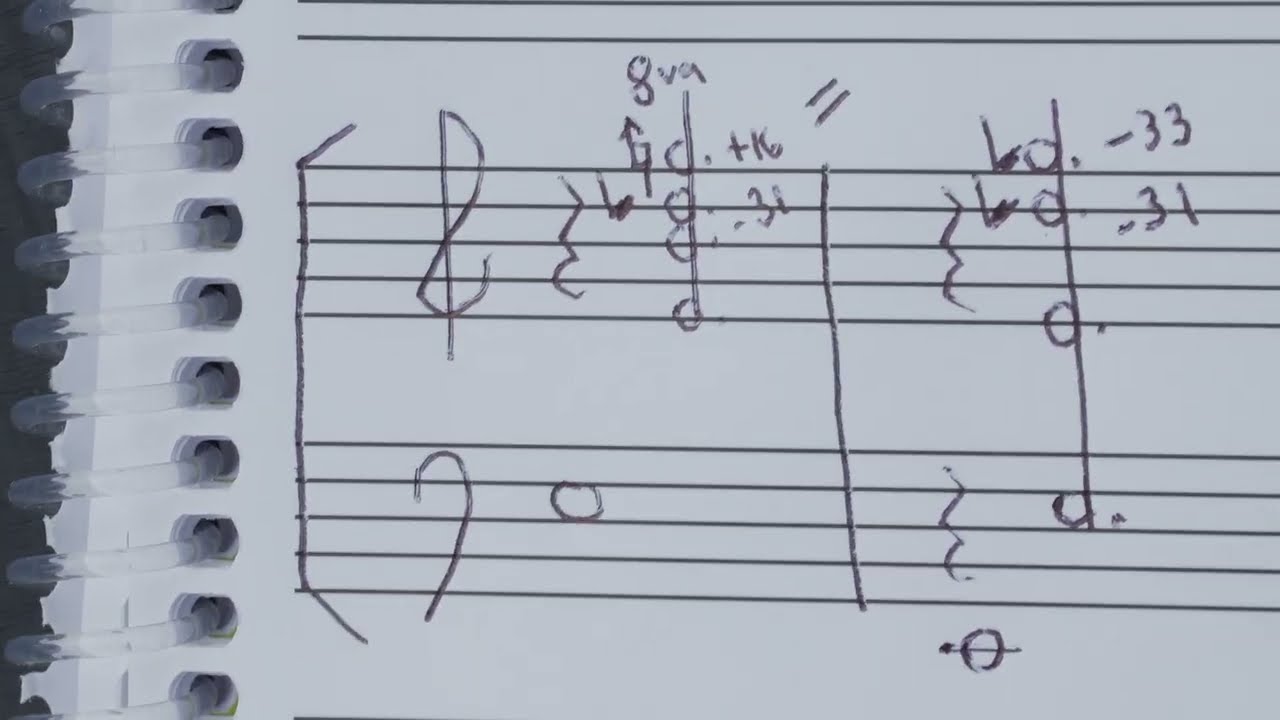
Microtonal Software Tutorials: Part 1
3.3K
This tutorial demonstrates how to use the Vienna Synchron Player software to implement microtonal tuning, including features like cent deviation adjustment on the piano roll, support for various tuning systems (22 EDO, just intonation), and keyboard mapping for non-standard scales. The presenter shows practical techniques such as applying the same cent deviation across all octaves of a note, creating custom Scala files for scales like 22 EDO, and combining multiple software instances to create interesting microtonal effects.
Click to watch →

Çifteli: This microtonal instrument changed the way I think about music
1.3M
The Çifteli (shiftili) is a traditional folk instrument from Albania and Kosovo that uses a microtonal tuning system based on the Turkish makam husseini scale, which divides the octave into 53 intervals rather than the 12 equal parts used in Western music; this demonstrates how different cultures develop unique musical scales outside the Western 12-tone equal temperament system, and how modern digital audio software can be adapted to support these alternative tunings for authentic musical reproduction.
Click to watch →
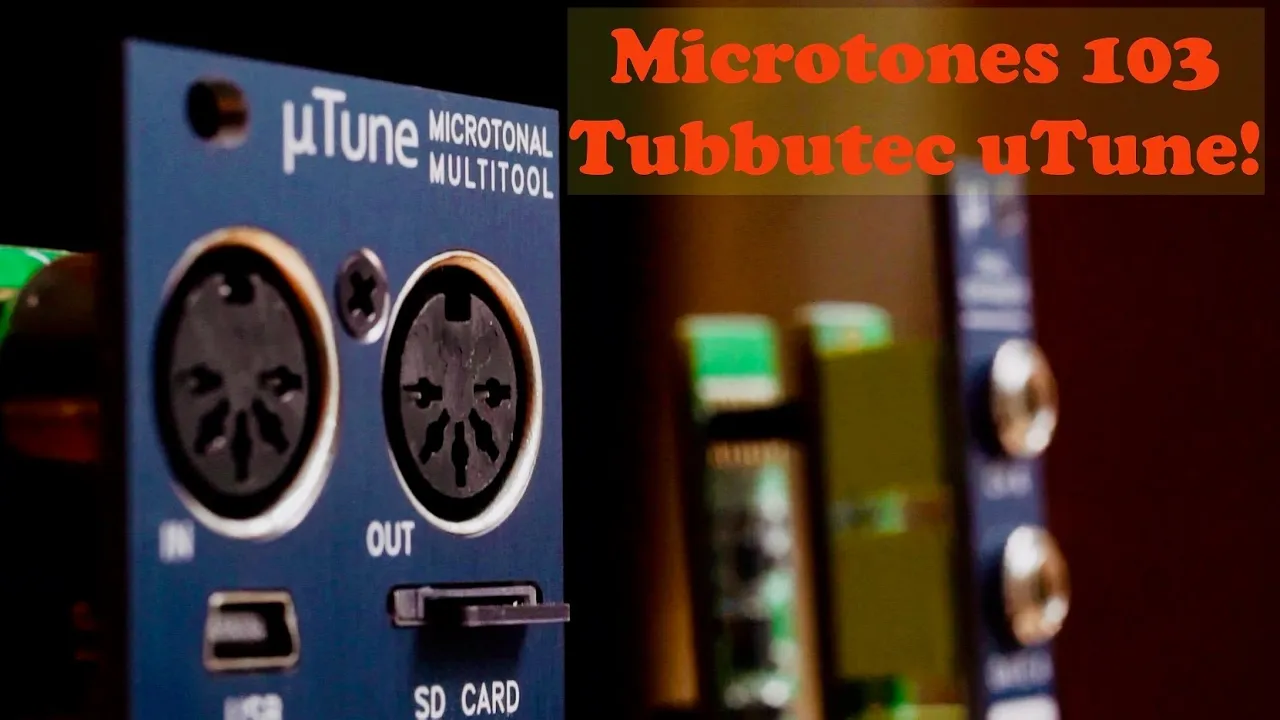
Microtones 103 - Tubbutec uTune, the right multitool for the job!
7.5K
The module provides access to thousands of pre-loaded tunings including the complete Scala archive of microtonal scales organized alphabetically. Users can create custom Equal Division of Octave (EDO) scales by specifying notes per octave, with the module automatically displaying octave points. The system supports ratio-based editing where users can define intervals using frequency ratios (e.g., 3:2 for perfect fifth) and receive descriptive interval names. Channel configuration allows independent assignment of CV/Gate outputs, MIDI channel routing, and pitch bend range matching to selected scales. System Exclusive routing enables sending tuning data directly to microtuning-capable synthesizers like the Yamaha SY77.
Click to watch →
Deep Dive
Comparative study of other equal division systems, such as 19-EDO and 31-EDO, to analyze their respective harmonic and melodic characteristics.
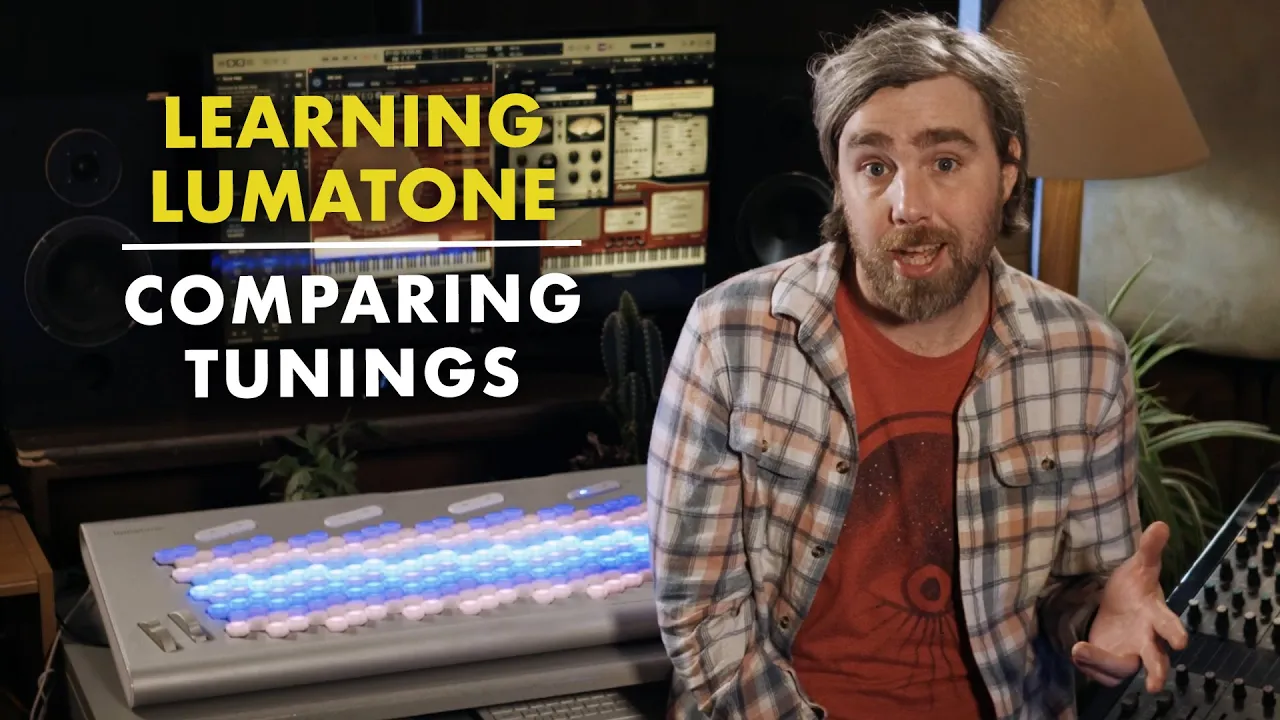
Learning Lumatone: Ep. 31 - "Comparing Tunings"
2.9K
Different microtonal tunings (19-EDO, 22-EDO, 31-EDO, 41-EDO, and 53-EDO) approximate just intonation differently, with each tuning offering unique musical characteristics: 41-EDO and 53-EDO provide excellent approximations of just intonation, while 22-EDO offers distinctive new musical territories; the perfect fifth remains relatively stable across tunings with deviations of about 7 cents flat in 19-EDO and 7 cents sharp in 22-EDO, and while individual interval differences may seem subtle, they create an accumulated effect that makes each tuning stand apart in terms of musical feel and capability.
Click to watch →
Now and Xen Podcast: 087 Chris Kline
176
In projective tuning space, temperament quality depends on generator position relative to just intonation. Generators nestled within dense regions (near large numbers) produce better temperaments, while sparser outer regions produce worse results. For mean tone, 31-EDO is excellent, 19-EDO is good, but moving further out creates increasingly deformed intervals. The schisma (≈1.95 cents) is the difference between three Pythagorean commas; temperaments like 12-EDO, 17-EDO, 41-EDO, and 53-EDO temper it out.
Click to watch →
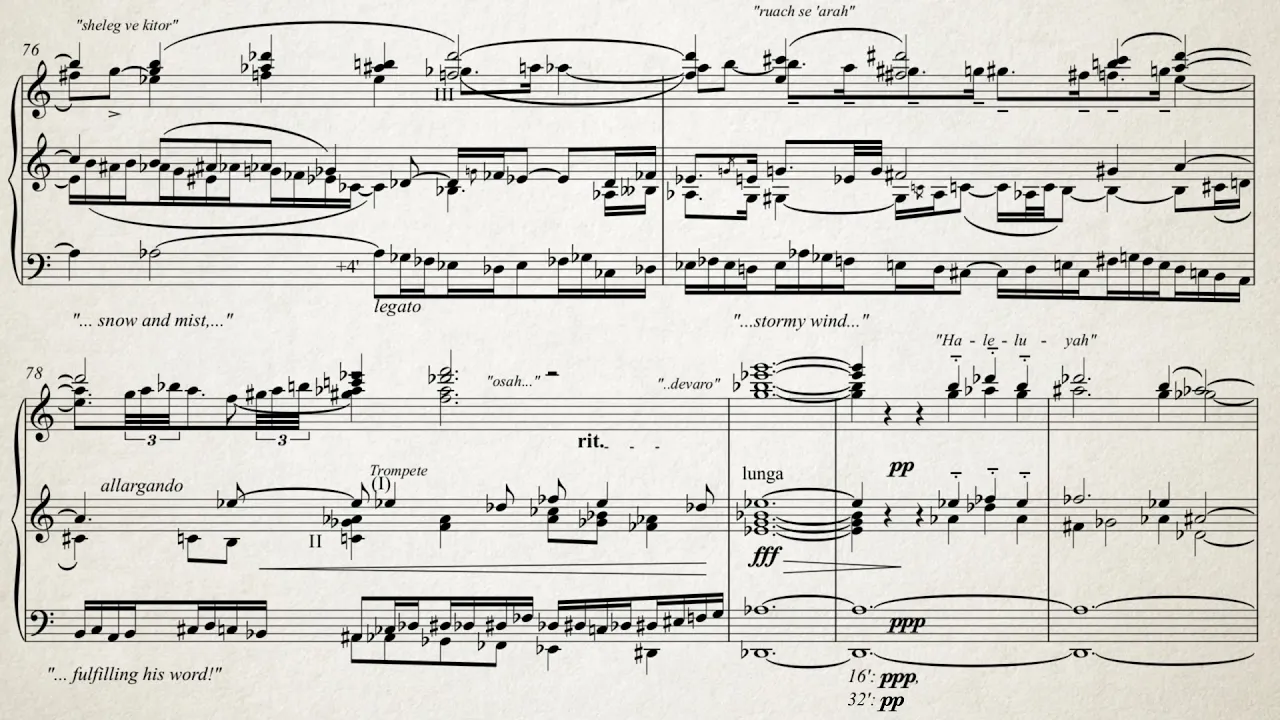
Fabio Costa: "Meditation" in 19-EDO (1/3-tone) - 2 versions: Orchestra / Organ
7.5K
Fabio Costa’s "Prelude-Meditation" was originally composed in 12-EDO but inherently suggested higher-limit harmonics—specifically those involving ratios 7:, 11:, and 13:—which are poorly approximated in 12-tone equal temperament. He later transcribed the piece into 19-EDO, which more accurately represents these intervals: 7: is only 20 cents off just intonation (vs. 30 in 12-EDO), 11: is 20 cents off (vs. 50), and 13: is 20 cents off (vs. 40). 19-EDO is described as an archi-meantonal system, closely resembling third-comma meantone tuning, tempering out the syntonic comma (81:80) in three steps, resulting in a nearly just 6:5 minor third. It also tempers out 45:44, aligning the lydian augmented fourth with the 11th harmonic. The 63-cent step size remains within a comfortable critical band, offering good harmonic clarity without excessive complexity. Costa believes 19-EDO reveals the deep meantonal character intuitively present in the original composition. Two versions exist: orchestral and organ, with the organ version recommended first for clearer harmonic perception. Each version offers a distinct auditory perspective on the same harmonic structure. Additional versions in 12-EDO and 19-limit just intonation are available for comparative listening.
Click to watch →

How To Notate Microtonal Music
10.4K
Microtonal music is defined as music written in tuning systems other than the standard 12-note system, with more than 12 notes per octave creating notes between semitones. The 19-EDO system divides an octave into 19 equal divisions, adding 7 notes and making previously enharmonically equivalent notes (like C and Db) distinct. The 24-EDO system doubles notes per octave, introducing quarter tones and requiring new accidentals (half-sharp, half-flat) for notation. In 24-EDO, C half-sharp is enharmonically equivalent to Db half, and D half-flat is equivalent to C# half. These systems demonstrate how increasing notes per octave creates new harmonic relationships and notation requirements.
Click to watch →

Learning Lumatone: Episode 21 - "19-EDO Basics"
12.7K
The 19-EDO (Equal Division of the Octave) tuning system divides the octave into 19 equally spaced intervals of approximately 63.2 cents each, providing a manageable gateway to microtonality that extends the familiar 12-note tuning by adding seven more notes. Unlike 12-EDO where enharmonic equivalents like C# and Db are the same note, 19-EDO treats them as distinct, enabling new intervals such as the super major third, augmented fourth, and B-sharp. While 19-EDO offers more accurate minor and major thirds compared to 12-EDO (closer to Just Intonation), it sacrifices accuracy in perfect fourths and fifths (about 7 cents off versus 2 cents in 12-EDO). This tuning system creates unique harmonic possibilities including sub-minor triads, super-major triads, and pure-sounding sixths, demonstrating that all tunings have distinct sonic characteristics rather than being universally 'in-tune' or 'out-of-tune.'
Click to watch →
Deep Dive
The psychoacoustics of consonance and dissonance, specifically exploring how synthesizer timbre design can be tailored to match 22-EDO tuning to reduce sonic beating.
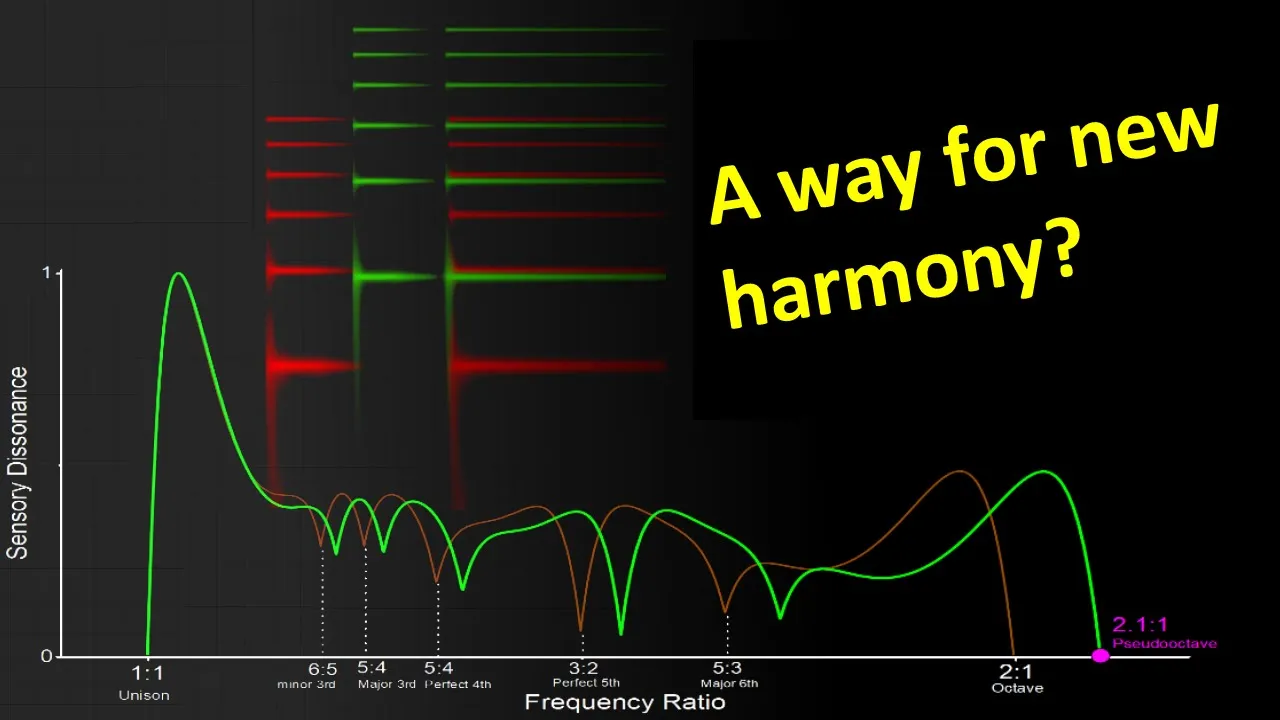
Can Octave Sound Dissonant?
18.7K
Research identifies three major mechanisms contributing to perceived dissonance: (1) Spectral interference/beatings between misaligned partials, (2) Periodicity - how close the spectrum is to a harmonic spectrum, and (3) Cultural conditioning - learned associations with consonance/dissonance. To demonstrate, stretched spectra (where partials deviate from harmonic series) cause dissonance even when frequency ratios remain perfect. By stretching tuning proportionally (e.g., 2.1:1 instead of 2:1), dissonance can be minimized. This shows that tuning must match spectral characteristics - Just Intonation works for harmonic spectra, while stretched tunings suit inharmonic sounds. The relationship between timbre and tuning is fundamental to understanding musical harmony.
Click to watch →

Ableton Live: Psytrance FM leads w/ Wavetable
28.9K
The 'tune' parameter in Wavetable allows detuning the modulator oscillator against the carrier oscillator. Values of 50%, 100%, -50%, and -100% yield consonant timbres, while other values yield dissonant timbres. This creates a transition from consonant to dissonant back to consonant timbres by editing the tune parameter.
Click to watch →

Exploring Microtonal Guitar in 22 EDO: Intervals and Demonstration
40.6K
In 22 Equal Division of the Octave (22 EDO), each step is approximately 54 cents, which is close to a quarter tone (50 cents in 24 EDO), allowing for new consonant intervals while maintaining familiar chord structures like the major triad; this tuning system provides intervals such as a neutral second (11:10 ratio), subminor third (7:6 ratio), and 11:8 interval that sit between standard Western intervals, creating novel harmonic colors while preserving musical consonance.
Click to watch →
Psychoacoustics: Explaining Tonotopicity, Consonance, and Dissonance | Susan Rogers | Berklee Online
24.1K
The human auditory system exhibits tonotopicity, meaning specific frequencies activate particular locations on the basilar membrane; this frequency-to-place mapping explains why small integer ratio intervals (like octaves 1:2, perfect fifths 2:3, and perfect fourths 3:4) are perceived as consonant, while closely spaced frequencies produce difference products and roughness that create dissonance, as demonstrated by the tritone interval's unpleasant quality.
Click to watch →
Intro To Synthesis Part 2: Shaping Multiple Oscillators | Reverb Learn To Play
197.8K
Beyond octave settings, oscillators can be tuned with fine-grained pitch adjustments. Slightly detuning two oscillators at the same octave creates a phenomenon called 'beating,' where the slight frequency difference produces a pulsing, organic sound effect. This imperfect but lively quality is a hallmark characteristic of synthesizer design.
Click to watch →
Opening
Intro
Main Topic
Details
Examples
Summary
Opening
0:52- 1
Video starts with music.
- 2
No clear content yet.
The Case for Pure Just Intonation (JI) over Equal Temperaments
While 22-tone equal temperament (22edo) offers a unique microtonal palette by approximating various non-standard intervals, proponents of Just Intonation (JI) argue that equal temperaments inherently compromise acoustic purity. Just Intonation utilizes whole-number frequency ratios based on the natural harmonic series, producing perfectly consonant chords free of the acoustic 'beating' or phase interference caused by tempered approximations. In electronic and ambient music, where synthesizers can achieve precise frequency control, critics argue that utilizing dynamic Just Intonation is superior to imposing another rigid, tempered grid like 22edo. From this perspective, rather than dividing the octave into equal, artificial steps, composers should embrace the natural physics of sound to achieve ultimate harmonic clarity and psychoacoustic resonance.
Fundamentals of 12-Tone Equal Temperament (12-TET), including basic interval arithmetic and standard Western scale construction.
The acoustic concept of Just Intonation (JI) and how division-of-the-octave systems approximate pure integer frequency ratios.
An introduction to the concept of microtonality and xenharmonic music, specifically how 'cents' are used to measure interval sizes.
Basic chord theory, including triads, seventh chords, and extensions, to provide a basis of comparison for complex microtonal chords.
In-depth analysis of 22-EDO scale structures, such as decatonic scales, and how they map to specific historical temperaments like superjust.
Practical application of microtonal software tools (such as Scala and MTS-ESP) to configure synthesizers for alternative tuning systems.
Comparative study of other equal division systems, such as 19-EDO and 31-EDO, to analyze their respective harmonic and melodic characteristics.
The psychoacoustics of consonance and dissonance, specifically exploring how synthesizer timbre design can be tailored to match 22-EDO tuning to reduce sonic beating.
1.7K views64likes4:58@XotlaOriginal Release: 2019-06-29
[Music] [Music] [Music] [Music] [Music] [Music] [Music] [Music] [Music] [Music] [Music] [Music] [Music] [Music] [Music]
Up Next
17:49
Master Microtonal Music with the M4L Microtuner | Ableton Live Guide
@SeedtoStage
44.6K views•2022-04-07

10:20
Mozart's Musical Dice Game Explained: History, Rules, & Fun
@webpianoacademy
5K views•2023-03-13

47:36
Understanding Diatonic 7th Chords in Major Keys | Music Theory Tutorial
@GracieTerzian
54.7K views•2022-03-02
10:49
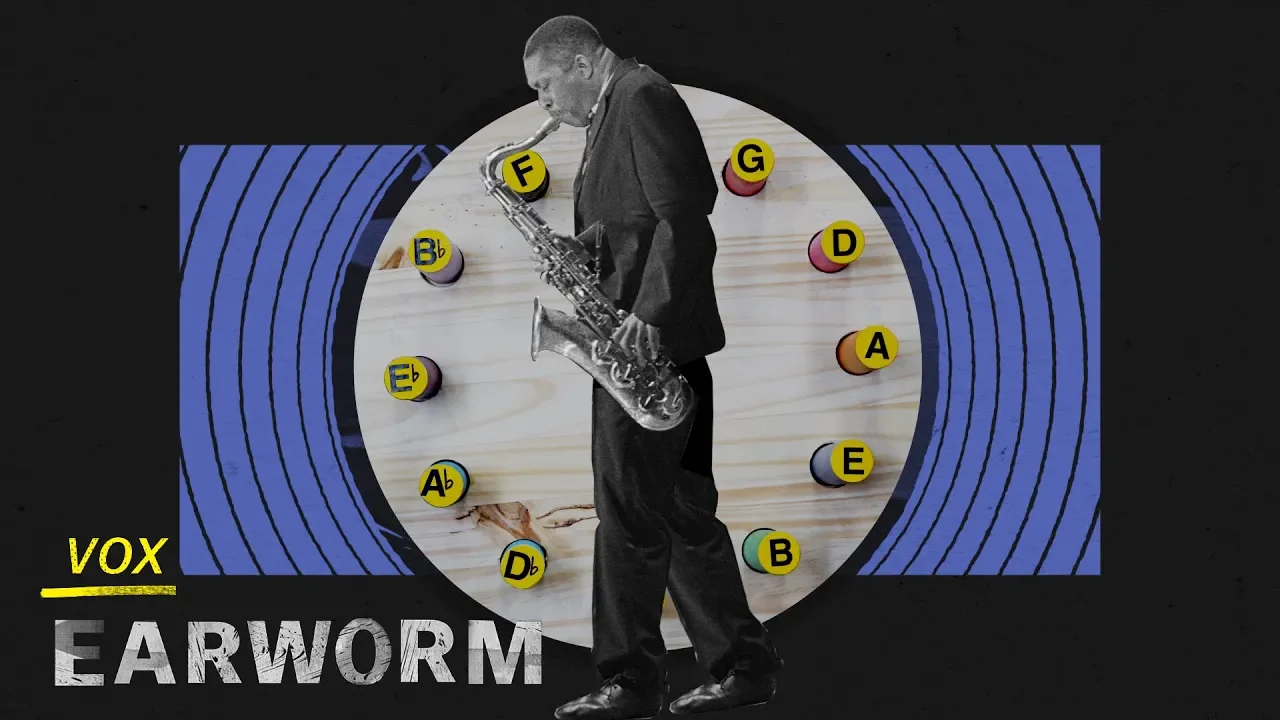
Understanding John Coltrane's Giant Steps: A Music Theory Analysis
@Vox
10.4M views•2018-11-12
Related Study Plans & Knowledge Roadmaps
Structured learning paths in Music Theory
music-theory
Composing Galant Music: Partimento & Schemata
01Foundations of Figured Bass and Keyboard Harmony
02The Rule of the Octave (Regola dell'Ottava)
03Galant Schemata: The Building Blocks of Form
+ 2 more learning modules
30h5 modules
Explore Roadmap
music-theory
Decoding Overtone Series: Tuning & Drone Music
01Acoustic Foundations: The Physics of the Overtone Series
02Tuning Systems: Equal Temperament vs. Just Intonation
03Microtonality and Spectralism: Beyond Standard Pitches
+ 2 more learning modules
24h5 modules
Explore Roadmap
music-theory
Impressionist Harmony: Scales, Planing & RPGs
01Foundational Music Theory: Keys, Intervals, and Seventh Chords
02Impressionist Color: Chord Planing and Parallel Harmony
03Whimsical Textures: Pentatonic Cascades and Whole-Tone Scales
+ 1 more learning modules
14h4 modules
Explore Roadmap
music-theory
Negative Harmony: Axis Reflection in Indie Pop
01Music Theory Foundations: Scales, Intervals, and Triads
02Functional Harmony and the Circle of Fifths
03Demystifying the Negative Harmony Axis Reflection
+ 2 more learning modules
16h5 modules
Explore Roadmap