When Western music adopted twelve-tone equal temperament in the 18th century, it sacrificed just intonation—a tuning system based on whole number ratios that creates naturally occurring harmonics more in tune with each other—for the ability to play in all keys without retuning; this means that while equal temperament provides consistent tuning across all keys, it introduces subtle imperfections in intervals like the perfect fifth that make them sound slightly discordant compared to the pure, resonant tones of justly tuned instruments such as Koshi chimes.
Equal Temperament vs Just Intonation: What We Lost in Music
Added:Deep Dive
The physics of sound waves, frequency, and the harmonic series, specifically how whole-number ratios (like 2:1 and 3:2) relate to pure musical intervals.

The Harmonic Series Explained: The Physics Of Pitch
310
A harmonic is a micro-frequency that occurs naturally when a musical note is played, where the string vibrates at multiple frequencies simultaneously; every harmonic is a whole-number multiple of the baseline frequency (e.g., for an A note at 110 Hz, the harmonics are 220 Hz, 330 Hz, 440 Hz, etc.), and these harmonics maintain consistent vibration ratios (2:1, 3:2, 4:3) regardless of the starting pitch, creating what is known as the harmonic series.
Click to watch →

Plus One Model Exam | Physics - Super 60 | Xylem Plus One
188K
For a string fixed at both ends, the allowed frequencies are fₙ = n(v/2L), where n = 1, 2, 3... is the harmonic number, v is wave speed, and L is string length. The fundamental frequency (n=1) is f₁ = v/2L, and higher harmonics are integer multiples: f₂ = 2f₁, f₃ = 3f₁, etc. The ratio of frequencies is 1:2:3:4...
Click to watch →
David Sulzer, "Music, Math, and Mind: The Physics and Neuroscience of Music"
4.7K
Sound waves are periodic vibrations in air that push and pull molecules back and forth. Humans hear frequencies from 20 Hz to 20,000 Hz, with an octave representing frequency doubling (e.g., 440 Hz to 880 Hz). The siren mechanism demonstrates how spinning discs with holes create sound through alternating high and low pressure pulses. Pythagoras discovered that musical intervals correspond to simple whole-number ratios using a monochord: dividing a string in half produces an octave (2:1), thirds produce a fifth (3:2), and quarters produce a fourth (4:3). These ratios form the harmonic series—the sequence of notes that naturally occur when strings vibrate. When sound waves combine, they reinforce or cancel each other based on alignment, creating the foundation for understanding consonance and dissonance in music.
Click to watch →
Armonía 3ºEP - La serie Armónica y la consonancia
10.9K
Sound is defined as air vibration, with stable homogeneous vibrations producing musical notes. Frequency measures vibrations per second (Hertz), with human hearing ranging from 20-20,000 Hz. Musical instruments produce fundamental notes plus harmonic components. The harmonic series consists of integer multiples of the fundamental frequency. Pythagoras discovered that dividing a string in half produces an octave (frequency ×2), while dividing into three parts produces a perfect fifth (frequency ×3). These relationships form the mathematical basis of musical consonance.
Click to watch →
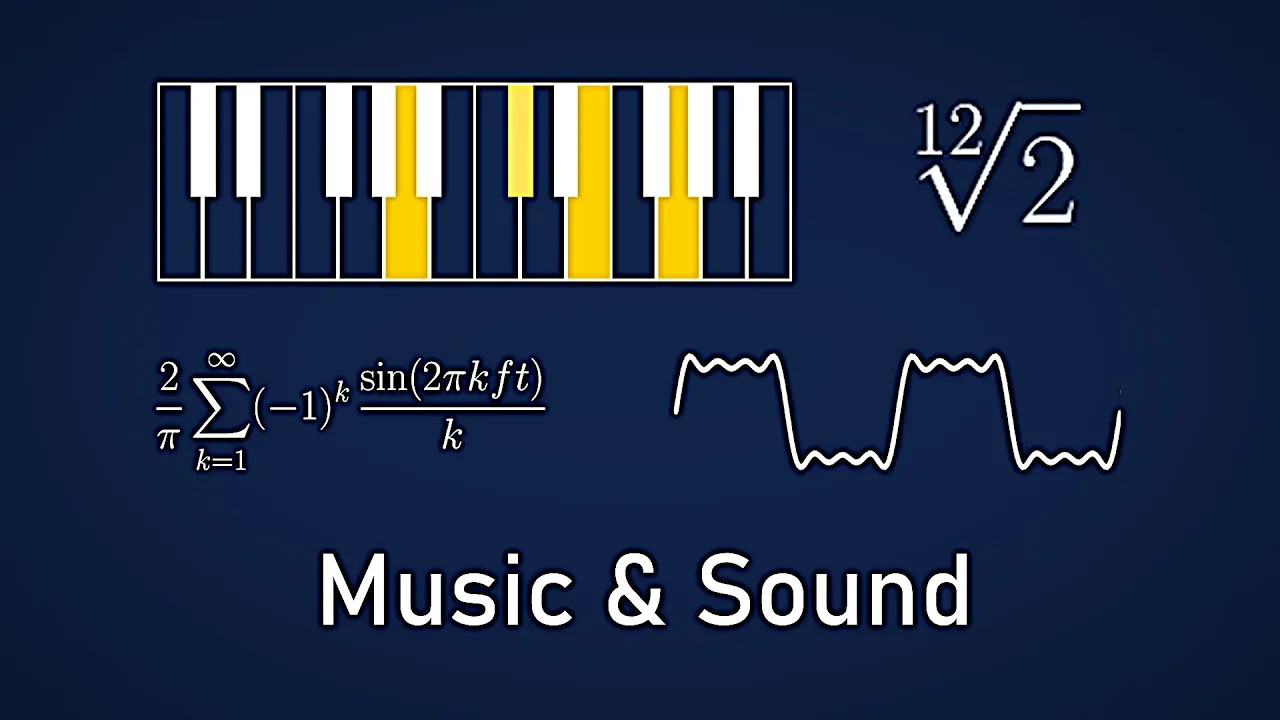
The Math Behind Music and Sound Synthesis
655K
Sound is produced by vibrations traveling through air as longitudinal waves with compressions and rarefactions; pitch relates exponentially to frequency (not linearly), meaning intervals with the same ratio (like 1:2 for an octave) sound equally spaced, while consonant intervals like the perfect fifth (ratio 2:3) and major third (ratio 4:5) sound harmonious due to simple whole-number frequency ratios, whereas dissonant intervals like the tritone (ratio √2) sound unstable because they lack such simple ratios; musical instruments produce tonal sounds when their frequencies align with the harmonic series (integer multiples of the fundamental), while inharmonic frequencies create atonal sounds; and electronic sound synthesis uses four basic wave shapes—sine, triangle, square, and saw waves—each constructed from combinations of sinusoidal waves with different harmonic relationships.
Click to watch →
Deep Dive
Fundamental music theory concepts, including the construction of major/minor scales, intervals, and the circle of fifths.
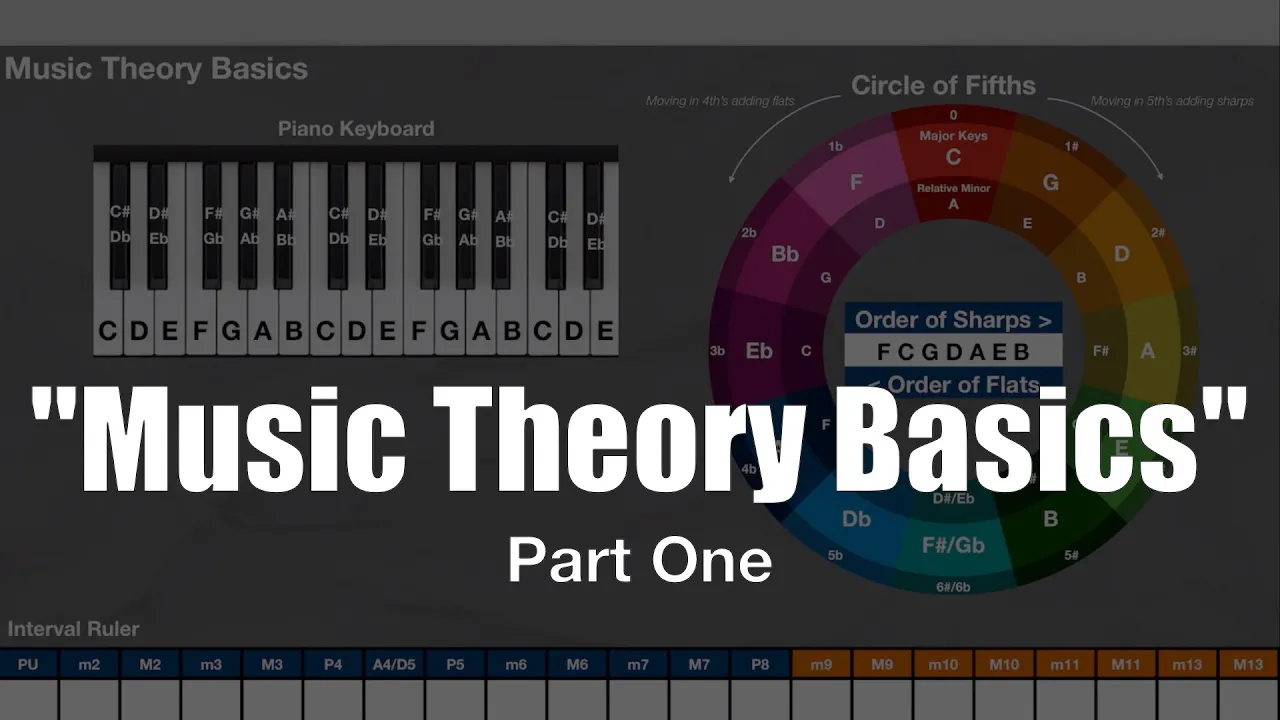
Music Theory Crash Course | Part 1- Intervals, Scales and Circle of Fifths
1.8K
Music theory provides musicians with a systematic way to communicate and understand music without instruments. The piano keyboard uses 12 notes (A-G with sharps/flats) where sharps raise pitch by one semitone and flats lower it by one semitone. Intervals measure the distance between notes: minor second (1 semitone), major second (2 semitones), minor third (3 semitones), major third (4 semitones), perfect fourth (5 semitones), and perfect fifth (7 semitones). The circle of fifths arranges all 12 notes in a circle based on perfect fifth intervals, with C major having 0 sharps/flats, G major having 1 sharp, and so on. To build any major scale, start with the root note and apply the appropriate sharps or flats from the order of sharps/flats. Relative minor keys share the same notes as their major counterparts but start on the sixth degree of the major scale.
Click to watch →

Como Dominar o Campo Harmônico Maior
591
Musical intervals are distances between notes measured in whole tones and semitones. The interval table shows: semitone = minor 2nd, whole tone = major 2nd, 1.5 tones = minor 3rd, 2 tones = major 3rd, 2.5 tones = perfect 4th, 3 tones = augmented 4th/diminished 5th, 3.5 tones = perfect 5th, 4 tones = augmented 5th/minor 6th, 4.5 tones = major 6th, 5 tones = minor 7th, 5.5 tones = major 7th, 6 tones = perfect 8th. The major scale follows the pattern: whole tone - whole tone - semitone - whole tone - whole tone - whole tone - semitone. The Circle of Fifths arranges all 12 notes in order of perfect fifths, with sharps accumulating as you move right (C:0, G:1, D:2, A:3, E:4, B:5, F#:6) and flats accumulating as you move left (F:1, Bb:2, Eb:3, Ab:4, Db:5, Gb:6). This system allows practical construction of all major scales by knowing the number and order of accidentals.
Click to watch →

Fundamentos básicos da música tonal: escalas diatônicas, ciclo das quintas e campo harmônico
149
The Circle of Fifths constructs major scales by moving up perfect fifths. Starting from D major (0 sharps), the next tonality is G major (1 sharp). Take the fifth note of D major (Sol) as the new fundamental and apply the diatonic formula. The seventh note (Fá) must be raised to Fá# to maintain correct intervals. Each subsequent tonality adds one more sharp, always altering the seventh note. The sequence is: D (0 sharps) → G (1 sharp) → C (2 sharps) → F# (3 sharps) → B (4 sharps) → E (5 sharps) → A (6 sharps) → D# (7 sharps). This systematic approach allows construction of all major scales.
Click to watch →
How to use circle of fifths - practical tips
730
This comprehensive lesson covers essential music theory concepts. A scale is a set of notes or tones, with an octave containing 12 sounds and a scale containing 8 notes. The C major scale is the most commonly used because it only uses white keys with no sharps or flats. An interval is the distance between two sounds, such as a half tone between C and C sharp or a whole tone between C and D. The circle of fifths is a powerful tool showing relationships between major and minor scales, where each major scale has a corresponding minor scale. The magic formula for building minor scales is: Whole, Half, Whole, Whole, Half, Whole, Whole. The magic formula for building major scales is: Whole, Whole, Half, Half, Whole, Whole, Half. These formulas allow musicians to build any scale from scratch. Pentatonic scales are reduced versions useful for improvisation, created by removing specific degrees from major or minor scales. The instructor demonstrates practical applications including building chord progressions in different keys and converting notes to chords.
Click to watch →

Scales, Chords, Intervals & Circle of Fifths
314
A major scale consists of seven notes built using whole steps and half steps. The pattern is: whole step, whole step, half step, whole step, whole step, whole step, half step. For C major, the notes are C-D-E-F-G-A-B. To build scales for other keys, use the circle of fifths: moving up adds sharps (C to G to D), moving down adds flats. A sharp is a half step up, a flat is a half step down. This systematic approach allows musicians to construct any major scale by applying the same interval pattern.
Click to watch →
Deep Dive
The historical development of fixed-pitch instruments, such as the piano or organ, and the mechanical challenge of tuning them to play in multiple keys.
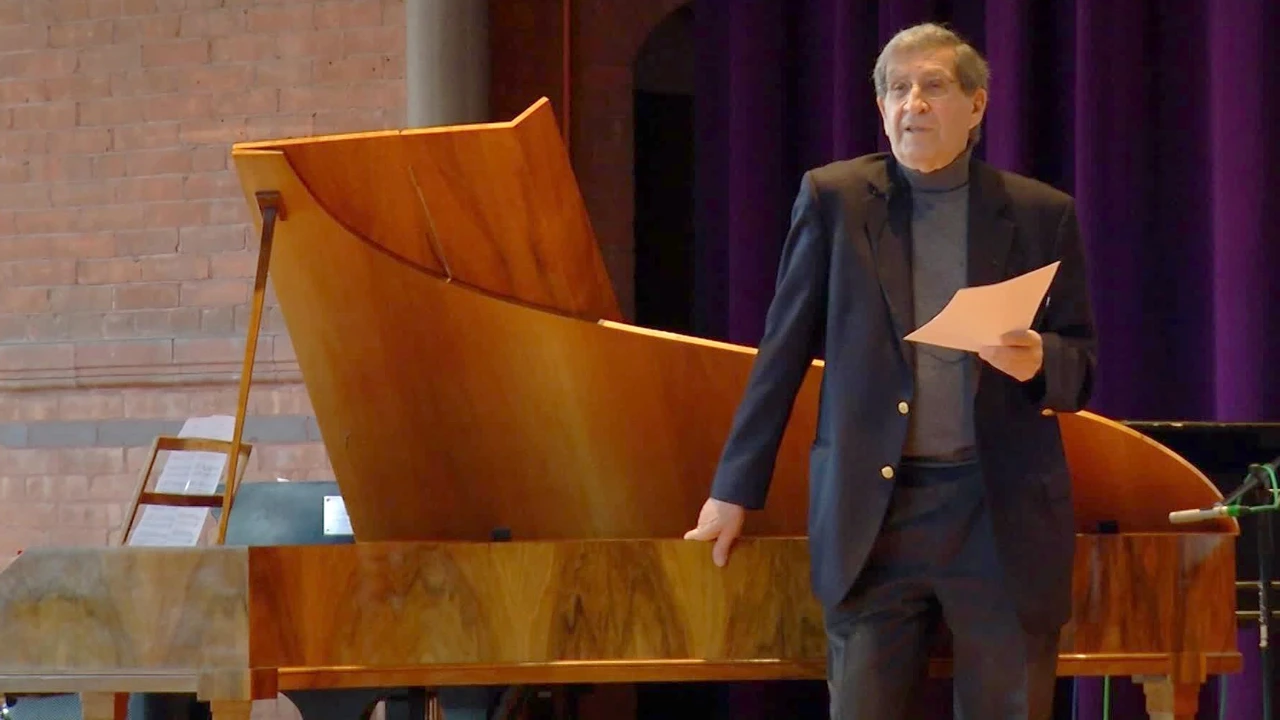
A Piano is not a Piano is not a Piano...
14.9K
Historical pianos have different pedal systems than modern pianos. Some have no pedals but have knee levers, and a Celeste stop that brings a cloth strip between the hammer and string. Some have a third pedal that shifts the keyboard to play fewer strings. The piano hammer evolved like a series of bells: smaller bells have smaller, harder hammers, while larger bells have larger, softer hammers. This corresponds with strings getting bigger and heavier. Modern pianos are tuned in equal temperament, while historical pianos are tuned so one key sounds nicer and another sounds harsher. Composers moved through these keys differently, and this changed in the later 19th century.
Click to watch →

L'organo a canne più PICCOLO del MONDO - con Carlo Dell'Orto e @fabiobonizzoni-larisonanza461
5.2K
While Truhen organs have Baroque origins, they developed significantly in modern times when traveling orchestras became common. The organ can accommodate two pitch standards (440 Hz modern and 415 Hz historical) through a dual pitch system with additional pipes for each key. Tuning takes approximately two hours and can be set to any temperament, though the organ has limited pitch range due to physical constraints. The organ is temperature-sensitive and requires 1-2 hours to acclimate to a new environment before tuning. The touch-sensitive pipes change articulation based on key speed, reflecting historical musical practices where variety was achieved through touch rather than register changes.
Click to watch →
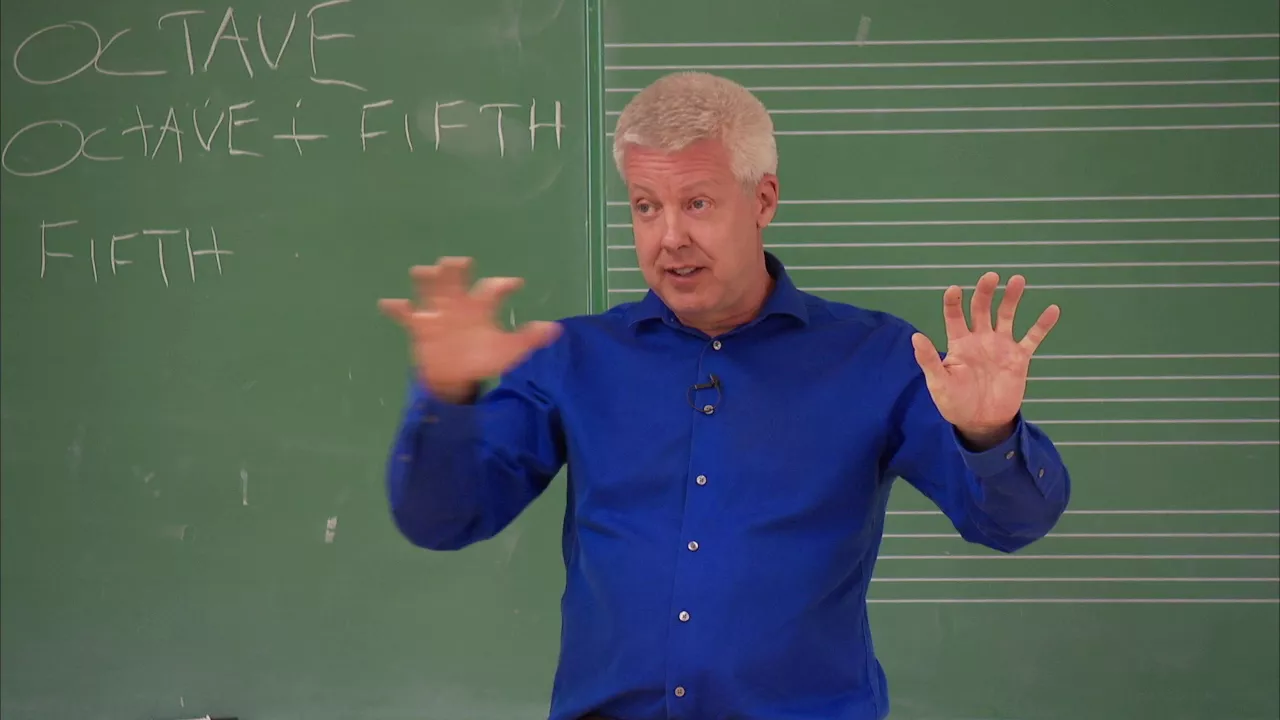
The Fundamentals of Sound, Overtones, and Tuning
801
Just tuning is perfect alignment of all overtones with no dissonance. However, on fixed-pitch instruments like pianos, perfect just tuning is mathematically impossible because stacking perfect octaves (2:1) and fifths (3:2) never returns to the same pitch. Temperament is the necessary compromise. Equal temperament, the most common, makes every key equally out of tune, with major thirds beating at about 7 beats per second. This is why pianos sound the way they do.
Click to watch →
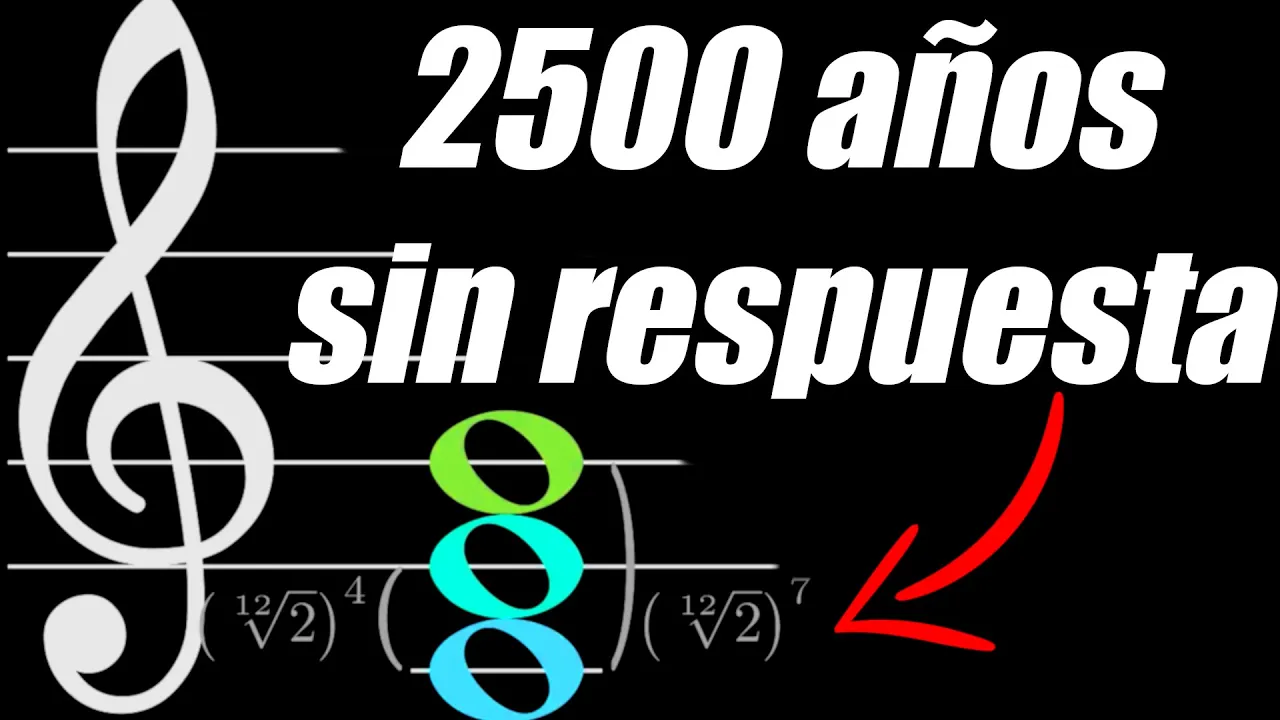
El Problema Musical que NADIE ha podido resolver
455.4K
Musical instruments face a fundamental tuning dilemma: natural tuning based on the harmonic series produces pure intervals but causes frequency drift during harmonic progressions, while equal temperament divides the octave into 12 equal parts to allow playing in any key but creates impure intervals. This mathematical impossibility of perfect tuning has driven centuries of innovation, from Pythagorean tuning with pure fifths (creating the Pythagorean comma) to quarter-comma meantone (creating the wolf fifth) to Bach's well-tempered system, culminating in modern equal temperament as the practical compromise for fixed-pitch instruments like pianos and guitars.
Click to watch →

Bonifazio Asioli - Osservazioni sul temperamento proprio degli stromenti stabili - Milano 1816
293
Bonifazio Asioli's 1816 treatise 'Osservazioni sul temperamento proprio degli stromenti stabili' presents practical methods for achieving equal temperament on fixed-pitch instruments like harpsichords and organs. Asioli argues that while equal temperament (dividing the octave into 12 equal semitones) was theoretically known since ancient times, the practical challenge lay in developing reliable tuning methods. He proposes using thirds (major and minor) and sixths as the primary tuning intervals, rather than relying solely on fourths and fifths, to achieve a more uniform temperament. The treatise provides several specific methods, including dividing the octave into five parts using combinations of thirds and fifths, with the goal of creating equal semitones and consistent intervals across all keys.
Click to watch →
Prerequisite Knowledge
- Concept 01The physics of sound waves, frequency, and the harmonic series, specifically how whole-number ratios (like 2:1 and 3:2) relate to pure musical intervals.
- Concept 02Fundamental music theory concepts, including the construction of major/minor scales, intervals, and the circle of fifths.
- Concept 03The historical development of fixed-pitch instruments, such as the piano or organ, and the mechanical challenge of tuning them to play in multiple keys.
Subsequent Learning
- Step 01The study of transitional tuning systems, such as Pythagorean tuning, Meantone temperament, and Well-temperaments, and their influence on classical repertoire.
- Step 02Microtonality and xenharmonics, exploring modern compositions that utilize non-traditional scale divisions (such as 19-TET or 31-TET) and pure just intonation.
- Step 03Psychoacoustics and auditory perception, analyzing how the human brain experiences acoustic 'beating' in equal-tempered intervals versus the stability of pure chords.
- Step 04Practical application in digital music production, learning how to load and use custom tuning maps (such as Scala files) in software synthesizers.
Bells Intro
Elemental Sounds
Piano Contrast
Final Verdict
Bells Intro
0:00Playing Section
- 1
Introduces Koshi chimes, handcrafted in France with just intonation.
- 2
Explains pre-equal temperament tuning offers more consonant harmonics.
- 3
Claims chimes produce a positive feeling versus discordant piano.
The Triumph of Tonal Freedom: Why Equal Temperament Enabled Modern Music
While critics of Equal Temperament (12-TET) lament the loss of the 'pure' mathematical intervals found in Just Intonation, defenders argue that 12-TET was not a tragic compromise, but a monumental creative breakthrough. Just Intonation restricts musicians to a single key; modulating to distant keys on fixed-pitch instruments produces jarring, out-of-tune intervals known as 'wolf intervals.' By distributing the acoustic discrepancy (the Pythagorean comma) evenly across all twelve semitones, 12-TET democratized the keyboard. This compromise enabled seamless modulation to any key, paving the way for the complex harmonic journeys of late classical, romantic, and modern music. Without equal temperament, the development of Western classical, jazz, and popular music would have been severely constrained by acoustic limitations. Rather than a loss of purity, 12-TET represents the liberation of musical expression, allowing composers to navigate the entire tonal landscape fluidly and expanding the boundaries of human creativity.
Deep Dive
The study of transitional tuning systems, such as Pythagorean tuning, Meantone temperament, and Well-temperaments, and their influence on classical repertoire.

Temperaments - What you need to know
1.4M
Temperaments are systems that define the exact sizes of musical intervals; historically, they evolved from Pythagorean tuning (pure fifths creating a 'wolf' interval) to meantone temperaments (prioritizing pure major thirds), then to irregular/well-tempered temperaments (offering some pure intervals while others sound tense), and finally to equal temperament (where all 12 fifths are equally tempered to close the circle, becoming the dominant system by the 19th century despite being technically achievable only with modern tuning machines).
Click to watch →

Piano Tuner Shows Classical Repertoire Performed in Historical Tunings
195.1K
Historical tuning systems like well temperament and mean tone temperament produce distinctly different sound qualities compared to equal temperament. Keys are based on major thirds with different widths, creating unique qualities—narrower major thirds produce contracted, darker sounds, while wider major thirds produce vibrant, shimmering sounds. Mean tone temperament, used as late as Chopin's time, has more extreme qualities with more pronounced differences between keys. Key coloration refers to the different qualities of keys, with specific colors representing different interval widths: yellow for large major thirds, purple for small minor thirds, green for regular major thirds, and blue for regular minor thirds. There are 24 separate keys, each with its own unique relationship to itself.
Click to watch →
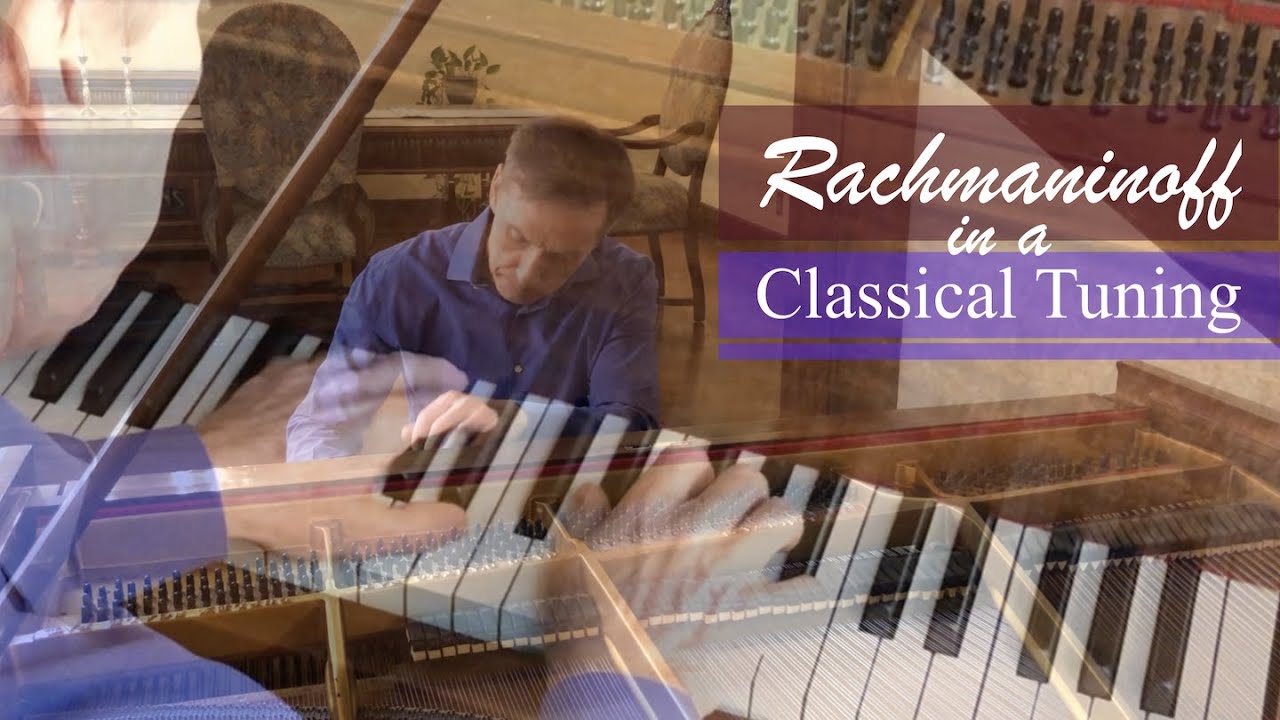
Rachmaninoff in a Classical Well Tempered Tuning
10.5K
Classical well-tempered tuning creates distinct tonal colors and emotional qualities in different keys that are lost in modern equal temperament; this explains why Rachmaninoff chose extreme keys like G-sharp minor (with five sharps), as they produce vibrant, agitated sounds in well-temperament that pianists compensate for by playing too fast in modern tuning, missing the nuanced musical details that emerge when performed in the original tuning.
Click to watch →
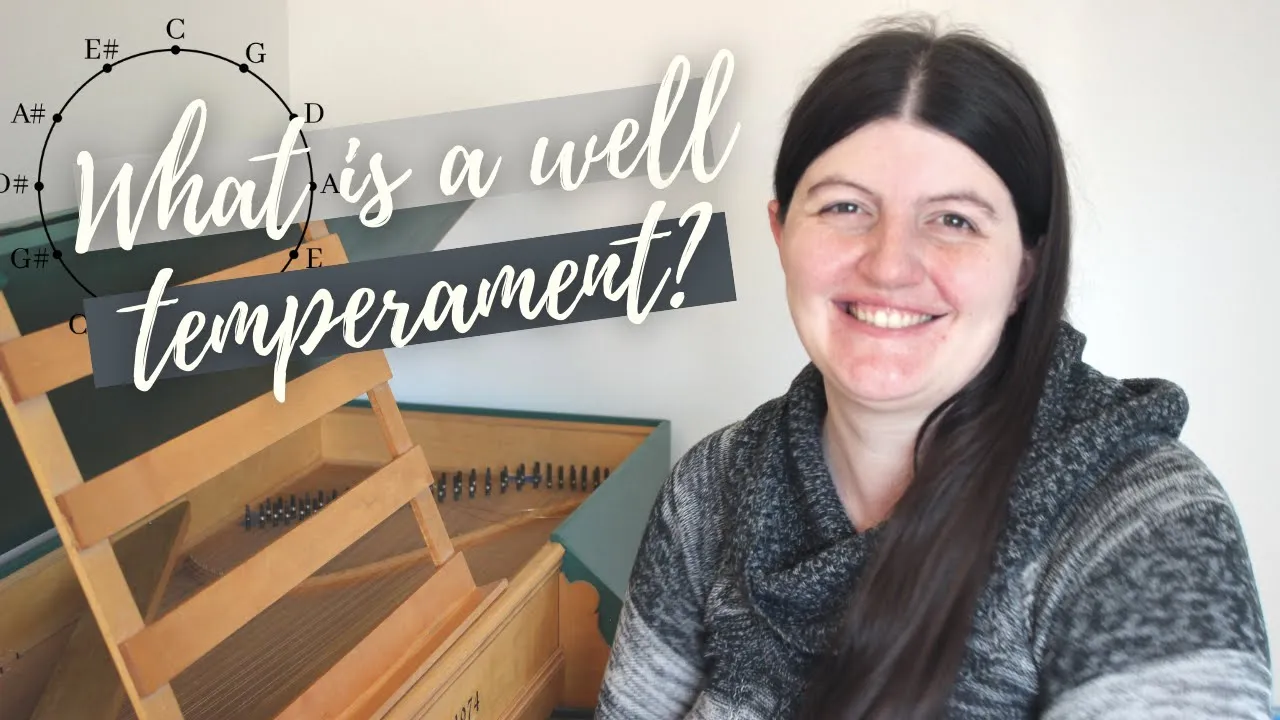
Meantone Temperament and Other Historical Tuning Systems, Part 2
10.3K
Well temperaments are tuning systems that allow satisfactory performance in all 24 major and minor keys without any key being completely unusable, emerging in the late Baroque period as composers like J.S. Bach wrote music in all keys; unlike equal temperament which has uniform intervals and no key-specific character, well temperaments give each key its own unique sound and emotional quality, making them essential for authentic performance of Baroque music such as the Well-Tempered Clavier.
Click to watch →
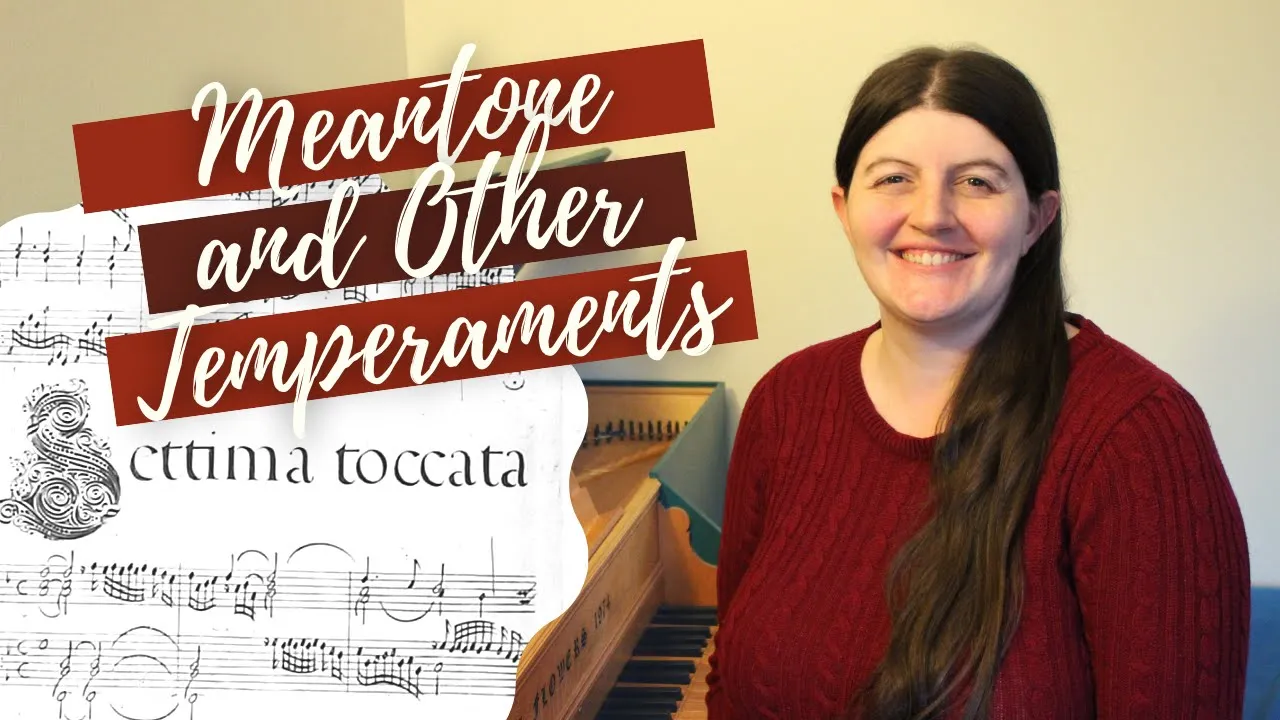
Meantone Temperament and Other Historical Tuning Systems, Part 1
27.1K
In most of Western Classical music history, enharmonics (notes like G# and Ab) were not actually the same pitch due to tuning systems like quarter-comma meantone temperament, which prioritized pure major thirds over equal semitones, resulting in a 'wolf fifth' and requiring musicians to choose between different pitches for enharmonic equivalents; this contrasts with modern equal temperament where all semitones are equal and enharmonics truly coincide.
Click to watch →
Deep Dive
Microtonality and xenharmonics, exploring modern compositions that utilize non-traditional scale divisions (such as 19-TET or 31-TET) and pure just intonation.

Azali's microtonal music transcribed (19-TET, 31-TET)
2.3K
This video demonstrates how to transcribe microtonal music from different equal temperament systems, specifically 19-TET (19 equal divisions of an octave) and 31-TET (31 equal divisions of an octave), using the example of Azali's microtonal pieces 'i have no idea whats happening' (31-TET) and 'there are 19 notes in an octave' (19-TET). The transcription process involves understanding how these systems divide the octave into equal parts, with 19-TET using 3/19 of an octave for whole steps and 2/19 for half steps, while 31-TET uses 5/31 for whole steps and 3/31 for half steps. The video shows how to represent these microtonal intervals on a piano keyboard and demonstrates the unique chord structures created by these non-standard tuning systems.
Click to watch →

Intro to Microtonal and Xenharmonic Theory
3.9K
Microtonal and xenharmonic theory explores how all musical harmony originates from the harmonic series, where every sound wave consists of harmonics at integer multiples of the fundamental frequency; when notes are played together, they construct the harmonic series of a note at half the frequency, creating consonance or dissonance based on how closely their frequency ratios match ideal harmonic intervals like 2:1 (octave), 3:2 (perfect fifth), and 5:4 (major third); temperaments like 12-tone equal temperament approximate these ratios by dividing the octave into equal steps, introducing small errors called commas that affect how chords sound, beat, and behave under distortion, making understanding prime number approximations essential for composing in alternative tunings.
Click to watch →

Qué es la música XENARMÓNICA o MICROTONAL
5.3K
Microtonal music (XENARMÓNICA) explores tuning systems beyond the standard 12-note equal temperament by dividing the octave into different numbers of equal parts (such as 5, 7, 17, 22, or 31 divisions), creating new harmonic relationships and intervals that differ from traditional Western music, where the octave is divided into 12 equal semitones to approximate the natural harmonic series.
Click to watch →
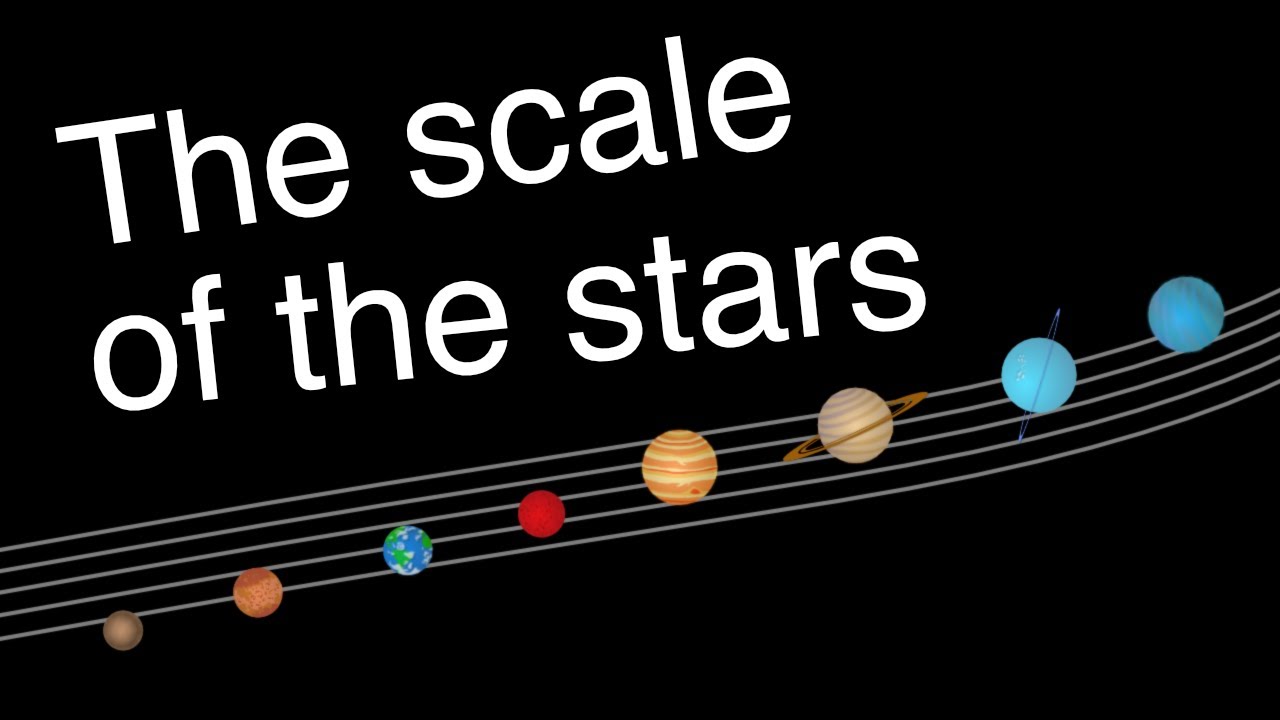
You've never heard (of) these scales...
17.5K
31 TET (31-tone equal temperament) divides the octave into 31 equal parts, creating a smallest step size called the 'fifth tone' (approximately 40 cents), which is about 60 cents smaller than the 12 TET semitone. This microtonal system enables multiple versions of familiar scales by combining different step sizes (chromatone at 80 cents, diatone at 120 cents, and halftone at 160 cents), allowing musicians to recreate Western scales while also exploring new symmetrical scales, non-Western scales like Arabic Maqam, and overtonal scales that approximate the overtone series. The unique step sizes create 'wormholes' for musical exploration, enabling modulation possibilities and novel chord structures that are not possible in traditional 12 TET.
Click to watch →
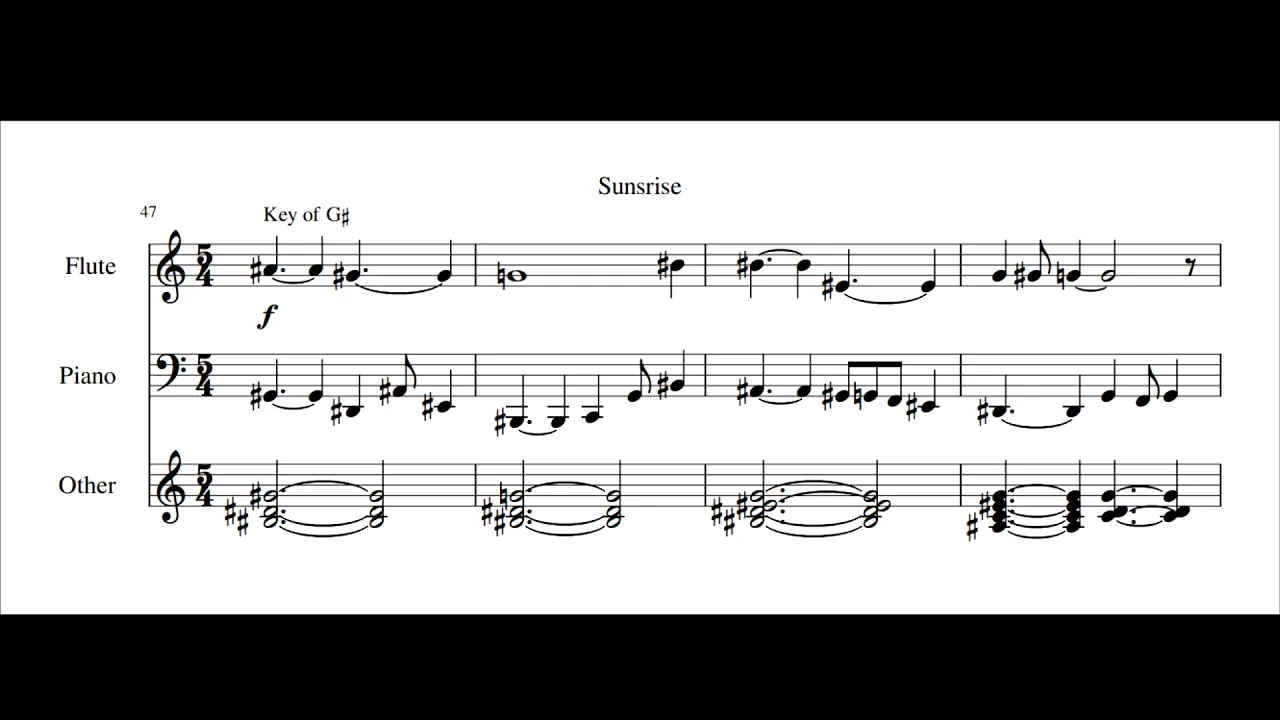
Sunsrise - 19-TET microtonal music
87.1K
This video presents an original musical composition in 19-tone equal temperament (19-TET), a microtonal tuning system dividing the octave into 19 equal parts. The piece begins in B-flat using harmony reminiscent of standard 12-tone equal temperament (12-TET), gradually introducing xenharmonic elements as it progresses. A key structural moment occurs with a modulation to a G# Enneatonic scale, a nine-note subset of 19-TET, which is maintained for approximately one minute. Following this, the composer employs a minor third cycle drift—a technique involving sequential modulations by minor thirds—to return to the original B-flat tonal center. The composer notes that while the piece was not explicitly designed as a compilation of ideas from prior instructional videos on 19-TET, it naturally incorporates techniques and concepts previously explored in those materials, suggesting familiarity with xenharmonic theory and scale construction within 19-TET. The composition serves as an auditory demonstration of how microtonal systems can be used to create evolving harmonic landscapes beyond conventional tuning. Supporting materials including MP3, FLAC, and PDF files are provided for further exploration, and a link to the Xenharmonic Alliance Discord is included for community engagement.
Click to watch →
Deep Dive
Psychoacoustics and auditory perception, analyzing how the human brain experiences acoustic 'beating' in equal-tempered intervals versus the stability of pure chords.

Just Intonation vs Equal Temperament: A Comparative Analysis
377.6K
Just intonation produces pure, resonant harmonic intervals by using natural frequency ratios, while equal temperament slightly detunes intervals to allow modulation between keys; modern technology now enables musicians to restore pure harmony that composers like Bach could only approximate, eliminating the 'rough and restless' beating heard in tempered tuning.
Click to watch →

10 things Van Halen can teach us about food and cooking
312.2K
12-tone equal temperament is the standard Western tuning system that divides the octave into 12 equally spaced notes. This system allows you to play anything in any key and have it all sound equally in tune. However, the interval of a major third sounds noticeably sharp in 12-tone equal temperament because it doesn't get the mathematically perfect whole number ratios of just or pure intonation. This problem is particularly noticeable on overdriven rock guitar because distortion emphasizes a phenomenon called acoustical beating - a nasty sound that happens between two notes that are not perfectly justly tuned.
Click to watch →
Just Intonation vs Equal Temperament: Visual Demonstration
53.6K
Just intonation creates perfectly stable, consonant intervals by tuning notes to simple whole-number frequency ratios, producing no audible beating or pulsing when notes are in tune; however, this system only works optimally within a single key, causing severe tuning problems when modulating to other keys. In contrast, equal temperament distributes tuning compromises evenly across all twelve diatonic keys, allowing musicians to play in any key without significant tuning issues, though none of the intervals are perfectly just—the major third in equal temperament is approximately 13 cents sharper than its just intonation counterpart.
Click to watch →

VERBOTENE FREQUENZEN: DIE GEHEIME HEILKRAFT KLASSISCHER MUSIK!
2K
Bach was a deep expert in the Pythagorean tuning system, understanding the controversy between pure tuning (based on whole-number frequency ratios) and equal temperament (which compromises these ratios for all-key playability). In pure tuning, intervals correspond exactly to Pythagorean ratios: the fifth is 2:3, the third is 4:5. In equal temperament, these ratios are slightly compromised—the fifth is minimally smaller than 2:3, the third is noticeably larger than 4:5. This enables transposition to all keys without retuning but means no interval stands in perfect resonance with the natural overtone series. For normal listeners, the difference is barely perceptible, but for acousticians, it is fundamental. Beat frequencies from musical intervals range from fractions of a hertz to several hertz, overlapping with brain wave patterns: delta waves (1-3 Hz), theta waves (4-7 Hz), alpha waves (8-13 Hz), and gamma waves (30-100 Hz).
Click to watch →
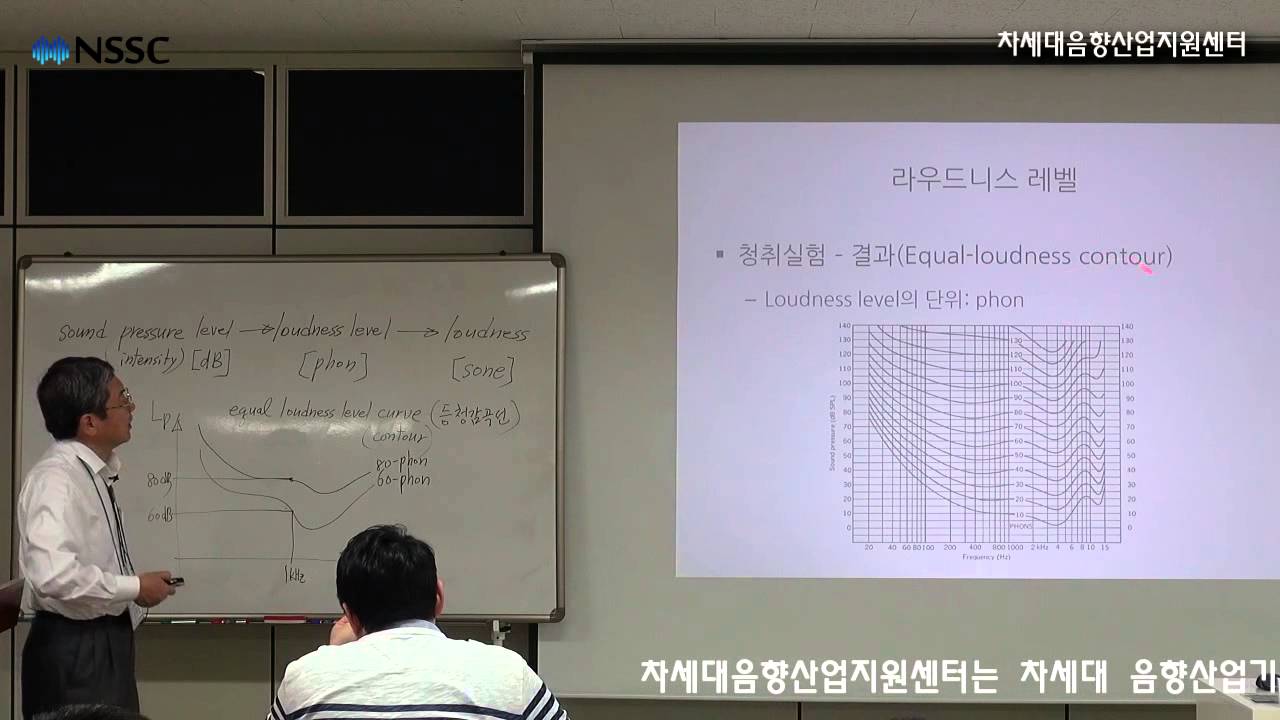
음향학 강의 2_1부 part3
828
Human hearing encompasses fundamental principles including frequency discrimination (average 0.7%, some individuals 0.4%), pitch perception involving nonlinear combination tone generation, and the cent scale for measuring musical intervals (1 cent = 1/100th octave). Below 2000 Hz, increasing intensity decreases perceived pitch; above 2000 Hz, intensity increases perceived pitch. Two major tuning systems exist: just intonation uses exact harmonic ratios (2:3 for perfect fifth) producing pure intervals but causing beats when notes change, while equal temperament divides the octave into 12 equal semitones (2^(1/12) ≈ 1.05946) slightly narrowing fifths to enable key modulation.
Click to watch →
Deep Dive
Practical application in digital music production, learning how to load and use custom tuning maps (such as Scala files) in software synthesizers.
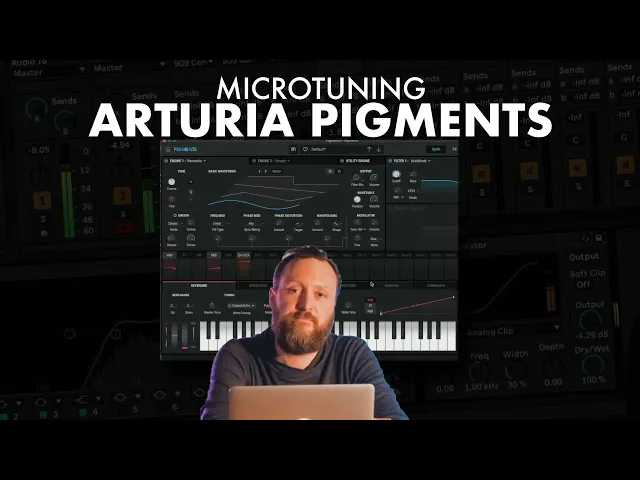
Making Microtonal Hypnotic Techno Using Alternate Tuning in Pigments
4K
Music production software allows users to load custom tuning files in Scala (.scl) format, which contain specific frequency ratios for alternative tunings. When loading a Scala file, the software may specify a reference note (such as A3 or A4), which determines the overall pitch of the tuning. Multiple plugins using the same Scala file should reference the same note to maintain consistency. The video demonstrates loading a custom Scala file that creates a strange collection of frequencies with very small microtonal steps and larger jumps. Musicians can discover unusual intervals that don't exist in the standard chromatic scale, such as 9ths, 10ths, 11ths, and 12ths, by zooming out on the keyboard display.
Click to watch →
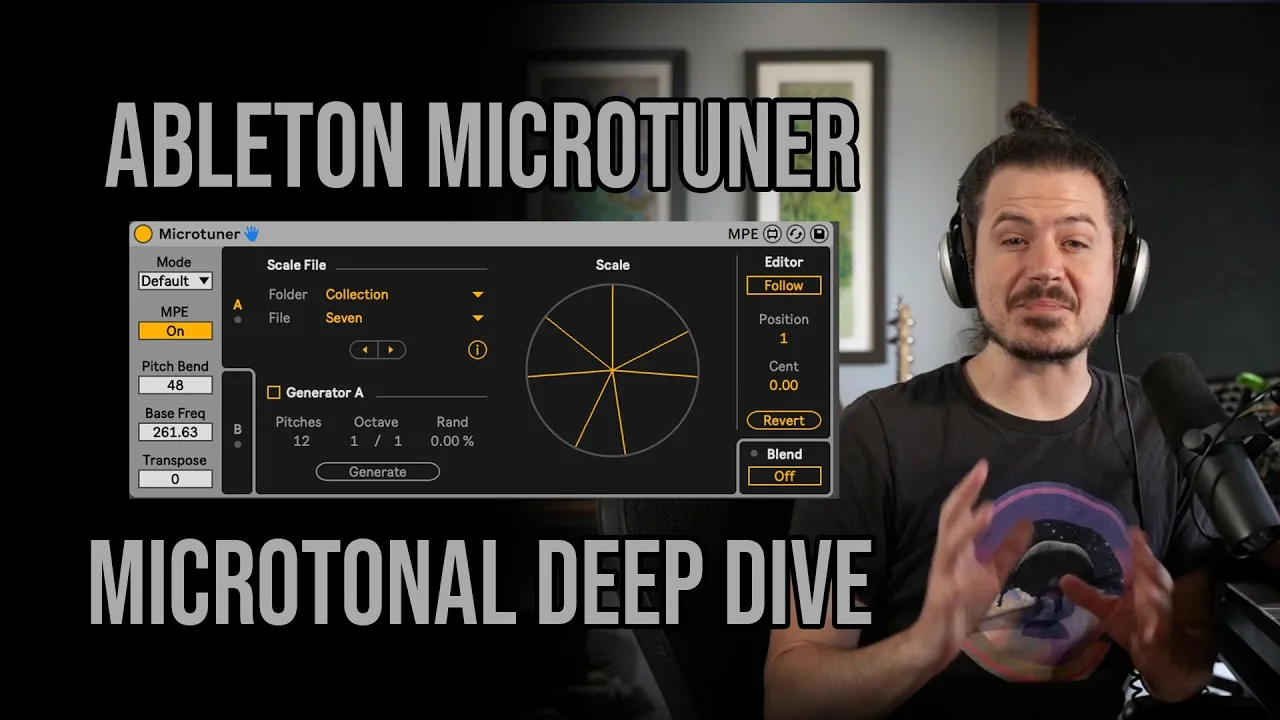
Master Microtonal Music with the M4L Microtuner | Ableton Live Guide
44.6K
Microtuner includes access to 5,000 Scala tuning files through the help view. These files can be downloaded and dragged directly into microtuner. When multiple microtuners are connected, dragging one scale file tests it across your entire set, allowing you to quickly audition different tunings on all tonal sounds.
Click to watch →

Microtuning - Exploring new frequencies // Novation Live
5.7K
The Lima software exports tuning systems as Scala files (.scl format). The Base Station 2 has MIDI Tuning System (MTS) support, allowing users to upload custom tuning tables. The Peak synthesizer has 16 built-in tuning tables that can be saved and recalled. Users can create custom tuning systems in Lima by adding notes at arbitrary frequencies, then export the Scala file and upload it to the Base Station 2. This enables musicians to implement custom microtonal tunings on hardware synthesizers, demonstrating the practical application of microtonal theory.
Click to watch →
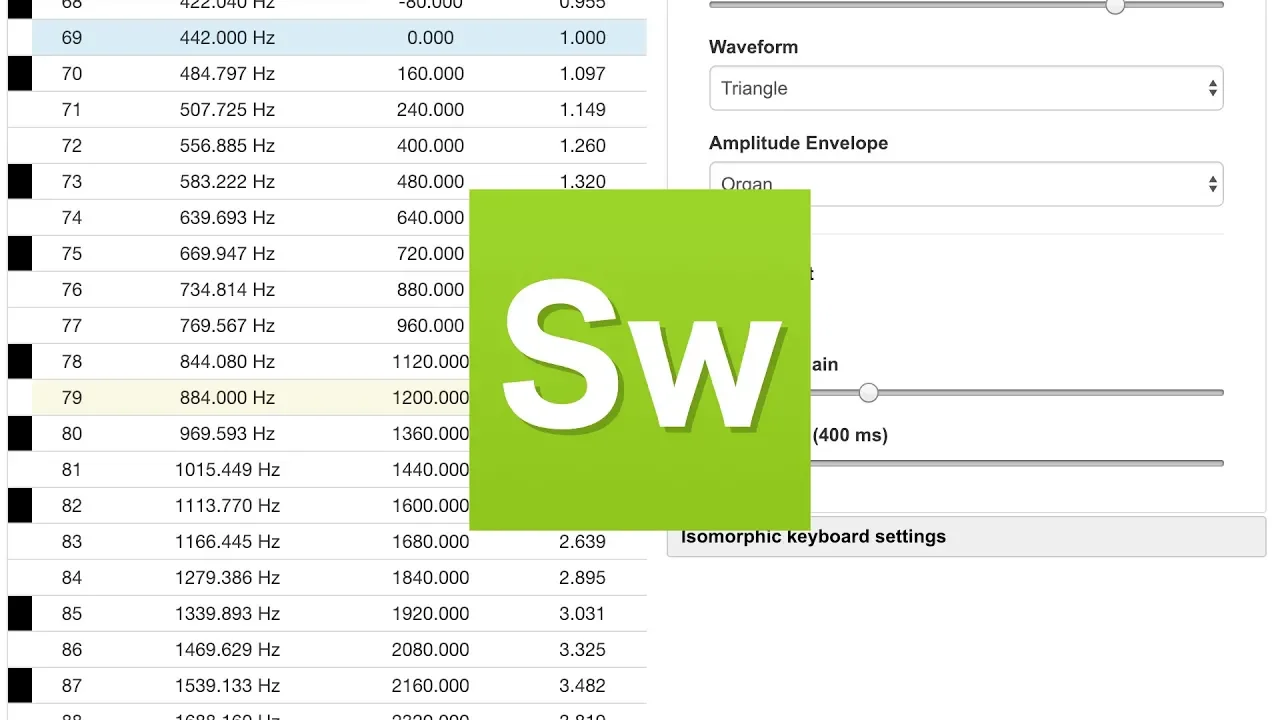
Making microtonal scales with Scale Workshop
12.9K
Scale Workshop enables users to implement custom microtonal tunings across major digital audio workstations and synthesizers. The application supports exporting to multiple formats including Anna Mark Tune files for Omnisphere, Native Instruments, and Serum; Scala files for Arturia synths and GPO 4; Carla files for open-source synths like ZynAddSubFX and Absynth; Max/MSP text files for Max/MSP and Pure Data environments; and Kontakt scripts for Native Instruments Kontakt instruments. This comprehensive compatibility allows musicians to experiment with microtonal tunings across their entire software synthesizer collection.
Click to watch →
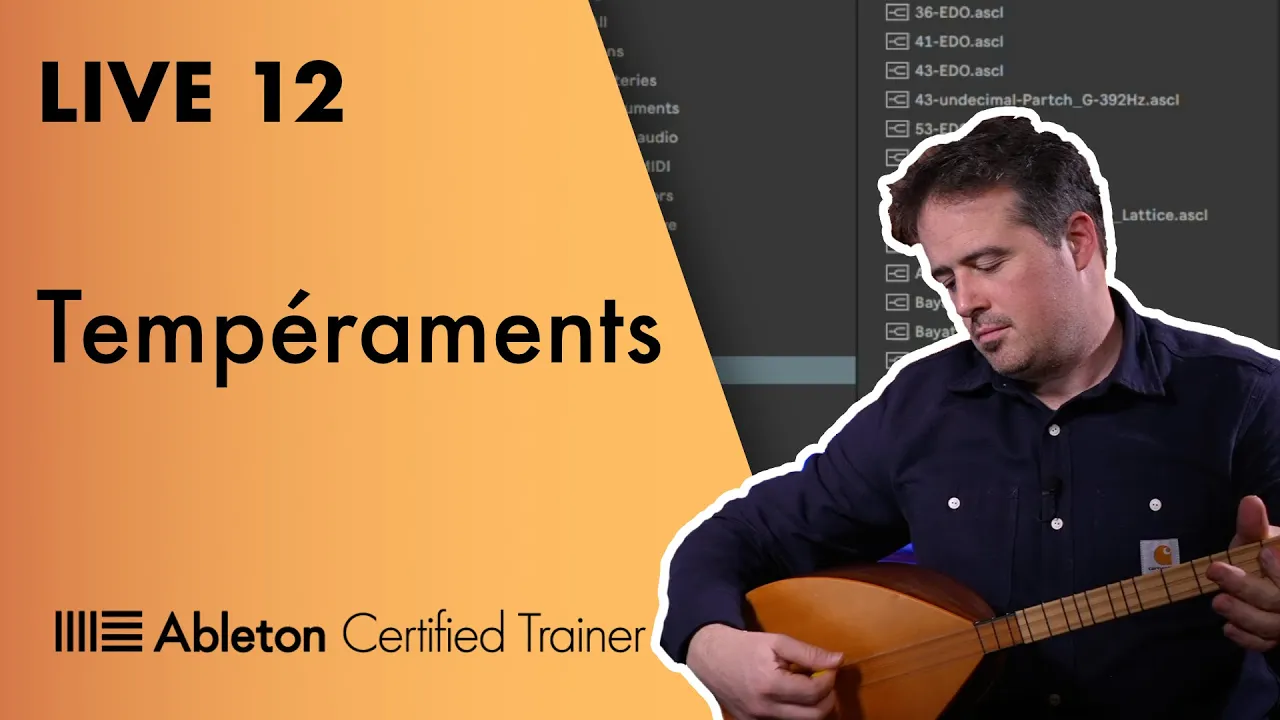
Live 12 : Comprendre et utiliser les tempéraments alternatifs
3.9K
Tuning systems in Live are based on Scala files (.scl files), text files defining specific tunings. The Scala software allows users to create custom tunings for any musical scale. Users can download Scala files from the project website, containing thousands of tunings from around the world. Tuning systems can divide the octave into various numbers of equal parts, including 24 and 31 equal divisions, creating microtonal scales with finer granularity. Live implements tuning by using the pitch bend wheel to adjust pitch note by note. With MIDI 2.0 (MPE), Live provides independent pitch control for each note, enabling polyphonic tuning where each note in a chord can be tuned differently according to the selected system.
Click to watch →
Bells Intro
Elemental Sounds
Piano Contrast
Final Verdict
Bells Intro
0:00- 1
Introduces Koshi chimes, handcrafted in France with just intonation.
- 2
Explains pre-equal temperament tuning offers more consonant harmonics.
- 3
Claims chimes produce a positive feeling versus discordant piano.
The Triumph of Tonal Freedom: Why Equal Temperament Enabled Modern Music
While critics of Equal Temperament (12-TET) lament the loss of the 'pure' mathematical intervals found in Just Intonation, defenders argue that 12-TET was not a tragic compromise, but a monumental creative breakthrough. Just Intonation restricts musicians to a single key; modulating to distant keys on fixed-pitch instruments produces jarring, out-of-tune intervals known as 'wolf intervals.' By distributing the acoustic discrepancy (the Pythagorean comma) evenly across all twelve semitones, 12-TET democratized the keyboard. This compromise enabled seamless modulation to any key, paving the way for the complex harmonic journeys of late classical, romantic, and modern music. Without equal temperament, the development of Western classical, jazz, and popular music would have been severely constrained by acoustic limitations. Rather than a loss of purity, 12-TET represents the liberation of musical expression, allowing composers to navigate the entire tonal landscape fluidly and expanding the boundaries of human creativity.
The physics of sound waves, frequency, and the harmonic series, specifically how whole-number ratios (like 2:1 and 3:2) relate to pure musical intervals.
Fundamental music theory concepts, including the construction of major/minor scales, intervals, and the circle of fifths.
The historical development of fixed-pitch instruments, such as the piano or organ, and the mechanical challenge of tuning them to play in multiple keys.
The study of transitional tuning systems, such as Pythagorean tuning, Meantone temperament, and Well-temperaments, and their influence on classical repertoire.
Microtonality and xenharmonics, exploring modern compositions that utilize non-traditional scale divisions (such as 19-TET or 31-TET) and pure just intonation.
Psychoacoustics and auditory perception, analyzing how the human brain experiences acoustic 'beating' in equal-tempered intervals versus the stability of pure chords.
Practical application in digital music production, learning how to load and use custom tuning maps (such as Scala files) in software synthesizers.
2.7K views175likes6:36@10thdimOriginal Release: 2022-01-29
we start with a point [Music] hi friends these are my new koshi chimes and that we have four of them here these are handcrafted in france and uh really an amazing example of what we lost when we introduced that the well-tempered clavier equal tempered tuning there's actually uh the music that was composed prior to that time used harmonics that were much more in tune with each other which meant you could only play in certain keys and these koshi bells are tuned that way [Music] and they have an immensely positive feeling to them that i think becomes immediately apparent when you listen to them and then you play a piano along with them and the piano sounds so discordant by comparison even when you play a perfect fifth after uh having the the koshi bell experience you you listen to a perfect fifth on the piano and you go gee there's really still a lot of things that are beating out of pitch with each other there's all sorts of things that aren't as consonant as they are in the koshi bell experience so uh let me just uh demonstrate them a little bit here we've got the the four earth elements and uh so here is earth [Music] [Applause] [Music] [Applause] [Music] [Applause] this is what [Music] [Applause] [Music] fire [Music] [Applause] [Music] do [Music] india [Music] [Applause] [Music] [Applause] [Music] [Applause] [Music] [Applause] [Music] [Applause] do [Music] [Applause] [Music] [Applause] [Music] [Applause] [Music] [Applause] [Music] do [Music] okay so this one is an a minor play the piano along with it now [Music] and the fifth [Music] now just listen to the piano by itself [Music] enough said
Up Next

11:49
Introduction to Spectral Music: French & German Composers
@liamcarey8809
48.7K views•2020-06-28

10:20
Mozart's Musical Dice Game Explained: History, Rules, & Fun
@webpianoacademy
5K views•2023-03-13

47:36
Understanding Diatonic 7th Chords in Major Keys | Music Theory Tutorial
@GracieTerzian
54.7K views•2022-03-02
10:49
Understanding John Coltrane's Giant Steps: A Music Theory Analysis
@Vox
10.4M views•2018-11-12
Related Study Plans & Knowledge Roadmaps
Structured learning paths in Music Theory
music-theory
Composing Galant Music: Partimento & Schemata
01Foundations of Figured Bass and Keyboard Harmony
02The Rule of the Octave (Regola dell'Ottava)
03Galant Schemata: The Building Blocks of Form
+ 2 more learning modules
30h5 modules
Explore Roadmap
music-theory
Decoding Overtone Series: Tuning & Drone Music
01Acoustic Foundations: The Physics of the Overtone Series
02Tuning Systems: Equal Temperament vs. Just Intonation
03Microtonality and Spectralism: Beyond Standard Pitches
+ 2 more learning modules
24h5 modules
Explore Roadmap
music-theory
Impressionist Harmony: Scales, Planing & RPGs
01Foundational Music Theory: Keys, Intervals, and Seventh Chords
02Impressionist Color: Chord Planing and Parallel Harmony
03Whimsical Textures: Pentatonic Cascades and Whole-Tone Scales
+ 1 more learning modules
14h4 modules
Explore Roadmap
music-theory
Negative Harmony: Axis Reflection in Indie Pop
01Music Theory Foundations: Scales, Intervals, and Triads
02Functional Harmony and the Circle of Fifths
03Demystifying the Negative Harmony Axis Reflection
+ 2 more learning modules
16h5 modules
Explore Roadmap