Rogier van der Weyden's 'Descent from the Cross' (Prado Museum, Madrid) revolutionized 15th-century art by pioneering the emotional power of realism, using innovative oil painting techniques to capture profound human feelings such as grief and sorrow with unprecedented expressiveness, particularly evident in the Virgin Mary's tear-streaked face and the detailed depiction of Christ's wounds, while his bold color palette—ranging from blood-red backgrounds to luminous blue hues—serves as a vehicle for emotional impact that transformed religious art.
Rogier van der Weyden's Descent from the Cross: Emotional Realism
Added:Deep Dive
Understanding the key differences between the Northern Renaissance and the Italian Renaissance, particularly regarding style, medium, and cultural context.

Italian vs Northern Renaissance Art: Key Differences
17.3K
The Italian Renaissance (late 14th to late 16th century) centered on humanism and classical ideals, with artists like Raphael, Michelangelo, and Leonardo da Vinci creating works emphasizing human potential and individuality, while the Northern Renaissance (across Western Europe including Germany, France, Low Countries, and Poland) focused more on religious themes due to the Protestant Reformation, with artists like Hans Holbein and Albrecht Dürer utilizing printmaking and depicting peasant life alongside religious subjects; additionally, the Italian Renaissance favored sculpture and oil painting, whereas the Northern Renaissance embraced printmaking technology and genre paintings of everyday scenes.
Click to watch →

ART115Lecture09 Northern Renaissance (Burgundy)
217
Northern Renaissance art differs from Italian Renaissance art in several key ways. First, Northern works typically feature much more detail, especially in earlier periods. Second, compositions place figures closer to the picture plane, creating a sense of immediacy. Third, Northern art often contains more drama, anxiety, and darkness in both subject matter and depiction. For example, Northern crucifixion scenes are typically more gruesome, bloody, and gory compared to their Italian counterparts.
Click to watch →

The Renaissance | Art 101
306
The Renaissance is commonly divided into regional groups: Northern Renaissance and Italian Renaissance. The Northern Renaissance is generally less aware of classical influence, has fewer religious subjects, is less interested in science, focuses more on landscape, pioneers oil paint media, and uses more distinguished symbols. They are generally less aware of the rebirth mentality compared to their Italian counterparts.
Click to watch →

Comparing the Italian & Northern Renaissances
12.8K
Italian Renaissance art emphasizes classical mythology, religious scenes, geometric composition, idealized realism, and fresco painting, while Northern Renaissance art focuses on domestic interiors, portraits, natural detail, oil painting, and social reform themes, reflecting different cultural inspirations and artistic approaches.
Click to watch →

Art 201: Early Renaissance: Part 2: Northern Europe
527
A key difference between Northern and Italian Renaissance art was the painting medium used. Northern European artists predominantly used oil paint, while Italian artists typically used tempera paint (pigment bound with egg) or fresco (painting on plaster). These different media created distinct visual effects: oil produced richer, deeper colors and allowed for finer details, while tempera and fresco had different characteristics suited to different artistic goals.
Click to watch →
Deep Dive
Familiarity with the Christian biblical narrative of the Passion of Christ, specifically the Descent from the Cross (the Deposition) and the figures involved.

Semana Santa en Lamas 2025. #jesuschrist #lamas #peru
166
The Descent from the Cross (Deposition) is a biblical narrative describing how Jesus's body was removed from the cross after his crucifixion. According to Mark 15, Joseph of Arimathea, a wealthy disciple, requested Jesus's body from Pilate, wrapped it in clean linen, and placed it in a new tomb. Nicodemus assisted in this process. This scene occurs between the crucifixion and the lamentation over Christ's dead body. The narrative explores theological themes of divine justice and human innocence, particularly through the figure of Jesus as an innocent victim, raising questions about why an innocent person would suffer.
Click to watch →
Procesión del Santo Entierro de Cristo de Popayán
18.8K
The Descent from the Cross is documented in all four Gospels. Joseph of Arimathea, a wealthy member of the Sanhedrin and secret disciple, requested Jesus's body from Pilate to prevent burial in a common grave. Nicodemus brought approximately 100 pounds of myrrh and aloes for embalming. This event serves as the 'notarial act' confirming Christ's physical sacrifice was complete.
Click to watch →

Giotto, Scrovegni, Compianto su Cristo morto
32.9K
This section covers the complete narrative framework of the fresco. It explains how Giotto depicts the biblical Deposition from the Cross (Matthew 27:57-60), where Jesus' body is anointed and wrapped before burial. The winter landscape symbolizes death while the bare tree prefigures resurrection. The composition arranges multiple figures across registers: Mary Magdalena (identified by her red robe and long hair) supports Christ's feet, while other women hold his hands and head. Standing figures like Nicodemo and Joseph of Arimathea (who retrieved the body from Pilate) flank the scene. Christ's body serves as the central axis, with standing figures aligned horizontally and celestial beings separated above. This arrangement demonstrates how medieval religious art structured complex narratives through spatial organization and symbolic visual elements.
Click to watch →

AF: El descendimiento, el santo entierro y la resurrección
144
The Descent from the Cross (Descendimiento) is a pivotal scene in Christian art depicting the lowering of Christ's body from the cross. According to the Gospels, Joseph of Arimathea requested the body, wrapped it in clean linen, and placed it in a new tomb, with Nicodemus adding myrrh and aloes. Women, including Mary Magdalene and Mary the mother of James, witnessed the event. Artists consistently identify Mary Magdalene by her oil flask or loose hair. The scene varies in composition—some show crowded crowds, others empty spaces—reflecting different artistic interpretations. The calavera (skull) symbolizes the place where Christ died, representing how his blood restored life to Adam, reversing original sin.
Click to watch →
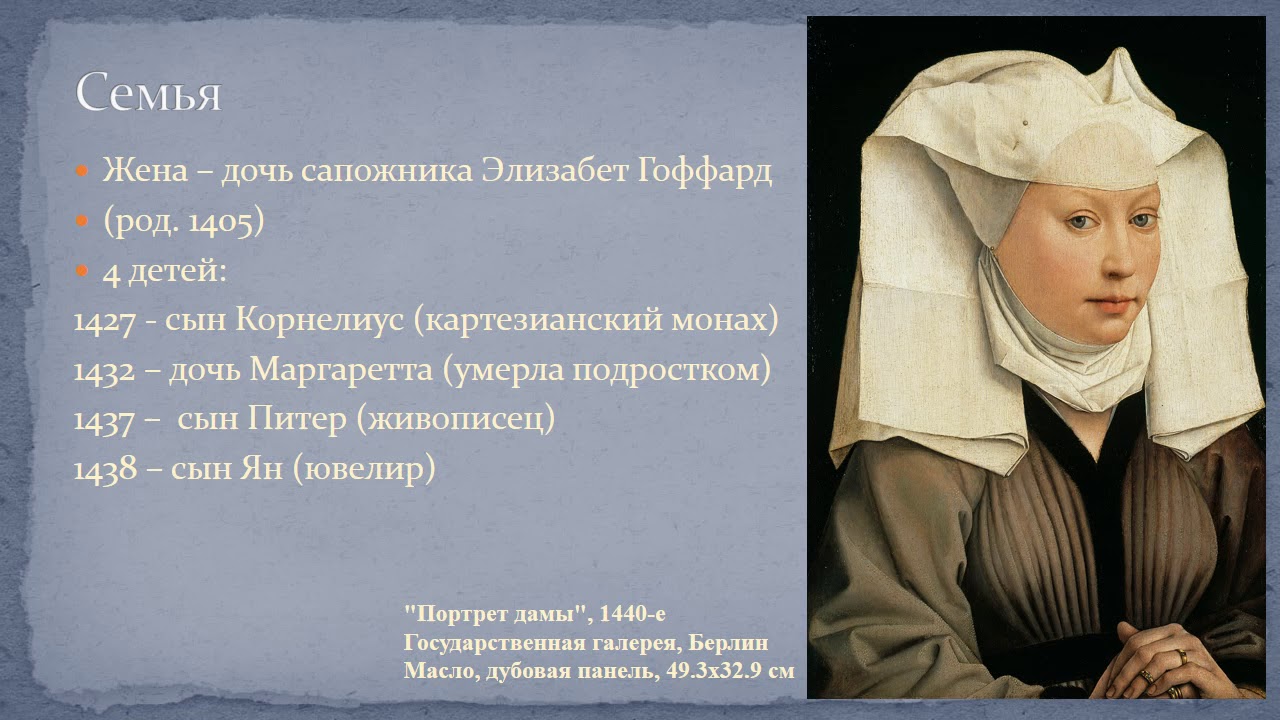
Северное Возрождение. Рогир ван дер Вейден (часть 1). Биография и ранние работы.
5.5K
In 'The Deposition from the Cross,' Rogier van der Weyden depicts several key figures from the Passion narrative. Joseph of Arimathea, an elderly Jewish judge, is shown supporting Christ's body; he was a secret Christian who provided his own tomb for Christ's burial. Nicodemus, another secret follower, assists in the burial. Mary Magdalene, traditionally depicted in elaborate clothing (a tradition from later medieval apocrypha), holds a vessel of ointment. The two other women are Mary Cleophas and Mary Salome, believed to be daughters of Mary's mother Anna. The composition uses geometric symmetry, with two groups of three figures arranged symmetrically on either side of Christ's body.
Click to watch →
Deep Dive
Basic knowledge of 15th-century Flemish oil painting techniques and how the medium of oil allowed for unprecedented detail, glazing, and luminosity compared to tempera.
Rick Steves Art of the Renaissance
481.2K
Oil-based paints gave artists richer colors and more flexibility. They could apply layer upon translucent layer called glazes to create ever more subtle details. Medieval tempera paintings showed limited detail, while oil paintings enabled extraordinary detail like reflections in mirrors, stubble on aging faces, and even glasses magnifying prints. Jan van Eyck's paintings from the early 1400s remain vivid centuries later. Raphael benefited from oil's fuller spectrum of colors, and Leonardo could paint with more nuance. Oil painting became the standard medium thereafter.
Click to watch →

Освобожденный Ренессанс: Боги, мифы и живопись маслом (1 серия) 1/4
75.9K
The comparison between Filippo Lippi's egg tempera painting and van Eyck's oil painting reveals the technical superiority of oil paints in Flemish art. In Lippi's 'Annunciation,' the fabrics and plants appear relatively flat and lack the luminous quality of van Eyck's work. In contrast, van Eyck's 'Annunciation' shows fabrics with remarkable depth and luminosity, and the white lilies symbolizing Mary's purity are rendered with extraordinary detail. The oil paint technique allowed Flemish artists to achieve a level of detail and luminosity that was impossible with egg tempera, enabling the revolutionary visual effects that characterized Northern Renaissance art.
Click to watch →
![[추석! 몰아보기– 미술편] 알고 보면 더 재밌는 미술 속 비밀](https://i.ytimg.com/vi/z5La0QTpvFE/maxresdefault.jpg)
[추석! 몰아보기– 미술편] 알고 보면 더 재밌는 미술 속 비밀
751.7K
Oil painting offered several advantages over tempera, the traditional medieval painting medium. Oil paint's slow drying time allowed artists to blend colors smoothly and make corrections after the paint had dried. The medium's transparency enabled artists to build up multiple layers of color, creating depth and luminosity. These technical advantages made oil painting particularly suitable for detailed works like 'St. Jerome in the Study,' where the artist could achieve extraordinary richness in color and texture.
Click to watch →
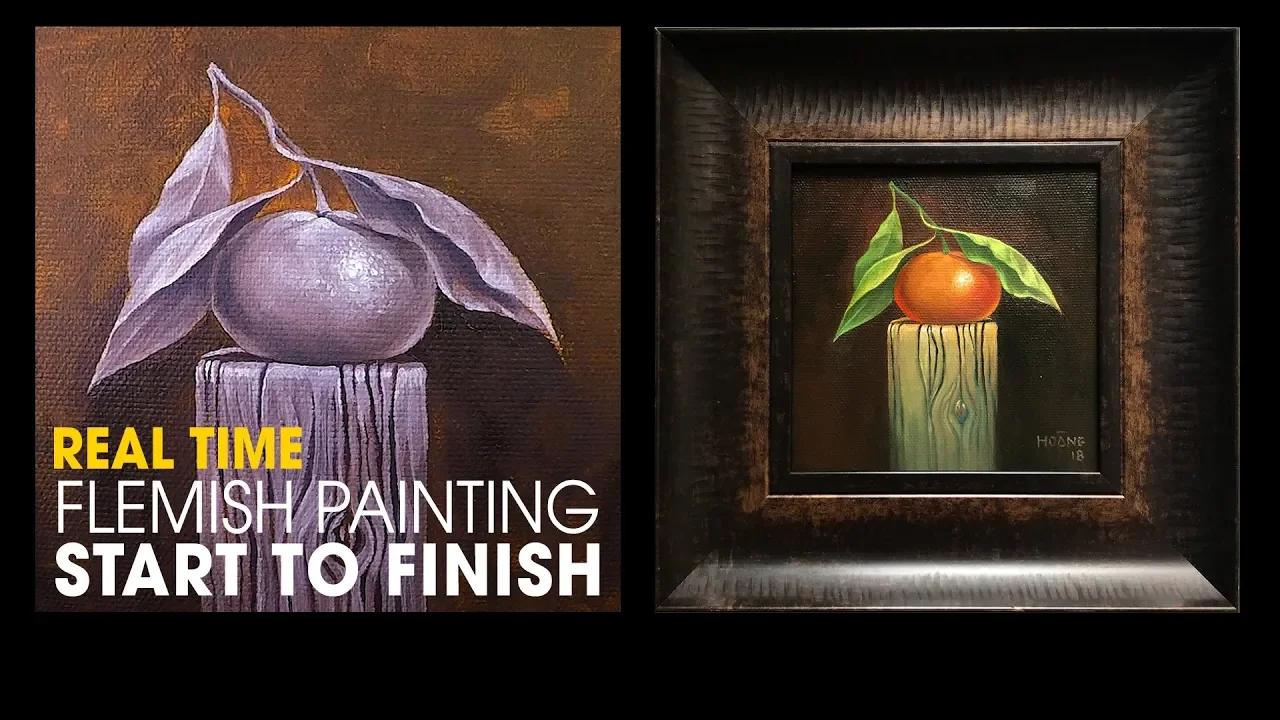
The Oil Painting Techniques tutorial series - Flemish - Old master inspired
15.4K
The Flemish oil painting technique, inspired by Old Masters, involves building up a painting through multiple transparent glaze layers applied over an underpainting, allowing colors to mix optically and creating luminous, dimensional effects that develop over time as each layer dries.
Click to watch →
La tecnica della pittura a olio fiamminga
17.3K
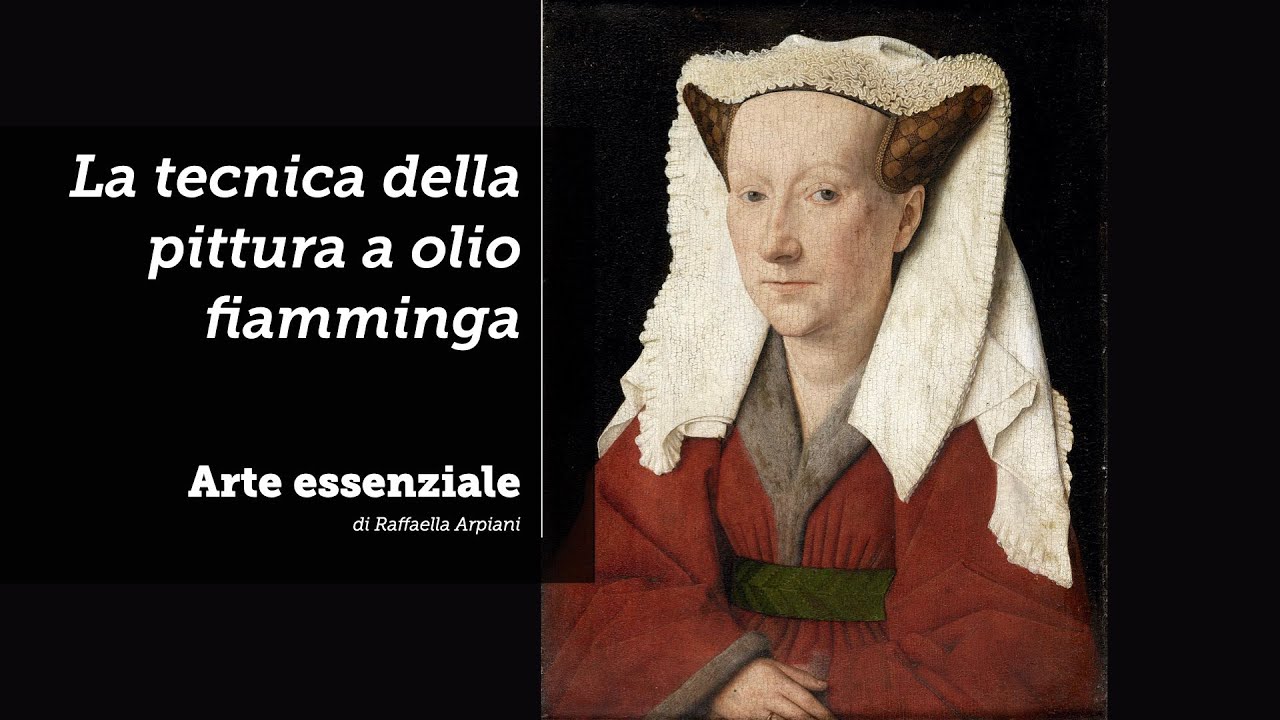
Oil painting construction involves multiple stages: support (oak in Flanders, poplar/fir/cypress in Italy), animal glue layer, white chalk/gesso ground layer (3-4 layers), black drawing, oil impregnation to impermeabilize the surface, initial color layers, successive velature layers, and final resinous layers. The oil impregnation prevents subsequent layers from absorbing into the ground. The imprimatura was often slightly colored (amber-toned) to enhance chiaroscuro effects. Oil painting required very long drying times, allowing for corrections and gradual development of chiaroscuro. Flemish oil painting became synonymous with lenticular and minute detail painting. Artists could achieve extraordinary detail by painting through a magnifying glass, analyzing reality with rigorous precision. The velature process added transparent pigments in successive layers, creating soft, deep, transparent shadows.
Click to watch →
Deep Dive
The concept of 'pathos' in art history, representing how visual artists evoke pity, sympathy, and sorrow from the viewer.

The Holberg Lecture by Griselda Pollock: "Art, Thought and Difficulty"
58.5K
The pathos formula refers to the formula of affection or emotion encoded in images across cultures. Aby Warburg argued that images are carriers and mnemonics that store powerful emotional or effective energy in gestures and movements. This concept explains how certain visual formulas persist across different periods and cultures, such as how Christian culture in the Middle Ages adopted pagan classical imagery despite their differences.
Click to watch →
Quantificare i concetti? Un’analisi delle Pathosformeln di Aby Warburg
4.6K
Pathosformeln (pathos formulas) represent a central concept in Aby Warburg's work, referring to the representation of intense emotional states including passion, emotion, suffering, and agitation. Pathos is defined as emotion conducted to its extreme, representing a superlative form of emotional expression. The concept combines two elements: pathos (the emotional intensity) and form (the stable, organized structure that can persist over time). This combination allows for the transmission of emotional states through visual art, where bodily movement becomes a sign of emotional situations.
Click to watch →
Ranking the Greatest Living Painters According to Objective Criteria with Bork Nerdrum
9.3K
Great paintings evoke emotions of pity and fear in viewers. Pathos literally means physical suffering and is closely related to pity and suffering. Tragedy is stronger than comedy for evoking catharsis because death unifies everyone—people cry when watching tragedies more than comedies. Comedy may not make us better human beings in the same way.
Click to watch →
Greco Roman Class Lecture 05: Archaic Scupture & Architectural Sculpture
315
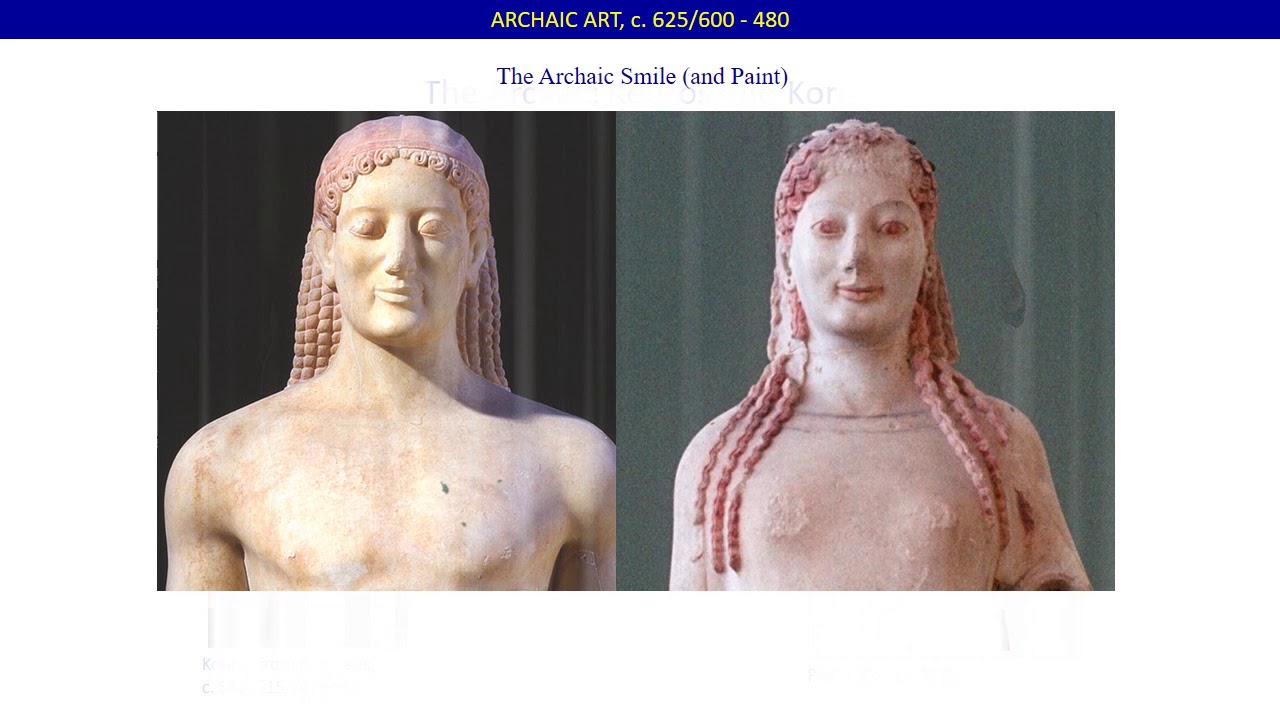
Unlike his counterpart on the west, the fallen warrior in the east seems to have his hand on the hilt of the sword rather than the arrow that has inflicted its mortal wound. All of this adds up to something new: there is a sense of pathos, which is a feeling of pity, sympathy, or sorrow on the part of the viewer. This sense of pathos is attained by imbuing the sculpture with a believable sense of pain and suffering. There is also a sense of ethos, which is character, attained by imbuing him with a sense of pride and vulnerability as he struggles and yet fails to get up.
Click to watch →

Immagini, linguaggi artistici, pensiero performativo nella formazione pedagogica e filosofica cont.
126
The formula of pathos is an artwork, sculpture, or painting that conveys an emotion at its maximum intensity of dramaticity or exaltation. It is a figurative schema that can be reused across centuries and geographies, becoming a repertoire of artistic convention. The limit from a representational perspective, but also the strength of the formula of pathos, is the precedence it gives to the bodily manifestation of emotion, to the form of the body inhabited by emotion, rather than to its univocal meaning.
Click to watch →
Prerequisite Knowledge
- Concept 01Understanding the key differences between the Northern Renaissance and the Italian Renaissance, particularly regarding style, medium, and cultural context.
- Concept 02Familiarity with the Christian biblical narrative of the Passion of Christ, specifically the Descent from the Cross (the Deposition) and the figures involved.
- Concept 03Basic knowledge of 15th-century Flemish oil painting techniques and how the medium of oil allowed for unprecedented detail, glazing, and luminosity compared to tempera.
- Concept 04The concept of 'pathos' in art history, representing how visual artists evoke pity, sympathy, and sorrow from the viewer.
Subsequent Learning
- Step 01An in-depth analysis of the painting's unique compositional structure, particularly the 'rhyming' parallel poses of Christ and the swooning Virgin Mary (representing the theological concept of 'compassio').
- Step 02Tracing the profound influence of Rogier van der Weyden's emotional style on subsequent Northern European artists, such as Hans Memling and Hugo van der Goes.
- Step 03Comparing Northern Renaissance emotional realism with the mathematical perspective and idealized anatomy of contemporary Italian Renaissance masters like Masaccio or Fra Angelico.
- Step 04Investigating the patron and historical context of the masterpiece, specifically its commission by the Greater Guild of Crossbowmen of Leuven and its impact on the guild's public status.
Emotional Mastery
Crossbow Symbolism
Scale and Color
Emotional Mastery
0:08Playing Section
- 1
Van der Weyden's art centers on profound emotion and realistic texture.
- 2
His masterpiece depicts Christ's descent with unmatched expressive tears.
- 3
The work blends Flemish realism with deep religious sentiment.
Sculptural Artificiality and Choreographed Devotion
While Rogier van der Weyden's Descent from the Cross is celebrated for its emotional realism, an important counter-perspective emphasizes the painting's deliberate artificiality and highly stylized, theatrical composition. Rather than presenting a naturalistic scene, van der Weyden compresses his figures into a shallow, box-like space that mimics a painted wooden altarpiece (retable). This structural choice consciously rejects the deep, three-dimensional perspective pioneered by contemporaries like Jan van Eyck. Furthermore, the characters' expressions of grief and physical postures are not purely spontaneous, realistic representations. The parallel curves of Christ's body and the swooning Virgin Mary (representing the theological concept of imitatio Christi) are highly choreographed, rhetorical gestures designed to prompt a specific liturgical and meditative response in the viewer. Thus, many art historians argue that the masterpiece is defined not by pure realism, but by a sophisticated tension between lifelike surface details and a highly artificial, symbolic, and Gothic formal structure.
Deep Dive
An in-depth analysis of the painting's unique compositional structure, particularly the 'rhyming' parallel poses of Christ and the swooning Virgin Mary (representing the theological concept of 'compassio').
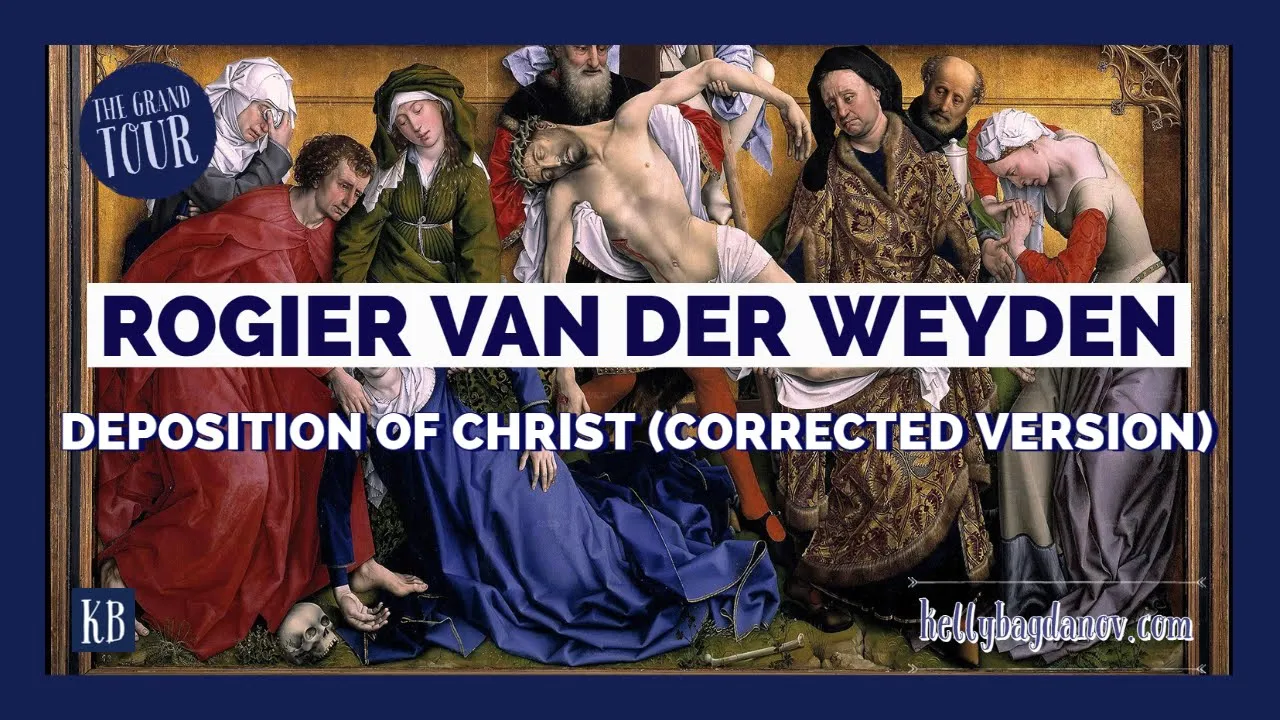
Van der Weyden Deposition (corrected version)
984
The image of the swooning Virgin Mary in the Deposition represents a pivotal moment in Western art history. As Christ falls physically dead from the cross, Mary falls to the ground, perhaps emotionally dead. Their mirrored positions—Christ's head lulling down with the crown of thorns piercing his skull, and Mary's head bowed in similar fashion—cause viewers to connect emotionally with the painting as a mother watching her son die. This humanizes Christ, presenting him not as a divine figure but as a dead child and a mother overcome with loss. The swooning Virgin image would resonate with artists across Europe for several hundred years until the Counter-Reformation, when the Church decreed that Mary must be shown strong and resolute rather than falling into a swoon.
Click to watch →

Rogier van der Weyden, The Descent from the Cross, c 1435
182
Rogier van der Weyden's The Descent from the Cross (c. 1435) visually embodies the theological concept of 'compassio'—suffering with Christ—through the Virgin Mary's collapsed posture mirroring her son's sacrifice, demonstrating that true compassion involves entering into others' suffering rather than observing it from a distance, as the painting's intimate composition of grief and sacrifice invites viewers to bear one another's burdens with love.
Click to watch →
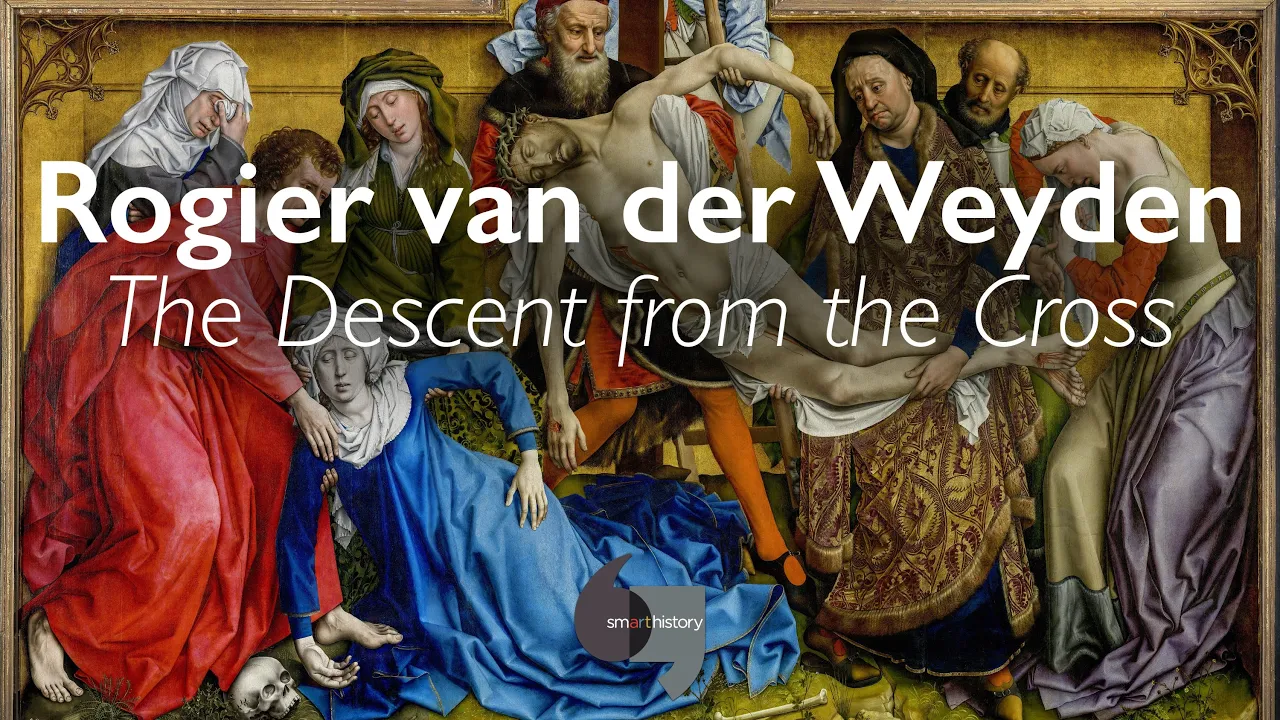
Rogier van der Weyden, The Descent from the Cross
9.7K
Rogier van der Weyden's The Descent from the Cross (Prado Museum, Madrid) exemplifies Northern Renaissance painting through its remarkable realism, emotional depth, and symbolic composition; the artist creates a shallow, box-like space that concentrates mourners around Christ's body, using visual arcs and mirrored body positions to connect figures emotionally while depicting the Virgin Mary and Christ with equal intensity, reflecting the theological concept of 'compassio' (compassion) where mourners partake in Christ's pain, and employing rich colors, intricate textures, and anatomical precision to achieve lifelike figures that demand profound emotional engagement from viewers.
Click to watch →

03 Flanders 12 Van der Weyden, Deposition
2.8K
In Van der Weyden's Deposition, Christ and the Virgin Mary share remarkably similar poses, with both figures positioned in downward and leftward movements. Their arms hang down in parallel positions, symbolically linking them as mother and son while distinguishing them from other figures in the painting. This compositional choice establishes their unique relationship and guides the viewer's eye through the narrative toward Christ's eventual placement in Mary's lap, reinforcing their familial bond.
Click to watch →

5 Paintings That Make the Mona Lisa Look Ordinary
538
Van Eyck's compositional genius creates a visual rhyme between Mary's suffering body and Christ's lifeless body above her. Her body curves in the exact same broken arc, showing her suffering has become physical—a reflection of Christ's death without speaking a single word.
Click to watch →
Deep Dive
Tracing the profound influence of Rogier van der Weyden's emotional style on subsequent Northern European artists, such as Hans Memling and Hugo van der Goes.

ARTH 2020 Rogier van der Weyden and Hans Memling
6.7K
Rogier van der Weyden (c. 1399-1464) and Hans Memling (c. 1430s-1494) were foundational figures in early Netherlandish painting, with van der Weyden known as an 'inventor' who created distinctive compositions and emotional narratives, while Memling, a German artist who worked in Bruges, developed idealized, serene figures and pioneered landscape backgrounds in religious art; both artists exemplified the collaborative nature of 15th-century Northern European art through workshop relationships and shared techniques like silverpoint drawing and linear perspective.
Click to watch →
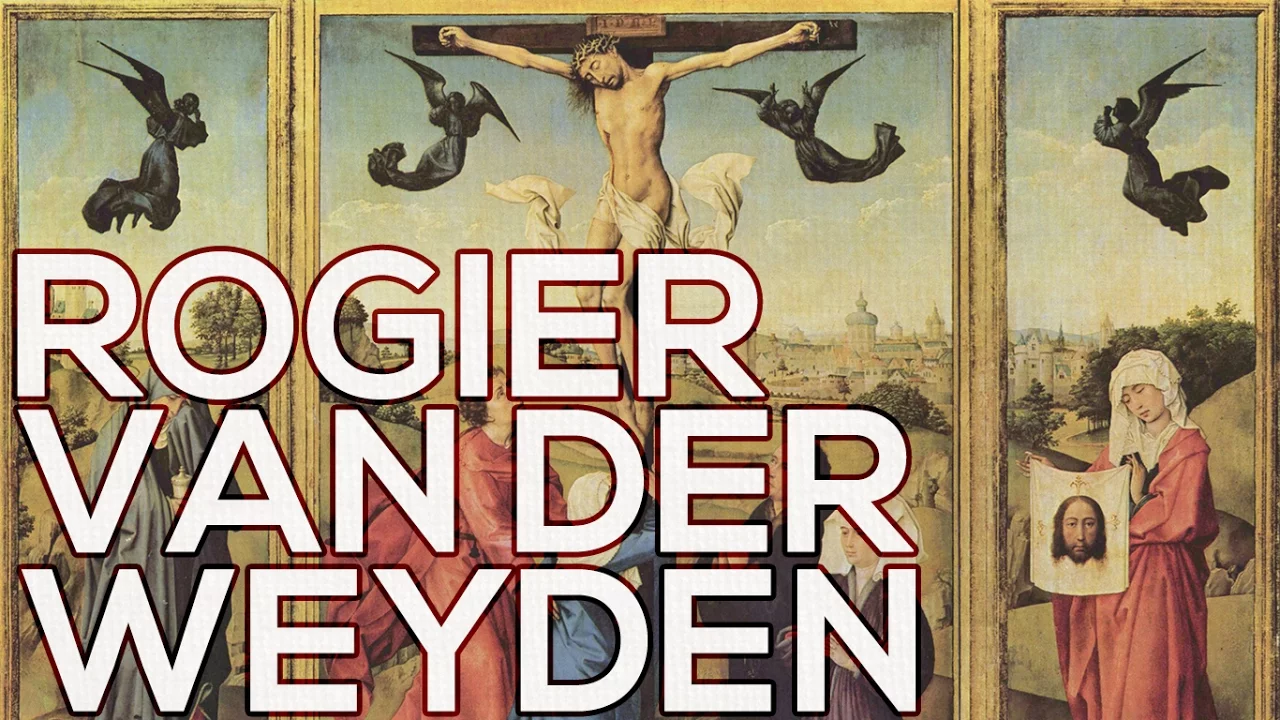
Rogier van der Weyden: A collection of 68 paintings (HD)
11.2K
Rogier van der Weyden, born Rogier de la Pasture in Doornik, was a South-Netherlandish painter active in the 15th century, positioned chronologically between Jan van Eyck and Hugo van der Goes among the Flemish primitives. He married Elizabeth Goffaert in 1426 and joined Robert Campin’s workshop in 1427. By 1432, he was established as a master in Doornik and became Brussels City Painter in 1435, thereafter using his Flemish name. He likely resided in Bruges between 1432 and 1435, where Van Eyck’s influence is evident in his work. In 1450, he traveled to Rome for the Holy Year and created works for the Medici family in Florence. His oeuvre primarily consisted of religious themes; secular works are lost. He never signed his paintings, leading to ongoing scholarly debate over attribution. He likely operated a large workshop with assistants. His style featured clear composition, vivid color, and rich symbolism. His major works include the Descent from the Cross and the Beaune Altarpiece (Last Judgment), intended to rival Van Eyck’s Ghent Altarpiece. He significantly influenced later artists, notably his student Hans Memling. Van der Weyden died in Brussels in 1464 and was buried in St. Gudula Church (now St. Michael’s Cathedral). He was prosperous and widely admired during his lifetime, with his style imitated for at least fifty years after his death.
Click to watch →

09-02 Early Netherlandish Art
744
Hans Memling (c. 1430-1494), German-Flemish painter who studied under van der Weyden in Brussels, settled in Bruges in 1465. His Last Judgment (c. 1467) shows Christ on rainbow with Archangel Michael weighing souls. The painting was seized by Gdansk privateer during transport to Florence and remains there today. Hugo van der Goes (c. 1440-1482), born in Ghent, became master in 1467. His monumental Portinari Altarpiece (c. 1473-1478) was commissioned by Florentine banker Tommaso Portinari for Santa Maria Novella church. It had significant impact on Italian Renaissance artists when it arrived in Florence in 1483, influencing artists like Domenico Ghirlandaio. Both artists demonstrate how Bruges became cosmopolitan center with thriving international commerce, allowing early Netherlandish artists to influence Italian arts through commissions from Italian patrons.
Click to watch →
Między wpływem a nauką. Czy Rogier van der Weyden ukształtował Memlinga? Aleksandra Stanek
187
Rogier van der Weyden (c. 1400-1464) was a leading Flemish painter of the late medieval period whose expressive style, characterized by intense emotional depictions and meticulous detail in textiles and facial features, significantly influenced Hans Memling (c. 1430-1494). While scholars debate whether Memling was formally trained by van der Weyden, evidence suggests Memling absorbed van der Weyden's artistic innovations through direct observation and possibly collaboration, as seen in Memling's adoption of van der Weyden's architectural niche compositions and emotional intensity in works like the Last Judgment. The relationship between these artists exemplifies how artistic traditions evolved through both formal training and visual learning in the Northern Renaissance.
Click to watch →
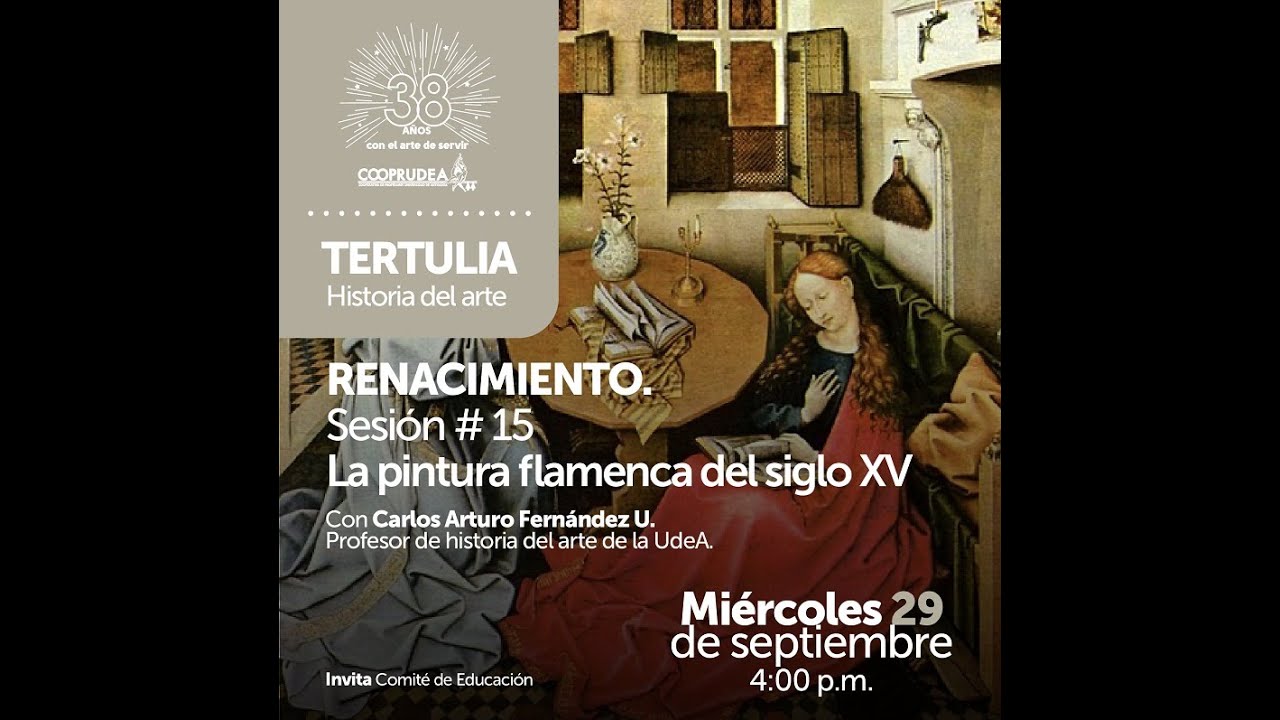
La pintura flamenca del siglo XV.
542
Roger van der Weyden (c. 1399-1464) was a student of the Master of Flémalle and possibly succeeded Jan van Eyck. His paintings, such as the Lamentation in the Prado Museum, are characterized by emotional intensity and dramatic compositions. The figures show tormented movements, and the colors are particularly striking, especially the blues achieved with the glaze technique. His work represents a more emotional approach compared to the detailed naturalism of Van Eyck. Hugo van der Goes (c. 1440-1482) painted the Portinari Altarpiece (Adoration of the Shepherds), a massive work nearly 6 meters wide on wood panels. The altarpiece was commissioned by Tommaso Portinari, head of the Medici bank in Bruges, for the church of Santa Maria Novella in Florence. The work was revolutionary because it was painted in oil and introduced Flemish naturalism to Florence, causing a profound impact on Florentine artists including Leonardo da Vinci.
Click to watch →
Deep Dive
Comparing Northern Renaissance emotional realism with the mathematical perspective and idealized anatomy of contemporary Italian Renaissance masters like Masaccio or Fra Angelico.
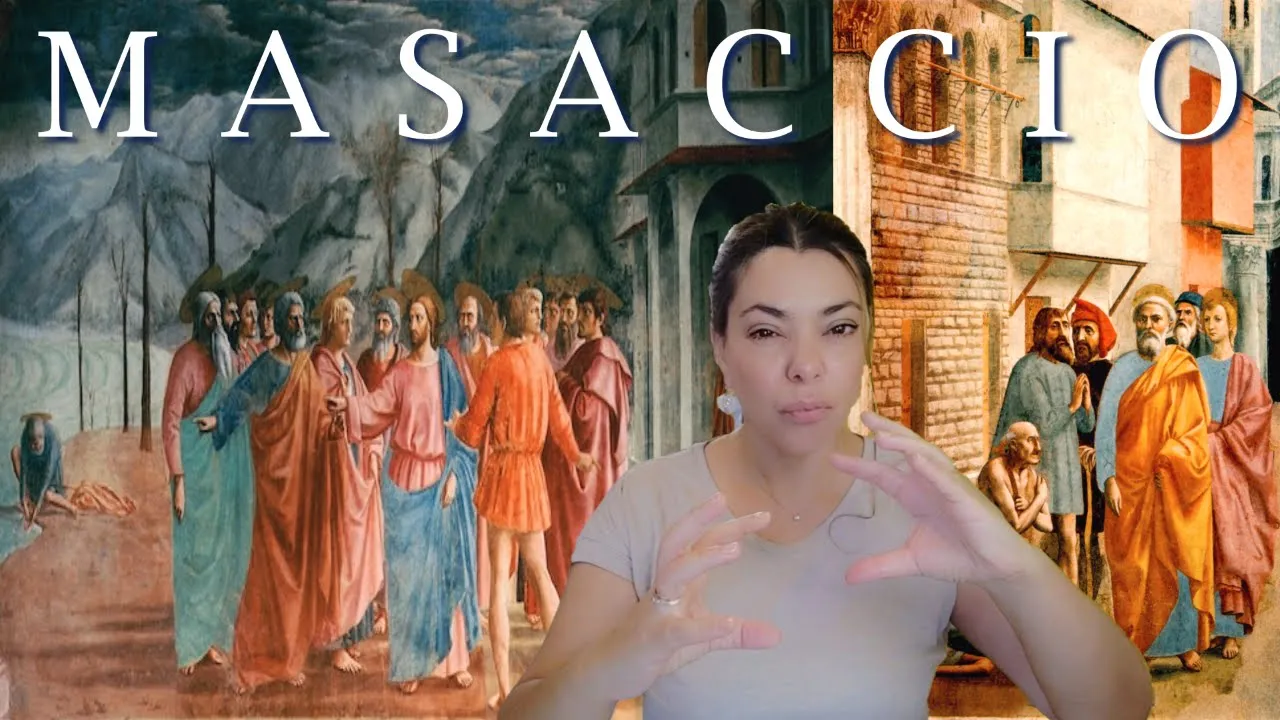
Masaccio y el Quattrocento Italiano: aires de Renacimiento
12.9K
Masaccio (1401-1428) revolutionized Italian Renaissance painting by applying scientific principles to art, particularly mathematical perspective and chiaroscuro, which transformed religious figures from idealized symbols into realistic human beings; his innovations in the Brancacci Chapel frescoes established the foundation for modern art by creating a new visual language that combined scientific observation with emotional expression, directly influencing artists like Michelangelo and establishing the paradigm of the artist as an intellectual observer of nature.
Click to watch →

Art of Europe: Early Renaissance Painting — Rick Steves Art Bite
14.5K
This macro-level knowledge point examines how Renaissance artists combined empirical techniques with spiritual devotion to create unprecedented artistic achievements. Masaccio applied mathematical principles of linear perspective to create spatial illusions, while Fra Angelico employed the fresco technique of painting wet plaster to create durable, integrated wall decorations. For these artists, technical mastery served spiritual purposes—Fra Angelico viewed painting as prayer, unable to paint crucifixes without emotional response. This synthesis of scientific method (geometry, anatomy, optics) with spiritual expression enabled artists to achieve unprecedented realism, drama, and emotional impact, demonstrating how Renaissance humanism bridged rational inquiry and religious faith in artistic creation.
Click to watch →
ASMR | History Of The Renaissance | Part 2 | Facts Friday #43 | Whispering
1.3K
The Renaissance (14th-16th centuries) marked a revolutionary transformation in European art and culture, characterized by two distinct regional approaches: Northern European artists like Jan van Eyck pioneered unprecedented realism in works such as the Ghent Altarpiece (1432) and the Arnolfini Portrait (1434), while Italian artists like Fra Angelico, Piero della Francesca, and Botticelli developed classical humanism, mathematical perspective, and philosophical themes, with cultural exchange between these regions spreading artistic techniques across Europe.
Click to watch →

Nadia Righi presenta ai Quadratini il dipinto "La Crocefissione" di Hans Memling
2.9K
The Renaissance split into two distinct artistic traditions. In Florence, artists like Brunelleschi, Donatello, and Masaccio created synthetic visions using geometric perspective to make flat surfaces appear three-dimensional, immersing viewers in architectural space. In contrast, Northern artists like Jan van Eyck and Rogier van der Weyden developed analytical vision, painting every hair, leaf, and object with microscopic detail. These approaches communicate emotion differently: Masaccio shows cold through a single shoulder gesture, while van Eyck shows shivering through individual goosebumps. Both achieved profound emotional truth through fundamentally different methods.
Click to watch →
In Search of Fra Angelico: The Artist as a Young Man
19.3K
The approximately 45-year span of Angelico's active career (1410-1455) coincides with the Italian Renaissance, meaning rebirth—a revival of classical antiquity marking a movement away from medieval autocratic faith toward secular enlightenment. Conventional histories describe the progressive triumph of democratic realism and naturalism over Gothic styles, beginning with Masaccio and Brunelleschi. Masaccio, born 1401 and died 1428, achieved seismic influence comparable to Mozart, Keats, and Jimi Hendrix in just 27 years. His revolutionary approach to two-dimensional image making and mature command of technique required prior experience and practice, making it impossible for a 23-year-old boy even with powerful mentors to achieve such results without prior experience. Roberto Longhi's 1940 revisionist scholarship pushed Angelico's first artistic efforts back about ten years to shortly before 1420, arguing these early works proved Masaccio was even greater and more precocious than previously thought. The fortuitous discovery of the San Giovannino altarpiece dated 1422 challenged assumptions about Angelico's early career, revealing a young painter of strong but relatively crude talents. Fra Angelico received training in the workshop of Don Lorenzo Monaco, another gifted artist who had embraced monastic vows. In February 1414, Lorenzo Monaco appended an inscription to the Coronation of the Virgin, the largest altarpiece commissioned in Florence at the time. The three left-hand scenes are unmistakably by Lorenzo Monaco, characterized by calligraphic elegance and disregard for perspectival rendering or architectural accuracy in favor of emotional storytelling—figures grow larger as they move back from the picture plane. In contrast, the right half of the predella displays architectural forms precisely ruled with compass and straightedge, space constructed lucidly with measurable accuracy, and narratives faultlessly logical. In reimaging scenes from the Legend of Saint Benedict six years later, Angelico demonstrated revolutionary optical realism by painting a real monastic cell rather than a floating chapel, adding practical details like windows and fishing nets to rationalize pictorial conventions. This represents a fundamental shift from Gothic fantasy to representational logic that characterizes Angelico's mature work.
Click to watch →
Deep Dive
Investigating the patron and historical context of the masterpiece, specifically its commission by the Greater Guild of Crossbowmen of Leuven and its impact on the guild's public status.

Artifact #3.4; Early Northern Renaissance
545
Northern Renaissance art was often commissioned by guilds, serving as both religious devotion and guild publicity. The Deposition by Rogier van der Weyden (c. 1435) was commissioned by the Crossbowmen's Guild in Leuven, who paid for the painting to be displayed in their cathedral. The painting includes crossbows in the architectural frame, symbolizing the guild. The composition shows Christ being removed from the cross, with his upper body brightly lit while his lower body is being lowered, and features a skull at the cross's base (reminder of Adam's burial site). The painting demonstrates the shallow picture plane characteristic of Northern Renaissance art, with figures crammed into the composition. This practice of guild commissions was common in Northern Europe, where groups of skilled workers would pool resources to commission paintings that honored both their profession and religious devotion.
Click to watch →
Conferencia: El Descendimiento de Rogier van der Weyden y sus copias de época (LSE)
11.2K
The Descent from the Cross was commissioned for the crossbowmen's guild chapel in Leuven. Dendrochronology places execution between 1435-1443. After remaining in Leuven for a century, Mary of Hungary acquired it in 1570, paying 500 florins and receiving a copy by Michael Cox. In 1549, Prince Philip II saw it at the castle of Vincennes, with chroniclers describing it as the best painting in the world. Five years later, the castle was destroyed by Henry II of France's army, and the painting was evacuated.
Click to watch →

Why the Church Banned This Painting of Jesus and Mary
25.8K
At the center of the painting, the curve of Christ's body bends in a curve that looks almost like a drawn crossbow. This is no coincidence—it is a nod to the guild of the crossbowman in Loven, who commissioned the painting for the main altar of Onzel Fra Vaninderton. Vanerviden subtly reinforces this with crossbows tucked into the corners of the composition, but the symbolism runs deeper. In medieval theology, Christ's body was often compared to a bow string stretched to the limit by pain.
Click to watch →
El Descendimiento de Cristo de Rogier van der Weyden: misterio y emoción en cada detalle
4.2K
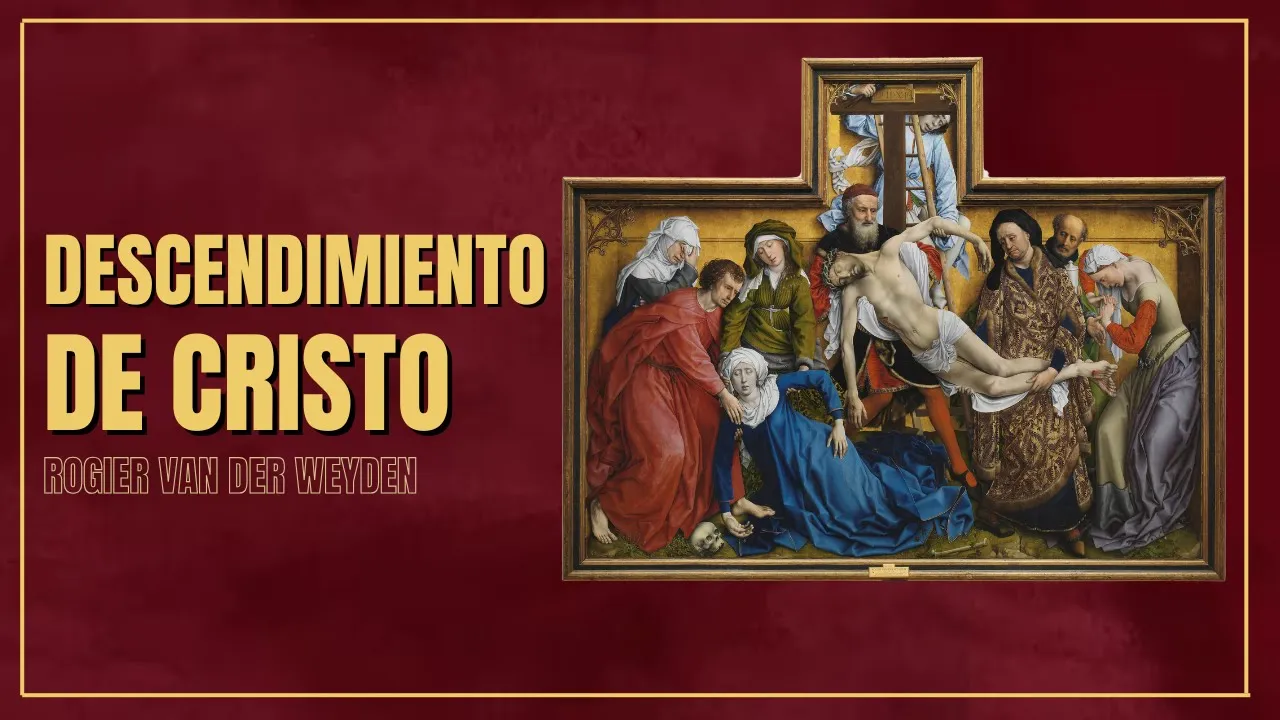
The Descent from the Cross (Descendimiento) is a religious scene depicting the moment when Christ's body is lowered from the cross after his death. This painting, created around 1435, was commissioned by the Guild of Crossbowmen of the city of Leuven, Belgium, to decorate the altar of a chapel. The inclusion of crossbows in the corners of the painting serves as a visual acknowledgment of the guild's financial patronage of the artwork.
Click to watch →

#10 - De beste schilder van Leuven
102
This audio story from Het Geluidshuis, commissioned by M Leuven, humorously depicts a 15th-century art competition in Leuven's Sint Pieterskerk where hundreds gathered to discover who painted the most beautiful Last Supper. The ceremony reveals that the true masterpiece was created by Dirik, who sacrificed his own recognition to let Hubert Sturb receive the award, demonstrating that artistic legacy and the appreciation of one's work matter more than personal fame.
Click to watch →
Emotional Mastery
Crossbow Symbolism
Scale and Color
Emotional Mastery
0:08- 1
Van der Weyden's art centers on profound emotion and realistic texture.
- 2
His masterpiece depicts Christ's descent with unmatched expressive tears.
- 3
The work blends Flemish realism with deep religious sentiment.
Sculptural Artificiality and Choreographed Devotion
While Rogier van der Weyden's Descent from the Cross is celebrated for its emotional realism, an important counter-perspective emphasizes the painting's deliberate artificiality and highly stylized, theatrical composition. Rather than presenting a naturalistic scene, van der Weyden compresses his figures into a shallow, box-like space that mimics a painted wooden altarpiece (retable). This structural choice consciously rejects the deep, three-dimensional perspective pioneered by contemporaries like Jan van Eyck. Furthermore, the characters' expressions of grief and physical postures are not purely spontaneous, realistic representations. The parallel curves of Christ's body and the swooning Virgin Mary (representing the theological concept of imitatio Christi) are highly choreographed, rhetorical gestures designed to prompt a specific liturgical and meditative response in the viewer. Thus, many art historians argue that the masterpiece is defined not by pure realism, but by a sophisticated tension between lifelike surface details and a highly artificial, symbolic, and Gothic formal structure.
Understanding the key differences between the Northern Renaissance and the Italian Renaissance, particularly regarding style, medium, and cultural context.
Familiarity with the Christian biblical narrative of the Passion of Christ, specifically the Descent from the Cross (the Deposition) and the figures involved.
Basic knowledge of 15th-century Flemish oil painting techniques and how the medium of oil allowed for unprecedented detail, glazing, and luminosity compared to tempera.
The concept of 'pathos' in art history, representing how visual artists evoke pity, sympathy, and sorrow from the viewer.
An in-depth analysis of the painting's unique compositional structure, particularly the 'rhyming' parallel poses of Christ and the swooning Virgin Mary (representing the theological concept of 'compassio').
Tracing the profound influence of Rogier van der Weyden's emotional style on subsequent Northern European artists, such as Hans Memling and Hugo van der Goes.
Comparing Northern Renaissance emotional realism with the mathematical perspective and idealized anatomy of contemporary Italian Renaissance masters like Masaccio or Fra Angelico.
Investigating the patron and historical context of the masterpiece, specifically its commission by the Greater Guild of Crossbowmen of Leuven and its impact on the guild's public status.
41.8K views515likes5:25@zczfilmsOriginal Release: 2016-03-14
Visari's Lives of the Artists is the most impactful art book ever written, but it misses out so many important artists. And this ignoral which influenced so much of the art history that followed reaches its inglorious climax in the case of an artist who I think was the greatest of all the Flemish painters. He's the one who gets you here, the emotional one. Roger Vaneriden.
Vanerviden who gets a line in Versari too worked not in Bruge but here in Brussels. This is his masterpiece the descent from the cross which hangs now at the Prao Gallery in Madrid. If you shoved me against a wall, put a gun in my face, and forced me to name the greatest painting of the 15th century, I suppose I'd go for this. What Vanderiden brought to art was profound emotion. The new oil paints could describe textures. Yes, they could make things look scarily real, but they could also describe such deep and plungent feelings. Christ is being taken down from the cross and his mother, the Virgin Mary, has fainted and these cold tears are running down her fainted face.
[Music] In the entire history of art, has anyone painted tears as expressively as this? I don't think so. They're on every face, each one different. A symphony of sadness tracked in watery pearls of pain.
This was actually commissioned by the crossbowman's guild. So see these tiny crossbows in the corner of the frame.
And more importantly, Christ, his dead body has formed the shape of a crossbow.
[Music] Look how his feet are still nailed together. How his wounds are described so graphically with his brilliant Flemish realism. Fierce religious emotions are hitching a ride on perfectly observed realism and smuggling themselves deep inside us.
And look here. It's Van Dividan's last judgment. Preserved these days in his own dark room in the bone hospital. To examine every detail of this great dark masterpiece would take many hours. Here his serene saints look on nervously while us earthly mortals are cast into heaven or hell. Each emotion etched so convincingly onto the faces of these fragile bodies. As their fates are decided, we feel every ounce of their joy and their pain. And he works in these big scales too that feel very unflemish. And the big scale and the realism combine to create these looming dramas that involve you in the tragedy as if they're happening just there. Look at his colors, too. how they sing and sting and add to the emotional impact. This outrageous red backcloth to Jesus's crucifixion which soaks the picture space with the mood of blood or the glowing blue of the swooning virgin that's almost pure lapis lazily. Art has never before seen colors of the kind you get in the art of Roger Vaneriden.
Colors that quicken the pulse and soak the senses.
[Music]
Up Next

75:22
Unraveling the Mysteries of Hieronymus Bosch
@exactamundoo
455.1K views•2014-12-30

114:18
Christian Iconography: History, Theology, and Meaning | Fr. Panayiotis Papageorgiou
@Trisagionfilms
58.8K views•2020-02-21
7:48
Ukiyo-e Art: History, Woodblock Printing & Influence
@japanathand
6.3K views•2023-06-08

16:34
Earliest Depictions of Jesus in Art: 10 Ancient Images Explained
@UsefulCharts
5.9M views•2022-06-03
Related Study Plans & Knowledge Roadmaps
Structured learning paths in Art History
art-history
Gothic Cathedrals: Engineering, Light & Society
01The Birth of the Gothic: Romanesque to Suger's Vision
02The Structural Triad: Pointed Arches, Ribbed Vaults, and Flying Buttresses
03Theology of Light: Lux Nova and Sacred Geometry
+ 2 more learning modules
14h5 modules
Explore Roadmap
art-history
Pre-Raphaelites: Realism, Symbolism & Critique
01The Victorian Art Establishment and Academic Formula
02The Founding of the PRB and Radical Realism
03Medieval Revivalism and Literary Symbolism
+ 1 more learning modules
8h4 modules
Explore Roadmap
art-history
Street Art: From Subways to Art Market
01Subcultural Origins in Philadelphia and New York (1970s)
02The Subway Era and Style Wars (Late 1970s - 1980s)
03The East Village Scene and Early Gallery Crossover
+ 2 more learning modules
10h5 modules
Explore Roadmap
art-history
Classic Maya Art: Iconography, Glyphs & Ritual
01Foundations of Classic Maya Visual Culture
02Deciphering Maya Hieroglyphs & Text-Image Integration
03Sacred Geography and Cosmological Architecture
+ 2 more learning modules
14h5 modules
Explore Roadmap