




















Acid mine drainage (AMD) is a global environmental problem caused by the chemical reaction between water, oxygen, and pyrite (FeS₂) in mine waste, producing sulfuric acid and ferric hydroxide (the orange precipitate), which lowers stream pH to dangerous levels (0-6.5) and releases toxic heavy metals; remediation efforts aim to neutralize pH but create 'sacrifice zones' where metals precipitate and make habitats unlivable, while different aquatic organisms exhibit varying tolerances to AMD—from highly sensitive species like mayflies and stoneflies to tolerant species like leeches and blackfly larvae—which researchers use to assess stream health through biotic indices.
Acid Mine Drainage Chemistry and Stream Remediation Explained
Added:Basic concepts of pH, acidity, and chemical neutralization (acid-base reactions).
An understanding of oxidation-reduction (redox) reactions, particularly involving iron and sulfur.
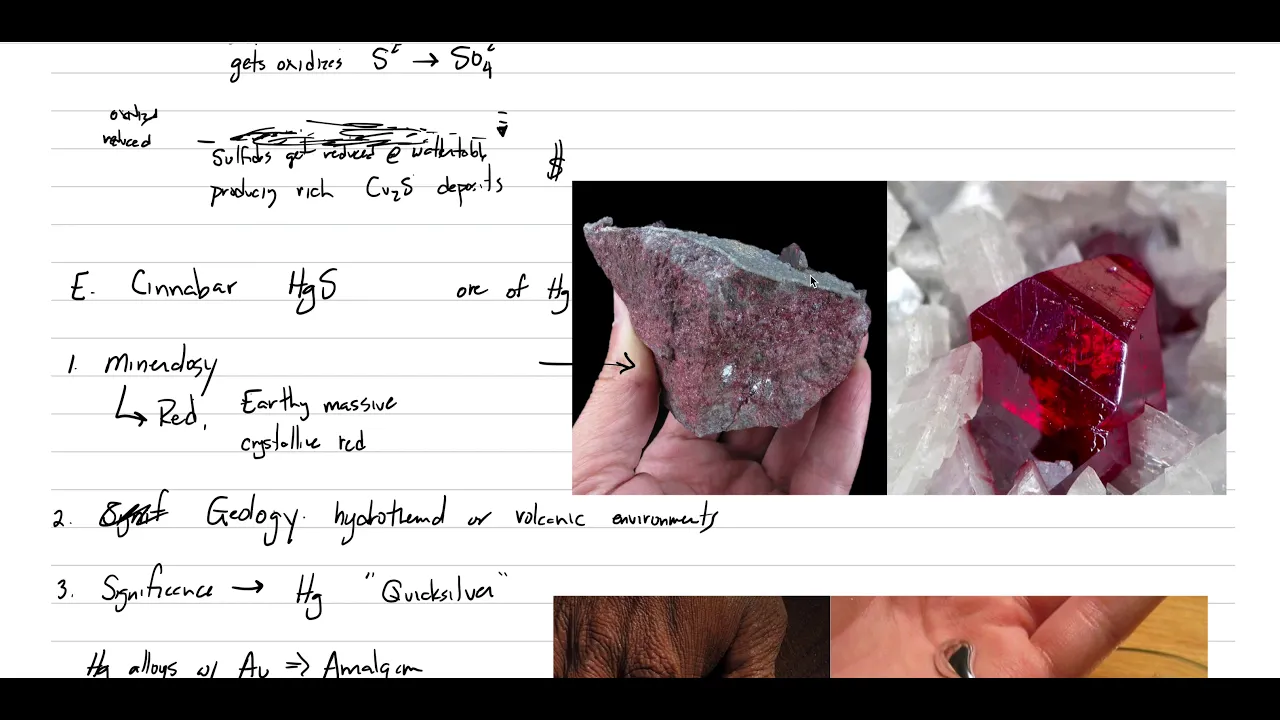
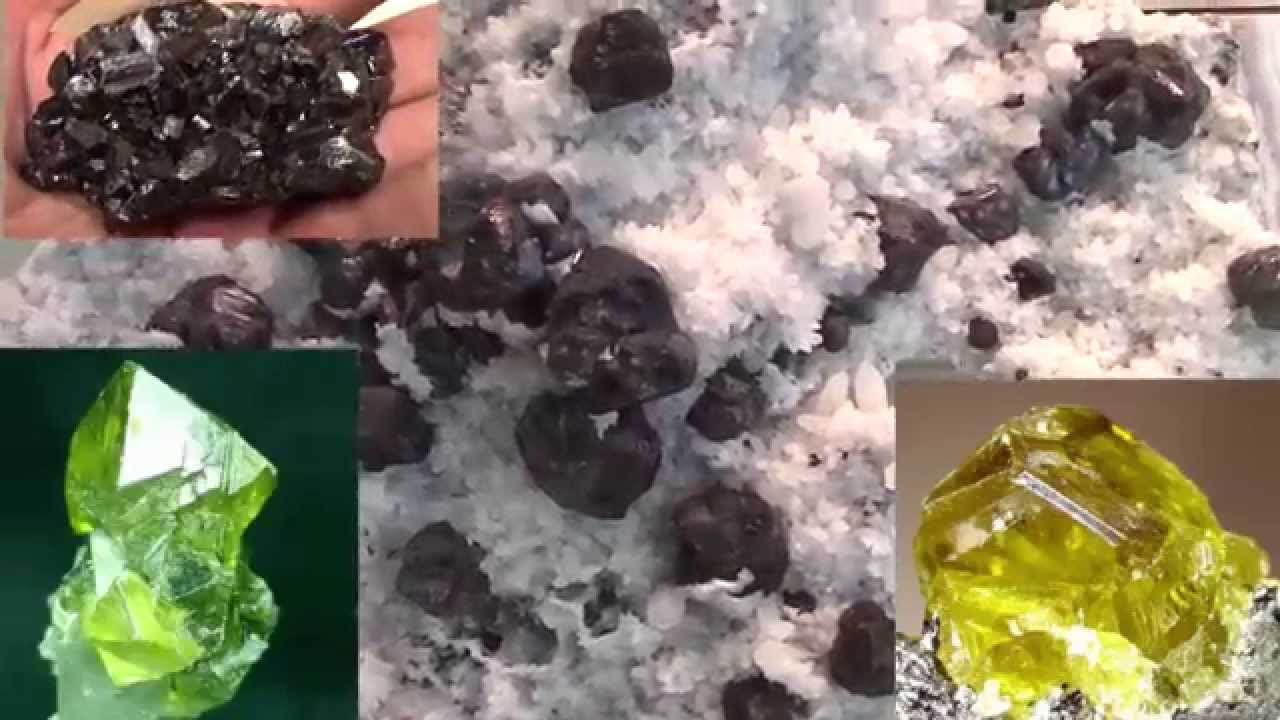
Fundamentals of geology and mineralogy, specifically the occurrence of sulfide minerals like pyrite (FeS2) in mining environments.
Basic aquatic ecology and how changes in pH and dissolved heavy metals affect aquatic life and food webs.
Advanced engineering and design principles of passive treatment systems, such as anoxic limestone drains, successive alkalinity-producing systems (SAPS), and constructed wetlands.
The role of extremophile microbiology (e.g., Acidithiobacillus ferrooxidans) in accelerating acid mine drainage generation and their application in bio-remediation.
Environmental policy, regulatory frameworks, and legal responsibilities surrounding active and abandoned mine reclamation (e.g., the Clean Water Act and Superfund/CERCLA).
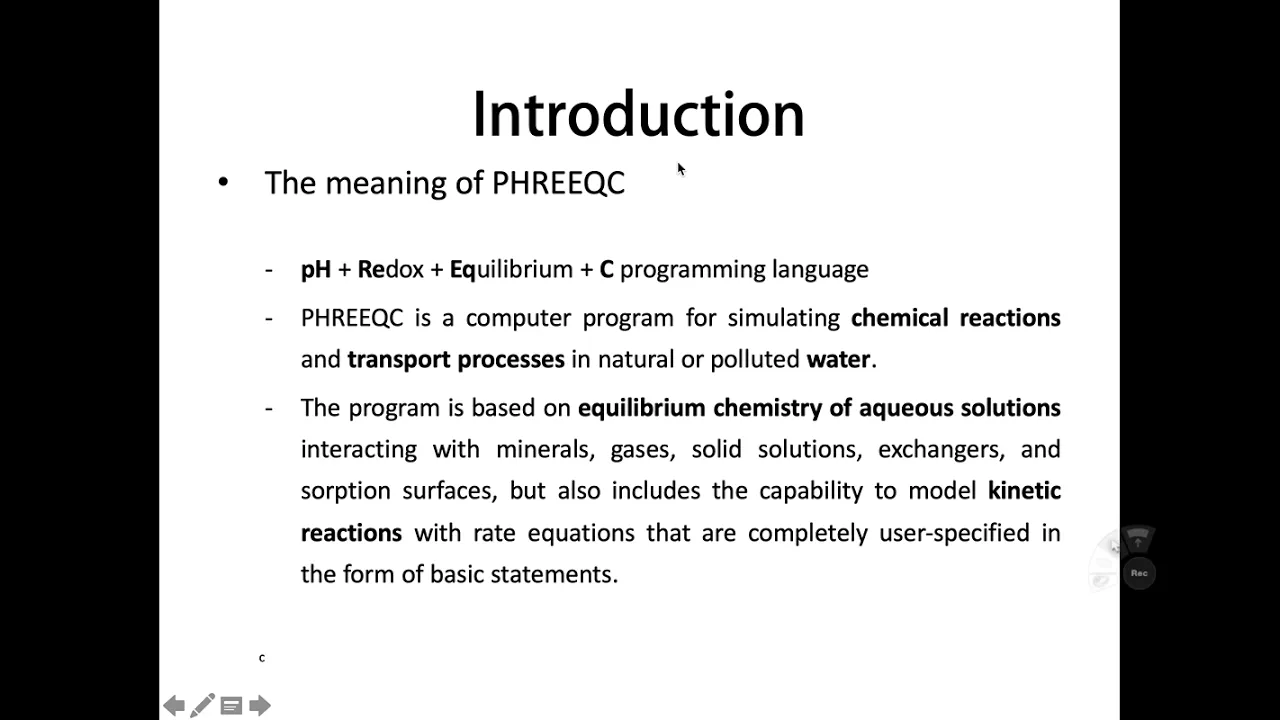
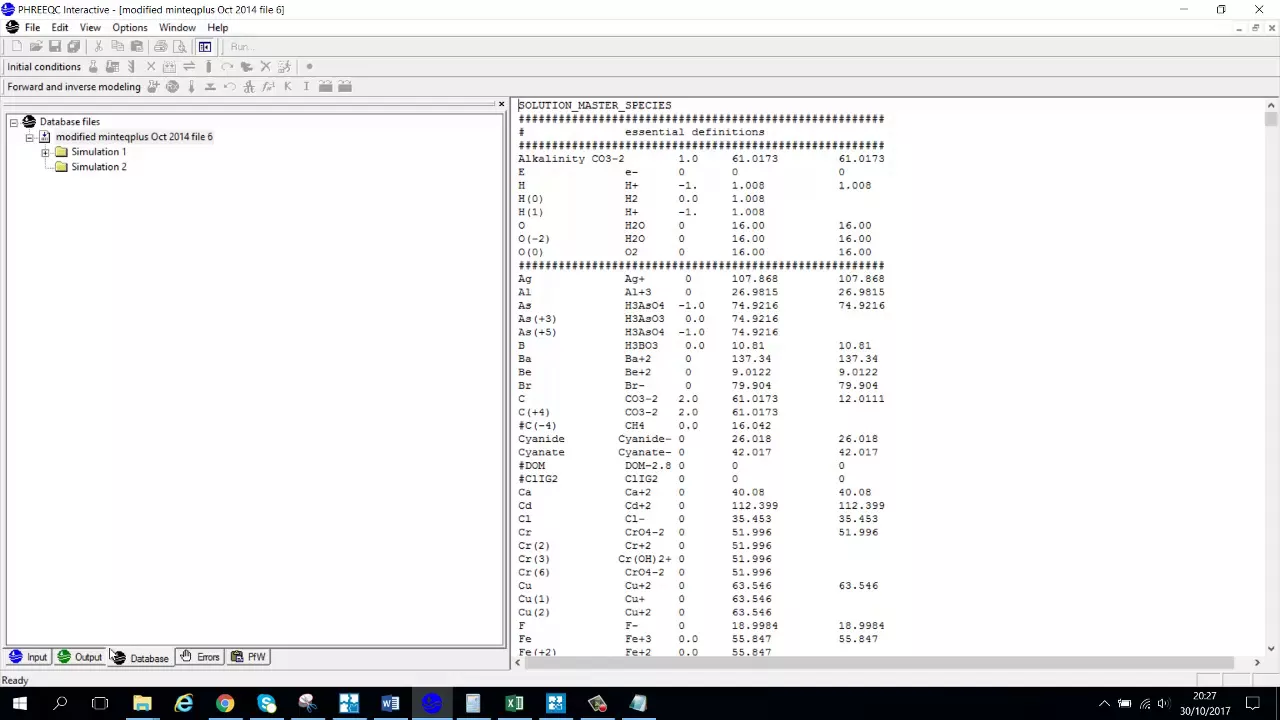
Using geochemical modeling software (such as PHREEQC) to simulate chemical equilibrium, mineral precipitation, and remediation outcomes in affected watersheds.
36.2K views317likes15:03Original Release: 2017-01-18
Today we'll be talking about the big orange problem that we can find across the globe called acid mine drainage.
This lesson was made by Mariah Thrush as part of Ohio University's NSF funded boat of knowledge in the science classroom. Let's start off with a comparison. This is a stream and this is a stream with acid mine drainage or AMD.
Describe what you see in both pictures.
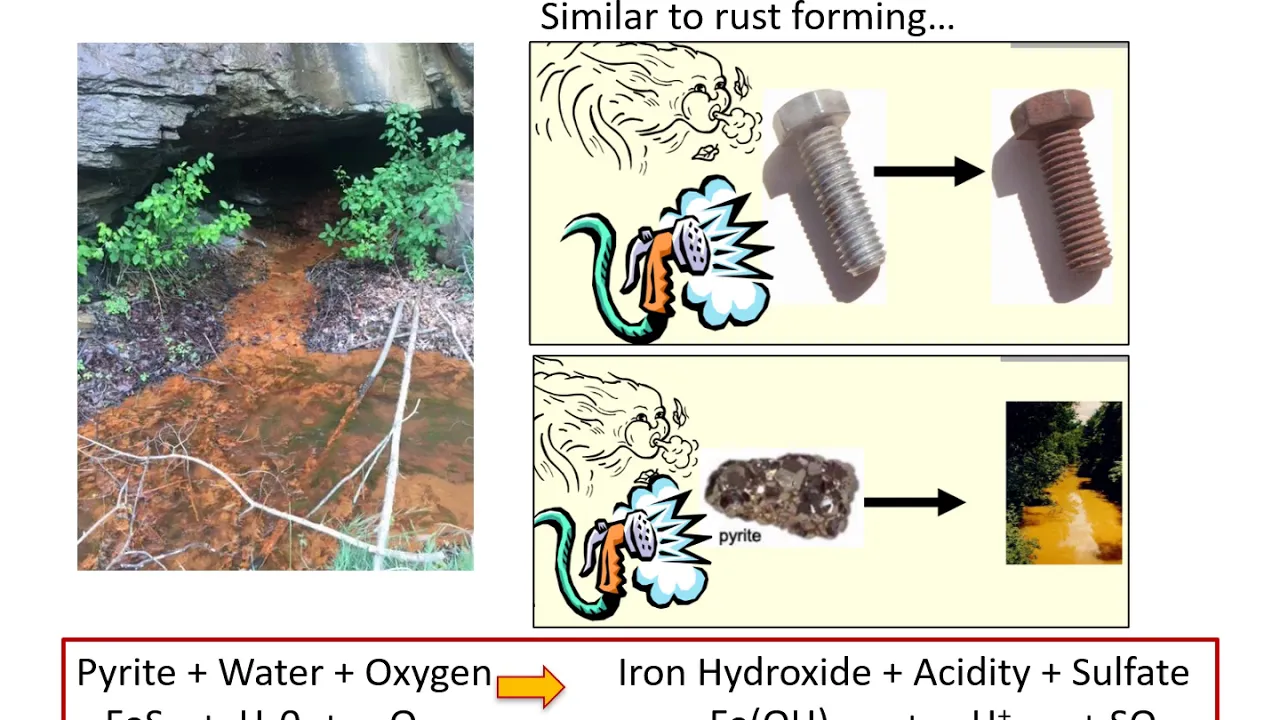
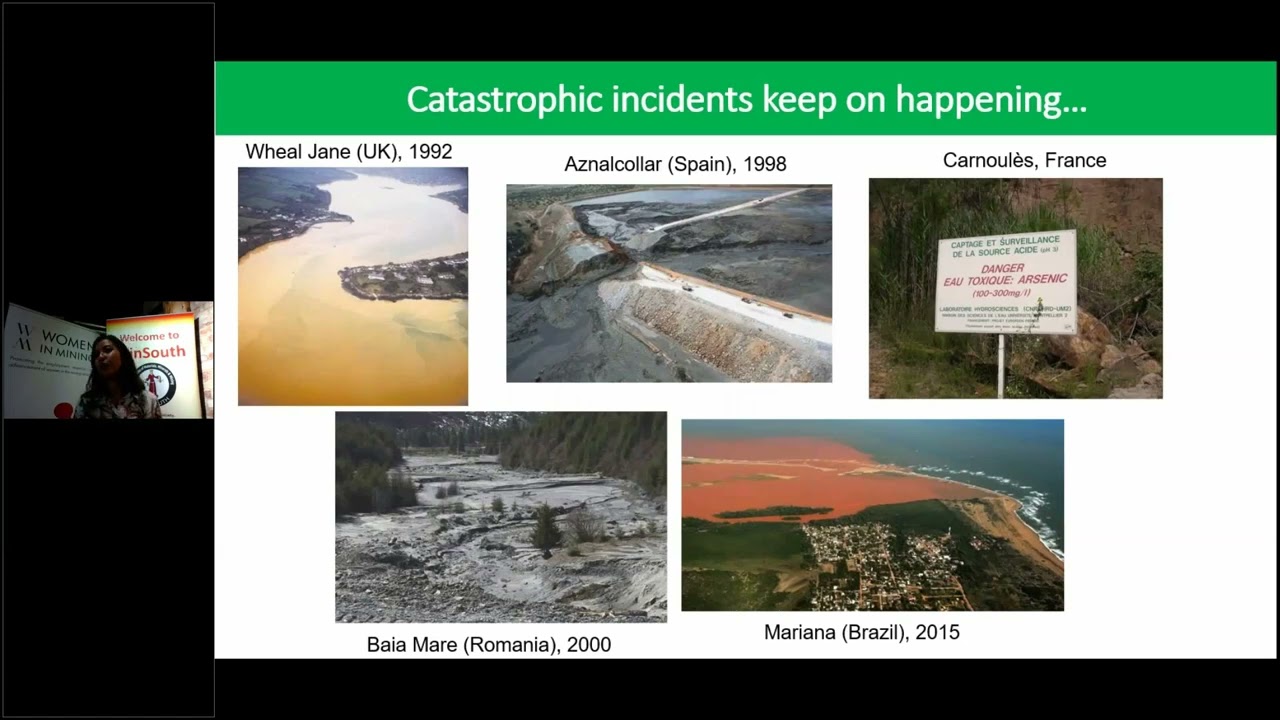
As well as making observations, make an inference or guess about the health of each stream. Pause the video now and discuss with your classmates. The most noticeable difference between these two streams is the color. The AMD affected stream is bright orange while the unaffected stream looks clear. There are other observations you may have made about these streams, including the depth of water, extensive shade from nearby trees, and so on. Ultimately, the stream without AMD is healthier than the stream with AMD. Acid mine drainage is the result of a chemical reaction between oxygen, water, and sulfate compounds such as pyite, creating a high acidity solution with a high concentration of heavy metals. Waterheds with acid mine drainage tend to have portions of the stream that are orange like this picture or milky white depending on the heavy metals present. The orange color is not the color of the water but it is a fine sediment called precipitate covering the bottom of the stream. Like other fine sediments, the precipitate can mix into the water creating murky orange colored water.
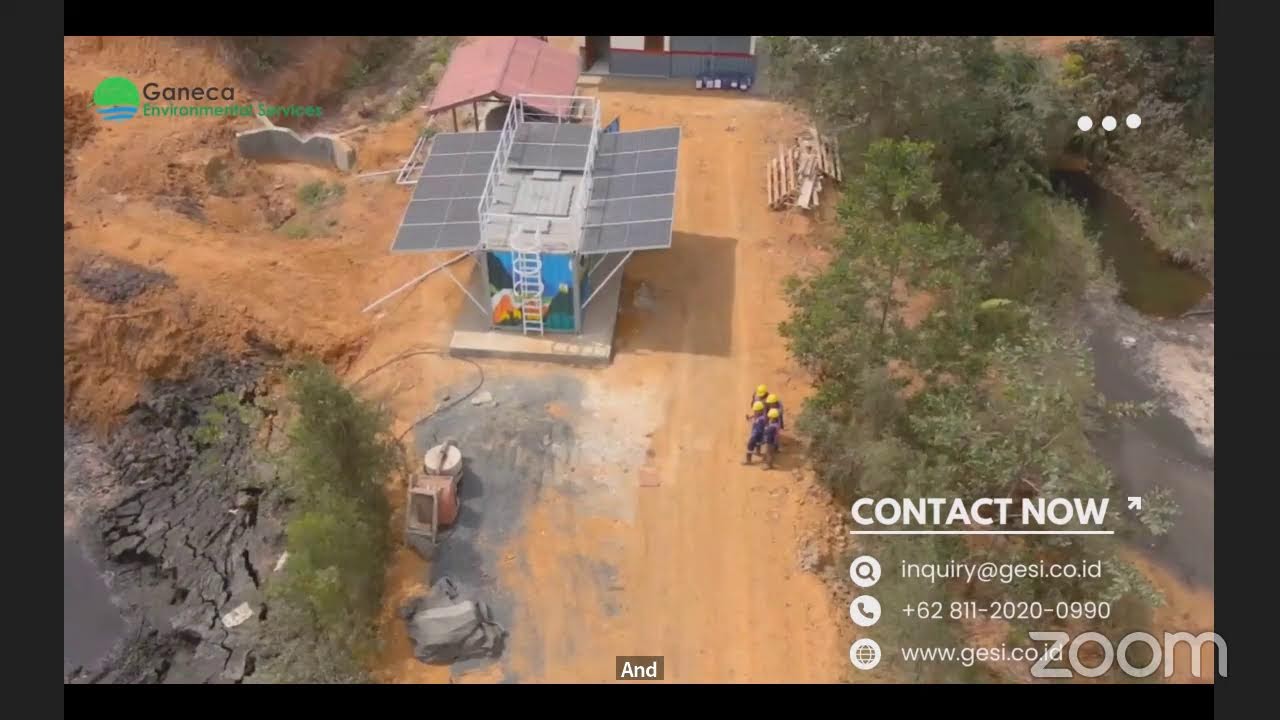
As the name suggests, acid mine drainage comes from underground mines, strip mines, and piles of waste rock from mines. In some cases, land managers pump AMD contaminated waters directly from underground mines into treatment ponds. There are several chemical steps to produce acid mine drainage, but this is the summary reaction.
The reactants pyate from the mine, oxygen from the air and water from humidity, precipitation or a stream combine and produce ferrris hydroxide also called yellow boy and sulfuric acid. Yellow boy is that yellow orange precipitate that we talked about earlier. The sulfuric acid produced in the reaction lowers the overall pH of the stream, which then increases the concentration of dissolved metals within the stream. Streams affected by acid mine drainage can have a pH as low as zero, meaning very acidic, to a pH of 6.5, meaning only slightly acidic. You can pause the video here and complete a quick activity to compare pH of familiar foods and household products to acid mine drainage. Some of the liquids you could use are lemon juice, vinegar, milk, baking soda dissolved in water, soapy water, orange juice, tomato juice, and coffee. Before measuring pH, predict the pH of each of the products. Pause the video now to complete the activity.
How close were your predictions to the actual pH measurements? Remember, the pH of acid mine drainage can range from 0ero to 6.5. So, how do land managers and researchers fix streams affected by acid mine drainage? Overall, the goal is to neutralize the pH, meaning bringing the pH near 7. But neutralizing the pH creates some problems of its own.
As the pH increases, the dissolved metals precipitate out of solution. The precipitate covers the bottom of the stream, making the stream unlivable. This precipitate covered unlivable area is called the sacrifice zone. To understand how metals precipitate out of acid mine drainage water as the pH increases, complete this activity, either as a teacher-led demonstration or as an experiment for student groups. You will first need to gather materials. Hydrochloric acid and sodium hydroxide are very costic, meaning you can cause chemical burns if you're not careful. Always wear goggles, gloves, and a lab coat. Now, we need to prepare the materials. To make one molar ferrris sulfate, dissolve.
28 g of the ferrra sulfate powder into about 80 ml of distilled water. Stirring to help the powder dissolve. After stirring, top off the water until it reaches 100 ml of solution, stirring again to make sure all solids are dissolved.
If the ferrraulfate isn't completely dissolving, add a very small amount of 3% hydrogen peroxide, no more than 1 or 2 millilit completely dissolve.
Be careful making six molar hydrochloric acid. For this marity, we need to combine 50 ml of acid and 50 ml of distilled water. This reaction is exothermic, meaning it produces heat.
So, make the solution in an ice bath as shown. When dealing with acid, always slowly add acid to water and stir constantly.
Be careful not to splash liquids and use glass containers that can withstand the temperature rise of the exothermic reaction. Making six molar sodium hydroxide is very similar to making the acid solution. Again, you will need to make the solution in an ice bath because the reaction is exothermic.
Sodium hydroxide is a solid that is dissolved into about 60 ml of water by slowly adding sodium hydroxide into water and stirring constantly. Once the sodium hydroxide is all or mostly dissolved, top off the solution to 100 ml. It's likely that you won't immediately use the materials you just made. Be sure to tightly seal all containers to prevent evaporation, contamination, or accidental spills. You can use paraffilm or another tight lid. Now that all materials are made, it's time to complete the experiment. As before, make sure you have goggles, gloves, and a lab coat on. First, pour approximately 30 to 40 ml of ferrraulfate into a clean beaker. The exact amount isn't important, but you want to be able to see the reaction. Next, grab the sodium hydroxide that we made and remove the cap or paraffilm. Add 15 to 20 ml to the beaker of ferrra sulfate or until precipitation occurs.
You will know precipitation has occurred when the solution turns a dark brown. Be sure to stir during this to make sure the reaction is complete. Give it a little time to see the precipitated metals collect into visible pieces.
The change in color is the precipitated metal and you can see the solids collecting in the beaker. Test the pH of the solution by using a pH probe or test strips. The pH will be basic, but your exact pH probably won't be 11.8. To reverse the precipitation reaction, you need to use hydrochloric acid.
Carefully remove the cap or paraffilm. Now add 15 to 20 ml to the beaker or until all solids are redesolved, stirring to make sure the solution is clear. It should take approximately the same volume of hydrochloric acid as the sodium hydroxide you used to cause the precipitation reaction.
Again, make sure that no solids are visible and that all metals are completely dissolved. Test the pH of the solution by using a pH probe or test strips. The pH will be acidic, but your exact pH is determined by how much acid you've added. Let's tie this experiment back to acid mine drainage streams. The precipitated metals you saw in the beaker are very similar to the metals you find in some streams affected by acid mine drainage. So when an acidic stream has a pH that is rising into the basic spectrum, metals precipitate out. Like we also saw in the experiment, metals in a stream can dissolve into water if the pH drops into the acidic range. Now that you've seen the reaction, pause the video here to refer to the steps if you would like to complete the reaction on your own. There are several ways land managers and researchers neutralize the acid caused by acid mine drainage.
There's two general treatment methods, active and passive. Active treatments require continuous inputs of resources to sustain the remediation process. We're only going to mention one of the most popular active treatments, which is an alkaline doser. Alkaline is another word for the basic portion of the pH range.
An alkaline substance, usually lime, is put into large silos near the stream and is dosed into the stream to neutralize the AMD affected stream.
Passive treatments require relatively little resource input once constructed than compared to active treatments. Our first example is a limestone leech bed.
Water is diverted to flow through channels made of limestone and since limestone is alkaline, the acidic water is neutralized as it flows through. Another passive treatment is wetland enhancement.
Researchers found that wetlands tend to neutralize and remove dissolved metals from the water. The phenomenon was originally found in naturally occurring wetlands, but wetlands are now constructed and enhanced by land managers. Gob pile removal and reclamation is another passive treatment. Gob piles are piles of waste rock from mining, which can also secrete AMD contaminants. By removing gob piles from nearby streams and restoring the land, the problem of AMD is largely reduced or completely eliminated. Let's talk a little bit about how organisms react to acid mine drainage. The lowered meaning acidic pH and the dissolved metals from acid mine drainage are stressful to organisms.
Each organism has its own tolerance level, but a pH of five or below is severely stressful for most organisms. Particularly sensitive species or life stages can begin to be negatively affected at pH of 5.5. Different life stages have different sensitivities and different responses to AMD. More mobile organisms like fish and macro invertebrates can drift out of stressful areas. More stationary organisms like some macro invertebrates can change their feeding behaviors or find many refuges as seen in this picture. Completely stationary organisms like algae must have adaptations against AMD or perish. As mentioned before, organisms have different tolerance levels.
Focusing on macronvertebrates and datoms, which are a type of algae, we can identify their tolerance level into three general categories.
Sensitive species include most mayflies, water pennies, stone flies, some catis flies, and simella datoms. These species tolerate the least amount of AMD before dying or moving out of the area if possible. Crayfish, dragonflies, helgrammites, and athenidium datoms are considered moderately sensitive, meaning that they can tolerate more than sensitive species, but they still die or move out of areas that contain moderate or severe AMD contamination. Tolerant species such as leeches, blackfly larvae, riffle beetles, and fragileria datoms can tolerate the most AMD contamination.
While there are AMD affected streams that contain no organisms, these organisms can survive in streams with pH below 5.5. It's also important to remember that tolerant species can also be found in healthy streams alongside sensitive and moderately sensitive species. Researchers have developed methods in which they can assess the health of a stream by examining the organisms that live in the stream. These methods have resulted in a tool generally called the biotic index. Go to this boat of knowledge lesson to learn a little more about biotic indexes and try your hand at calculating the health of a few example streams.
To recap the lesson, acid mine drainage is the result of a chemical reaction between water, oxygen, and pyrite, creating a high acidity solution with a high concentration of heavy metals.
Remediation is possible, but metals precipitate when pH increases. This creates a sacrifice zone where the metal precipitates make the habitat unlivable.
Acid mine drainage causes stress on stream organisms. Some organisms are more sensitive or tolerant to acid mine drainage. Organisms can be split into general categories of sensitive, moderately sensitive, and tolerant. Thank you for watching.
Up Next

16:11
How pH Affects Solubility: Mg(OH)2 Example | Ksp Chemistry
@brianaugustine6080
249 views•2020-03-30
83:56
Biocatalysis and Catalysis in Islatravir Synthesis | Merck Webinar
@SCIwheresciencemeetsbusiness
675 views•2020-10-08
10:06
1H NMR: Determining Number of Peaks from Structure
@MSJChem
59.2K views•2017-04-06

17:31
Edible Water Bottles: A DIY Guide to Sodium Alginate Spherification
@ryan
10.5M views•2019-06-21
Related Study Plans & Knowledge Roadmaps
Structured learning paths in Chemistry
chemistry
Nuclear Chemistry: Decay, Meds & Fuel Cycle
01Introduction to Nuclear Structure and Radioactivity
02Decay Dynamics and Kinetics
03Radiation Interaction and Detection
+ 2 more learning modules
24h5 modules
Explore Roadmap
chemistry
Supramolecular Chemistry: Forces & Machines
01Foundations of Chemical Bonding and Intermolecular Forces
02Introduction to Host-Guest Chemistry
03Thermodynamics and Dynamics of Self-Assembly
+ 2 more learning modules
16h5 modules
Explore Roadmap
chemistry
Photochemistry: Excited States & Reactions
01Foundations of Light-Matter Interactions
02Molecular Orbitals and Electronic States
03Photophysical Processes and Jablonski Diagrams
+ 2 more learning modules
18h5 modules
Explore Roadmap
chemistry
Coordination Chemistry: Bonding & Properties
01Introduction to Transition Metals and Ligands
02Crystal Field Theory (CFT) and Geometry
03Magnetic Behavior and Spin States
+ 2 more learning modules
14h5 modules
Explore Roadmap