



![ChatGPT ti sta IMBROGLIANDO [AI e Bias Cognitivi]](https://i.ytimg.com/vi_webp/ua3FKHyXzYQ/maxresdefault.webp)










Human decision-making is governed by two cognitive systems: System 1 (intuitive, automatic, emotional, and rapid) and System 2 (deliberative, reflective, and slower). People are often bad at making decisions because System 2 hasn't been adequately educated on the subject matter, while System 1 can be easily triggered by environmental cues like colorful displays or emotional appeals. This explains why people are vulnerable to manipulation in settings like supermarkets, where products are strategically placed to activate System 1 responses. The key insight is that understanding these cognitive limitations allows for 'nudges'—small changes in the environment that guide people toward better choices without restricting their freedom.
Decision-Making Science: How Nudges Shape Our Choices | Cass Sunstein
Added:Introduction to Behavioral Economics: Understanding how human psychology systematically deviates from the 'rational agent' model of classical economics.
Cognitive Biases and Heuristics: Familiarity with common mental shortcuts and systematic errors in decision-making, such as anchoring, loss aversion, and status quo bias.
Dual-Process Theory (System 1 and System 2): Daniel Kahneman's model of fast, intuitive, automatic thinking versus slow, deliberate, analytical thinking.
The Concept of Choice Architecture: The understanding that there is no 'neutral' design in how options are presented to a decision-maker.
Libertarian Paternalism: Exploring the philosophical and political theory championed by Thaler and Sunstein that justifies nudging while preserving freedom of choice.
Applied Behavioral Insights (Nudge Units): Studying how governments and institutions worldwide use behavioral science to design public policy, healthcare initiatives, and financial regulations.
The Dark Side of Nudging ('Sludge'): Investigating how cognitive biases are exploited through administrative burdens, deceptive design patterns, and manipulative marketing.
Ethical Evaluation of Behavioral Interventions: Analyzing critical arguments regarding voter/consumer autonomy, government overreach, and the transparency of choice architecture.
22.9K views1.3Klikes50:58Original Release: 2026-03-17
If you had to leave behind one truth about how humans make choices, what would it be?
>> It is true that Amazon can manipulate you. You say, "I want to buy a a charger and then there's the Amazon charger and it's huge and it's called Amazon Basics." And then there's something else that's exactly as good but costs half as much you have to click five times on to get. Agreed. That's a form of manipulation.
Ladies and gentlemen, I have the distinct privilege of bringing to you one of the most intellectually dangerous professors out of Harvard. I am sitting with Cass Sunstein whose research is frankly used by the White House, the Pentagon, world governments on how to how to make people behave a certain way.
Let's put it like that. He ran a bunch of policies for President Obama as well.
And today I'm sitting with Cass in a very deeply meaningful engaged conversation asking him how is it that people decide what they decide and what can you do about it. If you remember this very famous book called Nudge. Cass is the co-author of Nudge. So we're having a lot of fun. If you have just logged on, put this in your ears, gone for a walk, go to the gym, order yourself some food, relax, learn something new. This is the Prahar Gupta experience where you're either going to have so much fun or learn so much. My name is Prahar and welcome.
>> Well, Cass, thank you so much for your time. It's an exceptional campus. I've been here before, but every time I'm back here, it reminds me of what educational royalty looks like.
>> That's very kind.
>> Um, Cass, you've spent a lifetime studying how people make decisions. But before I move on to that, I want to ask you something personal.
What were you like as a child? Were you always looking at people and seeing how they decide and how they make choices?
>> I was mostly focused on sports. So, as a kid, what I was interested was any game with a ball. If it was baseball, American baseball, if it was either soccer, as we call football, I'd love that. If it was tennis, squash, which is my favorite sport. So as a kid I was thinking how can I run faster and be more accurate with my foot or my hands?
>> And then when and how did you get interested in decision-m?
>> I'd say it was probably when I was in my 20s. So after law school, I went to teach at the University of Chicago and I was interested in conventional legal topics and I was surrounded by people who were either recipients of the Nobel Prize or going to get the Nobel Prize and their emphasis was on human rationality. So what they would say is that people are rational that they respond to incentives and if someone is playing tennis or if someone is buying a good or if someone is taking a job or if someone is uh maybe going to date someone they think rationally about what works because I had studied literature in college poems and and novels and drama. I thought that human beings were complicated and not fully rational. And so I started to write papers about how our decisions depart from perfect rationality. We might be too optimistic.
We might be reckless. We might be impulsive. We might be excited. We might not show foresight. And I started to write some papers about that. And I eventually discovered some work in psychology and economics that was very uh rigorous about departures from rationality. And that work was done by uh Richard Thaylor who became my collaborator and friend uh Daniel Conorman who became my collaborator and friend Amos Traverski whom I didn't know um many others all over the world. And that work activated in my mind a sunburst. And so once I saw the work in psychology and economics on what human beings really are like I thought my gosh there's a world of opportunity here and it's it's like a planet that we've just started to visit. You know what's actually sad? India generations and slowly they're dying and the product is not the reason and even customers taste is also not the reason but they failed to do it online.
And if you ask me, then here's my only answer. If you want to actually scale your business in 2026, have an online course. Have an online e-commerce website where you can promote and manage your business and even sell your products online.
This is where UDO's e-commerce app comes in.
By following these steps, you create an e-commerce website with the help of UD.
Step one, online store choose and business type B. Next step is to choose color palette or let Udu pick it up from your logo and then select the pages and features. Select your favorite online catalog, even a product page you would like for your website. And in the final step, select a theme from so many AI generated themes and your e-commerce website is ready to personalize. So there you have it. I edited it for me or which minutes may you have a stunning business website that speaks for your brand. Just like this. Now to add products, select new product. Then add products either from barcode option or manually add details like name and price of the product. Once the product page opens, you can add images and descriptions. You can customize the product page as well by dragging and dropping blocks and changing the content as well.
Just like this, I added all the products of my store and see we are ready to start selling already. Udu provides various payment gateway options, even shipping options and the checkout process is also super smooth and easy.
No hassle, no fuss, just pure efficiency. And also I did this for free as the first app on Udu is free forever with lifetime free unlimited hosting and support. And the customer domain name will also be free for the first year. No hidden cost. If you want to try advanced features or even try more apps, you can do it with just a monthly subscription of rupees 580. It's that affordable. So go to the link in the description and pin comment and make your e-commerce website with Udu right now.
Let me see if I understand this properly. The predominant view in economics or your professional circles was that human beings operate with perfect rationality. that if I say I want an ice cream, I am going to go get an ice cream because I want an ice cream. It follows from there. But there was a concurrent line of work from Daniel Carnean, Richard Taylor, Amoski where you discovered that there is a lot of irrationality also. There's a lot of impulsivity. There's a lot of emotionality in the way humans make decisions. And so you got interested in figuring out how do humans actually make decisions?
>> Yeah.
>> And what are they actually like? And now with 40 odd years behind you working around these questions, what have you found? What are human beings like?
>> I think we've had more knowledge in the last 40 years about our species than we had at least in some important domains than we had in the previous uh many years. Um, a lot of it is in religious texts, but it's more uh organized and analytical now than it has ever been.
So, let me give you some examples. I it it's probably best to use the word bounded rationality rather than irrationality because we may have some friends who are irrational or we may ourselves be irrational at times but it's usually imperfect rationality rather than randomness or uh you know complete departures from rationality. Here are some examples. We know that human beings tend to show present bias. That is today and tomorrow really matter. The future is a foreign country. Let's call it later land. And we're not sure we're ever going to visit. So the focus on short term defines our species. It defines other mammals as well, by the way. So it's kind of built into living creatures. But present bias can create real problems if we don't protect our future selves from, let's say, uh, illness and disease.
We know also that human beings uh tend to show inertia. That means that the status quo has a lot of force. And these are things by the way about human animal, not about people in any particular country. So if we are used to doing something, it might be that we'll be very reluctant to try something else, even if we have good reason to believe we should try that other thing. So inertia has a bit more power than it ought to. We know that human beings tend, and this is in many ways a good thing, to be unrealistically optimistic.
So we tend to think that we uh are better drivers than the average driver, that our sense of humor is better than the average sense of humor. I like to think that about myself, and I think that's funny. uh we tend to think that the likelihood that things will work out for us is higher than statistically the likelihood is. We tend to think that our plans will work in two weeks when they really will take three weeks or four weeks. That's optimistic bias. We know that human beings have limited attention. So we can focus on a subset of the things that are relevant to us.
We might focus on you know our family and our friends and we might focus on our economic situation but to focus on everything is really hard and that can create a problem because there are things that are important that we might not attend to. So those are a bunch of things that are clear about humanity. We know that people hate losses. So a gain of a certain amount of money is good. A loss of the same amount of money is more bad than the gain of that amount of money is good. So losses really trigger our attention. And that can produce departures from perfect rationality. And these are kind of the if you had a constellation in the sky of the most important behavioral findings of the last 40 years. Uh these would certainly be among them. But the constellation has a lot of stars in it. H walk me through how someone could think about decision-m in the wild. So somebody I go to a supermarket and I'm looking at all the options. What are the kind of things that would go on in the head of an average individual while making a choice? Okay. It's useful to think and this is an idea that's been pioneered in social science and publicized by uh Daniel Conaman and Dick Thaylor and I do a lot with it. It's useful to think that there are two families of thinking in the human mind. Let's call them system one and system two. And system one is intuitive and automatic, sometimes emotional and really rapid. System two is more deliberative and reflective. It assesses things in a more conscientious way and it's it's slower. So, if you go to a grocery store, I'll I'll be very autobiographical here, and you see there are milk chocolate candy bars right there, your system one will think, I want them and I kind of need them now.
And you might uh fall prey or celebrate system one and just go get the chocolate bars. And grocery stores are often very smart at organizing themselves so that they activate system one, especially if the grocery stores stand to make good profits if they can get people's system one going. So they might show very colorful, delicious things at the uh checkout counter. They might make very visible things that uh get people excited and saying, "I really want that.
That looks fantastic."
Um, some people are more system one types in grocery stores. My wife is a system two type at a grocery store. I'm more of a system one type. A system two type will be more reflective and deliberative and think, what do we need for the next week? And then might think, well, we need uh some salad because people in the family like salad. And the system two person might think uh we need some fish because people really like fish and fish is kind of healthy. still get the fish and all this is more deliberative reflective assessments of what the family or the purchaser really needs. A system one purchaser would be more impulsive and more reflective of the short term. Now, every one of us has a system one and a system two. So, our judgments about grocery purchases are a combination of the two. There are different combinations. If you go into a grocery store really hungry, chances are you're going to buy more and more that immediately satiates you than if you're not too hungry when you go in the store.
So, people are very vulnerable to their shortterm moods. And grocery stores can nudge people towards particular purchases. You can nudge people to buy things that are delicious and not that healthy. Or you can nudge people to buy things that are not that delicious but very healthy. Or you can nudge people to buy things that are delicious and healthy. That's my favorite. There's a grocery store in the United Kingdom that has the name nudge on it. And that you can see all over the world certainly in North America uh grocery stores are being very attuned to human decision making. Sometimes to try to make as much money as they can sometimes to try to help their customers to make healthier choices. So you might do that by knowing that people have limited attention, putting the healthy foods in a very conspicuous places so that people see them immediately and maybe system one will say healthy great or by having information like calorie labels or sugar labor labels or labels that have something about salt content that will maybe get system one to be a little nervous. I don't want to get something that has so much salt, sugar. or maybe get system two activated to think I like a lot of salt and I lot like a lot of sugar but isn't good for me and I know that in India as in North America I've been to India there's keen interest in um seeing how the uh virtues and imperfections of human decision making can interact with the architecture of choice as we might call it uh to promote decisions that'll help people be more prosperous and be healthier.
>> Could we burden this difference between system one and system two where system one is more emotional, impulsive and sort of less thoughtful, less considerate of the future and system two is more rational.
I take into account all the many variables and the tomorrows and all of that. Could we say that people are famously bad at deciding for themselves because they're often system one-driven and can only accommodate maybe 3 GB worth of data until tomorrow? or are there any other reasons specifically as to why people are so bad at deciding things for themselves?
>> Okay, it's a great question. So, let's back up. Um, if you look at the human capacity to make decisions compared to, let's say, imaginable creatures, we are fantastic. It's a marvel. So, um, I'm looking out the window as we speak and I see people cross by and people know how to get from one place to another either in a familiar place or a place that isn't so familiar in a way that's kind of magical. If you put someone in a grocery store, especially if it's a familiar grocery store, but even if you put someone in an unfamiliar grocery store, they're basically going to know what to do. So our capacity for decision making is uh something first and foremost to celebrate. Um when we depart from perfect rationality, it's often because we find ourselves in a situation that system one can't handle and that system two hasn't been educated to handle. So take a a person who's never been in a car and ask them to drive.
Their system one has no clue about how to drive and their system too just needs a lot needs to do a lot of learning. And notice if you would that for people who have been driving for a long time, the knowledge that you get from having driven as a learner migrates from system two to system one. So, it's automatic.
So, I drove into work today and there wasn't a lot of cognitive effort in it and they didn't crash.
>> And that's because my system one basically knows what to do with a car.
If I find myself in an unfamiliar situation, which is a little dangerous, then system one is going to be challenged and I'm going to have to use a lot of cognitive effort. So what I'd say is when people make mistakes, it's often because the situation is one that they haven't seen easily or well before and system one is just disabled. Um I'm thinking in my trip to India when I first got to the airport, I didn't know anything. I was a a completely confused person. And then there were all all the people who'd been to the airport who, you know, looked at me like I was uh extremely ignorant or there was something wrong with me. I didn't know where to go. And of course, they were right because their system one, they knew what to do. System two often can be brought up to speed. So the first time people deal with a laptop if they uh haven't had one before, system one thinks, what's this? Is it what is it like that I'm familiar with? System one can't handle a laptop. So they might make a series of terrible decisions and system two has to learn. And that's how human beings are often in uh forming habits about uh consumption or in figuring how to do a job. So when I worked for the government under President Obama, I'd been a law professor for a long time and I thought I understood the subject matter. I taught the subject matter but in my first months I realized I I don't know anything because working for the government entails some system one things you know you have to have some intuitions about how to handle government decisionmaking and I lack those and my system two hadn't been educated so my first months in government my system too was working really hard to figure out this unfamiliar country and then once I got it then a lot of things became intuitive So generally people are bad at making decisions because system two which is the more sort of thoughtful part of their decision-m is it hasn't been educated on the subject matter. So it does not know its way around and system one well either is dysfunctional because it also does not know what to do with the laptop if it hasn't seen one or is too quick and therefore might lead to errors. Have I understood that properly?
>> Yeah, that sounds perfect. Okay. Um, tell me about this idea of nudge which well you wrote the book back in 2007208.
Very interesting time to write this book partly because right after that there's a financial crisis and that changes the world but besides that it's also the birth of social media. This is when like the modern reality that me and a lot of my listeners inhabit is being born in that very moment. And I find that social media eventually ended up becoming algorithm media very much in line with a lot of the suggestions made in your book. So first tell me about the idea of nudge and how that influences decision-m overall.
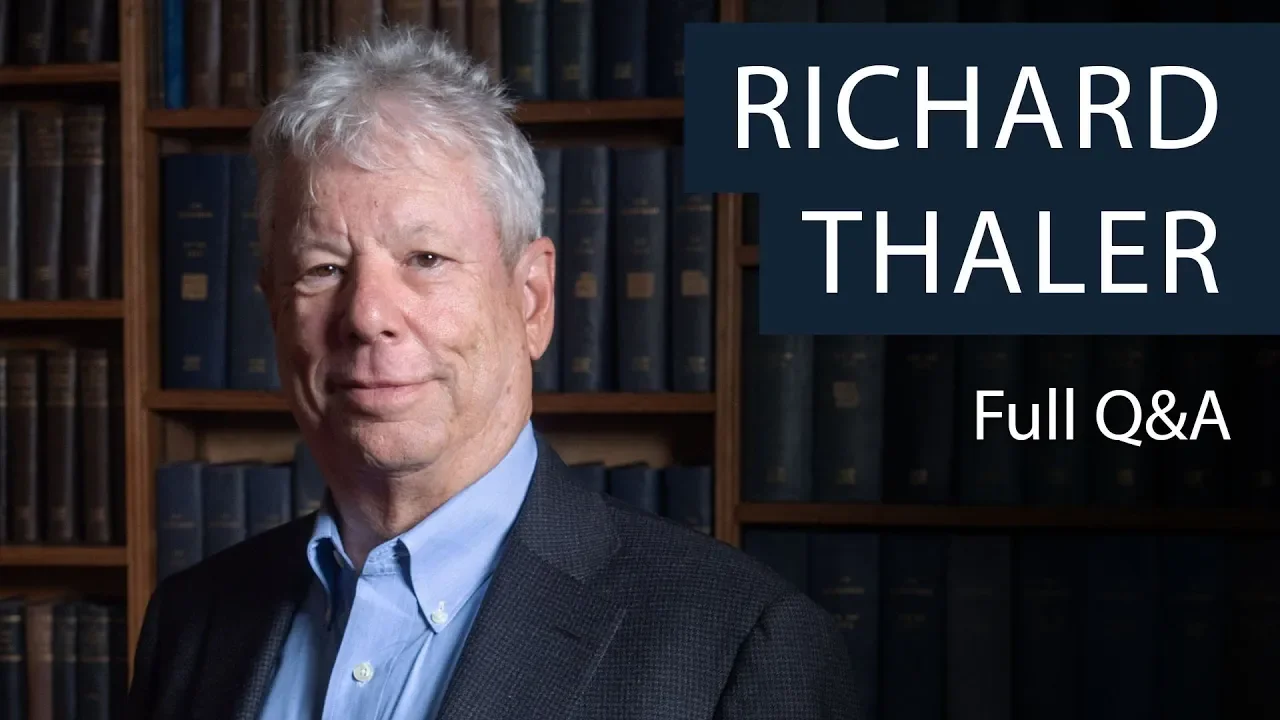
>> Okay, great. Thank you for that. So um Dick Thaylor and I had worked on human decision making and on public policy.
Thaylor got the Nobel Prize for his work on decisionmaking as an economist. I'm trained as a lawyer and we became very good friends and we worked for a few years on what do you do with policy and law if you know how people depart from perfect rationality. So h how do you handle the problem of crime? Uh what about environmental problems? So we did some work on that and then the idea came to us of libertarian paternalism which is a terrible term but we fell in love with it. Uh and libertarian paternalism means an approach that preserves freedom. So libertarian but is paternalistic in the sense that it steers people. So you can think of uh a warning that the waters where you're swimming at the beach there uh there's an undertoe so it's dangerous uh be careful that's a nudge if it doesn't stop you from swimming it preserves your freedom but it nudges you not to swim and so we got keenly interested in libertarian paternalism terrible term and we wrote a paper about that and improbably the paper attracted a lot of interest despite our title. And we worked on this for a few years really and then we worked on the subject after the paper was done and then people said you should do a book called nudge and nudge should be the term not libertarian fraternalism. So, think of a nudge as uh a GPS device where if you want to get to some place in a city that you don't know very well or country that you don't know very well, the GPS device will help you.
It's paternalistic in the sense that tells you this is the route you should go. If you want to get from New York City to Chicago, long drive, this is the route you should go. That's a form of paternalism. But it's libertarian in the sense that you say I want to go to Chicago and you say I don't like that route if you don't want to use it. So you both say the destination and you can override the nudge. So nudges are everywhere. A grocery store and I thank you particularly for giving that example is full of nudges. often unintentional.
They're just trying to put up their store. But sometimes, especially if they're savvy, they are intentionally nudging people either because they want to sell as much as possible or because they want their customers to make sensible choices. So, those are two two different or maybe overlapping things.
Okay? So, we're being nudged all the time. If you go on a website, it will nudge you because there will be some things that will be at the top and in large font. There'll be some things that'll be in smaller font. Maybe the large font will say, "Here's the product you can buy and it's fantastic and this is what it costs." And then the small font will say, "There are additional prices of this and this and this." And that the product might break after a week. And that'll be nudging you to buy it. And the small print will be, you know, telling you things they kind of have to tell you, but nudging you not to pay attention. So, we're being nudged all over the place. In every airport in the world, there are nudges that help you, you know, go to a place where you might want to uh pray, a place where you might want to uh help your child in some or another way. Uh and to the gate.
There are nudges everywhere. Um so we got keen, we got very excited about the use of nudges to improve people's lives.
And I I know in countries all over the world, people have been extremely creative in using nudges for good. For example, to diminish cigarette smoking, to increase road safety. These are issues I'm very interested in. I worked on when I was in the United States government. And you can nudge people not to smoke. I think that's a good thing.
You can nudge them to promote a cleaner environment, maybe make air quality better. Uh that's certainly important both in my country and in India. You can nudge people to make healthier decisions. Uh you can nudge people to get job training or education. You can nudge people not to commit crimes. And these are a bunch of things. And I think we've just started to see the promise of nudging. And I've noticed just in the last weeks really that in at the United Nations and at the World Health Organization uh the World Bank the amount of uh creative thinking and using nudges to help people live better longer lives is something that they learn I could not have anticipated back in 2007208 on social media. You're completely right. So really thank you for that that the social media companies are nudging all the time. Um I have a birthday coming up. The social media companies are nudging me to form a charitable donation moment in connection with my birthday. I'm grateful for that. Uh I'm going to do it. We'll see if my system too works to help me do it or whether I get too forget forgetful and inattentive. that they're nudging me to form a charitable thing. That's great.
Uh the social media companies are also nudging us to buy things uh to engage.
Large language models are really effective nudgers. You may have noticed if you use a large language model and you ask it a question, it often follows its answer by asking you a question to maintain engagement. Right.
>> So it's nudging you to stay on it. Yes.
I guess with the thought that more money is coming the more time you spend on it, >> right? It's actually one of the most blatant uses of the idea is that every time an answer is made on an LLM, it'll finish with saying do you want me to XYZ ABC which is an expansion sort of continuously stay on the app kind of thing. um you know all this sort of it's it's it's actually remarkable right because when you come up with the idea of libertarian paternalism or or for that matter nudge I don't think you'd expect that you would have a Cambridge Analytica kind of situation with the government where it was basically a political opinion allegedly they nudged a political opinion and a democratic election you know using social media and maybe not as sinister But I can totally see how I can get one of my friends to buy this new jacket from this clothing store just because they've been nudged often enough in this conspicuous way over social media for that matter any advertising um medium and that'll eventually happen.
At that point one has to wonder is there a difference between a manipulative nudge and an sort of an influential nudge? Like is there a difference between manipulation and influence? I'm grateful I'm grateful for that. I I've spent a lot of the last 15 years on this question and I just published a new book called manipulation which has two chapters on this topic. So I I thank you for that. Um man we need a definition of manipulation. So here's here's one.
Manipulation involves a form of influence that doesn't respect people's capacity for reflective and deliberative choice.
So if a doctor instead of saying here are your two options, here are the benefits, here are the costs, uh I recommend one, um that's not manipulative. If the doctor says to you something like if you don't go this way, I don't know how I can keep being your doctor, that's manipulative. That's not respecting the person's capacity for reflective and deliberative choice. If a company is selling you a product, nudging you, let's say to buy product A over product B showing that product A has certain characteristics like durability that are better than product B, even though product A is more expensive, that can involve nudges of various sorts and it needn't be manipulative. If they're trying to nudge you to choose product A over product B by hiding certain characteristics of product A which involve expenditure of money and those are not unavailable to you but they're kind of hard for you to find because they're in smaller font or maybe you have to click a few times to find the small print then they're not respecting your capacity for reflective and deliberative choice. So nudging I see as uh uh fully respecting people's capacity for reflective and deliberative choice. So think of something that says this has this much salt, this has that much salt, this has a lot of sugar, this doesn't have a lot of sugar. Educative nudges are completely non-manipulative.
If a GPS device says here's the recommended route to get to this place, that's not manipulating you. It's um not necessarily educating you, but it's not tricking you. There's no form of trickery.
>> I think what is also very interesting, Cass, and tell me if you've thought about it. This is something that comes from my professional experience working in media and specifically digital media.
I think the term social media is kind of redundant at this point. It's no longer social media. It's no longer a way to connect with people I know or I might want to know in whatever capacity. At this point, it's pure algorithm media.
And something shifted in 2017 18 when Tik Tok came about. Um because Tik Tok said I refuse to show you what you wish to see. I will tell you better what you want to see. And that entered a place from where instead of me thinking I'm going to follow unshadow of system 2. I know this fellow. I've known him 20 years. I'll follow him. It became a lot of system one over a short period of time exploited until boredom and then move on to the next one. So I am suddenly interested in Cass's work. I'll be shown all of Cass's work in the next two days until I'm sick of his face and his voice and I have to be like next.
But that's a very what's the word?
That's a very harmless form of inundation. It gets it has much more um it has scarier forms as well. I feel like we live in a algorithm-driven world completely and one might make the case I'm not interested in this moral position overall that the people responsible for the algorithms don't particularly care for the moral theory of good nudges and bad nudges. Would you say it's a fair characterization? I think >> the world's complicated. Yes. So, I've worked with Facebook uh in the past and they have various social good enterprises. Um, one of these is the birthday charity one. They have others where they encourage people in ways large and small uh to help their fellow citizens.
If you look at Facebook, you'll also see at various times under COVID, at various times in elections, things that are publicspirited.
I mean, not heavy-handed especially, but yes, public spirited about uh it's voting day. here's where you go to vote or information about COVID was on people's homepages. So there there was a lot about that that was publicspirited.
I I agree with you that that's very far from the whole picture. So social and I'm very concerned about social media platforms and uh these days I'm probably more concerned than I've ever been about social media platforms and I agree. I like your formulation a lot if I may say that there are two things that are troubling. One is the social media platforms know so much about their users not like Mark Zuckerberg individually knows but like the algorithm knows. So there's a technology which may have no person closely associated with it which knows. And what's the algorithm trying to do? It's not trying to help the person whom it knows super well. it's trying to maximize some things. Now, engagement is typically something it's trying to maximize. Uh literal purchases may be something it's trying to maximize. And the relationship between engagement and purchases and the well-being of users is highly imperfect.
>> Um and so just hypothetical kind of plays with the variables. My question is say you were reimagining any platform of your choice. Twitter in in specific I find is a consistent dumpster fire that's always inflaming people around the world. How would you change that in view of good nudges or nudges that promote well-being so that the political environment in America or the political environment in India is not as charged as it usually is.
>> That's great. And uh one thing that makes it great is to frame it as what should the managers of the platforms be themselves doing uh as the first question not what should government be doing. I think that's that's right because freedom is kind of important.
Um there are a lot of tools they have.
So the social media platforms can take stuff down.
They can reduce distribution.
They can label and they can warn.
At one point, Meadow was doing, I think, a better job than it's now doing at all of these. So, certain things would be taken down. So, if you said, I believe this is an example, if you said, uh, the election has been postponed and it's being held not on November whatever, but the next day, people that would have to be taken down. um certain kinds of bullying and threats would be and I think still are being taken down. So for the most egregious things take down is a very good thing to do.
>> It's content moderation. That's that's what you would do. There'd be more moderation of content.
>> Yeah, definitely.
>> Yes. And I do agree the world's a complex place. I feel like this question is kind of it's a hypothetical and the hypothetical sort of isolates many variables. I feel like Facebook did some content moderation but then there were other forces for instance competition where if a competitor refuses to do content moderation and gets more engagement then they're kind of forced by economic forces to sort of you know avoid content moderation. I think that happened specifically in 2022. Um and then roughly between 2020 and 2022 there was a lot of questions about who gets to decide what the truth is. And so they they I think they changed their strategy around content moderation after that.
That's that's my sense of it. Um let me personalize the problem, right? Uh how can I design my daily life for better habits? How's that as a problem question?
>> Um question is what first and this is going to be a freedom friendly answer on my part is what kind of habits would you like to have?
>> Healthier, wealthier. Let's take the standard. Yeah.
>> Sure. Okay. So to set up an a personal architecture that gives wealth and health the benefit of the doubt. So for wealth uh to set up a savings account is a very good idea. To make it automatic is a very good idea. To ensure that you pay your bills automatically in a way that doesn't result in late fees or overuse fees. That's also a very idea good idea. So to automate things is an is an excellent idea. Um for wealth for savings automation is a very good idea for health to establish a plan. Let's say that you have uh a smoking issue. Uh to adopt a firm rule I'm not going to smoke is is very good. It's kind of easier for many to stick to than they anticipate. If you have an addiction to smoking that's very tough for but you know sometimes life is tough and doing tough things is really important. I discovered I'll tell you something personal. I discovered that uh I used to drink a lot of diet soft drink a lot a lot a lot of self diet like a crazy amount of diet soft drink. And I loved it so much I can't tell you how much I love Diet Coke. And I I discovered that there was some reason to think that Diet Coke was not a good health choice for me. I learned that and I decided I'm going to drink no Diet Coke. I decided like on a Tuesday and that was clearly a wise health decision. And I haven't had even a little tiny bit of Diet Coke in I think three years now.
Not even a sip. And that that was just by a pre-commmitment strategy and declaring it to myself and others. No more Diet Coke ever. And everyone will have their own individual uh thing. My wife's dad uh died young of alcohol. He died in his 40s of alcohol and and this is preventable this alcohol deaths. So if you have an alcohol problem, you might need uh a self-nudge, which maybe takes the form of uh firm commitment. It might take the form of enlisting uh friends and family. If there's a health issue that's called for by insufficient exercise or that's produced by that, to create a habit like every Tuesday and Thursday, I'm going to do the following. uh that and and to make it routinized. That's often a very good nudge. What we've learned over the past few decades is to require people to enlist their system too repeatedly to deliberate and reflect. Now I'm going to be healthy. Now I'm going to be wealthier. That's really hard to create an AR architecture of routine is is much easier for people.
I mean I get that like sure I I'll personalize this to myself. I want to get healthier. I need to exercise more and eat better foods. So those are the two simple problem statement. I can tell myself all I want. I'm going to exercise tomorrow or I'm going to stop smoking or I'm going to eat better or stop drinking or whatever that might be. But when it comes to the minute of you know actually performing it, it's not that simple. And then in my head I think well I don't have good habits. I don't have a strong willpower. and then I get into some sort of self-lame and that takes a different route. How do I build a nudge so that it becomes more obvious? Like I fall into exercising. I carry a book around with me. I fly a lot now. Um and I carry a book around with me, a book, a different book every time I'm in a flight, but I never find time to read it. Like it's it's funny. I'll be in a flight 15 hours, but it just does not occur for whatever reason that I should pick the book up and read. I'd much rather watch a movie or I'd much rather listen to some kind of music. And one can say this is my personal preference. Um but I'm sure there's a lot of people who do something akin to that, right? So how do you explain that?
>> Okay, so I was at the White House in 2015 where there was an event for nudging and behavioral science and it was the unveiling of some initiatives there and Daniel Conaman there then I'm pretty sure in his 80s was one of the speakers and he surprised me. He said that in the 1930s there was a German social theorist who said that people think that in order to get people to do things you should push them. And what the German theorist said instead is it's better to think out why aren't they doing it anyway and remove the obstacle.
>> So I love that. Why aren't they doing it anyway and remove the obstacle? So I'm and I've thought about that a lot both in working with companies and in working with countries. Why aren't they doing it anyway and remove the obstacle? So we have a program in the United States where people are supposed to get something called a real ID which is more reliable ID and people weren't getting the ID. There are two things you can do.
You can tell them you can't fly if you don't have the real ID or you can make it much easier for them to get the real ID. And we ended up doing both. We made it really easy for people to get the real ID. And only after that had been in place did we say you can't fly without the real ID.
>> And that kind of worked. So I'm thinking, why aren't you reading the book anyway? And can we take away the obstacle >> now? You would know why you're not reading the book anyway. It it might be that you shouldn't read the book because you want to fly and relax. It's better to watch a movie. And uh I can give you some books of mine, but that might even make it less appealing to read a book, but if if there's a book that you would find would be consistent with what you're trying to get out of those 15 hours, maybe you you do it anyway, >> right? So the question then becomes, how do I remove the obstacle in someone's behavior? I'm trying to focus on work, but I get distracted by my phone. And so remove the phone. That's seems to be the advice, right?
>> Moving the phone.
>> Yeah. moving it away somewhere making it very effortful for me to log into those places >> is probably the idea >> completely.
>> So in effect you could you say that the path to building healthy habits goes through either putting up obstacles against bad behaviors or removing obstacles that prevent good behavior.
>> Okay. There's a framework used in many countries which is an acronym. It's east easy attractive. social and timely. Uh, easy means make it automatic if you can or make it simple if you can't make it automatic. So, if you want people to have access to some permit or some license or to use uh greener energy or whatever, make it really easy for them to do that. A attractive means make it catch the eye. So if people aren't going to doctor's appointment or healthy foods, it might be that it's just not on their view screen, it's not attractive.
But attractive is a pun, making it likable also and appealing. S is social.
And that means if people know the social norm is most people are, let's say, in their community shifting to vegetarian food, then the likelihood that people will shift to vegetarian food jumps. And T means at the right time. When I was a law student, I interviewed with a law firm and uh the senior partner at the law firm, a very distinguished Washington lawyer, asked me at the end of the interview what I'd like to know about the firm. And I thought I'll ask him a question that will make him like me because I wanted the job. So, I thought I wouldn't ask him a testing question. I said, "What do you like best about your firm?" knowing I was a little bit of a behavioral scientist back then knowing that that would make him smile and if he was smiling there'd be some positive effect on me and he said the best thing about my firm he said thank you for asking it's our pension program now I was 24 years old and I didn't know what a pension program was the fact that his firm had a good pension program that was not timely for me right it wasn't an essential so if you want to get people to do something make it time. So that's the east framework. It's four ideas, not one. Though easy leads the list. Uh my amendment to the east framework is to add F at the beginning to call it feast and I feel very strongly about this where F stands for fun. So to get people to do something, if it's running, if it's eating, you know, healthier stuff, if it's uh doing something economically new, it's really important that it be fun. So the best way to get people to exercise is not to tell them you're going to feel so great afterwards. It's instead to tell them you're going to have a great hour. The best way to get people to eat healthier is not to tell them you're going to, you know, feel better if you eat this food rather than that food, but say this is going to be a fantastic meal.
>> Have you through the course of your work ever wondered about free will? Because if you've had all this data and if you've seen all the ways in which I might find that I'm free, but my choice has been influenced by a nudge in my environment.
Am I actually free? Is there a concept of free will in your philosophical framework? Let let me give you some data. So if people are in an office where the people who run the office want energy to be saved and they turn the thermostat down a little bit in the summer to save energy so it's cooler.
That will be a successful notch. people will live live with the slightly warmer temperature, but if they turn it down a lot, the thermostat so it's really warm, they turn it right up again.
>> That is to say, people can be nudged unless the nudge is making them too hot.
If you automatically enroll people in a savings plan where some small percentage of their salary is going into their savings, most people will say, "Okay, that's great." If you make it so that a large percentage of their savings goes into their earnings go into savings, they'll say, "Hold on now, I need the money." So, they will opt out and and get the money now. So people can be nudged, but not if it makes them too hot. And I think that's a profound truth. Uh a GPS device can tell me how to get from one place to another and I'll basically follow it. But it if it is making me go into long traffic and it's a horrible nightmare or making me go round and round and round and I can't get to the place, I'm going to stop using it. I'm going to refuse the nudge.
If there's information that says this product is uh full of sugar and it's got dancing happy people all around, I'm probably not going to buy it even though they're dancing people. So, people are nudgible but within constraints. People will ultimately exercise their own agency if they really care a lot.
>> Got it.
um about artificial intelligence. I I would have asked you a more specific question that pertains to decision-m and and sort of a psychological in but I want to leave it broad. Uh what do you think about this revolution we are a part of?
>> I think it's exciting and terrifying.
>> Yeah, >> both.
>> Exciting because well that's more obvious. Terrifying. Why?
Well, the low-level current risks are that AI can be used to make people's lives go less well. So AI can be used to manipulate people. It can be used to influence people to make choices that make their lives go worse. It can exploit absence of information. It can exploit behavioral biases that people have. So these are all problems.
Also there are large level large risks that are terrifying. I think the probability is low but early days which could be uses of AI really to create horror >> you know like deaths and such. There are also potential uses of AI to compromise how governments work, either through national security threats or through things that involve manipulation of citizens. These are all very worrisome things. Right now, I feel much more upbeat about AI, much more excited than terrified, but it's reasonable to have a little terror.
>> Um, I have one last question for you, Cass, and then I'm going to let you be.
Um, if you had to leave behind one truth about how humans make choices, what would it be?
>> With overconfidence.
>> Yeah, that seems to be the consensus.
>> Yeah.
>> Um, thank you so much for your time.
This has been an absolute privilege. I hope you enjoyed this.
>> I enjoyed it greatly. It's fantastic.
>> Thank you. Thank you. Thank you.
Up Next

4:51
Mood Disorders: Depression and Bipolar Disorder Explained
@BrookeMiller
734 views•2014-07-08

68:32
Cognitive Skills for Differentiated Instruction | Teacher PD
@BrainWareLearning
631 views•2017-12-17

9:55
Thinking, Fast and Slow: Daniel Kahneman Animated Book Summary
@FightMediocrity
2.3M views•2015-06-05

6:40
The Nocebo Effect: How Beliefs Can Cause Real Harm
@CGPGrey
10.4M views•2013-12-23
Related Study Plans & Knowledge Roadmaps
Structured learning paths in Psychology
psychology
Neuroscience of Creativity: Networks & Training
01Foundations of Creative Cognition
02The Cognitive Neuroscience of Insight & Fixation
03The Triple Network Model of Creativity
+ 1 more learning modules
15h4 modules
Explore Roadmap
psychology
Imposter Syndrome: Etiology & CBT Framework
01Defining the Imposter Phenomenon
02Socio-Developmental Etiologies
03CBT Fundamentals & Thought Distortions
+ 2 more learning modules
15h5 modules
Explore Roadmap
psychology
Adult ADHD: Executive Dysfunction & Scaffolding
01Neurobiology of the ADHD Brain
02The Core Triad of Executive Deficits
03Executive Dysfunction and Emotional Regulation
+ 2 more learning modules
12h5 modules
Explore Roadmap
psychology
Loneliness: Evolution, Neurobiology & CBT
01Evolutionary Origins of Human Connection and Loneliness
02The Neurobiology and Physiology of Chronic Loneliness
03Maladaptive Social Cognition: The Psychological Loop
+ 2 more learning modules
12h5 modules
Explore Roadmap