





















The personality theory of personal identity faces a significant objection known as the duplication problem: if a person's complete personality (memories, beliefs, desires) could be transferred to multiple bodies simultaneously, then according to the pure personality theory, all recipients would equally be considered the same person, which is logically impossible. To resolve this, proponents of the personality theory can introduce a 'no-branching clause' that states a person retains their identity only if there are no competing individuals with identical personalities; however, this revision creates another problem because it means personal identity would depend on external facts about whether competitors exist elsewhere in the world, rather than solely on internal psychological continuity.
Personal Identity: Objections to Personality Theory
Added:Professor Shelly Kagan: We've distinguished three different views as to the secret or key to personal identity across time. There's the soul view, the body view, and the personality view.
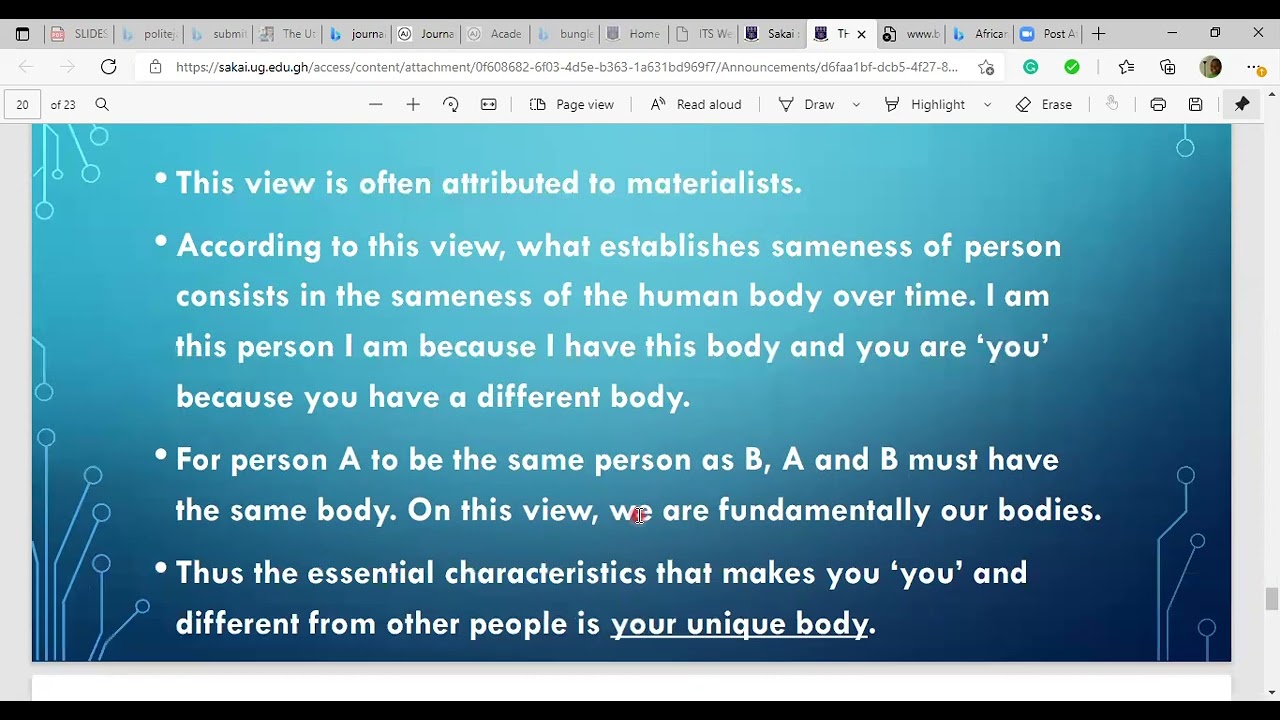
Putting aside, for the most part, the soul view, because I've argued that there are no souls--although occasionally I bring it out just for the sake of comparison and contrast--the main question we want to ask ourselves is how to choose between the body view and the personality view. The body view says follow the body. If somebody around in the future's got my body, that's me.
The personality view says follow the personality, that is, the set of beliefs, desires, memories, goals, ambitions, and so forth.
Somebody around in the future that's got my memories, my beliefs, my desires, that's me.
How should we choose between these two views?
As I mentioned at the end of last lecture, what I want to do is offer us a set of thought experiments.
They've got to be thought experiments, because in real life, bodies and personalities go hand in hand.
But by doing some science fiction experiments, we can take them apart and ask ourselves, "Which one do I think is me? When my body goes one way and my personality goes another way, where do I go?"
Again, just to remind you, in order to get the intuitions actually flowing, what I'm going to do once I've separated the body and the personality this way, is torture one of the end products.
So I'm going to be asking you to put yourself in the first person. Imagine this is happening to you. And ask yourself, "Which one do I want to be tortured?
Or which one do I want to not be tortured?"
Because that will give you some kind of evidence as to which one you take to be you. And think about this in that special first person ego-concerned way that comes naturally to us. Just bracket any moral concerns you may have about torturing other people or agreeing that somebody else should be tortured.
For our purposes, right now, if I brought up a volunteer from the class and I'm asking you--here's you, there's the other volunteer--which one do you want to be tortured? it's, "Let that one be tortured. Don't let it happen to me."
That's how we know this is me speaking.
All right, so that's the question I'm going to ask you.
I'll probably slip into talking about this experiment as though it's being done to me. But to get it vivid, you should think of it as though it's being done to you.
I'll mention, just in passing, that these thought experiments that I'm about to give, I'm going to give a pair of them, come from Bernard Williams, who's a British philosopher.
All right, so case number one. Here you are.
The mad scientist has kidnapped you and he says: I've been working on mind transfer machines.
And what I'm going to do is I've got you and I've also kidnapped somebody else over here, Linda.
And I'm going to hook you up to my machines and swap your minds.
And what that means is, I'm going to read off the memories and the beliefs and the desires from your brain and read off the memories and desires and beliefs from Linda's brain.
And then I'm going to electronically transfer Linda's memories and beliefs and so forth over here and implant them onto this brain. And take your memories and beliefs and so forth and implant them onto Linda's brain.
First, we'll put you to sleep when we do all this procedure.
Then when you wake up, you will wake up in Linda's body." There'll be something here that, you'll wake up and you'll say, "What am I doing in this new body? What happened to my beard?
How come I'm speaking in this high female voice?"
Whatever it is, but you'll think to yourself, "Well, here I am, Shelly Kagan.
I seem to be inhabiting Linda's body.
Don't know how that happened. Oh yes, the mad scientist kidnapped me and he transferred us, he swapped us.
He swapped our bodies, swapped our minds.
I guess the whole thing works." So the mad scientist explains all of this to you, but in order to give it a little kicker, because he's also an evil mad scientist--that may be evil already, but because he's an evil mad scientist--he says, "And then when I'm done--" So over here we've got Shelly's body but Linda's personality.
So Linda thinking "What am I doing?"
and "What am I doing in Shelly's body?
How did I get a beard?" So over here, Linda, in Shelly's body. Over here, Shelly, in Linda's body. "I'm going to torture one of these. But because I'm a generous evil mad scientist, I want to ask you which one should I torture?" Now, when I think about this, and again, I'm inviting you to think about this in the first person, so this is happening to you.
When I think about this, I say "Torture the one over here." I'm going to be over here in Linda's body, horrified at what's been going on, horrified that she's being tortured, but at least it's not happening to me.
That's the intuition I've got when I think about this case.
When the mad scientist asks me, "Which one of these two should I torture?" I say, "Torture this one."
Because if I were to say "Torture this one" and then he does it, think about what's going to happen. I'll be thinking "I'm Shelly Kagan. Oh, this is what a horrible situation. Oh, the pain, the pain!
Stop the pain! Make it go away!"
I don't want that to happen to me.
If this one's being tortured, nobody's thinking to himself, "Oh, I'm Shelly Kagan in horrible pain."
So I want this one to be tortured.
All right, that's the intuition I've got about the case.
Now, if you've got that same intuition, think about the implications of that intuition. You're saying that I, Shelly Kagan, ended up over here.
But that's not my body. This is Linda's body.
Shelly Kagan's old body is over here.
But this is the one that's me, because this is the one that I don't want to have tortured. So the body isn't the key to personal identity. Personality is the key to personal identity. This has got my personality, my memories of growing up in Chicago, becoming a philosopher, my thoughts about what I want to have happen to my children, my fears about how I'm going to explain what's going on to my wife. Whatever it is, this is the Shelly Kagan personality over here.
This is me. That follows then that this intuition suggests that what I find intuitively plausible is the personality theory of personal identity.
Now, let's tell a different story.
Both of these stories, as I say, come from Bernard Williams. Bernard Williams says here's another example we can think about.
Mad scientist, again, kidnaps you, kidnaps Linda. And he says, "Shelly, I've got some news for you."
I'm switching between you and me.
He says, "Shelly, I've got some news for you.
I'm going to torture you." I say, "No, no!
Please don't do it to me! Please, please, don't torture me!" He says, "Well, you know, I'm in the mad scientist business.
This is what I do. I'm going to torture you."
He says, "But because I'm a generous mad scientist, before I torture you, what I'm going to do is give you amnesia. I'm going to completely scrub clean your brain so that you won't remember that you're Shelly Kagan. You won't have any memories of growing up in Chicago. You won't have any memories of deciding to become a philosopher.
You won't remember getting married or having children.
You won't remember the--you won't have any desire.
The whole thing wiped clean, complete perfect amnesia before I torture you. Don't you feel better?"
No, I don't feel better. I'm still going to be tortured and now we've added insult to injury.
I've got amnesia as well as being tortured.
No comfort there. "Well," he says, "Look, I'll make the deal sweeter for you.
After I give you amnesia, before I torture you, I will drive you insane and make you believe that you're Linda. I've been studying Linda.
There she is. I've been reading her psychology by looking at her brain waves and so forth and so on. And so I'm going to delude you into thinking that you're Linda. I'm going to make you think ‘Oh, I'm Linda.'" You won't talk like that.
"Oh, I'm Linda." "And you'll have the memories of Linda growing up in Pennsylvania and you'll remember Linda's family and, like Linda, you'll want to be an author, or whatever it is that Linda wants to be.
And then I'll torture you. Are you happy now?"
No, I'm not happy now. First of all, I'm being tortured. I was given amnesia.
And now you've driven me crazy and make me--deluded me into thinking that I'm Linda. No comfort there.
He says, "Okay, last attempt to make--you're not being very reasonable," he says.
"Last attempt, I'm going to, after I drive you crazy and make you think you're Linda, I'm going to do the corresponding thing for Linda.
I'm going to give her amnesia and then I'm going to drive her crazy and make her think that she's Shelly.
Give her all of your memories and beliefs and desires.
Now is it okay that I'm going to torture you?"
No. It hardly makes it--it was bad enough I was being tortured and given amnesia and driven insane.
It doesn't really make it any better that you're also going to give amnesia and drive insane somebody else.
Don't torture me!
If you've got to torture somebody, I say in my nonethical mood, if you've got to torture somebody, do it to her.
Don't do it to me. When I think about this second case, that's my intuition. Now, think about the implications of this second case for the theory of personal identity. If I don't want this thing over here to be tortured, that must be because I think it's me. But if it's me, what's the key to personal identity?
Well, not personality, because after all, this doesn't end up with Shelly Kagan's personality before the torture. Shelly Kagan's personality is over there. This is Shelly Kagan's body and that suggests if I don't want this to be tortured, it's because I believe in the body theory of personal identity. Follow the body, not follow the personality. Even though he swapped our personalities, it's still me he's torturing.
That's the intuition I've got when I think about Bernard Williams' second case. Now, we're in a bit of a pickle here, from the philosophical point of view.
Because when we've thought about the first case, the intuition seemed to be, ah, personality's the key to personal identity. But when we thought about the second case, the intuition seems to be, huh, body is the key to personal identity. That's bad, right?
Two different cases give us two different, diametrically opposed, answers on the very same question.
One sec. And it's worse still--Of course, if you don't share the intuitions that I just--I was being honest with you. Those really are my intuitions when I think about these cases. If you're with me, you're in a philosophical problem.
If you're not with me, if you didn't have the same intuitions, then maybe you don't have a problem.
But I've got a problem. And it's worse still because it's not really, if we're careful and think about it, it's not really as though we have two different cases and intuitively we want to give different answers to those two different cases.
Really, all we've got there is just one case.
It's the very same case, the very same story, that I told two different times.
In both cases, before the torturing ends, goes in, there's Shelly Kagan's body over here with Linda's personality and there's Linda's body over here with Shelly Kagan's personality. And we're asking, "Which one do you want to be tortured?"
It's the very same setup. I just emphasized different elements in a way to manipulate your intuitions.
But it's the very same case. It can't be that in one of them, follow the body and the other one, follow personality.
So it's very hard to know what moral should we draw.
The appeal to intuition, thinking about these cases doesn't seem to take us very far.
There's a question back there. Yeah?
Student: [inaudible] Professor Shelly Kagan: Nice suggestion. So the suggestion was this.
When the mad scientist put my personality, Shelly Kagan personality, onto Linda's body, he had to modify Linda's brain.
And in modifying Linda's brain--this was the question that was just raised--hasn't he actually made that brain more like Shelly Kagan's brain than Linda's brain?
And if that's right, shouldn't we say--Remember, the best form of the body view, I argued previously, was the brain version. So if this is really Shelly Kagan's brain over here, then this isn't a problem for the body view. We were deceived when we said the body view said this is Shelly Kagan.
Really, the body view, to wit, the best version of the body view, that is the brain version, now has to say, "Oh, we moved Shelly's brain and put it here." Well, if you're prepared to say that, then indeed you will be able to say, yeah, it's the body view. The body view says, "Do it to this one." Rather, "Don't do it to this one, because this is Shelly Kagan."
I don't actually find myself though inclined to agree with you that this has become Shelly Kagan's brain.
If you ask me, "Where's Shelly Kagan's legs?"
They're still here. "Where's Shelly Kagan's heart?"
It's still here. "Where's Shelly Kagan's brain?"
It's still here. It's not as though what the scientist did was open up my skull, take the brain out.
At least, if that's the way we're imagining it, don't imagine that! This is all electronic transfer.
It's not as though he took the brain out and literally moved that hunk of tissue over here. All he's done is reprogram Linda's brain. Analogy here that might be helpful. Think of the difference between the computer and the programs and files saved on the computer.
Personality is a little bit like a program that's running on the computer. Though we have to have not just the generic program, but the specific data files and databases and so forth. What the mad scientist did, in effect, was wipe out the hard drive, put in the other programs from the Shelly Kagan computer, but it's still the very same computer.
It's still the same central processing unit, or so it seems to me. Of course, it's true that now, in a certain way, Linda's brain will be similar to the way that Shelly Kagan's brain had been before.
In terms of how, as it were, the floppy drives are set up. But still where's, literally speaking, Shelly Kagan's brain?
I want to say it's over there, not over here.
There was another question or comment.
Yeah. Student: [inaudible] Professor Shelly Kagan: I'm not quite sure what the question is. So the thought is, look, over here we've got Shelly Kagan's body with Linda's personality. If we torture this one, this thing, whoever it is, is going to think to itself, "I'm Linda. I'm in horrible pain.
I wish it would stop. I wonder whether I'll ever see Linda's husband again."
Over here we've got Linda's body, Shelly Kagan's personality. If we torture this one--of course to torture, you cause pain to bodies, but the pain gets felt in the mind.
So over here, we've got something that's going to think to itself, "I'm Shelly Kagan.
I'm in horrible pain. I wonder whether I'll ever see Shelly Kagan's wife again." Yes, of course, we're torturing bodies. By torturing the bodies we cause pain to the minds, the personalities, who have beliefs about who's hurting.
What I'm inviting you to think about is which one, if you had to choose between these two gruesome scenarios, which one would you rather save?
Which one would you rather protect?
Which do you care more about? Making sure that your lump of flesh doesn't have its neurons hurt?
Or making sure that the person who's thinking to yourself, "I'm Shelly Kagan" or whatever your name is, that "I'm in pain." You don't want to be thinking, "I, Shelly Kagan, am in pain."
Or if your name is Mary, "I'm Mary.
I'm in pain." That's what we're trying to get straight on here. The trouble though is that you tell the very same story two different times and I find myself sometimes being pulled this way, sometimes being pulled that way. So I can't use thinking about the Williams cases as a method of deciding what do I really believe, the body view or the personality view?
I find, myself, you spin the story one way and I follow the body. You spin the story another way, and I follow the personality. If we're going to have a way to decide between these two theories, it seems as though we need some other kind of arguments.
At least, I need some other kind of arguments, because of the intuitions I've got about the cases.
So let me turn to a different approach to solving the question, answering the question, which one should we believe? It starts by raising a certain philosophical objection to the personality theory.
It's going to say, look, the personality theory of personal identity has an implication that we cannot possibly accept. So we have to reject the view.
And then become body theorists, if there are no souls.
Here's the objection. It's a common enough objection.
It's probably occurred to some of you.
According to the personality theory, whether somebody is me depends on whether he's got my beliefs.
For example, the belief that I'm Shelly Kagan, professor of philosophy at Yale University.
Well, I'm a not an especially interesting fellow.
So let's make it more dramatic and think about Napoleon.
You've probably read about this thing.
Every now and then there are some crazy people who think they're Napoleon. So imagine that there's right now somebody in an insane asylum in Michigan who's got the thought, "I am Napoleon." Well, the objection says, clearly this guy's just insane, right?
He is not Napoleon. He's David Smith who grew up in Detroit or whatever. He just insanely believes he's Napoleon. Yet, the personality theory, the objection says, would tell us that he is Napoleon because he's got the beliefs of Napoleon.
He's got Napoleon's personality. Since that's obviously the wrong thing to say about the case, we should reject the personality view.
But not so quick. The personality view doesn't say anybody who has any elements at all of my personality is me.
One belief in common is obviously not enough.
Look, we all believe the earth is round.
That's not enough to make somebody else me.
Of course, the belief, "I am Napoleon" is a much rarer belief. I presume that none of you have that belief. I certainly don't have that belief. Napoleon had it and David Smith in Michigan's got it. But so what?
One belief, even one very unusual belief's not enough to make somebody Napoleon, according to the personality theory. To be Napoleon, you've got to have the very same overall personality, which is a very big, complicated set of beliefs and desires and ambitions and memories.
David Smith doesn't have that. David Smith in the insane asylum in Michigan does not remember conquering Europe.
He doesn't remember being crowned emperor.
He doesn't remember being defeated by the British.
He doesn't have any of those memories.
He probably doesn't even speak French.
Napoleon spoke French.
He doesn't have Napoleon's personality.
So the David Smith case isn't really bothersome.
It's not really a counterexample to the personality theory. The personality theory says, to be Napoleon, you've got to have Napoleon's personality. But David Smith doesn't.
So, of course, we can all agree David Smith, despite thinking he's Napoleon, is not Napoleon.
No problem here for the personality theory.
But we could tweak the case. We could revise the case.
Some foe of the personality theory could say, "Okay, imagine that this guy in Michigan does have Napoleon's personality.
He's got the memories of being crowned emperor and being defeated, conquering Europe. He's got all of those memories."
And, remember we want him to have Napoleon's personality.
He doesn't have any David Smith memories.
He doesn't have any memories of growing up in Detroit.
How could Napoleon have memories of growing up in Detroit? Napoleon grew up in France.
The objection then says even if this guy had all of Napoleon's memories, beliefs, desires, personality, still wouldn't be Napoleon. So the personality theory's got to go.
Well, when I think about this example, I think, now we've got it right. That is, that is what the personality theory has to say about that case.
But I'm not so confident anymore that it's the wrong thing to say. So think of this, as it were, from the point of view of Napoleon, right? So there was Napoleon in the 1800s conquering Europe and being crowned emperor, being defeated by the British, being sent to exile on, was it Elba, right?
And I forget where Napoleon actually dies, but he's got memories of getting sick and ill and the light begins to fade and he goes unconscious.
And then--well, we'll at least try to describe it this way--he wakes up. And he wakes up in Michigan.
And he thinks to himself, "Hallo.
Je suis, Napoleon! What am I doing in Michigan?"
I don't speak French, so I'm going to drop that, right? "But the last thing I remember I was going to bed from my fatal illness on the Isle of Elba.
How did I get over here? I wonder if there's any chance of reassembling my army and reconquering the world."
If he had all of that, it's not so clear to me that it would be the wrong thing to say that, by golly, this is Napoleon. I mean, it would be totally bizarre. Things like this don't happen.
But of course, we're doing science fiction stories here. So we'd say to ourselves, wouldn't we, somehow Napoleon has been reborn or reincarnated, taking over, by some sort of process of possession, the body of the former David Smith, but now it's Napoleon.
I find myself thinking maybe that would be the right thing to say. Yeah?
Student: [inaudible] Professor Shelly Kagan: All right, so the thought was, look, this guy over here, David Smith's body with Napoleon's personality--And let's be clear about this. There's no underlying David Smith personality still there, to have the counterexample or the example that we're after. It can't be that he's got mixed together memories of growing up in France and memories of growing up in Detroit. He never thinks to himself, "I'm David Smith. How did I become Napoleon?"
If you got that junk, you don't have Napoleon's personality. He's just got Napoleon's personality through and through. Well, the question then was, maybe that's not so. After all, he doesn't really have Napoleon's experiences, did he?
Napoleon had the experience of being crowned emperor.
But this guy didn't have the experience of being crowned emperor. Maybe what we should say is he thinks he remembers the experience of being crowned emperor, but it's a fake memory. It's an illusion, or a delusion, but he didn't really have the genuine memory. To have the genuine memory, he has to have been crowned emperor.
And he wasn't crowned emperor; Napoleon was crowned emperor. Well, that's what we could say, but we can't say that until we decide he's not Napoleon.
After all, if the personality theory is right, since he does have all of these memories, or semi-memories, or quasi-memories, or whatever we should call them.
If that's the key, then it is Napoleon.
So he is remembering being crowned emperor.
If you want to say, no, no, no, those memories are illusions, it must be because you don't think he's really Napoleon. In which case, what you're discovering is you don't really believe the personality theory. Why isn't he Napoleon?
It's not his body. The body of Napoleon is not this body and to be Napoleon, you've got to have Napoleon's body. It's a possible position.
That's the thought that the body theorists are trying to elicit in you when they offer these Napoleonesque counterexamples. You could match the personality as much as you want, but it's still not Napoleon.
Don't you agree? That's what they say.
And if you do agree, that shows you don't really accept the personality theory. I'm not going to try to settle this here. Who should we believe?
The personality theory or the body theory?
I'm trying to invite you to think about the implications and the differences between these views so as to get clearer in your own mind about which of these you accept.
In many moods--at least, when I think about not the simple, the ordinary David Smith case with a single belief or two, but the full bodied--that's a bad term--the full blown Napoleon case with all the memories, all the beliefs.
Suppose David Smith there thinks, "I remember.
I remember." I can't say it in a French accent. "I remember playing as a lad in France burying my little toy saber."
Some memory that Napoleon never wrote down in his diaries.
And we go and we dig up in France and there is the saber, right? This guy remembers things that Napoleon would remember. I find myself thinking, well, maybe that's Napoleon.
Imagine a slightly different version of this case.
Napoleon dies on his death bed, wakes up in heaven saying "Je suis Napoleon. I was emperor of Europe and now I have come to my due reward. I am here in heaven."
Well, it seems like what we would want to say is, "Yeah, that's Napoleon." It's Napoleon even if it doesn't have Napoleon's body. Napoleon's corpse is rotted in France. God gives Napoleon some new angelic body. It seems straightforward.
If it's got Napoleon's memories, beliefs, desires, goals, and so forth and so on, wouldn't we say it's Napoleon? Imagine that--back to this earth--this Napoleon type of case happened all the time.
We might have a term for this sort of thing--possession.
Every now and then, people's bodies get possessed.
They become this other person who's, now, personality has taken over. If this happened frequently enough, instead of just a little science fiction story like with the David Smith case, maybe we'd say, yeah, possession is one of these things that needs to be explained. How is it the personality travels? Well, maybe there'll be some sort of physical explanation for it.
Still, maybe we'd say, yeah, the people have been taken over. They've become somebody else.
So speaking personally, I don't find the Napoleon objection a telling one. It doesn't give me a reason to reject the personality theory.
But we can now tweak the worry in a slightly different way.
Okay, so here was Napoleon back in France with his memories and his beliefs and so forth and so on.
Death bed, goes to sleep, goes unconscious, whatever it is. I told you a story in which he wakes up, or his personality wakes up, however we should put it, in Michigan. But if it could happen in Michigan, I suppose it could also happen in New York.
And if it could happen in New York and it could happen in Michigan, I suppose it could happen in New York and Michigan.
So right now, let's imagine two people with Napoleon's personalities, complete personalities, one of them in Michigan, one of them in New York.
Whoa. What should we say now?
What is the personality theory going to say about this case?
So I don't know how to draw personalities very well on the board, so I'll draw little stick figures of bodies, but I mean these to be the personalities.
So here we've got the continuing, evolving over time--this is all taking place in France--the personality of Napoleon in France.
There's the deathbed scene. Now, up here we had somebody with Napoleon's personality continuing.
Of course, he's going to change. He's going to evolve.
Just like the actual historical Napoleon kept having new beliefs and new desires, if this really was Napoleon in Michigan, he'll start having some new desires and beliefs about Michigan, which perhaps Napoleon never gave any thought to at all. Who knows?
So this is Michigan over here. And I said I was willing to entertain the possibility that this is all Napoleon.
Napoleon, if you think of it, Napoleon's a person extended through space and time. According to the personality view, what makes somebody in the future the same person as somebody in the past is if it's part of the same ongoing personality. So maybe that's what we've got going on in the Michigan case. Now, we imagine in our new version of the worry somebody with Napoleon's personality over here in New York.
Now, if the Michigan guy hadn't been there, what I would have done, if I believed in the personality theory or when I believe in the personality theory, is say "Oh look, Napoleon--reincarnated in New York." That's what the personality theory should say and I said it doesn't seem like a crazy thing to say if we only had the guy in New York.
Just like it wasn't a crazy thing to say if we only had the guy in Michigan. The trouble is, imagine the case where we've got one guy who's got all of Napoleon's personality in Michigan, one guy who's got all of Napoleon's personality in New York. Now what should we say?
What are the choices here? Well, I suppose one possibility would be to say the guy in New York is Napoleon.
The guy in Michigan isn't. He's just an insane guy who's got Napoleon's personality. You could say that.
The reason that it seems difficult to say though is because it seems like it would be just as plausible to say the reverse. Say no, no, no.
It's not the New York fellow who's Napoleon.
It's the Michigan fellow who's Napoleon.
Well, we could say that, but the difficulty is there seems to be no good reason to favor the Michigan fellow over the New York fellow. Just like there was no good reason to favor the New York fellow over the Michigan fellow.
Saying that one of them is Napoleon and the other one isn't seems very hard to believe. Well then, what's the alternative? Well, I suppose another possibility is to say, at least another possibility worth mentioning, is to say they're both Napoleon. Somehow, bizarrely enough, Napoleon split into two. But when splitting into two, he split on to two bodies, but they are both Napoleon.
Now, it's very important to understand how bizarre this proposal would be. The claim is not now we've got two Napoleons who are, of course, not identical to each other. No, no, we've got a single Napoleon. A Napoleon who was in one place in France and is now simultaneously in two places in the U.S. That seems very hard to believe.
It seems to just violate one of our fundamental notions about how people work, metaphysically speaking.
People can't be in two places at the same time.
Well, maybe that metahphysical claim I just made should be abandoned. Maybe we should say, oh, under normal circumstances, people can't be in two places at the same time. But if you had something like this, by golly, this guy would be, Michigan dude is Napoleon and he's the very same person, the very same person as New York dude.
New York dude and Michigan dude are a single person, Napoleon, who is bilocated. It doesn't happen.
But if it did happen, it could happen.
Well, maybe that's what we should say.
But again, all I can tell you is, I find that too big a price to pay. People can't be in two places.
It's one thing to say people are space-time worms extended through space and extended through time.
It's another thing to say that they are Y-shaped space-time worms. It seems to violate one of the fundamental metaphysical things about how people work.
All right, I've got to remind you though, none of the options here are all that attractive. So when I say, you don't want to say that, you don't want to say that, we're going to run out of possibilities.
So maybe this is what you'll want to say.
All right, saying that Napoleon is in Michigan but not New York doesn't seem very attractive. Saying he's in New York but not Michigan doesn't seem very attractive.
Saying he's in both places at the very same time doesn't seem very attractive. But what other possibilities are there? If he's not one but not the other, and if he's not both, the only other possibility is that he's neither.
Given this situation, neither of these guys is Napoleon.
You've got separate people. There's the person Napoleon, a space-time worm that came to an end in France.
And there's some space-time worm taking place in Michigan, some space-time person worm taking place in New York.
But neither of them are Napoleon.
That seems to me to be the least unattractive of the options we've got available.
But notice that if we say this, if we say neither of these guys, despite having Napoleon's personality, neither of these guys is Napoleon, then the personality theory of personal identity is false.
It's rejected. We're giving up on it.
Because the personality theory, after all, said if you've got Napoleon's personality, you're Napoleon.
But now we've got people that are not Napoleon but they've got Napoleon's personality. So the personality theory, follow the personality, is wrong if we say neither of these guys is Napoleon. But that does seem to be the least unacceptable of the options.
At least that's how it seems to me.
So the personality theory's got to be rejected.
Now, I think that's right. I think, in fact, the personality theory's got to be rejected.
But that doesn't mean we couldn't revise it.
We could try to change it in a way that keeps much of the spirit of the personality theory, but avoids some of the problems we've just been looking at.
Here's what I think is the best revision available to fans of the personality theory. They should say we were simplifying unduly. We were simplifying it, getting it wrong, when we said, "Follow the personality. If you've got Napoleon's personality, that's enough to make you Napoleon."
That's not true. We need to throw in an extra clause to deal with branching, splitting cases, of the sort that I've just been talking about.
We need to say, if there's somebody in the future who's got my personality, that person is me, as long as there's only one person around in the future who's got my personality. If you have multiple examples, duplications, splittings and branchings, nobody, none of them is me. So where the original personality theory said, same personality, that's good enough for being the same person, the new version throws in a no-competitors clause, throws in a no branching clause.
It says, same personality's good enough, as long as there's no branching. If there is branching, neither of the branches is me.
Now, if we say that, if we throw in the no branching clause, then we're able to say, look, in the original story I was telling, where there was the Michigan guy who had Napoleon's personality but no New York guy, that really would be Napoleon, because it would have the same personality with no competitor.
Similarly, had we had somebody with Napoleon's personality in New York and nobody with the personality in Michigan, that guy would have been Napoleon, because we would have had the same personality with no branching, with no competitor. But in the case where we've got branching, where we've got somebody with Napoleon's personality both in Michigan and New York, that violates the no branching rule, and we just have to say nobody's Napoleon in that case. As I say, that seems to me to be the best revision of the personality theory available to them. So what we now need to ask is, can we possibly believe that revision?
Can we possibly accept the no branching rule?
The no branching rule seems rather bizarre in its own right.
Think about the ordinary familiar cases that we're trying to make sense of. I'm the same person as the person that was lecturing to you last time.
According to the personality theory or the revised personality theory, that's because I've got the same personality. The guy last time thought he was Shelly Kagan, believed he was professor of philosophy. I think I'm Shelly Kagan.
I believe I'm the professor of philosophy.
He's got all sorts of memories of his childhood.
I've got the same memories. He's got desires about finishing his book. I've got those desires about finishing my book. Same personality, it's me.
That's what the personality theory says.
So I conclude, hey, it's me. I know you were all worried whether I'd survive over the break a couple days.
Came back, it's still me. I made it through Wednesday.
Or did I? Or perhaps I should ask, "Or did he?" Yeah, there was somebody there on Tuesday and yeah, there's somebody here on Thursday, and yeah, this person here now has got the same personality as the guy who was there on Tuesday. But according to the no branching rule, we can't yet conclude that I'm the same person as the person that was lecturing to you on Tuesday. We can't conclude that until we know that there aren't any competitors, that there isn't anybody else right now who also has the same personality.
If I'm the only one around today who's got Shelly Kagan's personality, then I'm the same person as the person who was lecturing to you on Tuesday. But if, unbeknownst to me, and I presume unbeknownst to you, there's somebody in Michigan right now who's got Shelly Kagan's personality, then we have to say, huh, it turns out I'm not Shelly Kagan after all. Neither is he.
Neither of us are Shelly Kagan. Shelly Kagan died.
So am I Shelly Kagan or am I not Shelly Kagan?
Can't tell until we know what's going on in Michigan.
Whoa! That seems very, very hard to believe. Whether I am the same person as the person who was lecturing to you on Tuesday presumably should turn on facts about that guy who was lecturing to you on Tuesday, and facts about this guy who's lecturing to you today on Thursday, and maybe some facts about the relationship between that guy and this guy--or that stage and this stage, if we prefer to talk about it that way.
We can see how whether it's the same person or not has to turn on the relations between the stages.
But how could it possibly turn on what's happening in Michigan?
How can whether or not I am the same guy as the guy who was lecturing to you on Tuesday depend on what's happening in Pennsylvania or Australia or Mars?
To use some philosophical jargon, the nature of identity seems like it should depend only on intrinsic facts about me or perhaps relational facts about the relations between my stages.
But it shouldn't depend on extrinsic, external facts about what's happening someplace else. But if we accept the no branching rule, we're saying whether or not we've got identity depends on what's happening elsewhere.
With the no branching rule, identity ceases to be a strictly internal affair. It becomes, in part, an external affair. That's very, very hard to believe. And if you're not prepared to believe it, it looks as though you've got to give up on the personality view. Last thought.
During all of these problems for the personality theorist, the body theorist, the fans of the body theorist, is standing there laughing. "Ha!
You poor fools. Look at all the problems you've got adopting the personality theory.
See how easy it is to duplicate personalities, leading to these totally implausible no branching rules.
We can avoid all of that if we become body theorists."
What we'll ask ourselves next time is whether or not the body theorist is in a better situation.
Up Next
John Locke on Personal Identity and Memory
@bbcradio4
169.1K views•2015-01-19

John of Damascus on Holy Images: A Theological Defense
@BannedBooks
139 views•2026-04-25

John Rawls' Theory of Justice: The Rawlsian Social Contract
@YaleCourses
184.8K views•2011-04-06
The Myth of Sisyphus: A Greek Legend of Eternal Punishment
@TEDEd
8.6M views•2018-11-13
Related Study Plans & Knowledge Roadmaps
Structured learning paths in Philosophy