





![Federal Rules of Evidence (FRE) Rule 803(3) - ["Then existing"] State of mind](https://i.ytimg.com/vi/0PqJVQyPFE0/sddefault.jpg)








Under Federal Rules of Evidence 803(1) and 803(2), present sense impressions are statements describing events as they are perceived contemporaneously, while excited utterances are statements made while a person is still excited from an event and about that event; both exceptions apply when the declarant had no opportunity for reflection, making the statements reliable enough for admission despite being hearsay.
FRE 803(1) & (2): Present Sense Impressions & Excited Utterances Explained
Added:The definition of hearsay under Federal Rule of Evidence 801(c), including what constitutes an out-of-court statement and the 'truth of the matter asserted' standard.
The general rule of inadmissibility for hearsay under FRE 802 and the underlying policy reasons for restricting it.
The structural difference between hearsay exclusions/exemptions (under FRE 801(d)) and hearsay exceptions (under FRE 803 and 804).
The role of the trial judge as a gatekeeper of evidence under FRE 104(a) regarding preliminary questions of admissibility.
Advanced FRE 803 exceptions, such as State of Mind (FRE 803(3)) and Statements for Medical Diagnosis (FRE 803(4)).
The impact of the Sixth Amendment's Confrontation Clause (specifically the 'Crawford v. Washington' doctrine) on the admissibility of excited utterances in criminal trials.
Hearsay exceptions under FRE 804 that require the declarant to be unavailable to testify, such as dying declarations and statements against interest.
Trial advocacy and litigation skills for laying the foundational requirements of these exceptions during witness examination.
4.8K views67likes16:39Original Release: 2020-10-02
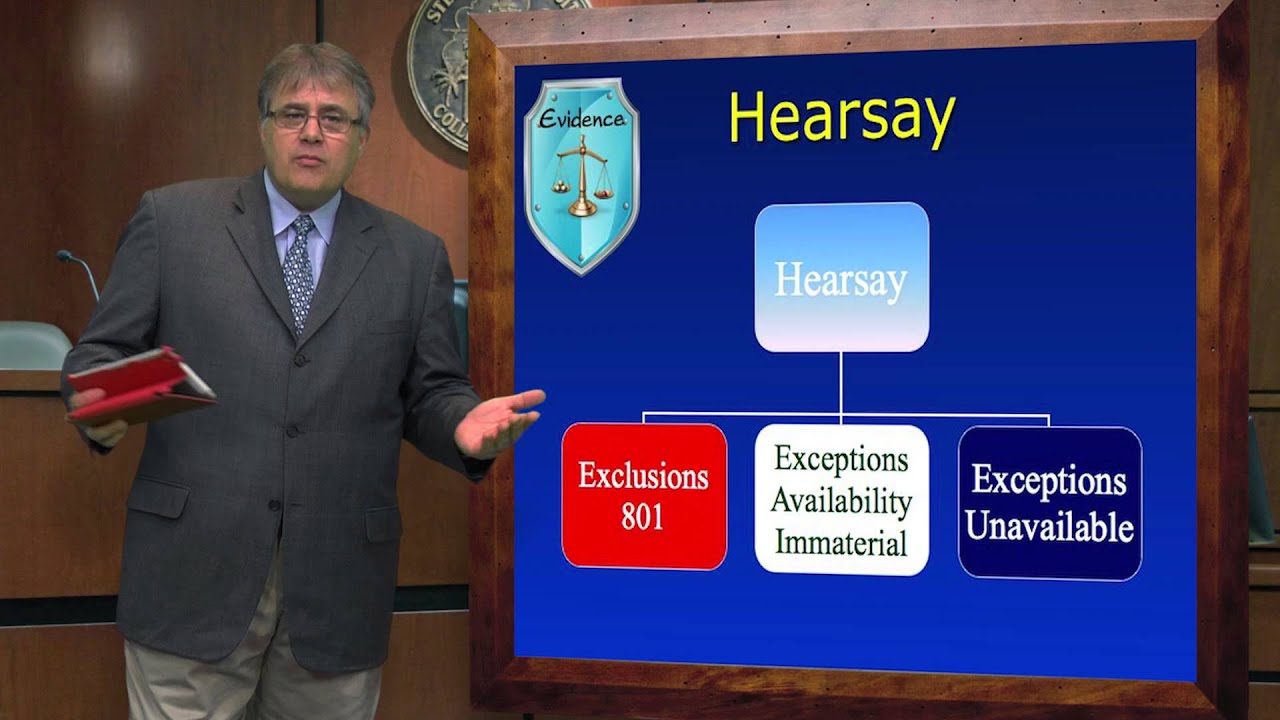
aloha this is professor porter we're discussing the federal rules of evidence in particular into the weeds of hearsay and we've moved past uh definitional here santa 801 c we've moved past uh not here say defined under 801 d and we're into uh the different batches of exceptions and first we cover what i call the reliability exceptions under uh the rule of evidence 803 and all of its subparts and we have to keep in mind i can include these slides every time i cover 803 videos because essentially these are options available to the proponent the opponent has a familiar refrain that's objection hearsay because they're embracing the definition of 801c out of court statement for the truth of matter asserted these are the many pathways below these three arrows these three boxes that are available to the proponent the proponent can have arguments under that same definition to say nosa we do not have a statement we do not have out of court or most popularly it's not offered for the truth of the matter asserted they might have some not here say defined pathways under 801 d either prior consistent statements prior consistent statements out of court identification or statements against party opponents when a statement is made by or attributed to a party and offered by that party opponent here we have something different in a checklist type way if it's not a definitional argument to make or not a not hearsay argument to make that we're making our way to while it might be hearsay an exception applies [Music] and again you see all the arguments available to the proponent and really what we're saying here where the rule makers are saying by offering us these exceptions these narrow patches these narrow circumstances what we're really saying is the rule makers are telling us when a statement is made under these narrow circumstances we're okay with its reliability we're okay with the underlying policy of hearsay that we want to meet uh out-of-court declarance we want to meet the declarant we want to have first-hand information come from the witness stand so we can our opponents can cross-examine that declarant and so our jury can evaluate the credibility of that declarant with these circumstances the circumstances that we're going to cover in 803 exceptions including 8031 and 8032 that we're going to cover in this video what we're really saying is if the statement is said and these circumstances and has these attributes and has these foundational requirements available to the proponent then the proponent can argue while it might be here say an exception applies that is it's a reliable enough under these circumstances not guaranteed to be true not guaranteed to be trustworthy just reliable enough to where we're able to say we're good on meeting the declarant we're good on evaluating the jury evaluating that declarance credibility or the opponent being able to ask questions and cross-examination and here's the three arguments we make it's not hearsay most popularly it's not offered for the truth of the matter asserted instead it's offered for some other purpose or under 801 d it's not hearsay defined under 801d because it's prior inconsistent statement a prior consistent statement a prior auto court identification or maybe a statement made by or attributed to a party offered by a party opponent and then lastly my first phrase that comes out of my mouth if i am the proponent responding to a hearsay objection at trial and i intend to use my kind of last part of the checklist i intend to use an exception particularly an exception under 803 as we're covering here your honor while it may be hearsay an exception applies specifically this is a an excited utterance under 8032 or other parts of the rule that we'll cover okay here are the main ones that courses cover won't spend a lot of time we're going to cover 8031 present sense impressions and 8032 excited utterances but here are the main ones that that we cover even though there's more than 20 in 803 [Music] present sense impression not not a fan of how they've titled this rule it's really imagine present spoken observations it's someone sort of reporting as it's happening so the visual that i like to use and if you can think about you know these exceptions have underlying policy too just like hearsay itself and the entire article 8 has underlying policy why do we have here say why do we allow this objection it's because we want first-hand accounts we want a chance to probe the reliability the sincerity of the declarant the reliability of the statement we want a chance to ask cross-examination questions for our opponent we want a an opportunity for our jury to view and evaluate credibility but this is one of those circumstances we say if this happens if if the statement of the out of court statement happens in these circumstances it's reliable enough and really it's because there's no opportunity for reflection we're not we're not remembering something we're not stating something we are talking as it's happening so the the image that i like to use in class is uh imagine that you're on the phone with your close friend i'm on the the phone my close friend dave uh and i'm i'm looking out the window as i'm on the phone with them talking about something else and and right away i'm looking out at the street and i see something very distinctive i see someone roll up on a bike hop off the bike throw the bike to the side and start going right into jimmying a car on the sidewalk i i know whose car it is i know that's not the owner i see this happening i'm basically watching a crime taking place of a breaking entering of a car and immediately i shift from the conversation with my friend on the phone to describing what i'm seeing so i am reporting as it's happening i am the newspaper reporter for my close friend over the phone and what the rulemakers tell us is because these are my present spoken observations i'm telling you what i'm seeing as i'm doing it now he's doing this now he's doing that i'm saying it in real time reporting that's what the rulemakers have decided is a present sense impression it's something that i'm reporting contemporaneously or immediately thereafter a really tight timeline so imagine it comes down to trial and i'm not around i went away uh i'm not going to be there i'm not going to be a witness i was the declarant i'm the one that said it out loud while it was happening but instead they for other reasons they call my friend on the other side of the phone and you can imagine the line of questioning that leads up to getting into porter's statements when he's questioning my friend dave were you on the phone with him yes had you talked to him before yes did you recognize his voice yes did you know the context of our conversation yes what were you talking about immediately prior to his observations out the window oh we were talking about sports we were talking about current events we were talking about whatever at some time did you come to understand that porter was looking out the window yes what did he say and you see all those foundational questions that go into leading up to and maybe even satisfying an authentication objection everything that goes into essentially that moment of what did porter say well porter is the declarant my friend dave who's on the other end of the phone line he's the witness so this is one of those circumstances where we don't get to meet the declarant we don't get a first-hand account we don't get to ask follow-up questions of porter we don't get to have the jury evaluate the credibility reporter has all the problems of hearsay so as the opponent especially for your exam taking self you are going to say objection hearsay as the opponent and you're going to explain it by embracing this is an out of court certainly i was in my living room statement i'm making a statement i'm telling you about all the activities of the of the the robber who's going through the car and and we're offering it for the truth right we want to we want to get it in purportedly out of trial or you know for reasons that we're getting into that this is the person and here's what they were doing for the truth of whatever i'm saying in quotes describing this this breaking and entering as it's happening so the opponents absolutely right they're absolutely right to object what did he say this is a witness dave who's quoting someone else on the outside porter who said the statement so that the clarence porter the witness is dave he's quoting what uh someone else said it's an out of court statement offered for the truth don't miss it don't skip it objection here say on behalf of the opponent then we go into uh you know uh the options for the proponent the proponent could say something definitional they could maybe even make an argument uh that doesn't apply here but you know a a not hearsay defined argument but really what we're talking about is this meets the narrow circumstances of an 8031 present sense impression because what you would say if you made your way over to sidebar objection hearsay says the opponent council who sponsored dave as a witness makes their way over to sidebar your honor while this may be hearsay an exception applies this is a present sense impression under 803.1 because the declarant was describing events as he was perceiving them contemporaneously not even immediately thereafter contemporaries talking while he's observing it has enhanced reliability it has sincerity because there is no reflection he's literally saying the things as he's describing him the objection would be overruled because the proponent met the foundational requirements of this exception so sure the opponent met the foundational requirements of their 801c this is hearsay but as soon as the proponent can meet the foundational requirements of present sense impression under 8031 and do so against these definitions right the conversation with narrow the opponent do you have anything to say now it comes down to does 8031 apply as proponent says or not that's the argument you can make the objection is overruled and the statement porter's statement about what he observed looking out the window would be admitted or allowed in as testimony similarly when we talk about 803.2 it's a kind of a related exception we're talking about an excited utterance another title that i absolutely hate because not too many people think of when they're excited and they're going to say something that it's going to be an utterance so excited statements look out for exclamation points look out for any event by which a normal declarant perceiving those events would be excited so the typical one that you hear in hypos is running from a burning building or you've just seen a car crash and you're the one calling into 9-1-1 something like that right there's some event by which we would justify whatever comes out of our mouth uh to be you know kind of in that excited heightened tone where it would justify exclamation points at the end so look out for exclamation points and the foundational requirements there are a few it has to be a statement you know in a sort of excited statement with this look at the content of that statement look for the exclamation point i you know i just saw the red card crash into the yellow car and i think people are hurt exclamation point you know it's an excited statement but then the second two foundational requirements it has to be while the person is still excited and about the excited event one two three has to be an excited statement has to be while still excited from the event and it has to be about the excited event so usually typically if you have the exclamation point you have the content of the statement you can evaluate all three and uh pay close attention to those timeline type elements it's a little longer timeline than a present sense impression under 8031 right it's uh not immediately thereafter or contemporaneous it's while you're excited so if depending on how crazy the thing you saw how excitable the event that you witnessed as a declarant you might be able to be excited for some amount of time what's what's definitively not going to be included is that some amount of time is not going to last weeks or months right if they say it's two weeks after the statement you're probably gonna have to find another excited event and maybe your excited event is going through it or talking about it again or being uh re-victimized or you know whatever whatever the circumstance but it's probably not going to be the underlying event of the fire of the car crash uh weeks later some kind of time and remember we're making arguments so if i'm the opponent and i'm objecting i'm basically saying this is not a court statement for truth of the matter asserted i'm objecting to hearsay because we're going to say upon running from the fire when porter was right next to the co-worker and said i can't believe that dan did this i can't believe that he blew up the work like he said he was going to do i've said that statement right and i've done it in a heightened tone we're literally running from the burning building again i'm not around for trial i'm the declarant i'm saying it to my co-worker donna don is going to be the witness at trial at trial you can imagine those foundational questions leading up to it donna uh what happened oh there was this big fire there was an explosion what did you do i ran was anyone around you when you were running sure i was running with porter strike for stride we were leaving the burning building at that time did porter say something to you yes before you get into what he said how would you describe his manner at that time he liked the rest of us he was frantic he was excited he was um he was yelling uh everything parenthetical everything that he said justified having an exclamation point at the back end um and then it would be this the the absolute uh you know pivotal question what did porter say again porter is the declarant on the outside we're trying to get into that statement um and donna is the witness so again you're justified as the opponent this is an out of court it's right outside the building when it's burning it's a statement where he's saying i can't believe the co-worker did this that like he said he was going to do and it's offered clearly for it's truth and a matter sort of because they're trying to get into the fact that probably this person was responsible for the fire so they have the one two three they have the foundational requirements of of this uh exception for 8032 excited utterance and again it shifts back to the proponent the person that called my co-worker donna to the stand they're over at sidebar they have options they have definitional arguments i know you don't want c they have definitional arguments under 801d or they go to the wonderful world of 803 exceptions reliability and they say i have one of those narrow circumstances where the rule makers tell us the circumstances under which this were made make this statement reliable enough because here i have the foundational requirements to the exception as the proponent i have the foundational requirements of the exception this was absolutely an excited statement you can see by what it was the context that it was said and the exclamation point at the end it was said while he was still excited while porter was still excited he was literally running from the building there's no question no argument as to what excited even if it were minutes later hours later and he's sitting down he could still be um you know in that excited state uh and and talking about this event that just happened to him that was so personal and most critically and especially when you you get to different testing with the bar and and the like his statement was about the fire and about the excited event about the thing that made him get excited clearly if his statement was something else that was unrelated uh that he really prefers peanut butter and banana sandwiches over peanut butter and jelly sandwiches and that happens to be what he's yelling when he's running out of the building it could be relevant it could be important to trial it could be something that you know the proponent would want to advance at trial it just doesn't have to do with this excited event it's not connected to this excited event so therefore it fails as it relates to that one foundational requirement so if you satisfy again if the proponent satisfies the foundational requirements because the statements about the excited event about the fire then it's going to be the objection is overruled the testimony is allowed into porter's statement from donna the witness uh if the statement is something else about what kind of sandwiches he likes even if it's relevant at trial it's going to be the objection is sustained because the foundational requirements of the exception were not met and if the objection is sustained then the testimony will not be allowed or the testimony will be excluded at trial counsel with donna move on to something else other than porter's statement it's not going to see the light of the day before these jurors
Up Next

19:50
YNW Melly Trial: Legal Analysis of Jury Selection and Evidence
@CLRBruceRivers
346.9K views•2022-04-11
4:27
US Secondary Sanctions Impact on EU Businesses and Blocking Legislation
@Bureauvandijk
1.6K views•2019-03-20
5:27
Forensic Phonetics: Speaker Identification in Legal Cases
@nptel-nociitm9240
539 views•2025-03-19

24:42
Police Interrogation Tactics: False Confessions & Legal Reform
@LastWeekTonight
7M views•2022-04-18
Related Study Plans & Knowledge Roadmaps
Structured learning paths in Law
law
Self-Defense Law: Imminence & Castle Doctrine
01Foundations of Self-Defense Law
02Imminent Threat & Reasonable Belief
03The Principle of Proportionality
+ 3 more learning modules
12h6 modules
Explore Roadmap
law
Defamation Law: First Amendment & Actual Malice
01Introduction to civil torts and the First Amendment
02Elements of Defamation: Libel and Slander
03Public Figures vs. Private Individuals
+ 2 more learning modules
8h5 modules
Explore Roadmap
law
Hearsay Rule: Trial Evidence & Exceptions
01Introduction to Trial Evidence & Courtroom Basics
02Demystifying Hearsay: The Core Definition
03Non-Hearsay: Exclusions Under FRE 801(d)
+ 3 more learning modules
14h6 modules
Explore Roadmap
law
Medical Malpractice: Law, Liability & Care
01Foundations of Tort Law and Civil Liability
02The Four Elements of Medical Malpractice
03Defining and Proving the Standard of Care
+ 2 more learning modules
12h5 modules
Explore Roadmap