






















The popular 'butterfly effect' (sensitive dependence on initial conditions) differs fundamentally from what Edward Lorenz actually intended; Lorenz's 1969 work revealed that certain deterministic multiscale systems have finite predictability horizons (approximately 10 days) that cannot be extended by reducing initial condition uncertainty, making the Navier-Stokes initial value problem potentially ill-posed and representing one of the great unsolved problems in 21st-century mathematics.
The Butterfly Effect: Lorenz and the Limits of Prediction
Added:The concept of determinism in classical mechanics, specifically the classical view that knowing exact initial conditions allows for perfect prediction of future states.
Basic understanding of dynamical systems and how differential equations are used to model physical systems over time.
The fundamental principles of numerical weather prediction and how computer models simulate atmospheric behavior.
The distinction between linear systems (where output is proportional to input) and non-linear systems (where small changes can produce disproportionate effects).
The mathematical definition and geometry of the Lorenz Attractor and strange attractors in phase space.
Ensemble Forecasting techniques, which run multiple weather simulations with slightly varied initial conditions to estimate forecast uncertainty.
Lyapunov Exponents, which are used to mathematically quantify the rate at which chaotic trajectories diverge.
The limits of predictability in other complex systems, such as orbital mechanics (the three-body problem), macroeconomics, and population dynamics.
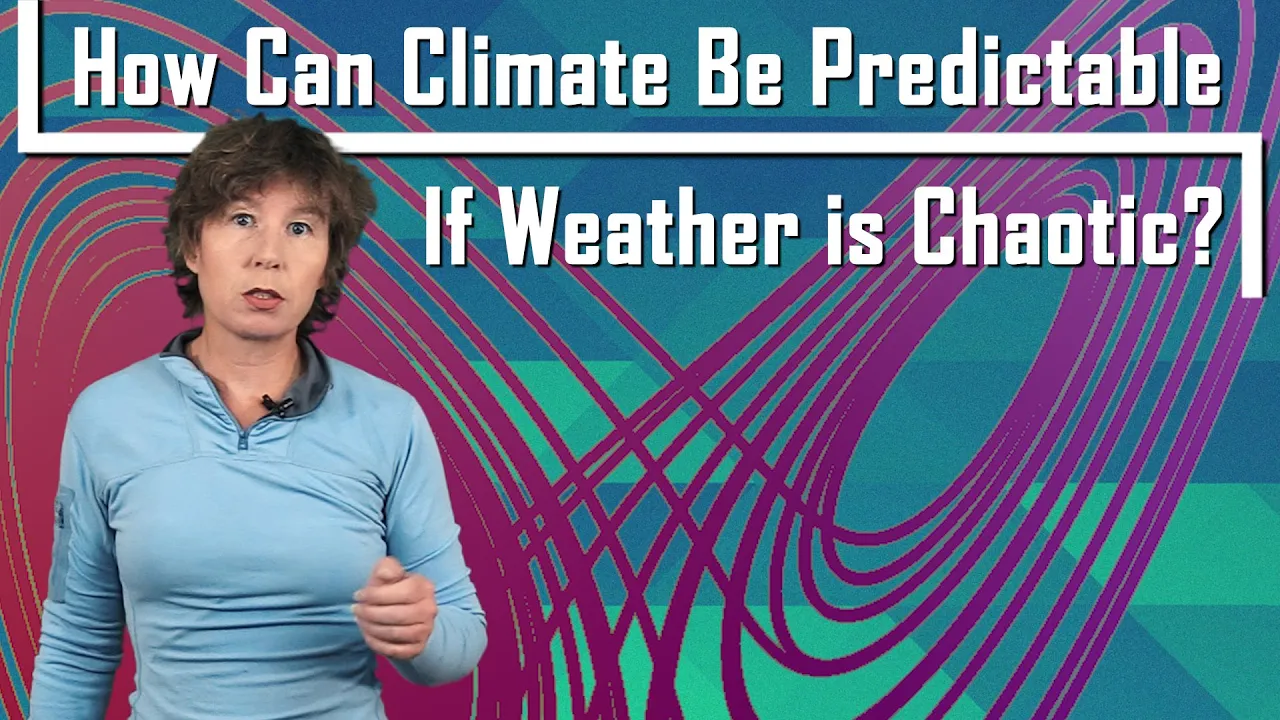
The distinction between short-term weather chaos and long-term climate predictability, explaining how climate projection remains robust despite weather's chaotic nature.
23.1K views445likes1:01:10Original Release: 2017-05-19
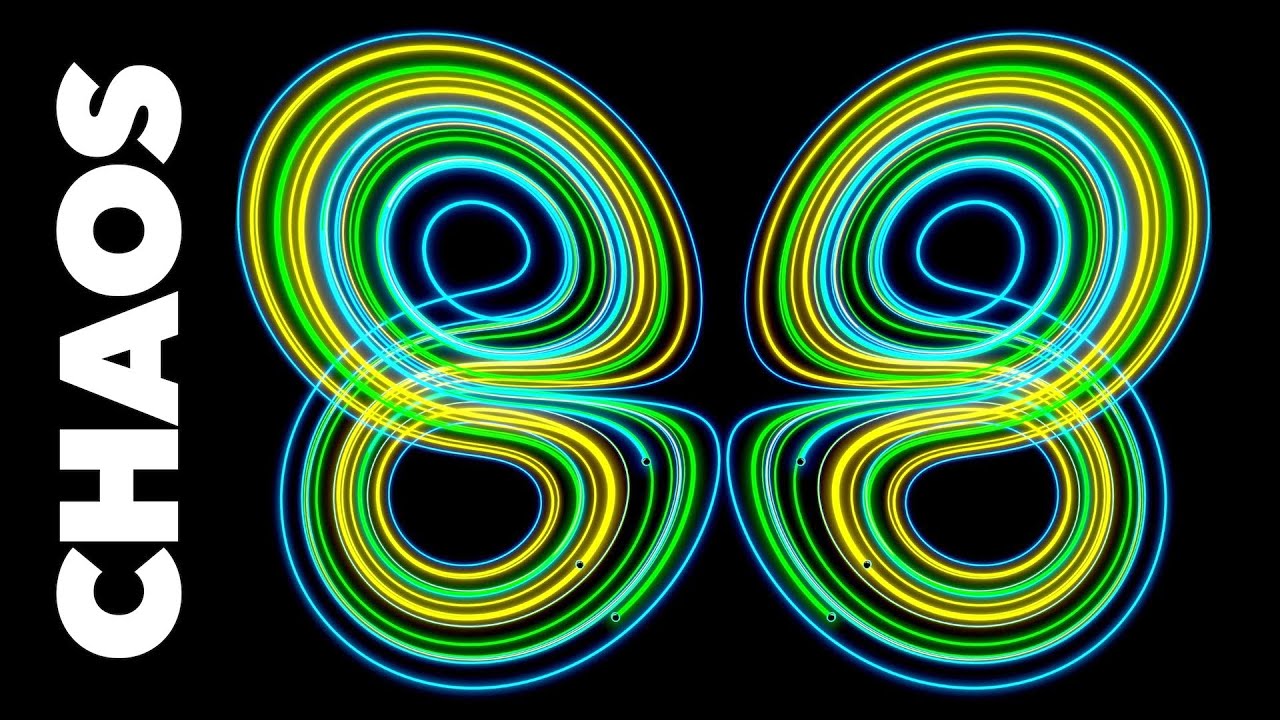
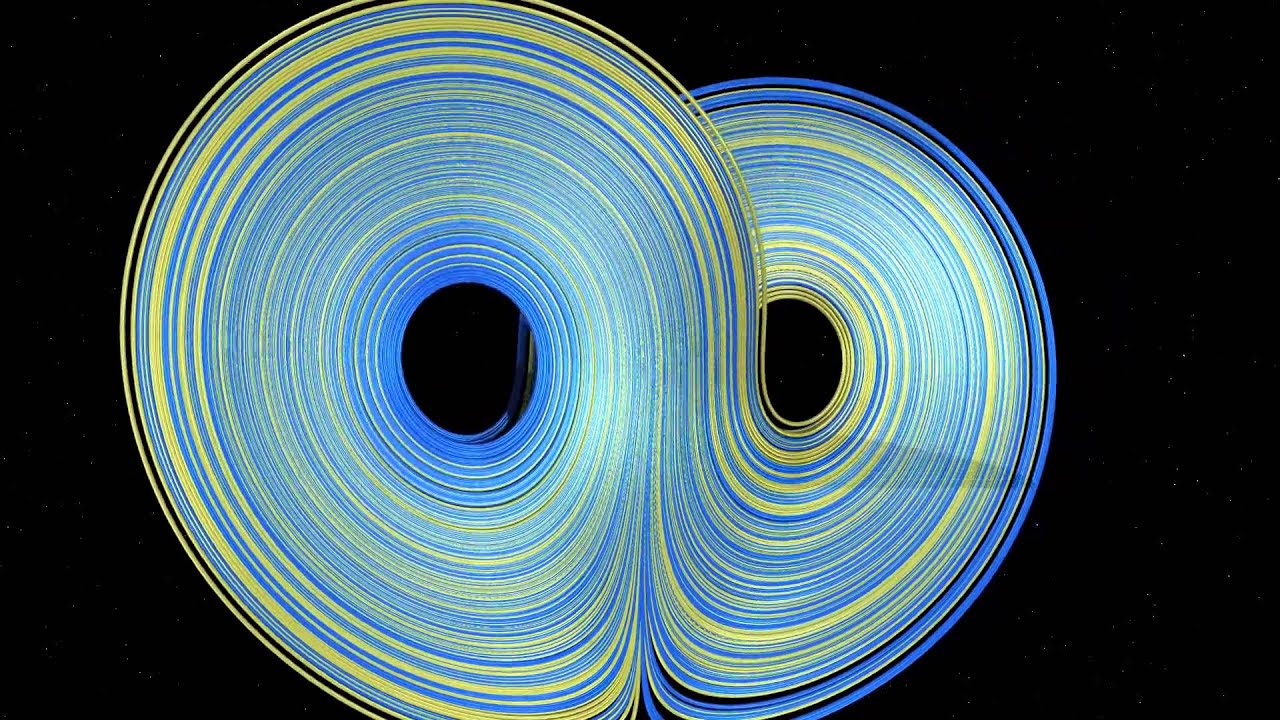
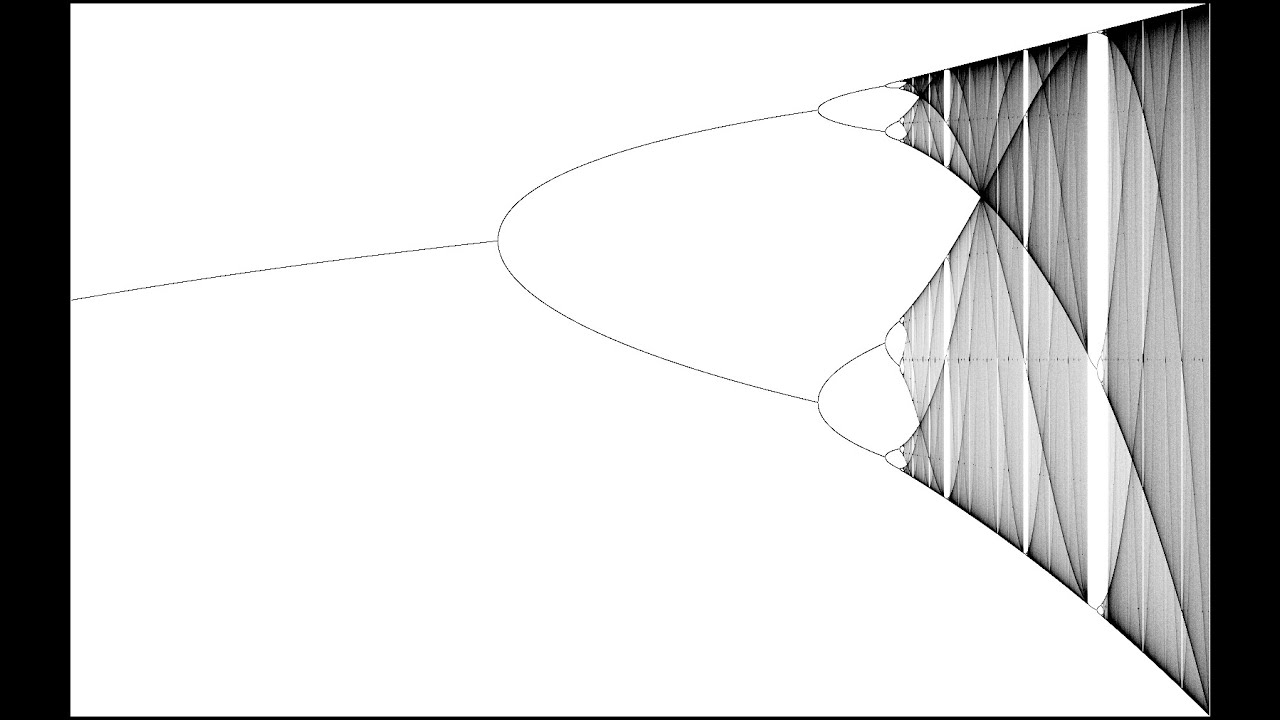
[Music] thank you for that kind introduction and it's great to be here and all for coming this evening I'm going to start by as Eileen says winding the clock back a bit and in fact start by referring to what was an extremely or what had proved to be an extremely influential popular science book which was published in the second half of the 1980s by James Glick because it was this book that coined this iconic phrase the butterfly effect which I think has pretty much gone into everyday language and popular culture in fact the very first chapter of the book is called the butterfly effect and in this chapter Glick describes the work of MIT meteorologist ed Lorentz whose picture is up there and a paper that he wrote back in 1963 which was pretty much ignored I would say for 10 years or so it was published in a what most scientists think of as an obscure meteorological journal turns out actually it's the premier mutual integral journal in the field that anyway there we go but what Glick describes and I'm going to talk about this at some length in the talk is how Lorentz came to discover three very simple equations which had no in determinism or no randomness everything was precisely defined the three equations coupled together in a way which I'll tell you and it had the property that it was almost impossible to predict the future of these equations in the sense that starting with just a tiny tiny tiny perturbation let's say to the initial state the solution developed quite differently so let me actually illustrate that right at the beginning with this animation so we're going to look at the evolution in time of what actually are - it's not apparent until about now that there are actually two different solutions of these equations starting as I say from almost but not quite identical initial conditions and after a while although they track together the red and the blue for a while they sort of D correlate and so knowing one of the solutions if you like tells you almost nothing about the second solution after a certain time now Glick then went on to say that this model of Lorentz basically formed a you know a hard quantitative bedrock for his notion that he'd been that he Lorentz had been talking about that some years of how the flap of the butterfly's wings could let's say in Brazil could cause a tornado let's say in Texas now this is where the history actually becomes slightly confused and one of the apart oh I've got two parts to my talk one is to try to review what is pretty standard stuff which is how Lorentz came to arrive at these equations and some of the amazing insights he had incidentally in linking these very simple essential equations that Isaac Newton would understood very well with modern 20th century fractal geometry a sort of concept that Newton would have found quite alien so there's enormous Cir insights that Lorentz had in in deriving his 1963 model but I also want to say and this is something which I'm sure most most of you will not know is that actually Glick got it completely wrong about attributing this sixty-three model to the idea that Lorentz had in when you referred to the butterfly effect so unfortunately the butterfly effect has actually been missed and I'm going to try to explain why that is so the but the town the term well the term the butterfly effect comes from glicks book but it essentially refers to this paper or this talk let's say that Lorentz gave in 1972 at the American Association for the Advancement of science and that the title was a kind of a sort of semi it was essentially a public talk about predictability of weather and that was the title does the flap of a butterfly's wings in Brazil set off a tornado in Texas so what I wanted to do in the sort of towards the end of the talk is actually to say a bit more about precisely what Lawrence said in this 1972 meeting and you will see that it's actually not referring to his 63 paper at all but to something he published in fact in 1969 and that is much less well known I would say in the broad community and in fact this problem that Laurent Lorentz wrote about in the 69 paper and which he talked about in the 72 meeting turns out to be one of the great unsolved or closely linked to one of the great unsolved problems in 21st century mathematics so it actually gets to the heart of something which is actually much more radical than kind of the chaos theory we might think chaos it is very radical but this is even yet more radical so so that's the outline of the talk you'll know some of it maybe and I'll fill in some details but towards the end I'll say stuff that I'm sure most of you don't know and I hope to I'm not going to really change popular culture it'll it will always be called the butterfly effect but I'm going to call what I what what the rents really meant the real butterfly effect so we'll come to that towards the end of the tool let me just say a little bit about the biography of Lorentz so here he is as a young man grew up in New Hampshire very interested in astronomy as a kid apparently had a passing interest in weather but it wasn't a particularly sort of passion of his and in fact probably weather a nuisance because it literally the stars when he wanted to go out and look at them but he claims you know in in later years he had to me he had somewhat of an interest in whether but he went at university he went to study mathematics and in fact he went to Harvard and went through his undergraduate degree and in fact started a postgraduate degree in mathematics under the great George Birkhoff where he was studying some topic in currently Riemannian geometry nothing directly to do with Kaos and his plan was to carry on that was going to be his PhD in mathematics but then the second world war came and sort of upset the plan and I think by chance Lorentz discovered an advertisement that the zai the army or the or the Air Force I think it was the army at the time they were looking for weather forecasters maybe it's the Air Force cuz it was to to rout planes and so on so he thought wow ok well I've had a you know thought back to his childhood a little bit of interest in weather so maybe y'all that would be a good sort of career for me during the war so he he joined up and you know he was sufficiently good but after he'd been through this course they decided he was the right person to teach the next lot of weather forecasters to be weather forecasters so he actually became a tutor if you like in weather forecasting for the for the Air Force he eventually got sent out to Okinawa I think in the Pacific so he actually was involved in some of the real action in the in the Pacific sector came back after the war and thought about ok do I restart my career in in mathematics and decided actually you taken quite an interest in a real interest in weather and so instead he enrolled at MIT just up the road to do a PhD in meteorology and the topic he was essentially given was trying to solve this equation so it doesn't matter if you don't know this equation but this is one of the archetypal equations in fluid mechanics it's essentially Newton's second law of motion if you know suit in second law of motion force equals mass times acceleration this is well it's actually the other way around it's its last times acceleration equals force but written for our fluid which could be the atmosphere or it could be the oceans or it could be a laboratory fluid fluid that potentially has many many many scales of motion and it is actually a remarkable thing that if you count cut remember I last time I counted the number of symbols it was around 20 something 22 or so mathematical symbols it always strikes me as a wonderful thing that with just 22 mathematical symbols you can describe the dynamics of every scale of motion in the atmosphere from the very largest jet streams you know which extends thousands of kilometers in length in the upper atmosphere you know right down to clouds right down to the little Eddie's coming out of my mouth as I speak this is all described by this one set of equations so this is Laurentiis job to look at how do you now the problem is so ok so this is this is this equation can be likened to very much a work of art it is a work of art but instead of likening it to a Renoir here I'm going to liken it to a Russian doll and this is actually a very special Russian doll Russian dolls unpack into small Russian dolls this one mum packs into yet smaller Russian dolls and indeed yet smaller Russian dolls and indeed yet smaller Russian dolls and indeed yet smaller Russian dolls dot and in the same way if you actually want to solve this equation you have to as it were unpack it also into actually what turn out to be billions of individual equations this is actually what makes weather forecasting one of the things it makes so difficult because you need to unpack it into the equations which describe the big jet stream which describe low pressure systems which describe clouds which describe sub cloud turbulence and all that stuff so the way to solve these equations which is what Lorenz did is is to look at truncating these equations oh sorry before I do that yes let's let's say that these Russian dolls can be likened to you know the world's or the eddies in a turbulent fluid and in fact it's it's probably appropriate at this stage to refer to the little piece of doggerel that was written by one of the founding well one of the real pioneers of turbulent theory and also incident it a pioneer of weather forecasting Lewis fry Richardson sometimes the beginning of the century anyway this famous little poem big whirls have little whirls that feed on their velocity and little world's have lesser whirls and so on to viscosity okay not a great poet but still it makes the point that in a turbulent system you have these many many many scales so these scales the big worlds are the big Russian dolls the little worlds of the lesser the smaller Russian dolls and so on and the fact the so notion of feeding on their velocity captures this idea that as it were the Russian dolls can sort of bash into each other and transfer energy from one one Russian doll to another and this is manifest mathematically in the fact that the equation here this U is the fluid velocity and it sort of multiplies itself and that makes the system nonlinear and non-linearity is the thing that allows energy to move up and down scales and that's one of the complications of things so Lawrence's PhD was actually about trying to whoops was actually if I could go back was trying to solve these equations in a sort of simplified way by getting rid of some of the scales and just treating maybe the system in a simplified approximate way and he came up with some what are called time stepping schemes and other types of vertical numerical schemes which actually even to this day as still used anyway the PhD was I would say moderately successful it wasn't like set the world on fire but it was moderately successful and he found that within a few years of his PhD he had been invited back to M my tea as a proper member of faculty but there was a slight rider on this appointment because he had to be in charge of a group that was who's kind of principal research activity was doing long-range weather forecasting so long-range means you know a month or two ahead whereas the people that were trying to kind of approach weather forecasting from the from the point of view of solving these navier-stokes equations we're only thinking about maybe 12 hours ahead at the moment or maybe a day ahead at most but just very short time so how would people even think about doing long-range forecasting so this was actually done by completely different methods of solving these equations it was just done with the statistics so the idea is you have a big pile of weather maps which let's say we do this today with a big pile of weather maps from today going right back to whenever you like 1800 for the sake of argument so we're in what we now May so let's suppose our task is to forecast what the weather's going to be like a month from now so the monthly forecast for June or July or something so the idea that this group had and incidentally he got a lot of this group got a lot of support from the Statistics Department at MIT so this had some pretty high-level support was you just go back in time and find a weather map that from the past that looks like today so you go back and find let's say 1961 May 1961 the weather looked very similar to May 2017 then what you do you predict for June July 2017 what the weather was in May and June everyone said 1961 it's kind of method of analogs so Lorenz got put in charge of this team and his first reaction was hmm this doesn't sound right to me you know what's the scientific basis for this this idea of just so you can find an analogue because it seemed to suggest that the weather was somehow very periodic you know if it if it was a site that's like it is in May 61 then necessarily what we see in the next couple months will be what happened in 1961 and his kind of intuition was that the weather isn't periodic like this it seems to be irregular and apparently had long battles with people not only in this group but again with the statistics people at MIT and he said you know I've got to try and sort this out I'm going to try to prove that this really this idea isn't going to work how am I going to do it so that's when he went back to his truncated navier-stokes equations so maybe I can prove that this property of of periodicity just doesn't happen if I take a semi realistic model and use I mean computer technology was starting to in the 50s computer technology was starting to arrive so ok I think we could solve these equations on a computer and just show them that this won't work so he said about you know taking actual weather type of equations and for a long time he worked with Russian dolls of their 8 so actually he worked for a long time with 12 yeah a 12 component so truncating the equations down to 12 compotes but you know the computers just weren't up to the job and he found this is really hard work trying to do anything it just took too long to get anywhere and he had a real breakthrough when he talked with a colleague of his from a nearby University who had been studying not so much whether but what's called convection in a in a fluid where you heat a fluid from below and look at it's the circulations that develop and this guy actually said that he had a seven component model that seemed to seem to have this property of non periodicity and maybe Lorentz could look at that and the rents did in fact move on to that problem and he realized within this subset of several equations there was actually a three compact so he realized when he was looking at these non periodic solutions that four of these components almost went to zero so we kind of had the intuition that there would be a three component he had a three component subset that that had the required property and this is what led into these iconic equations the Lorraine sixty three equations so this is a three Russian doll truncation of a laboratory fluid so you've got three variables XY and Z so these are not space these sort of describe a type of circulation it doesn't really matter this this equation has been truncated so much it now sort of slight some you lose contact a bit with the real world so it's kind of an idealization of the real world so x and y is they're just variables thinking of those variables and in the three equations that the left hand side are DX by DT dy by DT DT by DT is the time rate of change of x y&z and it's given by these terms on the right hand side the numbers 10 and 28 are not they don't have to be precisely those these are the numbers that Lorentz used but you can choose numbers nearby and you get the same behavior and you notice that in the right hand side you get these terms multiplied together X and Z multiplied together x and y multiplied together so it does retain that notion of non-linearity which as will come to is all-important and when Lawrence integrated these equations so now we're looking at the the X component variable as a function of time you can see it it it doesn't have any it doesn't you know it looks very irregular there are periods when it seems to be up in one state but then it kind of jumps down or periods when it's down here and then it jumps up so this is exactly what he was looking for to try to kind of prove this counter example to the statistical model but the more Lorentz looked at this it realized he didn't really understand what was going on what on earth you know what is causing this behavior and he had the real insight into plotting it in a different way so instead of taking one variable and plotting it against time you take all three variables and imagine a three-dimensional space spanned by those three variables and then let time kind of represent be represented by the length along the trajectory so this represents some fairly random starting condition in this three-dimensional space of x y&z so give it anything you like and then let it go with his computer and and what he found was that the trajectory start to sort of strange shape now the first thing is you can see it's got this these two kind of wings if you like and sometimes people call this a looks like a butterfly but that's entirely coincidental but it has these two kind of wings which which in a sense describe those that to that kind of regime behavior it tends to be up the x-variable tends to be up here or down here will those color if you like up here up here is is going around here and down here goes around here so that was kind of that was an interesting thing but then Lorentz sort of said well what exactly is this thing that this this trajectory is kind of oscillating on what is what is the geometric object behind this and for a while you thought maybe it's some kind of surface these two lobes are lying on the surface and somehow the surface is just sort of glued together but then you realize that couldn't be the case because then the trajectories would have to kind of cross over each other it just didn't work and it was he agonized about this for by the way just once I talked about that I've got a nice animation of the of how the actual state doesn't seem to work anymore okay still not to worry this would have been an animation showing a state going round in a very irregular way around so just going to you okay and you've got different perspectives that's now the Y and the Z I think you had the Zed and the X direction that's one of the X and y direction then it'll rotate around to me so now rents kept asking some what on earth is this geometry what is it what is it actually what what how can I describe this in a kind of mathematical way and that's what you realize this has to be some kind of fractal now it may be these days were kind of blase about fractals we see them everywhere but just kind of caution line back to the 1960s he's dealing with equations which as I say Newton would have had no trouble understanding and suddenly how this fractal geometry kind of comes out so what I want to do spend a few minutes trying to get this insight into why why a fractal and to do that I'm actually going to use a slightly simpler dynamical system it's just easier to explain and this actually was was was derived as you can see thirteen years later by rustler in a way as a way of kind of really trying to describe this phenomenon of chaos as simply as possible and again it's a three component system of differential equations so the dot stands for D by DT so D by DT of X D by DT of Y D gradute you've said but slightly different equations but again notice the non-linearity pointers okay so what I want to do is take you through the Rustler attractor and try to understand why that is fractal so I'm going to use some nice pictures from a book by Abraham and Sean 1984 so first let me start with solar I didn't introduce our three essential components for this type of chaos and the first two components are illustrated here and this is generic to all chaotic systems so imagine you take a little area here this is in this space of states state space X Y Zed whatever and we're going to look at let's say - two points on the edge here and let them evolve in time now what this what what these lines are illustrating is the fact that one of the essential ingredients of chaos is the notion of instability that you two points that are initially close start to diverge in general exponentially from each other and that's kind of illustrative as I say here so this this point goes off in this direction whereas this one goes off in this direction so this direction here is a kind of direction of instability where initially closed trajectories are diverging apart so that's one key ingredient the second key ingredient is actually looking at this in the sort of transverse direction so looking at points let's say which start on the other edge of the square because the second feature of chaos is that these of this type of chaos cities is that these trajectories in this direction are actually converging together so they're getting closer now the key point is that over all averaged over the whole system in all time it's actually the converging direct directions win over the expanding directions so that if I was to measure the area of this so here's the if I take this area at Denisha as imagine this is at some initial time and then that evolved into an area imagine looking at this object from the far side then there'd be an area here which was stretched out in this direction but compressed in the transverse direction then on average the area will be smaller afterwards than it was before so there's overall a shrinkage of area so these are two key ingredients for pro chaos so this just shows the same thing again except I just drawn or they've drawn this the transverse if you like to action as a rather small just much smaller that's fine now we have a problem I mean if as I say these if you just imagine Exponential's evoke divergence then you know this would just carry on they would diverge as far a part as you like go off to infinity as it were so this can't possibly explain the fact that we have a kind of a geometry which seems to sit in a in a finite compact region of state space so how do we stop for the trajectories going off to infinity well this is where the third ingredient of non-linearity comes in and in the case of the Rossler attractor it's rather simple the non-linearity just folds one of this the surface over like this so instance we just take one end and just fold it over so let's have a look at that in a bit more detail so let's let's take our let's like our little surface here our two points two trajectories and they kind of involve and the system becomes nonlinear and the surface folds over like this so that one trajectory has gone to the top part and the other trajectory to the to the bottom part there and it's kind of folded over in half now if you remember what I said if you try to let's try to kind of compress that down into the same cross-sectional area as we started with then what I've said if you if you recall is that this is the combined area order to the total area of this top part plus the bottom part is actually less it's smaller because of the overall effect of this contracting this so this is the effect of dissipation effectively this total area is smaller than the one I started with so if I try to compress the whole thing into the same area there must be a gap between these are the top sheet if you like on the bottom sheet this is a really crucially important point there's a gap there has to be a gap they don't kind of completely because you've got some effectively all right so let's take this thing again you can imagine this is just like here but with the gap that I've sort of blown it up a bit and so this kind of comes round as two sheets and we'll go we'll go through the whole exercise again fold it over and now you see what was two sheets have become four sheets now this gap has now kind of formed two small gaps if you like here and here and a bigger gap has appeared in between them for the same reason that I said before and now we do it again we got now for these four sheets we folded over and now we've got eight sheets with a big gap two small gaps and for really small gaps which is the original gap dum-dum twice over now if we keep doing this over and over and over and over and over and over and over and over what are we going to end up with okay well one way to to try to understand that is to take a cross-section through this this structure here after you know a very large number of these types of iterations this is sometimes actually called the Lorentz section the whole thing is sometimes called a plank or a section and this kind of cut transverse through the trajectory is called in the right section so what is this well this was this structure was discovered some years earlier in fact in the late 19th century early 20th century by the great mathematician Georg Cantor and his reason for this invented this set called the Cantor set was really nothing to do with chaos per se but really to try to understand a bit more about the nature of numbers and this is an interesting set is an interesting example of a of a set which has an uncountably infinite number of points but but the points actually take up no volume at all no volume at all in the on the on the line so the Cantor set is is constructed by starting with just the let's say the line between 0 & 1 and throw away the middle third so you've got two pieces and then throw away the middle third of the remaining two pieces and then throw away the middle third of the remaining four pieces and continue continue and then just take the intersection of all of these iterative left with this set now so this big the big gap is is if you like is this part of the of the Rustler attractor or it's a gap in the Russell attractor and then the next iterate are these two smaller gaps and so on and so forth so we have this so this is where fractals basically come from the three ingredients in stability dissipation non-linearity and this is what Lorentz said in his sixty-three paper we see that each surface is really a pair of surfaces so that where there appear to merge there are really four surfaces continuing this process for another circuit we see there eight processes that we finally conclude there's an infinite complex of surfaces each extremely close to one another or other the two merging surfaces I think Ian Stewart in his popular science book does God play dice absolutely nailed the reaction I think of a lot of mathematicians when they read this paper and he said when I read Lorentz his words I get a prickling at the back of my neck and my hair stands on end he knew 34 years ago he knew and when I look more closely I'm even more impressed in the mere 12 pages Lorentz anticipated several major ideas of nonlinear dynamics before it became fashionable so if I had to say you know one thing that Lorentz for me absolutely characterizes the genius of Lorentz it's actually not so much the you know this divergence of trajectories but the realization that are this fractal geometry which under underpinned these sets of differential equations which by all accounts should look very smooth and unexceptionable unexceptionable so i with that in mind i am going to make the claim that in some sense Lorentz provide a bridge really between the classical physics and classical mathematics of Newton and some of the real key ideas in 20th century math so we've already mentioned contour this is cut girdle and this is Alan Turing and I'm sure people know that they really revolutionized our ideas in mathematics by by by raising the notion that there are there are things which are true in mathematics but not probably true or in Turing's language propositions which are kind of undecidable algorithmically no matter how complex or your your computation might be you just cannot establish the truth of certain propositions and it turns out that many of the properties of these fractal geometries are quite isomorphic quite similar to the types of propositions or girdle ensuring that our undecidable in fact they're there well I went there papers written on this showing this in a formal way so there is this bridge between say the calculus of Newton which as I say Newton would look at these equations say yes I dig that I understand that and but through this remarkable geometry that they generate we have these links to some of the most profound things in mathematics now I've included Andrew Wiles here because there's lots of other interesting things you can ask for example suppose I want to have a type of arithmetic where I add numbers on on this sort on this fractal set on this can't all set let's say on this transverse Cantor set or multiplied numbers such that the sum of the numbers or the product of the numbers also lies on the Cantor set other words can we do a kind of arithmetic on the Cantor sets it turns out you need a special type of number system to do that called p-adic numbers so p-adic numbers are a very rigorous branch of pure mathematics that has a very close link to fractal geometry and as I say they respect sort of geometric constraints of fractals in doing algebra and it turns out that a lot of the deep theorems from p-adic numbers systems were very important in Andrews celebrated proof of Fermat's Last Theorem one of the things which really intrigues me as a physicist is whether there are links between these ideas and and quantum physics so people may recognize when Schrodinger Werner Heisenberg Paul Dirac and another very celebrated Oxford mathematician Roger Penrose certainly three of these people showing a Dirac and Penrose I'm not so sure about Heisenberg but the three of them were very uncomfortable with quantum theory it works and it does work to this day but the foundations are very why this keeps jumping the foundations are very kind of bizarre and difficult to understand and I think all three of them felt that there must be something deeper underpinning quantum theory something much more deterministic but Roger Penrose in his books like the emperor's new mind which I'm sure some of you will have read very much emphasized that if we if there is some deterministic underpinning to quantum theory it has to have some notion of non computability that's undecidability has to feature somewhere deeply just an ordinary type of deterministic system won't do it so the reason I've included Roger here is because he has very much stressed the potential role of non computability in going deeper into fundamental physics so again perhaps these types of fractal objects play a role I personally believe they do but one has to say at the moment it's a matter for for study and so on so I'm not going to dwell upon this any more in the talk but I think happy to talk to people afterwards if they're interested chaos theory for sure has revolutionized many different branches of science and physics in biology in engineering in economics and social science facts hard to think of any area where it's left untouched unfortunately sometimes also abused so I want to give an example of an abuse of chaos theory and this is actually something that's close to my heart because I have to deal with these sorts of people quite a lot the climate well they don't like to be called denier so I call climate sceptics now one argument which is quite common actually it goes like this you guys okay you might be able to forecast the weather tomorrow but you're pretty hopeless and even then you sometimes get it wrong and you know a couple of weeks ahead is pretty dodgy a year ahead no chance so what what on that way and earth should I believe what you say about the climates 100 years from now so this is this was this was brought up not so long ago in a review of a book in The Telegraph Daily Telegraph the game's up for climate change believers the theory of global warming the gigantic weather forecast and therefore it can have where a century or more level can have no value as a prediction okay so I just want to debunk that very briefly and then we'll move on because basically that is to misunderstand the problem of climate change what I've done here is to do a kind of climate change experiment in lorentz world by adding an extra term to one of the equations now just think of this term here this is actually just going to be a number but just think of this as a kind of a surrogate for doubling carbon dioxide concentrations in the atmosphere so I'm sort of applying an extra forcing term if you like to the equations so how does that affect the lorentz as the lorentz system so here's again the X equation as a function of time before the system would oscillate roughly between these two kind of regimes the two lobes of the butterfly with equal sort of frequency so it is likely to be up here in one lobe of the butterfly as it would be to be down here what's happened happens with this additional term is that I've increased the likelihood of it being in this upper lobe and decrease the likelihood of it being in this lower lobe now the system is still chaotic because if I want to predict in detail at one of the trajectories I want to make a weather forecast if you like in this Lorentz world it's still going to be unpredictable it's still going to be subject to uncertainties in the initial conditions but what is predictable is this kind of gross statistic that the probability of the state being up here has been affected in a very predictable way in fact we can you know we can actually plot this on in the Lorentz attractor world in the state space so here's the original Lorentz attractor in the new system these two kind of what I call centroids all right in pretty much the same place as they were before but now the system spends a lot more time zipping around here than it does zipping around here so we could view in this perspective we could view climate change as a problem in geometry the question is how is the geometry of this attractor being affected by the addition of this term which I've now set equal to ten so it's important to understand this though climate change this is the problem of climate change how does the whole climate attractor which basically means the statistics of weather change as we double carbon dioxide levels which we surely will be sometime later this century or so over in pre-industrial how how how does that change the statistics of weather and that's not the same problem at all completely different class of problem to saying how there's a particular trajectory evolve on its climates attractor over some from some initial condition okay let me just now move on to the sort of part of the talk I wanted to I wanted to get to which is what did Lorentz actually mean by the butterfly effect and you'll see that in fact he wasn't talking about it sixty-three paper at all he's talking about the fact that the weather is a multiscale system so we have we have a you know if you imagine a large low pressure system crumbling across the Atlantic embedded in that low pressure system there'll be let's say you know thunderstorm clouds big thunderstorm clouds well they might the thunderstorm clouds are maybe 100 kilometres in scale whereas the weather system itself is a thousand kilometres in scale embedded in that thunderstorm cloud there are small sub clouds turbulent eddies and within those sub cloud turbulent Eddie's there're yet smaller turbulent Eddie's so we're looking at this this Russian doll hierarchy again now around said okay let's suppose our problem is to predict this weather pattern the large-scale weather pattern that's what we're interested in we might be able to measure you know the initial or starting condition so this weather pattern very very accurately in fact we can imagine almost perfectly for the sake of argument measuring the initial conditions for that weather scale but that's not going to give us indefinite predictability because sooner or later the fact that we haven't been able to measure the the clouds scales or the sub clouds scaled motions perfectly that's going to catch up with us because these errors are going to kind of propagate up nonlinearly from the small scale to the larger scale to the very largest scale if you want to actually read this his Lorentz himself wrote a popular book called the essence of chaos and in the appendix he actually describes what went into this talk in the triple a s meeting page 72 and he talks about errors in the course of script structure so that's the large scale weather pattern and then errors in these finest structures which are the clouds and then in fact the fact that errors in the finest structure can start to induce errors in the course of structure what I've decided to do for this talk is actually not to go through in detail with what he wrote but return to my Russian doll example and try to describe what he what his thinking was with that so let's imagine the Russian doll the big Russian doll this big low-pressure system traveling across the Atlantic and that's the thing we want to predict we want to predict that as far ahead as we possibly can and let's imagine we've got some observing you know some instrument which has no error at all I mean it will infinitesimal is just quantum mechanics let's for the sake of argument measures perfectly measures whatever its wants to do temperature pressure and stuff like that and we have a whole load of these instruments and we're going to dot them around the whole globe we've got enough of them we can dot them around the whole globe in a regular Network where the distance between the two between any two of these measuring systems is sufficiently let's say small that it can it can resolve you know the this list of low pressure system really really well so that the initial conditions for this low for the scale this low pressure system scale of this low pressure system are known almost perfectly but the distance between these measuring objects is not sufficiently small that I can measure the initial conditions for all these smaller Eddie's the smaller wells of Richardson so I'm going to imagine that with that information let's say I can predict ahead five days means a reasonable sort of number so what Lorenz said was well maybe we're not happy with that how would we extend that predictions horizon we want to predict further well what's limiting us in this case is not our ability to measure this scale because we've measured this perfectly what's limiting it is the fact that we don't have any information about this scale so we'll stick a whole load more of these instruments down filling the gaps between the ones we had so now we have enough resolution that we can measure the initial conditions of this scale here so the question is how much is that going to buy us how much extra prediction skill is that going to give us now Lorenz says the answer is not ten days because the these things the errors are likely to be growing faster for these smaller scale features so for example imagine a cloud system the error the time takes because the circulation patterns are more vigorous in a you know in an individual cloud if you ever flown through a cloud in an aeroplane you know circular thunderstorm type cloud in a very vigorous circulation so errors are growing more rapidly so let's I'm kind of simplifying the for the experts I'm simplifying things a little bit just to make the point so but nevertheless the idea is qualitatively great so let's imagine for this second you only get two and a half days of extra prediction skills so you've gone up now from five days to seven and a half days so Lorenz says okay that's fine but let's let's say we want to go further so let's let's have a whole load more measurement systems and now fill in even the gaps in those gaps so that now we can even measure this Russian doll initially perfectly and he says okay again we'll only because these are growing yet faster the errors are going to get faster we may only get an extra see I'm I'm having the extra time each step so now you can get an extra day and a quarter so you can see this continual investment in imperfect measurement measurement systems which is driving the initial error closer and closer to zero is actually buying us less and less prediction time and what lorentz says let's take this to the limit and imagine we've got an infinite number of measuring systems which can basically take us down to infinitesimally small scales he's saying that what this will bias in terms of prediction time is a series which if with these particular choices of doubling times will actually converge to a finite number now normally when we have theories we think of convergence as a good thing and divergence as a bad thing but here convergence is a bad thing because it's really limiting your prediction capability to some finite time which in this simple calculation turns out to be 10 days so this has a remarkable if you think about it this is a remarkable thing if it's correct it says matter how small my initial error is I will never be able to predict more than ten days ahead now just think that's completely different to the 1963 paper because a sixty-three paper is about just these three equations which although it's very difficult to predict them you can always in principle predict as far as ahead as you like providing your initial error is sufficiently small but here's a system where that's not true and this is what he was about in is 69 paper which appeared in a Swedish journal called tellus and if you're 63 paper was you know it's considered to be in an obscure journal this is obscure squared I'm afraid afraid so very very not not really well-read at all but it's worth just if you don't mind just reading I'll read out the part of the abstract so it is because it's really important this he claims it it's probable he proposed it it is proposed that certain formally deterministic fluid systems which possess many scales of motion that's the key point many scales of motion not the three Russian dolls but a kind of essentially an infinity of Russian dolls are observational II indistinguishable for in deterministic systems specifically that two states of the system differing initially by a small observational error will evolve into two states differing as greatly as randomly chosen states of a system with a within a finite time interval in our calculations ten days and now here's the real ryder kicker which cannot be lengthened by reducing the amplitude of the initial error so this is very radical so what I'm proposing to do here today is to illustrate always to introduce you to two butterflies so now it's we're never going to stop the butterfly effect being used to describe low order chaos but I'm going to call this the common butterfly effect so here's the common blue and the common butterfly effects are the one everybody thinks of when they talk about the butterfly effect is about sensitive dependence on initial conditions so that means it's certainly difficult to predict the future but it's not impossible in principle you can predict in something like a Lawrence sixty three system you can as far ahead as you like providing the initial error is small enough on the other hand I'm going to use this monarch butterfly so this is a slight a weak pun on the fact that this is a monarch is a royal and put member of royalty and Rio Rio in Spanish or something is royal so the real butterfly effect the Royal butterfly effect if you like is the 69 paper which basically says that there are finite predictability horizons which cannot be extended by reducing uncertainty in initial conditions so we know that this is this has been certainly well verified so the common butterfly effect is being is kind of absolutely part of standard science how about this real butterfly effect is this part of of the kind of rigorous science let's just put this into a slightly more mathematical phraseology because what what we're saying here is if you take the initial conditions and change them as slightly as you like in a finite time you'll you'll diverge to finitely different solutions now in math in mathematics problems are referred to as well posed or ill posed according to certain properties that they have apparently from a definition given originally by haddem are so problems are well posed if solutions exist they're unique and the solutions depend continuously on the data this means initial data in our case now this continuously means if you change the initial conditions very very slightly you're just going to change the solution slightly and that's truing in the sixty-three chaos but it's not true in the 69 K in the 69 real chaos real butterfly effect so if this effect is really true it means that the navier-stokes initial value problem is not well posed in this sense so now that has becomes a problem in mathematics is the navier-stokes problem for a three dimensional turbulent fluid the initial value problem well posed and this is why I say this is actually turns out to be one of the great unsolved problems in 21st century mathematics so as I'm sure many of you no the clay mathematics Institute put out these kind of key problems unsolved problems in mathematics which include famous things like this is at the beginning of this millennium the Riemann hypothesis and so on and here's the navier-stokes one it's actually not framed in terms of this continuity property but rather whether solutions exist and are unique and even that's not known and we need to know that even before we can understand this property of continuity so I think it's fascinating to me that what Lorentz speculated about in 69 and then this triple is talking 72 actually refers to a very deep problem in maths so if I got just a few minutes to finish ok so I want to kind of get back to two more practical issues because a question you might ask is is it really the case then that we're limited in weather prediction to ten days or something and things aren't quite as simple as that in practice because ten days may well be sort of roughly an average time scale that we can make to the detail predictions about the weather but what do we rapidly find out is that there are many situations where we can make much longer range predictions apparently with quite good skill but equally other situations where predictions do in fact go wrong within a couple of days and that's very well Illustrated going back to the 63 paper and actually looking at how errors if you like or uncertainty so imagine this is an initial state with some kind of a ball of uncertainty associated with it this actually shows that there are some parts of the Lorentz attractor that are extremely stable so small perturbations hardly grow at all so this is telling you there are some parts of the system which are actually very predictable other parts of the situation other parts of the attractor where you start to explore the state space down here where you do start to see unpredictability and some initial conditions where the uncertainty just explodes now those of you most of you in the audience are not old enough another a few people to remember this but one of the most iconic weather events of the last maybe 300 years occurred almost 30 years ago October 1987 and this poor guy whose name is Michael fish although I have to say makes a great after-dinner living out of speech living earth from this famously made probably the worst weather forecast in history by saying there's no chance of a hurricane hitting the the UK in the next a day or so and indeed a hurricane did did hit and this was actually a great example of this very intermittent phenomenon of explosive unpredictability so what I'm going to do here is just animate two weather forecasts from two almost identical initial conditions these are these and surface pressure maps almost identical not quite identical you can look in detail you'll see differences it's just a couple of days before the storm hit so we'll just run this forward and they start off tracking each other pretty well but then leading up to the fateful morning of the 16th I think it was you see that reason these are really quite different this would be a very kind of benign day and and this is a really intense vortex poor Michel fish was given essentially this solution by the Met Office but for a flap of a butterfly's wing he would have been given this one and he would then have been a national hero instead actually shouldn't feel too bad about this because the Met Office did really well out of this poor forecast they said oh well our computers aren't big enough you need to invest lots more money so don't feel sorry for them okay so the question is how would a modern day Michael fish deal with this situation because chaos does chaos I mean chaos in 1987 will still happen again so this intermittent explosive unpredictability could still happen in 2017 so how would a modern day Michael fish deal with the situation well these days with much bigger computers and in particular with massively parallel computers we can take advantage of that type of architecture to run weather forecasts in what I call ensemble mode so we actually we actually run here 50 different forecasts this will be done typically every day at places like the Met Office some actually everywhere around the globe now you don't run a single weather forecast you run an ensemble of them and very very slightly the initial conditions and look to see ahead of time whether the forecasts are diverging and what you see in this case so this is the 87 storm run retrospectively it's run with a modern day ensemble system modern day weather forecast model but but on this on this 30-year old case and what this shows that at about a two and a half day range is a phenomenal spread in in solution so these are all pressure maps so you see you know you can get pretty much everything from you know absolutely barmy calm days to to horrendous weather very very wide divergence okay so what would you do with this information how would you sort of how would you convey this information to the public well one thing you can do is basically say okay how many of these members had hurricane-force winds and count them and if there were say 15 out of the 50 had hurricane-force winds you would say 15 and 50 30 out of 100 so you say as roughly a 30 percent chance of hurricane-force winds and that's actually pretty much what we see so this is a contour map showing the probability of hurricane-force wind gusts on the 16th of October based on that on so forecast and these are blue lines here in the English Channel are up around 30-40 percent now so what do you do with that information that's up to you that's not up to the meteorologist that's up to you if you've just bought a brand new yacht and you're not terribly good at sailing and you're thinking of crossing the channel maybe you don't want to do it if you just bought a brand new Lamborghini and it's sitting underneath a big oak tree maybe you want to move it 30 or 40 percent is probably a big enough probability that that would be a prudent thing to do but it raises very interesting and a whole topic for another talk some time about making decisions under uncertainty but the main point is and indeed much better decisions can be made once you have a quantified quantifying uncertainty and that's precisely what this does alright so I think I'm finished sorry for going slightly over time I'm going to be an unashamed advertisement if you're interested in reading any more about anything I've spoken about I just want to highlight three papers which I can send you or you can get them under on the internet most of this talk is actually based on a paper that I wrote with colleague andreas Turing from the physics department and Gregory Sir Egan who's here in the maths Institute about this butterfly real butterfly effects and we go into a lot more detail about the theory of the navier-stokes equations and things like that but as well as the history behind the you know what I spoke about I also wrote a biographical memoir for Ed Lorentz who died a few years ago who is a foreign member of the Royal Society so there's a lot of the biographical background to Lorentz in that which you can again get from the Royal Society and if you're interested in this area of this sort where I find rather fascinating linkage between Lorentz and the girdle incompleteness theorems and some of the ideas of Roger Penrose on non computability and physics that's in a paper in contemporary physics published by the institute of physics based on a lecture I gave in the physics department a few years back thank you for your attention you
Up Next

52:53
Optical Aberrations Explained: Ray, Wavefront & Zernike
@SanderKonijnenberg
11.2K views•2023-09-13

12:53
21cm Hyperfine Transition in Neutral Hydrogen: Radio Astronomy Basics
@AaronRobertParsons
12.4K views•2011-10-13

32:32
NMR Spin Physics I: Zeeman Effect, Resonance Condition & Larmor Frequency
@nptel-indianinstituteofsci8064
2.3K views•2024-01-17

27:14
Entropy and the Second Law of Thermodynamics Explained
@veritasium
27.5M views•2023-07-01
Related Study Plans & Knowledge Roadmaps
Structured learning paths in Physics
physics
Nuclear Physics (Decay, Fission & Reactors)
01Atomic Structure and the Binding Force
02Radioactive Decay and Half-Life
03Nuclear Fission Mechanics and Chain Reactions
+ 2 more learning modules
12h5 modules
Explore Roadmap
physics
Soft Matter (Polymers, Colloids & Rheology)
01Foundations of Soft Matter & Thermal Forces
02Polymer Physics and Macromolecules
03Colloids, Surfactants, and Self-Assembly
+ 2 more learning modules
38h5 modules
Explore Roadmap
physics
Analytical Mechanics: Lagrangian & Hamiltonian
01Mathematical Foundations: Calculus of Variations
02From Newtonian Mechanics to Constraint Dynamics
03The Principle of Least Action & Lagrangian Mechanics
+ 3 more learning modules
28h6 modules
Explore Roadmap
physics
General Relativity (Spacetime & Cosmology)
01Foundations of Relativity: Special Relativity
02The Geometry of Spacetime: Equivalence Principle & Curvature
03Einstein's Field Equations: The Mathematics of Gravity
+ 2 more learning modules
55h5 modules
Explore Roadmap