



















Chaos theory demonstrates that even simple systems governed by Newton's deterministic laws can exhibit unpredictable behavior due to sensitivity to initial conditions, where tiny differences in starting states lead to vastly different outcomes over time; this explains why some phenomena like weather and climate are fundamentally unpredictable despite being governed by mathematical equations, challenging Laplace's vision of a completely predictable universe.
Can Mathematics Predict the Future? The Limits of Chaos Theory
Added:Newtonian Determinism: The classical physics concept that the future state of a system is completely determined by its initial conditions and physical laws.
Linear vs. Non-linear Systems: The fundamental mathematical distinction between systems where outputs are proportional to inputs and those where they are not.
Basic Calculus and Differential Equations: Understanding how derivatives represent rates of change over time in physical systems.
The Concept of State Space: How the state of a system can be represented as a point in a multi-dimensional mathematical space.
The Lorenz Attractor and Fractals: Studying the geometric representations of chaotic systems and how strange attractors define their long-term behavior.
Lyapunov Exponents: Learning the mathematical tools used to quantify the rate of divergence of system trajectories and measure chaos.
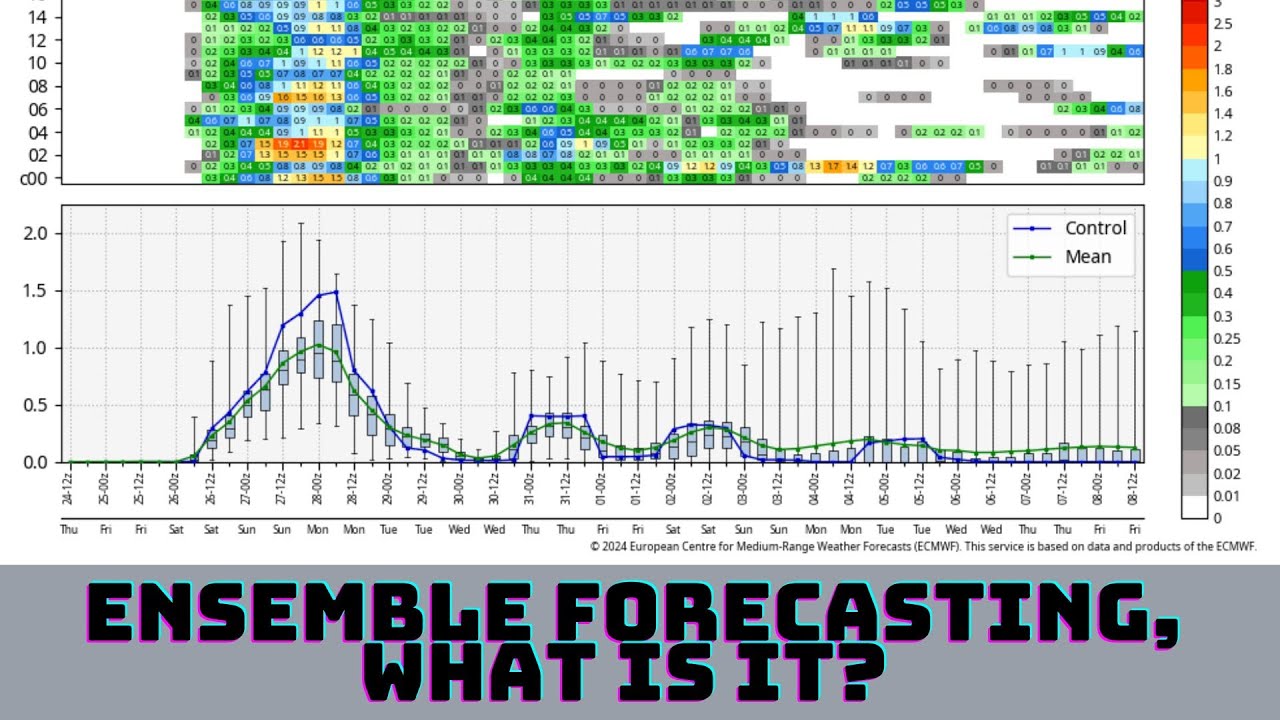
Ensemble Forecasting in Meteorology: Exploring how meteorologists use multiple simulations with varied initial conditions to predict weather despite chaos.
Bifurcation Theory: Investigating how small changes in a system's parameters can cause sudden qualitative or topological changes in its behavior.
24.6K views458likes57:40Original Release: 2018-10-15
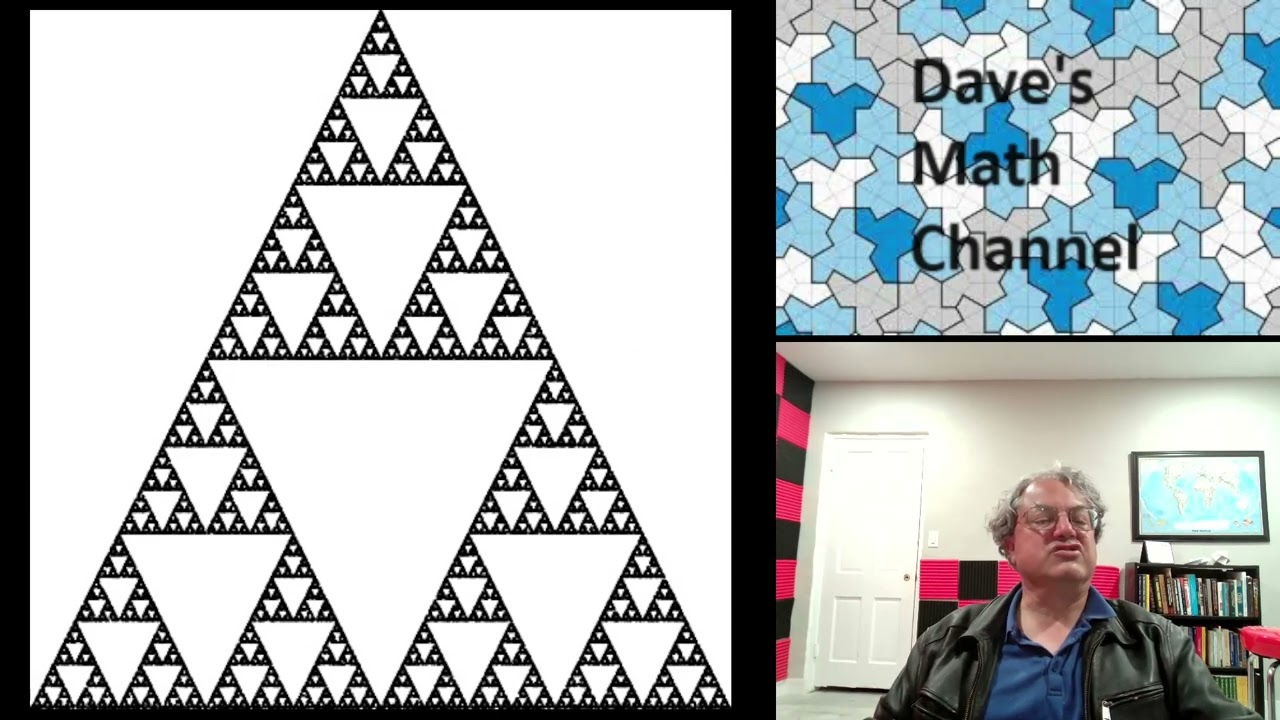
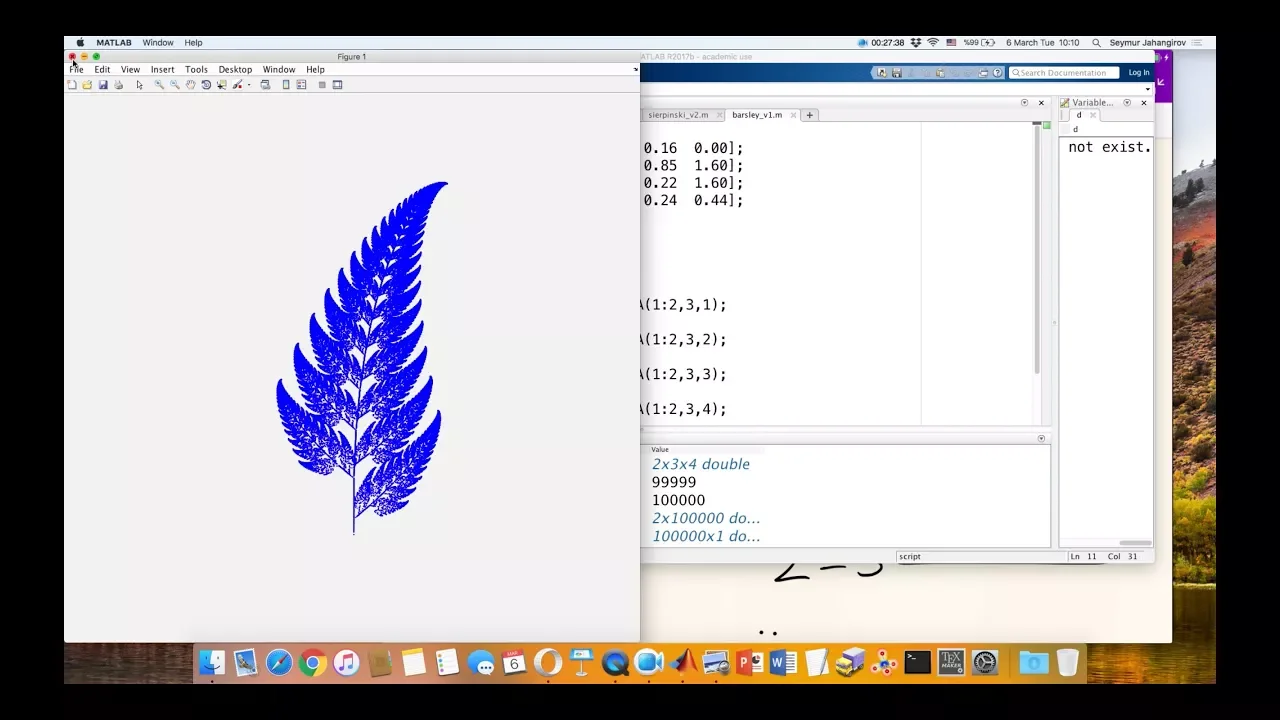
so my title is chaos and the theory of change and we start this lecture with a question and the question is can we predict the future now this is a question that has been asked by many people not just mathematicians theologians people working in the gambling industry fortune tellers astrologers all ask the same question can we predict the future and the answer is of course maybe okay can we tell what's going to happen in the next second yes you're still here okay you haven't run away although a second is actually a very very long time if you're a proton okay so it's hard to predict if your proton but very easy if you're a human being can we predict what's going to happen in the next hour probably in the next hour this building hopefully will still be here and all of you will be alive okay we hope that if there's anyone that disagrees with me talk to me after the lecture can we predict what's going to happen in the next year some things we can predict very well I predict that this building will almost certainly be here and in a year from now I predict I will be giving the fourth year of my lectures as gresham professor there's some things we can't predict at all in a year so I can predict in an hour's time reasonably accurately what the weather will be but I certainly can't predict in a year's time what the weather will be other than to say it will be all terminal okay so here's a lovely quote from Niels forth a very famous quote it is hard to predict anything especially about the future so these are some of the questions I'm going to address in this lecture and then this feeds into subsequent lectures so that the lecture I will give next month look at the mathematics behind climate change and predictability of the climate but it's also fair to say that some things are predictable and some things are not for example if you live in Scotland the weather is very predictable that's winter and that's your summer apologies to the Scots living in the audience other things can be sort of predictable for a while and then news predictability a famous example will be a came up where you put straws on the camel and for a while everything's nice and predictable nothing happens and then at a critical point you get the famous straw which breaks the camel's back and then everything changes and one of the issues about climate change is have we got to the point of the final straw and will everything change dramatically and that's a question I will address a little bit today and a lot in a month's time assuming we can predict that we'll be here in a month time so these are the sort of questions that we're going to look at but I'm going to start with an a somewhat simpler question which feeds into this and the question is is the universe itself predictable in the sense of is there pattern and structure to the universe so here's the question does nature itself have underlying order and pattern and the answer most definitively is yes and that's the great scientific kind of hypothesis science can be defined I believe as the search for order and pattern in the universe mathematics can be almost defined as the search for understanding of what patterns you get and how to classify them I agree this is somewhat vague definition but it will do so science is the search for order and pattern in the universe and science works because there is order and pattern out there that we can observe we can measure and we can predict so let's have a look at some examples here's one of my favorite examples snow flakes part of my day job is working with the Met Office and helping them predict whether it's going to snow or not in fact my particular speciality is ice but that's closely related and snowflakes are amazing things they are very small they're formed when water crystallizes high up in the atmosphere and they have a very predictable shape in fact there's an interesting dichotomy that no two snowflakes are the same here are eight snowflakes all of them are different but every single one of them has a predictable six-fold symmetry and that's really quite something and it always amazes me that in something like a snowflake which is made up of lots and lots of water molecules which are basically freezing the the water molecules over here know exactly what those ones are doing to form the same shape okay there's a lot of very deep science in that but we can predict very rapid accurately that a snowflake will have this beautiful symmetric form and in fact symmetry is one of the guiding forces behind the pattern that we see in nature we also see regularity in the animal world so here we have a honeycomb made up of beautiful hexagons and the reason we have hexagons is that they fill a lot of space and they are very strong and this pattern has evolved here we have a butterfly which has again beautiful patterns with dihedral symmetry and there is pattern inform there another area I work in a great deal is the mathematical theory of rock formation and we see patterns in rock formation so here are rocks in Cornwall this is a place called milic and what I like about this is the extreme regularity of these what across Chevron patterns and it's possible mathematically to accurately predict those shapes without actually going anywhere near a rock you can predict those in advance we also see and perhaps most importantly predictability in the heavens the dawn of modern science with Kepler and Copernicus and then later on with Galileo and Newton was hugely stimulated by the observation that the planets were round the Sun in extremely predictable patterns in fact if we go back much earlier to the Chinese they had already observed great regularity in the heavens and were using that predictability to work out when eclipses would occur it was a bit of an irony that we had a total eclipse of the Sun in the UK in 1999 we were able to predict to the second when that eclipse would occur however we weren't able to predict that when it did occur it will be raining heavily and you couldn't see it that's a bit of an irony but the actual motion of the planets is very very very predictable now one of the first people to realize this was one of my great heroes and that is Galileo Galileo was born in 1564 on the 15th of February a date I'm extremely proud of because it is also my birthday I share it with Shackleton as well and I wasn't born in 1564 though I should say but that he's actually around about the same time as Thomas Gresham was born I'm Thomas Gresham was born five hundred years ago from next year so 5:15 19 so same Silveira and Galileo was a professor in Pisa and he studied in Pisa and then had to chair there and developed the laws of motion that we now use all the time to understand the mechanics of the world he also was the first person to point a telescope that heavens and see all the patterns out there in much more detail than they'd ever been seen before a truly great man and one of the true modern scientists but the story I want to talk about occurred not when he was a mathematician but shortly before he became a mathematician when he was still a medical student and he was attending as everyone had to in those days mass in the cathedral in Pisa pictured here and he saw a chandelier swinging to and fro this was in 1581 a milestone date in science the pin chandelier was swinging to and fro buffeted by air currents which was keeping its motion going now I haven't got a chandelier with me today but I do have a pendulum so here's a pencil oh I'm sorry I couldn't bring a chandelier with me but wouldn't fit in my rucksack so here's my pendulum and what kind of no noticed it's in a nice regular way and the swing appeared to take the same time regardless of whether the pendulum has a long swing or a short thing so if it had a small kind of amplitude it would still take the same time as if it has a large amplitude and he he time this with his pulse I found it was the same and it didn't matter what day of the week he went or whether it was in the morning or the art no he's had this great regularity that it had the same time regardless of the amplitude of this way so he found that the swing time is constant regardless how it was pushed or where it was or when and the story was that he went back to his student lodgings and experimented into the night with different pendulums that he made and was able to repeatedly test this hypothesis very good piece of science and I like to think that that was why he decided to change from doing medicine and God to be a scientist so that's that was Galileo no he didn't at the time have a theory which explain this this had to wait for Isaac Newton so in a rather nice continuum of events on the year Galileo was the year after Galileo was born new died Newton was born so we have a kind of continuum of brilliant scientists and Newton was based in Cambridge a was based in Trinity College Cambridge and was arguably the greatest scientist of all time there are others as well but he was arguably the greatest or at least one of the greatest and it was a Cambridge that he formulated the laws of motion the law of gravity and also developed the theory of calculus which allowed him to do all the calculations that you needed to be able to solve the equations that he was writing down to explain the world so Newton wrote down the equations for the motion of the pendulum and here's our first equation of the of the day this is the equation for the pendulum and what Newton had done was developed the theory of calculus which was the theory about how things changed and one of the aspects of that theory was the development of what we call differential equations a differential equation relates how one thing changes to something else Newton was well aware of the importance of acceleration and this is the equation for the angle of the pendulum this is the acceleration this is the speed this is the effect of gravity and this here is the pendulum equation so Newton was able to write down the equation for this chandelier but Galileo had looked at about 60 or 70 years before so this equation it's actually quite hard to solve as it looks this term here the sine theta is a nonlinear term which makes it quite hard to solve and this term here is a model of the air resistance which also makes it a bit harder but if you take the assumption that the air resistance is small and the angle of the swing is not too large then this equation simplifies and then you can solve it and if you simplify it and solve it the solution is that the angle theta is a number a which is arbitrary that's the amplitude so that could be large or small times cosine of root G over L T G being the acceleration due to gravity L being the length and that's the equation of the solution and if you plot that solution you get this and that's basically what a pendulum does so Newton's equation correctly predicted the motion of the pendulum and another thing that it predicted is that the period of the pendulum capital T is 2 pi root L over G and that is independent of the amplitude so that was in perfect agreement with Galileo's observations and this equation here became the centerpiece of time keeping pendulum clocks so the pendulum clock was invented sometime afterwards by Christian Huygens and by using this formula they could predict exactly the swing tie of the pendulum and thus you have a way of telling the time just a little mathematical joke if you do all your calculations in SI units then the acceleration due to gravity is 9.81 meters per second per second and the square root of that is almost exactly pi so that square root is there that gives you a pie the PI's cancel so the time is 2 root L that means if the length of the ruler is 1 meter then the time of a swing a to a hole back and forwards is 2 seconds and the time for a swing from one end to the other is almost exactly one second so I think this is a fluke but it's a rather nice fluke that this half swing time of a meter rope is almost exactly one second and the approximation that PI squared equals G is really very helpful in many calculations so anyway that level of predictability allowed us to develop timepieces but much more importantly than this Newton by doing what he did opens the floodgates for a whole new way of understanding the world and his Newton's basic method the method is if I want to understand a physical system I write down the equations which govern it and these are nearly always differential equations you then solve the equations now that's not very easy I my job is basically to solve the equations and the fact that they are not easy to solve keeps me in a job these are the computers that are used by the Met Office to solve the equations for the weather and for the climate so they are there's an awful lot of them but once you can solve the equations like we did for the pendulum you can then start to predict into the future so the way we project the weather is we write down the equations for the weather we solve those equations and we solve them 24 hours into the future to allow us to predict the weather 24 hours into the future so this is Newton's key idea and that key idea is the basis are pretty well all of modern science and certainly all of modern engineering okay absolutely incredible idea going back to about 1690 that if you want to predict the future you write down equations solve the equations does this work well let's give an example where it worked incredibly well here is Newton's equation for gravity so this is gravitational acceleration acting on the body by a distant body of mass Capital m and G here is the gravitational constant so in the late 18th century William Herschel who actually lived in bath or I live pointed his telescope at the heavens and by searching around almost at random made an incredible discovery he discovered the planet Uranus okay this is a whole new planet no planet had been discovered up to that point other than the ones known by the ancients this was a whole new discovery the planet Uranus Herschel called the planet George after King George but then it got a slightly more serious name and what they did with Uranus was once they'd Herschel made his discovery they looked at its orbit and measured the orbit and started plotting its orbit around the Sun now a bit of history up to that point all of the planets that's Mercury Venus Mars Jupiter Saturn had been plotted their motion have been tracked around the Sun and found to be in exact agreement in exact agreement with Newton's laws and therefore you could confidently predict into the future what the planets would do when they looked at Uranus they found it almost agreed with Newton's laws but not quite so they were faced with two possibilities one was to ditch Newton's laws and the other words to say well maybe Newton's laws do apply to Uranus but something is causing the planet Uranus to deviate slightly from its orbit and they hypothesized that as Uranus was a new planet maybe there will be another new planet out there which was perturbing Uranus and two mathematicians John couch Adams in Cambridge and urbane levare in France went away and independently calculated where this planet would be and then German mathematician a German astronomer pointed the telescope's at the right part of the sky and found a whole new planet and that's the planet Neptune which was discovered by mathematics and the point about this in the context of this talk is that the existence and the location of Neptune was predicted and it was predicted by using Newton's approach of writing down equations and solving equations and that was an enormous boost to this sort of confidence of people trying this approach as I said we use exactly this approach now in forecasting the weather up to about a week ahead I'll talk about why we can't go forward further than that a minute and that is based on these things which are the navier-stokes equations for fluid motion equations not very different for this are used to forecast climate and I'll talk about that in a month and the success of Newton's program of predicting things led Laplace here to make a quote which I'll put up which is now called Laplace is demon and here's the quote we may regard the present state of the universe as the effect of its past and the cause of its future and intellect that's the demon which at a certain moment knows all the forces and where things are could use Newton's laws if it's Internet and vast enough to submit these data analysis so if they have a decent computer they could embrace in a single formula the motion of all the bodies in the universe from the galaxies right down to the individual atoms and nothing will be uncertain and the future like the past would be present before its eyes that's some quote basic in Laplace is saying forget free well there ain't no free well it's gonna happen because it's gonna happen okay once you know what the particles are there Bain Ian's laws off you go the future is written for you okay so it's kind of a scary quote so that's the passage demon do we believe that this is true it seems to be true to a certain extent we certain use this approach to predict what galaxy is going to look like what the solar system does but does it apply in general and I would say quite strongly it doesn't if it did life would look very different from the way it does lots of natural and human events don't seem to be predictable they actually seem to be unpredictable we have a phrase for this we say do you feel lucky okay if I toss a coin is it going to come down heads or tails you know I don't know let's have a look at some of the unpredictability that we see around us so I talked about the weather if you ask me what tomorrow's weather is going to be I can could you well the five days it's starting to get a bit woolly a week very woolly two weeks forget completely I love this forecast here it's almost exactly right that Monday's weather today we know yeah we are is essentially a random guess okay ah weather forecasts seem to start going wrong fairly quickly despite the power that we throw into them so the weather after week is not particularly predictable here's a example of climate change so one of the dominant effects on the world's climate in the short term is the El Nino Southern Ocean warming and cooling of the Sun Ocean I'll talk a bit more about this again next month but this is an event which drastically affects the economies of the nations in the Pacific and to a certain extent affects the whole world's economy and climate this is the temperature of the ocean over the last 40 years or so and the blue shows the Cooling's the red shows the warming's there is a rough four yeah periodicity to this but certainly it will be very hard to make a clear prediction about what's going on here the El Ninos largely driven by large-scale ocean circulation and there seem to be just too much going on to give any reliability or prediction other than saying it'll probably happen in the next ten years here's a human thing that Wiggly curve is the FT index over the last well since 1984 many economists would love to be able to predict that with precision I don't think they can who would have predicted that for example that's the 2008 crash brain waves these are examples of EEG scans of the brain where you have these various types of wave and look at that these waves are very very different from the regular cosine periodic repeatability that we saw for the pendulum so the human brain probably fortunately doesn't look to be particularly predictable and my favorite example of unpredictability is this chat which is my dog okay he's a spaniel anyone that has a spaniel will understand me when I say it's extremely hard to predict what he's going to do if I let him loose in the woods so at a human scale that's an economic scale and insertion sort of climatic and other areas the universe seems to be unpredictable so the question is how do we square up the fact that I advertised at the beginning of this talk that science is all about finding predictability in nature that Newton said I can predict things using maths with the fact that the world also seems to be unpredictable as well what is going on so here's the question and it's incredibly deep question it's a sort of philosophical question it's a mathematical question it's possibly even a theological question does the complex and unpredictable the nature unpredictable behavior that we see in nature our eyes because nature just is like that so forget it we can't do any science or does unpredictability arise naturally in systems where Newton's law is acting okay so this is the fundamental question which I will address today I'm sorry it's taking me so long to get to it but this is it okay the is a very very deep question it's also linked with a related question which is does predictability and unpredictability sort of coexist in the way that we try to understand the universe and this is what we're going to look at now I didn't bring my dog along fortunately and I can't bring the weather along or the climate along but I have brought a demonstration along which I hope will allow me to illustrate the points that I want to make quite directly and for this I need to go back to the pendulum please so this is the pendulum that we swung earlier and I said was like the chandelier that Galileo looked at in the Cathedral in Pisa but I wasn't being entirely honest with you this isn't quite the pendulum that Galileo looked at in Pisa this is what we call a double pendulum so a double pendulum is two pendulums coupled together there's a bottom bit there and there's a top bit there okay so there's two bits of this pendulum and in a sort of mechanical way it's very like my leg that there is a hip joint meet a couple there's one area this is different from my knee in that this bit would go all the way around but she's my new won't do my elbow did that the other day and that wasn't good I was in hospital what's up but anyway this is the double pendulum now the double pendulum is a very simple mechanical system there are two bits to it there's a bit up here which has twice the mass of the bit down there it has what we call four degrees of freedom the top bit has an angle and a velocity the bottom bit has an angle and a velocity and it is described exactly by Newton's laws I'll put up the equations for it a minute the weather is just like a pendulum except you've got a billion degrees of freedom governed by Newton's laws this has only got four now if I swing it with small swings like that then it swings to and fro very predictably just like Galileo thought it would that's nice easy if I do it like this it still swings predictably but in a different way I call this out of phase motion so the top bit in the bottom bits are basically going in opposite directions but still that's predictable it's periodic okay let's give it a bit more of a kick see what happens see what it does by the way there's nothing here acting other than gravity and a bit of friction so eventually this will slow down because the friction acts but it may take a while it's got very good bearings this one little bit of history about this pendulum I have not ever appeared the Royal Institution Christmas lectures however this pendulum has this was one of the props which I built for the Royal Institution Christmas lectures back in 2005 when Marcos de Soto gave a very wonderful series okay at least I've got to keep the proper so let's do this once again just show you the really it's not silly ran out of steam in a minute okay so here we see what appears to be very random and irregular behavior okay if I started this off again it would do something quite different if I started it off again it would do something different again okay the motion here is unpredictable weird things on our you you want to do an experiment on predictability sure what are we to do I'll start it swinging and the bottom it goes to the top there and eventually the friction where it's about and it's off all you have to do is predict when the bottom it goes to the top it the last time if you can clap when you think it's gone through the bottom bit for the last time just give me a clap okay we have to do just try and predict when the bottom it has finished spinning through the top how good you are I see that one worked rather simply today I don't know you might have got that one right okay okay I think I think you did well that time like let's just do another one [Laughter] see it's behaving very differently this time by the way if you want I'm going to bring this next time as well to demonstrate a bit of climate so you'll get another go that's more like it [Laughter] okay if we can bring up the slides then please so the double pendulum exhibits three types of motion the motion is periodic in phase that's predictable can be periodic out of phase which is predictable and it can also be chaotic and that's unpredictable so what I've just demonstrated to you is chaos here's a picture that's if you put a light on the end of the pendulum assets in its chaotic phase and photograph it that's what it looks like incredibly complex and a random looking now as I said this is a system which is governed by Newton's laws and you can write down equations for this so the way you write down equations for it is you let the angle of the top bit be theta one and angle the bottom bit theta two the length of ultimate L 2 the length of top of L 1 the masses M 1 and M 2 for their angles and that's the equations that you get they look a little bit daunting they're not actually about bad these are two equations coupled together they're not like the billion equations that we have for weather forecasting and these are equations that you can derive by studying the system and applying newton's laws and if you look for small swings just as with the pendulum then you can solve these equations exactly and you find you get these predictable periodic motions that we saw and if you look for large swings these are too hard to solve analytically you have to use a computer but it's not a difficult computer program to write you find that the computer itself predicts that the motion looks like that the computer predicts that the motion is unpredictable now let's slightly expand what we mean by unpredictable in this case and what we tend to mean by unpredictable in this case is a thing called the butterfly effect so there was a film that was produced called the butterfly effect some time ago Oh told you what chaos is you better tell your cases so I've told you that the solutions are chaotic this is probably the most important slide of the whole day and I almost forgot to tell you it chaos is defined by scientists I don't mean by economists or by politicians or by parents that's something else but chaos means unpredictable and complex and irregular behavior that comes from a system which is in itself described by simple mathematical equations so that may not look simple to you but actually it is it's only two equations glued together it's much much simpler than the weather and infinitely simple in anything remotely described the brain chaotic motion is complex irregular behavior that comes from simple mathematical laws so link to this is what I wanted to now say as a thing called the butterfly effect now a film came out a few years ago called the how to fly effect and the premise of this film was that a small change in the past could dramatically affect things in the future and the reason that this book was called the butterfly effect was a guy called Lorentz who is one of the founders of modern chaos theory when trying to illustrate what he meant said that the weather was so sensitive that a butterfly that flaps its wings in Brazil could cause a hurricane in England okay that's called the butterfly effect we now know that the butterfly would have to have wings about a kilometer across to cause a hurricane in England but still the idea is the same so the rensis premise was this and what he means by that and is absolutely the case with the pendulum is that if I started off in a certain way it will behave in a certain way and if I started off there is close to that it will behave ultimately in a very different way and we call the sensitivity sensitivity to initial conditions so if you go back in a hundred years and stamp on a butterfly the world would be a different place from what it is now and that is a definite prediction of the subject of chaos theory this um this irregular behavior that comes from otherwise seemingly predictable systems and I regard this and not everyone agree with me as a partial answer to Laplace's demon so the class said if you knew the positions of the particles all the particles in the universe and ran it forward you could predict the future the sensitive to sensitivity to initial conditions and the kind of effects of the chaotic behavior means that you would have to know those particles exactly so within you know far better than the precision of half the width of an electron and even if you knew that at an atomic level subatomic level you have randomness built into the fabric of the universe through quantum effects I discussed this last year in my lecture on the quantum mathematician and that quantum randomness combined with sensitivity of initial amount of initial conditions means that predictability rapidly becomes impossible on the scale that the class was imagining that's not saying that some systems aren't predictable there we are the pendulum is now got into a predictable state and eventually it'll come to rest that's predictable but large-scale predictability on the scale of Laplace just won't happen if you want to see more examples is a lovely one go to some a Red Cliff Church in Bristol where they have this beautiful water chaotic pendulum I recommend a trip if you go there it's very closer to the station so you can walk there very quickly this is an example for my own and work if you have sort of ellipta or stadium shaped billiard table and you bounce a billiard ball off it obeying the usual rules of reflection than these are the paths that you get for the billiard ball going around the table in regular unpredictable paths from a completely regular system why is this important well if instead of billiard balls you think of radio waves or light rays bouncing around a room that's roughly what the Wi-Fi is doing in your living room okay and that's one reason it's very hard to predict where you'll get good Wi-Fi and bad Wi-Fi and that's part of my ongoing research short history accounts so although we think of chaos is a modern invention it goes back at least 100 years or more than that to this guy it's called punk ray it was one of the Giants of French mathematics and you know he's almost on a level with Newton in terms of his ability in mathematics and physics he was studying a problem that Newton was interested in which is the motion of three bodies of equal mass around each other these this is the sort of motion that you get with three bodies in blue green and red and Hungary realize that you get extremely irregular motion and essentially the three body problem is unpredictable so although we can predict planets going around the Sun the reason we can do that is the Sun is very big and the planets are very small if things are equal sort of masses they behave like this and that's what the asteroids do and I'll tell you why that's important at the end of this talk having discovered this chaos kind of went in some sort of limbo for a while and then it was rediscovered in the 1960s largely because by that point we had computers that were fast and could solve the sort of equations they were looking at so in night in the 1960s Lorentz whom I've mentioned already wrote down there set of equations which are called the Lorentz equations which are a very very simplified version of atmospheric convection so here are his equations for atmospheric convection he put these on a computer expecting to see regular behavior and was stunned to find that they behaved in a completely irregular way and this was the modern discovery of chaos and these equations are very very important part of the modern theory of chaos and that came as a complete surprise and having discovered that the floodgates opened and we discover chaos everywhere this is a solution of the Lorentz equations in blue and yellow you have two solutions which differ by five decimal places along decimal Mazal ten to the minus five some very very close to each other and they stay close to each other for a while but then start to drift apart that's the sensitivity to initial conditions but also if these an equation is an x y&z which represent magnitudes of different convective states if you plot x and y together then the chaotic behavior moves around this amazing thing which is called the Lorenz attractor where this set has very interesting structure but at least organizes the irregular behavior and this is a big difference between chaos and complete randomness chaos you have disorder at some level but order at other levels so that's the Lorentz equations and then chaos was kind of discovered again in a much simpler system this is what I want to quickly take you through as this talk so here's the problem of being a town planner a town planner has to try to predict the population of a town ten years into the future so that you can build schools and stuff like that and to do this you have to be able to predict here's our word predict again the future population of a town and the way to do this is to imagine the population in the year n is x and and that changes from year to year and the question that's how I'm planning would want to know is if I know the population in the year 2018 can I find the population in 2019 2020 and so on so one of the first people to look at this was Malthus and that was about 300 years ago a Malthus postulated this model but certain number of people died certain number of people are born so the population next year is a proportion of the population this year the constant of proportionality being a if as one the population stays constant around planners dream they can confidently predict into the future if it's greater than one the population increases and if it's less than one it decreases and in general the population in the RN is a race to the power n times the population in Year Zero now Malthus when he wrote down the equation realized that if a was positive the population would increase and increase and increase and then will drench nearly run out of resources and people would sort of desert the town or dying or stuff like that so this equation then gets modified into a thing we call the logistic map where the population in the year n plus 1 is a times population of the year and times this factor here and this factor is designed to get smaller as the population reaches a threshold limit saying that they'll run out of resources and then it can't increase this looks a little bit daunting so you can rescale it a bit and you get what's called the classical logistic map so this is one of the classical descriptions of chaos it's where you have something you know xn that's our population today xn plus 1 is the population a year ahead and R is the number which controls the basically rate of growth of the population this is simple if you want something to do you can code that into your pocket calculator or Excel or Python whichever computational device you wish to use you can even do it on pencil and paper so what we can do is what the town planner wants to do which is to start with some population and run it forward in time and see if we can predict the future and it turns out that the predictability of this model depends on this number R so if R is 2 for example if you start with some random start it doesn't matter what it is 0.42 in this case the population increases decreases for bit but then settles down to what we call a fixed point and is very predictable from there non-animal afterwards ok and town panel would like that and if you take a different number three point to something Rolla more interesting happens the the population bounces between two values this is like an economy where you have a move economy one year you use up all your resources so you have a bear economy the next year you can build up your resources and you go back to boom again so you get this boom bust boom bust behavior so a large population depletes the resources you get a smaller population so if you increase are a bit more then you get eight points where the population oscillates between eight different values so it's looking a lot more complicated and if you take R to the number four then this is what this little quadratic equation model does for you it couldn't be simpler purely quadratic equation gives you next one re plus four that's what you get this is the irregular behavior just like that we saw for the pendulum irregular unpredictable behavior which comes from a simple system okay and this is the kind of touchstone of chaos this this sort of behavior that we're seeing in this map is mathematically very very similar to what you were seeing in the pendulum and what we see in many other systems so there we are that's chaos so for those of you who like these sort of things here's a bit of why this happens I apologize if you're not mathematical in this regard but this is a kind of at least a mathematical explanation what's going on if you want to look at the case when or it was for although it's a complicated system it's actually possible to solve it exactly you solve it by making this substitution here if you substitute this into the equation here that's our logistic map then you find that xn plus 1 is this that's with a bit of trigonometry that tells you that the angle here is twice the angle of the previous one and then that ends up being the exact solution of the logistic map when R equals four so that's an exact solution is very very rare you get exact solutions for these things but in this case you do and the point about this is that all of chaos is in here this is our solution the cosine keeps everything bounded but the two to the N here means that if you have things which are very very close together to start with the separation between them doubles and doubles and doubles every time you do the map and you don't need to double very very many times before they get completely separated and so all of chaos from a mathematical point of view is encapsulated in that equation and that equation can also be used for the pendulum as well and here's a nice diagram which kind of explains what's going on to a certain extent it's saying when R is equal to 2 or lower this is what the solution is it's a single fixed point at 3.2 the solution bounces between two points this here is called a bifurcation points it's a point where things change so the solution becomes slightly less predictable at this point because it goes between two values there's another points it goes or values it's less predictable and then for its bouncing between lots and different parts and is essentially completely unpredictable and we use things like these they're called bifurcation diagrams all the time when we try to understand how complicated systems can go from a point of predictability here through these things called bifurcation points which we try to understand over to all this complexity here and in the next lecture when I talk about chaos climates I'm going to walk you through some of these sorted diagrams as we go through what we call tipping points where we try to understand something change so gas invented discovered rediscovered in the 1960s simple systems can have complicated solutions and the question is is it has it got any use now there's a general rule about mathematics which is the every bit of mathematics has a use sometimes it comes more quickly than others but believe me it can all be used for something and chaos turns out to be extremely useful so one of the first things that was useful was in computer graphics so one of the features of chaos is that simple rules can produce complicated shapes if I want to represent a complicated shape and computer graphics rather than representing the entire complicated shape wouldn't it be simpler just take a simple rule and get the computer to apply that a few times and this is what's called a fractal fern which is generated by applying and Rahl not in one dimension but two dimensions over and over again to produce this wonderful shape and then you can do that in computer graphics to produce mountains and other things which look like nature so that's one use another uses computer art so one of the other objects which comes into Carol Sierra's thing called the mound set which relates to the logistic map which I explained but looking at complex numbers and as a result of investigating that set you get all this beautiful complexity and this is coming from the logistic map but just in complex numbers and there's for some reason it's hard to explain that really looks very very good ok and there's another example of the same sort of thing in engineering engineering design this again is extremely exacting I do my research in the chaos theory has many many applications it helps us understand car exhaust patterns car suspensions tubes in a boiler all the way down to improving microwave cookers if you have a microwave cooker which uses a chaotic source for its energy rather than the regular one you get much more even cooking so everyone's happy ok so all of these are areas I do my own research in it also helps us understand nature better so that we can get a much better understanding of the irregularities that we see in turbulence for example over here we probably don't understand it about here we probably do it arises in things like river deltas and the example that I showed at beginning was we predict what planets are going to do juan curi said we don't really know what the asteroids are going to do and that's actually kind of important because if an asteroid hits us then the entire humanity civilization ends ok so this is one of the few areas of maths which could actually affect the entirety of human civilization in one go and certainly we're trying to use chaos theory to better understand how asteroids move and therefore when we see an asteroid whether it's going to come anywhere close to us or not so I've tried to touch in this lecture on whether we can predict things or not into the future and the limitations of doing that even if we understand everything else but there is one thing I definitely can predict and that's this new understanding of ok a nature through it Oh is the chaos is the science of the 21st century thank you very much you
Up Next

47:11
Nonlinear Systems and Pendulum Dynamics | MIT 18.03
@mitocw
71.8K views•2008-01-17

4:43
Elliptic Curve Cryptography Explained: ECC, ECDSA, ECDH
@PracticalNetworking
28.5K views•2024-10-21
10:44
Fourier Series Introduction: The Big Idea Explained
@DrTrefor
387K views•2021-05-03
6:00
The Mathematical Impossibility of Accurate World Maps
@Vox
23.3M views•2016-12-02
Related Study Plans & Knowledge Roadmaps
Structured learning paths in Mathematics
mathematics
Tensor Calculus: Vectors to Riemann Curvature
01Mathematical Foundations: Linear Algebra & Calculus
02Covectors, Dual Spaces, and Tensor Basics
03The Metric Tensor and Index Gymnastics
+ 2 more learning modules
40h5 modules
Explore Roadmap
mathematics
Gödel's Incompleteness: Logic, Proofs & Limits
01Introduction to Formal Systems & Hilbert's Dream
02Set Theory, Cardinality, and Cantor's Diagonal Argument
03Arithmetization and Gödel Numbering
+ 2 more learning modules
14h5 modules
Explore Roadmap
mathematics
Galois Theory: Fields, Groups & Solvability
01Foundations of Abstract Algebra: Groups & Fields
02Polynomials & Field Extensions
03Splitting Fields & Symmetries
+ 2 more learning modules
24h5 modules
Explore Roadmap
mathematics
Non-Euclidean Geometry: Models & Geodesics
01Euclid's Fifth Postulate and the Birth of New Geometries
02Hyperbolic Space and the Poincaré Disk Model
03Geodesics: Defining Straight Lines in Curved Spaces
+ 2 more learning modules
15h5 modules
Explore Roadmap