







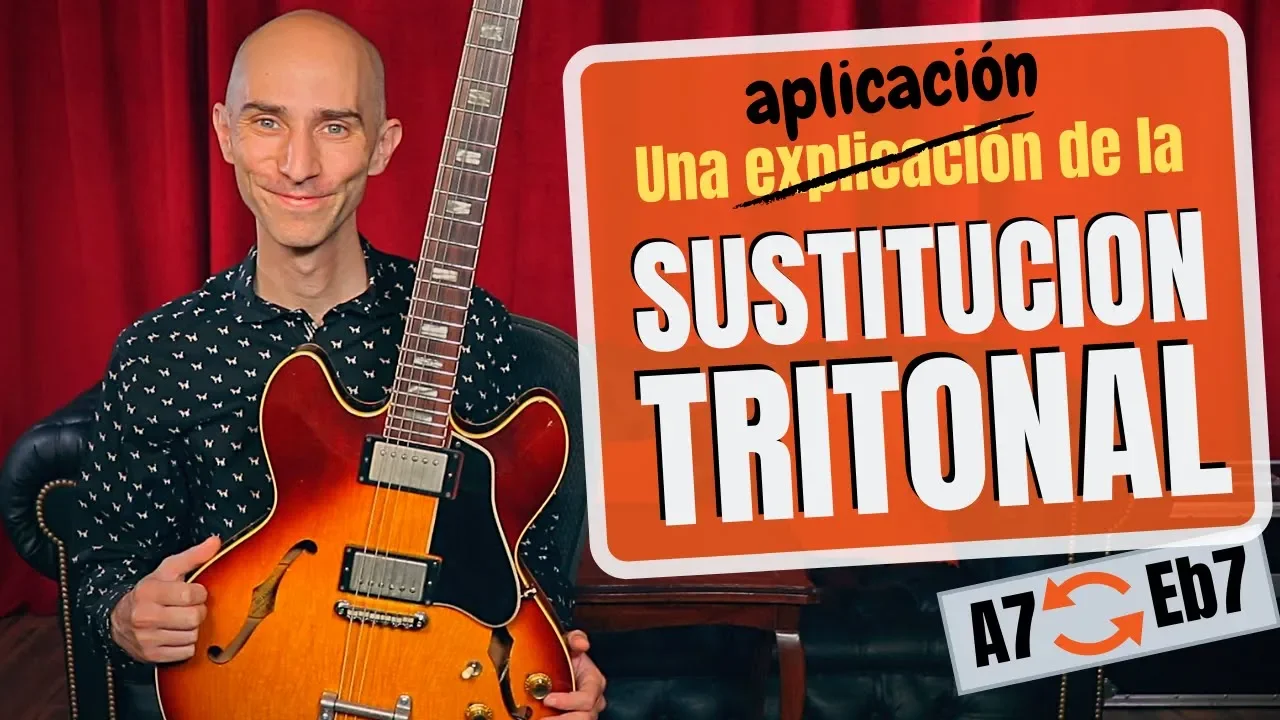






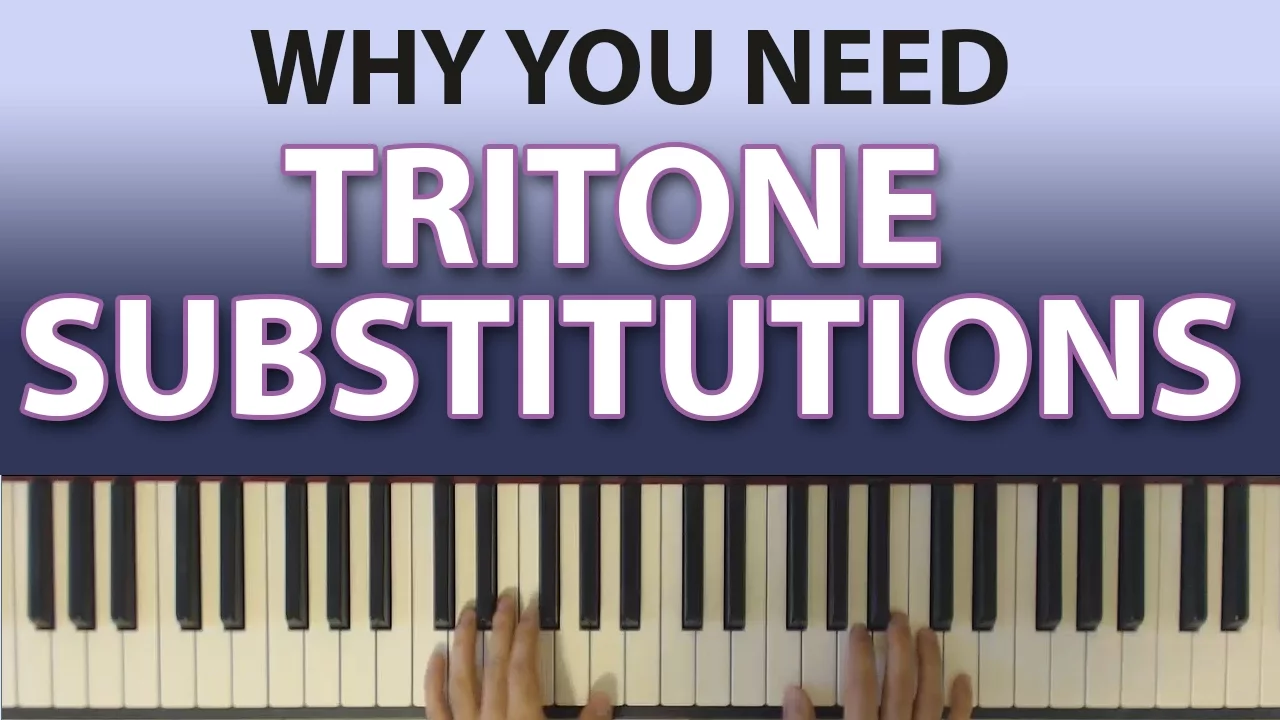

A tritone substitution is a non-diatonic chord that replaces a dominant 7th chord by using the same tritone interval but inverted; for example, in the key of C major, the G7 chord (V7) can be substituted with a D♭7 chord, which shares the same tritone (B-F) but inverted as F-B, creating a powerful chromatic effect that adds color and variety to harmonic progressions.
Understanding Tritone Substitution in Music Theory
Added:Understanding of interval theory, specifically how to identify and construct a tritone (an interval of three whole steps or six semitones).
Familiarity with dominant seventh chords (V7) and their harmonic function in resolving to the tonic (I).
Knowledge of the standard ii-V-I chord progression, which is the primary context where tritone substitution is applied.
Basic voice leading principles, particularly how the third and seventh scale degrees (guide tones) resolve in a cadence.
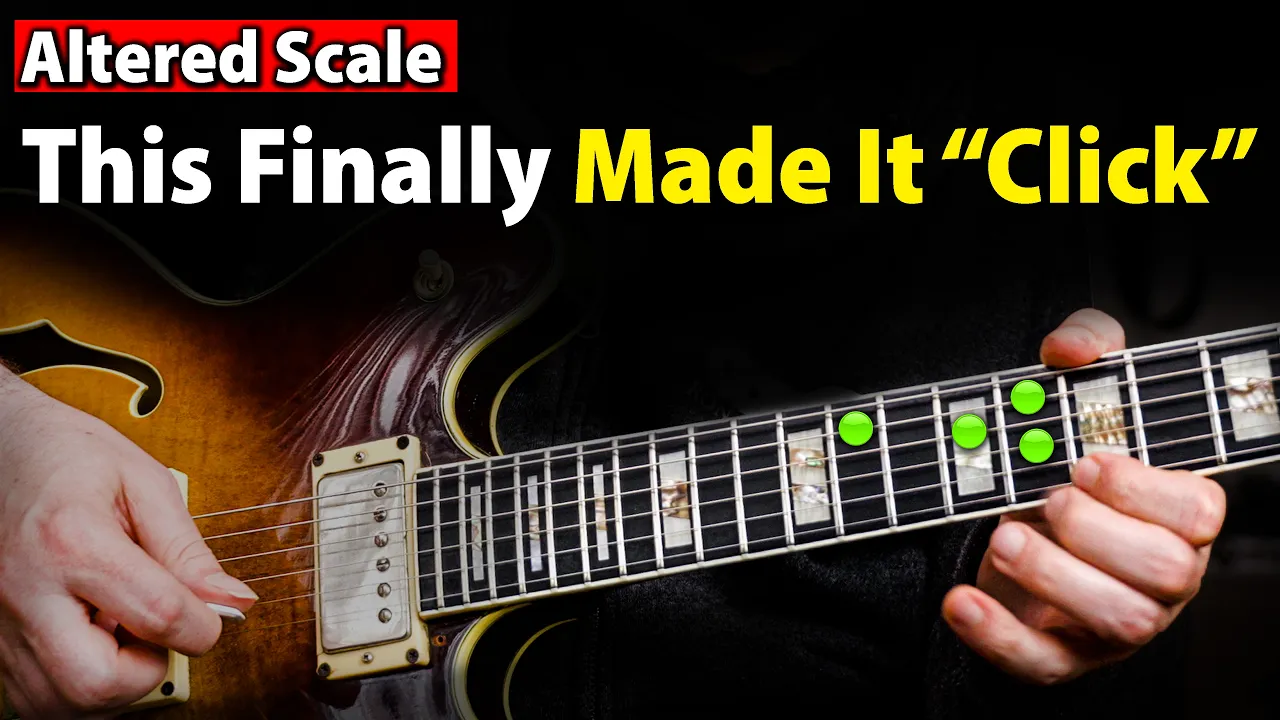
Exploring scale choices over tritone substitutions, such as the Lydian Dominant scale or the Altered scale.
Applying tritone substitutions to jazz chord melody arrangements and reharmonizing standard chord progressions.
Understanding related advanced substitution concepts, such as secondary dominants, diminished seventh passing chords, and Coltrane changes.
Analyzing real-world jazz standards to identify, play, and improvise over tritone substitutions in a performance context.
81.2K views3.4Klikes16:22Original Release: 2021-10-18
- Hi, I'm Gareth Green, and in this video, I'm going to try and answer a question that many people have.
What is a tritone substitution?
And when would you use it, what's it all about?
It sounds like something incredibly complicated.
So, let me see if I can break it down in a way that makes sense.
So, the first thing to say about a tritone substitution is that a tritone substitution is a non-diatonic chord.
So, what do I mean by that?
Well, a diatonic chord is a chord that comes inside a key.
So, if I'm in the key of C major, I'm using the scale of C major, and I make chords on each note of that scale by adding a third and a fifth above the root note, the bottom note, I get this chord, it's chord I or a C major chord, chord II, or a D minor chord, chord III, or an E minor chord, chord IV, or an F major chord, chord V, or a G major chord, chord VI, or an A minor chord, chord VII, or a B diminished chord, and then I'm back to where I started.
So, those are the diatonic chords in the key of C major.
They use the notes of the key signature, which is no sharps, no flats.
But sometimes you want to add a bit of colour, bit a flavour to a piece of music.
And you might use a non-diatonic chord.
In other words, a chord that uses notes that are not in the scale of C major, but the chord somehow works.
It sometimes has a function in relation to the key of C major.
So, that's the first confusion because people look at these sort of chords and they go, "Oh well, it's not using the notes of the scale of C major.
"It must be in some other key."
Well, yes and no.
But the point is, it's a non-diatonic chord.
It's not using the notes of the scale of C major.
But the point is this, it has a function in the key of C major, which is what we'll go on and talk about in a moment.
So, it works in C major, even though it's using notes that don't belong to C major.
But because it's using notes that don't belong to C major, it's adding a bit of colour, bit a spice to the music, which is why it's such a useful chord to use.
So, that's the first thing.
It's a non-diatonic chord.
Okay, let's think about this word tritone.
I mean, what does tritone mean?
Well, tri is three.
So, tritone is three tones, all right?
So, if C to C-sharp is a semitone, or what's sometimes called half step, well, C to D is a tone or a whole step.
So, if I put three of these tones, or three of these whole steps together, what do I get?
If I start on C, well, one whole step, or one tone, takes me to D.
Another whole step or another tone takes me to E.
And another whole tone, or a whole step, takes me to F-sharp.
So, one, two, three tones.
So, C to F-sharp is a tritone.
So, now we know what a tritone is.
You start on a note and if you go three tones away from it, you're dealing with a tritone.
Sometimes people know the tritone as an augmented fourth or as a diminished fifth.
So much of this depends on, you know, which tradition you've come through in your learning of music.
But if it's C to F-sharp, it's an augmented fourth.
If you've notated it differently as C to G-flat, it's a diminished fifth.
Either way, it's a tritone.
And it's interesting that back in mediaeval days when people were very superstitious, they talked about the tritone as the devil in music.
I think it just has such a haunting sound, doesn't it?
When you go around in tritones, it's a very haunting sound.
And I think they thought there was something a bit sinister about it.
So, they thought it must represent the devil in music.
So, there we are.
So, it's been around for a long time causing its own history of trouble.
But as you can hear, it's a very powerful interval.
And tritones normally have a resolution.
They pull in a particular direction.
So, if I have C and F-sharp, quite often they kind of pull outwards.
So, the C falls to B, and the F-sharp rises to G.
So, you can hear that tritone has a resolution.
If I call it C to G-flat, often it pulls the other way.
So, the C pulls up to D-flat, and the G-flat pulls down to F.
So I get that.
Now, when you hear a tritone like that, it kind of has a context that we're familiar with.
We've sort of heard that sort of thing happening.
So, it's possible to have a tritone that even though it sounds a bit stark and a bit sinister, you can kind of resolve it in one of those ways.
Okay, well we're gradually kind of building up to what the chord is about.
But before we get to that, well, why is it called a substitution?
Well, what's it substituting?
Well, let's think about this for a moment.
If I was in the key of C major, and I wanted to put a chord before a C major chord, quite often I would put a G seven chord, or what we sometimes call a V7 chord, because it's a really good chord to put before chord I in C major or a C major chord, because it kind of pulls you on there.
So, if I go G seven and then C major, that's a really good strong move.
And inside that G seven is this tritone.
Do you hear that tritone?
And it's kind of pulling me into a resolution.
So, that V7 to I, or that G seven to C is a progression that it comes up in music of all styles and all periods.
So, it's great.
So, if we get to what would be a tritone substitution in C major, let me tell you that the chord would be D-flat seven.
Now, you might be thinking, why would I want to use a D-flat seven chord when I'm in C major?
Well, remember what we said about it's a non-diatonic chord.
So, even D-flat, you immediately think, well, D-flat isn't in the key of C major, no, because it's a non-diatonic chord.
Okay, now why would I want to use a D-flat seven as some kind of substitution for a G seven, because we're really happy with our G seven going to C, aren't we?
But, I mean, it gets used a lot and sometimes we might think, another G seven going to a C, could I vary that G seven, do something else?
Well, let's have a think about how that D-flat seven could be a substitute for a G seven.
And there's two kind of reasons, really.
And the first is this.
Inside any dominant seventh, you've always got a tritone.
So, when we did that G seven, remember we talked about the tritone, didn't we?
B to F, there's a tritone in there.
And any of these intervals, or any interval in music in fact, can be inverted.
In other words, you can turn it upside down.
So, if I've got B at the bottom and F at the top, I could turn that upside down, couldn't I?
So I could call it F and B, and if I turn it upside down, so B to F turns upside down to F to B, I could also say that that B is also called C-flat because every note has more than one name.
I can call that B, but I can also call it C-flat because it's a semitone below C.
So, if I have a D-flat seven chord, can you see what's happening?
It's using the same tritone as that G seven chord, even though it's been inverted.
I had this in the G seven, and now I've inverted it.
And I've got that in the D-flat seven.
And if I call it C-flat instead of B, it still sounds the same.
But you see what I've done?
I've taken the tritone out of the V7, the G seven, I've turned it upside down and then said, there's a tritone inside a D-flat seven.
So, that's how that works.
It's about the inversion of that tritone.
They kind of belong to each other.
And it's also interesting that I was talking about a G seven chord, and now I'm talking about a D-flat seven chord.
It's also interesting that D-flat is a tritone away from G.
If I've got G, and then I go to D-flat, that's a tritone.
One tone, two tones, three tones.
So you see how this tritone thing plays out in two different ways really.
Okay, so what's the easiest way to find the tritone substitution chord in any given key?
Because you could use the information that we've just shared together, but you might be thinking, oh my goodness, I've got to find this G seven thing, and then I've got to find the tritone, then I got to turn that upside down, and then I've got to call that something else.
And oh dear, this is all too much.
That will work, I mean, you'll get there.
And the information I've just given you explains why it's a tritone substitution chord.
But if you just want to find the chord quickly, well, you could do it another way.
So, let me explain how you could do that.
First of all, you start from your tonic, in other words, your first note of the scale.
So, if you're in C major, your tonic is C, okay?
So, you start with C, the tonic, the first note of the scale, and then you're going to try and build a chord on flat-two.
So, if I'm in C major, well the second note is D, so the flat-two is D-flat.
So, either by saying, well, C's the first note, D's the second note, so flatten it to D-flat.
Or think, well, I'm starting on C, go up a semitone, D-flat, doesn't matter which way you do it.
And then build your seventh chord.
So, D-flat, F, A-flat, that gives you a major chord.
D-flat, F, and A-flat, then add your C-flat.
We called it B when we were doing G seven, but let's call it C-flat, doesn't really matter at the moment, really.
And you've got your tritone substitution.
So, do you see how we got there?
Just a slightly simpler way of doing it.
You start with C, you go up a semitone, or you go to the flattened second to D-flat, you've got a D-flat chord, D-flat major chord.
You add a seventh, the C-flat there, or the B, and then you've got your tritone substitution.
That's the chord that's going to replace your G seven or your V7.
And by the way, it works exactly the same in minor keys as it does in major keys.
So, if you wanted this to be a tritone substitution in C minor, it works just as well.
So, how are you going to use it?
Well, we've got common progressions in music.
So, you might have a progression, for example, that goes II-V-I.
Let's just put that in another language.
If we're in C major, it would be a D minor chord, a G chord, and a C chord.
So, II-V-I.
So, D minor, G, C.
Okay, now you could make that a bit richer by adding sevenths.
So, I could go II, or D minor, V7, or G seven, I.
I could add another seventh by using a seventh on the first chord.
So, II7, or a D minor 7, V7, or a G seven, and then I, the C chord.
Okay, now how about you replace the V7, or the G seven, with the tritone substitution.
So, I now go II7, or the D minor 7, and then I'm going to use this D-flat seven chord, and then go on to C, or could even be a C major seven chord, you know?
And then I could use that and then use a C major seven.
Just gives you more colour, doesn't it?
Now, some people watching this, they're going to say, "Hang on a second, that D-flat, F, A-flat, C-flat chord, "well, that's actually a V7, "or a dominant seventh in G-flat major, isn't it?"
Absolutely correct, you're right.
It's fine because it can function as a V7 in G-flat major.
So, I could use that and then go to G-flat major.
Or it can function as a tritone substitution in C major.
So, this is why it's such a useful chord.
It's very flexible, very colourful.
And other people might be saying, "Hang on a second, if I've got this chord "D-flat, F, A-flat, B, "that looks like a German sixth to me."
That's true, actually.
And it may be seen as a German sixth in the key of F major because we normally build a German sixth on a flat-sixth degree of the scale.
So, a German sixth is often referred to as a pre-dominant chord.
So, if we had that as a German sixth in the key of F, it would usually resolve to chord V in F, which is a C major chord.
So, it's doing exactly the same as the tritone substitution.
So, that's quite interesting as well.
And of course you can have a German sixth built on flat-two as well as on flat-six.
So, it's all about different conventions.
And if you're thinking, German sixth, what the heck's that?
Never heard of it.
Doesn't matter at all.
But I'm just making this link for people who perhaps have never heard of a tritone substitution, but have heard of a German sixth.
Or people who are not sure what this is, but they know about a D-flat seven chord relating to G-flat major.
It's just to make the point that, yeah, these things can function in different ways in different circumstances, but it's all amounting to what we're talking about here, the tritone substitution.
So, you know, the great thing is there are musicians around from so many different musical traditions, working in different musical genres, that's fantastic.
And, you know, we want to be open to all, that's great.
So, we sometimes have slightly different language for explaining the same things.
And we sometimes use the same things in slightly different ways.
But hey, non-diatonic chords add colour.
So, it doesn't matter if you're playing in a rock band or you're looking at some of this stuff in Mozart, non-diatonic chords are a way of adding colour, a way of adding variety, a touch of something less expected.
And as with all these things, you know, once you've got your head round what a tritone substitution is and how it works, what it sounds like, play around with it.
Just keep playing them.
You know, build them into your writing until you get happy about using them.
And you'll find it's a great way just to add a bit of colour to what you're doing.
So, I hope you enjoy working with tritone substitutions.
Up Next

10:53
Mastering Secondary Dominants: Tonicization in Music Theory
@MangoldProject
347.3K views•2022-09-30

10:20
Mozart's Musical Dice Game Explained: History, Rules, & Fun
@webpianoacademy
5K views•2023-03-13
28:04
Writing Four-Part Harmony: A Beginner's Music Theory Guide
@MusicMattersGB
257.7K views•2020-10-29
10:49
Understanding John Coltrane's Giant Steps: A Music Theory Analysis
@Vox
10.4M views•2018-11-12
Related Study Plans & Knowledge Roadmaps
Structured learning paths in Music Theory
music-theory
Composing Galant Music: Partimento & Schemata
01Foundations of Figured Bass and Keyboard Harmony
02The Rule of the Octave (Regola dell'Ottava)
03Galant Schemata: The Building Blocks of Form
+ 2 more learning modules
30h5 modules
Explore Roadmap
music-theory
Decoding Overtone Series: Tuning & Drone Music
01Acoustic Foundations: The Physics of the Overtone Series
02Tuning Systems: Equal Temperament vs. Just Intonation
03Microtonality and Spectralism: Beyond Standard Pitches
+ 2 more learning modules
24h5 modules
Explore Roadmap
music-theory
Impressionist Harmony: Scales, Planing & RPGs
01Foundational Music Theory: Keys, Intervals, and Seventh Chords
02Impressionist Color: Chord Planing and Parallel Harmony
03Whimsical Textures: Pentatonic Cascades and Whole-Tone Scales
+ 1 more learning modules
14h4 modules
Explore Roadmap
music-theory
Negative Harmony: Axis Reflection in Indie Pop
01Music Theory Foundations: Scales, Intervals, and Triads
02Functional Harmony and the Circle of Fifths
03Demystifying the Negative Harmony Axis Reflection
+ 2 more learning modules
16h5 modules
Explore Roadmap