





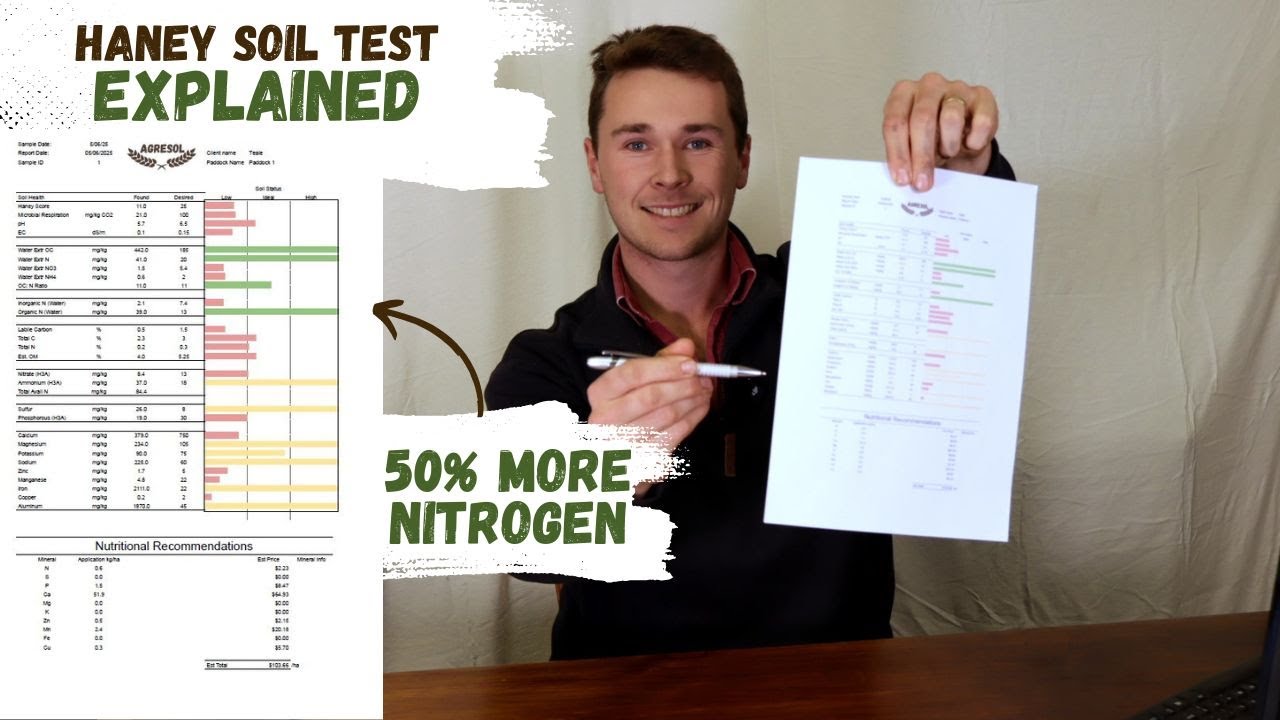

















The Haney soil health test evaluates soil biological function through interconnected metrics, starting with the Soil Health Calculation (SHC) score (ideally above 7, with 10+ being optimal), which combines soil respiration, organic carbon, and organic nitrogen. Key indicators include soil respiration (measuring microbial activity), percent MAC (microbially active carbon, ideally 50-80%), and carbon-to-nitrogen ratio (ideally 10:1 to 12:1). The test reveals whether microbes have sufficient food (carbon), proper environmental conditions (pH 6.5-7.5, low soluble salts), and adequate nutrients to cycle nitrogen and phosphorus efficiently, ultimately determining the soil's capacity to provide nutrients to plants through biological processes rather than direct fertilization.
How to Read Haney Soil Test Results | Regen Ag Lab Webinar
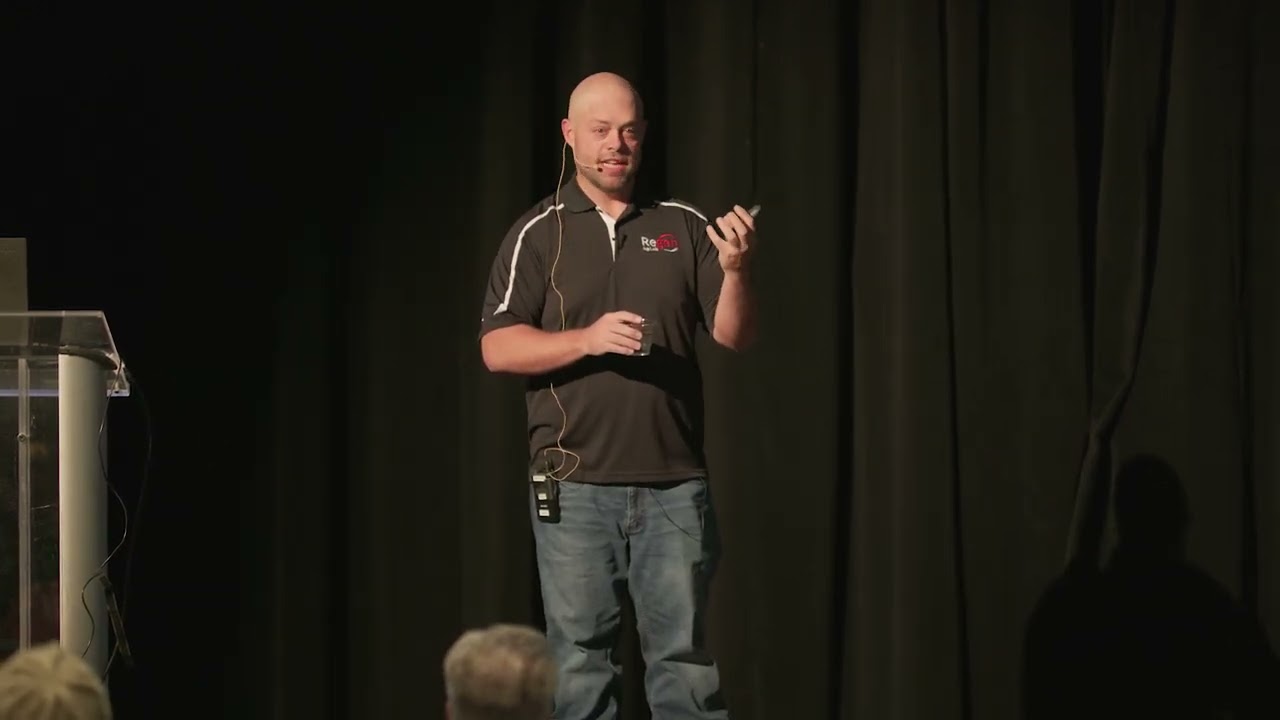
Added:Good morning and welcome to the Adisces Foundation how to read your soil health test your your Haney test uh with Lance Gunderson. My name is Lynette Miller and I work with the Adiesis Foundation. Um I've been to a number of your farms. Um I am kind of the contact for the growers so that they're able to uh get answers that they're looking for or if they need help with something. Um that's me. Um, and this is the amazing Lance Gunderson who's here with us today. He is the president and the owner and one of the owners of Regen A Lab. Um, and he is uh that person, right, that we send our soil test to. And so he's going to help us understand um how to read our Haney soil test. And a lot of you have received yours, so that you should have one. And if not, it's coming your way.
Um, and so yeah, Lance, get us started.
>> All right. Well, thank you everybody. I was just reading through the uh Q&A to see where everybody's from.
Uh I So I I've had the privilege of of working with Echodas and and their group for several years. I've known Dr. Longren uh for several years and Lynette and Gail. Um and so yeah, it's it's been been great. Um the the interesting part is is that as a lab, every time we receive the soil samples, we have zero idea of where they are from. Um we don't know who they belong to. I mean, and that's the way it should be, by the way. But um so now it's interesting that I get to look through this list of, you know, Oklahoma, Southeast Kansas, New York, New Mexico.
um you know I'll see a few names I I recognize um and location. So anyway um I am going to attempt to walk everybody through essentially the process that I take when reading a Haney test. Now, the process and the steps that I'm going to outline are the same steps that I take regardless if you're in a ranching operation, growing corn and beans, uh, garden, orchard, etc. Um the the test is not designed to work for a very specific set of management or growing um choices that you that you're exhibiting as part of your group. It is designed to be kind of a report card of your management and group. Identify areas that are we're doing very strongly in and other areas that maybe could use some help.
Think of this test a little bit like a a physical um at your medical doctor and understand that some of these numbers play off of each other.
So some of them as as if some of them go up that causes others to go down. as others go down, others come up. Um, and it's it's that's one of the I guess the beauties of the test and why it works, but also one of the I guess if you would say headaches um and trying to understand what is what is going on. I'm going to do my best. We got some examples. I'm going to put up some examples that um Lynette provided off of Fuller Farms and I'm going to walk through them and then we can have a general discussion. Of course, as you have questions, by all means, um I think Lynette, you're just going to stop me.
Um we don't have to wait till the very end. I'm supposed to do this in 15 to 20 minutes. It might take an hour, but if we have questions in between, that's fine. I want to give you plenty of opportunity to ask questions. So, let me share this screen really quick here and uh verify that everybody gets to see this.
Can you see that report now? Lynette, you can nod your head up and down. Okay, got a thumbs up. Okay, so I'm going to zoom in on this a little bit.
Um hopefully everybody can see this. Um so you'll notice up here on the top right it says cluster 71 field 4291. That is the way your samples come to me. Um again we don't have any idea. So this is the haney soil health analysis as we run it here at region a lab.
Really quickly the layout it is a left to right top to bottom layout. Um we group things. I know if I gave everybody an opportunity to tell me how they wanted this presented, I'd get 70 different opinions if there were 75 different people. So, we do our best as to what we think makes sense. Um, we group all the nitrogen numbers together.
You'll notice there's nine of them. Um, maybe, yeah, nine of them up here. Then we've got phosphorus grouped together.
There's six of them.
Other soil measures, those are things that you see on a standard soil test.
soil pH, soluble salts, excess lime, etc. organic matter. And then we've got our H3A extract fertility numbers. Um, most of those look familiar to you if you've run a soil test of any kind. Then finally, we've got our soil health and our nitrogen comparison. So, you get your results back, you open up your PDF, you look at this and go, "Holy cow, there's 56 numbers here. I have no idea where to start." Right. Um, fortunately for me, I've looked at about a half a million of these now. So, I had to develop what made sense to me and say, "Okay, where do we start?" So, if you've got them in front of you or you can follow along on the screen, I'm going to walk you through where we start. Here's the irony. We are going to start with what I say is the least important number on this entire report and that is the soil health calculation.
Now before anybody asks why do we start with the least important number it has more to do with that tells me where to look next. Okay. So, if we go down to that third block where it says soil health and we go over to that fifth number from the from the left, it says SHC.
And I do apologize about the abbreviations. It's really tough to fit all this stuff onto a page and make it readable. So, SHC is soil health calculation.
On this one, we see 8.35.
That number is a summary of your soil respiration. It is a summary of your organic carbon to organic nitrogen ratio and the amount of organic carbon and organic nitrogen as separate measurements. Okay.
Ideally, we like to see that number above seven.
Now don't worry about I'll I'll mention like what should it be? Everyone asked what should it be? That is going to be heavily dependent on your region. So for example, Eastern Oklahoma, New Mexico, you're both represented here. You have very different climates, growing seasons, rainfall, temperatures.
Now, they're you could say they're both hot. I've been in eastern Oklahoma. It is very hot. Um, but rainfall, things like that presents different limitations on that soil health score just like it presents limitations on yield um in in in rowcrop production or orchard production. So seven however is the tipping point where we start to see positive things happening in your soil system. That doesn't mean that when you get to seven everything is just grand disease disappears water infiltrates. Great. I mean but that's the tipping point especially on some of the numbers on this test where we start to see nitrogen cycling. we start to see um sustained soil respiration which leads to aggregation and water infiltration etc. Ultimately, we really like to see that number get above 10.
That that's really the goal. And you might say, well, I'm at 13, you know, but I talked to a guy in Ohio and he said his score was 27.
So, I my goal should be 27. It's Well, that may not be your potential, right?
Again, if you're in in Eastern or or if you're in New Mexico, that's going to be really tough to do. Um, you just have more constraints.
Now, when I look at that score, if I see a score of 15, 13, 21, um, I don't that tells me a a lot about what's going on already.
So, the very first number I mentioned was soil respiration.
So if we go four numbers to the left where it says soil restp part per million CO2C and on this example the value is 27.
When I see a soil health score of 15 I know that my respiration is fairly high.
When I see a score between seven and 10 I'm marginal.
Meaning like it's not off the charts high. It's not really low. I'm somewhere in between. And when I see scores below 7, I've got a pretty good idea that my respiration is really low.
So going through this example, 8.35, we look at respiration 27.
That's on the lower side.
So the very next number that goes into the soil health score is organic carbon right next to respiration.
So that number is 212 that is slightly above average. That is the food that the microbes have available.
So now if I say so for example, and I can't do this because you know show of hands type of thing on a Zoom meeting, but for those of you that have children or livestock or whatever, if you put all this food out there and your livestock decide not to eat it, is that a limitation of food availability or is it something else?
it's something else.
So the way we look at that relationship is with that third number on the soil health side called percent MAC.
MAC stands for microbially active carbon.
In other words, how much of the food available is being utilized by the microbes? And in this case, it's 12.7%.
So, we've got a lot of food out there that those microbes could eat. Something else is keeping them from eating. It's not a lack of food.
And I will say that in most systems, it the reason they don't eat is because of a lack of food. Most of our soil systems are lacking food availability for the microbes.
This is one of those instances where food is not really the limiting factor.
So, let me pause a moment on percent MAC.
I gave you a range for the soil health score. For percent, we like to see that number above 30%.
We really like to see it around 50% to 80%.
If we're below 30% it tells us that food is not the limiting factor.
If we are between 50 and 80, you know, 30 to 50 is kind of marginal.
50 to 80 is kind of ideal in that the the microbes are eating at a rate at which the system is supplying carbon.
And when I say the system, I mean photosynthesis from your living crops, compost additions, manure additions, cycling of residues at the surface that all feed back into this pool of carbon.
So it's kind of like think of it too like a battery. I'm charging the battery at roughly the same rate I'm using the battery.
>> Lance, Lance, quick question.
>> Yes. If your percentage of MAC MAC is above 100%, what does that mean? And how high does your range go?
>> So percent MAC can technically be as high as infinite. Um the what that means though is that so when we measure soil respiration, we're measuring that as a cumulative measure over 24 hours.
When we measure water soluble organic carbon, we're measuring literally just a single point in time. Okay.
What it tells us though is that if our respiration is really high, that is a huge demand for carbon. And as the microbes are eating over that 24 hours, they're actually outpacing the ability of the soil to replenish carbon.
And what you're seeing in so think of this two um like two conveyor belts running next to each other. Okay? One of them is your supply of carbon and the other one is how fast they're burning up carbon.
Well, unfortunately we can only measure one of those conveyor belts we measure over 24 hours. That's respiration.
And the other conveyor belt we're only measuring it we're stopping it and looking at it and then saying, "Okay, start again."
So the reason why those microbes can respire more carbon than what we measure is because over that 24 hours organic matter and other articul what they call particulate organic matter is breaking down in that system or and becoming water soluble or becoming food.
What it means for you from a management standpoint is that yes, there are different times of the year where your percent MAC is going to be above 100%.
You all operate some kind of agricultural operation. There are certain times of the year where your expenses outweigh or are higher than your income.
That time of year for most of us uh in the soil is in the spring, especially in annual rowcrop systems. So, as your soil start to warm up, the microbes start to go to work and they're eating all this carbon. But if we don't have covered crops or we don't have perennials or we don't have other sources to provide carbon, the percent Mac, the carbon number goes down. I know you probably can't see my hands. percent, it goes down and then the respiration is up and we get that above 100%.
If it's shortterm, meaning, you know, a couple of weeks and it only happens maybe a couple times out throughout the year, that's okay. If we start to see it be more of a constant pattern from a management standpoint, what that tells me is I need to figure out a way to increase carbon capture or carbon input into my system to offset the demand from the microbes.
The other analogy, and I'm sorry, I'm an analogy person. The other analogy is like you're building a fire.
So if you've got really low respiration, you've got a really small fire.
If you grow a cover crop that's six feet tall and it's 99% cereal rye and you go put it down on the soil surface, you now yell and scream because you have a residue problem. Well, in reality, you've basically added a 6ft log 4T in diameter to a fire that's the size of a match.
And so, you smother the biology, you smother out the fire.
You can watch these numbers with your management. And as your fire grows, so does the demand for carbon and fuel in that fire. And now you have to stop using newspaper and lighter fluid. And you got to start adding in more higher carbon robust things.
Just like a good fire. If you don't, the fire starts to burn itself out.
and the limitations on how big that fire can get. Again, that's really based on your climate at that point and your soil type. So once you get it going, it's feeding that fire to keep it going. And the whole reason to do that is because that fire yields you aggregation. It yields you nutrient cycling. It yields you disease prevention. It basically in a nutshell builds resiliency into your soil system.
That is the reason for doing it. We're not just building a fire to build a fire. Um there is a purpose behind the behind it.
So yes, good question. Percent Matt can be higher than 100%. Keep in mind if the microbes are eating carbon that we're not supplying, where does the carbon come from?
Well, just like money, it comes out of your savings account.
And if you don't have a savings account, you're borrowing it with interest. Um, and where these microbes are borrowing it or getting it is from the savings account, which is soil organic matter.
So by and large across almost every agricultural acre um not only in the US but around the world soil organic matter numbers have decreased because as we go to systems that we harvest a lot of the carbon off obviously we're selling things in a you know we turn around and bail up wheat stubble or corn stocks or we go in between for seven eight months out of the year. Um, you can say, "Well, I'm perennial and I grow hay." Well, yeah, but what little carbon we capture, we haul off, right? So, those things place constraints and end up um creating organic matter deficits and that's what's happening. And the fire slowly burns out, but it's it's trying to consume everything it can. So, percent Mac is a very valuable number. So again I just to step back start with the soil health score then I look at respiration.
If my respiration is 140 and you say well what should it be? Well that's dependent on your carbon availability.
So the balance between availability. So percent MAC is a more important number than just respiration by itself or carbon by itself.
Um I ask people this question all the time. For those of you who don't know me and you can see me and have some assumptions, but I always say I weigh 215 pounds. Is that good or bad?
Well, how old are you? How tall are you?
You know, what's your body type like?
What do you do? You know, so it's the general rule of thumb is that it's yes, there are extremes. If I told you I weighed 500 lb, it probably doesn't matter how tall I am. Um, I've got problems. Um, so that's that's the idea.
The percent MAC number tells you whether those two numbers are kind of in balance.
Then we have the carbon to nitrogen ratio.
The carbon to nitrogen ratio in this on this test is the ratio between the water soluble organic carbon. So 212 parts per million on this test and the water soluble organic nitrogen or think of it like this soluble protein.
So this is the the ratio between energy and protein in the soluble portions of food that microbes are eating.
Ideally again between 10 and 12 10:1 and 12 to1. This one is 15 to 1.
Now, one of the things I do know about this system because Lynette was kind enough to tell me was that this is a perennial system going back to native range, native plants, native prairie.
Native prairie systems typically do have a ratio that will climb and it should continue to climb uh Lynette uh as it matures between and you're going to get there kind of between 15 to1 and 20 to1 because these are very nitrogen low systems and what little protein is being introduced back to the soil it quickly gets converted into nitrate and ammonium and taken up by the next growing plant.
annual systems even without fertilizer addition have more eb and flow up and down to them um because we don't have this kind of perennial systems kind of run on cruise control and annual systems run more like sprint cars so they are going to speed up and slow down and speed up and slow down all the time. Um, so we do see that ideally again outside of a native range typically the the ratio between 10 to 10:1 and 12:1 is ideal. That maximizes your your nitrogen cycling.
What happens for those of you that have livestock in the room, you know that when you're balancing a ration, you're talking a lot about energy versus protein. Um, yes, there's fat in there, too, and it's part of your energy part, but you're balancing that ration because if you feed animals pure protein, number one, I've learned, not always the hard way, but I have learned that you don't want to stand anywhere towards the back half of them. And number two, the composition of the manure changes, but the animal may not perform that well because it needs energy as well as protein. On the other hand, if you feed them just pure fiber and high energy stuff with very little protein, they don't perform as well either, and they retain more of that nitrogen in their system, in their body, rather than cycling it back out the other end. Same thing with microbes. So, I get this question all the time. I put nitrogen fertilizer on.
Where did it go? Or why are they telling me to put on 1.1 lbs of nitrogen to grow a bushel of corn when corn grain removes.7 lbs of nitrogen? Where the other point4 go?
And you'll hear a lot of people, people that are supposed to be the experts, they'll say, well, if you're in a dry climate, you volatilize the nitrogen and it leaves the system back into the air. If you're in a wet climate with light textured soils, you leech it down through the root zone and it ends up in the water table or whatever. If you're on slopes, it's because it all ran off.
Now, I'm not saying that those things don't happen. They definitely do.
Part of where that nitrogen goes is the microbes take it.
They take it and they build enzymes which are proteins and they stick those enzymes back out into the soil. But that nitrogen, you don't measure it anymore.
If you're looking at if you're looking for nitrate, it's no longer nitrate. If you're looking for ammonium, it's no longer ammonium. You can't find it.
Microbes do that in order to access carbon and eat.
So, one of the ways you can prevent microbes from tying up nitrogen is by making sure they have food to eat.
And if that food is already a balance of a good balance of carbon and protein, nitrogen, then they will be more than happy to continue to cycle nitrogen and not try to take it for themselves.
and they will feed it directly to your plants because the plants return what?
Back to the soil, carbon and protein.
So, we actually fertilize soils.
Microbes deliver fertilizer or nutrients to the plant. We used to talk about fertilizing plants, but it's it's really you fertilize the soil.
We do surround that around, you know, what the plant may need.
But that's why it's incredibly inefficient because we can dump all the nutrients on we want to dump on, but if you don't have the transport system in place, microbes are incredibly powerful nutrient sinks. They literally tie it all up because they are starving and they're using it to access carbon that normally they couldn't access.
So, enough of my soap box there. I apologize. So on the test results themselves again recap soil health score seven or above love it to be above 10.
I'm going to jump to respiration.
I'm going to look at the balance between carbon and respiration with percent MAC and I'm going to look at your carbon to nitrogen ratio to tell me a little bit about whether or not we're going to be tying up or cycling nitrogen and phosphorus in this system.
So hypothetically, well, a little bit hypothetically. So I mentioned on this example, soil health score is 8.3. We're above seven. We're on the right track. Good work. Um seed in ratio is just a little bit high.
But again, knowing the context of what this system is, that's appropriate. And it's it's probably going to continue to go up a little bit.
What we see is a low percent mac. In other words, we've got food. Why aren't the microbes eating it?
Well, there's the next place I'm going to look. It actually goes more to conventional aronomy. I'm going to look at soil pH.
So, right above respiration, we have soil pH 7.6.
And I'm also going to look at soluble salts, which is the third number on that second line of other soil measures.
Soluble salt.
So microbes are constrained by their environment, temperature, moisture.
Absolutely. But then we're next after that we're talking about soil pH and we're talking about soluble salts.
So, soil pH on both extremes, high and low, starts to place a constraint on respiration.
Low soil pH is easier to address than high soil pH.
The wonderful thing is that, you know, if you're in Kansas, most of your subs soils are calcium carbonate. They're limestone. So, you're going to be dealing with high soil pH. Uh the systems in Kansas that don't have high high soil pH, it's typically because those have been traditionally formed and they've had lots of nitrogen fertilizer put into them for the last 30 to 50 years or more. And nitrogen fertilizer is an acidifying process. So, what you see in the top six inches is you might have a pH of 5.7.
Um, and but I will tell you this, if you sample to 12 inches, in most areas, your pH is going to be 8.4 85 because you're on calcium carbonate.
So, what you're seeing is actually a it's not a native type scenario. It is um a pH that has been created through fertilizer additions over time. Again, easier to address with lime application and reduction in nitrogen fertilizer uh than farming a hilltop that has a pH of 8.4 naturally, but pH does place constraints on respiration.
7.6 is not incredibly high. Now knowing the management of this farm uh this field particularly that pH very likely is going to creep down over time especially in the top 6 in and it's because of the grazing and the manure being cycled back to the surface etc etc and biological processes are acidic. So you started your parent material is calcium carbonate limestone, but you're going to see some of that reduction in pH over time. How long is it going to take? That really just depends on um the buffering capacity and strength of that soil to resist pH change.
Soluble salts, I will give you a real world example. Um so a quick word on soluble salts.
Actually, let me say this about pH.
Calcium does not change pH.
So, the common misconception is that calcium is 100% directly related to pH.
You can have now those two numbers typically if as your pH goes up typically so does your calcium, but that is because what you're measuring is calcium carbonate. And so some of that calcium is from the calcium carbonate ion.
Carbonate. When you put lime on the soil, carbonate is what neutralizes the acidity of your soil and raises the pH.
Do not do this because you'll be really mad. But you can use sodium bicarbonate or sodium carbonate, soda ash, to raise your pH.
The reason we don't use it is because nobody wants to add sodium to their soil, right?
But so calcium just is just a happen of circumstance. It it's not that the calcium does anything. So if somebody ever tries to sell you gypsum, which is calcium sulfate, and tells you to apply gypsum because you've got low pH, do not do that. Now, you can apply gypsum for other reasons, but it will not make your pH go up. So, stay away from that. What it does create is a salty environment. So, that transitions to soluble salts.
Soluble salts. When we hear the word salt, most of us think of chloride and sodium.
Um, every single nutrient in your soil is a salt.
Phosphate's a salt, potassium's a salt, etc. Most of them are not very soluble. What that means is is that the effect of the salt is not very high on the water that goes into your soil.
One of the problems with phosphorus is that it's not very soluble, right?
But the caveat there is that if you put on phosphorus, it's not going to make your salt number go way up.
The four nutrients that we typically apply or maybe you're applying in some way, shape, or form that are soluble are nitrate, sulfate, chloride, and sodium.
So the reason why gypsum can create a salt environment is because it is calcium sulfate.
When you put that with water or the soil, it rains, the sulfur and the calcium dissociate, meaning they they fall off of each other.
Sulfate will grab onto sodium and that can help lower sodium in sodic soils.
Um, but a lot of the free sulfate because it's soluble makes your soluble salt number go up. So, I will give you a real world example of this and how it affects the numbers on this test.
Some some gentlemen in Minnesota were told to use gypsum as a way to alter their soil pH.
They applied rates that were similar to lime rates. Um, you know, one one and a half, two tons of the acre. Their soluble salt numbers were in the three and a halfs and fours.
Soybeans will not tolerate soluble salt numbers much above 08. Once you get to one, they're in trouble really big. Corn doesn't like it above one, especially 1.2. Wheat, you can get up to around 15.
They were having trouble establishing any kind of row crop, but their soil organic matter was 9% average. Water extractable organic carbon was in the 400s, 500s.
Seed in ratios were 12:1.
Um, their respirations were in the single digits.
They were less intent because as soon as we added water to that soil, what we created was salt water and the microbes cannot function in salt water. Okay.
So this becomes an issue. Yes. When we talk about conventional or if you want to use the term synthetic fertilizer applications, it also becomes an issue when we talk about compost and manurses.
Too much of a good thing can become a bad thing.
Usually when people talk about manure, they're focusing on chloride and sodium.
Uh but keep in mind and watch those numbers. Now in a native system like this, anything between 0.1 and 0.25 25 is fine. It's not it doesn't have an effect. We start to see a negative effect when we get above that 08 range on respiration. That can lower your soil health score, lower your nutrient release cycling, etc. Um, rowcrop systems um you know 2 to 0.5 typically because there's a larger removal rate of nutrients on those systems. And when you're removing nutrients like sulfur, nitrogen, etc., your soluble salts go down. For any of you who have have put on conventional fertilizer pre-plant, if you were to test your soil, you'll see that your soluble salt number goes from 0.2 to 08, something like that. And then at the end of the growing season, it goes if if the corn grew or wheat or whatever, it will take that nitrogen out of the system and then it lowers it back down.
Where we get into trouble is again is with overlication over time and now we've got this huge salt load and that has a big effect on on microbes and what their ability to do is. Um, typically if your plants are exhibiting salt stress, that's your microbes are exhibiting the same salt stress.
Um, so beyond that, so let's say, okay, let's say my soul respir or excuse me, my my sole health score is 8.35, my respiration's 27.
Um, let's say my pH is exactly 68 to 7.
Perfect. Soluble salts aren't an issue.
Well, then what else can be constraining the microbes to respire to eat? Um, we don't see this very often, but we do see it.
We end up with a limiting nutrient.
So, I know that we've all been told in soil health that the idea is is that microbes make nutrients available in the soil.
They produce all these enzymes and all these things to make phosphorus soluble, potassium soluble, etc., etc. But what we run into is a classic chicken in the egg scenario because microbes need nutrients to grow.
They really are just little bags of fertilizer. So, if you've ever heard, I know we're not talking about this test, but if you've ever heard of a phospholipid fatty acid test or PLFA, all those cell membranes are made up of phospholipids.
Phospho being the key word there. They all have phosphate attached to these fat tails to make this membrane. Well, if phosphorus, for example, gets to be so limiting in the system, how do those microbes make more phosphorus available if they can't even grow to start with, right?
Same scenario with some of the micronutrients, copper, zinc, those are all co-actors.
In other words, the key to start the enzyme engine. So the microbes can build this enzyme.
Um, but if you don't have the key to turn it on and make it function, then it can't do what it does, which is break down cellulose or or phosphodieststerase like break down phosphorus and and convert that aerrol sulfotase to turn sulfur into sulfate and make it available to the plant etc etc. There are times where we have such low nutrient availability that it does limit respiration and it limits microbial activity which then of course limits all of the things you want them to do for you. So I'm not a proponent to say that yes we should always be applying fertilizer.
I'm just saying nutrients in general.
So, um whether that's compost, fish meal, um it's just something to keep an eye on. And I have seen it in in several real world examples.
Um I had a gentleman actually um from Oklahoma whose soil phosphorus levels uh were less than one part per million and he was in a purely grazing system.
um really struggled with with grass health and production and his soils were starting to seize up and and get tight and and he asked me what he should do and I recommended that he put some phosphorus on. And he he said, "Well, I I was told and thought that if I put on any form of, you know, synthetic phosphorus that I'm going to kill all the microbes."
And I said, 'Well, first of all, there's no such thing as synthetic phosphorus.
It's a naturally occurring element. Um, if you put on, I'm not saying they're all created equal, but what I'm saying is is that if you put phosphate fertilizer as 1152 on a corn field, that's conventional. But if you feed the corn to a cow and scoop up the manure, now it's organic. That's fine. Except keep in mind the phosphorus that's in that manure, some of it came from the corn and some of that came from the fertilizer.
Phosphorus is an element and so it it's not synthetic or organic. Um the source you can say is synthetic or organic. So I told him I said you need to put on some phosphorus now. Don't take this soil test to your co-op, the guy who's selling you the fertilizer, because he's going to tell you to put on 250 lbs of phosphorus at one time based on a table that they have hanging up in the office.
I said, "You need to put on 30 to 40 pounds of phosphorus, let the plants recover, come back and do your grazing program, and then maybe put on another 20 to 30 units of phosphorus, spread it out." And I said, "And if you do that for two years with two applications a year, you'll be good for the next 20 years." And as soon as he put it on, he said the plant response was huge.
There are times where it's limiting in that way. So when I get that far, if if 90% of the time the reason why res the soil health score is low is because respiration is low. 90% of the time that respiration is low, it's because the microbes don't have enough food to eat.
If it's not enough, if they do have enough food to eat, 90% of the time it's pH or soluble salts is your limitation.
If that's not the problem. Lance, >> quick question. Um, this one's Tulsa, Oklahoma. I produce and rotate sheep.
I've I've rotated meat and ducks into my produce field historically, and I brought in about 150 yards of compost onto a quarter acre uh produce field, and I noticed that my test shows high phosphorus.
>> That would be the compost edition. Um, so unfortunately not all compost is created equal, right? And depending on what that compost, so compost to chicken litter, really high in phosphorus. Um, turkey litter, poultry litter, really high in phosphorus. Um, hog and swine, not as much. You know, uh, beef, it depends if it's dairy or feed lot. Um, and then also if it's just lawn clippings or food scraps, things like that, those can be fairly high. Not the lawn clippings, excuse me, the the um food scraps.
So, one of the things you can do there is add in other higher carbon material that is lower in nutrient value. straw, newspaper, um assuming it's it's not, you know, covered with wax and all the other stuff you maybe don't want. But, um wood uh wood chips or even if you said, "Well, wood chips take too long." Um sawdust um anything that's that's relatively low nutrient value but higher carbon will help uh process some of that and kind of dilute out.
Also, keep in mind the term high, and I'm not I'm not picking on anybody, but but the the term high is relative.
I've had a lot of people tell me, "Oh man, my soil test phosphorus levels are really high, and they're 35 or 40 parts per million." And I said, I see soil test phosphorus levels over 800. Now, that's high. So, it's something to keep an eye on. If you are if if you are less than 100 parts per million, then you certainly don't need anymore, but it's also not causing any big issues. Um, it could, if we're losing soil into nearby waterways, of course, uh, if you have a retention pond and you're getting phosphorus runoff into there, then yes, you can have some problems, right? But um most likely the compost edition. I I would say 99% that that's what it's from.
Um okay. So that was about 45 minutes. So but those are the steps. And if you practice looking at those steps, it's the same on every single test.
Um here we go. The next example, I'm going to go through it quickly and show you. Soil health score 6.26.
Okay, that's below seven. It's relatively low. I know my respiration is going to be low, 15.6.
I've got a little bit less carbon here, but my percent MAC is really low at 8.9.
So, it's not lack of food that's causing that to be low. Something else, I immediately jump up to soil pH 8.2.
That's where I'm going to hang my hat.
So, when you're trying to answer the question, why does this look the way it looks?
Soil pH 8.2 very likely. That's what's causing your respiration to be low in this case. Um, yes, I can look at some of the other things. You know, soluble salts is about the same. My organic matter is 3.7. It's it, you know, that's relatively good. Um, I know I know if I said that Gail and Lynette would go, "No, it's not. It needs to be six." Um, but relative to where you probably started back in 2019, you know, this is a limitation of soil pH. Most uh most likely now I understand how the samples are pulled and they're down transsects and there's four transsects per field. So, this is one this this is not necessarily indicative of the entire field. This is a spot in the field, right? Um, and if we keep going down, well, here's the very next one.
Soil health score pushing 10.
We jump over. Respiration jumped. It's double the first sample. It is 5x higher than the second sample. And you'll notice there's not any more food available here, right? 150. This is one of those cases where as your respiration goes up, soluble carbon has a tendency to go down. Makes sense. The microbes are eating it, right? So, there's nothing to panic there. Percent mat climbs above 30%.
Well, why did that happen? Well, you could say, well, the organic matter is 4.4.
Well, the first sample, the organic matter was four or 4.2. 4.4 four is not that drastically different. The pH 8 point 7.6 on the first page, 8.2 on the second page. Now we're down to 7.4.
We're starting to see where that constraint of pH is starting to be released and the microbes are responding with higher respiration. Again, soluble salts are about the same. If you actually compare all the fertility numbers, potassium cal, they're all reli relatively close. I think potassium didn't go anywhere below 20 and above 25 on these four samples. Phosphorus is all relatively the same. Sulfur is relatively the same. So that again points back to pH constraint.
Um we'll go down here to the fourth one.
Um, again, now we drop to to seven.
Carbon's about the same. Respiration's a little lower. PH is still at that 74.
Now we're seeing the soluble salts get below 0.1 for the first time.
Um, there's just less overall fertility in this part of the field than the other parts of the field.
And that doesn't mean that I would tell Gail and Lynette to run out and go buy a bunch of fertilizer because I know they would tell me to pack sand anyway. Um, but one of the things that I would suggest here in in this scenario is maybe a little bit of compost added into the system here where now there's a nutrient source for the microbes in the plants to stimulate greater plant production used for grazing. your exportation of those nutrients is almost non-existent.
You're just trickle feeding additional nutrients into the system to to get the production level up overall. Um, better plant growth in a grazing system.
Again, 95% of the nutrients taken in the front end are going to come right back out the back end and the process starts over.
Um but when we see total phosphorus around two parts per million, we start to see um sulfur under under two. Um something like a well-rounded compost or or manure amendment. Again, um and not much, you know, we're not talking 25 tons to the acre. We got to figure out what to do with all this feed lot manure. No, this is more like a a half a ton to a ton of manure. And I'm talking two to 200 lb of compost. Um, something like that. And I think what you would see is you would see a bump in carbon obviously, but you would see the respiration immediately jump. And I would expect um the the soil health score to go from a seven to at least a 10, maybe even a 12 the first year of application. And then it's kind of maintaining that right through photosynthesis through proper management ro the grazing operation etc. and you are keeping the system going. Um most most ecosystems don't do well with drastic change.
they can handle small change meaning you know if we if we dose things in a relatively small amount um or I it's the same thing with almost any you know tillage you know um if if you are trying to convert something over and you've got some really gnarly weeds and you are like I don't know how to manage I don't want to spray something right I you're okay. Well, going out and doing a 2-in deep, you know, disturbance event followed by a a drill followed by a seating is much different than going out with a ripper to 12 in because that is a drastic effect and change. And so there are tools and things that can be done. Of course, you'd love to come in and say, "You know what? If we graze this hard enough, maybe we can knock it all back and follow it with a drill." But again, if you don't have if if you're not into animal husbandry and you don't have livestock available and your neighbors don't and you you just don't know how to manage that, well, there's other options to use. I'm just personally not a fan of saying um you shouldn't allow all the tools to be an option unless it's for your own personal reasons.
If your personal bias is I absolutely will never ever spray anything or I will not that's fine. That's great. Now let's figure out a way to do it without that.
Um, but keep keep that in mind because I think that we get too far sometimes on everything we do in this system is a stress. Everything.
>> Um, rainfall is a stress.
>> Yeah.
>> One more question. uh if if our SHC is 10 plus and our soil rep is okay and the organic C is is average but the MAC MAC is 15 to 25% how do we increase it?
This would be in an almond orchard.
>> Yeah. So in that scenario you you're talking you must have really high water soluble organic carbon. Um it it's I mean if your respiration is 80 90 100 and you have a percent MAC less than 25 then you're your organic carbon must be pushing over 350 to 400.
Um that is perfectly okay.
Um when you get to that point like your percent M can be lower. I mean, that's kind of like saying, think of it, uh, think of it like this. Um, I wish this was true, but it's not. But think of it like this. Like, I earn $10 million a year, but I only spend a million dollars a year. How do I increase my where do I find other stuff to spend my money on so I can get that percentage up to 60%.
Well, at some point when you get to a certain tipping point, you you it it doesn't matter a whole lot, if that makes sense.
Um, when you've got water soluble carbon numbers over 3 to 400, your respiration doesn't have to be 250 300 in order for this to work. Um, we see that a lot. Uh, actually, I just ran samples yesterday.
water- soluble organic carbon was 950 parts per million.
Don't see that very often.
Ironically, the organic matter was only 4%.
So, it's not like the organic matter was 30% or anything weird. Um, the respiration though was, you know, 200% MAC was 20%. 21%.
Um, but that's okay in that scenario.
I don't know what they were doing to get their water soluble carbon number that high, but um, we do see that from time to time.
>> Another question for you. For the Haney test and broad acre crops, corn and beans, what's the value of fall versus spring testing? Which is better to make decisions off of?
Um, that's a great question. That one typically coincides with your fertility management timing.
So, typically on largecale rowcrop production systems, there is some type of fertility program. Um, I don't care if it's traditional or not traditional. I I mean, but there's usually some kind of program involved.
So, typically your testing is around your application time. So, if you are a fall applicator, then you want to do fall sampling. If you're going to use the the test data to help you with making those decisions, it doesn't do any good to go out and apply everything that you think you need and then test in the spring.
Um, if you're a spring applicator, of course, the other is true. If you're doing split applications, then what I would tell you is that since you, so for example, I had a gentleman who they they nitrogen application on corn is split out over uh three distinct periods and they put 80 pounds on with the planter.
Well, they opted to say, "Well, look, we know we're going to need at least 80 pounds. we've been doing this long enough. Yes, they are doing a lot of really good things and their nutrient use efficiency is going up, but their yield, their 10-year farm average yield will dictate that they need at least 80.
So, they said we're going to put 80 on with the planner, but then we're going to come back maybe V4, V6, and we're going to run a test then to see how much is still there. Um, and then we're going to fine-tune our application in season because they're doing a side dress and then they also can fertigate um, through a pivot and tassel.
So again, try to pair it up with your application timing the best you can.
It's where you're going to get the best bang for your buck. Um because part of this too is that if if you know you're going to use fertilizers of some kind, say use as little as you need.
>> Okay, another question. Uh with my MAC MAC at 140 to 150 and my organic carbon at 80, should I be changing any management practice to prevent burning so much organic matter? I have a thick leaf mulch on my soil from the orchard.
>> Okay.
Um, yeah. So, the mulch is a good start and maybe you've been doing that for a while. Um, mulch is a good start.
You could continue with mulch uh if you'd like, but I would maybe try to supplement the mulch with some other um higher carbon type residues.
Uh, again, this isn't possible. I know sometimes when I say these things, you're like, "Well, that I can't there's nobody around. I can't do this. I'm just throwing out options. Um I ran into this situation in California. Um organic producer, lots of mulch. Um he was able to acquire uh sawmill um waste essentially sawdust, wood chips, etc. That really helped. Um, one of the suggestions I had to him of course was like wheat straw or or things like that. And he's like, "Well, there's nobody growing wheat out here." I said, "All right, okay. Sorry. Rice, you know, rice straw." Um, things like that. You can stick with the same mulch idea. Um, if that's what you'd like, just try to find some other higher carbon residues because leaves do they look like they're pretty well carbon, but I mean they're paper and they will they'll break down very quickly and so a lot of that carbon goes, especially with your respiration being as high as it is. So we have this huge influx of carbon, but your respiration's high and then as it gets consumed, that's what's plummeting that that carbon number. Some of this is sampling timing and I'm not saying it should change. What I'm saying is there's cycles within the system. Carbon up and down, up and down. Um, you might have caught this on a downswing um or towards a bottom as well.
Ultimately, if you would want to take the leap and um the combinational approach, which is annual crops in between your alleyways, um yes, if you have the ability, livestock integration into that. If you don't, you can create your own mulch um in addition to the leaves. So, you let that stuff grow. Um focus on a little higher carbon species. um your grasses, things like that. No, they don't have to grow six feet tall. Yes, you can simulate grazing and mow them back to keep them manageable, right? So, um but you're creating your own mulch. The difference between that and just bringing in mulch or using what's coming off the trees naturally is that you actually have a carbon addition.
So you're adding more carbon because of photosynthesis.
So instead of just relocating carbon that already exists um from one part of your orchard to another is you're actually importing carbon and carbon capture. So that will help offset some of that.
>> Another question on timing of sampling.
How does that relate to cover crops for fertility? Test at what point in the cover crop cycle?
Yeah. Um, so I'm assuming with that question is you're talking about fertilizing cover crops or adding nutrient amendments to cover crops. Um, if I'm wrong, >> yeah, I think what they're doing is is that they're relating the cover crops.
So, they've got cover crops, right? When do I need to test that soil uh to kind of show me what am I getting from that cover crop? What does the fertility look like?
Yeah. So, okay. So, based on that, um within two weeks of termination, um no earlier than two weeks of when you're going to terminate. Um the closer to termination, the better. Um you can sample after termination. So, if you terminate, for example, April 1st and you're not going to plant till May 1st, you don't have to get out there the day you terminate. anytime after the termination to run the soil portion of that um and up to two weeks before. Um I would strongly recommend that you coupled another test and and no I'm not here to sell you a soil test but I would couple another test with that and it is called the cover crop test where you actually take all the cover crop material in a given area. So, if you've got really tall, thick cover crops, you can do like a one foot by one foot square and do that in three or four locations in the field. And you're going to take all that material and you're going to cram it all into one bag. So, it's like making a composite soil sample. You're going to take all the above ground material, no dirt, no roots, just the above ground material.
What we're going to be able to tell you is a couple of things. Number one, if you tell us the square footage you sampled, we'll give you a biomass. In other words, how much cover crop that you produce. Um, again, above ground biomass. What is the carbon to nitrogen ratio of that cover crop? Tells us a little bit about how long it might last.
Um, you know, your climate and your rainfall, whether you irrigate, etc. If you run a Haiti test, we also know how high your respiration is. And the higher the respiration, the faster things will break down as well. And then on that plant material, we analyze for carbon, nitrogen, phosphorus, potassium, etc., etc. And we can equate that into pounds per acre. So we can say in your cover crop biomass above ground, you have 150 lb of nitrogen, you have 70 lb of phosphorus, you have 200 lb of potassium.
And then your question is is well how soon do I get that back? And we say well your soil respiration is 150. The seed to end ratio of this cover crop is 28 to1.
Um and you're irrigating or you're in this environment. Um it's still a guess but you can say well aggressively all of it in that scenario conservatively 60%.
Now, you can decide from there where you'd like to fall and then you can adjust your fertilizer recommendations accordingly. Um, we have a lot of people doing that and yes, they all have their own opinion.
I've had one guy who said, "Yeah, but you don't account for roots." And I said, "Well, do you want to dig up all those plants, find all those root hairs and all that, you know, and send them in?" I said, and he he's so aggressive.
This is his own personal way he likes to do it. He's so aggressive that he's like, "Well, I'm going to say that 60% of the biomass is above ground and 40%'s below ground. So, I'm going to I'm going to extrapolate these numbers out to another 40%."
And then I'm going to take the nutrient credits. I said, "That's fine. If that's if that's your comfort zone, that's fine. The whole point is to to start accounting for everything that's in this system, and that is a relatively cheap test." And and so, it's something you can do at that same time.
Um on my report the pH is 8.3 soluble soluble salt high is.24 excess lime is high soil respiration is 197.9.
It seems like the pH needs to be addressed.
>> Yep.
One your respiration's 197 >> uh 197.
>> You got a very you got a very adep Yeah. You got a one you got a wonderfully adapted community for higher pH.
Um, again, it's a general rule of thumb.
We do see high pH soils with really good respiration. Yes, all over Montana and Idaho, phes of soils are high. Um, eastern Colorado, yes, microbes live there. Yes, they are adapted to those environments. Um, so that's great that you've got that high of a respiration.
Um, pH can still place a constraint on nutrient availability. Can conventional aronomy. Um, I I've also had people say, well, I can't grow anything because my pH is 8.2. And I said, well, there's stuff growing all over soils with high pH. The problem with high pH is that there's only a couple of ways to really address it. One of them is with elemental sulfur.
However, the amount of elemental sulfur that you are going to have to apply is going to really lower the pH is one, not economical. Um, it's just too costly for the amount you need. And number two, it's going to create another problem that is way worse than a high pH. And that's going to be salt because elemental sulfur, the reason it lowers pH is because elemental sulfur gets oxidized and you end up with sulfate.
The source of oxygen is water. And so as water gives up oxygen to make sulfate, it creates hydrogen ions, which are acid ions.
That's what neutralizes the calcium carbonate and starts to lower the pH.
But all that sulfate that's left behind creates a salt a salty environment. Um, so unless you've got really good water flow infiltration down and you've got enough ample rainfall to essentially flush the sulfate down the profile, you end up with salt in the soil. That is very common in the Dakotas. They call those saline seeps. And I won't even pretend to talk about them because Dr. Longren lives there and he farms there.
So he knows more about that than I do.
But you do see those and that is just dissolved gypsum. It's calcium sulfate um that create creates those spots. The other option to lower pH and nobody likes this option um I'm assuming in this group is excess nitrogen fertilizer application.
Same exact reason. When you apply ammonium, all nitrogen fertilizers are ammonium based. And when you apply ammonium, ammonium gets converted to nitrate.
And as nitrogen takes on oxygen, it kicks off hydrogen and it does the same thing.
So, um, seen this all over the Paloo Valley where their idea, and I'm not picking on anybody, but the region as a their idea of a crop rotation is one variety of winter wheat for a different variety of winter wheat, and they apply huge amounts of nitrogen. Their soil phes were 8 and a half traditionally. Um, the top two inches now, the pH in the top two inches in a lot of places is under five.
So 47, you go to 2 to 4 in and it's 4.9 or five. And you go down four to six, it's 5.3. And by the time you get to 12 in, the pH is 8. And they asked me, "How do you fix that?" And I said, "Well, I can say the nastiest word to you on the planet, which is tillillage, because you've got a lot of calcium carbonate underneath your soil." And no, I'm not recommending they go out and till the hillsides in the Paloo Valley because I told them they need to bring in lime.
And they said, "We can't economically bring in lime." And I said, "Well, you're sitting on top of it.
>> It's everywhere. That's the problem."
And that's an environment that was created by too much nitrogen application.
So, >> another cover crops can't help.
>> Okay. Yeah. Another question uh comes from Yeah. the South Dakota area. Could you please address the phosphorus address the phosphorus as a limiting nutrient?
>> Uh please address if phosphorus is a limiting nutrient or where it is >> as as a limiting nutrient. Yeah.
>> Yeah. Um well from a couple of standpoints. So there's not a soil out there that is short of phosphorus.
I mean maybe pure sand.
There is a vast majority of soils are short on available phosphorus.
So when you talk about total phosphorus, most soils, every one of them I've looked at so far has more than enough phosphorus in the soil, even in the top 6 in to produce any crop we grow in this country.
The problem is is that it's locked up in a vault.
And that vault is primarily dictated by soil chemistry, pH being one of them. Um, soil texture being another.
So, most of your phosphorus is in the form of calcium phosphate when you get into a high pH system. Uh, if you get into a really low pH system, it's aluminum phosphate um, and iron phosphate. And you don't want either of those uh or excuse me not iron um not iron phosphate misspoke there but uh anyway aluminum phosphate's the big one.
So one of the limitations is is we apply so it takes around 18 pounds of P205 fertilizer to raise your soil test one part per million.
That's not very efficient is it? And as we keep buying it and putting it on, what you're doing is you're taking 98% of it and locking it in the vault and the other 2% it becomes part of your available pool.
The best way to address phosphorus availability is that there's a reason why microbes so many microbes contain phosphorus solubilizing enzymes.
acid phosphotase that is predominantly used or produced by microbes in soils with a neutral to acidic pH. That's okay because guess what? The microbes also can produce what's called alkaline phosphatase which is stable at higher pH. So those microbes produce that enzyme. There are what's called phosphodieststerase.
These are all enzymes that microbes produce. So on the Haney test, you'll see that we measure what's called organic phosphorus.
In other words, phosphorus that is soluble, the microbes can get to it, the plants can see it, but the plants can't utilize it because it's not in the correct form.
Well, on some of these tests, you'll notice if your organic phosphorus, you'll look at them, they're never really that high. 98% of them are less than 10 parts per million. But if you look at the release and you say, well, this is three part per million release, that doesn't seem like very much, but that equates to 55 lbs of P205 fertilizer.
That's because it's efficient.
So, how you address it is sometimes we need to add a little bit like in that example I gave earlier where the phosphorus was so low that the microbes couldn't do their job. Other times it's stepping out of the way and stop throwing so much phosphorus on which promotes the microbes to do their job. Um, it's much like we inoculate soybeans. We want them to nodulate and fix nitrogen out of the air. Well, the quickest way to stop that from happening is to put 300 lb of nitrogen on when you plant soybeans.
So, if we want phosphorus to be unlocked from the vault, we have to make the microbes work. We have to make the plants want it and they call out for it.
It's ugly. And yes, we have to supplement a little bit uh from time to time depending on where your soils are at, but those are the highest functioning soils. Now, there are farmers all over the country that are producing crops on soil test phosphorus numbers that aronomy will tell you is not possible.
The late David Brandt grew corn and beans with no phosphorus fertilizer addition for 20 years or at least 15 years. and his soil test phosphorus numbers and were less than 10 parts per million in most of his fields.
Well, conventional aronomy would say that's not enough phosphorus to grow corn. What I'm telling you is that he's got this giant pool of phosphorus over here that doesn't show up on a soil test and then he's got this little pool over here that's available. And they say, "But that's not enough to feed that crop." But if your microbes are working the way they're supposed to, they are taking phosphorus out of this total pool and trickle charging this pool.
Trickle charge is the key word. How fast is that trickle charge? And if if you can make it fast enough to keep up with crop demand, then you can produce really good crops on relatively low soil test numbers because we're just not looking at all of the numbers. Russell Hedrickk in North Carolina did the same thing.
And I'm not trying to name drop. I just I'm very intimate with those systems. I know what they're doing, but I could give you 15 to 20 other names.
It is possible. Now, the argument is is well, what happens to this total pool though? You're just mining it, right?
You're mining it all out.
That is true. Well, how long can you do that? Well, plant roots are not limited to the top 6 in. If you measure this down to 10 ft, 8 feet, you're talking about 10,000 or more pounds of phosphorus in the top 10 feet.
Removal, you can do the math. It's several hundred years. And again, I'm not saying we should never put any back.
Guess what? But when you bring in compost or you bring in even if it's conventional fertilizer, understand that when you're putting those things on, you're not really adding to this available pool very much. Remember 18 lbs, most of it's going here.
So if you can fertilize to replenish this, but not put so much on that we disrupt this process.
This process feeds your crop.
We fertilize the soil, remember? So, we're adding this to replenish. And do you have to do it every year? No.
Sometimes you can, you know, you can do it every 10 years as long as this part of the systems going. And to keep that system going, we have to feed the organisms, not destroy their homes.
Um, yeah, etc., etc. I'm not sure if that helped answer that question or not, but that's where the availability part comes in.
You're muted there, Lynette. You're muted.
>> One last question. Um, when we're looking at on on our sheet right on on the soil test, which of the nitrogen and phosphosphorus numbers are we supposed to be looking at?
>> Which of those numbers?
>> Yeah, we didn't talk. That's a great question. We didn't talk about that much.
on nitrogen.
Nitrate and ammonium are plant available and we we add them together and show you inorganic nitrogen. In other words, this is this is ion form nitrogen available to your plant. Then we have all these other numbers total in organic in organic in to inorganic ratio etc etc. The biggest one to look at is the organic nitrogen release. It's it's o rg n.
So what that release number is is that is what we are giving you credit for from the biological activity. In other words, as the microbes consume carbon and soluble protein, they're going to either tie it up or or release it. So the higher your respiration, the more they eat, the higher that number. But if your seed ratio is above 15, we start to lower that number. And so that the equation is there to look at the balance of carbon, nitrogen, how high your respiration is.
Ultimately, your total soil credit then is shown to you. If you just want to look at one number and you don't care where the nitrogen's coming from, you look at available nitrogen in pounds per acre.
Available nitrogen in pounds per acre is nitrate plus ammonium plus the organic nitrogen released from the microbes converted from parts per million into pounds per acre based on the depth of the sample.
Phosphorus, same idea. You've got total inorganic. That inorganic is plant available.
You've got organic, which is everything else that's left over the microbes can see. And then you've got organic phosphorus release.
So the release plus the inorganic is what your total credit is. And then we convert that to pounds per acre.
Yes, it looks a little different if you're used to using, you know, some people just multiply by two, some people technically with phosphorus if you multiply by two that is called P205. And then you multiply by 2 point or excuse me 2.3 and then you multiply by two again. So you'll see different factors out there. Rick Haney knows this. He simply uses the factor of 2.3.
The reason for that is because he's assuming that people running this test are probably not you doing a ton of extensive tillillage.
Phosphorus unlike nitrogen does not move in the soil through bulk flow. And so it it if you have questions, you can email me. But I'm just saying if the people that are listening, they start doing their own math and they're like, "Well, I was always told the factor was 4.6.
How come it doesn't work out that way?"
I'm more than happy to dive into that with you. But, um, that is the idea.
Available N, available P. We use those numbers in in fertilizer recommendations or nutrient addition recommendations if you ask.
>> Perfect. Thank you, Lance. Really quick, Lynette, I would say >> really quick, the n just the nitrogen comparison box >> next to the soil health numbers >> that shows you the difference between a traditional test and a haney test. So if we looked at this as a traditional soil test, traditional soil test only measure nitrate.
And so nitrate would be 3.9 pounds per acre. That would be your credit in this system.
The Haney test nitrogen includes nitrate and ammonium and the organic nitrogen release. So your credit here is 21.6 for a difference of around 17 12 pounds. The dollar amount is just arbitrary because the price of nitrogen changes all the time and depending on what you're buying. But it's to give you an idea to show you the additional in credits that you're getting by looking at these other things versus just nitrate alone. And the average savings across a half a million of these is around 25 pounds 20 23 pounds to the acre in the top 6 in.
So economically, if you are using fertilizer additions or even compost, it's not cheap. So if you're thinking you're going to buy compost to get 100 pounds of nitrogen, but really you only need 70, you can reduce your compost, you know, purchase by 30%.
>> So >> all right. Well, thank you so much, Lance, for all this knowledge. I'm telling you, I learned a lot, and I'm sure everyone else did. And we so appreciate your time. We know how busy you are and yeah, thank you for being part of the IDES Foundation and supporting us. We we truly appreciate you.
>> Yeah. Thank you.
>> Yes. Thank you so much and and everybody keep up the good work and thanks for being a part of such a wonderful groundbreaking innovative program because nothing like this has ever been been before and it may not happen again to be honest. So, um, applause to everybody who's a part of it and to the Echodas team for all the work they do. I don't know anybody who works as hard as they do. So, thank you.
>> Thank you.
Up Next

Measuring Soil Carbon for Effective Farm Planning & GHG Reduction
@agrology-ag
286 views•2023-06-30

Life in Biosphere 2: Sustainable Ecosystems & Human Survival
@TED
334.9K views•2009-06-16

Microplastics Everywhere: How Plastic Impacts Our Lives
@TEDx
100.9K views•2018-05-08

Ice Stupa Artificial Glaciers: Solving Ladakh's Water Crisis
@SonamWangchuk66
3.2M views•2015-05-03
Related Study Plans & Knowledge Roadmaps
Structured learning paths in Environmental Science