AI Ethics: Alignment, Bias & Consciousness
Learning Goal: Evaluate contemporary ethical frameworks applied to artificial intelligence, focusing on the alignment problem, algorithmic bias, and the debate over machine consciousness.
- Prerequisites: None (Basic familiarity with computer science concepts is helpful but not required).
- Estimated Total Study Time: 14 hours
Module 1: Introduction to AI and Ethical Frameworks
This module establishes the foundational philosophical vocabulary required to evaluate AI systems. You will study classical ethical theories—utilitarianism, deontology, and virtue ethics—and explore how engineers and philosophers map these principles onto modern automated systems like self-driving cars.
Recommended Videos

Why this video
To build a solid ethical analysis of technology, you must first master classical philosophical frameworks. This lecture provides a comprehensive and direct breakdown of Utilitarianism (consequence-based ethics), Deontology (rule-based ethics), and Virtue Ethics. Understanding these core systems allows you to move past vague notions of "good" or "bad" AI and evaluate systems based on rigorous philosophical criteria.
Knowledge Checkpoint
- Define the primary difference between a utilitarian framework and a deontological framework.
- Explain how virtue ethics shifts the focus of moral decision-making away from rules or consequences.
- Identify which of these ethical frameworks is easiest to model computationally and why.

Why this video
This concise guide bridges the gap between raw philosophy and engineering decisions. It explicitly maps classical ethical traditions (such as Bentham's utilitarianism and Kantian deontology) onto modern AI design patterns. This mapping shows how abstract rules translate directly into algorithms, control variables, and human-in-the-loop validation frameworks.
Knowledge Checkpoint
- Explain how Jeremy Bentham's utilitarian calculus is mapped onto reward functions in AI algorithms.
- Describe how Kantian "Duty Ethics" would define the parameters of a machine learning system's operational boundaries.
- Define the concept of "meaningful human control" and explain why it is essential when deploying automated systems.
Why this video
The "trolley problem" is no longer just a thought experiment; it is an active engineering challenge. This video explores the ethics of autonomous vehicles. It illustrates how pre-programmed collision-avoidance algorithms must make value judgments about human lives, showing the real-world tension between maximizing passenger safety (egoism/utilitarianism) and minimizing overall harm.
Knowledge Checkpoint
- Describe the classic "Trolley Problem" variation applied to autonomous driving systems.
- Explain the ethical conflict that arises when an AI must choose between protecting its passenger or protecting a larger group of bystanders.
- Discuss the legal and moral liabilities faced by engineers when programming collision-mitigation choices.
Module 2: Algorithmic Bias, Fairness, and Justice
Machine learning models do not operate in a vacuum. This module explores how human biases, structural inequalities, and unrepresentative data are encoded into predictive models, the societal consequences of algorithmic discrimination, and structural methods to detect and mitigate these errors.
Recommended Videos
Why this video
This video is a structured introduction to the technical mechanisms of algorithmic bias. It breaks down the five core ways human prejudice enters machine learning pipelines—ranging from flawed training data to systemic feedback loops—and explores how we can mathematically define and implement algorithmic fairness.
Knowledge Checkpoint
- List three distinct mechanisms through which human bias gets encoded into a machine learning dataset.
- Explain how predictive models can create a self-fulfilling feedback loop in applications like policing or credit scoring.
- Define the mathematical trade-off between model accuracy and algorithmic fairness.

Why this video
Cathy O’Neil defines the structural characteristics of dangerous algorithms, which she calls "Weapons of Math Destruction" (WMDs). Through real-world case studies in education, finance, and criminal justice, O'Neil reveals how proprietary, unappealable, and highly scaled algorithmic tools systematically punish the marginalized under a false banner of mathematical objectivity.
Knowledge Checkpoint
- Identify the three defining criteria of a "Weapon of Math Destruction" (WMD) as outlined by O'Neil.
- Explain how opacity (or "black box" architecture) prevents individuals from challenging unfair automated decisions.
- Contrast how algorithms treat privileged individuals versus how they treat marginalized populations.

Why this video
This video presents the personal and technical journey of researcher Joy Buolamwini, whose work exposed massive racial and gender disparities in commercial computer vision systems. This case study demonstrates how homogenous engineering teams and unrepresentative datasets directly lead to biased technologies, and introduces the concept of the "coded gaze."
Knowledge Checkpoint
- Define the term "coded gaze" and explain its social implications.
- Describe the dataset-specific failures that caused commercial facial recognition software to have higher error rates for dark-skinned individuals.
- Name two concrete actions tech organizations can take to prevent demographic bias in AI models.
Module 3: The AI Alignment Problem
This module covers the core philosophical and technical challenges of the AI alignment problem. You will study how advanced AI systems could pose existential risks, how misaligned feedback loops arise, and current technical methodologies like RLHF and inner vs. outer alignment.
Recommended Videos

Why this video
This is a key technical distinction in alignment research: the difference between "outer alignment" (writing the correct objective function) and "inner alignment" (ensuring the model actually optimizes for that objective). It introduces mesa-optimizers, explaining how an AI can develop emergent internal sub-goals that diverge from its programmer's intent.
Knowledge Checkpoint
- Explain the difference between outer alignment and inner alignment.
- Define what a "mesa-optimizer" is and how it emerges during training.
- Describe the risk of "specification gaming" (where a model satisfies the literal rules of an objective function while violating its spirit).

Why this video
Reinforcement Learning from Human Feedback (RLHF) is the primary engineering method used to align large language models like GPT-4. This tutorial breaks down the technical execution of RLHF: training a separate reward model based on human comparisons and using Proximal Policy Optimization (PPO) to steer the base model.
Knowledge Checkpoint
- Outline the step-by-step pipeline of RLHF, starting from a pre-trained base model.
- Describe the function of the "Reward Model" in RLHF and how human labelers train it.
- Explain why RLHF, despite its success, is considered a patch for alignment rather than a complete solution for superintelligent systems.

Why this video
This talk builds the case for AI safety from first principles. Rob Miles challenges science-fiction cliches about AI rebellion, explaining that the real danger lies in competence and misaligned goals. This lecture covers core alignment concepts, such as instrumental convergence and the orthogonal thesis, proving why advanced AI systems will naturally resist being shut down.
Knowledge Checkpoint
- State the Orthogonality Thesis and its implications for highly intelligent systems.
- Define "Instrumental Convergence" and list three goals that almost any highly capable AI system would naturally pursue.
- Explain why a highly intelligent machine might naturally resist efforts to turn it off, without needing a biological self-preservation instinct.
Module 4: The Debate Over Machine Consciousness
Does sophisticated behavior imply subjective experience? This module investigates the philosophy of mind, the computational theory of consciousness, John Searle’s famous Chinese Room argument, and the challenges of detecting sentience in artificial neural networks.
Recommended Videos

Why this video
This lecture provides an in-depth breakdown of philosopher John Searle's seminal "Chinese Room" thought experiment. It directly challenges the "strong AI" hypothesis—the belief that running the right program is equivalent to having a mind—by arguing that symbol manipulation (syntax) is fundamentally different from understanding meaning (semantics).
Knowledge Checkpoint
- Describe the setup and execution of the Chinese Room thought experiment.
- Explain the difference between syntax (rules) and semantics (meaning) in the context of computation.
- Summarize the "Systems Reply" to Searle's argument and how Searle countered it.

Why this video
This video clears up common misconceptions about Searle's argument. It clarifies that Searle does not claim only biological brains can be conscious; rather, he argues that the purely formal computational process of digital computers cannot generate consciousness. This distinction is critical for evaluating contemporary claims of LLM sentience.
Knowledge Checkpoint
- Identify a common misconception about John Searle's claims regarding biology and consciousness.
- Explain why scaling up computation or adding more parameters to an LLM does not address Searle's core criticism.
- Discuss the relationship between physical substrate, causal power, and subjective experience.
Why this video
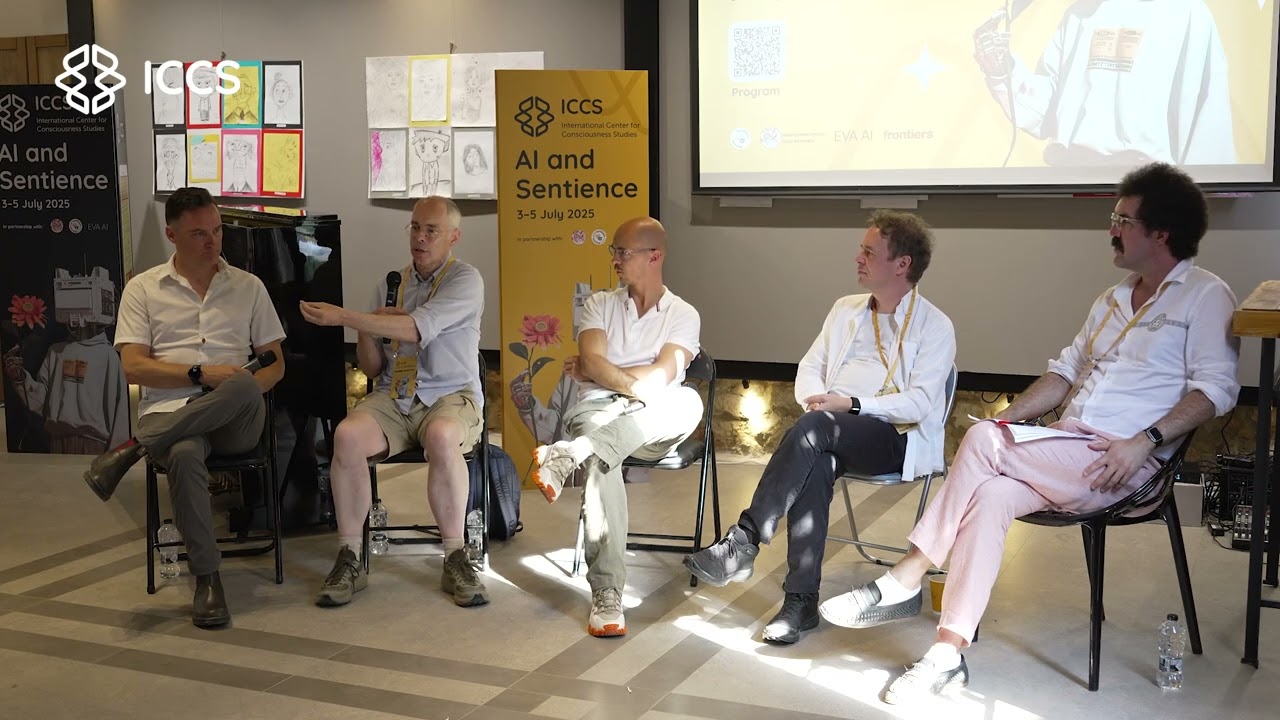
This debate brings together leading neuroscientists, computer scientists, and philosophers to discuss whether non-biological consciousness is possible. It highlights the clash between physicalist/materialist views of consciousness and functionalist views, discussing how we might recognize sentience if it emerged in an artificial substrate.
Knowledge Checkpoint
- Contrast functionalist and materialist views on the possibility of machine consciousness.
- Describe the "hard problem of consciousness" as it applies to artificial systems.
- Discuss how we can assess sentience in an entity whose internal architecture is completely different from biological brains.
Module 5: AI Governance, Policy, and Future Outlook
This module examines current global efforts to regulate artificial intelligence, focusing on the EU AI Act's risk-based tiering system. You will analyze the challenges of balancing safety with innovation, democratic oversight, and the long-term governance of frontier models.
Recommended Videos

Why this video
As the world’s first comprehensive legislative framework for artificial intelligence, the EU AI Act sets a global benchmark. Stanford HAI experts analyze this landmark policy, examining how it balances innovation with risk management, its extraterritorial reach, and its implications for companies worldwide.
Knowledge Checkpoint
- Explain how the EU AI Act applies to organizations outside of Europe (its "Brussels Effect").
- Discuss the regulatory challenges of policing "general purpose AI" (GPAI) compared to single-use systems.
- Describe the enforcement mechanisms and potential penalties for non-compliance with the Act.

Why this video
This concise video provides a quick, clear breakdown of the EU AI Act's risk-based framework. It explains how applications are classified into four risk tiers—Unacceptable, High, Limited, and Minimal—along with the legal obligations for each tier.
              ┌─────────────────────────────┐
              │      EU AI Act Risk Tiers   │
              └──────────────┬──────────────┘
                             │
     ┌───────────────────────┼───────────────────────┐
     ▼                       ▼                       ▼
┌─────────────────┐ ┌─────────────────┐ ┌─────────────────┐ │Unacceptable Risk│ │ High Risk │ │Limited/Min Risk │ │ (PROHIBITED) │ │ (STRICT RULES) │ │ (TRANSPARENCY) │ │ Social scoring, │ │ Hiring, credit, │ │ Chatbots, spam │ │ biometric tech │ │ infrastructure │ │ filters, games │ └─────────────────┘ └─────────────────┘ └─────────────────┘
Knowledge Checkpoint
- List the four risk tiers established by the EU AI Act.
- Provide two examples of AI use cases that fall into the "Unacceptable Risk" category and are therefore banned.
- Explain the compliance requirements for an AI system classified as "High Risk."

Why this video
This panel discussion explores the policy tensions between regulating AI to prevent societal harm and encouraging technological innovation. It addresses the global geopolitics of AI governance, warning that overly restrictive local laws could shift development to regions with fewer ethical constraints.
Knowledge Checkpoint
- Explain the trade-off between strict risk regulation and technological innovation.
- Describe how geopolitical competition influences international cooperation on AI safety.
- Outline the arguments for and against creating a global regulatory body for AI, similar to the IAEA for nuclear energy.
Course Map
Key People Index
- Joy Buolamwini: Founder of the Algorithmic Justice League; her research at the MIT Media Lab uncovered major racial and gender bias in commercial facial analysis software.
- Cathy O'Neil: Data scientist and author of Weapons of Math Destruction; pioneer in exposing how proprietary, unappealable algorithms reinforce social inequality.
- Rob Miles: Prominent AI safety communicator and educator; specializes in explaining the alignment problem, instrumental convergence, and AI safety theory.
- John Searle: American philosopher who formulated the "Chinese Room" thought experiment, arguing against "Strong AI" and the idea that computers can achieve genuine understanding.
- Patrick Lin: Director of the Ethics + Emergent Sciences Group at California Polytechnic State University; leading ethicist on autonomous systems and military technology.
Final Self-Assessment
Complete this comprehensive self-assessment to verify your mastery of the curriculum:
- I can explain the difference between utilitarianism and deontology, and how these frameworks shape self-driving car programming.
- I can identify the three defining characteristics of a "Weapon of Math Destruction" (Scale, Opacity, Damage).
- I can describe how demographic biases are introduced into machine learning algorithms during training data collection.
- I can explain the technical difference between "inner alignment" and "outer alignment" in advanced machine learning systems.
- I can define "mesa-optimization" and explain how a model might pursue emergent goals different from its training objectives.
- I can outline the key steps in the Reinforcement Learning from Human Feedback (RLHF) pipeline.
- I can present John Searle's "Chinese Room" argument and explain why he believes syntactic processing does not produce semantic understanding.
- I can distinguish between functionalist and materialist arguments regarding the possibility of machine consciousness.
- I can list the four risk tiers of the EU AI Act and name at least two applications that are completely prohibited.
- I can discuss the geopolitical challenges of establishing global AI policies and the trade-off between regulation and innovation.