

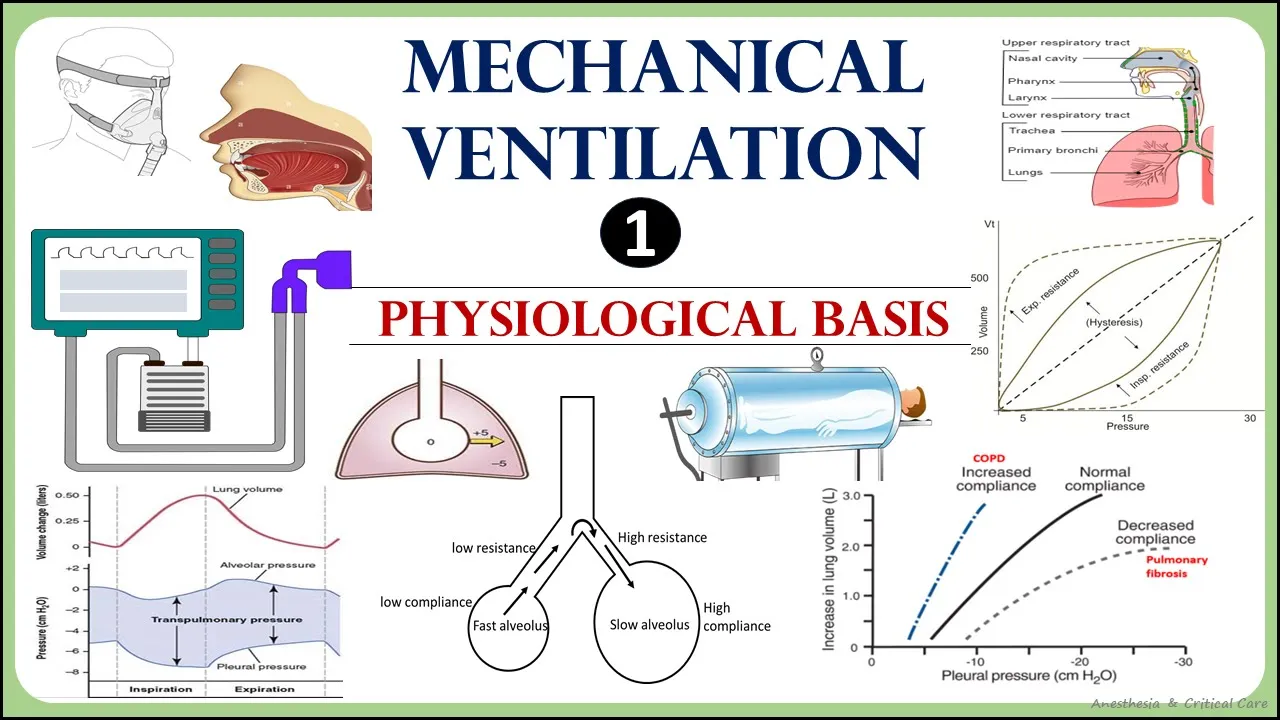




















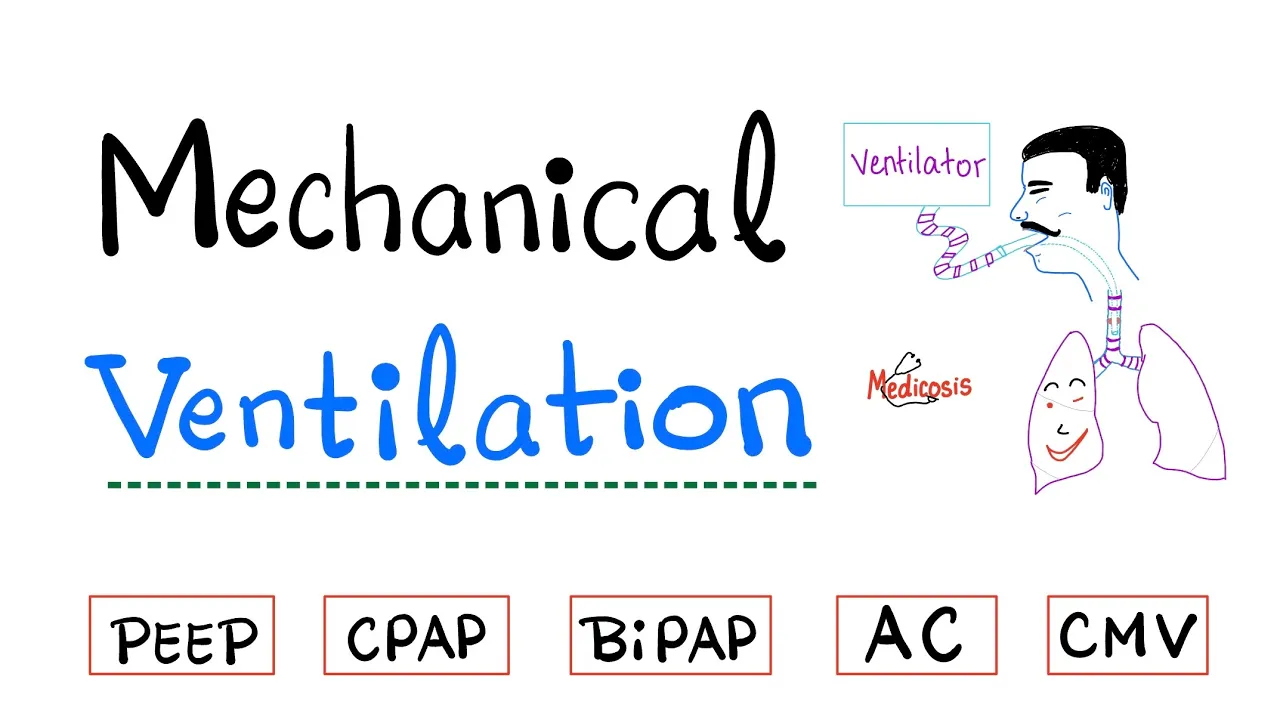



Mechanical ventilator modes are defined by three key variables: the trigger (how the ventilator initiates breaths—time, pressure, or flow), the control variable (what aspect of inspiration is controlled—pressure or flow), and the cycling variable (what signals terminate inspiration—volume, flow, or time). The four most commonly used ICU ventilator modes are Assist Control (provides guaranteed minimum ventilation with full support for all breaths), Synchronized Intermittent Mandatory Ventilation (SIMV) which combines mandatory breaths with partially supported spontaneous breaths, Pressure Control Ventilation (provides consistent pressure delivery but cannot guarantee tidal volume), and Pressure Support Ventilation (requires patient-triggered breaths and offers the most comfort for conscious patients). Each mode has distinct advantages, disadvantages, and indications based on patient condition and clinical goals.
Ventilator Modes Explained: AC, SIMV, PCV, PSV | ICU Lecture
Added:[Music] hello this is Eric strong again and this is the seventh lecture in this series on mechanical ventilation the topic uh today is ventilator modes if you've watched the first six lectures you may have started wondering when I was ever going to get around to discuss how actually to program the ventilator well this is the point where I will begin to make the transition from the physiology background to the practical application the learning objectives of this lecture are as follows uh first to understand the three variables which Define a v ventilator mode next to be familiar with the most commonly used ventilator modes that is assist control simv pressure control and pressure support ventilation finally to know how to choose modes for a specific situation and be aware of the advantages and disadvantages of each before I go any further I want to point out two things uh first the topics of ventilator modes and ventilator options are each difficult to understand without first learning about the other uh therefore you may not fully appreciate this lecture until after seeing the next one um and may even benefit from watching it again afterwards um second as problematic and inconsistent as terminology is within the general subject of mechanical ventilation I I find personally that there's no specific Topic in which this is more of an issue than with ventilator modes uh people will often use different terms to refer to the exact same form of ventilation and sometimes even use the same term to refer to different forms of ventilation this is a partially a consequence of different brands of ventilators coining fancy sounding names for a basic vent mode which could be known by a different name when by a different brand of vent the most common place this becomes a difficulty is when Physicians and respiratory therapists uh disagree with a terminology about what mode a particular patient is on uh usually a physician bases their language on what they've read in the textbook about ventilators in the general sense while the RT bases the language on the specific ventilator being used now whenever there seems to be a disagreement I advised just discussing the specifics of the form of ventilation being delivered and usually you'll discover that you are both describing the same thing patterns of ventilation also known as ventilator modes can be partially defined based on the following three variables the trigger variable the control variable and the cycling variable I will discuss each one at a time the trigger variable defines how the ventilator determines when to initiate a machine driven breath for patients with no spontaneous respirations the passage of a specific duration of time is a trigger for a breath for patients with spontaneous respirations this variable may be set to either pressure triggered or flow triggered such that the ventilator delivers a breath when either a threshold negative pressure or a threshold degree of flow is detected both pressure triggered and flow triggered ventilation are equally effective and there is rarely an advantage to switching from one to the other uh with the exception of patients with COPD who may do better with a flow trigger uh triggering options used less frequently include volume uh chest wall electrical impedance and motion the control variable defines what aspect of inspiration is the primary variable controlled by the venator uh during inspiration uh the most common options include pressure controlled and flow controlled in pressure controlled ventilation the pressure delivered to the airway is constant regardless of aay resistance or compliance therefore if pressure is preset and constant changing resistance or compliance results in changing title volumes in flow controlled ventilation the flow is controlled as a function of the preset title volume and the additional designation of flow pattern a flow pattern also known as flow Contour will be discussed later in this lecture as well as in lecture eight um if flow is predetermined changes in resistance or compliance result in changes in area pressures it should be noted that most clinicians and even many textbooks refer to flow controlled volume cycled ventilation such as most forms of assist control and SV as quote volume controlled although this seems like a logical description as the clinician is directly specifying and thus controlling the title volume to be delivered the ventilator is actually controlling the flow rate um some people would therefore state that usage of the term volume control is technically erroneous While others would brush off this criticism as inconsequential semantics the cycling variable now defines what signals the ventilator to terminate inspiration for example with volume cycled ventilation the ventilator will cease inspiration after a preset volume has been delivered with flow cycled ventilation the ventilator will cease inspiration after air flow drops below a preset threshold uh typically approximately 25% Peak flow ventilators can also be time cycled or pressure cycled the cycling variable has some overlap with the control variable and as kind of mentioned already the two are frequently um used interchangeably although some would say this is uh incorrect usage of the terms so here is a summary of common options for the three mode variables uh a mode can either be time triggered flow triggered or pressure triggered uh it could be flow controlled or pressure controlled and it could be flow cycled volume cycled or time cycled typical settings for these variables are listed to the right to add to the confusion of ventilator modes you should also be familiar with the terms volume targeted and pressure targeted volume targeted ventilation describes any mode in which the clinician is able to ensure the patient receives a specific tital volume pressure Target ventilation describes any mode in which the clinician is able to ensure the patient's inspiratory pressure does not exceed a maximum pre-specified value remember from lecture two that lung compliance is equal to the change in volume over the change in pressure therefore by setting either volume or pressure lung compliance will dictate the value of the remaining parameter for example in volume targeted ventilation High compliance of the lung will result in low AA pressures and low lung compliance will result in high airway pressure while in pressure targeted ventilation High lung compliance will result in high lung volume while low lung compliance result in low lung volume ventilator modes also distinguish between three different types of breaths mandatory breaths are triggered by the ventilator and receive full level of support the number of mandatory breaths per minute is dictated by the respiratory rate set by the clinician assisted breaths are triggered by the patient and may receive either full support or only partial support finally spontaneous breaths are those which the patient takes which do not trigger any response from the ventilator and therefore receive no support most modes allow fully supported assisted breaths to count as mandatory breaths in order to improve patient Comfort uh prevent patient ventilator D synchrony and prevent hyperventilation there are four basic common ventilator modes used in the ICU which I will talk about in this lecture they are assist control synchronized intermittent mandatory ventilation more commonly known as simv a pressure controlled ventilation and pressure support ventilation a fifth common mode is control mandatory ventilation or CMV however as this mode usually requires deep sedation and paralysis it is uh rarely done outside of the O and I won't be talking about it more at this time as I mentioned at the beginning of this lecture there is a severe lack of consistency with mode terminology therefore what I am referring to as pressure controlled ventilation may be called something different by other clinicians also in the common usage he terms assist control and SV imply volume targeted ventilation however pressure targeted assist control and SV also exist though they are much more rarely used to best understand the differences between these four ventilator modes I will first provide a brief description of the mode as well as its possible options for the trigger control and cycling variables I will then dis display graphs of air flow AA pressure and volume as functions of time here each hash mark along the horizontal axis will represent 1 second a peep for all examples will be set at 5 cm of water uh lastly I will list the advantages disadvantages and indications for each mode the first mode I will discuss is assist control this mode has a mix of mandatory and fully supported assisted breaths all breaths once triggered are treated the same and have a consistent title volume the trigger for assist control may be either time pressure or flow the control variable is technically flow though as mentioned before many people will refer to this as volume control and the cycling variable is typically time here is the typical appearance of flow pressure and volume graphs for the assist control mode in assist control the ventilator senses an inspiratory effort by the patient and responds to each by delivering a preset title volume the patient is able to vary respiratory rate but a backup rate is set to prevent hypo ventilation such that if a certain period of time passes without the patient initiating a breath the ventilator will give one in this particular example in the pressure tracing you can see the small downward deflections just before the first third and fourth breaths these are the result of the patient trying to take a breath on his own uh this small but relatively negative pressure pressure triggers the ventilator to deliver a fully supported breath the second breath has no such proceeding downward deflection but the ventilator has given a breath anyway because the maximum allowable time without a breath has elapsed in this case you can see that just over 4 seconds elapses between the moment when the first breath is pressure triggered by the patient and the moment when the second breath is time triggered by the ventilator uh thus you can infer that the backup rate for this patient is about 14 breaths per minute also you can see that the clinician has preset the title volume to be about 600 milliliters the ventilator then calculates the necessary flow rate to provide that tital volume in the amount of time designated for each breath advantages of assist control are that it guarantees a minimum minute ventilation and requires low work of breathing on the part of the patient disadvantages are that it can lead to respiratory alcal osis an auto Peep and hypotension in hyperventilating patients now this is because every patient triggered breath receives a full level of support therefore if the rate is set to 14 and the patient suddenly begins to breathe at a rate of 28 the patient's minute ventilation will literally double leading to a drop in arterial pco2 and significantly increased airay pressures indications for assist control are critically ill patients requiring full vent support and in whom fluctuations in title volume are undesirable assist control is overall the most commonly used vent mode in the world let's now talk about simv although SV can be used without pressure support it is very rarely done so the following will assume that pressure support is being used SB is a mix of mandatory breaths some of which are synchronized with spontaneous breaths and assisted breaths the mandatory non-synchronized breaths are time triggered flow controlled and time cycled while the assisted breaths which are synchronized with the mandatory breaths are pressure or flow triggered flow controlled and time cycled lastly the nonsynchronized assistant breaths are pressure or flow triggered pressure controlled and flow cycled these non-synchronized assistant breaths are only partially supported breaths in this example of simv the first and fourth inflations are synchronized pressure triggered fully supported breaths tial volume has been set for approximately 600 milliliters the second third and fifth inflations are spontaneous nonsynchronized breaths assisted by pressure support in this particular particular case pressure support has been set for 10 cm of water which is the difference between the maximum inspiratory pressure on the partially supported breaths and a peep one advantage of simv is that like assist control it guarantees a minimum minute ventilation however unlike assist control it generally leads to lower mean airr pressure and can provide a wide range of respiratory support depending upon the set respiratory rate a major disadvantage of sinb is that it requires more work of breathing on part of the patient um I've also heard multiple clinicians and textbooks claim that SV can reduce cardiac output in patients with LV dysfunction um however I am unaware of both the original source of this claim and the mechanism by which this would occur uh so therefore I I can't vouch for its accuracy the indication for simb is a critically ill patient who requires a relatively high level of vent supports but who are hyperventilating or otherwise prone to Auto peep or high Airway resistance the major difference between assist control and SV is that in assist control spontaneous breaths in excess of the set respiratory rate receive full support while in SV excess spontaneous breaths receive partial support therefore in a patient with no spontaneous breaths for example a patient who is deep sedated and paralyzed assist control and SB are identical the next mode to discuss is pressure control ventilation this mode has only mandatory breaths in its more common formulation and the patient is unable to trigger the ventilator it is time triggered pressure controlled and time cycled here are the flow pressure and volume tracings the inspiratory pressure is set at 25 cm of water the flow starts high with each inspiration then rapidly declines this is known as a decelerating flow contour and with pressure control ventilation it is simply a consequence of lung mechanics there are many advantages to pressure control ventilation it helps prevent excessive Airway pressures avoids Regional alveolar overd distension which can lead to lung injury and worsened VQ mismatch and may lead to earlier Liberation for mechanical ventilation unfortunately it is very uncomfortable and requires uh deep sedation plus minus paralysis it is also unable to guarantee a minimum minute ventilation the major indication for pressure control ventilation is a particularly high risk of barot trauma the final mode I will discuss in any detail is pressure support ventilation in pressure support ventilation there are no mandatory thus every breath must be triggered by the patient by pressure or flow it is pressure controlled and flow cycled in this example the pressure support is set at approximately 15 cm of water remember remember that the pressure support will be equal to the maximum inspiratory pressure minus the peep which in all these examples has been set at five also notice in the flow tracing how inspiration is terminated by removal of the precious port once the flow drops to 25% its maximum the major advantage of pressure support ventilation is that it is probably the most comfortable mode for the awake conscious patient there are many disadvantages including the patient must trigger each breath a minimum minute ventilation cannot be guaranteed it is associated with poor quality sleep than other modes and is generally incapable of providing full ventilator support it's indications are conscious patience and as a stepping stone immediately prior to exavation here is just one more relationship between vent modes which may help you to understand them a little bit better so pressure support ventilation with peep uh Bap or BiPAP as it may um discussed in the last lecture and simv with Peep and with respiratory rate set to zero are all equivalent they will provide the exact same form of ventilatory support to a patient recent advances in technology have given rise to an entirely new class of ventilator modes known as dual control modes dual control modes use instantaneous feedback to control aspects of long volume and airway pressure simultaneously remember that traditional modes uh Target only volume or pressure but not both and allow lung compliance to fully dictate the other parameter examples of dual control modes include pressure regulated volume control this mode is a form of pressure control ventilation in which the pressure limit is continuously adjusted in small increments to maintain a tital volume as close as possible to the desired volume some ventilators have a setting known as autoflow which is very similar to prvc there's also volume support this is a form of pressure support ventilation when the amount of pressure pressure support is adjusted up or down with each breath in order to maintain a minimum minute ventilation and minimum title volume there's volume assured pressure support this is a form of pressure support ventilation where the ventilator will provide additional air flow near the end of an individual inspiration if it predicts that the title volume from that inspiration will otherwise fall below a preset minimum allowed volume dual control modes are somewhat more complicated to use uh and understand than the other modes we've discussed in more detail and are best left to clinicians and respiratory therapists with significant ventilator experience I hope you found this lecture on vent modes to be both interesting and useful please continue to lecture eight on ventilator options which will further round out your understanding of how ventilators work and how they can be programmed to treat patients with a variety of clinical disorders [Music]
Up Next
Mechanical Ventilation Explained: Settings & Modes
@Medcram
2.6M views•2014-12-06

Graphic Medicine: Comics for Collaborative Healthcare Communication
@nationalpatientadvocate
189 views•2023-12-04
Liver Function Tests (LFTs) Interpretation Guide for Medical Students
@StrongMed
386.9K views•2014-10-08
Stages of Labor and Vaginal Birth | Childbirth Animation
@nucleusmedicalmedia
52.1M views•2017-08-18
Related Study Plans & Knowledge Roadmaps
Structured learning paths in Medicine