A microtone is any musical interval or pitch difference distinctly smaller than a semitone, found in various musical traditions including ancient Greek music, Arab and West Asian traditions, and different temperament systems where enharmonically equivalent notes like D sharp and E flat may have actual pitch differences.
What Is a Microtone? Musical Intervals Explained
Added:Deep Dive
Understanding of the standard 12-Tone Equal Temperament (12-TET) tuning system used in Western music.

Angine de Poitrine: ¿PAYASOS O GENIOS? 🤨
86.9K
The 12-tone equal temperament system is the standard musical system used in Western music, where an octave is divided into exactly 12 equally spaced notes. Starting from a reference note (such as C), the notes progress as C, C#, D, D#, E, F, F#, G, G#, A, A#, and B, before returning to C at the octave. This system allows for consistent tuning across all keys and is the foundation of most Western music, including guitar tuning.
Click to watch →
TET for Tat: Why Do We Use 12 Notes?
105.7K
The 12-note equal temperament system (12TET) is widely used in modern Western music because it provides excellent approximations of the most important harmonic intervals (octave, perfect fifth, perfect fourth, and major third) while maintaining practicality with a manageable number of notes per octave; although other TET systems like 19TET, 31TET, or 53TET may offer superior approximations for specific intervals, 12TET strikes the optimal balance between accuracy, playability, and historical tradition.
Click to watch →
10 things Van Halen can teach us about food and cooking
312.2K
12-tone equal temperament is the standard Western tuning system that divides the octave into 12 equally spaced notes. This system allows you to play anything in any key and have it all sound equally in tune. However, the interval of a major third sounds noticeably sharp in 12-tone equal temperament because it doesn't get the mathematically perfect whole number ratios of just or pure intonation. This problem is particularly noticeable on overdriven rock guitar because distortion emphasizes a phenomenon called acoustical beating - a nasty sound that happens between two notes that are not perfectly justly tuned.
Click to watch →
Visualize The Guitar Fretboard - HIDDEN Fretboard Geometry (Learning The Fretboard On Guitar)
70.3K
Pythagoras further divided the octave into twelve distinct intervals, creating the 12-tone equal temperament system used in modern Western music. These twelve notes are: A, A#, B, C, C#, D, D#, E, F, F#, G, G#, and then back to A. This system allows musicians to play in any key without retuning their instruments.
Click to watch →

Çifteli: This microtonal instrument changed the way I think about music
1.3M
The 12-tone equal temperament scale is the tuning system that forms the foundation of most Western music. It divides one octave into exactly twelve equal steps, with each step being equally spaced in terms of frequency ratio. This system is used by standard guitars and piano keyboards. However, some traditional instruments like the chipi may use different tuning systems that include notes not found on the piano keyboard, or notes that would fall between the keys if they existed.
Click to watch →
Deep Dive
Basic knowledge of musical intervals, specifically the definition of a semitone (half-step) and a whole tone.
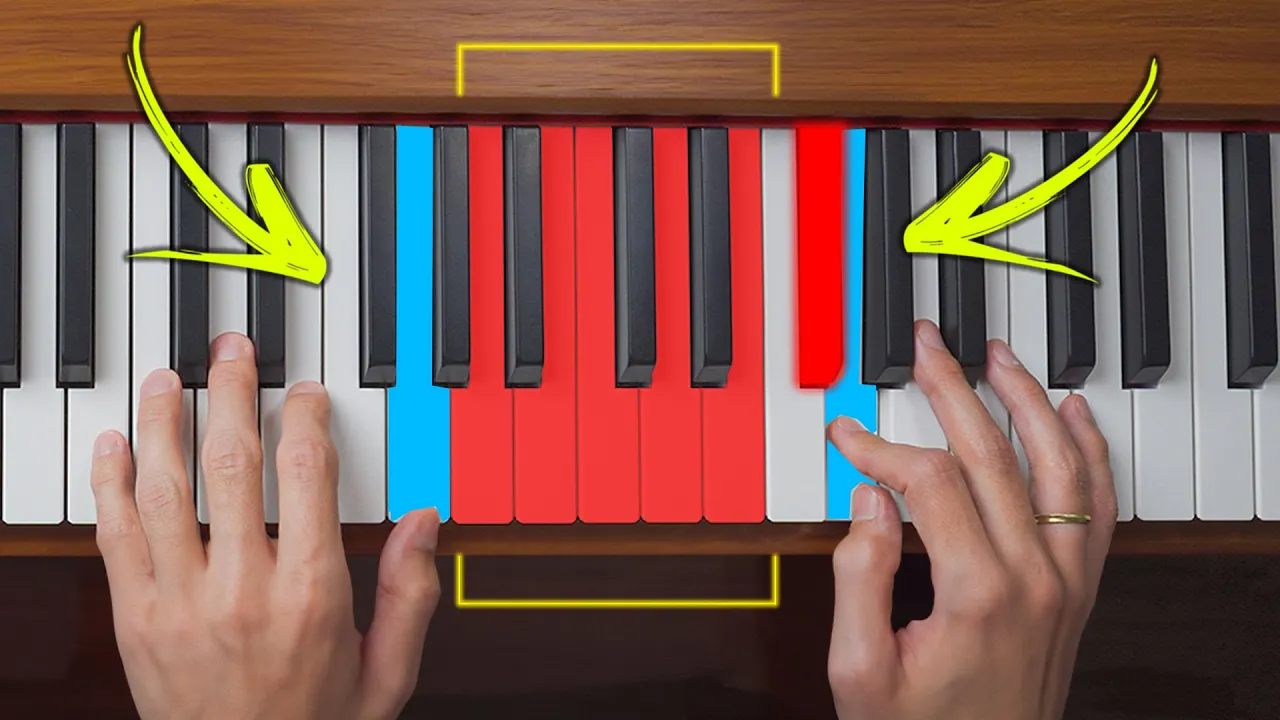
Diferença entre escala "Maior" e "menor"
42.1K
A semitone is the smallest distance between two musical notes, occurring when there is no key between them on a piano (like from C to C#). A whole tone (or 'tom') consists of two semitones combined, meaning there is one key between the two notes. The instructor explains this using the analogy of people standing close together (semitone) versus having space between them (whole tone).
Click to watch →

Music Theory 101 (Simple - No Music Teacher Jargon!)
35.4K
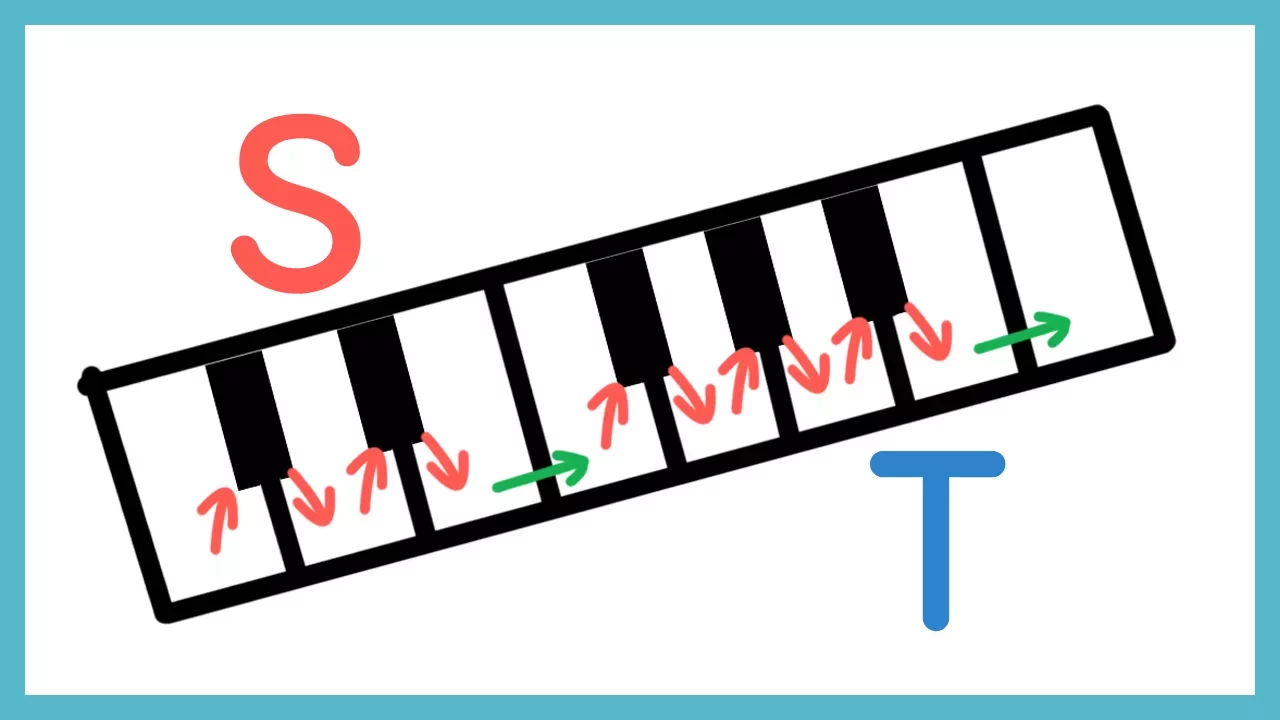
A semitone (also called a half step) is the distance between one note and the very next note. Moving from A to A sharp is one semitone. A whole step (or tone) is moving two notes apart, such as from F to G. These interval measurements are consistent across all notes on the piano, whether they are white or black keys.
Click to watch →
What are Semitones and Tones?
112.9K
In music theory, a semitone (half tone or half step) is the smallest interval between adjacent notes on a piano keyboard, such as from G to G#, while a tone (whole tone or whole step) spans two semitones, like from C to D; natural semitones occur between E-F and B-C where no sharp or flat is needed, and tones typically occur between notes of the same color (white to white or black to black), creating the familiar pattern of tone-tone-semitone throughout an octave.
Click to watch →

TEORIA MUZYKI od podstaw dla Każdego! - Lekcja 1 - Nazwy dźwięków
68K
A semitone (half tone) is the smallest interval between adjacent keys on a piano keyboard. A whole tone (whole step) consists of two semitones. The distance between any note and its octave is exactly 12 semitones. This 12-semitone structure is the foundation of Western equal temperament tuning, where all instruments are tuned to the same standard.
Click to watch →

Basic Music Theory Lesson 4 - Semitones, Whole Tones and Accidentals
4.1K
A semitone (half step) is the shortest distance between two notes, moving from one key to the next adjacent key on the piano (e.g., C to C-sharp, E to F). A whole tone equals two semitones, formed by skipping one key (e.g., C to D, D to E). These intervals apply universally across all instruments. Understanding these foundational intervals is essential for reading music and grasping more complex harmonic relationships.
Click to watch →
Deep Dive
Fundamental physics of sound, including the relationship between pitch, frequency, and octave division.
02 01 Hearing And Viewing Simple Sound Waves
7.4K
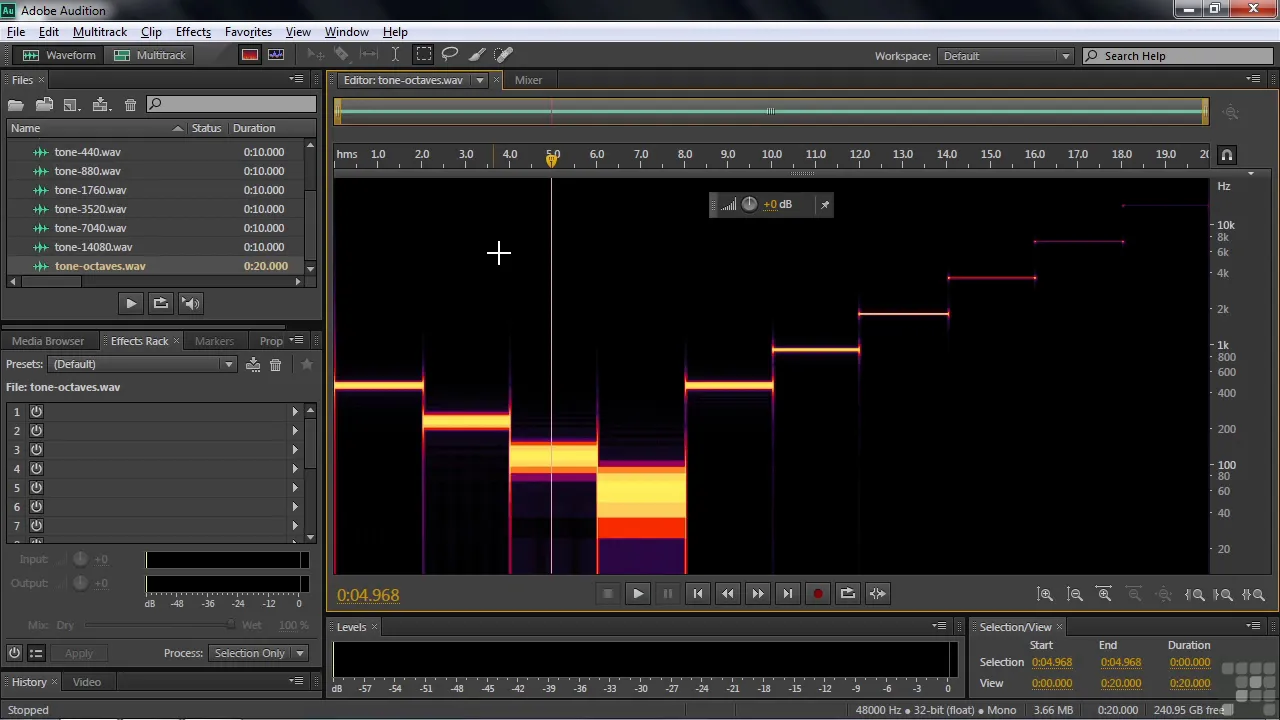
When the frequency of a sound wave is halved, the pitch drops by one octave. Starting with 440 Hz and dividing by two repeatedly produces 220 Hz (octave below), 110 Hz (another octave below), and 55 Hz (near the lowest audible frequency). Conversely, doubling the frequency moves up by octave: 440 Hz becomes 880 Hz, then 1760 Hz, and so on. This mathematical relationship between frequency division/multiplication and pitch change demonstrates the close alignment between mathematics and music theory.
Click to watch →
The science of sound waves to make electronic music - waveform math, additive synthesis, & harmonics
3.2K
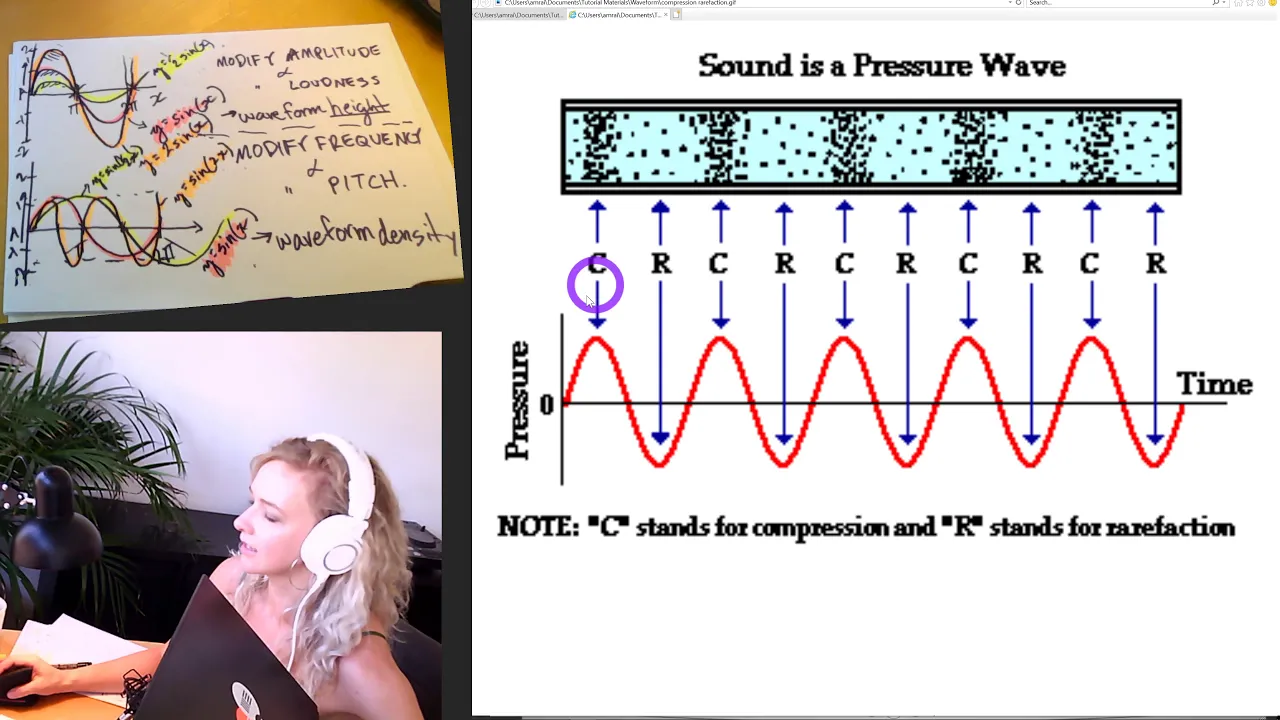
Musical pitch corresponds directly to frequency - lower frequencies produce bass notes with fewer oscillations per second, while higher frequencies produce treble notes with more oscillations. An octave represents a frequency doubling (multiplying by two), creating a pitch one octave higher. For example, 55 Hz (low A) becomes 110 Hz (A one octave up) and 220 Hz (A two octaves up). This mathematical relationship explains why octaves sound naturally harmonious and forms the basis for tuning systems and musical scales.
Click to watch →

5. Basics of Sound
18.7K
Sound travels through air as a chain reaction of molecules pushing and pulling each other, creating compression and rarefaction waves that reach the eardrum. The pitch of sound is determined by frequency—the number of vibrations per second. Higher frequency means higher pitch (flute, bird chirp), while lower frequency means lower pitch (bass guitar, diesel engine). Middle C on a piano vibrates approximately 261 times per second. When you go up one octave (12 semitones), the frequency doubles to 522 Hz; going down one octave halves the frequency to approximately 130 Hz, then 65 Hz. This doubling/halving relationship applies to all musical instruments and human singing.
Click to watch →

SOUND WAVE - What you don't Know
1K
Pitch is the position of a note on a musical scale, depending mainly on the frequency of vibration of the medium and consequently on the source. An octave note is a note with twice its fundamental frequency. For example, if the fundamental frequency is 165 Hz, the octave note is 330 Hz (obtained by multiplying the fundamental frequency by two).
Click to watch →
Sound
292
Frequency determines pitch: high frequency produces high-pitched sounds, low frequency produces low-pitched sounds. Frequency is measured in Hertz (Hz), representing vibrations per second. Middle C on a piano vibrates at 262 Hz. An octave represents a doubling or halving of frequency—the C below middle C is 131 Hz (half of 262), while the C above is 524 Hz (double). Concert pitch (A4) is standardized at 440 Hz. When vocal cords vibrate at 440 Hz, they produce middle C; at 880 Hz, they produce the octave above. Notes separated by octaves sound harmonious due to their simple frequency ratio.
Click to watch →
Deep Dive
Familiarity with standard Western music notation, including sharps, flats, and naturals.

#8 LEARN FREE MUSIC THEORY
175K
This section covers the three types of accidentals used in music notation. A sharp (♯) raises a note by one semitone, while a flat (♭) lowers it by one semitone. A natural (♮) cancels previous accidentals, returning notes to their natural state. All accidentals last for the entire measure and are cancelled at bar lines. The instructor demonstrates how to draw each accidental on staff paper, with flats resembling a 'B' shape, sharps as two crossing diagonal lines, and naturals as an 'L' followed by a '7' shape.
Click to watch →
How to Read Sheet Music in One Easy Lesson
171.1K
Accidentals modify note pitches: sharps raise notes by one semitone, flats lower them by one semitone, and naturals cancel previous accidentals. When an accidental appears at the start of a measure, it affects all subsequent notes of the same letter name throughout that measure. Special cases include B-sharp (identical to C) and E-sharp (identical to F), called enharmonic equivalents. These notes sound the same but are written differently in music theory. Understanding these relationships allows accurate note identification despite visual similarities.
Click to watch →
How To Read Accidentals (Sharps, Flats, Naturals)
303.6K
Musical accidentals (sharps, flats, and naturals) modify note pitches in sheet music: sharps (♯) raise a note by a half step, flats (♭) lower a note by a half step, and naturals (♮) cancel any sharp or flat, returning the note to its natural form; these symbols appear either in the key signature (establishing default alterations for the entire piece) or as individual accidentals within measures to override the key signature.
Click to watch →
BEGINNER THEORY | Grade 1 - PART 1 | ABRSM suitable
307.2K
Accidentals are symbols that modify the pitch of a note: sharps (♯) raise a note by one semitone (black key to the right), flats (♭) lower a note by one semitone (black key to the left), and naturals (♮) cancel any previous sharp or flat, returning to the natural note. Accidentals apply only to the specific note they precede and remain in effect for all notes of the same pitch in that bar. To change a note back to natural after a sharp, you must explicitly write a natural sign before it; the accidental does not carry over to subsequent bars automatically.
Click to watch →
Sharps and Flats | Music Theory for Beginners
82K
Sharps and flats are essential symbols in Western music notation that indicate semitone changes to notes. A sharp raises a note by one semitone (think of sitting on something sharp and jumping up), while a flat lowers a note by one semitone (like a car with a flat tire going down). These modifiers create the chromatic scale and allow for the naming of all possible pitches. The system may seem confusing at first, but it becomes logical when understanding how chords and scales are constructed in music theory.
Click to watch →
Prerequisite Knowledge
- Concept 01Understanding of the standard 12-Tone Equal Temperament (12-TET) tuning system used in Western music.
- Concept 02Basic knowledge of musical intervals, specifically the definition of a semitone (half-step) and a whole tone.
- Concept 03Fundamental physics of sound, including the relationship between pitch, frequency, and octave division.
- Concept 04Familiarity with standard Western music notation, including sharps, flats, and naturals.
Subsequent Learning
- Step 01In-depth study of the Arabic Maqam and Turkish Makam modal systems, focusing on how microtonal intervals (such as quarter-tones) are utilized in practice.
- Step 02Exploration of Just Intonation, Pythagorean tuning, and alternative temperament systems compared to Equal Temperament.
- Step 03Practical application of microtonal notation, including the use of specialized accidentals like quarter-tone flats and sharps.
- Step 04Investigation of modern and avant-garde microtonal composition, including the work of composers like Harry Partch and Ben Johnston.
- Step 05Technical implementation of microtuning in digital audio workstations (DAWs) and software synthesizers using tuning files (e.g., Scala files).
Microtones Defined
Global Usage
Microtones Defined
0:04Playing Section
- 1
Microtones are intervals smaller than a semitone.
- 2
Found in ancient Greek music and octave divisions.
- 3
Include differences from just intonation and mean tone.
Eurocentric Framing of Non-Western Tuning Systems
The very concept of a "microtone" is criticized by ethnomusicologists and non-Western music theorists for its Eurocentric bias. By defining a microtone specifically as an interval "smaller than a standard Western semitone," this terminology positions the Western 12-tone equal temperament (12-TET) system as the universal standard. In musical traditions such as Arabic, Turkish, and Indian classical music, the intervals that Westerners label as "microtones" are not subdivisions of a semitone. Instead, they are fundamental, independent scale degrees with their own historical and structural integrity. Critics argue that labeling these intervals as "microtonal" marginalizes complex, ancient tuning systems as mere deviations from a Western norm, rather than recognizing them as autonomous musical languages that developed independently.
Deep Dive
In-depth study of the Arabic Maqam and Turkish Makam modal systems, focusing on how microtonal intervals (such as quarter-tones) are utilized in practice.

El Glitch de las Escalas | Arquitectura de las Escalas - PODCAST Episodio 3.
134
The Maqam system (Arabic musical tradition) fundamentally challenges Western assumptions by introducing quarter tones (1/4 tone intervals). While Western music divides the octave into 12 semitones, Maqam uses microtonal intervals that fall between standard piano keys. This microtonality was theoretically calculated by philosopher Alfarabi in the 10th century, nearly 1000 years before Europe standardized modern piano tuning. Maqam is not simply a list of allowed notes but a modular system built from 'ajnas' (melodic atoms) - small groups of 3-5 notes with specific emotional characteristics. A complete Maqam is created by combining two 'hins' (lower and upper melodic sections), like assembling structures with Lego pieces rather than melting everything into one mold.
Click to watch →
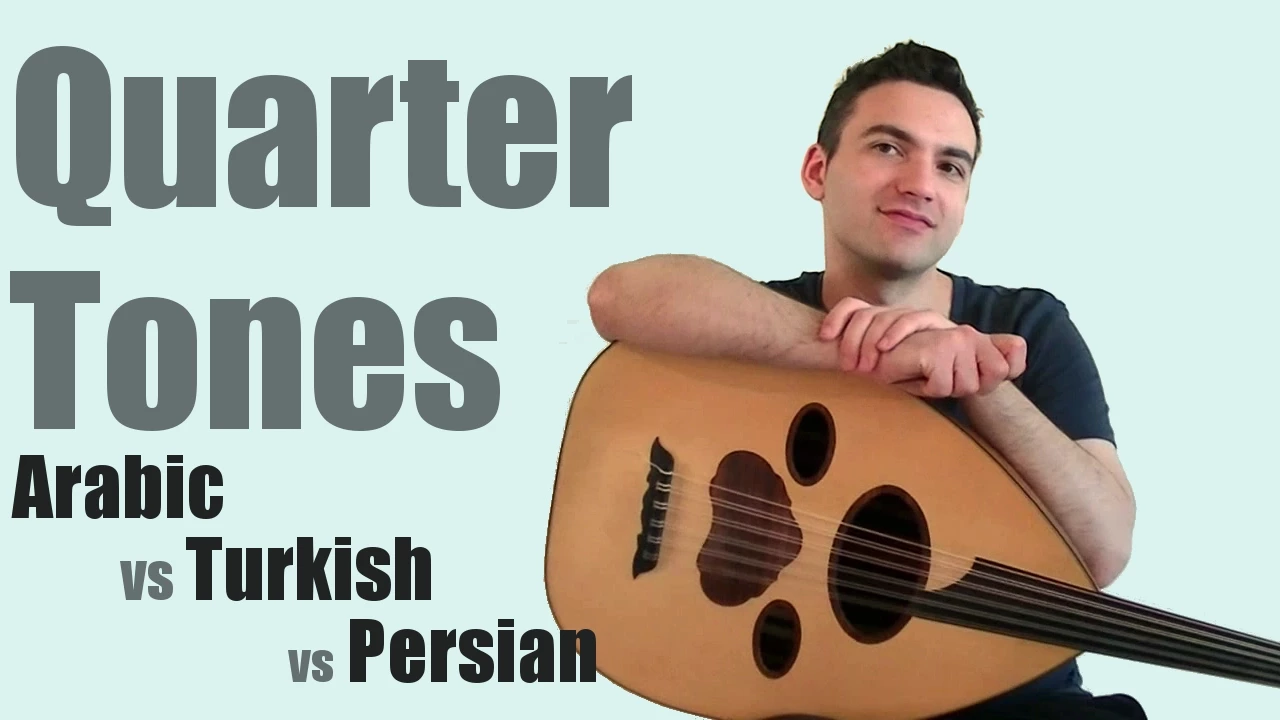
Quartertones in Persian, Arabic, and Turkish Music: A Comparative Guide
198.1K
In traditional Middle Eastern music, quartertone tunings differ between genres: Persian quartertones are generally flatter than Arabic and Turkish quartertones, while Turkish quartertones tend to be the sharpest; Arabic quartertones fall in between these two extremes, with the Abata/Makam/Maqaam scale (D-E quarter flat-F-G-A-B flat-C-D) serving as a common reference point where the quartertone appears on the second note.
Click to watch →
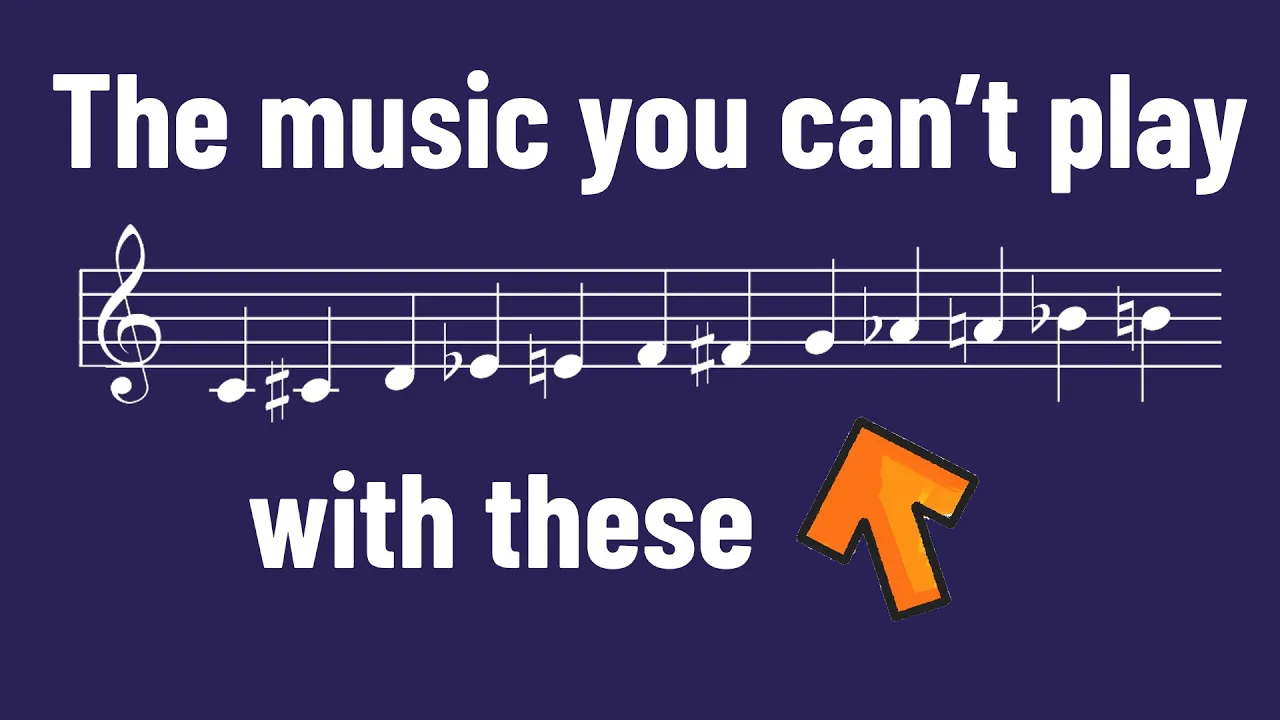
12-Tone Equal Temperament and Global Tuning Systems
109K
Arabic music is based on the maqam system, which functions like a scale but includes specific traditions for playing notes within it. The three most common maqamat are rust, seeker, and by arti. These systems include notes that are half-flats or quarter-tones (half of a semitone), which are not part of the equal-tempered scale. Research shows that Arabic musicians can distinguish up to twelve different pitches all referred to as variations of the same note (like E), demonstrating remarkable tuning precision.
Click to watch →

Ney Playing and Notation Tutorial
38.5K
In Turkish and Arabic music, the third degree of a makam is a quarter tone positioned between two whole tones from Western music theory, creating a distinctive 'quone' effect. For example, in Rust Makam, the third note falls between Me and Mi. This quarter tone is always positioned between whole tones, never at the half-tone position. When reading musical notation, musicians should focus on finger positions rather than specific note names. If a tune is written in Rust Makam, it starts on the Soul position regardless of ney size. Different ney sizes (Mansour NE, Bahen, Super) produce different pitches from the same positions. The key is understanding the position system and adapting to the instrument size.
Click to watch →

The difference between Arabic and Turkish Quartertones/Half-flats/Microtones
14K
In Arabic music, microtones like the E half flat vary by Maqam (sharper in Maqam Rast, flatter in Maqam Bayati and Sika), while Turkish music uses a more consistent intonation where the same note is played closer to E natural (about 10 cents flat) and features 'floating notes' that change pitch dynamically during ascending and descending passages.
Click to watch →
Deep Dive
Exploration of Just Intonation, Pythagorean tuning, and alternative temperament systems compared to Equal Temperament.
![Муз.Ликбез - (НЕ)-ТЕМПЕРИРОВАННЫЙ СТРОЙ [Сравнение]](https://i.ytimg.com/vi_webp/aaOZC_PnZ2c/maxresdefault.webp)
Муз.Ликбез - (НЕ)-ТЕМПЕРИРОВАННЫЙ СТРОЙ [Сравнение]
84.3K
This lesson compares three musical tuning systems: Pythagorean tuning (based on 4:3 and 3:2 ratios, creating dissonant thirds), Just Intonation (adding 5:4 and 6:5 ratios for pure thirds but limiting modulation), and Equal Temperament (dividing the octave into 12 equal semitones of 100 cents each, enabling modulation across all keys). While Equal Temperament sacrifices pure interval ratios (fifths are 700 cents vs. 702 cents in pure systems), it provides the practical advantage of consistent sound across all tonalities, making it the standard for modern instruments despite the subtle imperfections that composers like Scriabin noted.
Click to watch →
【音楽×数学】ピタゴラス音律/純正律/中全音律/平均律 計算して求める!そして聴き比べる!(誤認識もあったし概要欄も読んでね)
67.2K
Three alternative systems address Pythagorean's limitations. Just intonation (純正律) uses three rules: octave = 2:1, perfect fifth = 3:2, major third = 5:4. Major triads use ratios 4:5:6, creating pure harmonies. However, it cannot handle all keys equally. Meantone temperament (中全音律) narrows the perfect fifth by 1/4 of the syntonic comma, allowing 4 fifths to produce a pure major third. This allows 6 keys while maintaining good thirds. Equal temperament (平均律) divides the octave into 12 equal semitones (2^(1/12) per semitone), allowing any key without retuning but sacrificing interval purity. Each system represents a trade-off between harmonic purity and key flexibility.
Click to watch →

True Temperament Frets Explained By A Music Doctor
206.8K
This section explains the fundamental concepts of musical temperaments. Equal temperament uses A440 (440 Hz) as a reference to calculate all 12 notes in an octave, allowing musicians to play in any key with all chords sounding acceptable. Just intonation uses natural whole number ratios to create perfectly in-tune intervals but cannot support key modulation. Neither system is objectively right or wrong—they serve different musical purposes. Critically, achieving perfect intonation across all keys on a 12-note-per-octave fretted instrument is mathematically impossible.
Click to watch →

Just Intonation vs Equal Temperament: A Comparative Analysis
377.6K
Just intonation produces pure, resonant harmonic intervals by using natural frequency ratios, while equal temperament slightly detunes intervals to allow modulation between keys; modern technology now enables musicians to restore pure harmony that composers like Bach could only approximate, eliminating the 'rough and restless' beating heard in tempered tuning.
Click to watch →

The story of the THX Deep Note (and why it's so loud)
560.5K
Modern instruments typically use equal temperament tuning where octaves are divided into equal steps, resulting in complex frequency ratios between notes. Alternative just intonation systems keep frequency ratios simple, such as tuning a perfect fifth to an exact 3:2 ratio relative to the root note. These simpler ratios occur naturally in physical phenomena like vibrating strings, and some argue they produce purer, more harmonious sounds that resonate more naturally with human perception.
Click to watch →
Deep Dive
Practical application of microtonal notation, including the use of specialized accidentals like quarter-tone flats and sharps.
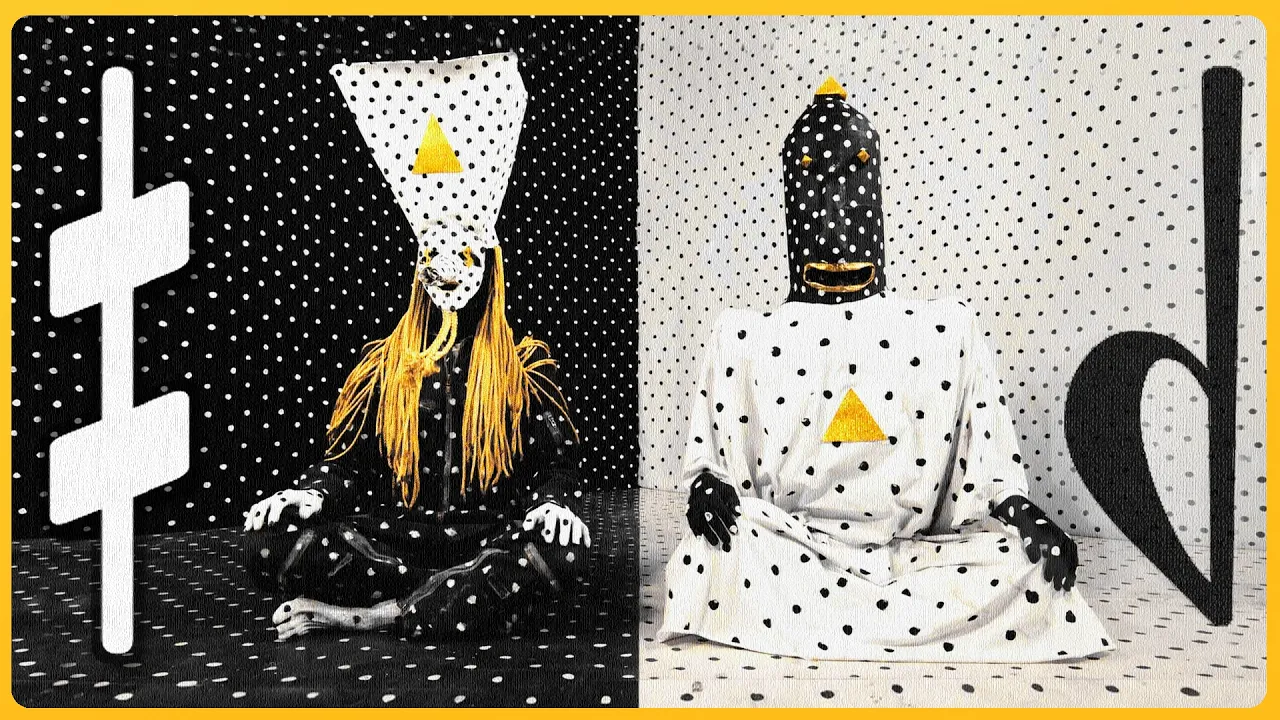
How Angine de Poitrine use Microtonality
331.1K
In 24-TET tuning, the 12 additional notes beyond the standard Western chromatic scale are called half sharps or half flats. These are indicated with special symbols. A half sharp raises a note by a quarter tone (e.g., D half sharp is a quarter tone sharper than regular D). A half flat lowers a note by a quarter tone (e.g., E half flat is a quarter tone flatter than regular E). When played in sequence, these microtonal accidentals create an ultra-chromatic scale where each adjacent note is only one quarter tone apart, such as D half sharp → E flat → E half flat → E natural.
Click to watch →

How To Notate Microtonal Music
10.4K
Microtonal music uses tuning systems with more than 12 notes per octave, requiring specialized notation systems such as the mainstream quartertone notation (using half-sharp and half-flat accidentals for 24-edo), Sagittal notation for complex tunings, and traditional Persian accidentals (K for quarter-flat, S for quarter-sharp) to accurately represent pitches between standard semitones.
Click to watch →

ARCHIVOS MUSICALES DEL PERÚ 12: La Música de la Cultura Nazca
1.6K
The video explains specialized notation systems for representing microtonal music. Natural notes (white piano keys) are shown in black, while sharp notes (black piano keys) are shown in green. Quarter tones have two different symbols: a flat symbol (B) for quarter tone below, and a sharp symbol with a line for quarter tone above. For non-musicians, blue indicates quarter tone above and red indicates quarter tone below. This notation system allows representation of the 18-20 notes used by Nazca instruments, which cannot be fully represented on a standard piano.
Click to watch →
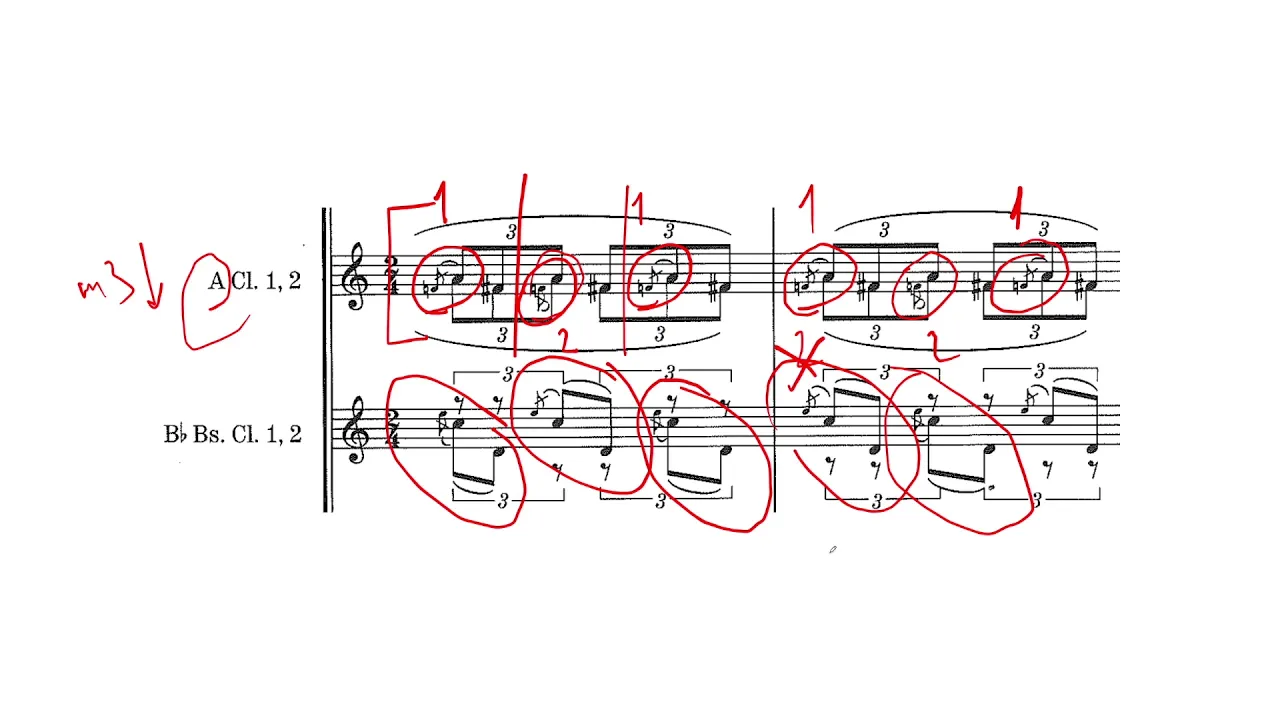
Orchestration - Lesson 8a - Scoring for Woodwinds Part II (Lecture Video)
2.1K
Microtonal notation in woodwinds uses specific symbols to indicate quarter tones. A regular flat symbol indicates one quarter tone lower, while three lines indicate three quarter tones lower. Similarly, regular sharps indicate one quarter tone higher, and three lines indicate three quarter tones higher. These symbols are standardized today. For microtonal passages, it is important to provide fingering suggestions since standard fingerings may not produce ideal results. Players can find appropriate fingerings in specialized books about special techniques for each instrument.
Click to watch →

The Secret Trio live at Paste Studio on the Road: NYC
3.6K
Microtonal music uses specialized notation symbols including backwards flats and three-quarters sharps within the standard five-line staff system. The Secret Trio explains how their compositions employ ancient microtonal modal systems combined with unusual time signatures, creating complex musical textures. They discuss translating these compositions to diverse ensembles from solo performances to symphonic orchestras, noting that contemporary classical music has developed standardized notation for microtones. However, practical challenges arise when adapting complex pieces to large ensembles within limited rehearsal time, requiring simplification and adaptation strategies.
Click to watch →
Deep Dive
Investigation of modern and avant-garde microtonal composition, including the work of composers like Harry Partch and Ben Johnston.
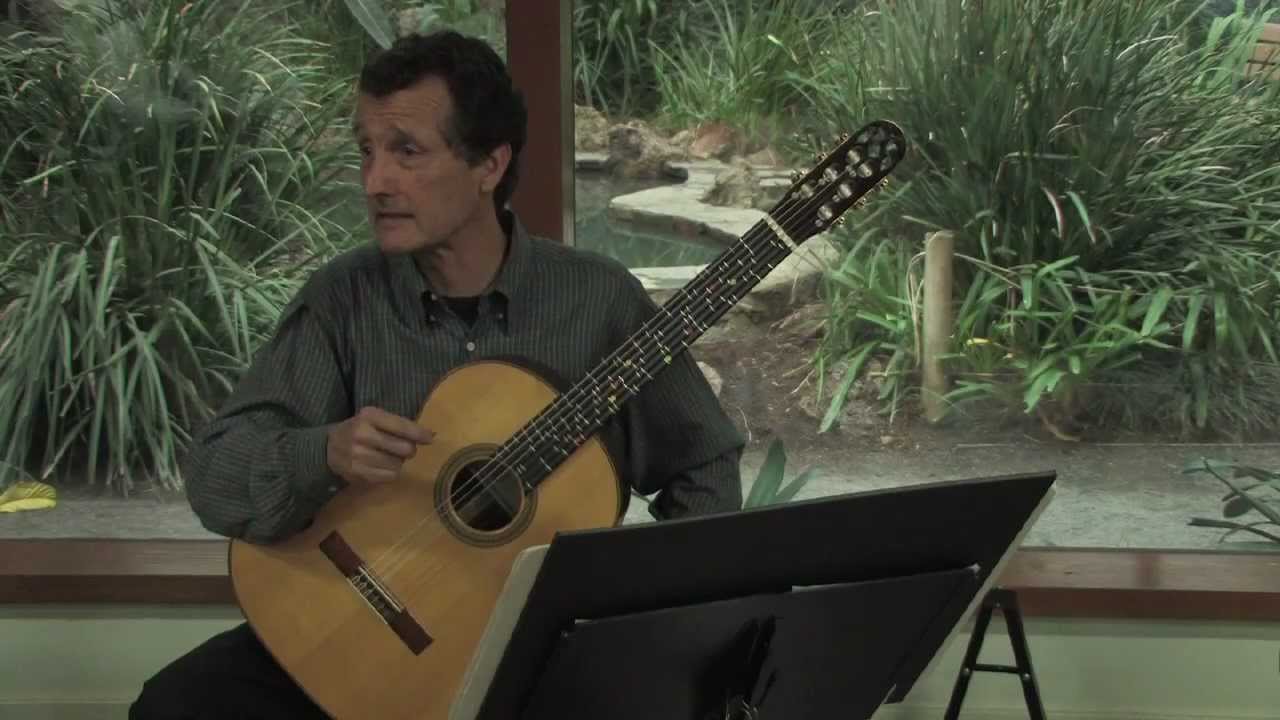
Ben Johnston / Played by John Schneider / sound. at the Kings Road Park Pavilion: Just Guitars
15.7K
Ben Johnston, a pioneering microtonal composer who studied with Harry Partch in 1949, composed this 1998 song cycle 'The Tavern' using his adapted guitar with movable frets that allows 15 notes per octave. The piece sets Rumi's Sufi poetry, which uses the metaphor of wine and taverns to represent spiritual enlightenment and the soul's journey toward divine union, exploring themes of transcendence beyond ordinary perception.
Click to watch →
Compositor profesional analiza ANGINE DE POITRINE (no es lo que parece)
105.7K
Microtonality is not a modern invention but has been used for centuries in various musical traditions. Arabic and Indian traditional music have employed microtonal intervals for centuries. In the Renaissance, composer Nicola Vicentino invented the Archicembalo, a microtonal keyboard instrument. In the 20th century, composer Harry Partch constructed entire instruments specifically for playing microtonal music. The reason modern audiences find microtonal music strange is that our ears have been conditioned by 100 years of radio, Spotify, and pop music that only uses the 12-note system.
Click to watch →

Harry Partch - US HIGHBALL
3.5K
Harry Partch's 'US Highball' is a 1946 microtonal composition that captures the experiences of railroad workers through innovative musical scales, recorded at Warren Gilson's home in Madison, Wisconsin, and pressed in a limited edition of 100 copies.
Click to watch →
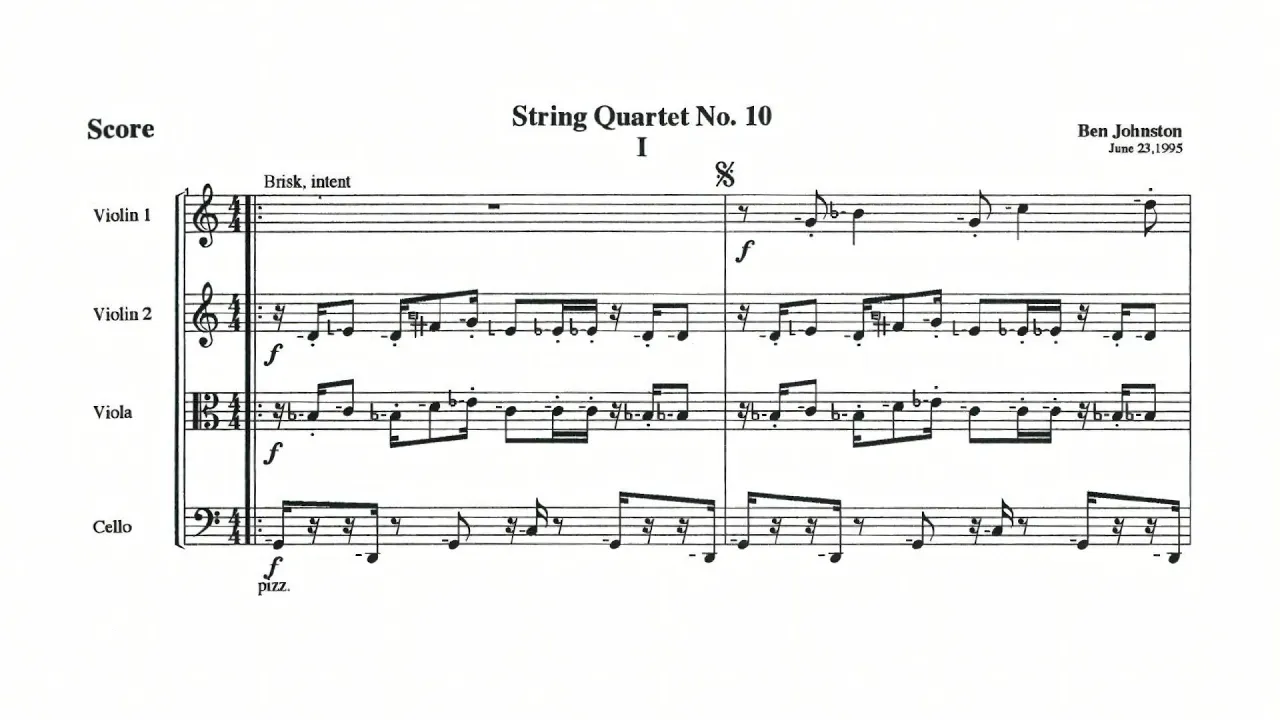
Ben Johnston – String Quartet No. 10 (1995)
13.9K
The opening movement of Ben Johnston’s String Quartet No. 10 follows a textbook sonata structure—exposition, development, recapitulation—with two themes: the first in microtonally extended G minor, the second in B-flat major, both returning in the tonic during recapitulation. Despite its classical form, the music features polyrhythms: violin 1 and cello imply 3-beat patterns out of phase with inner voices in syncopated 4. Harmony is tonal but extended microtonally, with notes “between the cracks” suggesting spectral independence. The slow movement is a fugue in 13-limit harmony centered on extended D minor. The scherzo and trio employ a complex rhythmic structure where each instrument divides the measure into 4, 5, 6, and 7 beats respectively, aligning only on downbeats, creating a Nancarrow-esque rhythmic tension. The finale functions as a “music history essay,” beginning with a Renaissance-style dance in 6/8, featuring viola col legno battuto, evoking Cowell and Harrison. A 4/4 middle section shifts harmonic language while preserving 5-limit just tuning with occasional 7-limit intervals. The movement then unexpectedly introduces “Danny Boy,” harmonized with extended 7th, 11th, and 13th partials, evoking jazz through a walking bass line. The entire finale is revealed as a set of variations on “Danny Boy,” with the opening theme being its strict inversion. The piece concludes with players sustaining open strings (D, G, C, C) while performing a glissando of harmonics, reducing music to pure tone and revealing its spectral structure—symbolizing the end of musical history and the emergence of acoustic essence.
Click to watch →

Partch performs Castor & Pollux by Harry Partch
42.4K
Harry Partch's 'Castor & Pollux' (1952) demonstrates his unique approach to microtonal composition by using three separate instrumental groups (each with identical measure patterns but different rhythms) that combine simultaneously in the final 'Delivery' section, creating a single unified composition from multiple independent parts—a technique he called 'triple exposure' where three different compositions become one through simultaneous performance.
Click to watch →
Deep Dive
Technical implementation of microtuning in digital audio workstations (DAWs) and software synthesizers using tuning files (e.g., Scala files).
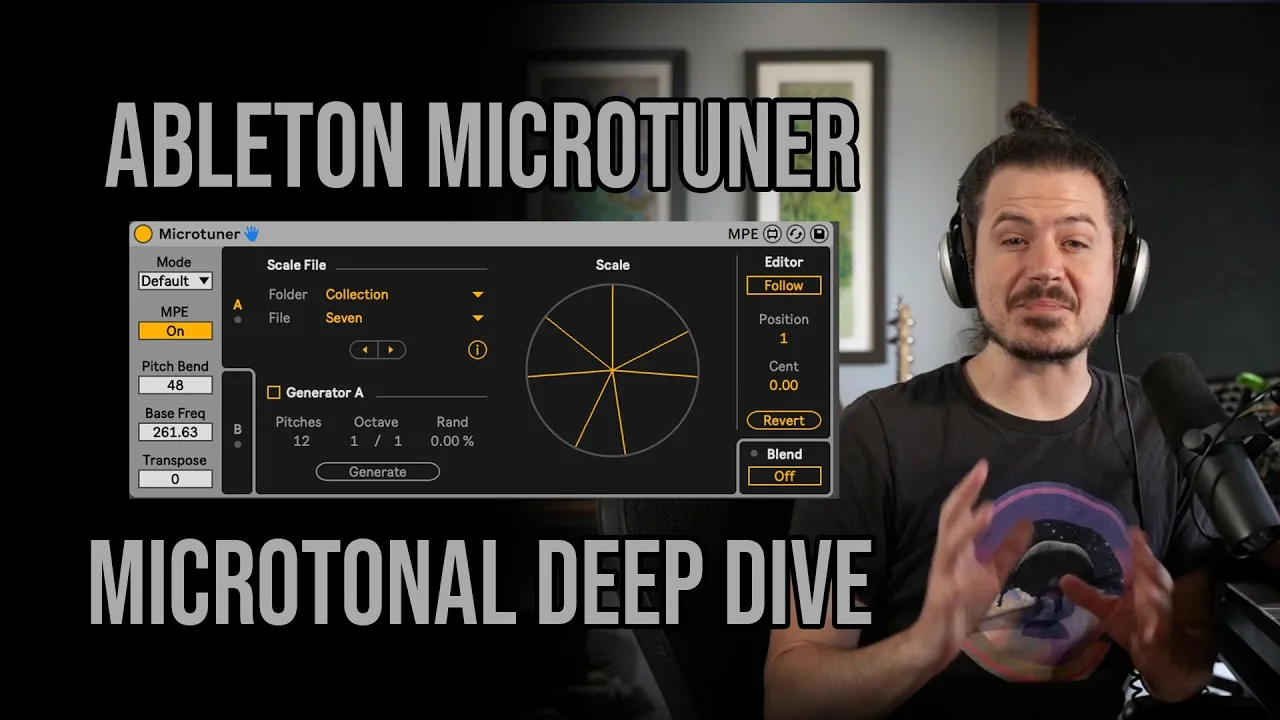
Master Microtonal Music with the M4L Microtuner | Ableton Live Guide
44.6K
Microtuner provides access to 5,000 Scala tuning files containing traditional and experimental scales from around the world. These files can be dragged directly into microtuner and tested across your entire set when multiple instances are connected. Experimenting with these tunings reveals unique sonic possibilities—some create tape wow and flutter effects by shifting individual notes at different rates rather than applying uniform pitch changes. This demonstrates how microtuning enables subtle yet transformative sound design that would be impossible with conventional tuning approaches.
Click to watch →
Çifteli: This microtonal instrument changed the way I think about music
1.3M
Modern digital audio software typically uses the 12-tone equal temperament scale by default. To accurately reproduce the sounds of microtonal instruments like the chipi, software must support custom tuning systems. This requires implementing microtuning features that allow users to load scale files (such as those in Scala format) and apply them to sampled instruments. Once implemented, users can drag scale files onto the sampler window to make notes play according to the specified microtonal system rather than the standard chromatic scale.
Click to watch →
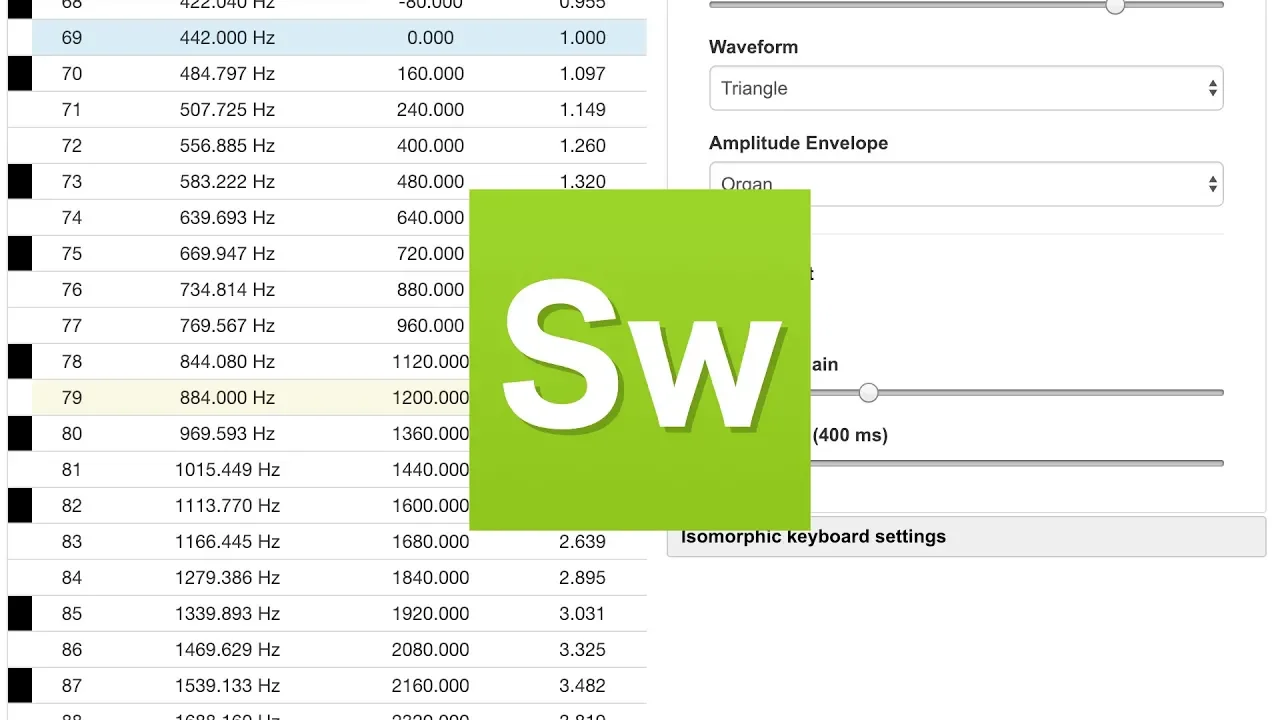
Making microtonal scales with Scale Workshop
12.9K
Scale Workshop enables users to implement custom microtonal tunings across major digital audio workstations and synthesizers. The application supports exporting to multiple formats including Anna Mark Tune files for Omnisphere, Native Instruments, and Serum; Scala files for Arturia synths and GPO 4; Carla files for open-source synths like ZynAddSubFX and Absynth; Max/MSP text files for Max/MSP and Pure Data environments; and Kontakt scripts for Native Instruments Kontakt instruments. This comprehensive compatibility allows musicians to experiment with microtonal tunings across their entire software synthesizer collection.
Click to watch →
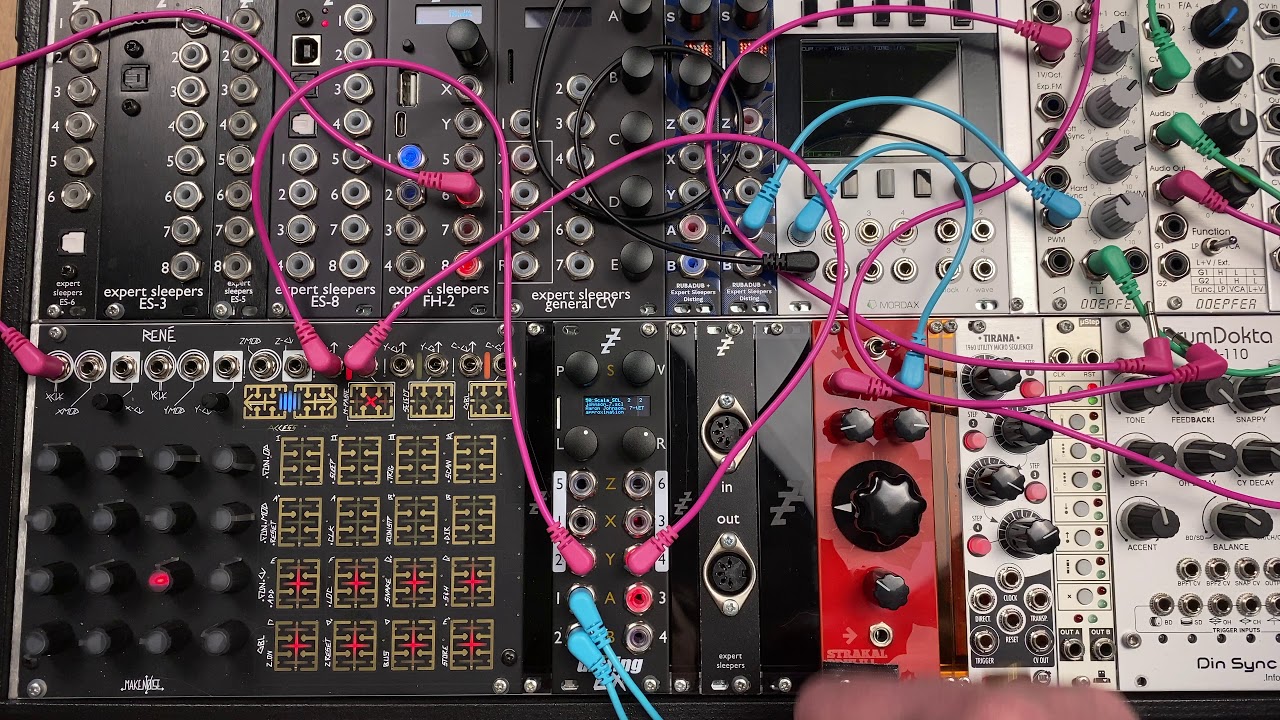
disting EX - Scala & microtuning
2.1K
The Destiny X synthesizer's SD multisample mode supports microtonal tunings using Scala files, which are placed on the microSD card in designated folders (SEL for scales, KVM for keyboard maps). Users can select from default scales like equal temperament or the R & Johnson 710 seven-tone scale, and must match the keyboard map to the scale to avoid mismatch warnings. Custom Scala files can be generated online and exported to enable microtonal tuning on the sample player.
Click to watch →
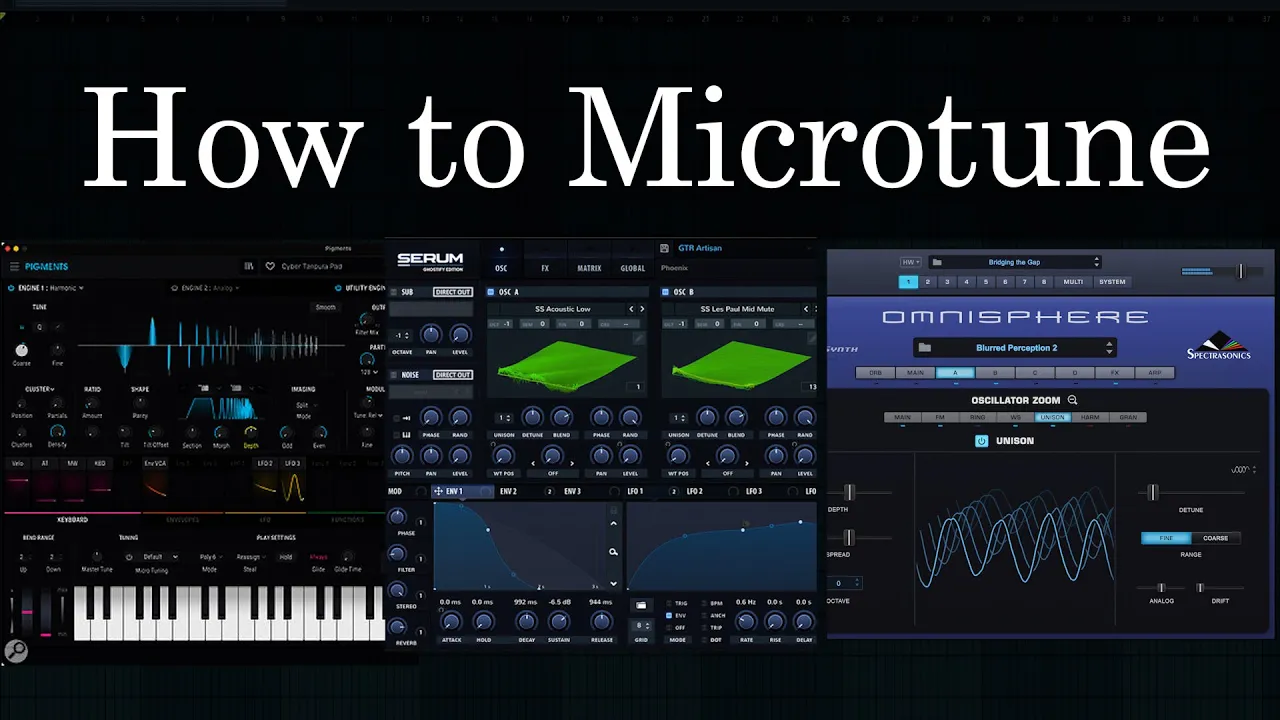
How to Microtune Easily
15.1K
The video provides a tutorial on microtuning various digital audio software used by music producers and composers. It begins with an introduction to Scaleworkshop, a web-based tool available at plainsound.org, likely used for creating or exploring microtonal scales. The video then guides viewers through applying microtuning in specific plugins: Pigments, Serum, Omnisphere, Kontakt, Pianoteq, LoungeLizard, and Harmor. Each section is timestamped, indicating step-by-step demonstrations for each software. The video explicitly references tuning files, suggesting users load custom tuning data (e.g., .tun or .scf files) into these plugins to alter pitch relationships beyond standard 12-TET tuning. The tutorial covers practical implementation rather than theoretical foundations, focusing on workflow within popular synthesizers and samplers. The video concludes with general tips for microtuning, likely addressing common pitfalls or best practices. The content is structured for users seeking to implement microtonal music in their productions using industry-standard tools. No theoretical background on microtonality or scale theory is provided. The focus remains strictly on software-specific procedures.
Click to watch →
Microtones Defined
Global Usage
Microtones Defined
0:04- 1
Microtones are intervals smaller than a semitone.
- 2
Found in ancient Greek music and octave divisions.
- 3
Include differences from just intonation and mean tone.
Eurocentric Framing of Non-Western Tuning Systems
The very concept of a "microtone" is criticized by ethnomusicologists and non-Western music theorists for its Eurocentric bias. By defining a microtone specifically as an interval "smaller than a standard Western semitone," this terminology positions the Western 12-tone equal temperament (12-TET) system as the universal standard. In musical traditions such as Arabic, Turkish, and Indian classical music, the intervals that Westerners label as "microtones" are not subdivisions of a semitone. Instead, they are fundamental, independent scale degrees with their own historical and structural integrity. Critics argue that labeling these intervals as "microtonal" marginalizes complex, ancient tuning systems as mere deviations from a Western norm, rather than recognizing them as autonomous musical languages that developed independently.
Understanding of the standard 12-Tone Equal Temperament (12-TET) tuning system used in Western music.
Basic knowledge of musical intervals, specifically the definition of a semitone (half-step) and a whole tone.
Fundamental physics of sound, including the relationship between pitch, frequency, and octave division.
Familiarity with standard Western music notation, including sharps, flats, and naturals.
In-depth study of the Arabic Maqam and Turkish Makam modal systems, focusing on how microtonal intervals (such as quarter-tones) are utilized in practice.
Exploration of Just Intonation, Pythagorean tuning, and alternative temperament systems compared to Equal Temperament.
Practical application of microtonal notation, including the use of specialized accidentals like quarter-tone flats and sharps.
Investigation of modern and avant-garde microtonal composition, including the work of composers like Harry Partch and Ben Johnston.
Technical implementation of microtuning in digital audio workstations (DAWs) and software synthesizers using tuning files (e.g., Scala files).
142.2K views2Klikes2:35@microtonalguitarOriginal Release: 2017-06-17
microtone is any musical interval or difference of pitch distinctly smaller than a [Music] semitone the microtones encountered in music theory include the tiny inharmonic melodic intervals of some of the music of ancient [Music] Greece they include some of the steps in various divisions of the octave into more than 12 [Music] parts and they include various discrepancies among the intervals of just intonation [Music] or between a sharp and its enharmonically paired flat in various forms of mean tone temperament the sharp and the flat say D sharp and E flat will not be the same there will be a microtonal difference between them an actual difference in [Music] Pitch Sur kinds of microtones are referred to in Arab Music Theory West Asian musical traditions of the present in Turkey in Arabic countries in Iran show a great abundance in microtonal inflections so it's an interesting subject to investigate n [Music] [Music]
Up Next
5:19
Quartertones in Persian, Arabic, and Turkish Music: A Comparative Guide
@OudforGuitarists
198.1K views•2015-05-16

10:20
Mozart's Musical Dice Game Explained: History, Rules, & Fun
@webpianoacademy
5K views•2023-03-13

47:36
Understanding Diatonic 7th Chords in Major Keys | Music Theory Tutorial
@GracieTerzian
54.7K views•2022-03-02
10:49
Understanding John Coltrane's Giant Steps: A Music Theory Analysis
@Vox
10.4M views•2018-11-12
Related Study Plans & Knowledge Roadmaps
Structured learning paths in Music Theory
music-theory
Composing Galant Music: Partimento & Schemata
01Foundations of Figured Bass and Keyboard Harmony
02The Rule of the Octave (Regola dell'Ottava)
03Galant Schemata: The Building Blocks of Form
+ 2 more learning modules
30h5 modules
Explore Roadmap
music-theory
Decoding Overtone Series: Tuning & Drone Music
01Acoustic Foundations: The Physics of the Overtone Series
02Tuning Systems: Equal Temperament vs. Just Intonation
03Microtonality and Spectralism: Beyond Standard Pitches
+ 2 more learning modules
24h5 modules
Explore Roadmap
music-theory
Impressionist Harmony: Scales, Planing & RPGs
01Foundational Music Theory: Keys, Intervals, and Seventh Chords
02Impressionist Color: Chord Planing and Parallel Harmony
03Whimsical Textures: Pentatonic Cascades and Whole-Tone Scales
+ 1 more learning modules
14h4 modules
Explore Roadmap
music-theory
Negative Harmony: Axis Reflection in Indie Pop
01Music Theory Foundations: Scales, Intervals, and Triads
02Functional Harmony and the Circle of Fifths
03Demystifying the Negative Harmony Axis Reflection
+ 2 more learning modules
16h5 modules
Explore Roadmap