






















Panpsychism is the philosophical theory that consciousness is irreducible and exists fundamentally at the foundations of reality, with three main forms: micropanpsychism (consciousness in fundamental particles), cosmopsychism (consciousness in the whole universe), and panprotoconsciousness (particles have protoconsciousness properties that produce consciousness when arranged in certain ways); Russellian monism provides the philosophical framework by noting that physics describes what matter does but not what it is intrinsically, leaving room for consciousness to fill this explanatory gap, and while pansychism is considered the most probable explanation for how consciousness fits into our scientific worldview, cosmopsychism may be motivated by quantum mechanics' holistic nature and the apparent goal-directedness of cosmological fine-tuning.
Panpsychism: What is the Argument For and Against?
Added:I have been intrigued by pansychism. U on the one side there's the arguments but the other side is okay if I give you the arguments then I I want to see what what are the options for describing different kinds of pansychism. I've seen terms that I've I've heard we have um micro pansychism and a pan proto psychism. We have cosmos psychism. We have rustellin modism. All of these are sort of ways of describing. Some of them may be synonymous, some of them may be contradictory. You got to help me.
>> When people talk about pansychism, they tend to talk about conscious particles.
And I think that's the view we're thinking of when we use the term microcsychism.
But actually, many physicists these days, many theoretical physicists don't tend to think that that our universe is made up of little billyard ball particles. They're often more inclined to think that the fundamental building blocks of our universe are fields.
>> Now fields fill the whole universe.
>> So if you combine that view with pansychism, we quickly get to the view known as cosmos psychism where the where the thing that has the fundamental consciousness is not little particles but the whole universe. So that would be the cosmosychist option. Pan protocsychism I think of a view that's not quite pansychism but is closely related to pansychism.
So for pan protocsychists particles have some property that's not consciousness.
For pan protocsychists particles are not conscious but are rather protoconcious.
The idea is here they have some property which is not quite consciousness but which is somehow intrinsically suited to bring about consciousness when arranged in in in in certain ways. So pan protocsychism this is a view I mean I take very seriously. I I think there's some some non-negligible chance it's correct.
My worry with it though is it seems to me to add mystery where none is needed.
Right? Because we we have no real positive understanding of what protoconciousness is supposed to be.
Right? Okay. We can we can describe it indirectly in terms of what it does. It produces consciousness.
>> But okay, but what is it? What is what is it in itself independently of what it does? And I think here we have no good positive grip on that.
So yes, it could be true. But it seems to me we can get everything we need by just postulating more of a property we already know exists and we have quite a good understanding of namely conscious experience.
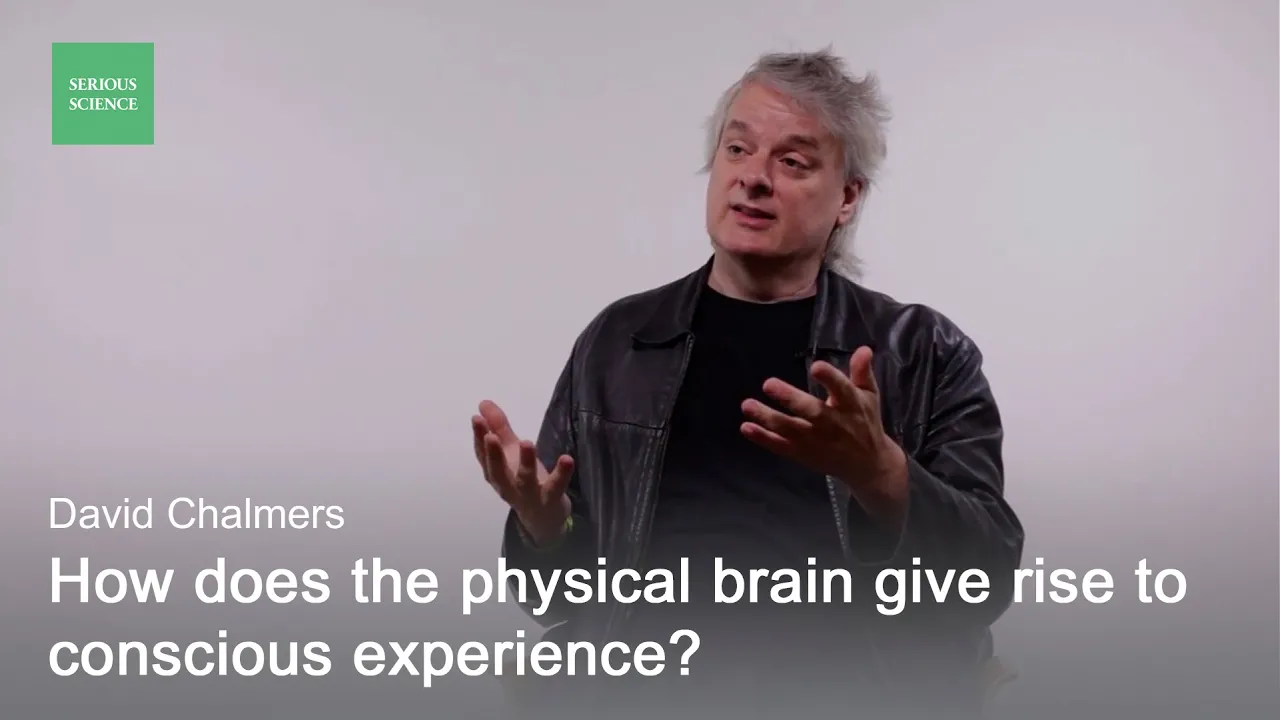
>> How about Russell and Monis? How does that articulate with these? that came before in different ways. But >> so I would say most contemporary forms of pansychism at least in anglophone analytic philosophy fall under the banner of Russelian monism. So this is a term we got from David Charas to describe an approach that's inspired by some very important work of Bertrren Russell in the 1920s.
And Russell's great insight here was that physics is just really telling us what stuff does. It's not really telling us. Physics isn't really interested in what an electron is intrinsically. It's just interested in what an electron does. That's why physics is so useful for building incredible technology. If you know in great detail how the natural world behaves, you can make incredible technology. But but in that sense there's a huge gap in our scientific story of the universe. Physics tells us rich information about what an electron does but not what it is. So this is where pansychists find a place for consciousness in that gap in our standard scientific story of the universe. But there are other options.
The pan protocsychists put protoconsciousness in instead of consciousness. Let's go to cosmosism and really understand how that works. Um because that sounds an order of magnitude more complex than even uh micro micro psychism because you now have to have the whole universe somehow as a conscious subject. I don't know how to properly phrase it but something like that.
>> It's important to emphasize we're not saying the universe is God. This is not at least not necessarily pantheism.
Okay? I mean, the universe is obviously going to have a very complicated experience because it's physically an incredibly complicated thing and its experience is going to reflect that great complexity.
But cosmos psychists needn't think the universe is a kind of intelligent agent.
We don't need to think it's self-conscious or has complex abstract thinking or anything like this. And in general, you know, pansychists will tend not to think that fundamental consciousness is akin to the kind of consciousness human beings have. Human beings have consciousness that's the result of millions of years of evolution by natural selection.
>> But consciousness comes in all shapes and sizes, right? The consciousness of a sheep is a bit simpler than the consciousness of a human being. The consciousness of a snail is simpler still. And as we move to simpler and simpler forms of life, we find simpler and simpler forms of conscious experience.
>> Right? But on that scale, if you have the universe as a conscious an agent or subject of consciousness or conscious agent, it would sound like that should be more complex.
>> It's going to be more complex. That's definitely right. But it's not necessarily going to have the kinds of conscious experience you get from millions of years of evolution. It's not going to have conscious understanding, intelligence, rational agency. Right? So in a way, pansychism is a very capernac view in the sense that we don't base our understanding of consciousness on human consciousness. We're not the center of the consciousness universe. We are just a highly evolved form of what exists throughout the whole universe.
>> Those are all those all sound nice. But what even gets me started towards cosmos psychism? In other words, why is that superior to microcychism? If if I'm forced to live in the pansy universe, it has to be some kind of pansychism. What might motivates and and motivates you towards a cosmos psychism? Well, I take all sorts of views seriously, but you're right. I have defended cosmos psychism in a couple of versions. I mean, there are there are a number of different tractions. One might just be the physics that many theoretical physicists don't think our universe is made up of little particles. It's made up.
>> That's for sure. That's for sure.
>> Yeah, that's one possibility. But yeah, but when you have a quantum field, it it attenuates. I mean the theoretically the mathematics you you can theoretically have a possibility that it can be fill the whole universe but in reality it's you know the square of the of the probability probability the square of the amplitude and it's it's very localized.
>> Yeah. Yeah. Look so there's always there's two things right? What physics is giving us is this mathematical structure that doesn't doesn't necessarily lead to pansychism.
But one thing we do seem to get out of quantum mechanics because of the phenomenon of entanglement is holism. We seem to have a very holistic picture.
Now that doesn't lead you to cosmosychism.
But if for independent philosophical reasons you're leading in a pansychist direction then you might be attracted to a a form of pansychism which is much more holistic and that's really what cosmos psychism >> okay so the motivation is you you you get to pansychism first you have to be there first and then look at how it it it it could be structured and then you feel more motivated towards cosmos psychism. Yeah, that's that's one way you could get to cosmos psychism. I've also explored whether a form of cosmos psychicism might help us with cosmological finetuning. This surprising discovery that certain numbers in physics are against incredible odds just right >> for the for the possibility of life. Now some people postulate a designer outside of the universe to explain this. But if we've already got a conscious universe, maybe we can explain the apparent goal- directedness of fine-tuning in terms of the goal directedness of the conscious universe. So your strong arguments are for pansychism per se, but once you're there, there are these uh um pressures or or tendencies towards cosmos they bringing in from other areas, but with less confidence necessarily than the whole pansychism project.
>> Absolutely. I would say pansychism is to my mind the most probable explanation of how consciousness fits into our scientific story of the universe.
Definitely not certain, but to my mind the most probable option. But I think we need to take seriously many different forms of the view.
Up Next
Panpsychism and the Combination Problem: A Philosophical Analysis
@RobinsonsPodcastClips
402 views•2024-04-27

John of Damascus on Holy Images: A Theological Defense
@BannedBooks
139 views•2026-04-25
Free Will: Science, Philosophy, and Theology Explored
@CloserToTruthTV
1.8M views•2016-11-04
The Myth of Sisyphus: A Greek Legend of Eternal Punishment
@TEDEd
8.6M views•2018-11-13
Related Study Plans & Knowledge Roadmaps
Structured learning paths in Philosophy