



![Lógica de primeira ordem [9] - Quantificadores (2/2)](https://i.ytimg.com/vi/LICgEY7cVtM/hqdefault.jpg)










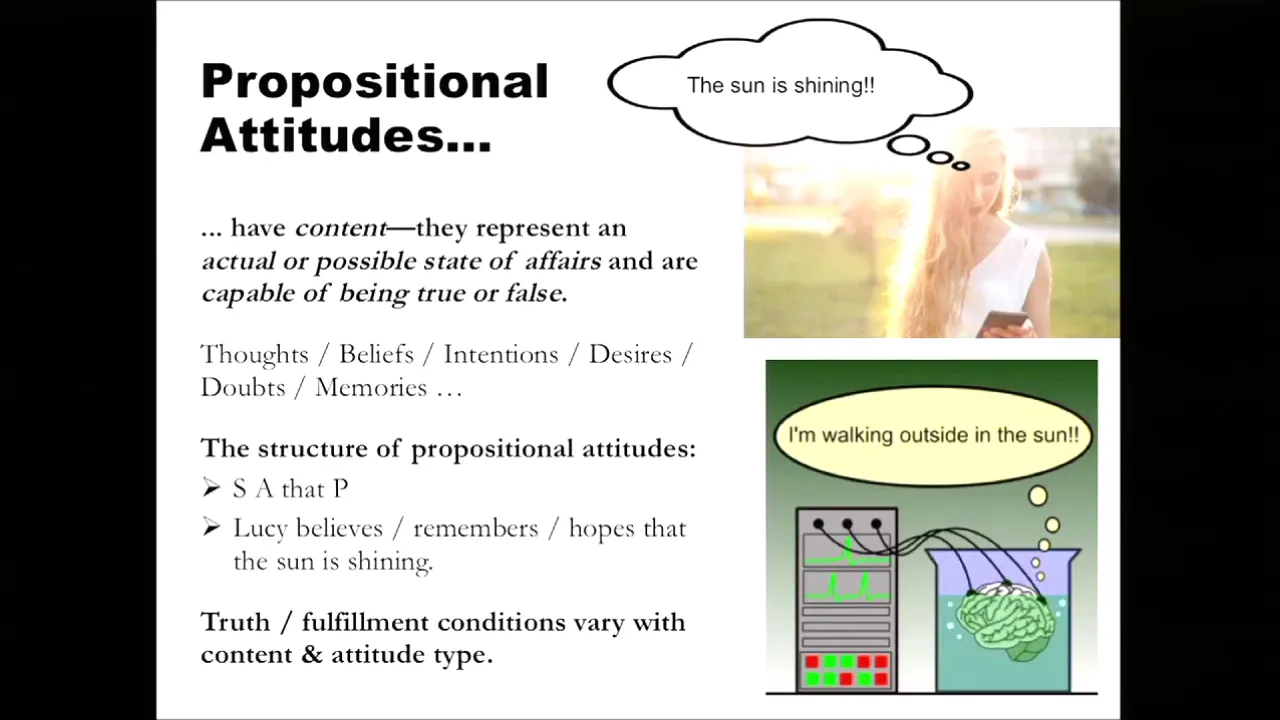



Frege revolutionized philosophy of language by arguing that meaning consists of 'senses' (Sinn) rather than mental images, and that sentences have a two-level structure where proper names refer to objects while predicates refer to concepts (incomplete functions). He discovered that in intentional contexts (like 'the sheriff believes that'), words lose their ordinary reference and instead refer to their senses, which explains why substitutivity of identicals fails in such contexts. This theory distinguishes between extensional contexts (where substitutivity holds) and intentional contexts (where it fails), and Frege proposed that only in the context of a whole sentence do words have reference, as reference is a speech act.
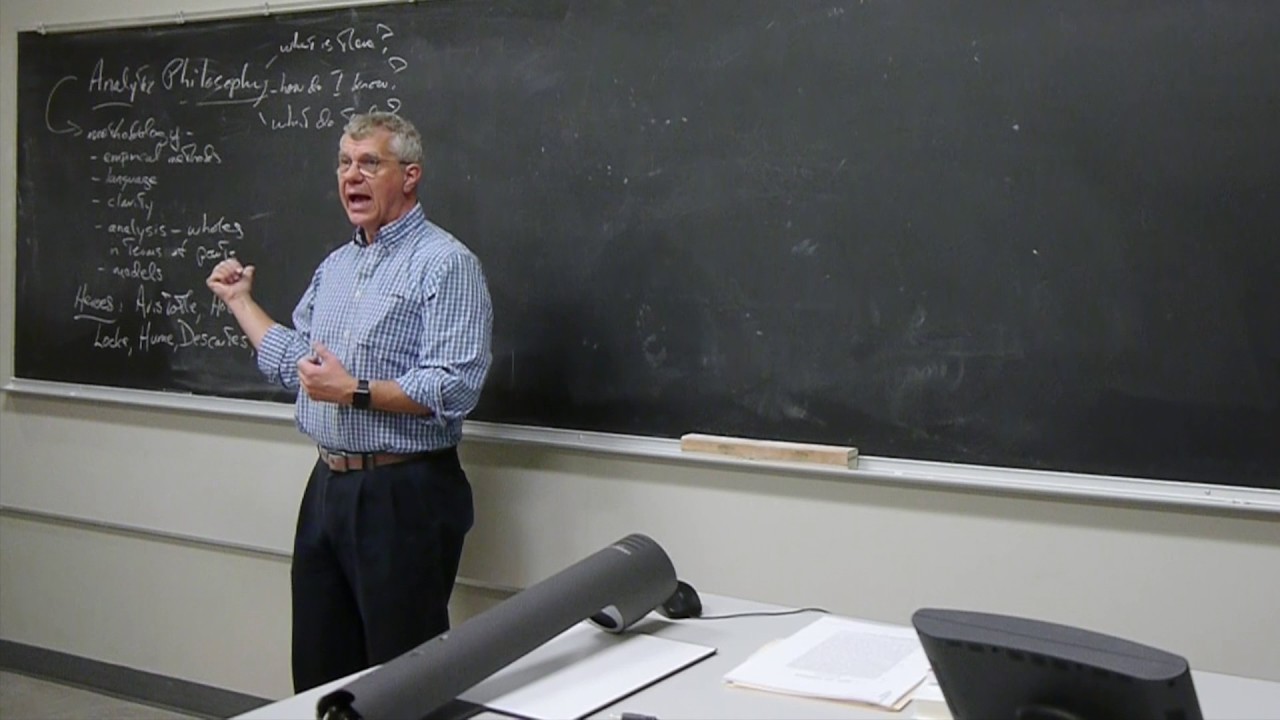
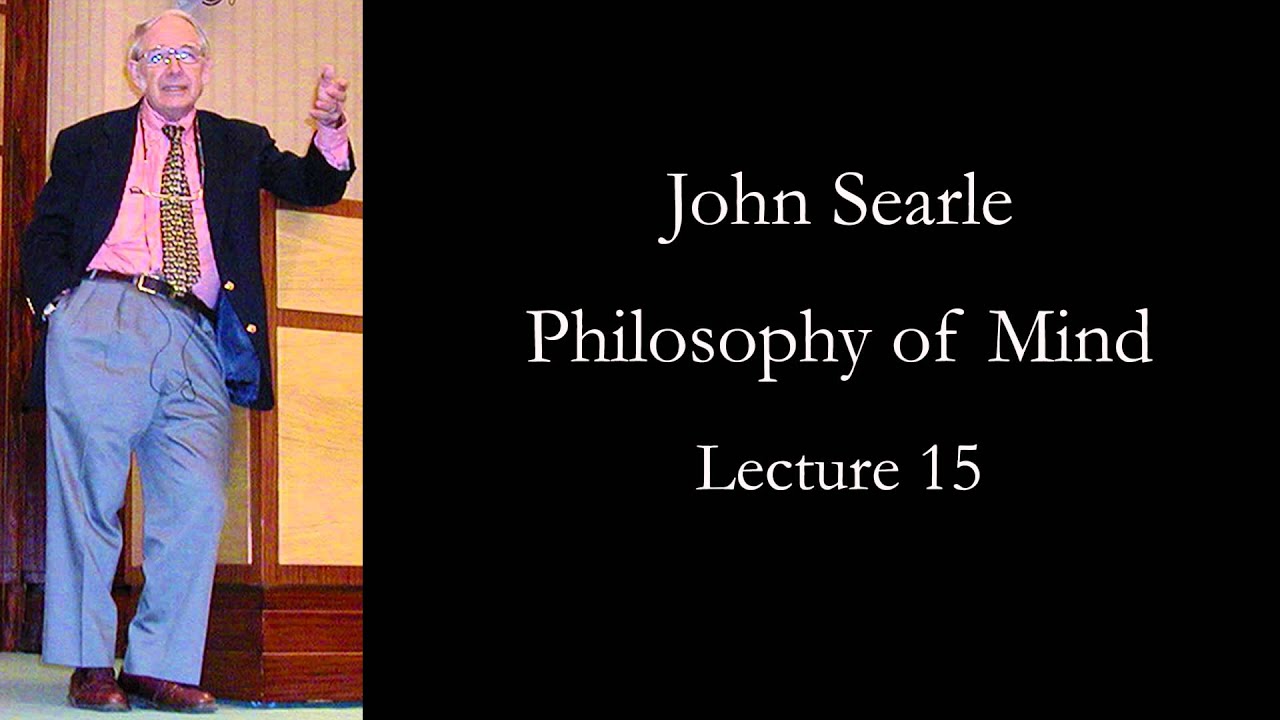
Searle on Frege & Russell: Philosophy of Language 11
Added:Gottlob Frege's distinction between 'Sense' (Sinn) and 'Reference' (Bedeutung), particularly how it addresses the puzzle of identity statements.
Bertrand Russell's Theory of Definite Descriptions, including his logical analysis of denoting phrases and non-referring terms.
The fundamental concepts of first-order predicate logic, such as existential and universal quantifiers, which Russell uses to decompose sentences.
The philosophical problem of 'empty names' and 'referential opacity' in modal or intentional contexts (e.g., belief reports).
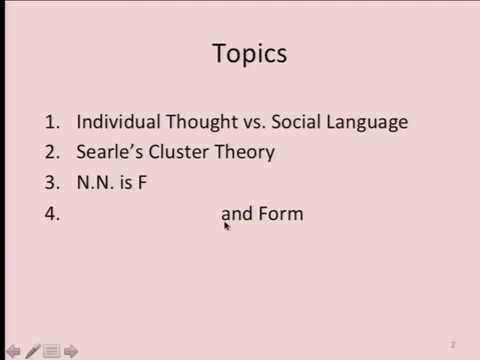
John Searle's 'Cluster Theory' of proper names, which attempts to bridge the gap between descriptivism and direct reference.
Saul Kripke's critique of descriptivism in 'Naming and Necessity', introducing the causal-historical theory of reference and rigid designators.
Searle's broader theory of 'Intentionality' and how mental states represent objects and states of affairs in the world.
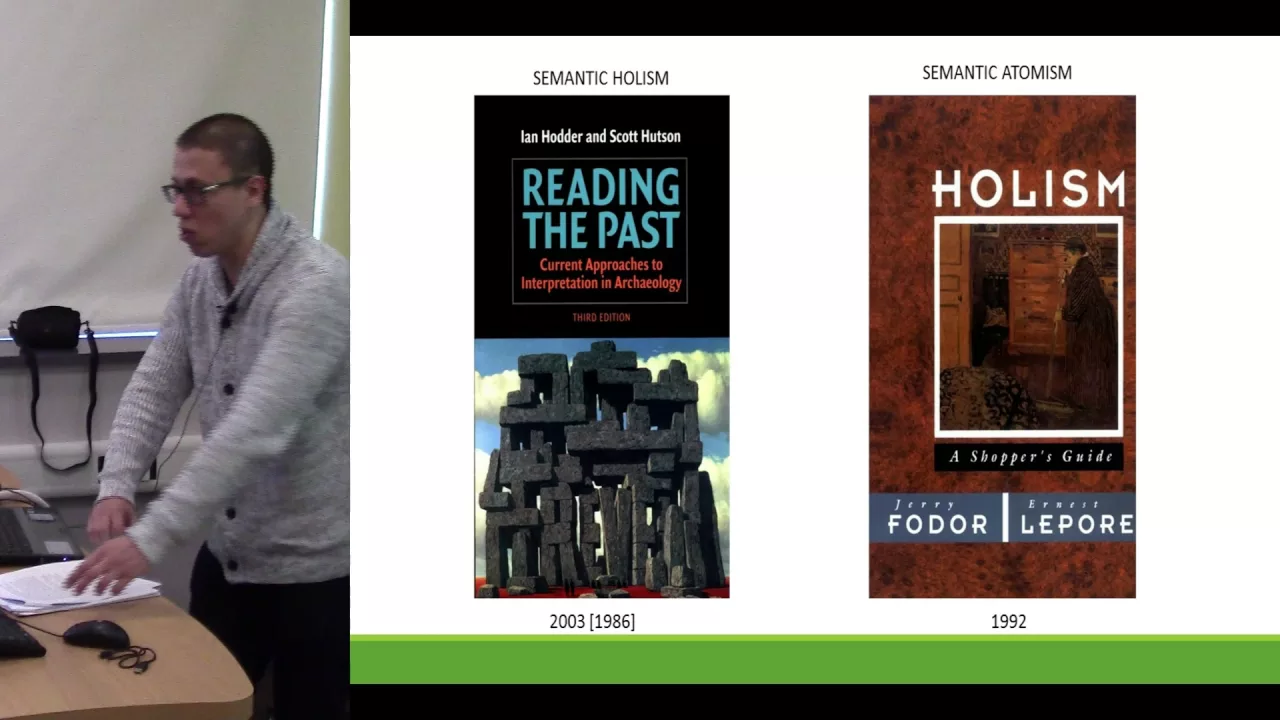
Contemporary debates in the philosophy of language regarding semantic holism, direct reference theory (such as David Kaplan's work on indexicals), and two-dimensional semantics.
8.8K views59likes1:15:21Original Release: 2011-10-26
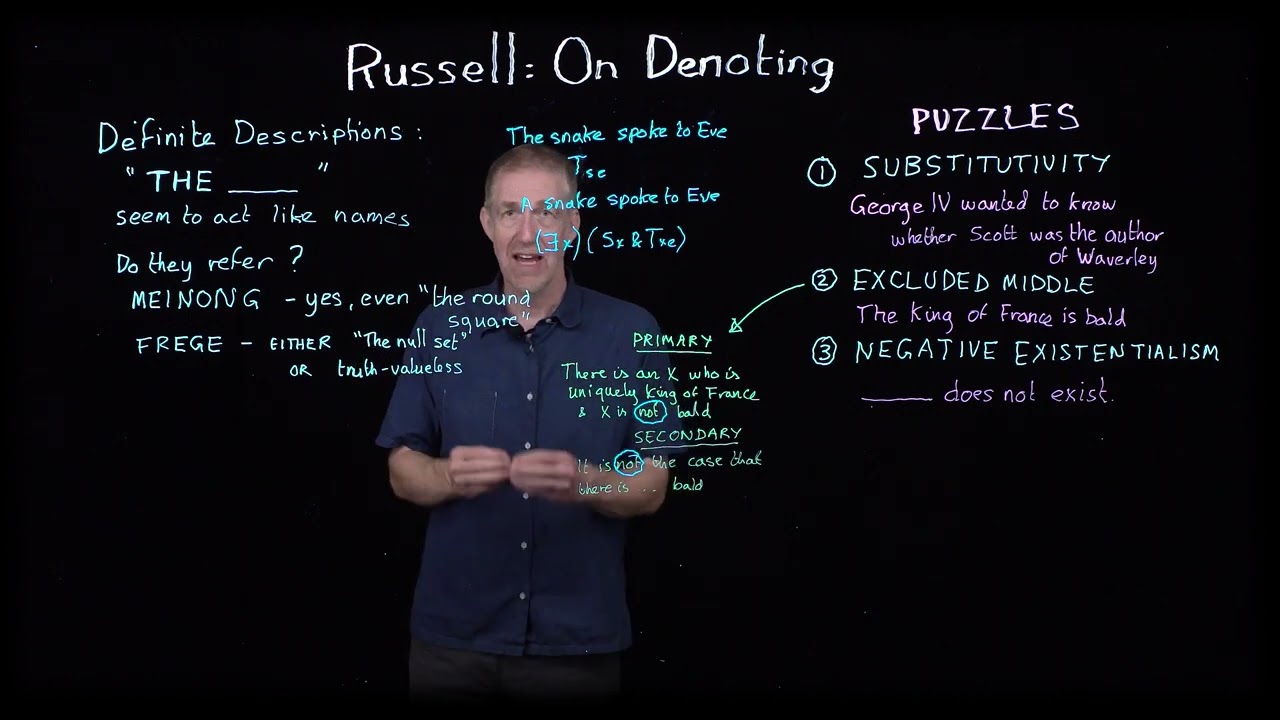
okay uh we're now heavily locked into mainstream philosophy of language uh and I'm very dissatisfied with the whole approach and I'll try to say why but I probably won't succeed because I'm not clear about it however I have to tell you that the leading intellectual achievements in philosophy in the past hundred years a little over a 100 years now uh have been in the philosophy of language that that's our greatest achievement the only exception to that would be Jack rs's theory of Justice uh the theory of justice is a stunning achievement and and he totally revolutionized the study of political philosophy and in so doing the study of Ethics but with that rival uh the philosophy language is where uh the most most of the high level stuff has gone on so if I'm dissatisfied with it I ought to be able to say exactly why now one reason I'm dissatisfied is that these guys assume what a solution to what I think is the hardest problem what is an object anyhow what's a fact uh and they talk on about objects and quantifi as if there was no philosophical problem but that's the problem I was trying to say that last time but anyway I'm now trying to explain to you fragga and then after fra we're going to talk about Russell now um Fraga revolutionized philosophy it took a long time for people to see that I and Russell and binstein got a lot of the credit but in any case fragga saw that there were problems about language that people hadn't seen before the general approach to language if if you look at the history of empiricist philosophy was to suppose there's no real problem words are associated with ideas they stand for ideas and if you go back to Lo Barkley and Hume who are our forbears uh they thought well you understand the sense because you know what the words mean and the words stand for ideas in the mind and how do the words connect to reality well basically it's because the ideas in the mind are pictures of the things in the world so the word chair gets its meaning because you have a little picture in your mind of a chair and then the word chair stands for uh chairs uh because they look like that you got a little picture and that's how words refer to things now it's amazing how long that view was accepted and if you look at uh lock Barkley and Hume the great debate was about whether or not general terms stand for General ideas which is what lock thought and Barkley made fun of that and said it's ridiculous you can't have a general idea and idea has always got to be about a particular thing um it's got to have specific details and then Hume came along and said well the particular idea is made General in its representation so uh you can't have a an idea of a a chair that doesn't have any particular features but says AE you can have an idea of a particular chair and then you use it for chairs generally now I'm not going to spend a lot of time criticizing that but it's obviously an inadequate account of language for a whole bunch of reasons one is there are whole lots of words that just I couldn't possibly get their meaning by standing for some mental image if a and therefore however but and perhaps do not get their meaning by standing for uh idea what what is your idea of perhaps or maybe it's perhaps I I wouldn't even know the the right word for such a thing uh so okay that's one difficulty the other is these damn ideas in your mind don't uh don't make any difference if you use the word correctly it doesn't matter what idea you have in uh your mind if I I say dogs cats horses elephants and whales are all mammals well you may have had a sort of mental Zoo going through your mind uh I didn't I just thought of some words uh and uh even if I had for dogs cats horses what did I do for a mammal did I have another dog there or what uh but in any case uh it's just not the case that you need to have these ideas going through your mind you have to know how to use the word and then furthermore uh if you always do have an idea in the mind associated with a certain word that's probably a form of pathology and not a semantic ability I mean there was a famous uh case of a woman who whenever she heard the word date she threw up uh you know eventually the psych psychiatrist got a hold of her God knows what they did to her but anyway the psychoanalyst went to work went to work on her I and I guess you can invent a scenario about how this happened to her but so uh so what I mean uh date doesn't mean throwing up whatever it means that's not its meaning uh in any case I the guy who really drove the nail into the coffin of this view is wienstein in the philosophical investigations he laboriously goes through a whole lot of considerations as to whether or not the meaning of a word is really some kind of introspectible entity some mental entity in the head uh some picture or a feeling or thought content and he argues that no um to know the meaning of a word is to know how to use it and you shouldn't think of meaning as the name of introspectible entities now that Fraga is the guy who really uh revolutionized the subject but he did in he took a step forward he saw that ideas in the head aren't going to do the job but he also took a step backward uh which is a I think a disaster and that is he thought in order that we can communicate there has to be not ideas in the mind because those are all private what the ideas in my mind may not be the same as the ideas in your mind but we all communicate in a public language so he said in order that we can communicate in a public language there has to be this world of abstract entities of Senses remember last time I told you about the senses of Expressions so it turns out that for Fraga there's a whole realm there's a whole universe of abstract entities that includes all of the numbers uh the infinite number of propositions or ganka and all of the senses of various words and sentences and you remember that a proposition just is the sense of a declarative sentence so Fraga thought that in order that we can communicate it all there has to be what he called a Third Realm of all of these abstract entities he used an unfortunate German expression he called it the uh and Hitler later made that expression famous but you can't blame frer for Hitler a lot of people would like to do that uh but I in any case fra said something that I think is really a disaster but it came out of the of the 19th century intellectual environment in which he was working he said in addition to the world of physics the physical world and the world of the Mind the mental world we have to re recognize a third world the world of abstract entities that include senses uh numbers propositions uh and all the rest of it now I think that's a terrible mistake and one of the things we've got to do in this course and one of the things I've been trying to do so far is to show you that language is just part of the ordinary sweaty world we all live in and that means we got to show how to get from the physics to the semantics and I've been trying to do that in various ways and in that article what is language I try to show how um language is built on top of prelinguistic biologically more basic capacities the capacities of intentionality so it's it's only an animal it's already got beliefs and desires that can have uh language and then once you get language you get an enormous capacity that you don't have when you just have intentional States you get sentences that have parts that you can Shuffle around at will but all of that I want to say is an extension of basic biological capacities the capacity to perceive and remember and believe and desire Etc and and and and don't forget the capacity to perform intentional actions because a speech act whatever else it is is an intentional action okay so fragga was right to see that the traditional Doctrine uh that the world that a words just consists in uh introspective their meanings of words consist in introspective entities mental images in the head he saw that's all wrong but he was wrong to see it was wrong to claim that you have to postulate a mysterious Third Realm okay but now he was also right to see that the right way to break up the sentence is not the way that Aristotle and logicians did it for almost 2,500 years it is not to think that sentences are always of this form s is p the subject predicate form and and he saw that the sentence Socrates is bald is really quite different from someone is bald and one of his great discoveries is to say that we've got to think of this as containing two different levels if you think of Socrates as a ground floor level object and then is bald as moving up one floor now I haven't told you how we do that but Fraga you know how he says it this stands for a concept and a concept is something incomplete then it turns out that someone is bold is a concept someone is a concept that applies to Concepts it is a second levela uh concept it's a it's a concept that's up one level so if you knock out and the way that he shows that I think is quite ingenious if you knock out Socrates from here and just have the concept expression X is bald then you can complete that by sticking in an aomin by sticking in a proper name or but you can stick in a higher level concept you just say there is some X such that X is bald and there you comine combine the two concepts there is an X such that X XXX and then and then you leave it blank and X is Bal you run those two together and you form a new Unity the proposition that there is some X that X is bold now that might look like that's no big deal but it's that move that makes possible modern logic it makes possible the predicate calculus uh okay now so far so good now we get into some more Troublesome claims fr also says and this part I think is right uh he says that you should think of the sentence as not something you get by putting words together but think of the words as what you get if you take the sentence apart now when I read that I was your age I was an undergraduate I thought that's crazy somebody else somebody might say look you shouldn't think of a car as what you get when you put part CS to uh car parts together you should rather think of car parts as what you get when you take the car apart it doesn't make any difference it seemed to me absolutely crazy to say one was in front of the other but I think he's right as so often uh and we can see that if you think of intentional States uh the words that express your belief are derived from the actual total propositional content of the belief uh and it's best to think of the words not as frus says as have having meaning in isolation but think of them as the meaning of the word is the contribution that it makes to the meaning of the whole sentence so to understand the meanings of words is to understand how to use them in sentences that will Express whole Pro whole propositional contents that is to say whole intentional states with the psychological mode the direction of fit and all the rest of it so I think frag is right to see that the sentence is primary and that's because the sentence is the unit of the speech Act and the unit is how you express intentional States all that is more biologically basic but then once you got that then you can take words out of the sends and shuffle them around you can do things uh with language that you can't do with pre-linguistic parts all right but now um let's go on on the hand out she I want to get through this because I want to go on to Russell today uh proposition number six expressions with the same reference can be substituted for each other without loss or change of Truth value uh and you remember that's the famous liet's law the second law of identity Theory and a good way to put that is just to say that if x is identical with Y that implies that any X any F that X has will be an F that y has so if x is identical with Y then FX uh if and only if FY does everybody get that um now this actually is an important point in the history of philosophy and weet held a view called the identity of IND discern that says if two objects have all of their properties in common then they are really the same object there's only one object and that's because objects that are IND discernible they have no different properties would be the same object now what this says is something slightly different this you might call not the identity of indiscernibles but the IND discernability of identicals because this says not if objects have the same properties they're the same object but rather if they're the same object then they must have the same properties if x is identical with Y then X has property F if and only if y has property F now that's a big deal for Fraga because it has very important applications to language and one of fraga's most important discoveries was the problem of intentionality with an S uh and intentional within s context and I'm now going to explain that to you Fran noticed that this law does not apply when you have sentences like John believes that uh because John might believe something about an object under one description or under one name and not believe that about the same object under a different disc description or a different name and I I I'll just go through an example to show you how this would work in real life I got tired of the usual textbook examples about Hesperus and phosphorus uh so I invented one um as you all remember uh the famous American Outlaw Jesse James uh had an alius uh when he was hiding out at a small town in Minnesota he called him self Mr Howard so we have an identity statement Jesse James is identical with Mr Howard and I hope you all know the song I Won't sing it this morning uh but the dirty little coward who shot Mr Howard laid Jesse James in his grave it was dirty Robert well I won't go through the whole damn song it was Robert Ford and you remember he shot Jesse it brings a tear to the eye because as we all know uh Jesse would never harm anybody and so with his brother Frank he robbed the Gallatin bank and shot up the Glendale train they went to the crossing not very far from here and there they did the same the agent on his knees delivered up the keys to the Outlaws Franken Jesse James consider yourself lucky I didn't sing it because I I know that damn I know the tune as well as the words in any case uh so we have an identity statement Jesse James is identical with with Mr Howard but the sheriff of Northfield Minnesota didn't know that all the sheriff knows is that there's this nice guy Mr Howard so uh the sheriff believes Mr Howard is an honest man but we also know that Mr Howard is identical with Jesse James now you cannot infer from that that the sheriff believes Jesse James is an honest man the inference doesn't follow I as you can see by the fact if you ask the sheriff now Sheriff that guy lives down the street in the nice house with a white piot fence is he an honest man Mr Howard oh yes says the sheriff very honest guy uh uh very law-abiding and always contributes to the policeman's fund um but if you ask him now what about Jesse James is he an honest man no no says the sheriff there's a a a reward out for his captur dead alive uh and I think Sheriff has two FS doesn't it well what I'm getting I'm getting corrupted by the computer it always comes up red uh when I when I misspell something but in any case the the sheriff will say no the Miss Jesse James is a notorious Outlaw he's not an honest man at all okay but now this looks like a serious problem because according to the law I just wrote If Jesse James really is identical with Mr Howard then you have to be able to substitute one name for another without changing the truth value of the sentence but here you do because it's true that the sheriff believes Mr Howard is an honest man false that the sheriff believes Jesse James is an honest man now the the context the sheriff believes that is said to be intentional with an S with respect to substitutability and that's sity intentional with an S and intentionality with an S is opposed to extensionality and extensionality is relative to certain tests for extensionality and the sentence uh Jesse James is an outlaw that sentence is extensional with respect to substitutability whereas the sentence um because you can substitute if Jesse James is an outlaw then Mr Howard is an outlaw that sentence is extensional with respect to substitutability but this sentence the sheriff believes Mr Howard is an man is not extensional with respect to substitute ability it's intentional now it's important to emphasize this because people often confuse intentionality with an S with an intentionality with a t and we can now see the difference intentionality with an S is that property of certain sentences by which they fail tests for extensionality the most famous test is the one I just gave you substitute of ability of identicals substitutability of co-referring Expressions but intentionality with a t is that property of the Mind by which it is about or of or refers to objects and states of Affairs in the world what's the connection well the sentence the Jones believes that or Mr the sheriff believes that is about a state which is intentional with a t and hence it's about a state that is a representation of its conditions of satisfaction but the sentence about that state is not a sentence about objects in the world it's a sentence about representations so its truth depends not on how things are with the actual Jesse James the actual Mr Howard but how it is in the sheriff's head what the sheriff believes about Jesse James and Mr Howard so the reason you can't substitute is in the one case you're not talking about the guy himself you're talking about how how the sheriff thinks of the guy now that seems to me right but fragga then said something that seems to me wrong he said in these what he calls indirect contexts context following uh such as the Sheriff believes that or the sheriff thinks that or Barack Obama hopes that in those contexts words lose their ordinary sense and reference what the word stands for then the the reference of the word is not Mr Howard but it's the sense of the expression Mr Howard so that in this uh whole passage here after the sheriff believes that the prop the words there don't don't refer to their ordinary reference they refer to their ordinary sense and in a way that you can see why he says that because of course you want to say well what has to follow believes that is that is something that names a proposition that was frager's idea so the sense of the whole sentence is now then the sheriff believes the proposition that Mr Howard is an honest man and that's not about Mr Howard it's about the proposition so this led him to his doctrine of indirect sense and reference normally the sense of a word is the meaning that it has and the reference is the object that it stands for but in these indirect contexts words lose their ordinary sense and reference and that's shown by the fact that substitutability fails but what it then is there sense and reference well the sense the reference of the word in these indirect contexts is its ordinary sense and hence the reference of the whole sentence will now become the ordinary sense of the sentence and you know that's a proposition so here this whole passage refers to a proposition and the sense is simply the sense of the words the thought that or the proposition that the sheriff believes the thought that Mr Howard is an honest man or but he believes the proposition that Mr Howard is an honest man it sounds better in German I don't know why my voice changes whenever I try to speak speak German but anyhow um uh okay so that's frager's famous Doctrine about indirect sense and indirect reference now it is important in general about language we're not just talking about fra we're talking about the fact that all kinds of sentences fail certain common sensical tests such as the substitutability of co-referring Expressions that's liet's law uh but there are other tests for existential for intentionality with an S the other tests for extensionality and a famous one is called existential generalization now it's generally the case that if you have a proposition of the form AF Socrates is Bal for example you can infer there is some X such that F ofx uh so from socrates's ball you can infer somebody is bold but there are cases where you can't make that inference if I say John lives in Kansas City you can infer the existence of Kansas City there is some X such as John lives in X but if I say John is looking for the lost city of Atlantis then you cannot infer there exists an actual city which is the lost city of Atlantis cuz he might be looking for it even if there is no no such place so the sentence John is look I'll write this out John is looking for the lost city of Atlantis that is intentional with respect to existential generalization over the occurrence of Atlantis over the occurrence of the expression the lost city it can be true that John is looking for the lost city of Atlantis even if there is no such place as the lost city of Atlantis so the sentence John lives in Kansas City that's extensional with respect to the occurrence of the direct object the object of the preposition John John lives in Kansas city is extensional with uh regard to the referring expression Kansas City cuz you can do existential generalization you can infer the existence of Kansas City but John is looking for the lost city of Atlantis is intentional with an S with respect to the occurrence of the name the lost city of Atlantis because you cannot conclude from the truth of John is looking for the lost city you can't conclude it doesn't follow that there actually is such a place does everybody see this now notice both of those cases are derive the the intentionality of the sentence the intentionality with an S of the sentence derives from the fact that the sentence is about and intentional with a T State the sheriff believes that reports a mental event in the sheriff his belief John is looking for reports an intentional effort on John's part he's intentionally seeking to find the lost city of Atlantis so in these cases you can explain the intentionality with an S of the sentence by showing how those sentences are about states that are intentional with a t but it doesn't follow that intentionality with a t is somehow essentially intentional with an S it's not uh the actual belief that Mr Howard is an honest man that belief itself is completely extensional that'll be true if and only if anything identical with u uh Mr Howard is also an honest man that's the belief not the sentence about the belief so the sentence about the belief has this intentionality whereas and it derives from the fact that the sentence is a report of an intentional with a T State now an intentional with a Tate is a representation hence the sentence is a representation of a representation and its truth depends not on how things are in the real world but how things are in the mind of the guy who is making the representation and that's why you can't make the substitution and why you can't infer the existence of the object in the case of John is looking for the lost city of Atlantis now I I want to take questions I want all this to sink in and I don't want to rush to through this too fast but I want you to see this this ambiguities are pervasive um there are perfectly ordinary sentences that are ambiguous between an extensional and an intentional reading if I say Sally is looking for an apartment near campus I that's ambiguous that can mean there's a particular apartment she's looking for uh 2317 Durant and that that's an extensional reading but there is another reading of the sentence Sally's looking for an apartment near campus which doesn't admit of uh existential generalization on the contrary the answer might be there aren't any that is she's trying to rent uh looking for an apartment to rent that's uh intentional because it doesn't follow from the fact that she's looking for it that there as actually is one but if they she has a specific apartment in mind uh she's looking for the apartment at 2317 Durant then you can make the existential generalization then there really is such a place okay I want all us to sink in for a minute let's take questions about all that I want everybody to understand all this because it's important for your for uh uh other parts of philosophy that you're going to do yes John lives in la la land okay this is another good example I hadn't thought of this one uh if I say John lives in la la land that is short for actually a description of his intentional state it doesn't mean uh he's moved from Berkeley and his mailing address is now on Oak Street in La La Land uh normally this is a metaphor John lives in la la land would be short light uh he is heavily involved in his fantasies or something like that so la la land there is not a referring expression it's used metaphorically it doesn't follow you can't do existential generalization you can't say there is some X X's La La Land and John lives in X yes yeah let me go through it again because this is important I cannot tell you how much confusion there is in philosophy over this now I think now much less than there was 50 years ago but here is if you state the definition then it's obviously they're uh not the same intentionality with a t is that property of Mind by which it represents objects and states of Affairs typically outside the mind intentionality is mental representation if you wanted a single slogan intentionality with an S is that property of sentences by which they fail tests for extensionality So when you say that a sentence is intentional with an S you have to say exactly which test for extensionality does it fail the two most common tests the most popular in the literature are liet's law and existential generalization what's the connection between intentionality with a t and intentionality with an S intentionality with a t is mental representation hence intentional with a t States represent their con conditions of satisfaction but sentences about intentional with a t states are often indeed typically intentional with an S sentences now I'm going to say that slowly because I want I want you to be able to get that it's it's probably it's written in the book and it's on your notes but anyway I want you to get it intentional with an sentences about intentional with a t states are often theed typically in intentional with an S sentences why well because the intentional with this Tate is a representation of something in the world the sentence about the intentional with a t state is a sentence about a representation it's not about the world but it's about how somebody represents the world so if I say the sheriff believes that Mr Howard is an honest man I'm not telling you about the world of Mr Howard and honesty I'm telling you about what's in the sheriff's head I'm telling you about his representation so typically when I report somebody's mental state using these uh words the sheriff believes that Mr Howard is an honest man I am giving you a representation of a representation the sentence represents how things are in the mental representation in the sheriff's head hence and this is the key point the truth of the statement about the representation depends not on how things are in the real world but how they are in the mental representation of the guy who's being reported of the guy who's being representation when you say the sheriff believes Mr Howard is an honest man you're not talking about the real world you're talking about the sheriff's mind hence you can't make the substitutability because the substitutability is about talk about the real world okay I want everybody to get that and I want to give you some other examples but I want you to see this part one of the things I want in this course is that you should be able to go out of it without being intimidated uh by all of the rasat Tas that people are going to throw at you and they're going to throw at you a whole lot of stuff about day Ray and de Dio and referential opacity and all the rest of it and I want you to be armed when you go into those battles yes what if you say what if you say the sheriff believes the world is BR is BR yeah is that still it's it is still the any sense of that form is intentional with an S because the sheriff might believe also that the world is the biggest piece of green cheese in the universe okay now I I I and if somebody he might hold that belief and he might believe that the biggest cheese of biggest piece of green cheese in the universe and not know that the biggest piece of green cheese in the universe was in fact uh in Racine Wisconsin in a cheese factory or something like that and he's not talking about that he's we're talking about his mental representation when we say these things about his beliefs but even if it's something that's proven to be true then it's here is the next confusion often in reporting beliefs we want to commit ourselves to the ex existence of the object that the belief is about uh we want to say about the world the sheriff believes that it's round and there the world there occurs extensionally because you can infer from that sentence about the world the sheriff believes that it's round you can infer there is some X such that about that X the sheriff believes that it's round now this is a famous another distinction I want you to get and I'm working up to it and that's the distinction between the day Ray where you talk about objects themselves and the day dicto where you talk about words and other representations of objects I'm going to get to that in a minute but let me uh make sure that people are clear about this let me just to clarify this let me give you some other s uh sentences I that are typically said to be intentional with an s a context involving it is necessary that or it is POS possible that are often intentional within as context because the necessity derives not from the objects in the world but from how they're represented so if I say uh the number of planets not it shrank actually the planet shrank it used to be eight it used to be nine but now it's eight I feel jipped you know I want I want that other planet back but anyway now the number of plan planets is eight but necessarily this little box means necessary actually I'll write it out it's necessary that 8 is greater than seven okay eight necessarily is greater than seven but you can't infer that necessarily the number of planets is greater than seven uh you can't infer that because that's just how it turns out in fact for all we know God knows if if things keep going the way they're going it might shrink more we might get down to six or five okay so the number of planets is eight necessarily eight is greater than seven but it doesn't follow that necessarily the number of planets is greater than seven see once again you have the failure of substitutability you see that you can't sub though the number of planets is identical with eight you can't substitute the expression of the number of planets uh for eight and get necessarily the number of planets is greater than seven now what's going on intuitively I want to give you in philosophy you always want to know what's the intuitive idea behind the phenomenon intuitively if the truth of what you're saying depends on how you refer to the thing then it's it's likely to be int then what you're saying is likely to be intentional with an S and that's what you get in the sheriff case how you refer to Jesse James is important for the truth of the claim about the sheriff's belief if you refer to the guy as Mr Howard then the sheriff believes he's honest if you refer to him as Jesse James then the sheriff believes he's dishonest that's a case where how you refer to the thing determines if how you refer to thing matters to its truth is likely to be intentional with an S that's substitute ability now existential generalization the intuitive idea is this does it matter to the truth of what you're claiming whether or not the thing that you are apparently talking about really exists if it doesn't matter whether or not it really exists as in uh John is looking for the the lost city of Atlantis I then the sentence is likely then the sentence is intentional with an S whereas in the case of John lives in Kansas City it matters for the truth of what you're saying that there has to be such a place as Kansas City if there's no such place then it can't be true that John lives in Kansas City if you say the child believes that Santa Claus comes on Christmas Eve then the occurrence of Santa Claus there is intentional with an S because it can be true that the sh child believes that Santa Claus comes on Christmas eve even if Santa Claus does not exist does everybody follow that that's the intuitive idea it seems tough but it's not a it's not all that hard it's not a big deal it's just uh a philosophy like science proceeds on Troublesome cases on paradoxical cases and fragga saw these are real difficulties and he had to have an account of how they work okay I want to stop our questions you and then you you first well I was maybe not important I was just going to say that you really do need a lot of background in order to even judge these like to know that is the place and that Atlantis isn't the place otherwise it's all oh yeah it's only I can only make these uh intelligible to you on the Assumption uh that you share with me uh the belief that Santa Claus does not exist I mean if you firmly believe in Santa Claus then you're going to be deeply shocked when I say I then I give you this story about how Santa Claus doesn't exist I and so I'm relying on that for your understanding of these examples but just the the case of the lost city of Atlantis is interesting because we don't know if there was such a place the Ancients talked about it but it doesn't matter for the truth of the statement that John is looking for the lost city of Atlantis whether or not there really is such a place whether or not there was such a place at the back can you speak up louder please yeah the reference is I well this is the question what does the expression the lost city of Atlantis refer to and fragga says it refers to the customary sense of the words and really the whole uh proposition the whole statement John is looking for the last lost city of Atlantis would be something like John seeks to find the truth conditions for X is identical with Atlantis uh something like that that is he's trying to find out what would make it true that this is Atlantis because we we don't know if Atlantis existed but the important point for this part of the discussion is that it can be true that John is looking for the lost city of Atlantis even if such a city never existed you see uh what was the name of the guy who discovered Troy who disc um he was a German in the 19th century uh Clon I I just renamed him clemon it was something like that Clon was looking uh for the site of the ancient city of Troy now that can it turns out there really was we now think there really was such a place I've been there is a kind of a dump really but in any case I that can be true that he was looking for this place even if there wasn't any such a place it turned out there was but the truth of he of he was looking for it doesn't depend on whether or not there was such a place now we now have though a set of devices by which you can mark the day Ray as opposed to the day dicto occurrence the day Ray occurrences are extensional and one of the ways we Mark that in syntax is we say about Kansas City John Liv there and about uh the lost city of Atlantis they finally found it okay those are day Ray the day dicto would be things like John is looking for the lost city of Atlantis uh uh Bill wish wishes that he lived uh in uh the nicest city in the world uh those are cases where how you refer how you refer to it matters for the truth of the statement and it doesn't matter in the case of John is looking for the lost city of Atlantis whether or not there actually is such a place so these are said to be day Ray uh these are said to be day dicto and hence intentional and the day Ray occurrences are typically marked in English by sticking it outside the rest of the sentence you can say now about this town there is this town see Kansas City and about that town John lived there uh but if I say John is looking uh for a really nice place to live in Kansas uh or the really the really nice place in Kansas it doesn't follow that there is a really nice place in Kansas or even in Missouri there might be or there might not be okay I want everybody to understand this because we're going to go on now and we're going to come back to this when I tell you how I think language actually works remember we got to get inside the proposition uh because I I did the outside the proposition part that's mostly the theory of speech acts now we're inside the proposition which is Mo where most of the philosophy of language has in the history of the subject has gone on and I'm explaining the problem of intentionality Quin calls this you remember the problem of referential opacity because these intentional with an S contexts are said to be opaque in the sense that the reference doesn't go right through to the object they are referentially opaque uh okay uh now where are we on our handout sheet I got to get through at least frga today and I'd like to get on to Russell all right well I've I'll read this out because I've already explained it to you in indirect context in sentences preceded by such words as Sam believes that or Sally said that words have their indirect sense and their indirect reference the indirect reference of a sentence is its customary sense that is a proposition and its indirect sense is the sense of the words the thought that and then follows the words that you are reporting the then eight we should think of the meaning of a sentence not as made of the meanings of the parts but the meanings of the parts is derived from taking apart the whole sense the meaning of a part is just a contribution it can make to the meaning of the whole sense and then he makes a famous claim only in the context of a whole sentence do words have reference V and a lot of people think that's I mean dumm for example think that's fr's most important claim and well the way we would put that is in this in the course that I'm that I'm teaching here we would say only in the context of a whole speech act do you succeed in referring to something reference is a speech act and it's part of the speech Act of a whole illocutionary act so in the whole illocutionary Act of saying Socrates is bold you refer to Socrates but in order to refer of Socrates you got to say something it's not just enough to write the word on the Blackboard you have to say something you and only in the context of a total speech act do you succeed in the subsidiary propositional speech Act of referring okay now in addition a sense and reference there's also Force when we make an assertion that is in utterance with the illocutionary force of an assertion we proceed from a thought to a truth value there is a kind of beginning of a theory of illocutionary Acts in fraa but he didn't spell it out he wasn't really interested in orders and commands and promises he was interested as a mathematician almost entirely in statements only a thought that is a proposition can be true or false the thought that P is the same thought as the thought that P is true and P is indefinable now I'm not sure you can make fragas theory of truth fully consistent but anyway here's how it goes fragga thought that P if and only if p is true so the thought and he thought on the base of that he also thought The thought that P is the same thought as the thought that P is true but he also said and he Al said two other things that make this seem puzzling truth is a property of propositions and truth is indefinable now later on uh we're going to get to truth and I'm going to give you a theory of Truth God knows that's and I guess that's a promise because uh that's another tough one but anyway n we're now we're just slogging away uh uh all right we're going to come back uh to referential opacity and about the difference between the day Ray and the day Dio yeah but now now we're going to go on and talk about Russell okay now the it but but before we say goodbye to frer we come back to fra You Haven't Seen the Last of him but I want you to have Russell under your belt uh before we start I I go back to the other hard parts of Fraga um I any last Fraga type questions uh fra was I think the greatest German philosopher after Kant and here's a funny fact uh most educated Germans never heard of him this is changing I was at a very fancy dinner party in in Berlin uh and we were talking about German philosophy and about philosophy and the Germans are very proud of their philosophical tradition B they they think all the great philosophers are German there a couple of exceptions but but they have great pride and I said mentioned Fraga and none of these fancy educated people had ever heard of golob Fraga I anyway I explained to them who Fraga was that's the price of being a boar at a dinner party um but then driving around the streets of Berlin I discovered and here comes the Germans to the four there is a frasa in Berlin they named a straight after him even if a lot of educated people have never heard of golob Fraga okay now nobody paid much attention to Fraga really until well until in 1930s and 40s and then his Works became widely known in Translation only in the 1950s but one guy who knew about Fraga or rather two guys who knew about Fraga and recognized him his importance were Russell and viin indeed uh vidin Stein when he was a young man went to visit Fraga in y and talk philosophy to him and vidin was not a very modest person but he said uh during their argument Fraga wiped the floor with me uh he thought he couldn't keep up with fragga so fraa was pretty uh uh uh powerful in argument on the other hand by all reports he was a perfectly Dreadful lecturer a carap went to fragas lectures in Vienna and found that Fraga faced the black Lord the whole time and just mumbled and wrote Things in and mumbled and anyway that's there are different styles of lecturing and fragas was not the most effective now on to Russell okay Russell knew about this about the theory of sense and reference and he thought that he could show that it didn't work I that there was an incoherence in any case he came up with a rival uh conception of language and I'm now going to explain it to you one point at which Russell and Fraga differ is this what do you do with a sentence where the subject expression fails to refer that is we saw uh the uh the picture of Socrates it is bald where the subject expression refers to the sky and the predicate refresh expers to this and then the whole thing refers to the true or the false a truth value I'll just say a truth value but what do you do in a case where there isn't any guy here um and suppose you had a sentence such as a Santa Claus comes on Christmas Eve but there is no such person as Santa Claus or to take an example which Russell made famous suppose I say the king of France is bald the present King of France the king of France right now in in 2010 is bold and there is no king of France now says Fraga well for a sentence like that if you say that the sentence is false then it that's got to be wrong because then there would be two ways of negating the king of France's Vault you could say the negation was either the king of France is not bald or there is no such person as the king of France and there aren't two ways of negating the king of France is bald there's only one way and that's to say the king of France is not bald so says Fraga this sentence the king of France is bald is neither true nor false because in order for it to be true or false you have to presuppose the existence of the king of France and that presupposition fails now that's his official argument his official argument is if you say that it's false if you say the proposition of the king of France is bald is false then uh there would be uh two ways of negating the king of France is bald and there aren't two ways there's only one way and that's to say the king of France is not bald now that's his official reason but I think his deep reason is has to do with his theory of the analogy between uh sentences and between predicates and uh function expressions in mathematics you remember he says a concept uh is the reference of a grammatical predicate and a concept is a function whose value is always a truth value so when we complete is bold by plugging in Socrates we are giving an we are are completing the incomplete functional expression we're giving an argument for the function is Bold and the value will always be a truth value but for a case where there is no reference as in San as in the king of France is bold then the function won't have a value it won't have a value because there was no argument you didn't specify an argument that is the the trio of function argument and value presupposes that in order to determine a value a function has to have an argument but if you give me a sentence in which the subject expression fails to refer there isn't any such a person as the king of France then you haven't specified a value for the function is Bal and conse quently there is no truth value because the value a a concept is a function whose value is always a truth value so he had two reasons an official reason but I I the one that he uses for the general public but his deeper reason had to do with his conception of function argument proposition and all the rest of it now I'm not criticizing this stuff yet I'm going to go back over this but I want you to see what these guys say CU these I they are two of the greatest philosophers well yeah I guess two of the greatest who ever Liv are frga and Russell I only met Russell once I never met well frga died in 1925 um a bit before me but I met Russell once and I was in a sense deeply disappointed I used to be a member of an undergraduate society and we had dinner with Russell once a year well one year would be Russell another year it be some other guy but the year that I was President I got to sit next to beran Russell and I thought this was a great occasion because I'd always admired Russell for his deep concern for Humanity his his concern for the human welfare and peace and all the rest of it uh what I discovered was that I had misunderstood him totally I thought he was a sort of a a wet liberal like all of us not at all Russell was a wig and you cannot possibly understand what it is to be awig Aristocrat but wig Aristocrats were deeply concerned about human welfare not because they valued individual human beings it would never have occurred uh to Russell to suppose that his cleaning lady was somehow his moral equal uh I mean idea would be ridiculous but because as a qug Aristocrat he had a responsibility to these unfortunate uh lesser beings a Russell was a snob he was a wig snob and he thought I that there were certain Superior people like himself and G Moore and and L wienstein and God L Fraga and maybe uh we would be included but we'd better prove ourselves first uh and uh the great mass of humanity you were concerned about not because you thought they were somehow your equal that would be ridiculous um but because you know like animals you ought to look out for their welfare they're not capable of looking out for it themselves uh I was very disappointed in that uh then and incidentally it was at this famous dinner party that he made this a great remark because at that time Russell was 85 years old that didn't seem so old to me now but it did then um and uh uh we asked him you know well you've been an Atheist all your life um but suppose you were mistaken I mean suppose you got up there and and uh and St Peter let you in the Pearly Gates now you've denied his existence all your life What would would you say to him and Russell didn't hesitate a minute he said well I would say to him you didn't give us enough evidence and of course from Russell's point of view that's right it's a straight epistemic problem and God let us down if if he really exist because he didn't give us enough evidence uh okay anyway Russell Russell says there are four puzzles that we need to solve in a theory of reference and I cannot exaggerate the importance of the article that Russell published in 1905 he doesn't use the piano notation so it's hard to read it but the article is called on denoting and I don't know if Al includes it in his book I don't think he does because his undergraduates and Texas can't understand it I'm not I'm sure you could but in any case maybe I should put it on the web if it's not in the book well it is it in the book okay is it assigned great okay read on denoting it's damn near impossible it almost killed me when I was at your age but anyway one reason it's so hard is that he doesn't use the quantifier notation when he wants to say there is an X such that he says it is not always false of C such that and well not always false means there is an X such that okay now says Russell there are four he says there are three but in fact he run two of them he runs together there are four puzzles one reference failure the king of Franc is B is that false or neither true nor false or what uh secondly negative existential propositions the Golden Mountain does not exist now how can we say something that it doesn't exist if we have to refer to it in order to say that it doesn't exist uh and the argument I mean remember in philosophy you got to be really dumb at the beginning of the investigation you have to be very naive and here's how the naive goes take the sentence the Golden Mountain does not exist is that meaningful yeah it's meaningful well then if it's meaningful it must be about something what's it about well obviously it's about the Golden Mountain but if it's about the Golden Mountain then there would have to be such a thing as the Golden Mountain in order that you can say about it that there isn't any such thing so what are you going to say I and indeed there was a Philosophers named Minong who made a lot of confusion about this I call it myong's muddle now I I never read the actual Minong and I'm I can't imagine he actually said this so when I talk about Minong I'm not talking about the historical guy but the Minong of philosophy lectures who committed myong's muddle and myong's muddle went as follows in order to say of the Golden Mountain that it doesn't exist you'd have to be talking about something okay but the something you're talking about is the Golden Mountain right but then it it would have to exist in order that you should say of it that it doesn't exist and that can't be so said mayong well it doesn't actually exist but it has to subsist in order that you can say that it doesn't exist and maybe this sounds better in German where you can do and exis Etc now that's a confusion because if it's meaningful to say the Golden Mountain doesn't exist then it's meaningful to say that Golden Mountain doesn't even subsist even if it's not true that doesn't even subsist it must be a meaningful claim uh so we got a puzzle about negative existentials how can they be meaningful if the object they purportedly about if what they assert about the object that they are purportedly about is that there are no such object for them to be purportedly about the third is identity statements Scott is the author of Waverly but remember that's how fragga got going in the first place was the evening star and The Morning Star now in Russell's article he runs three and four together what about substitutability liet's law George ivth wanted to know whether Scott was the author of Waverly but he did not want to know whether Scott is Scott but why does liet's law fail why can't you uh substitute George IV wanted to know whether Scott is the author of Waverly Scott is the author of Waverly therefore Geor i 4 wanted to know whether Scott is Scott incidentally Russell in 1905 was addressing an audience that took the writings of Sir Walter Scott uh as part of the cultural baggage uh he was at that time generally regarded as the greatest novelist who had ever lived in English and for the people who thought that he was the greatest novelist who ever lived period um and in fact I have had Scotsman I tell me that the greatest novelist who ever lived was Sir Walter Scott he was a Scott um and but nowadays I don't think anybody reads uh a Scott or maybe they do in English departments but the Waverly is a whole bunch of novels you can't go out and just pick up a single book called Waverly there are the Waverly novels of which ivanho is the probably the best known I once as a kid tried to read it and I got about a third of the way through before I got so bored I gave up but but in any case Russell is writing for an audience that recognized Sir Walter Scott as a very great figure and his greatest achievement as the Waverly novels Okay so we've got these puzzles now Russel's article is important not only for the view that it views that it puts forward but for a certain style of presentation which has influenced analytic philosophy since then uh there are a series of questions series of puzzles you give an answer to those questions or rather you give a a theory that answer those questions and then you explain how the theory answers those questions and why it's Superior to other theories now Russell didn't quite do it in that order but that form where you by you try to do three things present the puzzles present the solution to the puzzles and then present a theory as to why your solution is a better solution to the puzzles than anything else that is immensely influential to this day uh Russell gave us a model for what analytic philosophy was supposed to be like and he did something that no previous philosophers had done and this is a a marked distinction between contemporary philosophy and the philosophy that goes back to uh the ancient Greeks and that is is he used the predicate calculus he used fraus invention uh as a technical device and this is the this is a tool that contemporary philosophers have that did not exist previously in the history of philosophy the use of mathematical logic in solving philosophical problems and Russ so one of the reasons that his article was so influential and so much admired was that it gave us a model it gave us a model of how you could give a technical solution uh to philosophical problems and here's the solution the first one what shall we say about the king of France is bald well says Russell that looks like it is a subject predicate claim it's got a subject the king of France and it says about the subject uh that the subject is bald but says Russell grammatical form is misleading as to logical form the grammatical form is that of a subject predicate sentence but the logical form is that of an existential sentence the real meaning of the sentence the king of France is bold is given by the formula in the predicate calculus and I've written that as number one and I want you to go through with that I won't write it on the Blackboard we don't have a lot of time but but you've got it in front of you there is some X so that X is a king of France K is short for King of France there is some ex that's that X is a king of France and for each thing why Y is a king of France implies Y is identical with x and x is bold now let's go through that why is that such a big deal well the first part says there is at least one King of France but then that next clause which is inside the scope of the existential quantifier the universal quantifier that upside down a you notice is inside the scope of there is some X such that and what that the those first two Clauses say is there is at least one king of France and there is at most one king of France so there is an X such that x a king of France and for anything in the universe if that is a king of France then it is identical with X that says there's only one does everybody see that point that so those are in ordinary English you'd say there's at least one king of France there is at most one king of France and then the next one says and X is bold Russell when writing this out in ordinary English would say that what he's arguing is there is at least one king of France there is at most one king of France whatever is King of France is bald or if anything is King of France it's bald now I I that seemed to provide us with a solution to the puzzle about the truth value of the king of France's Bal it's false because the formula comes out as false the formula says falsely uh there is one and only one thing which is King of France and that's not true there's nothing which is King of France so there is a point where uh Russell parts from Fraga about negative existentials well we got a very simple solution to that how can we say about something that doesn't exist if we have to refer to it in order to say that it doesn't exist we just point out that the existential claim the Golden Mountain does not exist again is not a subject predicate statement it's grammatically subject predicate but its logical form is a negative existential claim and that's why for number two you have the squiggle sign that not is outside the whole formula it says it's not the case that there is an X such that X is a golden mountain and for each thing y y is a golden Mountain implies Y is identical with X and that says it's not the case that there is one and only one thing which is a golden mountain now you might say but then that would allow for the possibility that maybe there are a whole lot of golden mountains it would but Russell thinks that's fine because he says when we say the Golden Mountain does not exist he says we're using the strictly so as toly uniqueness it's not the case that there is one and only one thing which is a golden mountain and that's that allows for the possibility which is not blocked by the sentence that there might be more than one Golden Mountain okay now so we've got through two of the puzzles already now you recognize the third one about George I fourth that our old friend intentionality with an S and we'll go on to that but let's take questions about the first two yes France yeah I say France does not exist France does not exist you could say that and You' say something false because France does exist I the question I for all of these cases is to try to analyze the meaning of the sentence and we analyze the meaning of the sentence independently of whether or not it's true but the meaning must determine under what conditions it is true now Russell one of the deepest questions in philosophy I want you to learn to ask this over and over is what fact makes it the case that now what fact makes it the case that the king of France does not exist and when we get to necessary proposition what fact makes it the case that something is not only true that nine is greater than seven but necessarily greater than seven and then you get all these puzzle cases like counterfactuals if um uh uh Nixon I had uh handled the uh the Watergate crisis better he wouldn't have had to resign now what fact I suppose that's true what fact makes it true and again ethics what fact makes ethical statements true if it's true uh that you ought not to push your grandma off the bus then what fact makes that the case and this and now we're getting here Russ the question Russell is asking is what fact makes a negative existential statement through what fact makes uh the the reference failure statement uh what would make it true and then you can ask what makes it true then you can see why it isn't true it's false somebody else had a hand up did yeah this reading may go totally side um so for the first thing we're just are we just saying that if the subject is false the subject doesn't exist and the whole thing is false yes in these cases that's okay yeah but now remember though you get external negation if the subject doesn't exist as the Golden Mountain doesn't exist then the whole thing is true if you've got it's not the case that and then you get the existential claim so for the second one we're saying it's not the case that there actually is a golden mountain and so therefore it doesn't exist no it already doesn't exist that is the question is the puzzle is how can we say of it that it doesn't exist without having to presuppose its existence in order to talk about it and refer to it and say about it it doesn't exist and Russell's answer to that is because you're not talking about it when you say it doesn't exist you're making a negative existential claim you're saying it's not the case that there is any such thing we will go on to this uh and we're now we're now into heavy duty uh Center of of uh a philosophy over the past 100 years and you got we're going to I'm going to lead you out of this woods but we're still in a in a big way
Up Next

119:52
Doctoral Dissertation Strategies: Supervision & Research Methods
@arabiclng2046
217 views•2020-06-17

164:01
John of Damascus on Holy Images: A Theological Defense
@BannedBooks
139 views•2026-04-25
78:54
Philosophy of Language: Speech Acts & Performatives | Searle Lecture 2
@SocioPhilosophy
41.2K views•2011-10-26
4:57
The Myth of Sisyphus: A Greek Legend of Eternal Punishment
@TEDEd
8.6M views•2018-11-13
Related Study Plans & Knowledge Roadmaps
Structured learning paths in Philosophy
philosophy
Frankfurt School: Critical Theory & Culture
01Foundations of the Frankfurt School and Critical Theory
02Horkheimer & Adorno: The Critique of Instrumental Reason
03The Culture Industry and Mass Deception
+ 2 more learning modules
12h5 modules
Explore Roadmap
philosophy
Philosophy of Language: From Frege to Austin
01The Linguistic Turn: An Introduction to Language in Philosophy
02Gottlob Frege: Sense and Reference
03Early Wittgenstein: The Picture Theory of Meaning
+ 3 more learning modules
15h6 modules
Explore Roadmap
philosophy
Feminist Epistemology: Standpoint & Injustice
01Introduction to Epistemology and Feminist Critiques
02Sandra Harding and Standpoint Theory
03Donna Haraway and Situated Knowledges
+ 2 more learning modules
12h5 modules
Explore Roadmap
philosophy
Environmental Philosophy: Ethics & Deep Ecology
01Foundations of Environmental Ethics & Anthropocentrism
02Biocentric Individualism and Animal Liberation
03Ecocentric Holism and Deep Ecology
+ 1 more learning modules
10h4 modules
Explore Roadmap