
















This tutorial demonstrates how to realize Giovanni Furno's Partimento No. 2 in B minor using four voices, applying the rule of the octave and proper voice leading principles including chord doubling, seventh chord enrichment, and avoiding parallel fifths and octaves; the realization follows specific patterns for each scale degree, such as using six-five chords on the fourth degree, dominant seventh chords on the fifth degree, and simple cadences with octave doubling on the first degree, while maintaining correct fingering throughout.
Giovanni Furno Partimento No. 2: Voice Leading & Rule of the Octave
Added:Basic knowledge of figured bass notation and the historical context of the Neapolitan partimento tradition.
Fundamental rules of four-part voice leading, including the avoidance of parallel fifths and octaves.
A conceptual understanding of the 'Rule of the Octave' (Regola dell'ottava) for harmonizing major and minor scales in the bass.
Basic keyboard harmony skills, specifically playing triad inversions and fundamental chord progressions.
Exploring diminution and embellishment techniques to transform simple chordal realizations into florid, artistic keyboard pieces.
Studying more complex partimenti from masters like Fedele Fenaroli, Durante, or Leo that feature chromaticism and modulation.
Analyzing Galant-era schemata (such as the Monte, Romanesca, and Fonte) to understand structural patterns in 18th-century music.
Applying partimento-based improvisation to compose original preludes or sonata movements at the keyboard.
872 views0likes8:36Original Release: 2020-06-18
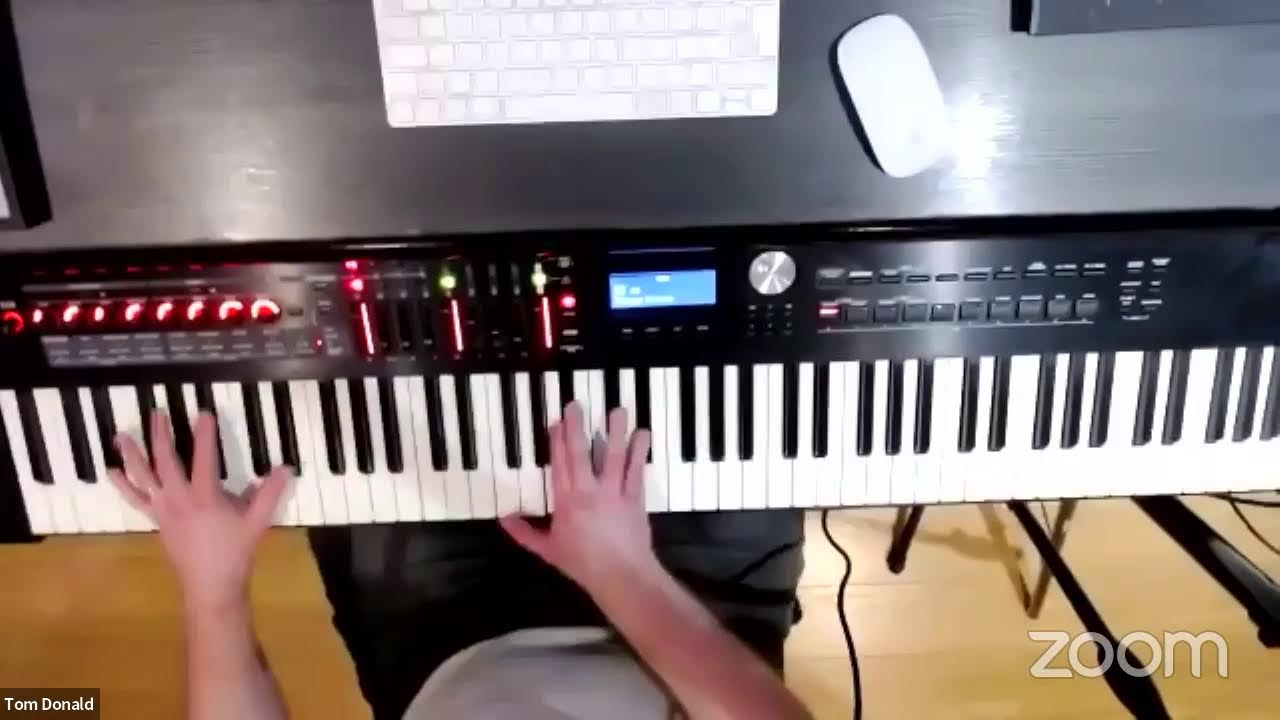
[Music] today we will attempt a simple for voice realization of Ferno to with correct fingering voice leading and observing the rules of parliament to a theory this part amento is in the key of B minor and some things you should practice before attempting this parlamento is getting a bit of fluency and the rule of the octave in B minor in the first position and also the simple cadence with the seventh where you double the octave and omit the fifth in first position for left hand fingering just refer to the on-screen image and I will mainly focus on what's happening in the right hand when I mentioned the rule of the octave in this video I'll be referring to the first position so let's begin with bar one beat one we have D F sharp B with fingers one two five just like the beginning of the rule of the octave in B minor then on beat two we can maintain the right hand as the base moves from B to D this is also in line with the rule of the octave now in beat three we will play e f-sharp and a sharp with one two four also just like the rule of the octave beat four returns us back to the first scale degree and we will play the first chord D F sharp B with one two five again with the octave and bar to beat one we descend to the seventh scale degree a sharp and we will play the rule of the octave ascending here e F sharp C sharp with fingers one two five on b2 we will have a return to the first scale degree and we will just play D F sharp B with one two five b3 is the fourth scale degree E now it's going to f-sharp in the next beat on the E is a six five chord C sharp G B with one three five same as the rule of the octave ascending have a nice G in the alto no doubling of the e every note in this chord is very important in a minor key you have the seventh which is between C sharp and B the G and the alto is also the sixth scale step which must descend before we go to the fifth scale degree as mentioned before we will add in a seventh to enrich the harmony play e F sharp a sharp with one to four omitting the fifth and doubling the eighth f-sharp this would be different from what you play on the fifth degree in the rule of the octave where it's just a five chord moving on to bar three beat one we have scale degree one again so D F sharp B one to five rule of the octave when you go from beats one two three you have a B which stays with finger five in your right hand b2 now we move to the fourth scale degree and it's descending in the next beat so you're not going to make it a six five chord as it's not rising to the fifth scale degree like in the rule of the octave ascending so you will just play a five chord that means you will play egb one three five keep in mind the be that you've played with finger five that hasn't moved from the previous be b3 is interesting because instead of following the rule of the octave and playing D F sharp B we will play a three voice texture of just F sharp and B with fingers two and five this is to avoid octaves between the tenor and the bass this is good voice leading because in the previous beat the e rises to F sharp and the G descends to F sharp so two voices sing the same note F sharp so we have also emitted the D beat for is C sharp scale degree two so we can follow the rule of the octave e F sharp Asia one two four now bar four beat one back to B again D F sharp B with one to five rule of the octave B two we go to the sixth scale degree descending to the fifth so we will use the rule of the octave descending very interesting chord we will play C sharp F and B one to five b3 we are now in the fifth scale degree F sharp and we'll follow the rule of the octave again C sharp F sharp a sharp one to four just a five chord beat four following the rule of the octave descending we will hold the chord in the right hand as the bass descends to the fourth scale degree from F sharp to e we have arrived in bar five and beats wanted to have D followed by B in the bass so we can play D F sharp B one to five and hold the chord while descending from scale degree three d21 bb3 the bass descends to a sharp the seventh scale degree so we play the rule of the octave ascending here e F sharp C sharp one two five on beat four we can hold the en F sharp the previous chord and play a sharp with finger for while the bass moves from a sharp to C sharp it's the rule of the octave but take note of the common harmony here between scale degrees seven and two in the right hand much like scale degrees of one and three bar six beat one back to D F sharp B one to five rule of the octave again no different b2 is a repeater bar for b2 where the sixth scale degree descends to five so rule of the octave again we again play C sharp F B with one two five be three is the fifth scale degree so C sharp F sharp a sharp one to four take note of finger four in the left hand here before we rise to the seventh scale degree a sharp and we'll play the rule of the octave ascending e F sharp C sharp one to five now we go to bar seven beat one which is B in the left hand so just D F sharp B as usual with the roti octave B 2 is d so scale degree three we can again hold the cord from beat 1 D F sharp B as the space moves from B down to D B 3 is the beginning of the cadence with the fourth scale degree so it's a six five chord again like in bar 2 B 3 C sharp G B 1 3 5 just like the rule of the octave ascending B 4 is the fifth scale degree and if we were to go to the first scale degree we double the 8th and omit the fifth but since the next beat is scale degree 6 not 1 we have to instead play a complete dominant 7th chord and that would be C sharp e a sharp 1 2 5 this means we keep the fifth and we add the seventh but we didn't double the 8th we did not double the 8th which is what happens when you move from scale degree 5 to 6 you want a complete dominant 7 chord bar 8 beat 1 we are now on scale degree 6 we will double the third and play B D and with finger five B so 1 2 5 B DB on a 6 chord it is not a problem to double the third at all doing this avoids parallels from the previous course such as fifths between the tenor and the bass F sharp C sharp to G and D now B 2 we now descend to D in the bass which to return to the starting position of D F sharp B one to five rule of the octave B three cadence scale degree four C sharp G B 1 3 5 a 6 5 chord rule of the octave ascending beat for we go to the fifth scale degree F sharp so it's going to one simple cadence so we will omit the fifth double the eighth and play e F sharp Asia one two four bar nine is beat while on beat one is B so D F sharp B one to five role of the octave in this penultimate bar what we have next is scale degree six followed by scale degree for descending thirds progression so the first choice is to play fifth chords so on the second beat we will play D G B 1 3 5 then we go to beat 3 scale degree 4 a 6 5 chord again rule of the octave ascending C sharp G B 1 3 5 and on beat 4 F sharp fifth scale degree 5 1 2 1 e F sharp a sharp 1 2 4 just like all the previous simple Cadence's the ultimate bar is a return to be so D F sharp B 1 to 5 ruled the octave and congratulations you've completed the Ferno 2
Up Next
8:54
Partimento Bass Lines: The Rule of the Octave Explained
@decipherguitarandmusictheory
4K views•2020-05-29

10:20
Mozart's Musical Dice Game Explained: History, Rules, & Fun
@webpianoacademy
5K views•2023-03-13

47:36
Understanding Diatonic 7th Chords in Major Keys | Music Theory Tutorial
@GracieTerzian
54.7K views•2022-03-02
10:49
Understanding John Coltrane's Giant Steps: A Music Theory Analysis
@Vox
10.4M views•2018-11-12
Related Study Plans & Knowledge Roadmaps
Structured learning paths in Music Theory
music-theory
Composing Galant Music: Partimento & Schemata
01Foundations of Figured Bass and Keyboard Harmony
02The Rule of the Octave (Regola dell'Ottava)
03Galant Schemata: The Building Blocks of Form
+ 2 more learning modules
30h5 modules
Explore Roadmap
music-theory
Decoding Overtone Series: Tuning & Drone Music
01Acoustic Foundations: The Physics of the Overtone Series
02Tuning Systems: Equal Temperament vs. Just Intonation
03Microtonality and Spectralism: Beyond Standard Pitches
+ 2 more learning modules
24h5 modules
Explore Roadmap
music-theory
Impressionist Harmony: Scales, Planing & RPGs
01Foundational Music Theory: Keys, Intervals, and Seventh Chords
02Impressionist Color: Chord Planing and Parallel Harmony
03Whimsical Textures: Pentatonic Cascades and Whole-Tone Scales
+ 1 more learning modules
14h4 modules
Explore Roadmap
music-theory
Negative Harmony: Axis Reflection in Indie Pop
01Music Theory Foundations: Scales, Intervals, and Triads
02Functional Harmony and the Circle of Fifths
03Demystifying the Negative Harmony Axis Reflection
+ 2 more learning modules
16h5 modules
Explore Roadmap