Frederic Edwin Church's 1857 painting 'Niagara' exemplifies the American sublime tradition, capturing the awe-inspiring power and dangerous beauty of nature to inspire humility and perspective in viewers; this masterpiece, which sold for a record $8.4 million in 1979, represents the most significant American landscape painting of its era and symbolized the grandeur and expansionism of the United States.
Niagara by Frederic Edwin Church: Sublime American Landscape Art
Added:Deep Dive
The philosophical concept of 'the Sublime' in 18th and 19th-century aesthetics, particularly the ideas of Edmund Burke regarding awe and terror in nature.

Edmund Burke on the Sublime: A Philosophical Inquiry
230K
Edmund Burke, an 18th-century philosopher, argued in his book 'A Philosophical Inquiry into the Origin of Our Ideas of the Sublime and Beautiful' that the sublime differs fundamentally from beauty: while beautiful objects are small, smooth, delicate, and attractive (like a blue bill or a doll), sublime objects are vast, gloomy, dark, and threatening (like cliffs, mountains, or thunderstorms). Unlike beauty which produces pleasurable feelings, the sublime overwhelms us with terror while paradoxically still delighting us—because experiencing the sublime activates our basic self-preservation instincts and exercises the nerves that would save our lives in genuinely dangerous situations. This theory had a profound influence on Romanticism, the artistic movement that celebrated the untamed power of nature.
Click to watch →

The Romantics - Nature (BBC documentary)
462K
The sublime was more than just beauty of a sunset—it was about awe and terror. The natural world was dangerous without convention, society, or God. The sublime is man lost in the immensity of nature. The key to the sublime was the ability to lose yourself, experiencing no horizons and no sense of confinement. It represented longing to be free.
Click to watch →
The Sublime: Edmund Burke's Philosophy of Awe and Insignificance
442.5K
Edmund Burke proposed that the sublime is a pleasurable experience that makes us feel insignificant in the face of overwhelming natural forces or grand artistic works, paradoxically helping us gain perspective by humbling our ego and reminding us of our place in the larger scheme of things.
Click to watch →

The Harry Styles of It All
306.5K
Philosopher Edmund Burke defined the sublime as a blend of terror and admiration, distinguishing it from beauty which consists of well-formed, aesthetically pleasing objects. According to Burke, the sublime has the power to compel and destroy us, while beauty merely pleases. This philosophical inquiry into the origin of our ideas of the sublime and beautiful was published in 1757 and marked the transition from neoclassical to romantic art styles. The sublime celebrates the vastness and unimaginable largeness of nature and how humans are not in control of it.
Click to watch →
Edmund Burke on the Sublime
14.1K
Edmund Burke defines the sublime as a form of astonishment characterized by a state of the soul where all its motions are suspended with some degree of horror, arising from elements such as terror, power, obscurity, vastness, privation, and potential; he emphasizes that these features work together to create an awe-inspiring experience that differs fundamentally from beauty.
Click to watch →
Deep Dive
The origins and characteristics of the Hudson River School, America's first native school of art founded by Thomas Cole.

Hudson
127
The Hudson River School (1830s-1870s) was America's first native painting movement, celebrating the American landscape with Romantic influences. Thomas Cole founded the movement after admiring landscapes by Thomas Doughty, moving to New York in 1825. His paintings of the Catskills brought instant fame, establishing themes of the sublime—awe and danger in nature's presence. Followers included Frederick Church (acknowledged master by 1850) and Albert Bierstadt. The school emphasized untouched wilderness, depicting vast landscapes where human figures appeared diminutive. Works like Cole's 'Landscape Composition' and Durand's 'Kindred Spirits' (featuring Cole and William Cullen Bryant) captured America's idyllic state before industrialization. The movement was strongly nationalistic, seeking independence from European artistic traditions while celebrating the natural beauty of the American interior.
Click to watch →
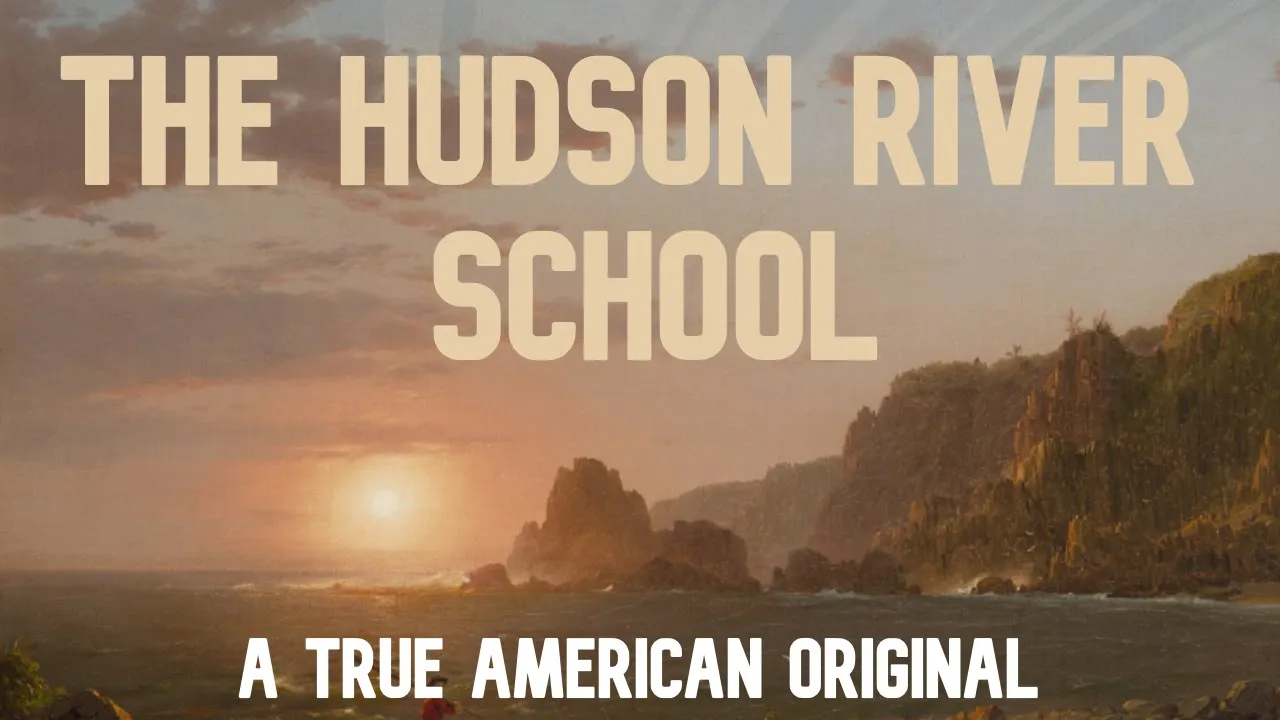
The Hudson River School Art Movement: A True American Original
20.1K
The Hudson River School (mid-19th century) was America's first true art movement, founded by Thomas Cole who pioneered landscape painting as a primary subject matter to establish American artistic identity; artists like Frederic Church and Albert Bierstadt traveled extensively across North America and South America to capture dramatic wilderness scenes, creating epic studio paintings that inspired Western expansion and contributed to the establishment of the National Park system.
Click to watch →

Hudson River Painters at Kaaterskill Falls, NY - Landscapes Through Time with David Dunlop (#111)
12.1K
The Hudson River School emerged in 1825 when Thomas Cole arrived at Kaaterskill Falls, marking the birth of America's first distinctly visual identity in painting. This movement arose from the Louisiana Purchase doubling the nation's size and fostering a new sense of American destiny. Cole, an immigrant artist, brought European traditions of ideal landscape painting while emphasizing nature interpretation with moral purpose. The school evolved from a loose affiliation of friends including Cole, Durand, Church, and Gifford into a movement that combined Romantic spirit with scientific observation of geology and meteorology. Second-generation painters like Sanford Gifford became Luminists, focusing on luminous light and spiritual transcendence, establishing American art's unique visual language rooted in both European techniques and distinctly American themes.
Click to watch →

Samsung Galaxy Z Fold 4 Real-World Test (Camera Comparison, Battery Test, & Vlog)
77.6K
The Hudson River School was a 19th-century American art movement founded by Thomas Cole, an English immigrant who moved to the US in 1818. Cole traveled up the Hudson River to sketch the Catskill Mountains, creating detailed paintings that captured untouched nature. His work caught the attention of patrons like Colonel John Trumbull and Asher Durand, launching his career. Cole's Cedar Grove home became his permanent residence in 1836, where he painted his most famous works. His art served as both a celebration of landscape beauty and an artistic protest against industrial development that was destroying natural beauty. Cole's philosophy emphasized preserving natural beauty for future generations, warning that another generation would find landscapes desecrated by what he called 'improvement.'
Click to watch →

The Hudson River and Its Painters (The Metropolitan Museum of Art, 1987)
529
The Hudson River School was America's first homegrown coherent group of landscape artists, led by Thomas Cole and his followers, who emerged in the mid-19th century and portrayed the Hudson River Valley and other wilderness areas with romantic reverence, transforming landscape painting from an inferior art form into the dominant genre in American art by the 1850s.
Click to watch →
Deep Dive
The historical context of 19th-century America, including the ideology of Manifest Destiny and the tension between industrial expansion and the preservation of wild nature.

RDR ВРЁТ ВАМ ДО САМОГО КОНЦА
80.8K
The United States of America did not suddenly appear out of nowhere. First, there were 13 former British colonies that rebelled against London's tax policy. But a colony is a colony. People huddled along the Atlantic coast, while everything west remained a white spot on an incompletely marked map. Formally, the territory of the country was unexplored land, where a human foot stepped only in exceptional circumstances. In the 19th century, Manifest Destiny occurred. At some point, Americans looked at the map, covered wagons, guns, crosses, and the Bible, and decided: 'We are a chosen people. Our nation is a sacred city on a hill that should stretch from ocean to ocean.' This ideology became a precursor and first embodiment of the American dream.
Click to watch →

Can India Crush Trudeau’s Ego?
81.5K
Manifest Destiny was a 19th-century American ideology that held the United States was destined by God, nature, and historical circumstances to expand across the North American continent. This belief justified westward expansion and underpinned American territorial growth throughout the 1800s. The term was coined in 1845 by journalist John L. O'Sullivan, who argued it was America's divine mission to spread democracy, civilization, and capitalism across the continent. In reality, this ideology was used to acquire more land and resources for Americans, including the displacement and subjugation of Native Americans.
Click to watch →

The Real Reason LA Is Burning — And It’s Not Climate Change | Ep. 1511
162.6K
This segment examines Manifest Destiny as the 19th-century belief that it was America's destiny to expand westward across the continent. The analysis shows that this belief drove pioneers and settlers to expand. The segment argues that if America hadn't expanded, other countries (Britain, Spain, France, Russia, China) would have claimed the western lands. The United States as it exists today wouldn't exist without Manifest Destiny. This expansion, while controversial, created the nation that exists in 2025.
Click to watch →

EUA no Século XIX
118.8K
Manifest Destiny was an ideology that emerged at the beginning of the 19th century, characterized by the belief that the United States had a divine mission to spread political and economic development throughout the entire American continent. This ideology served as a strong justification for US imperialism during the 19th and 20th centuries.
Click to watch →

History of the America in 25 minutes
1.6M
The Louisiana Purchase (1803) doubled US territory through Napoleon's sale of French Louisiana for $15 million. The Lewis and Clark expedition explored the new lands. The War of 1812 failed to change territorial boundaries but damaged British-American relations. The Indian Removal Act (1830) forced Native tribes westward, creating the Trail of Tears. Manifest Destiny drove expansion: Texas won independence from Mexico (1836) and was annexed (1845). The Mexican-American War (1846-1848) added vast territories. The Oregon Treaty (1846) established the 49th parallel boundary with Britain.
Click to watch →
Deep Dive
Basic elements of visual analysis in landscape painting, such as scale, atmospheric perspective, and the dramatic use of light.

The One Landscape Painting Tip You Really Need
267.3K
Atmospheric perspective consists of four elements that create the illusion of depth in landscape painting: (1) Colors - distant objects appear cooler (blues dominate) while yellows and reds drop out; (2) Values - foreground has higher contrast between darks and lights, background has less contrast; (3) Edges - distant objects have softer, fuzzy edges while foreground objects have crisp edges; (4) Simplicity - distant objects are painted more simply with fewer details saved for the foreground.
Click to watch →
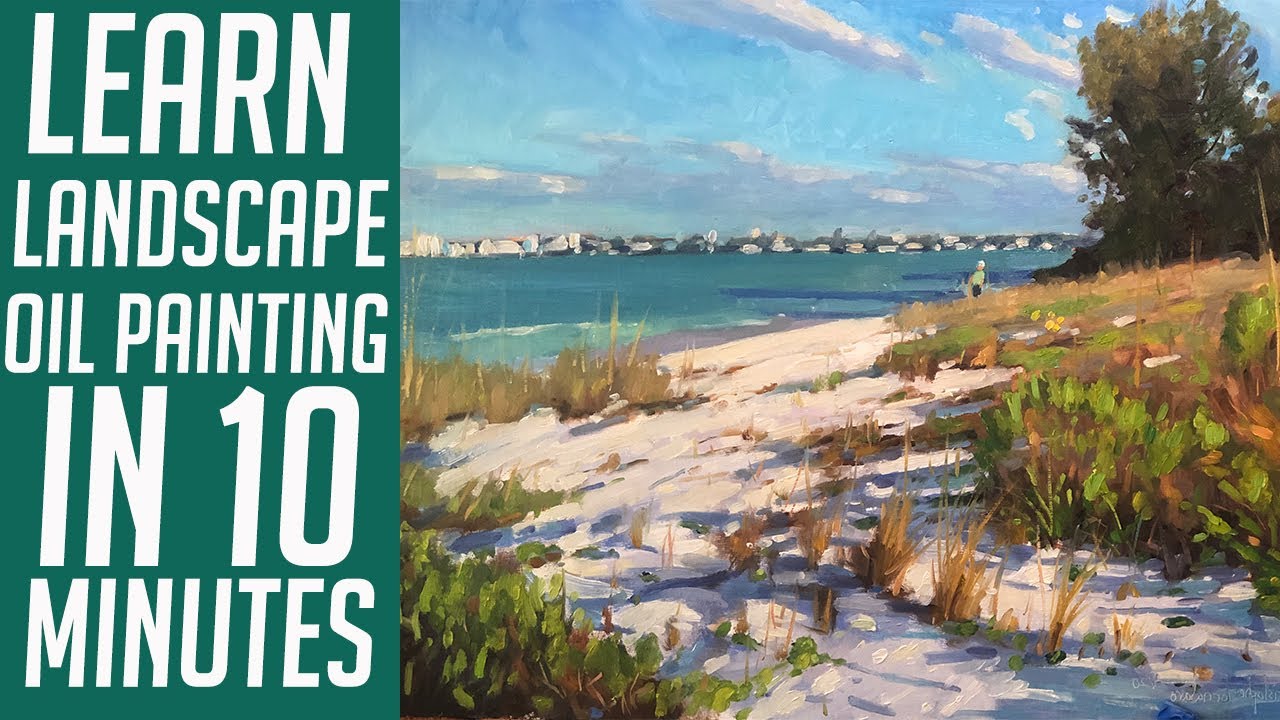
Landscape Painting Broken Down
104.8K
Landscapes follow four value planes: sky (lightest), ground, slanted planes (mountains/hills), and upright planes (trees/structures). Black and white sketches establish value relationships before color application. Atmospheric perspective creates depth: yellows drop first, then reds, leaving blues; saturation decreases with distance; contrast between light and dark values diminishes. These principles apply to all elements including trees and clouds, helping artists create convincing spatial relationships.
Click to watch →
Acrylic Landscape Painting Tutorial / Lady Waiting for Thunderstorm / JMLisondra
88.6K
This segment teaches the principles of atmospheric perspective and scale in landscape painting. The instructor explains how distant objects should appear lighter and less detailed than foreground elements, creating depth through color and detail variation. The segment covers applying these principles to mountains, pine trees, and figures, emphasizing that objects farther away should appear smaller. This technique helps create realistic spatial relationships in landscape compositions.
Click to watch →

Live do Duart’s - paisagem Rural - Amanhecer
3.4K
This segment covers perspective and light principles: (1) Objects closer to the viewer should be painted larger and more detailed, while distant objects should be smaller and less detailed; (2) Light should be applied last, with more paint applied to light areas than shadow areas; (3) The brightest points in the painting should receive the most paint application; (4) Create a sense of depth by varying the intensity of colors - yellow (light) should be more intense than blue (shadow); (5) Apply paint to the tip of the brush for precise control; (6) Create shadows on the ground by painting darker tones in areas where objects cast shadows.
Click to watch →

Pittura di PAESAGGIO e i VALORI TONALI
1.8K
Painting is built upon three fundamental elements: light, atmosphere, and elements. Light is the most important element, as everything we see is perceived through light. According to John Carlson, the space in an image is composed entirely of light, and colors are simply the relationship between light and surfaces. A painter is essentially an illusionist who creates impressions through light manipulation. Atmosphere refers to the emotional sensation the artist wants to convey. Elements are the subjects within the composition. Landscape painting requires understanding four fundamental planes: the horizontal plane (ground), the vertical plane (trees), the oblique plane (mountains), and the arched plane (sky). The light source is the sun and sky, making the sky the brightest element. When a plane is horizontal relative to the light source, it receives complete illumination and becomes the second brightest element. The vertical plane (trees) is generally the darkest element because light strikes only the upper portions while the rest remains in shadow.
Click to watch →
Prerequisite Knowledge
- Concept 01The philosophical concept of 'the Sublime' in 18th and 19th-century aesthetics, particularly the ideas of Edmund Burke regarding awe and terror in nature.
- Concept 02The origins and characteristics of the Hudson River School, America's first native school of art founded by Thomas Cole.
- Concept 03The historical context of 19th-century America, including the ideology of Manifest Destiny and the tension between industrial expansion and the preservation of wild nature.
- Concept 04Basic elements of visual analysis in landscape painting, such as scale, atmospheric perspective, and the dramatic use of light.
Subsequent Learning
- Step 01The development of Luminism, an offshoot of the Hudson River School focusing on tranquil, highly detailed, light-infused landscapes.
- Step 02An in-depth study of Frederic Edwin Church's later global masterpieces, such as 'The Heart of the Andes' and 'Cotopaxi', to understand his travel-based oeuvre.
- Step 03A comparative analysis of the American Sublime with European Romantic landscape painters, specifically J.M.W. Turner and Caspar David Friedrich.
- Step 04The role of 19th-century landscape art in pioneering the American environmental conservation movement and the eventual preservation of Niagara Falls.
Church's Niagara
Iconic Masterpiece
Church's Niagara
0:02Playing Section
- 1
Explores Frederick Church's 1857 painting of Niagara Falls.
- 2
Highlights its role in establishing his reputation as a top landscape artist.
- 3
Discusses the work's depiction of nature's power and beauty.
The Myth of Untouched Wilderness: Manifest Destiny and Industrial Erasure
While Frederic Edwin Church’s 'Niagara' is traditionally celebrated as a masterpiece of the transcendent American sublime, critical art historians offer a demystifying counterpoint. They argue the painting functions as an ideological tool of Manifest Destiny and industrial erasure. By 1857, when the work was painted, Niagara Falls was already heavily industrialized, cluttered with factories, hotels, and tourist infrastructure. Church deliberately omitted these human incursions to present a pristine, Edenic wilderness. This romanticized depiction created a nationalist myth of an empty, divinely ordained continent ripe for American expansion and resource exploitation. Far from a neutral appreciation of nature's power, this perspective views the painting as a sanitized construction that masked the ecological toll of industrialization and facilitated the erasure of Indigenous displacement by framing the land as an uninhabited, God-given frontier.
Deep Dive
The development of Luminism, an offshoot of the Hudson River School focusing on tranquil, highly detailed, light-infused landscapes.
The Full Timeline of the Art of the United States I Behind the Masterpiece
1.5K
Luminism emerged from the Hudson River School, emphasizing the landscape itself with diminishing human presence and distinct focus on radiant effects of light and atmosphere. Led by John Frederick Kensett, luminism parted ways with monumental dramatic scenes, focusing instead on smaller, quieter canvases. Artists associated with specific localities returned to the same scenes painting changing light and atmosphere day-to-day and season-to-season. They revealed no brush strokes, hiding their hand in the painting to create silent, almost impersonal surfaces of effervescent beauty. Fitz Henry Lane's 1863 painting Lumber Schooners at Evening on Pemigewasset Bay demonstrates this approach—the painting is not about people or ships, though rendered with miniaturist care, but about the sweep of nature, infinite sky, and water catching light. The calm atmosphere is contagious, as if the painting is breathing out and viewers are breathing it in.
Click to watch →
The Rise and Fall of Arthur Suydam The Zombie King Part 1
6.8K
Luminism was an artistic movement that emerged as an offshoot from the Hudson River School of painting. It is characterized by a specific approach to light usage and concealment of brush strokes, both designed to minimize the painter's own personality in the finished work. Unlike other styles that emphasized the artist's individuality, luminism focused on creating atmospheric effects through careful manipulation of light and subtle brushwork.
Click to watch →
Vieunite Art Library: Luminism, how it differs from Impressionism
415
Luminism emerged around 1850 in America as a distinct response to light depiction, remaining purely national unlike international Impressionism. Scholars coined the term in the 1950s recognizing coherence in paintings from the Hudson River School. Luminist characteristics include pervasive luminosity creating a glowing effect, tight indivisible surfaces achieved through extensive brushwork covering entire canvases, and expansive skies capturing entire days in shifting hues. Unlike Impressionism's fleeting moments, Luminism creates suspended, detailed dreamscapes. Philosophically connected to Transcendentalism, Luminism reflects beliefs in self-reliance and nature's spiritual guidance, with its glow representing spiritual enlightenment rather than mere visual effect.
Click to watch →

CIVILISATIONS paradise on earth
5.5K
The Hudson River School emerged from Thomas Cole's success, with Edwin Church seeking the American sublime in epic depictions of natural wonders. Americans in the 18th and early 19th centuries were poor country cousins on Europe's outermost fringe, taught that Rome was the center of all arts. They began celebrating their own high mountains and big animals in the same terms. The Hudson River School pioneered luminism, using light effects and concealed brush strokes for overwhelming detail. Ansel Adams pioneered photography as true art, working backwards from visualized images to anticipate moments of illuminating light. His 1960 book 'This Is the American Earth' became an instant bestseller.
Click to watch →

Exploring the Hudson River School: American Landscape Art
15.7K
For 'Heart of the Andes,' Church rejected traditional exhibitions, instead designing a special installation with an elaborate wooden frame creating the illusion of looking through a window onto the scene. Palm trees and dramatic lighting created immersive experience. People lined up around the block to see it for a dollar—a fortune was made. This marketing innovation reflected Church's determination to promote himself. Meanwhile, younger artists developed 'Luminism,' emphasizing light, calm water reflecting sky, smooth surfaces, and panoramic compositions. Linked to transcendentalism, Luminists like Kensett and Lane created peaceful worlds evoking Emerson's vision of becoming 'transparent eyeball' part of God.
Click to watch →
Deep Dive
An in-depth study of Frederic Edwin Church's later global masterpieces, such as 'The Heart of the Andes' and 'Cotopaxi', to understand his travel-based oeuvre.

Frederic Church 200: See the World in 2026
131
The 'Frederick Church Global Artist' exhibition represents a revisionist approach to understanding Church. Rather than accepting the limiting term 'Hudson River School' (which emerged in the 1870s as a derogatory term), the exhibition pushes back to examine Church's actual lifetime and global travels. The project engaged 14 scholars who wrote revisionist essays, with the goal of reintroducing Church to new audiences by asking new questions about 19th century landscape art. The exhibition features over 40 major loans including 'The Natural Bridge' (exploring abolitionist sentiments) and 'Cayambe' (with ancient American ruins).
Click to watch →

The Painter Who Brought The World to New York
144
Frederick Church's 'The Heart of the Andes' (1859) revolutionized art exhibition by creating an immersive theatrical experience. The 10-foot painting was displayed in a 14-foot window-like frame, with visitors seated on theater benches and encouraged to bring opera glasses. This 12,000-person exhibition drew crowds for weeks, with some moved to tears. Critics called it 'all the rage' in New York, representing a new form of art consumption before landscape photography existed. Church staged this like Barnum's shows, making art accessible to masses who would never see the Ecuadorian Andes in person. Victoria Johnson discovered Church's archives expecting a serious, ambitious artist with a massive ego. Instead, she found a funny, witty man who loved puns and made bad puns. He had 'boyish playfulness' and ribbed his mother-in-law constantly. People noted he never wrote about himself in letters, staying modest and mysterious. Church was devout but found connection to God in nature rather than through traditional religion. His friend described his Christianity as 'more the gospel of love' than 'fire and brimstone.' Thomas Cole, a British immigrant who became America's greatest landscape painter in the 1820s-30s, settled in the Catskill Mountains at Cedar Grove. Cole was passionate about nature and found incredible subject matter in the Catskills. He rarely took students, but Church, who obsessively drew from age 4, was accepted at 18. Church spent two years with Cole, learning landscape painting despite other more respectable options like historical painting. Cole believed in Church's talent and helped launch his career by introducing him to the National Academy of Design, where Church showed his first painting 'Twilight Among the Mountains' in 1847. In 19th century New York, art was accessible through the National Academy of Design and American Art Union, which held free galleries for all walks of life. Founders believed art exposure was refining and beneficial for democracy, while also signaling to Europe that America was not culturally backward. Landscape painting was new in America, having been established in Europe with sophistication. This genre helped Americans appreciate their countryside and showed Europe that American artists could create excellent paintings from American subject matter. Church became a catalyst in changing European opinion, particularly British, about American painting. Church lived between Union Square and Lower Broadway in the 1850s, traveling between his family's home and studio on Broadway. His Puritan parents wrote letters warning him about vice, but his friend described his Christianity as 'more the gospel of love' than 'fire and brimstone.' Church was devout but found connection to God in nature. Every summer and fall, he traveled to New England with sketchbooks, creating quick records. He learned from Cole to label pictures with numbers corresponding to colors, creating a sophisticated 'color by numbers' system. Church had two remarkable gifts: an exceptional eye for drawing and an unbelievable visual memory that enabled him to remember exact colors of rocks he had seen months earlier. Church's first major trip beyond New England was to the American South with Cyrus Field, who commissioned him to paint landmarks like Virginia's Natural Bridge. Alexander von Humboldt's 'Cosmos' profoundly influenced Church's decision to travel to South America. Humboldt, who had traveled extensively in 1804, wrote that only a painter could capture the exact blue of the sky and vapory mist on volcanoes. Church marked the book with notes, writing 'note to self here it is' next to passages about South America. Humboldt's thesis that 'man is not the center of the cosmos' but that nature is a complex globe-spanning web influenced Church's philosophical approach to landscape painting.
Click to watch →
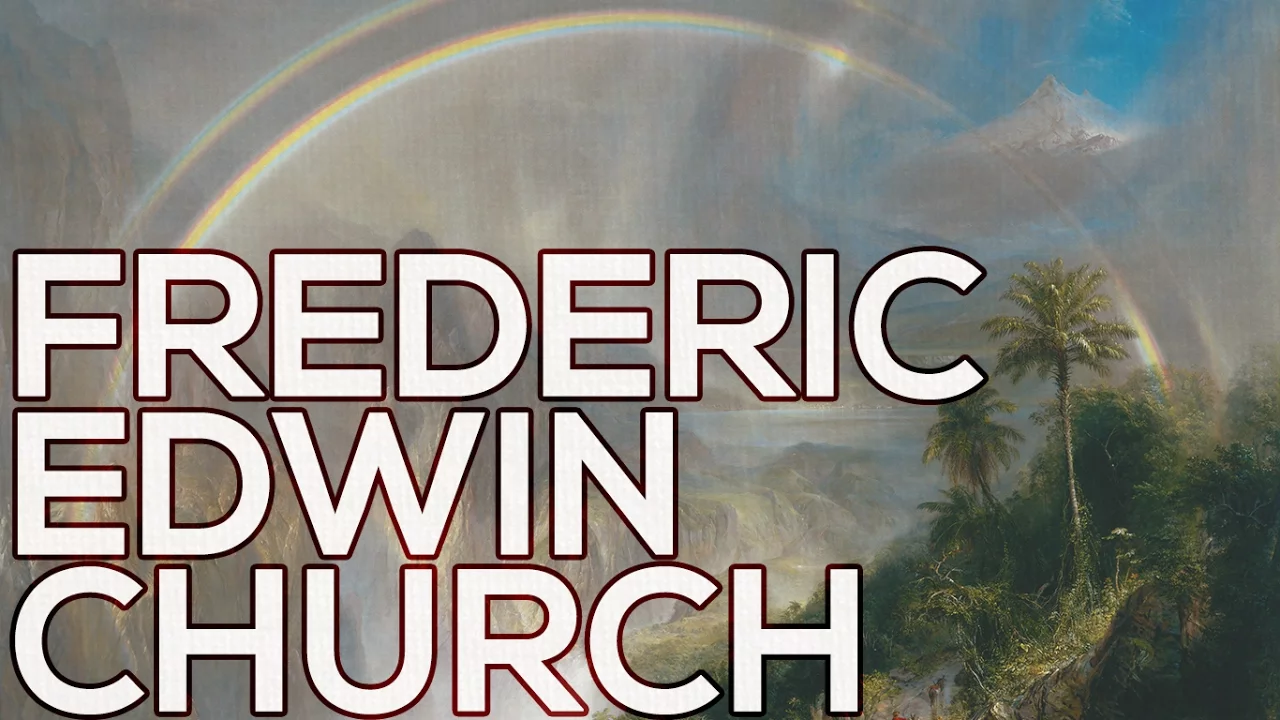
Frederic Edwin Church: A collection of 206 paintings (HD)
54.6K
Frederic Edwin Church was a leading American Romantic landscape painter and a prominent member of the Hudson River School. He studied under Thomas Cole and was deeply influenced by the naturalist Alexander von Humboldt, whose writings shaped his approach to depicting nature. Church sought to capture nature’s grandeur through subjects like Niagara Falls, erupting volcanoes, and icebergs. He traveled extensively, including to Ecuador, where he lived in Humboldt’s former home and painted the Andes Mountains and tropical forests with meticulous detail. His works combined scientific observation with emotional resonance, using light, color, and atmospheric effects—such as rainbows, mist, and sunsets—to create realistic yet evocative scenes. He systematically studied subjects over time, notably painting the Ecuadorian volcano Cotopaxi across several years in varying states of eruption. Major works include Andes of Ecuador (1855), Niagara (1857), and Cotopaxi (1862). Church achieved significant acclaim in his lifetime, selling paintings at high prices. After 1877, rheumatism forced him to stop painting. His masterpiece Icebergs (1861), long considered lost, was rediscovered in 1979. In the late 20th century, art historians reevaluated his contributions, recognizing him as one of America’s foremost landscape painters.
Click to watch →
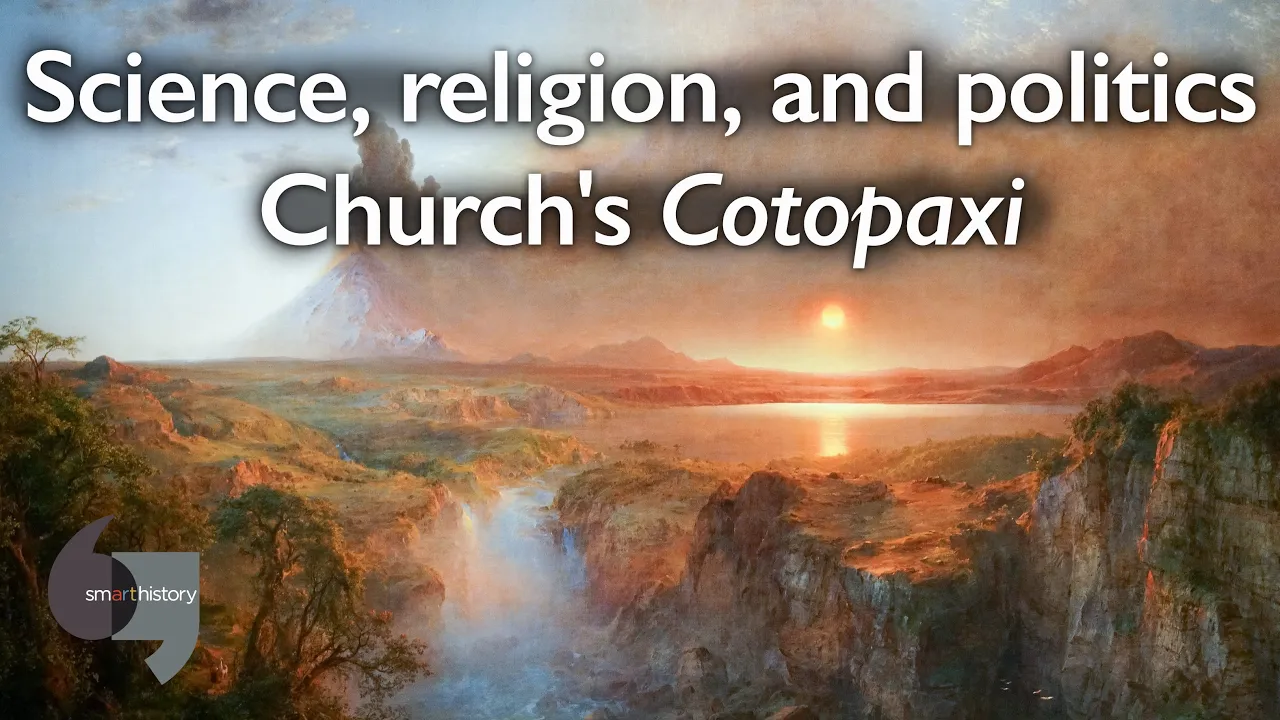
Science, religion, and politics, Church's Cotopaxi
8.8K
Frederic Edwin Church's 1862 painting Cotopaxi, depicting an erupting Ecuadorian volcano, exemplifies how 19th-century American artists used dramatic natural scenes to reflect contemporary social and political tensions; during the Civil War, viewers interpreted the volcanic eruption as a metaphor for the nation's violence and despair, while finding hope in symbols like the clear blue sky and a cross reflected in the lake, demonstrating how art can serve as powerful social commentary.
Click to watch →

Frederic Edwin Church: A collection of 108 works (4K)
220
Frederic Edwin Church, the first student of Thomas Cole, adopted his mentor’s allegorical vision of American scenery but later evolved beyond moralistic landscapes under the influence of John Ruskin’s belief that detailed natural study revealed universal truths. Inspired by Alexander von Humboldt’s Cosmos, Church pursued a scientific yet grandiose approach to landscape painting, merging panoramic views with precise natural detail. He traveled to South America in 1853 and 1857, producing sketches that became iconic paintings of Andean volcanoes like Cayambe, Cotopaxi, and Chimborazo. He also visited Niagara Falls, where his 1857 painting earned international acclaim and established him as America’s leading painter. In 1859, he journeyed to Labrador and Newfoundland, painting iceberg scenes documented by his companion Reverend Louis Legrand Noble in After Icebergs with a Painter (1861). Church married Isabel Carnes in 1860 and built Olana, a Persian-style estate overlooking the Hudson River. His career peaked in the 1860s but declined in the 1870s; by 1880, rheumatism forced him to abandon large canvases, turning instead to small oil sketches of Olana under varying weather. He died in 1900 largely forgotten by the art world.
Click to watch →
Deep Dive
A comparative analysis of the American Sublime with European Romantic landscape painters, specifically J.M.W. Turner and Caspar David Friedrich.

MARK ROTHKO - 1a parte / by ANNA MERONI
7.1K
Art historian Robert Rosenblum wrote 'The Sublime Abstract' establishing a connection between Caspar David Friedrich, J.M.W. Turner, and Rothko. Friedrich's 'Monk on the Beach' (1809) shows a small figure contemplating the infinite sea and sky, with horizontal lines pushing toward abstraction. Turner's 'The Evening Star' earned him fame as a precursor to abstract painting through extreme color rarefaction. Rothko's 'Brown on Blue' (1954) was seen by Rosenblum as doing the same thing, revealing that in Rothko's abstract language, viewers themselves become the monk before the sea, in contemplative silence. Rothko associated colors with specific meanings: intense yellows and reds expressed vitality but were also colors of hell and blood; black represented death and feelings of inadequacy. He believed people who wept before his paintings were experiencing the same religious experience he had when painting them.
Click to watch →
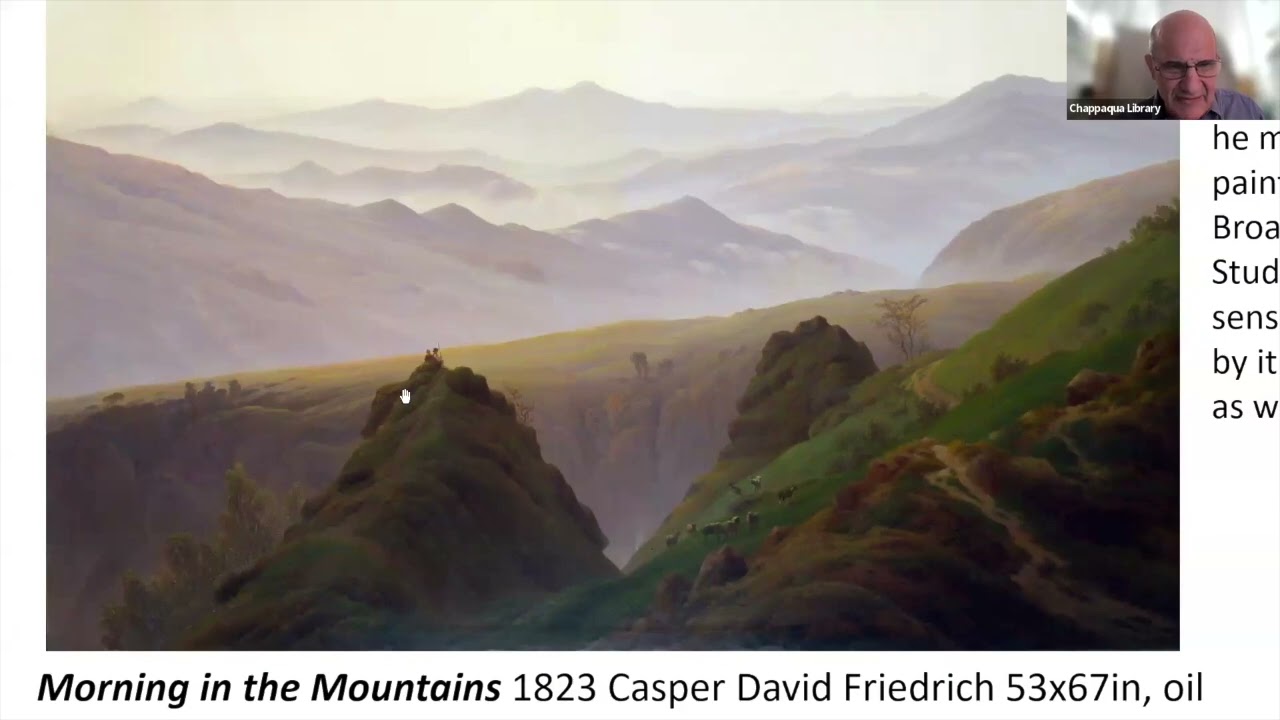
Art Talk - (Un)Settled: The Landscape in American Art
137
Albert Bierstadt, after his 1859 Rocky Mountains trip, combined studio training with outdoor sketching to cultivate a market for Western pictures. Caspar David Friedrich's German Romantic landscapes with symbolic meaning and the sublime concept of vast, awesome, terrifying nature influenced American Hudson River School painters. Frederic Church's 1857 South American journey produced works unveiled on Broadway in 1859, attracting 12,000-13,000 viewers. The Hudson River School's idealized landscapes represented the first ecological movement, preserving natural beauty through documentation as actual landscapes were being destroyed.
Click to watch →

Caspar David Friedrich, his Paintings, a talk
13.2K
Caspar David Friedrich (1774-1840) was a pioneering German Romantic landscape painter who pioneered the use of landscape as a self-contained emotive subject, using isolated figures seen from behind to invite viewers to experience the sublime—a concept defined by Edmund Burke as powerful natural phenomena that evoke awe, dread, and transcendence through their threat to human existence, while remaining safely observed from a distance.
Click to watch →
CIVILISATIONS paradise on earth
5.5K
In 17th century Holland, landscape art focused on building national identity through reclaiming land from the sea. The Dutch felt emotionally invested because they physically made much of the landscape. Between 1600 and 1612, 200,000 acres of the Inland Sea were turned into pasture using 43 windmills. Jacob van Ruisdael transformed Holland's emblem into a hero, with paintings often disguising religious devotion—sails forming the cross of the Redeemer, with openings in the sky as visual echoes of divine Providence. European artists like Altdorfer and van Ruisdael did something irreversible with landscape painting. John Constable combined scientific curiosity with critical views of industrialization, launching Romanticism. His contemporary JMW Turner used landscapes as metaphors for European civilization ravaged by Napoleon's conquests, showing individuals at the mercy of vast forces. These images instilled awe and terror, reaching the 'sublime'—experiences in nature inducing fear, apprehension, and excitement. Turner's sublime sense of Titanic forces shaping human destiny crossed the Atlantic with Thomas Cole, who pioneered American landscape painting with a style of effective coarseness that emphasized wilderness. The Hudson River School emerged from Cole's success, with Edwin Church seeking the American sublime in epic depictions of natural wonders. Americans in the 18th and early 19th centuries were poor country cousins on Europe's outermost fringe, taught that Rome was the center of all arts. They began celebrating their own high mountains and big animals in the same terms. The Hudson River School pioneered luminism, using light effects and concealed brush strokes for overwhelming detail.
Click to watch →

The Painter Who Revolutionized Landscapes
360K
Caspar David Friedrich, a German Romantic painter of the early 1800s, revolutionized landscape painting by using nature to evoke the sublime—a concept from Kantian philosophy where humans experience awe and terror before something vast and incomprehensible; Friedrich achieved this through techniques like tiny human figures against vast landscapes, ominous nebulous environments with rolling mists and contorted trees, and the röken figure (viewed from behind), which invited viewers to feel their own insignificance before nature's immensity, making him particularly resonant for winter's humbling season.
Click to watch →
Deep Dive
The role of 19th-century landscape art in pioneering the American environmental conservation movement and the eventual preservation of Niagara Falls.

Resurrected Landscapes: Frederic Church and the Public Park Movement
289
This webinar explores how 19th-century American landscape painter Frederick Church's paintings, New York's Central Park, and Niagara Falls Reservation represent 'resurrected landscapes'—works that recreate and memorialize natural environments lost to rapid urbanization and industrialization. Church, who served on Central Park's Board of Commissioners and initiated the Free Niagara Movement, collaborated with landscape architect Frederick Olmsted and architect Calvert Vaux to preserve threatened natural scenery. Both Church's paintings and the parks served as therapeutic landscapes offering solace to urban dwellers while memorializing pastoral ways of life that were rapidly disappearing. This connection between artistic representation and environmental preservation demonstrates how artists of the Hudson River School used their work to advocate for land conservation and create lasting connections between people and nature.
Click to watch →

Frederick Law Olmsted | Designing America
73.2K
Olmsted's work at Yosemite advanced the theory that republics have responsibilities to protect scenic beauty, which he implemented at Niagara Falls through the decade-long Free Niagara Movement. His 1885 victory established precedents for national preservation. Meanwhile, his practice evolved from individual work to organized firm operations at Fairstead, Massachusetts, where apprentices and partners developed systematic approaches. This parallel development of conservation philosophy and professional practice established foundations for both environmental protection and landscape architecture as distinct disciplines.
Click to watch →

Toronto | Neighbors to the North - Part 3 - NIAGARA FALLS, GRAFFITI ALLEY, KENSINGTON MARKET
65.3K
Niagara Falls has a rich history of conservation efforts. In the 19th century, private individuals owned the land and built mills, factories, and fences that people had to pay to view the falls, degrading the natural landscape. Influential figures including Frederick Law Olmsted formed the Free Niagara Movement to restore the area to its natural state. This movement culminated in 1885 with the establishment of Niagara Falls State Park, which preserves the falls in their natural condition. The park offers guided tours that explain the history, current state, and future plans for the area.
Click to watch →

Virtual Talk - 19th Century Painting in America: The Hudson River School
251
Thomas Cole painted Niagara Falls in the early 1830s, capturing the waterfall before significant industrial development had spoiled the area. By the time he painted it, factories and tourist facilities were already appearing near the falls. Cole deliberately excluded unsightly buildings, hotels, and scenic overlooks from his paintings, instead depicting only the romantic and beautiful aspects of the area. His paintings served as environmental preservation statements, celebrating the unspoiled grandeur of America's natural wonders before they were threatened by industrialization and tourism.
Click to watch →
Frederick Law Olmsted | Designing Western New York
10.2K
The Free Niagara Movement, led by Olmsted, marked the first big national campaign on behalf of scenic preservation in North America. When Olmsted revisited Niagara Falls with William Dorsheimer and H.H. Richardson in 1871, he was dismayed by the changes since his childhood visit. The once-pristine wilderness had become industrialized with factories, hotels, and carnival-like tourist attractions. Barker hawkers assigned prices to everything related to the falls, and only Goat Island remained as a vestige of the natural landscape. The movement proposed using New York State's constitutional power of eminent domain to buy back private lands surrounding the American side of the falls for scenic preservation, requiring approximately one million dollars to tear down factories and purchase land. After 16 years of political struggle, legislation passed in 1885, creating the first state park in America. This achievement demonstrated that government action could prioritize conservation over short-term economic interests, establishing a precedent for future environmental protection efforts.
Click to watch →
Church's Niagara
Iconic Masterpiece
Church's Niagara
0:02- 1
Explores Frederick Church's 1857 painting of Niagara Falls.
- 2
Highlights its role in establishing his reputation as a top landscape artist.
- 3
Discusses the work's depiction of nature's power and beauty.
The Myth of Untouched Wilderness: Manifest Destiny and Industrial Erasure
While Frederic Edwin Church’s 'Niagara' is traditionally celebrated as a masterpiece of the transcendent American sublime, critical art historians offer a demystifying counterpoint. They argue the painting functions as an ideological tool of Manifest Destiny and industrial erasure. By 1857, when the work was painted, Niagara Falls was already heavily industrialized, cluttered with factories, hotels, and tourist infrastructure. Church deliberately omitted these human incursions to present a pristine, Edenic wilderness. This romanticized depiction created a nationalist myth of an empty, divinely ordained continent ripe for American expansion and resource exploitation. Far from a neutral appreciation of nature's power, this perspective views the painting as a sanitized construction that masked the ecological toll of industrialization and facilitated the erasure of Indigenous displacement by framing the land as an uninhabited, God-given frontier.
The philosophical concept of 'the Sublime' in 18th and 19th-century aesthetics, particularly the ideas of Edmund Burke regarding awe and terror in nature.
The origins and characteristics of the Hudson River School, America's first native school of art founded by Thomas Cole.
The historical context of 19th-century America, including the ideology of Manifest Destiny and the tension between industrial expansion and the preservation of wild nature.
Basic elements of visual analysis in landscape painting, such as scale, atmospheric perspective, and the dramatic use of light.
The development of Luminism, an offshoot of the Hudson River School focusing on tranquil, highly detailed, light-infused landscapes.
An in-depth study of Frederic Edwin Church's later global masterpieces, such as 'The Heart of the Andes' and 'Cotopaxi', to understand his travel-based oeuvre.
A comparative analysis of the American Sublime with European Romantic landscape painters, specifically J.M.W. Turner and Caspar David Friedrich.
The role of 19th-century landscape art in pioneering the American environmental conservation movement and the eventual preservation of Niagara Falls.
302 views13likes4:15@FreedomProjectMediaOriginal Release: 2021-08-13
[Music] welcome to another instant classic this is church week on the dr duke show that is frederick edwin church the great american sublime artist who was born about uh the middle of the 1820s 1826 or so died in 1900 had a great career one of the most at the time probably the most famous american painter in the world one of his paintings sold in 17 1979 for more money than any other american painting in the history of the of the country so very one of our great painters one of our most known painters and we're studying him today because of his understanding of the sublime about turning to nature to give us a sense of perspective and humility two things that the modern progressive does not have a sense of place where are we in the what is our role in the universe and humility right gratitude and self-abasement in the in the face of these great great natural wonders that god has made for our contemplation and what natural wonder in the western hemisphere has been more covered and more painted than niagara falls here is of all the renderings of niagara falls by sublime painters in the 19th century this is clearly the greatest this is uh frederick edward church's niagara uh it was his most work most important work to date by then 1857 he was just beginning to cut his chops he was just beginning to make a name for himself we've seen how many of his great paintings were written between painted between 1861 and 1865 this was early on for him and this one really put him on the map 1857 confirmed his reputation as the premier american landscape scape painter of the time in his history of niagara falls pierre bertone writes quote of the hundreds of paintings made of niagara before church and after him this is with common consent the greatest i think it's exactly right the falls were very very commonly painted being such an attraction to landscape artists that writes john howard they were quote the most popular the most often treated and the tritest single subject matter of item of 18th century and 19th century european and american paintings so it was done so often it was it was trite but not this picture you get a just gorgeous panorama here stepping back from the falls you can see the power and the rush of those falls you can see the swirling white caps but boy that ominous gray sky in the back with those almost periwinkle dark blood-colored uh clouds i mean you got a real sense here of the the not just the beauty but the dangerousness of this kind of a spectacle how fatal it can be if you try to insert yourself into it any other way and so the fouls were over painted ultimately but this was a masterpiece the public was so captivated by the natural wonder of the falls they considered this landmark of north american landscape a major tourist destination in the 1850s it was the subject of millions of stereographs and its image could be found on wallpaper china lampshades among the consumer other consumer items for americans the falls symbolized the grandeur and expansionism of the united states is also an image from an american not a canadian perspective perhaps of manifest destiny it's un this unstoppable force that was pouring across the land and so so many really really great institutions and ideas represented in this painting of niagara by by our painter of the week painter of the highest magnitude american painters anyway painter church [Music]
Up Next

13:36
Romanticism Art History: Delacroix to American Landscape Painting
@marycmcconnell
204 views•2016-02-11

114:18
Christian Iconography: History, Theology, and Meaning | Fr. Panayiotis Papageorgiou
@Trisagionfilms
58.8K views•2020-02-21
7:48
Ukiyo-e Art: History, Woodblock Printing & Influence
@japanathand
6.3K views•2023-06-08

16:34
Earliest Depictions of Jesus in Art: 10 Ancient Images Explained
@UsefulCharts
5.9M views•2022-06-03
Related Study Plans & Knowledge Roadmaps
Structured learning paths in Art History
art-history
Gothic Cathedrals: Engineering, Light & Society
01The Birth of the Gothic: Romanesque to Suger's Vision
02The Structural Triad: Pointed Arches, Ribbed Vaults, and Flying Buttresses
03Theology of Light: Lux Nova and Sacred Geometry
+ 2 more learning modules
14h5 modules
Explore Roadmap
art-history
Pre-Raphaelites: Realism, Symbolism & Critique
01The Victorian Art Establishment and Academic Formula
02The Founding of the PRB and Radical Realism
03Medieval Revivalism and Literary Symbolism
+ 1 more learning modules
8h4 modules
Explore Roadmap
art-history
Street Art: From Subways to Art Market
01Subcultural Origins in Philadelphia and New York (1970s)
02The Subway Era and Style Wars (Late 1970s - 1980s)
03The East Village Scene and Early Gallery Crossover
+ 2 more learning modules
10h5 modules
Explore Roadmap
art-history
Classic Maya Art: Iconography, Glyphs & Ritual
01Foundations of Classic Maya Visual Culture
02Deciphering Maya Hieroglyphs & Text-Image Integration
03Sacred Geography and Cosmological Architecture
+ 2 more learning modules
14h5 modules
Explore Roadmap