






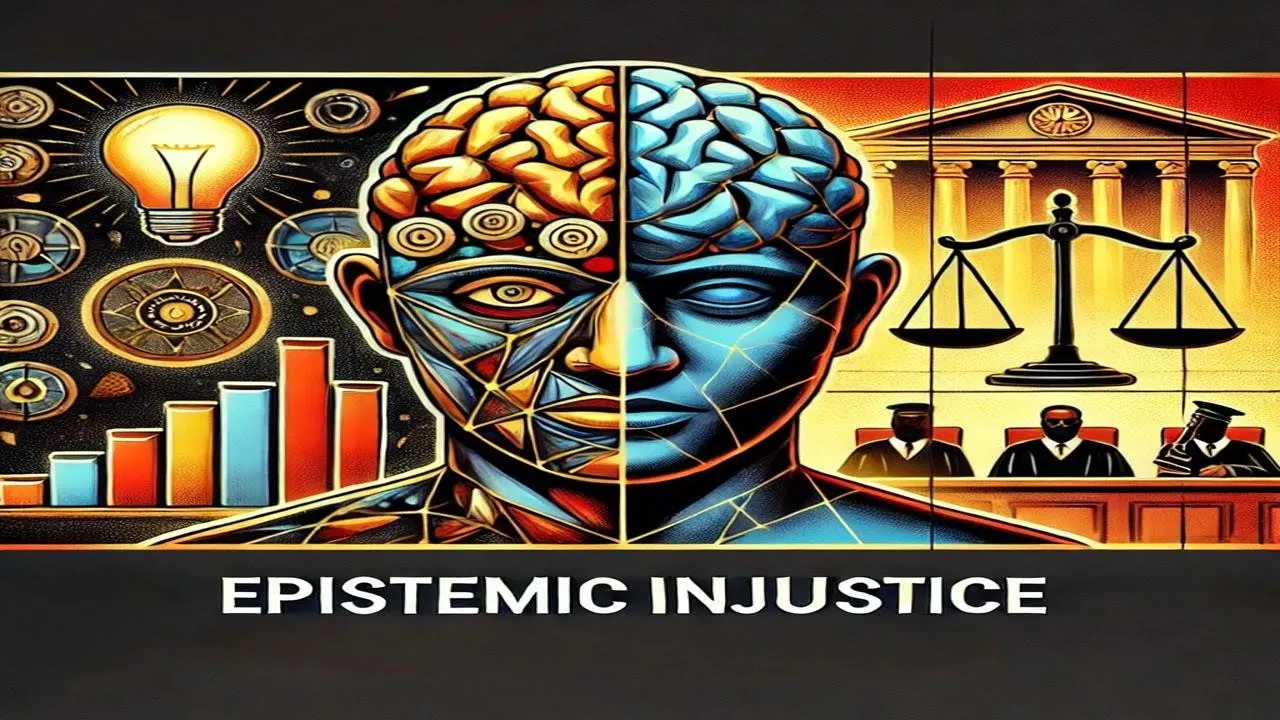

















Epistemic injustice, including testimonial injustice (where speakers are unfairly discredited due to prejudice) and hermeneutical injustice (where people cannot articulate experiences due to lack of shared concepts), represents a fundamental barrier to human flourishing that should be recognized as a distinctively social capability requiring institutional safeguards to ensure fair participation in knowledge production and collective understanding.
Epistemic Equality: Fricker on Social Epistemic Contribution
Added:Introduction to Social Epistemology: Understanding how knowledge is constructed, shared, and validated within social contexts and institutions.
Miranda Fricker's core concepts of Epistemic Injustice: Specifically, the definitions and distinctions between testimonial injustice and hermeneutical injustice.
The Capabilities Approach: Familiarity with the normative framework developed by Amartya Sen and Martha Nussbaum regarding basic human capabilities and well-being.
Basic Feminist Epistemology: Understanding how standpoint theory and situated knowledge challenge traditional, supposedly objective epistemological frameworks.
Applied Epistemic Justice in Policy: Analyzing how to design democratic institutions and legal systems that protect and promote epistemic capabilities.
Epistemic Decolonization: Exploring how colonial power dynamics historically and currently suppress non-Western systems of knowledge and epistemic contributions.
Epistemic Virtue Ethics: Investigating the individual and collective intellectual virtues (like epistemic humility and corrective justice) needed to mitigate epistemic harms.
Algorithmic and Digital Epistemic Injustice: Examining how modern search engines, social media algorithms, and AI systems reinforce credibility deficits and marginalize voices.
33.7K views581likes40:57Original Release: 2014-09-10
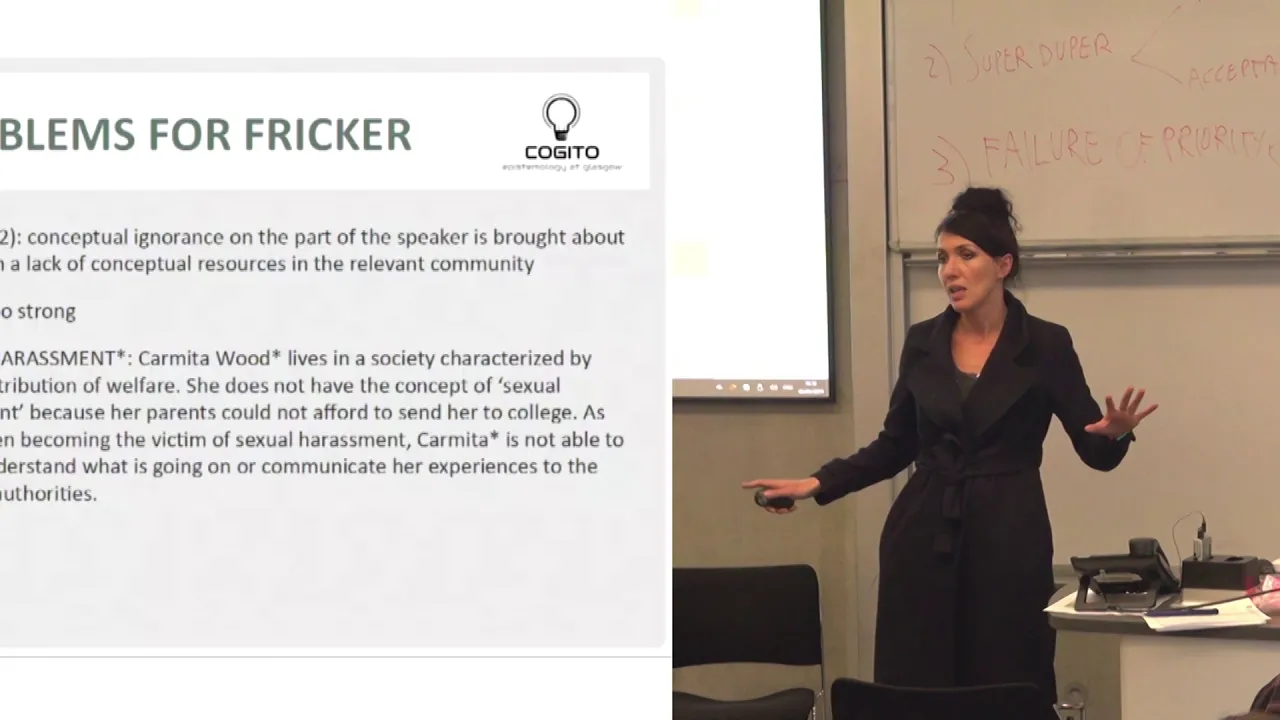
the reason is a question mark that George noticed is not because I'm a fan of ending every sentence with a question but because I'm going to make a proposal the time uncertain about I'm certain there is such a thing as epistemic inequality but the proposal I'm going to make at the end having gone through a few examples is a repose abut we might think about a certain sort of epistemic contribution that I call social epistemic contribution as a basic human capability along the lines that Martin and then Martha Nussbaum have developed as an international theory of and the condition of justice and I'm uncertain about that I merely put it before you for your consideration and I which are Azaria in general I found it useful in thinking about the intersections between epistemology ethics and our political life to start with the negative and to be fairly explicit about this as a methodological approach to look at injustice first rather than justice inequality of rather than equality and in fact this finds its precedent in virtually theory too it's very useful to think of virtues in general as Philippa foot once suggested as the things that help us stave off certain natural pressures towards egotism selfishness etc and I think of a lot of social value certainly equality and justice as being of that kind that they are as it were success terms that if you can achieve justice or equality in some patch of society or an in smore in some stratum of our activity in society then that's because you're successfully holding off certain sorts of pressures for collapse into injustice and collapse into inequality and the pressures I take it come from very basic features of human nature that there's a sort of will to power that there is prejudice that we often operate under conditions of competition and so there are these natural endemic pressures towards collapsing into the negative versions of these things and that means although somebody could perfectly well define epistemic equality or any kind of equality in justice without explicit reference to their failure I would suggest that a full conception and certainly certainly an understand landing of the nature of these that success states in society requires us to understand what sorts of pressures are being staved off and in fact I've argued elsewhere that some kinds of justice in particular epistemic justice just doesn't come to light as existing at all until you look first at how it fails until you look at examples of epistemic injustice it might not occur to anyone to think that there's such a thing as epistemic justice so that's the sort of general pattern of the methodology and I'll be looking at forms of epistemic inequality today in connection with ideas I put forward in relation to as forms of epistemic injustice elsewhere so I think that we could think that there's very broadly at least two kinds of unfair epistemic inequality and I've talked about them elsewhere as forms of epistemic injustice but what I haven't done elsewhere is emphasized the importance of the distributive paradigm or the district distributive notions of epistemic inequality I only didn't emphasize them because I thought of them as well understood already which I think they are but they're nonetheless important for all that and therefore worth emphasizing an incredibly important area of epistemic inequality is the question of whether people have fair access to X Teaneck goods such as education information good advice technical legal advice and resources for inquiry of various kinds that's something which as I say I think is an entrenched feature of ordinary social theory and understanding about how injustice and inequality works but it's worth emphasizing the epistemic aspect of it now to circle off discriminatory forms of epistemic injustice as a kind of epistemic inequality isn't to say that there's a clear line of difference between distributive issues and discriminatory issues very often you can re-express the same phenomenon in distributive terms as you can in discriminatory terms but part of the purpose of looking at specific forms of discrimination in how we operate as Noah's and Inquirer's and Harrah's is to try and look deeper into the source of the inequality that's at work it's one thing to know that this group isn't getting their fair share of information or of Education but that's a fairly superficial reading of a phenomenon if discrimination is the source of the problem and so while I don't pretend these are completely different categories they are different headings under which very often similar phenomena can be brought and which bring out different aspects of those phenomena so elsewhere I've argued that there's two kinds of discriminatory epidemic injustice and we can distinguish testimonial injustice from the hermeneutical now no wish to repeat myself too much but I don't want to assume anyone knows these things so let me just give brief definitions to get the categories on the table and then I want to go and discuss a particular case to lead me on to the question about capabilities so a brief definition of testimonial injustice testimonial injustice happens when supposing I'm the hearer and there's a speaker she tells something perhaps we might imagine it's a female politician maybe I'm hearing politician views on this that and the other and evaluating their authority with respect to what they're talking about if perhaps entirely I'm unbeknownst to me maybe I'm a signed up feminist with not a sexist belief but somehow unbeknownst to me prejudicial stereotypes of male political gravitas male political authority are working on my social imagination in a way that leads me without realizing it to perceive her as somehow lesser and him somehow more in their political word if that happens and when they offer a view if you like tell me something but it needn't be strictly testimony if I allow the prejudices at work in my social awareness to depress the level of credibility I give her word then I do her a testimonial injustice and so testimonial injustice is often come about without our intending them to happen at all just because of the stealthy nature of prejudice and how it works on us below the level of belief without our permission unites it's important for me this is something I haven't stressed so much in previous work but it needn't apply narrowly to case the testimony or tellings it might apply to as Chris Hook way as suggested the asking of a question in a classroom situation if in a classroom the somebody or the teacher allows him or herself to be subject again perhaps without their realizing - prejudices of some kind which lead him to regard this students question it's not so relevant as that students then he will do the first student a testimonial injustice - so I intend I had a particular reason in earlier work for calling a testimonial and for grounding it in the business of testimony but it was always intended to extend to other speech tax all sort of asset Oryx feat tax so that somebody trying out an idea airing an opinion suggesting a hypothesis these any sorts of speech track that can be on the receiving end of a prejudicial credibility deficit is going to be the sort of thing that can give rise to a testimonial injustice obviously the deficit of credibility can come in degrees it might just be very slight but even on occasion where it's very slight that might just be enough to shift it below the belief of acceptance or it might be very great and then it's very likely to shift the level of credibility below the level required for accepting what somebody tells you what about hermeneutical injustice well again just to get this on the table for us this is a slightly more complicated thing to explain it requires us to also have on the table a notion of hermeneutical marginalization so roughly speaking I have this idea that this there's often something unjust about a situation where a member of a certain group has a social experience that he or she just isn't in a position either to understand themselves or if they understand it well and maybe their social group understands it well they might yet not be in a position to articulate it properly and communicate it to other powers-that-be other social groups because it's not sufficiently shared or that sorry the concepts required to understand it properly are not sufficiently shared across the social space now that can happen through bad luck it could be that I have an illness which gives me certain sorts of particular social experiences for instance as an experience of inability to concentrate let's say where it so happens that the medical condition I've got just through bad luck is not yet well understood it's not going to be explained by what I call hermeneutical marginalization because hermeneutical marginalization is a question of whether people like me get to contribute on an equal equal enough basis to the stock of shared meanings to the pool of concepts and interpretive trips that are at work at large in society so in a case where it's just bad luck that my illness isn't so well understood at this point in history so I've got some experiences which are hard for me to understand or hard for me to articulate to others that in itself isn't going to be a hermeneutical injustice it's kind of bad luck what would make it an injustice is if a significant part of the explanation why these concepts are not sufficiently shared across social space is that people like me don't generally get to contribute to the stock of meanings and concepts that are so shared and so there has to be this aspect of hermeneutical marginalization in the background for a case of unintelligibility as it were to count as hermeneutical injustice and an example I use again today because I think it's a very straightforward example isn't it the case of someone suffering sexual harassment maybe back in the 50s a at a time when that term and that form of understanding was not sufficiently established for them to understand what it was they're experiencing day to day in the workplace why they were feeling so upset about it and or if by now maybe it's the late 60s and that that concept has just sort of started to grow in localized feminist groups and so on but it's not yet sufficiently shared then still such a person is suffering a hermeneutical injustice because again it's no accident is it sin because of her hermeneutical marginalization that though she understands it and her colleagues aren't her friends that were her feminist group understands it she can't use it in a speech track to the powers-that-be to make a complaint about it so it's not sufficiently shared across social space that too is a case of hermeneutical injustice and so you see how hermeneutical marginalization can be highly localized to a particular patch of experience all can be entirely global in one's experience worst case scenario if you don't really get to contribute to the stock of meanings on anything much and furthermore hermeneutical injustice can be extreme if it's so much that even I don't understand the experience that I'm having as in the case of sexual harassment in the late 50s or it can be much more than me and all my community understands damn fine what this thing is that we're experiencing but we haven't got sufficiently shared concepts with the other lot to convey our experiences in Pat's protest them so it's a very internally diverse category but I think it's still sufficiently unified in form because we've got this idea that it's roughly a deficit of intelligibility owing to hermeneutical marginalization so that's the unifying factor okay so with those two terms just on the table I want to explore a particular example a very sad example from British history of which some of you will know of there was a 18 year old young man a black man who was murdered in 1993 by a gang of young men white men in east southeast London and Eltham and it was an explicitly racially motivated murder in fact these two young friends were waiting at the bus stop and they heard some shouting from across the road by the five or six that still not known exactly how many of them there were young white guys and it resulted in Dewayne Brooks running away somewhat palling to his friend Stephen come on Stephen we gotta go we gotta go Stephen Lawrence didn't run or not so far and he got caught up with by the gang of white youths and he was stabbed several stab wounds and eventually died of those stab wounds later that evening at the scene Dewayne Brooks a fellow victim of the crime therefore but who had escaped stabbing was also the prime witness the chief witness to the crime obviously no ambiguity about that and what happened was that as diagnosed by the government independent inquiry commissioned by the government later on which was published in 1999 called the McPherson report was that the police officers arrived at the scene and perceived both Dewayne Brooks and Steven Lawrence are according to racialized negative stereotype that they were probably part of the trouble there's probably a gang stabbing they were probably part of things in fact they've just been sounding innocently a bus stop at a bus stop and earnings that prejudicial perception of these two young men the police among other things failed to ask Dwayne Brooks any questions at all at the scene of the crime and it said that when he did try and of course he's in a terrible state he's watching his friend bleed to death before him on the pavement and is furious that the police don't seem to be trying to hurry along the ambulance the police arrived before the ambulance did so he's in an incredibly heightened state and they failed to calm him and there's an explicit police protocol that any victim of a crime which he was is supposed to be calmed and helped they didn't treat him in that way he was also the chief weak witness and was not treated in that way either and the McPherson report is a is a very interesting and well done document and I really read the philosophy almost off the surface of the report actually but let me just read out this little section of the report the officers failed to concentrate upon mr. Brooks and follow-up energetically the information which he gave them nobody suggested that he should be used in the searches of the area although he knew where the assailants had last been seen nobody appears properly to have tried to calm him or to accept that what he said was true - that must be added the failure of inspect and Steven groped the only senior officer present before the ambulance came to try to find out from mr. Brooks what had happened it couldn't be simpler they did not perceive this young man as a source of knowledge they perceived him as part of the trouble and the explanation as is made manifest in them at first a report is a prevailing what came notoriously to be called institutional racism on the part of the Metropolitan Police whereby white and black officers according to some of the testimonies taken from the members of the black Police Association was somehow insidiously party to all sorts of prejudicial racial stereotypes which caused them to perceive any black person they meted a crime certainly any young black man they saved a crime as part of trouble and in fact when you read on the way that Stephen Lawrence's parents were treated throughout his a palling and its long and difficult saga whose history you can read up elsewhere but I'll just focus on what happened at the time at later in the evening I should say Dwayne Brooks was interviewed and he was asked whether he wanted to have the interview there and then he wasn't required to do it at night and he was also asked whether he wanted to have someone else present whether his mother for instance would be present so they did get his testimony properly later but they totally failed the crucial opportunity to get evidence at the scene of the crime so they could have discovered where these people had gone and so on and followed up other evidence and other testimonies and they failed to and for many many years that meant there was no prosecution though some of you may know there was I think in more recently I think 2012 a prosecution of joint enterprise where two of the assailants were prosecuted for the murder so thinking about this sad example I want to focus on the epistemic aspect of it and give the sort of diagnosis fairly obviously I think it's a case of testimonial injustice I've described it as such that Dwayne Brooks when he tried to tell the police things he received a deficit of credibility owing to the operation of the racial stereotype on the police's part he is also on the receiving end of what I call preemptive testimonial injustice which is that they didn't ask him anything you're you're a subject to preemptive testimonial injustice if prejudice in the perception and cognitive faculties of you're here as your interlocutors means that they don't even ask you your view you don't even get the chance to receive a credibility deficit as it were the rain Brooks Brooks did because he was demanding he's trying to he was telling them things so basically they didn't ask him stuff and when he did demand and tell them things he received a deficit of credibility so he was on the receiving end of both kinds of testimony on injustice there I'd also like to think about this case in connection with the phenomenon of hermeneutical injustice in a slightly extended way because of the introduction into a much of wider use which the McPherson report did of the notion of institutional racism the notion existed before and I have absolutely no doubt that communities on the receiving end of all forms of racism had a very clear idea of how institutional racism functioned but it did not it had not reached the kind of collective use and institutional use that was required for it to do a lot of work for anybody for instance to be the sort of thing someone could complain about in their workplace or complain about in how they were treated by the police and so this example provides us with some materials to think about hermeneutical injustice to Duane Brooks is experienced in so far as it was among other things and experience of institutional racism no doubt it was an experience of the plain interpersonal racism to I don't rule that out but at the very least institutional racism as diagnosed by McPherson that meant that the type of experience he was having they're being ignored sidelined held perhaps and some contempt by the police at least the investigating officers was not an experience for which there was a ready conceptual label that could be used across social space and in in so far as that's the case there was a conceptual lacunae a gap where the notion of institutional racism needed to be inserted into much wider use and so the example illustrates that phenomenon too if we look at how it panned out after McPherson so if we think about these kinds of epidemic injustice that I've been characterizing what I wonder is whether we can actually sort of abstract to a conception of them both as involving something very basic a basic inhibition on how the person who's subjected them is able to function as a knower inquire as a as an epistemic subject and I think there is where is a previous work I've always loved Kevin very separate it does seem to me that being prevented from making your contribution to the pool of resources for which which we use to create knowledge and shared understanding is the crucial common factor between both kinds of testimonial or justice and hermeneutical injustice in the testimonial case it's more at the level of beliefs knowledge as a whole things one might say of assertions but in the hermeneutical case is at the level of concepts and interpretive tropes but in both cases for unfair reasons whether it's its visit prejudice or whether it's this hermeneutical marginalization which is a subtler more structural form people subject to these in justices can't contribute to a pool of epistemic resources and i've started to wonder whether this really is an extremely basic and sufficiently unified sort of capability to counter something that we ought to turn our attention to as a basic human capability a distinctively epistemic one it's rather abstract but it comes out in these extremely concrete forms and it has a great reach in terms of the things we need in society to flourish and to achieve any sort of equality and the two examples of its reach I just want to briefly go through with you are two political values one freedom of speech and the other non domination now one doesn't normally think very explicitly about epistemic function of this kind a post emic what i going to call social epistemic contribution as a condition of freedom of speech or as playing any particularly important part in the liberal case for the importance of the freedom of speech but it's fairly explicit it's close to explicit in Mill and I just want to make it very explicit for us to put it on the table so in on Liberty Mill says this famously assuming that the true opinion abides in the mind but abides as a prejudice a belief independent of and proof against argument this is not the way in which truth ought to be held by a rational being this is not knowing the truth truth thus held is but one superstition the more accidentally clinging to the words which enunciated truth I like his tone sounding rather Kantian this is not the manner in which a rational being ought to hold a truth what seeing on about the people have often talked about this defense of freedom of speech in terms of being an instrumental argument related to the value of truth but others have rightly pointed out really it's it's actually related to the value of knowledge as this little extract reveals I think Mills argument for the importance of freedom of speech is an instrumental argument along according to which we must have freedom of speech because otherwise we won't know things collectively and the connection with Kant is more and more obvious when you remember that cants at least on a constructionist view cants conception of the whole rat the whole authority of Reason itself is that every critical thought will come to the fore reason is what you get both theoretical and practical when every single point of view finds representation in the form of discussion when it can't it's a very abstract ideal but in Mill it's meant to be a concrete ideal aim we can actually organize society to maximize and what we're trying to maximize this makes clear isn't truth it's actually knowledge now collective knowledge I don't particularly want to emphasize collective as in you know plural subject this honor just knowledge that is held in society by individuals and/or by groups is something that requires every critical thought or just about every critical thought to come to the fore in order that we do have a proper grasp of the grounds for the truths that we have hit on um obviously well at least it seems obvious to me I hope it seems obvious to you if there is either kind of epistemic injustice and the kinds of epistemic inequalities that lie behind them operative in that society we won't have all the critical thoughts coming to the fore either because not just because some people will be drowned out or they're not allowed to say things those are important arguments too and that's what's often emphasized but also as I want to emphasize because in order to be heard people need to be heard without prejudice in order for the grounds for a piece of knowledge to come through it needs to be not just expressed without punishment but expressed and fully understood and its import for the doctor to be grasped by others without prejudice which means that testimonial justice is a condition for this sort of argument for freedom of speech to work similarly hermeneutical injustice if that is at large in a significant patch of society for instance if we take the example of a certain experience of racial prejudice which is purely institutional and so let's say let's try and let me be a bit more explicit that what I think was has been usefully introduced into more common and institutional consciousness in the UK since McPherson report is that there can be institutional racism in the abbé in the absence of any as it were hot active prejudice on the part of individuals within the police force so you can have these institutional structures and habits which produce racist results even if there isn't any active racist motivation on the part of the individuals in the police force so an accusation of institutional racism needs to be understood as set Herbal imprints of although often it won't be but separable in principle from an accusation of other kinds of racist attitude on the part of individuals who are dealing with one now that operating being on the receiving end of institutional racism before that concept is sufficiently established in institutional practices of complaint and so on means that you you know your thoughts your voice your experiences are not going to come to the fore in this common forum in which free speeches is is meant to be operating and so there isn't a freedom of speech and the argument of at least in that locale and the argument for freedom of speech that it will produce knowledge will fail there's a great patch of the social world to do with the operation of institutions around race which is not going to be known about because these voices are not coming through oh into hermeneutical injustice so I just think it's worth making very explicit when you have liberal arguments that depend on the idea that oh yes everybody's voices will come to the fore what does that actually mean and what does it mean procedurally for institutions and how they make it happen I don't have an answer to the practical question about procedure I can merely emphasize that in effect institutional virtues of epistemic justice need to be in place for the point of free speech according to mill to be achieved a different area where the importance of the kinds of epistemic equality that we're wishing for should be operative but often it's not really noticed so much and again worth making explicit a particular conception of political freedom comes from Phillip Pettit's Republican theory and we don't need to agree with the particular Republican idea that the proper conception of political freedom per se is non domination we might agree with that or we might just as liberals if we're liberals think well you know actually I think political freedom is best thought of in terms of negative Liberty but non domination is a very very important phenomenon and anyone who values not being interfered I suppose we might stop phrase not being in to not having your Liberty into feared ways is going to value having a certain security against having your Liberty interfered with and that's what according to pet it non domination amounts to so whether we like the Republican perception of political freedom I present these arguments on the in the hope that were all keen on the idea of non domination regardless of our view of political freedom so let me just remind us the notion of non domination is security against interference how well let's let's see it's really a kind of status on pet it's view so I might count as dominated by my employer if she could in fact even if she never would sack me on a whim with it with impunity I don't have any recourse I might be in a situation where I've got the loveliest employer in the world I happen to know I'm indispensable to her and I'm confident she'd never sack me on a whim but in fact because strictly speaking she could according to Pettitte I'm in a relation of domination that's a bit more more sort of awful example but one that Pettit discusses and I think is really important that helps one see the importance of the relation that one's in even if you can personally be sure the person will never do the bad things you so pride at the time in the UK when rape within marriage became a crime if a woman was married to a man the loveliest man in the world who would never hurt her in any way nonetheless the fact that he could in fact sexually assault her with legal impunity meant on Pettit's view she was dominated by him she was as his wife in a relation of domination I think that's really true in the sense that pet it makes very elaborate very carefully I think that this the relationships were in with others whether they're institutions or institutional officers like one's boss or whether it's personal relationships within a certain institutional setting like marriage the relation you're in if this person could work he very different do this bad thing to you it changes it shifts your sense of how you relate to each other or at least you're at great risk of it shifting your sense of how you could relate to each other and it puts in the in it makes us rely on trust and love or friendship or decency things that we can't rely on the law for and that I agree with Pettit I don't know if you will but I think that does have a general tendency to shift the actual interpersonal relations that are involved and when bosses know even though they never would they'd kind of know they could sack you on a whim if they really wanted they do kind of have a habit of treating you just a little bit differently because of that and if it can push comes to shove well they might so that's the Republican conception of domination and non domination as a stasis a relationship which depends on a counterfactual possibility of hurting you with impunity no matter how unlikely in fact that counterfactual is and I think it's a very powerful idea and a crucial aspect of it and one thing it's wonderful I think about Pettit's theory is that he his whole conception of freedom and non domination is very much I would say though it's not explicitly so built on a conception of the negative built on a conception of what the risks to our freedoms and liberties are the risks are endemics and we want a conception of how we protect ourselves repeatedly and as of right against the sorts of things that powerful bodies might otherwise be able to do with us and so what's crucial to whether you count has dominated or not is whether you have the power to contest I kept using the word just now with impunity so if my boss in fact does sack me on a whim which could happen if the University of Sheffield or the head of my faculty suddenly gets really fed up with me maybe she just tries to sack me on a whim well I could do something about it I could contest no status in the world is going to stop people doing bad stuff to each other but if you can contest it then when bad stuff happens you don't count as thereby on free whereas if you don't have the power to contest you're just dominating when it happens so if I'm sacked on a whim I can content at least I haven't checked I really hope I could I presume I could then I could contest it and that's what makes the kind of interference that goes on when somebody sacks me no good reason different from somebody sacking someone with no contract just on a whim I'm not dominated though the bad things happened was my counterpart the bad things happened and she is dominated because she can't Kontest it's done to her with impunity now this you can probably see where I'm heading requires something else which is not mentioned by Pettitte and which i think is worth making explicit which is that contesting and for him that's a success term contesting needs to be propped up by certain sorts of institutional measures he's very aware of this but there's an institutional measure he doesn't mention and that is that when contesters contest or whether they have others who can test on their part they need to be heard without prejudice and they need to be understood and so if an employer who's been sacked not just on a whim but maybe on a whim which is connected up with institutional racism wants to go and contest this fact then he or she better hope that there isn't either kind of epistemic injustice going on either in the room or in the background in the case of her music how many neuticle injustice he or she better hope that there is a term institutional racism which is going to be understood not just by him and his colleagues but cross institutionally with for the powers that be so that it can actually constitute a protest and a complaint and he'd better hope that he's heard without prejudice and that those things these epistemic or communicative aspects of contestation tend to get discussed without mention I think is a pity because they're crucially important aspects where is it they're kind of taken for granted unless we bother to flag them up and since I think off stage there is such a thing as institutional virtue and we can make sense of what would be involved in setting procedures in place to to actually make it be that a certain jury or a university or an industrial tribunal has a virtue of testimonial in testimony or justice has a virtue of hermeneutical justice then I think you know the more we make these things visible the more we can see what to do about them institutionally and so I make them explicit but my purpose in mentioning freedom of speech and non domination today is more particularly to try and make a case for house what great sort of reach this phenomenon of epidemic inequality has how it permeates aspects of whether we have free speech or not permeates aspects of whether we're dominated or not and on some views whether we have political freedom or not and so it looks to me like a candidate for something that should be on the list of basic capabilities now put on US pounds mister capabilities here just to remind us what they are I won't go into them in detail life is largely a notion of not having one's life cut short etc etc can physical notion bodily health bodily integrity understood particularly as security against physical assault sexual assault and so on sense imagination and thought that's the closest one to anything epistemic we have emotions to an emotional life practical reason that's the interesting that practical reason it gets its own special mention but as it were theoretical reason or what I'm going to call social epidemic contribution isn't singled out I'm in effect going to suggest that hey if practical reason gets its own place and then this I reckon social epistemic contribution ie theoretical reason should have its own place too affiliation which covers being a member of group having friendships and relationships and so on relationships with other species play and control over one's environment so that that's the list just to remind us but I want to focus on four and I read the list my thought hmmm does it does it cover it I thought well no I really don't think that mentioning thought and imagination is nearly explicit enough to bring out the sorts of the importance of the kind of epistemic equality that I'm concerned with so let's just look at it in full sense imagination of thought being able to use the senses to imagine think and reason and to do these things in a truly human way a way informed and cultivated by an adequate education including literacy and basic mathematical and scientific training being able to use imagination and thought sorry typo there thought in connection with experiencing and producing self expressive works and events of one's own choice religious literary Musical and so forth being able to use one's mind in ways protected by guarantees of freedom of expression with respect to both political and artistic speech and freedom of religious exercise being able to search for the ultimate meaning of life in one's own way being able to have pleasurable experiences and to avoid non necessary pain I don't fully understand the unity of these ideas especially when one gets to the bottom of this and but we won't worry about that for now our concern is whether sense imagination and thought is a heading under which we should just sort of insert social epistemic contribution of the kind I'm talking about the contribution of concepts meanings interpretations and contribution of our beliefs and with like items of knowledge that we've got I don't think so I think this is an almost explicitly individualistic conception of the value of thought and freedom of thought and that is highly valuable and I haven't got a problem with the importance to individual human flourishing that individuals are indeed able if they so choose to exercise this particular capability in the form of a concrete functioning whereby they write a book or or read a book and talk about it think imaginatively about the meaning of life think whatever thoughts they like these are all incredibly important things and think and freedom of expression she's got in there so it's also has this communicative aspect but this does not speak to the difficulties the the pressures which are against people especially in powerless groups and groups against to impress tends to operate as regards their actual capability to contribute to the pool of concepts meanings ideas beliefs knowledge from their own experience from their own point of view and that seems to me something that's a distinctively social epistemic function which is not captured this much more individual individualistic sort of expressive conception of what one ought to be entitled to and what one would be entitled to in a just society so I would like to simply suggest or propose to you tentatively I suppose that if we think about the different kinds of epistemic and just as I've talked about and how they are all forms of epistemic inequality and their different forms of course which are worth differentiating exploring in therefore different detailed ways in which they actually get manifested but nonetheless if we fuzz up our eyes a bit and we see there's actually set a basic epistemic capability here which is the social capability to contribute to the pool of resources for knowledge and understanding but that's something because of the social reach that it has because of the many different ways it can disadvantage one if it's taken away from one in a particular area of one social activity that it would be worth thinking about that capacity a distinctively social capacity being on the list of basic human capabilities thank you very much
Up Next

8:59
1984 and Epistemic Justice: Orwell on Language
@PhilosophyTube
263.7K views•2017-03-31

164:01
John of Damascus on Holy Images: A Theological Defense
@BannedBooks
139 views•2026-04-25

68:32
Should We Destroy the Machines? Big Tech Surveillance Critique
@TheStoriesWeTell303
167.9K views•2025-11-30
4:57
The Myth of Sisyphus: A Greek Legend of Eternal Punishment
@TEDEd
8.6M views•2018-11-13
Related Study Plans & Knowledge Roadmaps
Structured learning paths in Philosophy
philosophy
Frankfurt School: Critical Theory & Culture
01Foundations of the Frankfurt School and Critical Theory
02Horkheimer & Adorno: The Critique of Instrumental Reason
03The Culture Industry and Mass Deception
+ 2 more learning modules
12h5 modules
Explore Roadmap
philosophy
Philosophy of Language: From Frege to Austin
01The Linguistic Turn: An Introduction to Language in Philosophy
02Gottlob Frege: Sense and Reference
03Early Wittgenstein: The Picture Theory of Meaning
+ 3 more learning modules
15h6 modules
Explore Roadmap
philosophy
Feminist Epistemology: Standpoint & Injustice
01Introduction to Epistemology and Feminist Critiques
02Sandra Harding and Standpoint Theory
03Donna Haraway and Situated Knowledges
+ 2 more learning modules
12h5 modules
Explore Roadmap
philosophy
Environmental Philosophy: Ethics & Deep Ecology
01Foundations of Environmental Ethics & Anthropocentrism
02Biocentric Individualism and Animal Liberation
03Ecocentric Holism and Deep Ecology
+ 1 more learning modules
10h4 modules
Explore Roadmap