













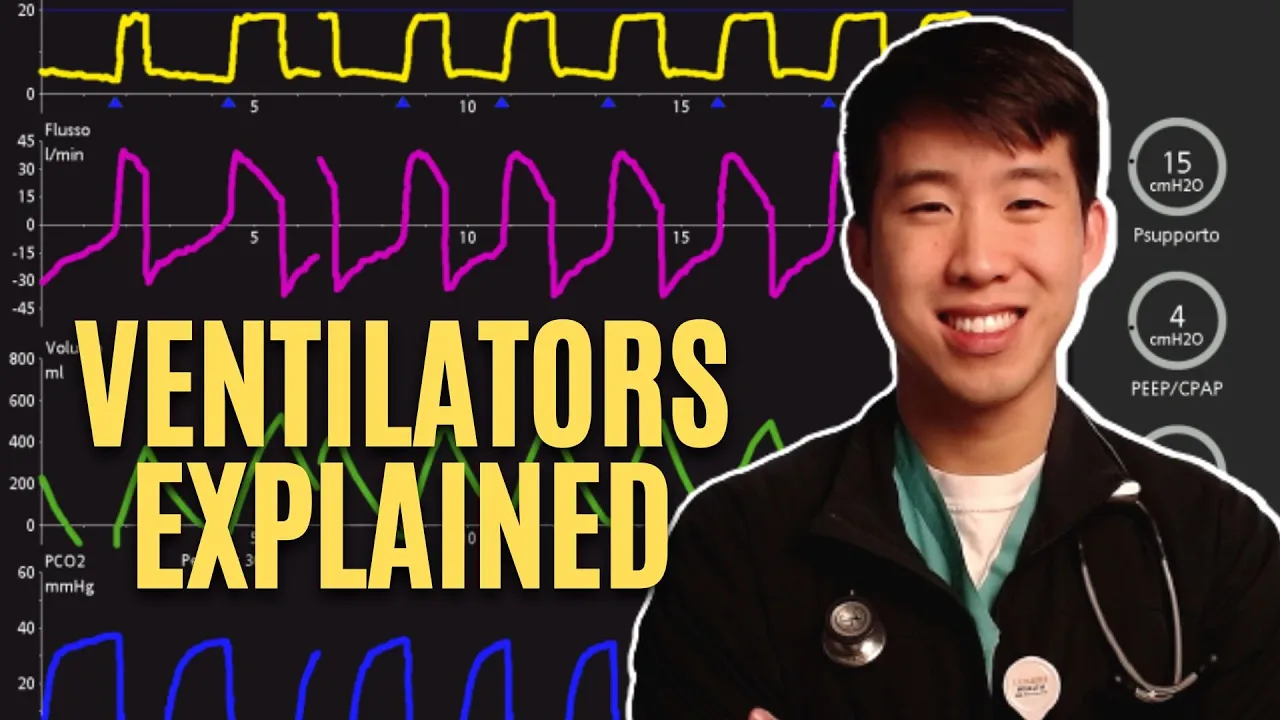



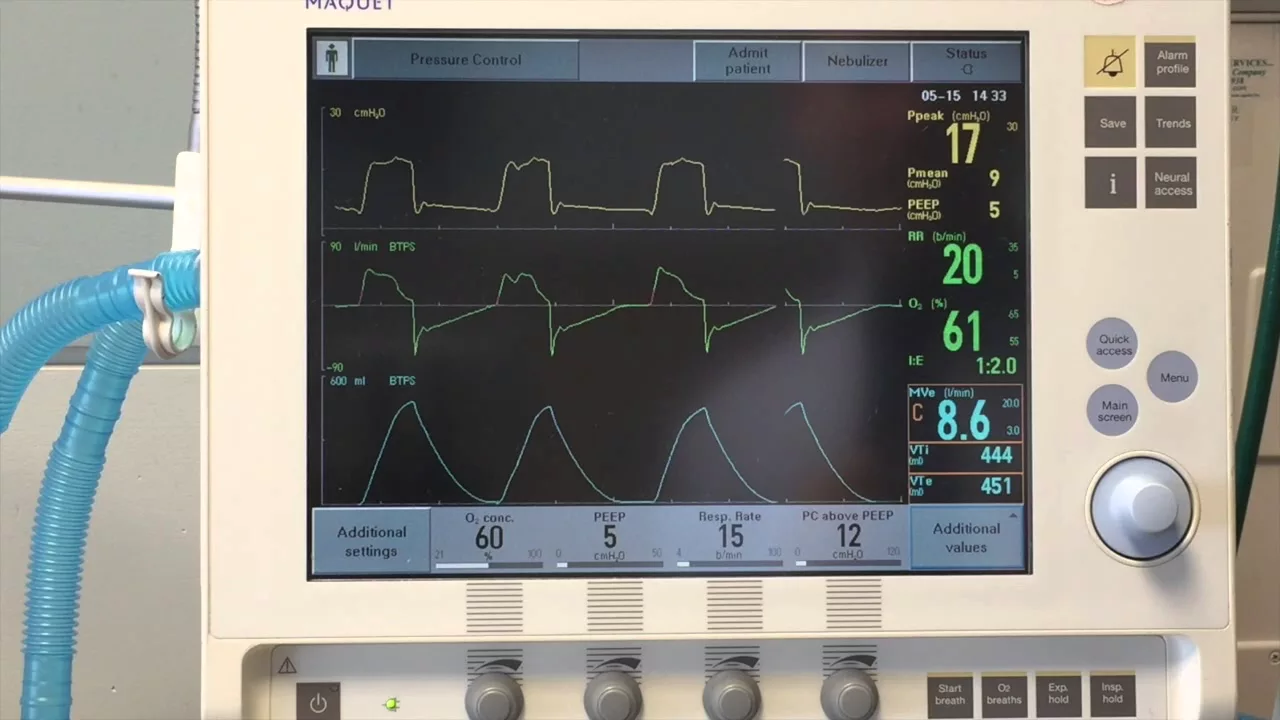
This video explains how to interpret three main ventilator waveforms (pressure, flow, and volume curves) and troubleshoot common problems: air trapping (flow doesn't return to baseline, treat with increased expiratory time and bronchodilators); breath stacking/double triggering (two quick breaths in succession, treat by increasing tidal volume to 6-8 cc/kg); air leak (volume doesn't return to baseline, check for pneumothorax or cuff leaks); and flow hunger (camel bump sign on pressure waveform, treat by providing additional flow). Flow-volume loops show normal leaf shapes, while pressure-volume loops indicate compliance (upright = improved, flat = decreased) and can reveal increased work of breathing (fishtail) or alveolar overdistension (bird beak).
Ventilator Waveforms & Troubleshooting | ICU Basics
Added:all right guys in this video we're going to be talking about basic ventilator waveforms and ways to troubleshoot problems that arise in less than 10 minutes so let's get right into it so when you look at your ventilator there's going to be three main curves that you're really going to be looking at the first one is going to be your pressure curve and then you're going to have your flow curve which is signified by a v with a dot on top of it and then you're going to have your volume curve so the way that the pressure curve usually looks is that you're going to have a little bit of peep here and you're going to get this kind of shape like this this is if you're in pressure control if you're in volume control mode then it's going to look slightly different it's going to have a little bit more of this kind of shark fin appearance in volume control mode for the flow waveform you're going to have the inspiratory limb and then you're going to have the expiratory limb and what you're going to see is a sharp increase in the flow on inspiration which gradually tapers off and then you go to the expiratory limb where you should see this kind of go back to baseline so you start off positive and then you start having the expiration here and then again you repeat the cycle like this and then finally for the volume curve this is just going to show some peaks when you're having inspirations kind of like this all right and so there's a few problems that i want to go over with you guys that may come up when you're treating patients or may come up on rounds and that's going to be air trapping it's going to be breath stacking or double triggering air leak flow hunger and then i'm briefly going to go over some flow volume and pressure volume loops all right so for air trapping this is going to be a common one that you're going to see and this one you really want to be looking at the flow curve and what you're going to see here is that you're going to see an inspiration and then you're going to go into the expiration limb and then it starts to go back to baseline but before this gets all the way back to baseline you already have the next inspiration so the key thing that you want to look at here is that you do not have a return to baseline in terms of your flow before the next breath initiates and so typically this is going to be in your patients with severe emphysema copd or asthma so what are the ways to treat this well the main principle that we want to use here is we want to use the eye to e time and obviously this is a problem with obstruction in the airways and by increasing the expiratory time you're actually going to give time for that trapped air to come out of their airway system so what you want to do is you want to decrease the inspiratory time and increase the expiratory time in addition you can also use things like bronchodilators which can help with severe obstructive lung disease and then also you can increase the flow also you know push air more quickly in the patients which will decrease the eye time and also help to alleviate some of the air obstruction so so let me just illustrate this for you um so first try some bronchodilators and then decrease the eye time you can either do this directly if you're in pressure control or if you're in volume control you can increase flow and then the other thing you can do is you can actually decrease your title volume or respiratory rate because decreasing both of both of these are going to lead to reduced eye time and prolonged e time which will help alleviate the air obstruction but usually we kind of avoid doing this because in patients this is going to affect their minute ventilation and so preferably we would rather just affect the eye time by increasing flow or just changing the eye time parameter on pressure control we're giving some bronchodilators rather than changing their tidal volume or respiratory rate this is a common one that you're going to see and has been mentioned several times by attending when i've been in the icu so this is definitely one to know so next let's move on to breast stacking or double triggering so again i'm going to draw the flow curve and then i'm also going to draw the volume curve here and so what you're going to see is you're just going to see kind of a normal flow volume curve here and then all of a sudden patient takes a breath here and then all of a sudden they have a second breath right immediately after that which is basically the double triggering on the corresponding volume curve you're also going to see kind of a normal breath here and then just two quick breaths in succession like this usually when this occurs it's a sign that the tidal volume is not enough for the patient and the patient is actually asking for more tidal volume and so for low tidal volume ventilation we often are doing a target of four to six cc's per kilogram for tidal volume um but say you're on the lower end of that you're currently at four or even if you're at six one of the ways that you wanna treat this breast stacking or double triggering is by increasing the tidal volume so you can go up to six cc's per kilogram or maybe seven or eight slices slightly to bump it up and try and reduce the amount of double triggering and you really want to stop the double triggering because and definitely increase the risk of volume trauma and barotrauma if left untreated so again increase the tidal volume in order to treat breast stacking next let's talk about air leaks this so this is going to be on your volume curve and you're just going to see a normal inspiration but it doesn't really go all the way to baseline you have this kind of leak right here where basically the air has disappeared and the machine was not able to calculate that back and so basically you're left with this kind of dead zone right here so this this appearance can actually occur in two situations so the first one is air trapping so what you want to do is actually go back to the flow curve and see if you have any uh air trapping going on and if so then the air leak is basically just you know it's not detecting air because it's being trapped in the lungs but if you see that the flow curve actually does return to baseline uh as it should then that's a sign that you have air leak somewhere in the system whether that's like a pneumothorax or your cuff is leaking or there's different areas where air is escaping okay so look for sources of leak flow hunger is one that i don't typically see that often because in our institution we typically run patients in pressure control but this is something that you're gonna see on your pressure waveform and instead of being this nice pressure waveform like this what you're going to see is kind of this camel bump sign like this and this is basically because the patient is asking for more flow so the treatment is going to be provide additional flow for the patient all right and then last but not least let's talk briefly about flow volume loops and pressure volume loops so right here i'm going to draw a flow volume loop and so again above the x-axis is going to be your inspiratory limb and then you're going to have an expiratory limb and it should look something like this so that's going to be a normal flow volume loop and sorry let me draw this a little bit smaller so i have some more room and so one of the problems that you may see is in a patient with excessive secretions you may see this kind of kind of scratchy appearance like this and this is going to be excessive secretions so you're gonna have to try and treat the patient secretions in order to treat that uh you can also see it on the inspiratory limb and that would be a sign of excessive condensation in kind of the tubing so you definitely want to dry that out and then finally in patients with severe obstructive lung disease what you're really going to see is this kind of scoped appearance and that's going to be a sign of airway obstruction so if somebody has severe asthma copd or emphysema next we're going to look at pressure volume loops and so the normal pressure volume loop is going to look something like this just kind of a little like leaf like this and this is going to correspond to a peep of five and so what i want you to know here is that this actually gives us a sign of how the patient's compliance is doing so if this starts to become more upright like this then that's improved compliance if on the other hand it starts to become more flat like this then that is a sign of decreased compliance we may also have a situation where you have a normal airway loop like this and then it becomes wider than normal and that would be a sign of increased airway resistance and finally the last one that i want to show you is a really abnormal pressure volume loop and in this one you're going to get kind of this fishtail appearance right here and then moving up you get this kind of bird beak appearance like this and so if you see this fishtail appearance that's a sign that there's increased work of breathing or that your trigger on your ventilator is not sensitive enough and so the patient is working harder to breathe and then if you have this bird beak appearance that is a sign of alveolar over distension so potentially you are having too much pressure or your peep is too high and you're causing over distension of the the alveoli so you need to fix that in order to go back to the normal appearance of just kind of this leaf shape on your pressure volume curve so that's my quick lecture on ventilator waveforms and common uh troubleshooting tactics that you're going to need to do based on the ventilator waveforms and some abnormalities that you may see on them please let me know down in the comments if you have any questions about this and i hope this was helpful for you if you like this content and would like to see more then please subscribe to see more videos like this thanks again for watching i'll see you in the next video and peace
Up Next

Pediatric Airway Management: Oxygen & Intubation Basics
@oldblueday
32.5K views•2013-05-24

Graphic Medicine: Comics for Collaborative Healthcare Communication
@nationalpatientadvocate
189 views•2023-12-04
DVT Screening with Two-Point POCUS: A Resident's Guide
@ConanLiuMD
3.7K views•2022-08-06
Stages of Labor and Vaginal Birth | Childbirth Animation
@nucleusmedicalmedia
52.1M views•2017-08-18
Related Study Plans & Knowledge Roadmaps
Structured learning paths in Medicine