











![How to Play Maiden Voyage [the REAL Book is Wrong] Harmonic Analysis and Scale Choice](https://i.ytimg.com/vi/x683DCwLdPg/maxresdefault.jpg)







![How To Use The Wrong SUSPENDED CHORDS To Make Any Progression Sound AMAZING [Guitar Harmony]](https://i.ytimg.com/vi/20bUfYY96Dg/sddefault.jpg)
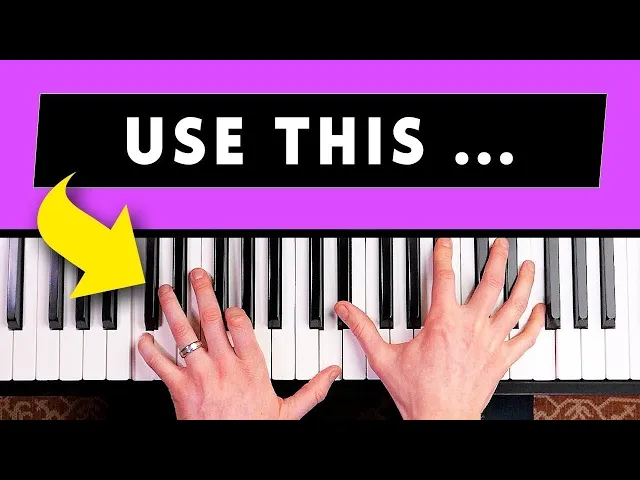
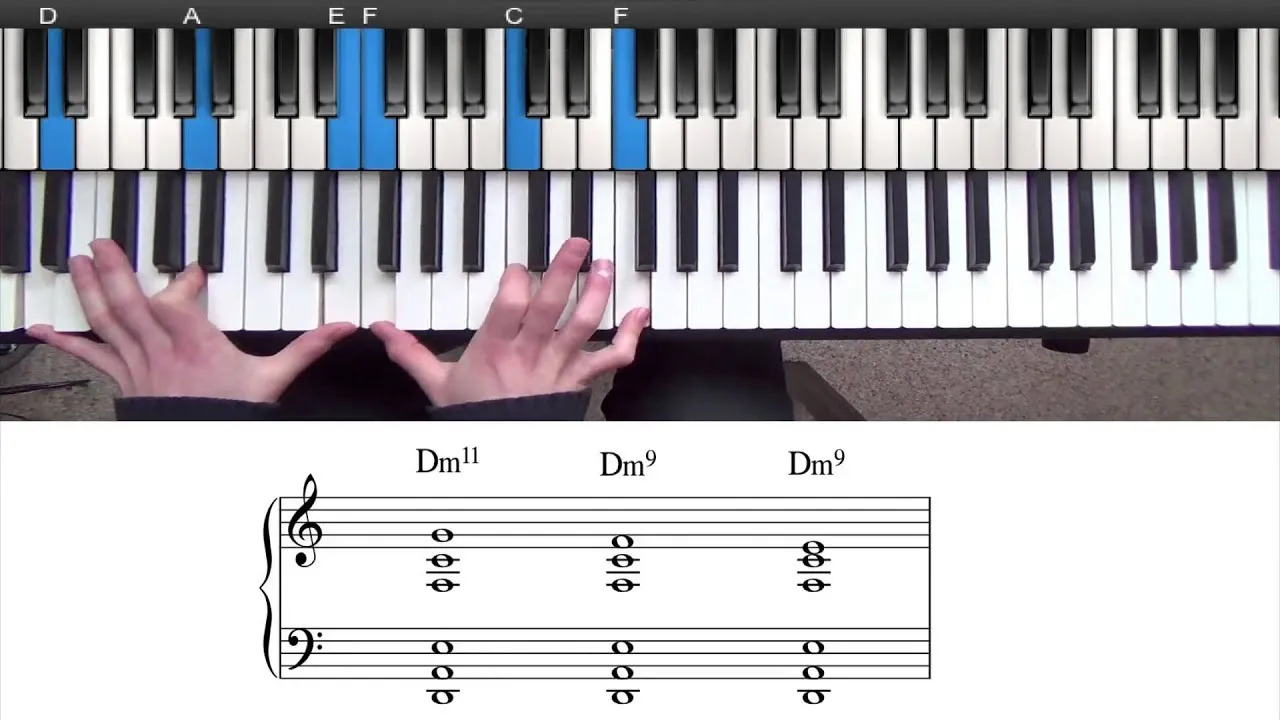
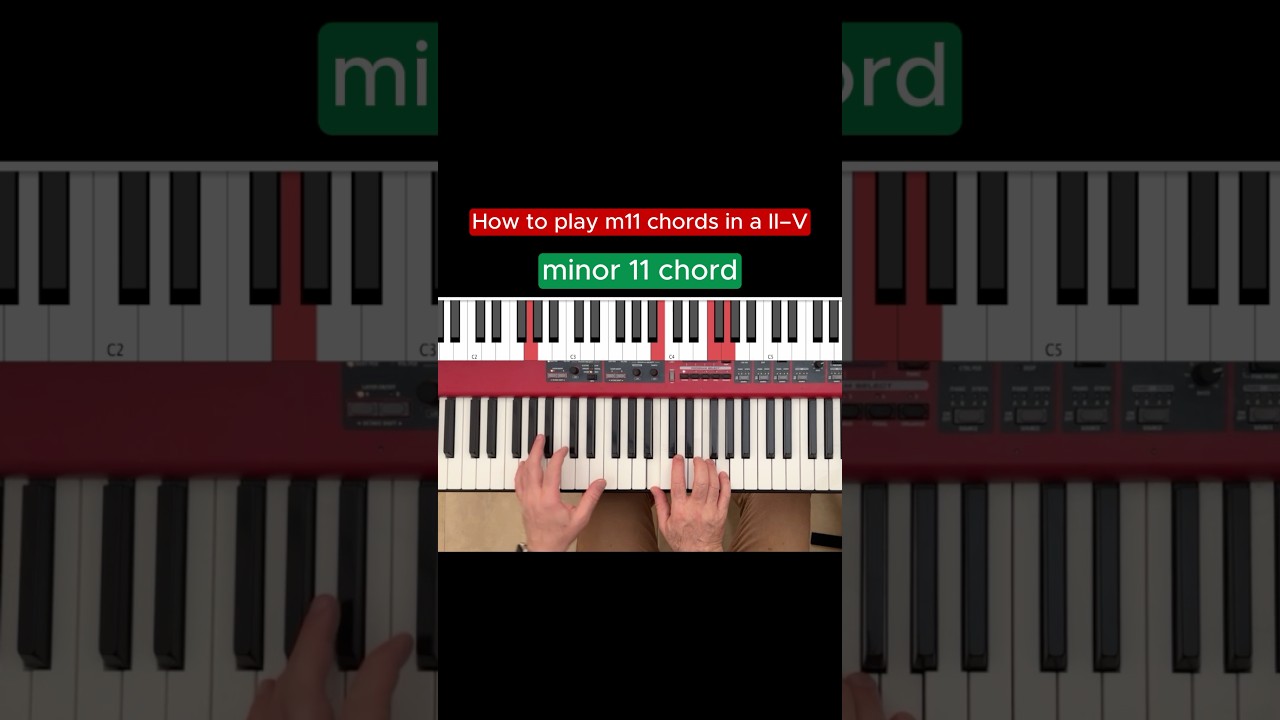
The Herbie Hancock Minor 11th voicing is a rich two-handed jazz chord voicing consisting of a 5th interval in the left hand (root and 5th) and four notes in the right hand (b3, 11, b7, and 9). This voicing is named after Herbie Hancock, one of the most famous modern jazz pianists and composers. The best way to learn this voicing is to memorize the scale degrees and apply them to any minor key. The voicing works best when the 9th appears in the melody, as it fits perfectly when you have that note in the melody. To practice, work through all 12 keys and around the circle of fourths.
Herbie Hancock Minor 11th Voicing: Jazz Piano Chord Construction
Added:Understanding basic minor triad and minor 7th chord construction, including intervals of thirds and fifths.
Familiarity with jazz chord extensions, specifically how 9ths and 11ths are added to minor seventh chords.
Basic knowledge of the circle of fifths and the ability to find roots and scale degrees in all 12 keys.
An introduction to quartal harmony, as modern minor 11th voicings are heavily built on perfect fourth intervals.
Applying the minor 11th voicing within standard jazz progressions, such as the ii-V-I turnaround.
Exploring modal jazz comping and improvisation, specifically on tunes like 'So What' or Herbie Hancock's 'Maiden Voyage'.
Learning voice-leading techniques to transition smoothly from this minor 11th voicing to dominant 7th and major 7th chords.
Studying other signature Herbie Hancock chord structures, such as dominant suspended (sus) voicings and slash chords.
223K views3.9Klikes6:03Original Release: 2015-01-18
[Music] [Music] Hi guys, welcome back. Today we're going to look at the Herby Hancock minor 11th voicing. So, I was just playing the first eight bars of the tune tenderly using the Herby Hancock minor 11th voicing for both of the minor chords in the progression. This voicing gets its name from Herby Hancock, who's one of the most famous modern jazz pianists and composers.
If you've not heard of him before, I'd highly recommend you check out some of his stuff. So, in this lesson, I'm going to show you how to construct the Herby Hancock voicing, how to spot opportunities to add this chord to the tunes that you're playing, and then also a few exercises to practice this this voicing to get comfortable playing it in all 12 keys.
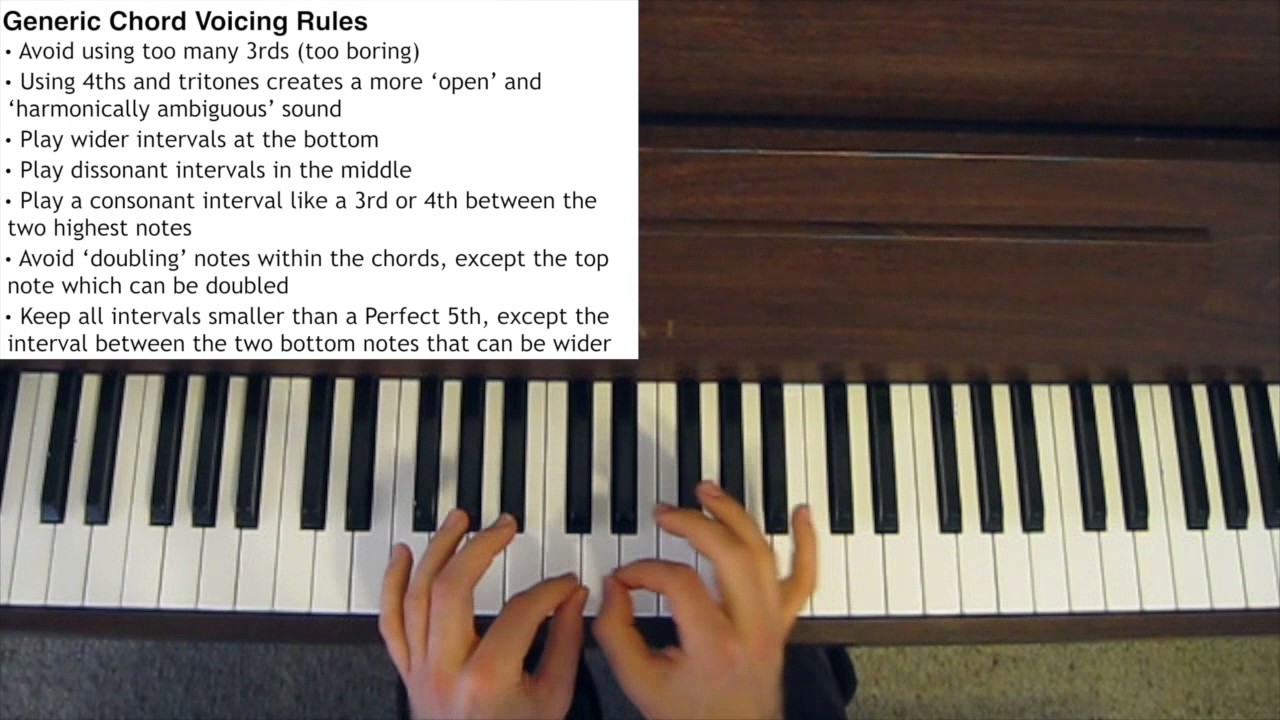
So, the Herby voicing is a rich sounding two-handed minor 11th voicing. So the voicing contains a fifth interval in the left hand and then four notes in the right hand.
The best way to learn the voicing is to memorize the scale degrees.
So we're in the key of a minor here. In the left hand we have the root and the fifth. And in the in the right hand we have the minor 3rd, the 11th, the flat 7th and the ninth.
So that's what you need to remember.
Left hand root is root and five. right hand minor 3rd 11th flat 7th and ninth.
So let's look at this in a few different keys. In the key of F minor we have F and C which is the root and the fifth.
And then we have A flat, B flat, E flat and G which is the minor third, the 11th, the flat 7th and the ninth.
In the key of B flat minor we have B flat and F which is the root and the fifth. And then we have D flat, E flat, A flat, and the C, which is the minor 3rd, 11th, flat 7th, and 9th.
Finally, in the key of D minor, we have D and A, which is the root and the fifth. Then we have F, G, C, and E, which is the minor third, 11th, flat, 7th, and 9th.
You can also play this voicing down here.
Also sounds good.
Okay, great. So, when can you use this voicing? Look out for minor chords with the ninth in the melody. Um, if we look here, this is the first eight bars of t of tenderly that I was playing in the intro. In bar three, we have an E flat minor chord with F in the melody. So, if we run up the E flat minor scale, 1 2 3 4 5 6 7 8 9. So F is the ninth, the chord works well there. So because the ninth is the top scale degree in this voicing, it fits perfectly when you have that note in the melody. Again, in bar five, we have an F minor chord with G in the melody. If we run up the F minor scale, G is the ninth.
So it works well there.
[Music] That's a left hand voicing for E flat major.
Another left hand voicing for A flat 7.
And there's the E flat herby voicing to A flat 7 with a flat N.
That's the F minor herby voicing with an extra nine in the middle.
That's a D flat 7 with a sharp 11.
And back to E flat major.
Okay. So, what's the best way to practice this voicing? Well, first of all, I'd recommend you take the voicing through all 12 keys. So start off with C down here and then work your way up chromatically.
So once you've done that a few times, you should feel familiar with the shape of the voicing. Um after that, I'd recommend taking the voicing around the circle of fifths or the circle of fourths. So let's take it around the circle of fourths. Start off in C.
Then move down to F up to B flat, E flat, A flat, D flat, F sharp, B, E, A, D, G, and back to C again.
So have fun practicing that stuff. If you have any questions, feel free to drop the questions in the comment box below and I'll do my best to get back to you.
[Music]
Up Next

6:51
Quartal Voicings on Piano: Jazz Theory and Application Tutorial
@PianoGroove
35.5K views•2019-01-13

12:54
Triumph of Orthodoxy Icon: Byzantine Art & History Explained
@BenCallan
2.1K views•2024-08-06

9:49
FastAPI vs Flask vs Django: Choosing the Right Python Web Framework
@TechWithTim
302.5K views•2024-05-26

1:42
Game of Thrones Opening Credits: A Cinematic Analysis
@gameofthrones
46.3M views•2011-04-18
Related Study Plans & Knowledge Roadmaps
Structured learning paths in General & Interdisciplinary Studies
general-studies
Elevator Engineering: History, Physics & Cities
01From Hoists to Safety Brakes: The Dawn of Vertical Lift
02Hydraulic vs. Traction: The Engineering Physics of Elevators
03Modern Speed, Safety, and Algorithms
+ 2 more learning modules
12h5 modules
Explore Roadmap
general-studies
Rubber: Material Science, History & Geopolitics
01Origins of Natural Rubber & Mesoamerican History
02The Chemistry of Natural Rubber & Vulcanization
03The Geopolitics of the Rubber Boom & Colonization
+ 2 more learning modules
12h5 modules
Explore Roadmap
general-studies
Containerization: Evolution, Logistics & Trade
01Ancient Trade & Bulk Cargo: Amphorae to Barrels
02The Industrial Revolution & Cardboard Packaging
03The Containerization Revolution: Malcom McLean
+ 2 more learning modules
12h5 modules
Explore Roadmap
general-studies
Textile Tech: Evolution, Labor & Global Impact
01Pre-Industrial Textiles: Handloom & Cottage Industry
02Mechanization: The Spinning Jenny to the Power Loom
03The Factory System & Global Labor Transformation
+ 2 more learning modules
10h5 modules
Explore Roadmap