




![Comment un marché concurrentiel fonctionne-t-il ? [Partie 3/4, Chapitre première]](https://i.ytimg.com/vi_webp/pQduO4JAxow/maxresdefault.webp)











![שיווי משקל במשק פתוח - יבוא ויצוא [תרגיל 10]](https://i.ytimg.com/vi/ZMcWCkqrQX4/sddefault.jpg)




![[5급공채] 2026 황종휴 국제경제학 GS3순환](https://i.ytimg.com/vi/RYHFp3qWvXI/maxresdefault.jpg)








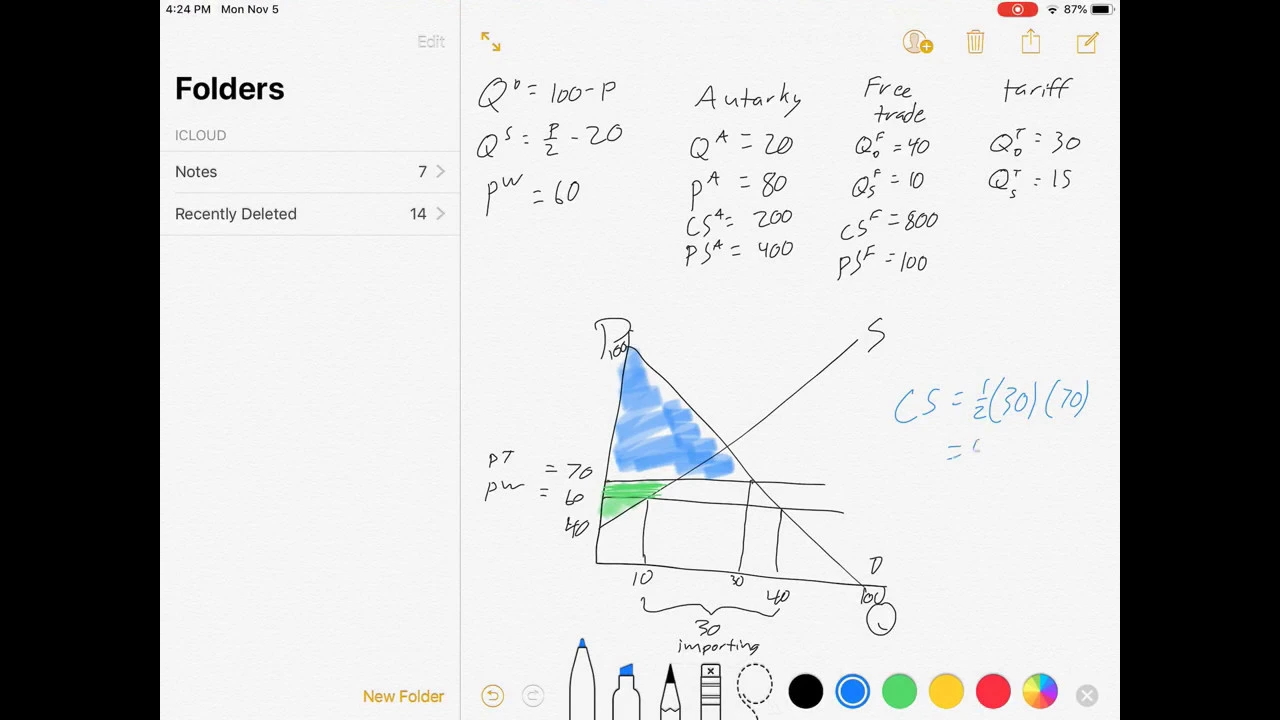
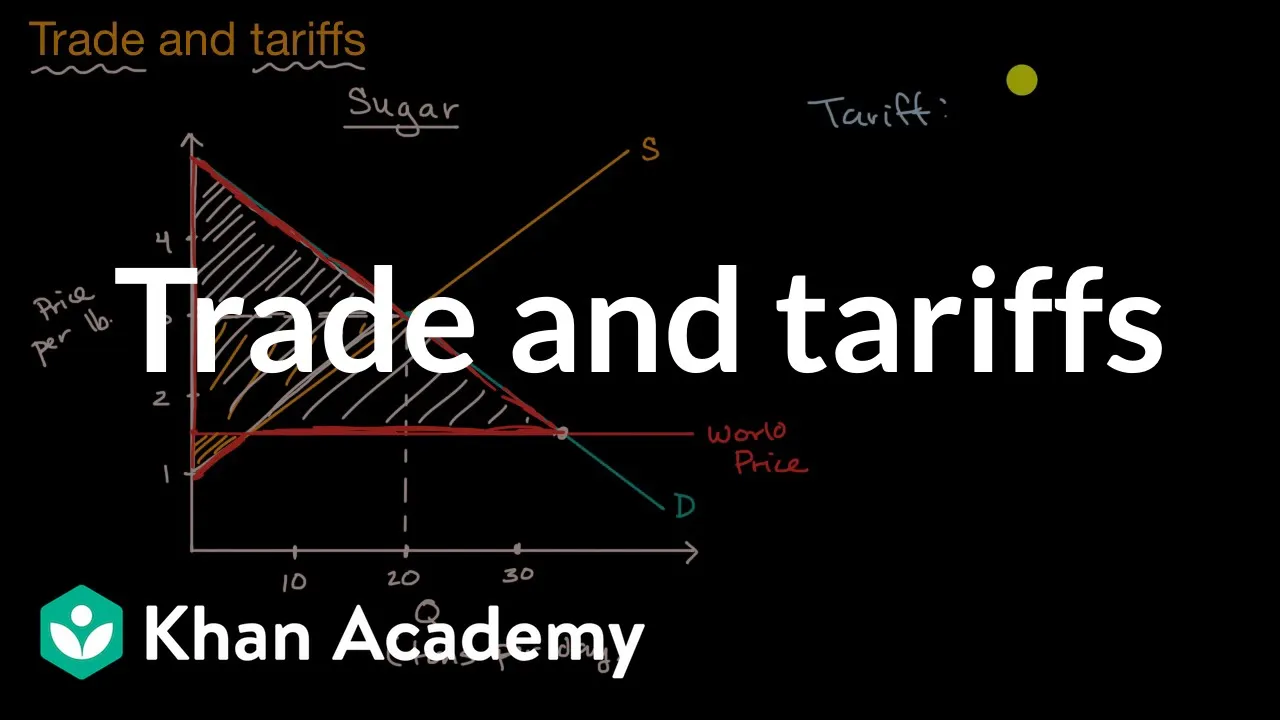
When a government imposes an import tariff, it raises the domestic price above the world price, which reduces consumer surplus (as consumers pay more), increases producer surplus (as domestic producers sell at higher prices), generates government revenue (tariff × quantity imported), but creates deadweight loss to society (the sum of lost consumer and producer surplus that isn't transferred to anyone). The total loss to consumers equals the combined increase in producer surplus plus government revenue plus deadweight loss.
Tariff Impact on Consumer Surplus, Producer Surplus, & Deadweight Loss
Added:Understanding the basic Supply and Demand model, including how market equilibrium is established and how curves shift.
The definitions and graphical representations of Consumer Surplus (CS) and Producer Surplus (PS) in a domestic market.
The concept of economic efficiency and how Deadweight Loss (DWL) represents a net loss of total social welfare.
Basic concepts of international trade, specifically the difference between domestic autarky and free trade, and how world price dictates import volume.
Analysis of import quotas and a comparison of their welfare effects (including quota rents) versus tariffs.
The impact of export subsidies and domestic production subsidies on economic efficiency and market participants.
The 'Large Country' tariff model, where a country is large enough to influence the world price and potentially gain from a tariff (Terms of Trade effect).
The political economy of protectionism, exploring why governments implement tariffs despite the deadweight loss they create.
The role of trade agreements and international organizations (like the WTO) in regulating and negotiating the reduction of tariffs.
333.7K views3.7Klikes6:44Original Release: 2010-11-13
In this tutorial, I'm going to talk about imports and the effects of tariffs.
We start with the supply and demand and that's the price. That's the domestic price. That's the quantity. Now, if a country begins to import and it receives an import price there below domestic price, quantity demanded is there and domestic quantity supplied is there.
Imports are measured there which is quantity demanded minus domestic quantity supplied.
Now before imports this is the level of consumer surplus and this is the level of producer surplus. After imports producer surplus shrinks in fact it shrinks to that level right there much less than before because they're producing much less obviously because of the imports.
Since consumers see a much lower price, consumer surplus increases to that level there.
The box outlined by the silver trapezoid actually is the increase in consumer surplus.
The area outlined by the yellow box or the triangle is lost producer surplus. That area there, decrease in producer surplus.
If the government imposes a tariff of let's say that level, there's a new price which is the import price plus the tariff.
Let me fade away and change and put some symbols in. I'm going to make that quantity demand QD and quantity supplied Q subs.
The import price tariff with quantity demand is there and also the quantity supplied is there with the tariff initially. That's the producer surplus before imports. After imports, it falls dramatically. And the tariff causes producer surplus to rise, which is actually what the government wanted, producers benefit. Initially, this is consumer surplus. After imports, it grows dramatically because of the lower price. But the tariff causes some consumer surplus to be lost. This black box, actually, it's a trapezoid, is loss consumer surplus because of the tariff.
Keep in mind that that measures imports and this is the level of domestic supply that's marked right there. Let me fade some of this out so you can see a little bit better.
So now there's going to be revenue from the tariff and it's going to be outlined. That box right there, the tariff revenue is the brown box. The silver or gray box is dead weight loss.
It was transferred to nothing. And also the silver triangle there is another area of dead weight loss. It wasn't transferred to anybody. Now in a second I'm going to switch to numbers to redo this whole thing with numbers. Here we go. So the tariff in this case is $15.
I'm going to fade away some of this stuff so you can see a little easier.
Now if I wanted to measure the lost consumer surplus is that trapezoid right there. Loss consumer surplus.
I take the area of the rectangle outlined by the gold or the lemon color.
I guess it's base time height, which is $15 and the base is 650. So, it's 650 * 15 is equal to $9,750.
The triangle outlined right there is base time height * 1/2. The base is 200. The height is 15. So it's 200 * 15 and that equals to oh times a half.
And that equals to $1,500.
Now we take this $1,500 and we add it to $9,750 for grand total of 11,250.
And that's the area of the trapezoid.
And that's loss consumer surplus.
Now I can calculate a few other things.
And the first thing I'm going to calculate is the increase in producer surplus, which is that trapezoid, the pink trapezoid.
I take the area of that little rectangle, which is 100 * 15, which is 1,500.
$1,500.
Then I take the area of the triangle, which is 200 * 15 * a half, which is $1,500 again, or $1,500.
So the 1,500 plus,500 combined is the producer surplus increase in producer surplus. The tax revenues is 350 which is also the imports how much is imported times 15 which is the tariff.
So that's 350 * 15 is equal to 5250 and that's total from that's revenue to the government from the tariff. Now, the gray area is dead weight loss. And the first triangle is 15 * 200. 200 * 15 * 1/2 is equal to 1,500.
And the other triangle, other dead white triangle is the same as before. And that's another $1,500.
So, if we add all this up, it should add up to $11,250, which is equal to the loss consumer surplus.
The increase in producer surplus as a transfer from consumer surplus. The tax revenues were also transferred from consumer surplus and dead weight loss.
Increase in producer surplus is a transfer. Tax revenues is also a transfer from consumer surplus. But dead weight loss is a loss to society.
All this adds up to $11,250.
And this is lost consumer surplus because of the tariff.
To review quickly, that is consumer surplus. That's producer surplus. We added an import price. Producer surplus shrunk. Consumer surplus increased dramatically.
The government imposed a tariff.
Consumer surplus shrunk. Producer surplus increased.
That's the tax revenue. And the gray area is dead weight lost to society.
And this is imports and effects of tariffs.
Up Next
7:05
Effects of Tariffs on Economic Surplus | AP Microeconomics
@khanacademy
267.4K views•2018-12-07

5:07
Impact of Yuan in Indo-Russian Trade Amid Sanctions
@WION
261.9K views•2022-07-01

7:19
Calculating Consumer & Producer Surplus with Price Floor
@economicsfun
110.3K views•2011-05-28

113:18
The Age of Easy Money: Fed & Inflation | Full Documentary
@frontline
21.2M views•2023-03-15
Related Study Plans & Knowledge Roadmaps
Structured learning paths in Economics
economics
Sovereign Debt: Defaults, IMF & Restructuring
01Introduction to Sovereign Debt & Government Bonds
02Debt Sustainability & Credit Ratings
03Anatomy and History of Debt Crises
+ 2 more learning modules
12h5 modules
Explore Roadmap
economics
Market Design: Matching Theory & Gale-Shapley
01Introduction to Market Design and Price-Free Markets
02Two-Sided Matching & The Gale-Shapley Algorithm
03School Choice Systems and Mechanism Design
+ 2 more learning modules
10h5 modules
Explore Roadmap
economics
Impossible Trinity: Forex, Capital & Policy
01Introduction to Monetary Policy and Central Banking
02Exchange Rates and International Capital Flows
03The Mundell-Fleming Model
+ 2 more learning modules
8h5 modules
Explore Roadmap
economics
Healthcare Economics: Market Failures & Systems
01Introduction to Healthcare Markets and Market Failure
02Asymmetric Information and Adverse Selection
03Moral Hazard and Insurance Design
+ 2 more learning modules
12h5 modules
Explore Roadmap