









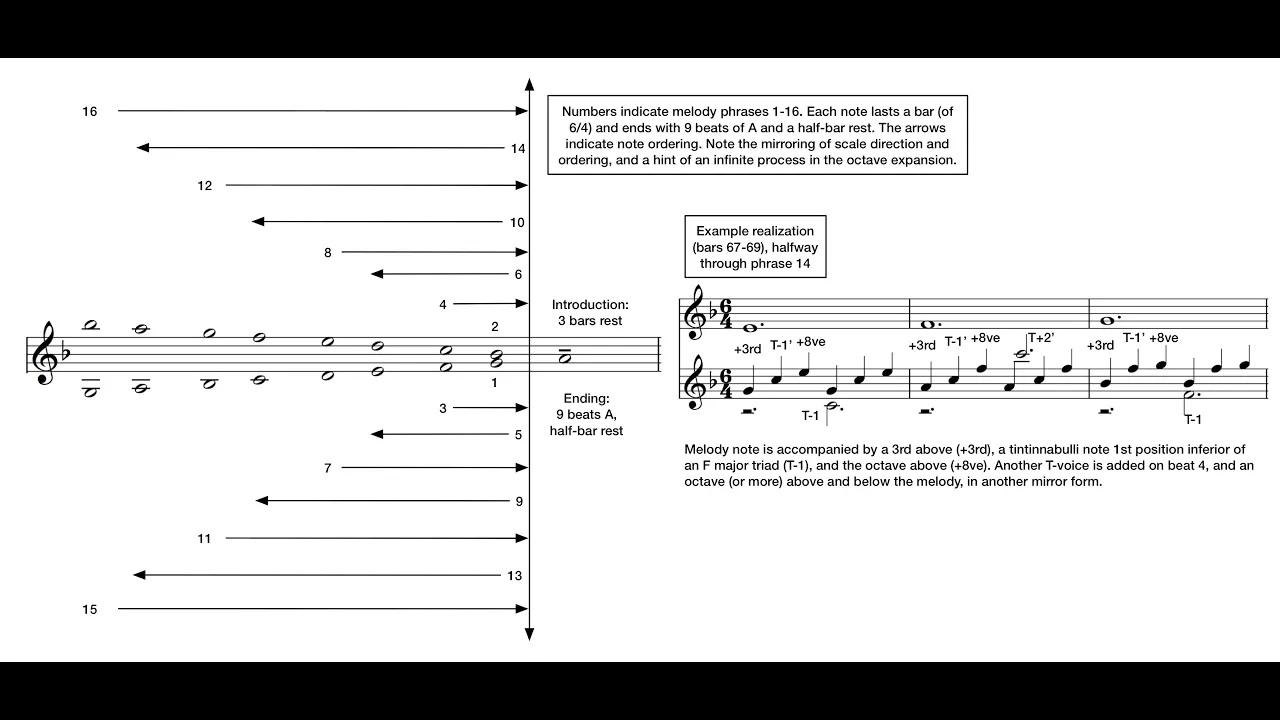



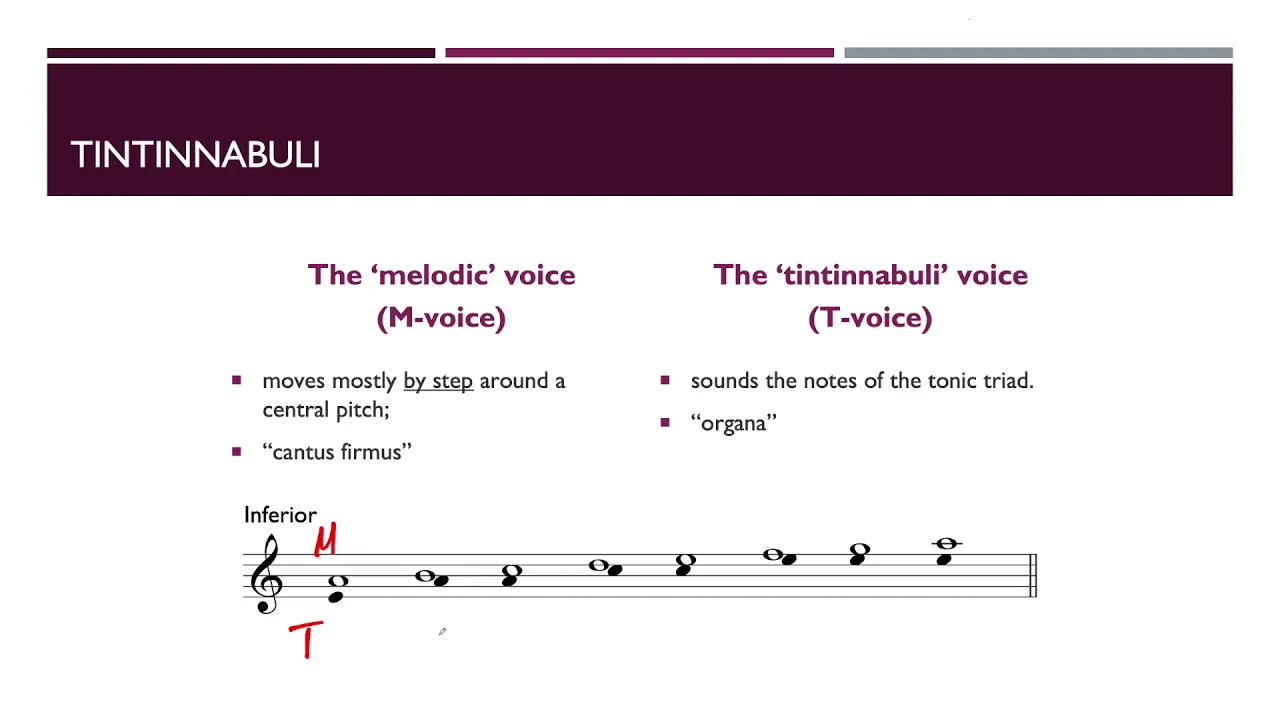





Tintinnabuli is Arvo Pärt's signature compositional technique, developed in 1976, which pairs a melodic voice (M-voice) moving by step with a tintinnabulating voice (T-voice) that uses notes from a predetermined triad in a set relationship to the M-voice, creating a controlled harmonic structure where consonance is infused into the composition's DNA while still allowing fine control over dissonances; the technique can be modified by changing directionality, distance between voices, or using alternating polarity, and while the name suggests bell-like sounds, Pärt has cautioned against viewing it as literal bell imitation since actual bells don't produce the same harmonic structure as vibrating strings.
Arvo Pärt's Tintinnabuli Technique Explained
Added:Understanding of diatonic scale construction, specifically how major and minor scales are built using stepwise motion.
Fundamental knowledge of triads and chord spelling, particularly tonic triads and their inversions.
Basic concepts of counterpoint and voice leading, such as how independent melodic lines interact.
A general familiarity with 20th-century musical minimalism and its departure from complex serialism.
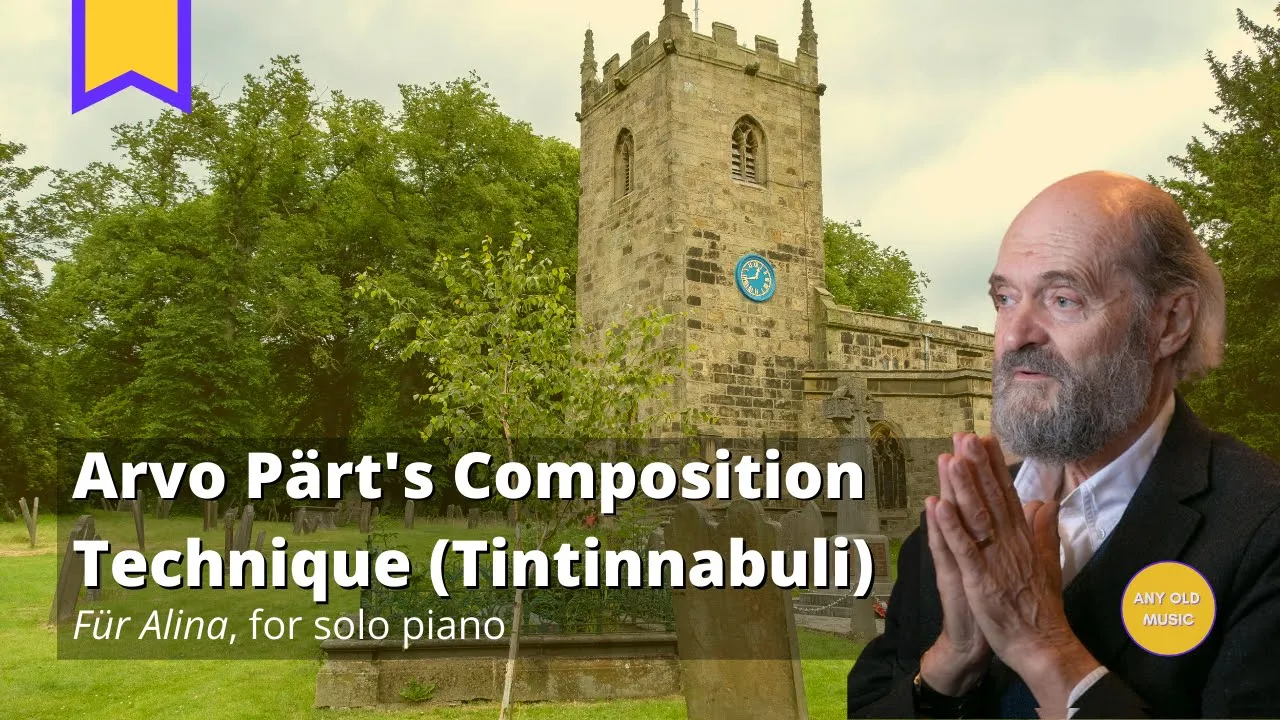
In-depth score analysis of Arvo Pärt's seminal works, such as 'Für Alina', 'Spiegel im Spiegel', and 'Fratres'.
Detailed study of the specific structural rules of Tintinnabuli, including the relationship between the Melodic (M) voice and the Tintinnabular (T) voice.
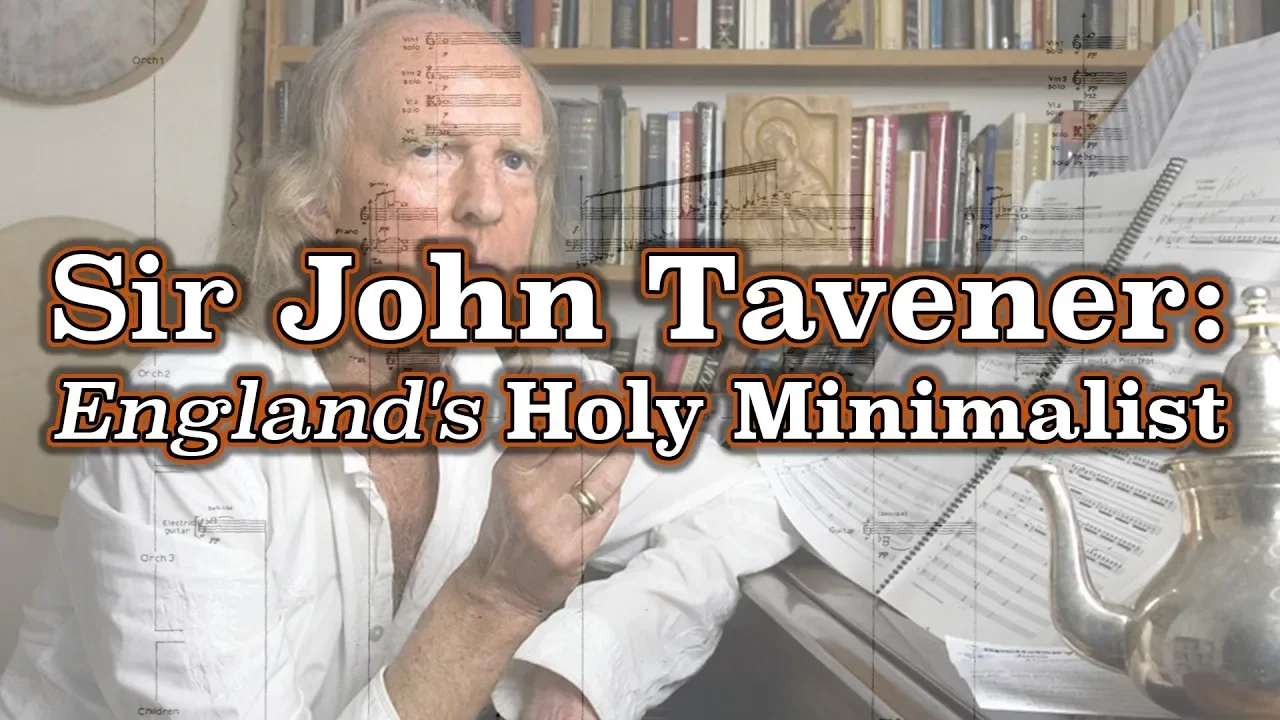
Exploration of the broader 'Holy Minimalism' movement, comparing Pärt's style with contemporaries like John Tavener and Henryk Górecki.
Practical application of the Tintinnabuli technique in original musical composition and modern film scoring.
55.9K views2.3Klikes10:49Original Release: 2023-04-04
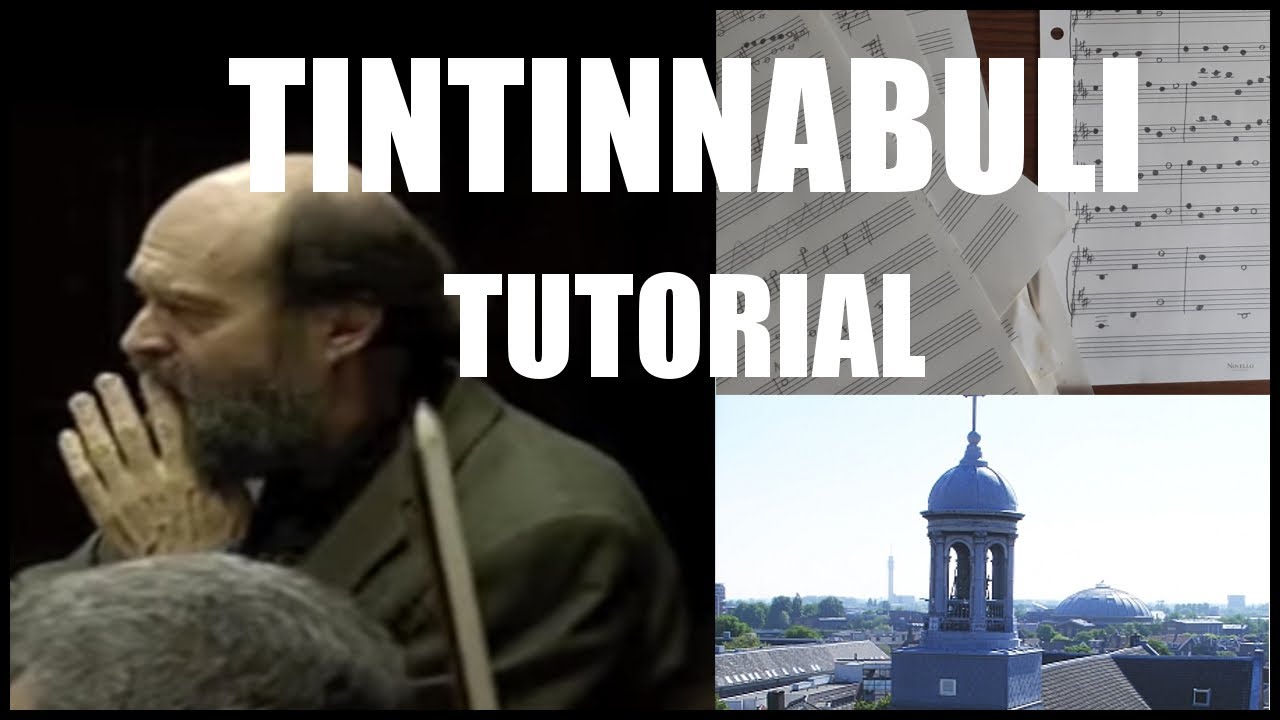
The music of contemporary Estonian composer Arvo Pärt is most often described as part of an offshoot of minimalism known as “holy minimilism.” Pärt’s music uses a technique of his own devising called “tintinnabuli,” which comes from a word that refers to the ringing of bells.
He came up with this in the mid-1970s—1976 is the usual date given— and it’s SUPER simple, almost annoyingly so.
Throughout the 1960s, Pärt wrote in a high modernist style, culminating in 1968’s “Credo” that earned the ire of the Soviet Union.
The resulting creative exile, during which he turned to Medieval poetry and early music, resulted in a newfound appreciation for simplicity—a simplicity borne from his Orthodox faith, that is just now getting the serious scholarly and analytical attention that it so richly deserves.
Tintinnabuli combines two lines in a very particular way.
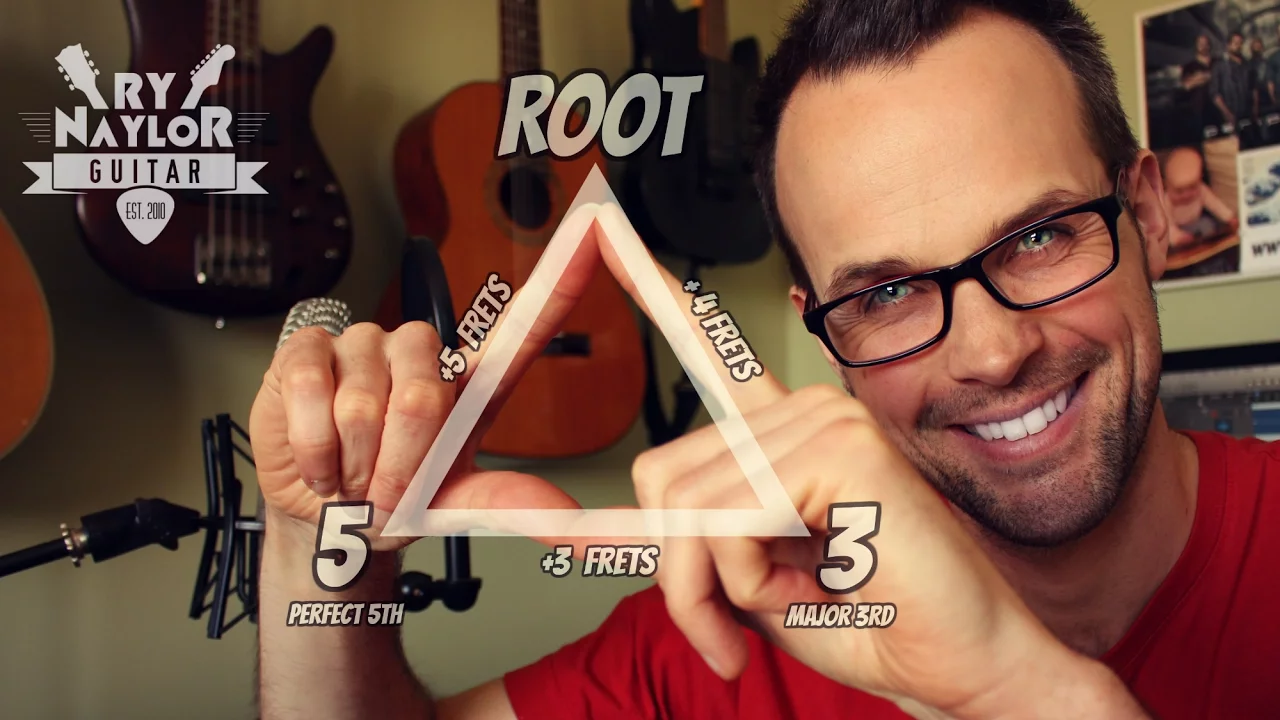
Each voice uses, at its basis, a familiar musical building block: the scale and the triad.
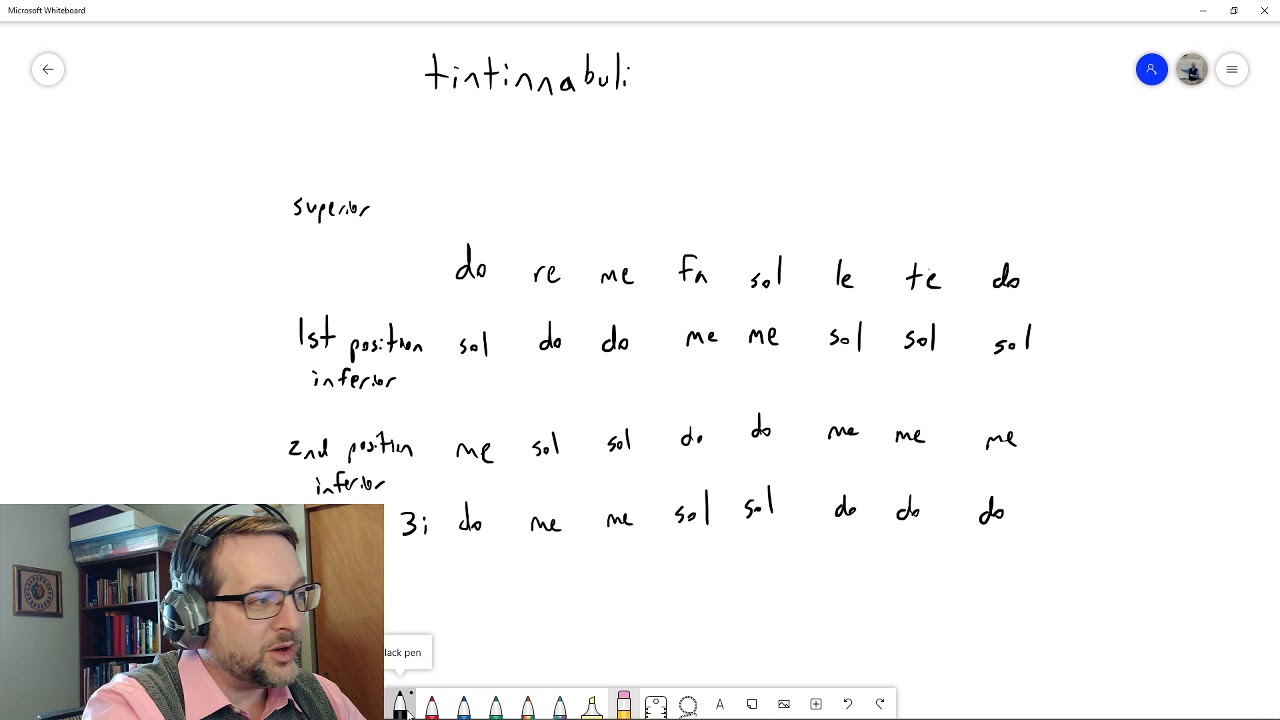
In its most basic format, the melody, or M-voice, which moves almost always by step, is paired with a tintinnabulating, or T-voice, which solely uses notes from a predetermined triad in a set relationship to the M-voice. Let’s say you’re working in D Major.
Say I have a D Major scale and that’s my melodic material, and we’re gonna keep it easy and use a D Major triad as the T-voice.
All Pärt has to do at this point is to come up with a melody, then figure out the rules of how the notes of the triad are related to the notes of the scale.
Let’s say the T-voice is always going to be ABOVE the M-voice, and let’s say it’s gonna be the NEXT note of the chord, UP.
For melodic notes D and E, the T-voice will be on F♯, the first note of the triad UP from those notes that is NOT one of those notes. Can’t harmonize it with itself.
For the F♯ and G, that’s harmonized with the A, and for A, B, and C♯, that’s harmonized with this D.
Each note in the M-voice is paired with a note from the T-voice.
So let’s hear how this sounds.
When used over long stretches of a piece, especially for resonant instruments like the piano, you get this carefully controlled sounding of pitches that all come from a single chord, following the melody around like… I dunno, a ghost, or something.
It infuses consonance into the very DNA of a composition, while still giving Pärt fine control over dissonances—and potentially very harsh ones at that.
If a note of the M-voice happens to be a half-step away from the next T-voice note up (if you’re using the first-note-up rule), you’re going to get a minor second—but you’ll also get a lot of thirds, fourths, fifths, and sixths no matter what you’re doing.
Okay, let’s do another.
This time B minor, sticking with the same key signature, but instead of going to the next note UP, we’re gonna try TWO notes, DOWN.
B, A, and G skip over the F♯ to the D, then F♯ and E skip over the D to the B, and D and C♯ down to the F♯ below that.
Same principle—we’re just changing two parameters: the directionality and the distance between the voices.
Pärt also uses an alternating technique where he’ll reverse the polarity for every note—if we do that to our first example, you’ll get this.
Pärt uses this pretty frequently to add more complexity to his textures.
To him, tintinnabulation is a metaphor: the melodic voice represents a state of imperfection and sin, and the triad a state of perfection and grace.
There’s a reason he’s called a “holy minimalist,” after all.
Do these triads and scales have to line up?
Many times, they do—but they don’t HAVE to.
In the fifth of his “Magnificat Antiphons,” Pärt uses melodic G♮s, [but] the tintinnabulation uses G♯s, and this generates some pretty crunchy cross-relations.
Does the triad have to come from the same tonality as the scale?
No—you can have a melody in one key and tintinnabulate another.
Nothing stopping you from that.
Does it always have to be a major or minor chord?
Almost always for Pärt— there’s a certain purity to the sound of a triad that Pärt has talked about quite a bit, but there are contexts in which he’ll use a diminished or dominant seventh instead, especially when he’s trying to evoke the fallen and sinful nature of this world.
And the fact that the technique pairs one voice with another does not mean that he sounds both of them at the same time— the T-voice can be delayed from the M-voice, resulting in new harmonic possibilities, as in “Da pacem Domine.” Pärt takes a simple idea and multiplies it—overlays it on itself to get greater and greater degrees of complexity of texture without destroying the technique’s ingrained harmonic simplicity.
The reversible nature of this technique— that is, T-voices that can exist on either side of an M-voice— leads to a lot of large-scale harmonic symmetry, Overlaying T-voices in sequence gives you arpeggiations in a mid-20th-century minimalist vein, while block chords assembled using these techniques sound like they come from the late Middle Ages.
Overlaying different M-voices at different rates, each with its own T-voice, gets you one of his most famous pieces, the “Cantus in Memoriam Benjamin Britten.” Now, the name is not exactly literal—Pärt has cautioned against viewing tintinnabulation as a literal imitation of bells, which tracks because bells don’t actually show up a lot in Pärt’s work.
Unlike a vibrating string, from which a major triad can be generated, bells—and especially those from the tradition with which Pärt is most familiar—just don’t have that.
Their overtones look totally wacky if you analyze them.
Tintinnabulation gives Pärt a reason to use consonance in a thoroughly modern and personal style, which has led to much popular success in a contemporary classical field often defined by a search for new sounds and novel textures.
In a world of dissonance and complexity, it’s kinda refreshing to know that it’s still possible to recombine some of the oldest, most basic elements of music into something entirely new—music of constant change on the one hand, but complete stasis on the other.
If you appreciated these hand-typed subtitles, please consider a small monthly donation: www.patreon.com/classiclnerd :)
Up Next
10:31
Arvo Pärt's Fratres for Viola: Live Performance by Emily Drexler
@Emily_violin
203 views•2018-09-09

178:38
Whole Brain Architecture: First International Workshop 2024
@thewholebrainarchitecturei9784
640 views•2024-07-22

9:49
FastAPI vs Flask vs Django: Choosing the Right Python Web Framework
@TechWithTim
302.5K views•2024-05-26

1:42
Game of Thrones Opening Credits: A Cinematic Analysis
@gameofthrones
46.3M views•2011-04-18
Related Study Plans & Knowledge Roadmaps
Structured learning paths in General & Interdisciplinary Studies
general-studies
Artificial Light: History, Tech & Human Impact
01The Pre-Electric Era: Fire, Oil, and Gas Lighting
02The Incandescent Revolution and Grid Electrification
03Gas Discharge and Fluorescent Illumination
+ 3 more learning modules
14h6 modules
Explore Roadmap
general-studies
Elevator Engineering: History, Physics & Cities
01From Hoists to Safety Brakes: The Dawn of Vertical Lift
02Hydraulic vs. Traction: The Engineering Physics of Elevators
03Modern Speed, Safety, and Algorithms
+ 2 more learning modules
12h5 modules
Explore Roadmap
general-studies
Rubber: Material Science, History & Geopolitics
01Origins of Natural Rubber & Mesoamerican History
02The Chemistry of Natural Rubber & Vulcanization
03The Geopolitics of the Rubber Boom & Colonization
+ 2 more learning modules
12h5 modules
Explore Roadmap
general-studies
Containerization: Evolution, Logistics & Trade
01Ancient Trade & Bulk Cargo: Amphorae to Barrels
02The Industrial Revolution & Cardboard Packaging
03The Containerization Revolution: Malcom McLean
+ 2 more learning modules
12h5 modules
Explore Roadmap