
















Robert Nozick's entitlement theory of justice proposes that a just society requires only three principles: just acquisition (legitimate initial ownership of unowned property through labor), just transfer (voluntary exchange without coercion), and just rectification (government intervention to correct unjust acquisitions); this libertarian framework champions minimal government intervention in private property and free market transactions, while critics argue it fails to address systemic inequalities and monopolistic power that can arise from purely voluntary exchanges.
Robert Nozick's Entitlement Theory: Free Market Justice Explained
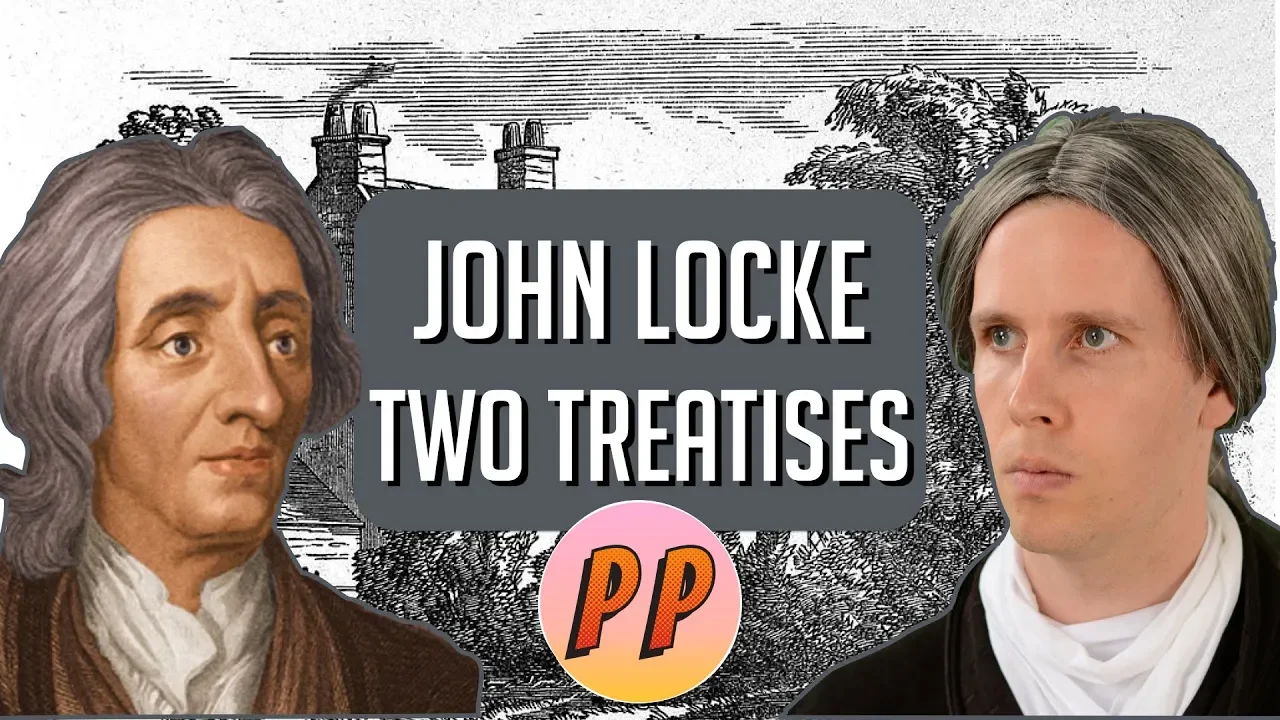
Added:John Locke's labor theory of property and the 'Lockean proviso' regarding resource acquisition.
The fundamental principles of political libertarianism, particularly the concepts of self-ownership and individual liberty.
John Rawls's 'Theory of Justice' and his arguments for patterned distributive justice, such as the Difference Principle.
The distinction between end-state (patterned) theories of justice and historical (procedural) theories of justice.
Philosophical critiques of Nozick's theory, such as G.A. Cohen's egalitarian critique of self-ownership.
The practical and legal challenges of applying Nozick's 'Principle of Rectification' to historical injustices like colonialism, land theft, and slavery.
Nozick's concept of the 'minimal state' (or night-watchman state) and how he attempts to justify its emergence from anarchy.
The ongoing philosophical and economic debates surrounding the ethics of taxation, comparing Nozick's 'forced labor' argument with social contract theories.
Left-libertarianism, which attempts to reconcile Nozick's concept of self-ownership with an egalitarian view of natural resources.
19.6K views600likes14:29Original Release: 2023-11-15
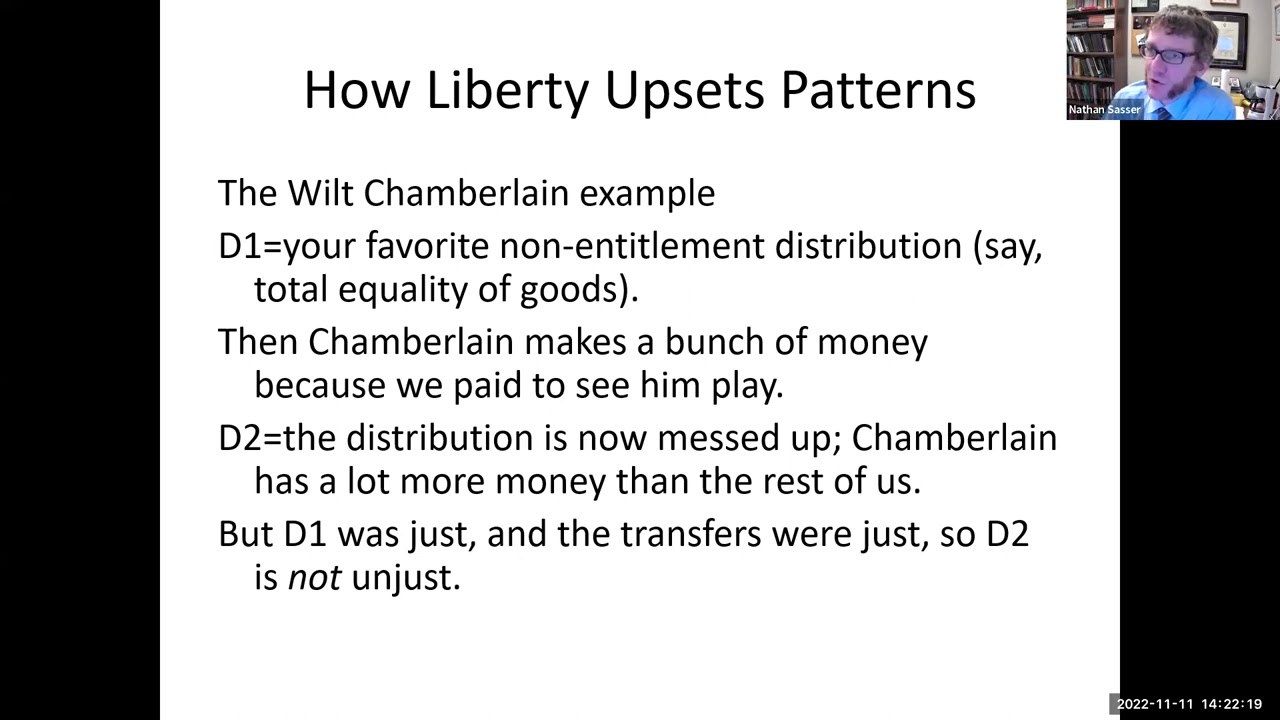
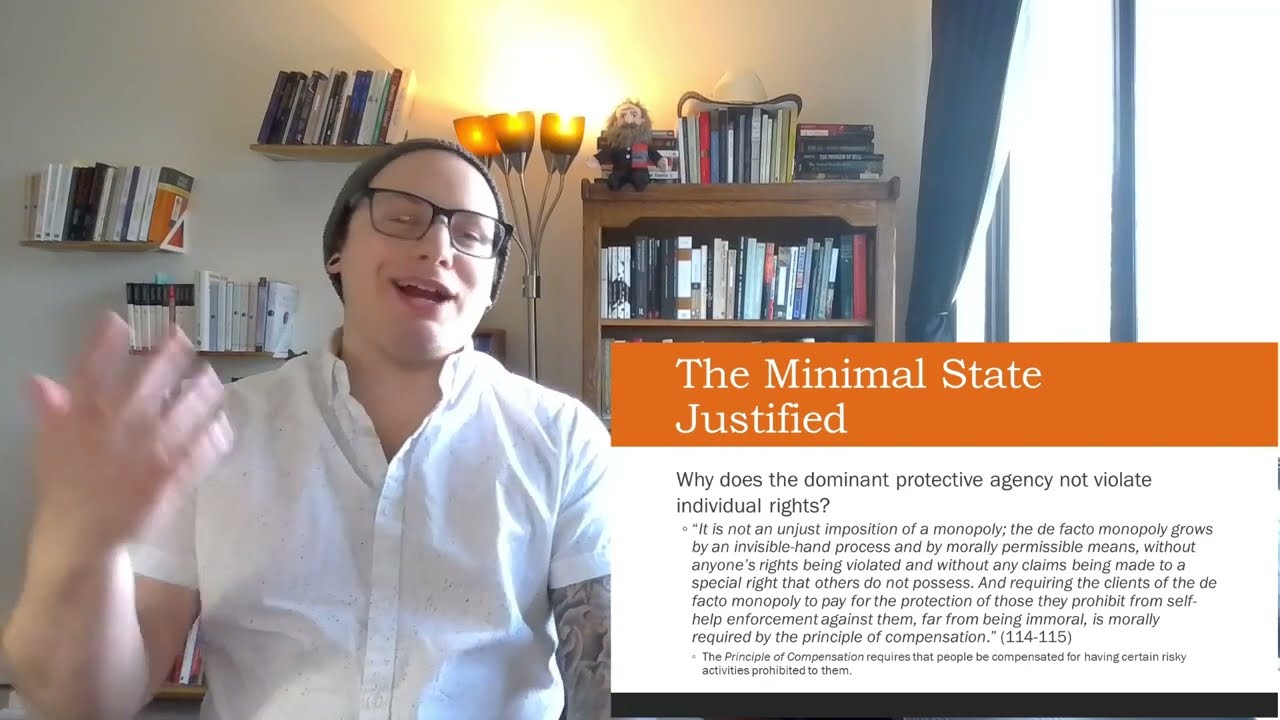
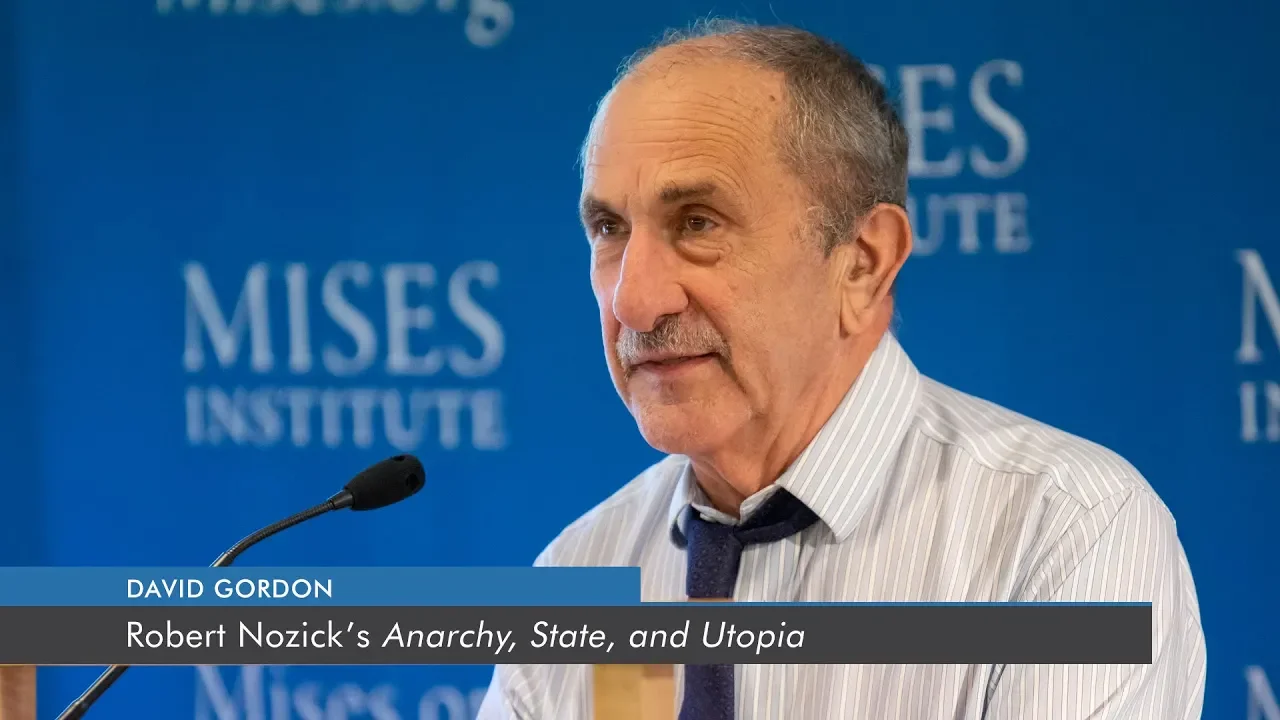
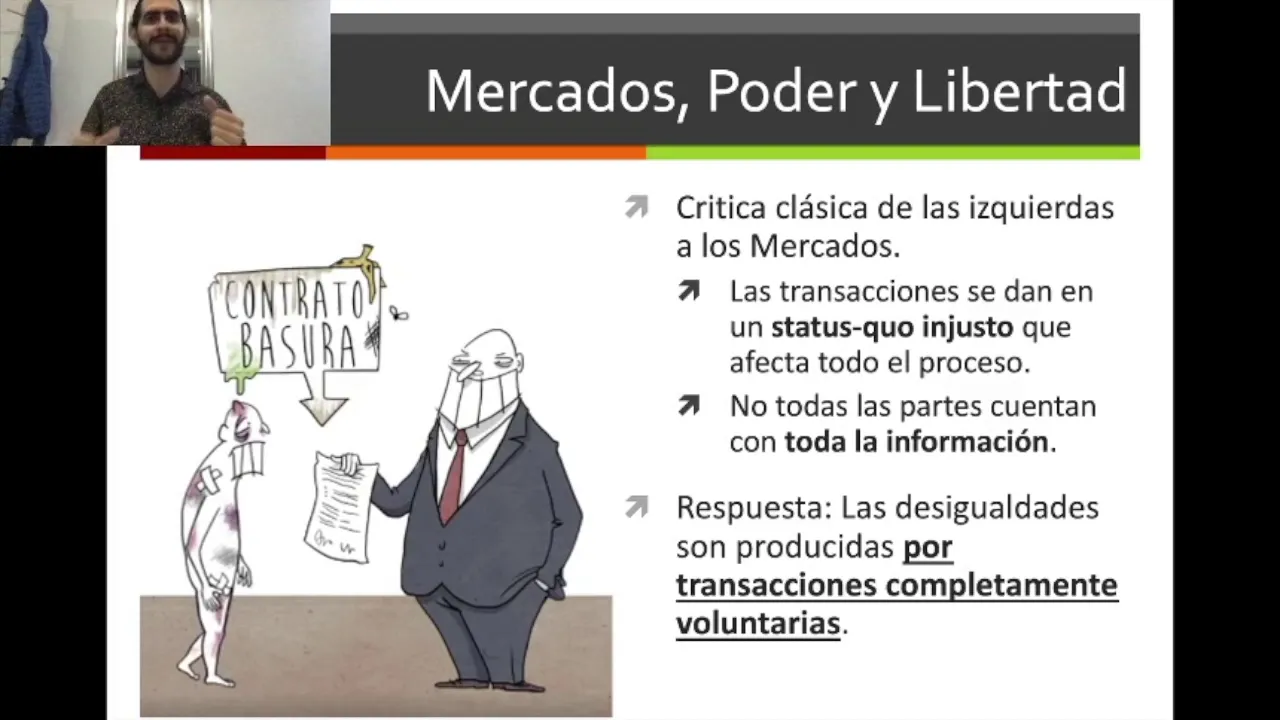
[Music] hello and welcome to philosophy 5 the channel where we discuss and debate different philosophical ideas today we're going to be diving into some political philosophy and looking into robbert nosik and his entitlement theory of Justice interesting so Robert noik was a 20th century philosopher whose Works covered a wide range of philosophical subjects in 1974 no released the political philosophy book Anarchy State and Utopia it was within this book that nosic questioned does society even need a state so is government even necessary no's conclusion was that Society should in fact have the most minimal government possible the sole responsibility of the state was to protect its citizens life liberty and property that was it nothing more noik was completely against a big blow oted government interfering in citizens day-to-day lives and private dealings noik argued that anything beyond the state protecting its citizens against Force theft and fraud as well as the enforcement of contracts would inevitably violate their natural rights this was seen as being the polar opposite to another contemporary philosopher at the time John rules who believed that the state had a responsibility to its least well-off citizens and can use its powers to make the best environment for the least well off this of course included redistribution of wealth in the form of Taxation and only allowing inequality if it was to the benefit of the least well-off for more information on rules please check out our video on him however nosik was vehemently against any government redistribution or any large states governing citizens private dealings because of this he developed his entitlement theory of Justice as a guidance to the private dealings of free individual ual and the accumulation of private property and wealth generation this has been seen as one of the Bedrock philosophies behind free market capitalism and nosic himself has been championed by minist and Libertarians alike in this video we will look at the entitlement Theory further and discuss some potential philosophical and social problems and objections that can arise this sounds really interesting so how does nosik lay out his entitlement theory of Justice it seems like a philosoph opy that tries to structure an individual's approach to private property and living together in a functioning society would be quite a complex Endeavor you would think so but in fact nosik lays out this Theory with just three very simple principles really yes so let's look into them principle one is around just acquisition this is around how people come to own things that are previously unowned and part of the natural world individuals may acquire this proper property so long as it's unowned and not taken by theft or fraud this is especially true if your labor is mixed in can you give me an example sure so say you're walking in a meadow and you stumble across a pear tree this tree and the pears on it are unowned it does not belong to anyone you then reach out and pick a pair under principle one this is just acquisition your discovery of something unowned mixed with your labor of picking the fruit has meant that you now own this pair this pair is your property and you are entitled to it I see say then you take the seeds off the pair and then plant them on unknowned land you then work at tending to the growth of a new pair tree the entire tree now becomes your property this is another just acquisition that you are entitled to yes I understand the second principle is the just transfer this is around property Exchange and allows individuals to transfer private property as long as the transfer does not involve any theft fraud or coercion so say I pick a bunch of pairs from my tree and I meet with someone who owns their own apple tree and we agree to swap five pairs for five apples this is a just transfer I am happy to exchange my property for his property there is no fraud or Force involved we have both voluntarily entered into this agreement upon Exchange the five apples now become my property that I entitled to and the five pairs becomes his property a just transfer yes this makes sense and finally the third principle is around just rectification this is how to deal with and punish those who have acquired property unjustly and how to compensate the victims it is here where government is needed this is what the minimal government should be used for protecting people's property and deciding adequate compensation and Punishment should someone break principle one or two so for example say I stumbled upon someone else's peir Tre that was not mine and I helped myself to a bunch of their pairs this is theft an unjust acquisition and say I then went to the person who owned the apple tree and threatened to chop down his tree or threatened him with violence if he did not give me some apples to which through fear he gave me the apples this is an unjust transfer so principle three is there to protect individuals from these situations happening yes so this is where say a police force or court of law would naturally flourish in accordance with principle 3 this would be the minimal government nosic explains correct so we can see with these three principles how private property and free market capitalism would indeed flourish and a big government would not really be needed outside of just regulating these three principles these principles are all Society really needs consider this one comes upon unowned land and decides he wants to make use of this land he is entitled to this land so through just acquisition this land now becomes his as he has acquired this land he begins to work the land growing crops fruit trees Etc this now becomes his just acquired property this individual begins selling and trading his produce for money and other things and here we have just transfer this is free market capitalism without government interference we can also imagine someone who acquires a number of different things through different people through just transfers and goes on to invent something new this brand new invention becomes his property and he is able to mass-produce this invention and starts trading it with others again a perfect free market system without the need for State intervention yes I see so if I'm correct noik would see government taxation as unjust effectively taxation is under coercion you must pay your taxes or face a penalty if you do not agree to taxation then it would be an unjust transfer yes correct of course the minimal government would need to exist and the people in the society would decide how much needs to be allocated to making sure principle 3 is upheld but generally taxation is seen as unjust and so is any redistribution for forced equality to illustrate this point further nosic gave the Wilt Chamberlain example Wilt Chamberlain was a very famous basketball player during the 70s noik asked us to imagine that wi Chamberlain has signed to a basketball team however he will only play if 25 cents of each ticket sale goes to him this is completely a free decision if the fans want to see Wilt they can freely pay their ticket the team owners have also agreed to these terms now imagine 1 million fans come to the stadium each paying for their ticket excited to see Chamberlain 25 cents of each ticket goes to Chamberlain so by the end of the night Chamberlain gets paid $250,000 which is a lot more than any of his teammates is Chamberlain entitled to this money yes of course this was a just acquisition all the fans voluntarily chose to come to the game and buy their ticket the team owners agreed to Chamberlain's contract demands so this is a just transfer where is the Injustice there is no Injustice here so how could one logically argue that money needs to be taken from Chamberlain and redistributed to other players or even other members of society if Chamberlain's acquisition of the money is just then surely taking any of it from Chamberlain would be unjust and as such this shows how involuntary redistribution is unjust yes I see and so that is the entitlement theory of Justice three principles that underpin the just acquisition of property that overlooks the wealth creation and the role of a minimal government very interesting this is actually really straightforward and initially this does sound like all you would need for a well functioning Society the free market sounds so simple so you can easily see the argument in favor of a minimal government indeed however we know that life is not that simple and there can be potentially huge problems with nox's entitlement theory that really need to be considered in real world terms like what you can easily conceive of private property that can be justly acquired yet through this just acquisition and its continuation it has huge negative effects on Society at large can you give me an example okay let's go back to your land acquisition example let's say someone comes across a field of apple trees the only one of its kind in that specific Society this person now justly acquires the land and begins tending to the apple trees so they own all the apples this person now has a complete man Monopoly on all the apples in that Society no one else can own any apples and this person can charge whatever they want for the just transfers surely this is not fair or just or what if someone owns the land where the town's Water Supply runs through this person effectively owns the water to the entire town and as such has a monopoly on the water supply charging extortionate prices for water putting all people into poverty yet their acquisition is perfectly just according to the entitlement Theory but clearly this is not the case yes I see the problem you also mentioned about the just acquisition through invention so what if someone invents a life-saving drug to a horrible illness they have entitlement as it's their property should they be allowed to restrict the distribution of the drug or perhaps again charge extortionate prices so only the rich can get the medicine what if the person is a horrible bigot and has hatred for certain people in that societ Society should they be allowed to withdraw consent to offer the drug to specific people or demographics this is horrible Behavior yet it all seems just under the entitlement Theory well not exactly monopolies like this were in fact considered by noik and as such he appealed to the Lan Proviso in this situation as an add-on to the entitlement Theory what's that the Lan Proviso was a clause set by John Loch in his own political philosophies on liberalism and property rights whereby individuals have the right to private property providing there is enough and as good left in common for others this means that the entitlement theory of course allows one to accumulate private property and wealth as long as Society at large is not affected one person's accumulation of private property must still leave enough for others to do the same and the quality of what is left must also be as good so no one person cannot own all the apple trees in the entire Society or all the water supply as this clearly violates the LOI and Proviso as there's not enough for others similarly one cannot have the full control and distribution of a life-saving drug as once again this is not leaving enough or as good for others by including the L improviso in the entitlement Theory we can effectively eliminate the unjust and unfair creation of monopolies right okay that makes sense and I agree with that but think about what this does to The Wider Theory this is supposed to be a Libertarian minist Theory underpinning small government and free market capitalism to me the inclusion of that Proviso entirely destroys that underpinning how so think about the size of government you would need to manage this Proviso to make sure that enough and as good is available to enough people in all areas of private property think about the bureaucracy needed how much the government would need to be involved in all areas of private property acquisition and transfer to make sure the provisor is upheld think about how much that would cost and subsequently how much in tax revenue would need to be generated to oversee such huge government intervention I am not challenging the Lan Proviso but I do not see how the Lan Proviso can be included in a free market minikus theory to rely on this provisor relies on big government a lot of intervention and a lot of Taxation which can completely contradicts where nosic was starting from H good point if you would like the script to this video and you would like to help support the channel then please check out the philosophy VI paperback Anthology volume 3 ethics and political philosophy it's available on Amazon and it's a compilation of a number of our scripts on ethics and political philosophy it's a great read it covers some fascinating political philosophy topics around the state liberty and more you also have a lot around normative ethics and meta ethics ethics as well this will make a great study guide for those studying political philosophy or ethics at college and all sales really help out this Channel and we really appreciate it the links are below but that's all the time we have for now thank you for watching we hope you enjoyed the vibe and what does everyone else think is no zix's entitlement Theory a great framework for society let us know in the comments below don't forget to like and share and for more philosophical debates and discussions please subscribe to the channel take care and we look forward to seeing you all soon bye-bye
Up Next

7:54
The Capabilities Approach | Martha Nussbaum | Examined Life
@jcr610
250.4K views•2010-02-01

164:01
John of Damascus on Holy Images: A Theological Defense
@BannedBooks
139 views•2026-04-25

9:14
Kierkegaard's Knight of Faith: Existentialism & The Absurd
@PhilosophyVibe
14.4K views•2021-10-13
4:57
The Myth of Sisyphus: A Greek Legend of Eternal Punishment
@TEDEd
8.6M views•2018-11-13
Related Study Plans & Knowledge Roadmaps
Structured learning paths in Philosophy
philosophy
Frankfurt School: Critical Theory & Culture
01Foundations of the Frankfurt School and Critical Theory
02Horkheimer & Adorno: The Critique of Instrumental Reason
03The Culture Industry and Mass Deception
+ 2 more learning modules
12h5 modules
Explore Roadmap
philosophy
Philosophy of Language: From Frege to Austin
01The Linguistic Turn: An Introduction to Language in Philosophy
02Gottlob Frege: Sense and Reference
03Early Wittgenstein: The Picture Theory of Meaning
+ 3 more learning modules
15h6 modules
Explore Roadmap
philosophy
Feminist Epistemology: Standpoint & Injustice
01Introduction to Epistemology and Feminist Critiques
02Sandra Harding and Standpoint Theory
03Donna Haraway and Situated Knowledges
+ 2 more learning modules
12h5 modules
Explore Roadmap
philosophy
Environmental Philosophy: Ethics & Deep Ecology
01Foundations of Environmental Ethics & Anthropocentrism
02Biocentric Individualism and Animal Liberation
03Ecocentric Holism and Deep Ecology
+ 1 more learning modules
10h4 modules
Explore Roadmap