Game Theory: Nash, Sequential & Evolutionary
Learning Goal: Game Theory and Strategic Decision Making: Constructing Nash equilibria, sequential games, and evolutionary strategies in competitive systems.
Welcome to this rigorous, graduate-caliber course on Game Theory and Strategic Decision Making. This curriculum is designed to take you from a basic structural understanding of payoff mechanics to advanced mathematical modeling of dynamic, evolutionary, and informationally asymmetric competitive environments.
Prerequisites
- Basic Probability Theory: Familiarity with expected value calculations and probability vectors.
- Basic Calculus: Understanding of derivatives (useful for optimization in continuous strategies and evolutionary replicator dynamics).
- Linear Algebra Basics: Matrix representation of strategic payoffs.
Course Parameters
- Estimated Total Study Time: 15 Hours
- Course Structure: 5 Core Modules with sequential dependencies.
Module 1: Foundations of Strategic Thinking
This module establishes the core mathematical structure of games. You will transition from conceptual descriptions of strategic conflict to formal normal-form representations. Crucially, this module directly addresses how to construct payoff matrices from real-world, text-based descriptions of games, identify dominant and dominated strategies, and mathematically formalize the iconic Prisoner’s Dilemma.
Recommended Videos
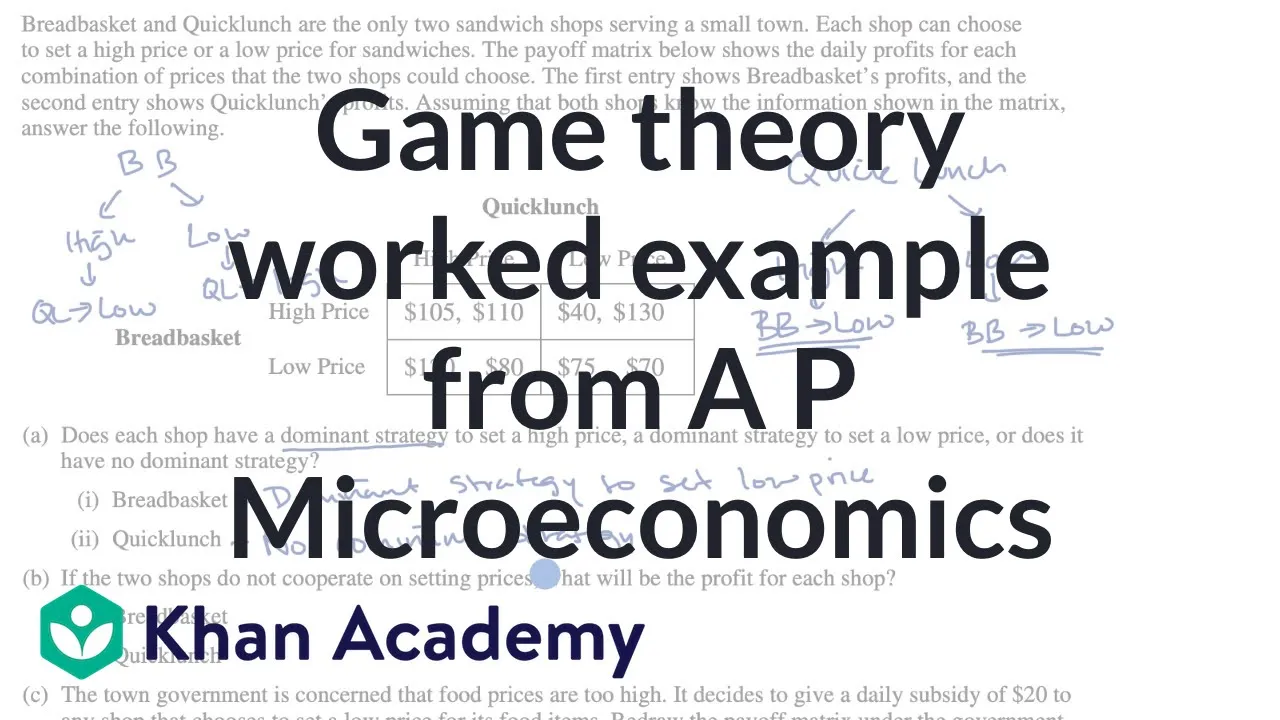
- Why this video: This video directly bridges the gap highlighted in initial curriculum reviews by walking through a highly structured, step-by-step methodology for constructing payoff matrices from raw text-based business scenarios (using a localized duopoly sandwich shop example). It explicitly demonstrates how to map written strategic conditions into numerical row/column player payoffs.

- Why this video: This video reinforces matrix anatomy, teaching you how to read, build, and interpret strategic interactions where firm decisions are highly interdependent. It prepares you to isolate individual player perspectives within a combined matrix cell.

- Why this video: This video provides a vivid, real-world narrative on the structural incentives behind the Prisoner's Dilemma. It details why individual rational incentives persistently drive non-cooperative outcomes, illustrating the gap between joint optimization and private best responses.
Knowledge Checkpoint
- Define the three structural elements of any normal-form game: Players, Strategies, and Payoffs.
- Construct a payoff matrix from a text-based description of a competitive scenario.
- Mathematically prove whether a player possesses a strictly dominant strategy.
- Explain why the Nash equilibrium of a standard classic Prisoner's Dilemma is Pareto inefficient.
Module 2: Simultaneous Games & Nash Equilibrium
In this module, you will master the mathematical extraction of equilibria in simultaneous-move games. You will explore pure strategy solutions and move deep into the mechanics of mixed strategies, learning to construct best-response correspondences and solve systems of equations to find the exact probabilities that make opponents indifferent.
Recommended Videos

- Why this video: This classic Yale lecture offers an unmatched theoretical foundation for Nash equilibria. Using coordinating games like bank runs, it explains how self-fulfilling expectations drive equilibrium selection and explores why multiple equilibria can arise in simultaneous-choice systems.

- Why this video: This tutorial provides the crucial intuitive jump from pure deterministic strategies to probabilistic mixing. It demystifies the core principle of mixed equilibria: a player mixes their actions precisely to make their opponent indifferent among their own pure strategies.

- Why this video: A direct, algorithmic walkthrough on calculating mixed strategy Nash equilibria. It maps out the algebraic expressions of expected utility as a function of choice probabilities, ensuring you possess the core computational toolset for matrices.
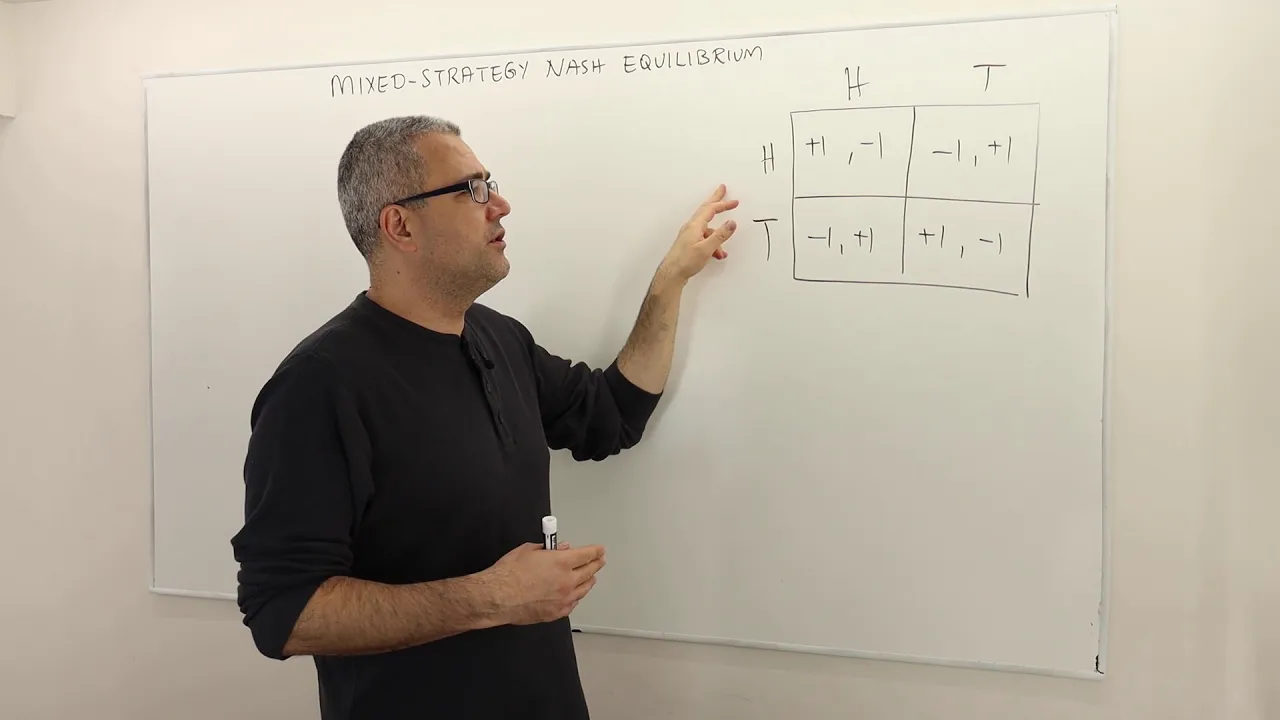
- Why this video: This mathematical derivation shows you how mixed strategies emerge from the intersection of best-response correspondences. This visual and logical formulation deepens your underlying algebraic framework.
Knowledge Checkpoint
- Determine all pure-strategy Nash equilibria in a matrix using the underline method.
- Mathematically construct the algebraic equations required to make Player 1 indifferent between their available strategies.
- Solve for the probability parameters and in a standard asymmetric game.
- Explain why a player would never assign a positive probability weight to a strictly dominated strategy.
Module 3: Sequential Games & Backward Induction
Real-world strategic interactions are rarely entirely simultaneous; turn-taking and chronological positioning dictate outcomes. This module shifts focus to dynamic, extensive-form games. You will learn to map choices onto game trees, apply the solution concept of backward induction, and refine your equilibrium selection by identifying Subgame Perfect Nash Equilibria (SPNE) to eliminate non-credible threats.
Recommended Videos
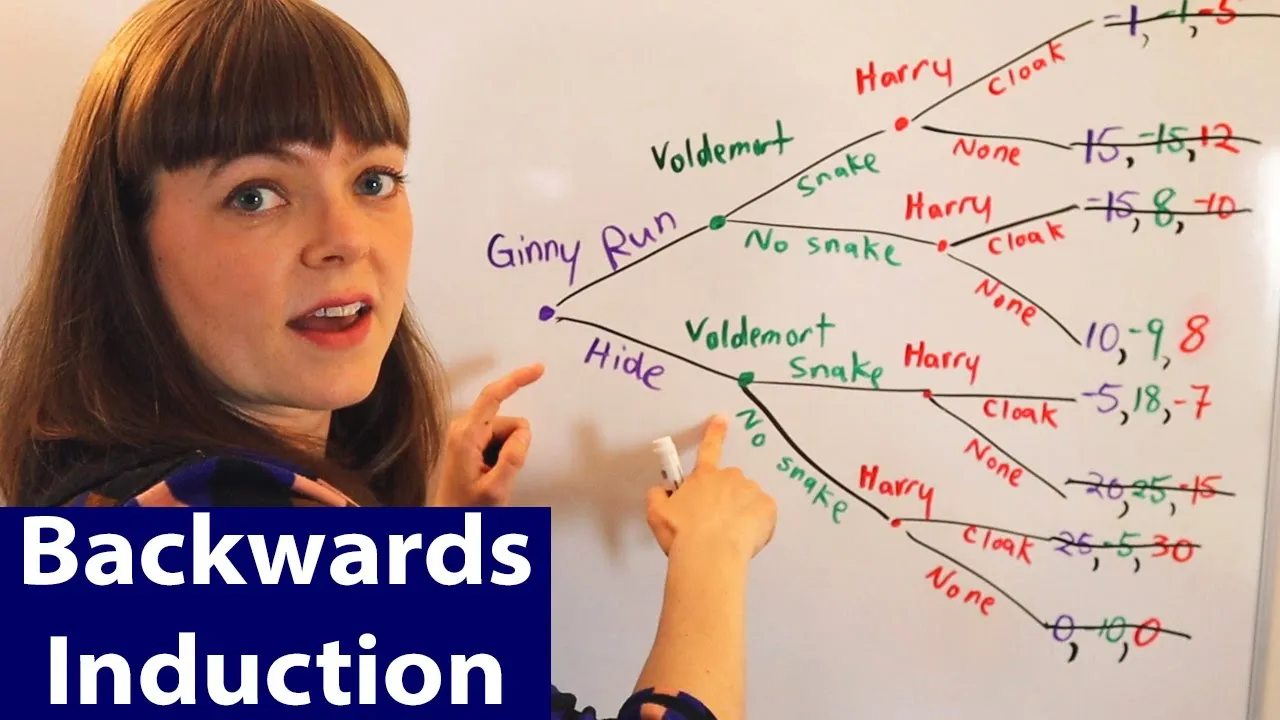
- Why this video: This video teaches how to solve dynamic extensive-form game trees step-by-step. It starts from the terminal nodes and moves backward, showing how to prune branches where rational actions are dominated to determine the optimal strategic path.

- Why this video: This video bridges sequential move profiles with their equivalent strategic normal form representations. It provides a formal breakdown of why certain standard Nash equilibria of a game tree fail to hold up to sequential rationality, leading to the refinement of Subgame Perfect Nash Equilibrium (SPNE).

- Why this video: An in-depth lecture exploring subgame perfection in business settings (such as strategic investments, capacity expansions, and entry deterrence). It shows how players can manipulate game trees to make threats credible through irreversible commitments.
Knowledge Checkpoint
- Translate a descriptive sequential-move scenario into a fully labeled game tree (extensive-form game).
- Define the formal properties of a "subgame" inside a larger extensive-form game.
- Apply backward induction to solve a multi-stage sequential game.
- Identify and discard Nash equilibria that rely on non-credible threats.
Module 4: Evolutionary Game Theory & Dynamics
This module replaces the hyper-rational agents of classical game theory with biological or cultural populations governed by mutation and natural selection. You will study how strategy distributions evolve over time using the classic Hawk-Dove framework, learn the mathematical definitions of Evolutionary Stable Strategies (ESS), and explore population change using replicator dynamics.
Recommended Videos
- Why this video: This academic lecture fills a critical mathematical gap. It outlines the two strict mathematical conditions required to prove that a strategy is evolutionarily stable (ESS) when challenged by mutant strategies, laying down the core mathematical foundations of evolutionary biology models.
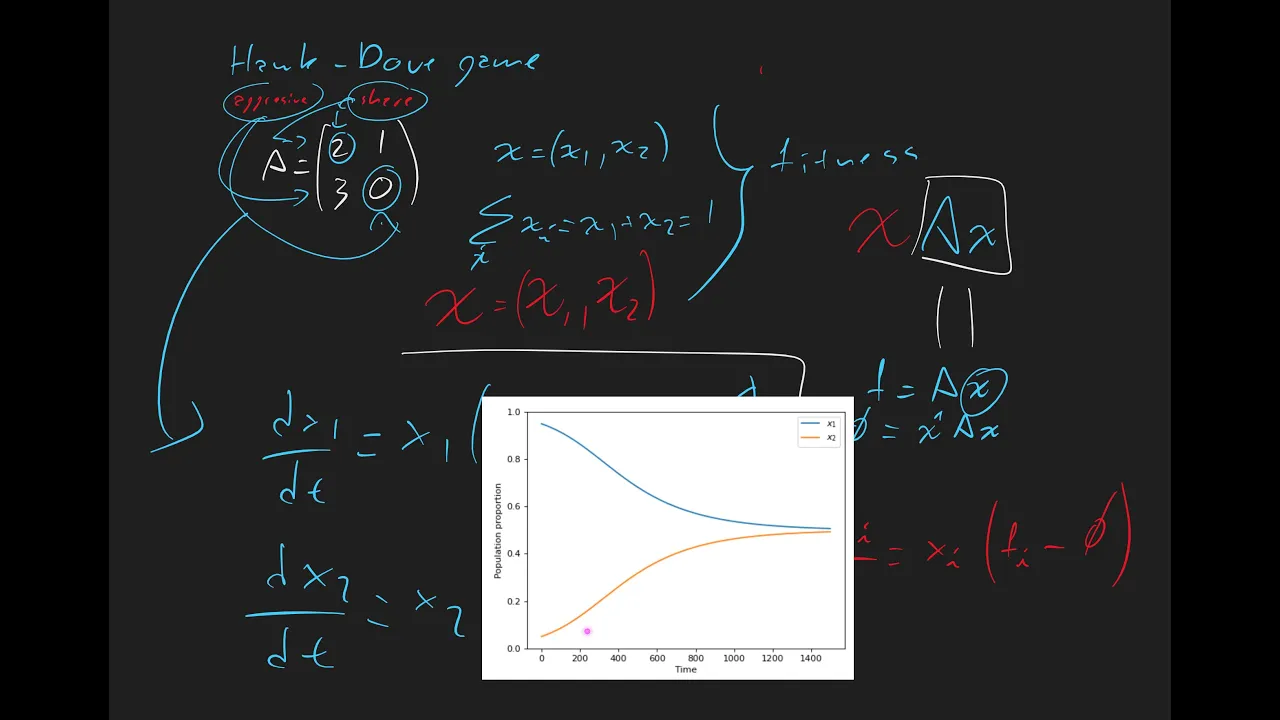
- Why this video: This video mathematically analyzes the Hawk-Dove game using replicator dynamics. It demonstrates how to write down differential equations that represent changes in strategy frequencies within a population over time, and shows how to solve for stable polymorphic states.

- Why this video: This segment uses arbitrary variables ( for resource value, for fight cost) to construct a generalized payoff matrix for the Hawk-Dove game. It mathematically proves under what conditions a pure Hawk strategy fails to be an ESS, leading to a stable mixed population strategy.
Knowledge Checkpoint
- State the two mathematical conditions required for a strategy to be an Evolutionary Stable Strategy (ESS).
- Construct the generalized Hawk-Dove matrix using resource valuation and conflict cost .
- Mathematically prove why a pure "Dove" population is always vulnerable to invasion by a mutant "Hawk" strategy.
- Set up the replicator dynamics equation for a population with two competing phenotypes.
Module 5: Asymmetric Information & Auction Design
The final module explores strategic decision-making under uncertainty and uneven information. You will analyze how markets operate when one player has private information (asymmetric information), study signaling and screening models, and examine auction design. This includes analyzing bidding strategies and revenue outcomes across English and second-price (Vickrey) auctions.
Recommended Videos

- Why this video: This comprehensive Yale lecture explores asymmetric information, modeling how high-quality participants can use costly signaling (such as education) to distinguish themselves from lower-quality types and prevent market collapse.

- Why this video: This lecture covers the mathematical foundations of Mechanism Design. It provides a formal proof showing why a second-price (Vickrey) auction is dominant-strategy incentive-compatible (DSIC), proving that bidding your exact valuation is always the optimal strategy.

- Why this video: This video compares auction structures, analyzing English auctions alongside Second-Price Sealed Bid (Vickrey) mechanisms. It explores strategic bidding behavior, information update patterns, and pricing dynamics under each format.
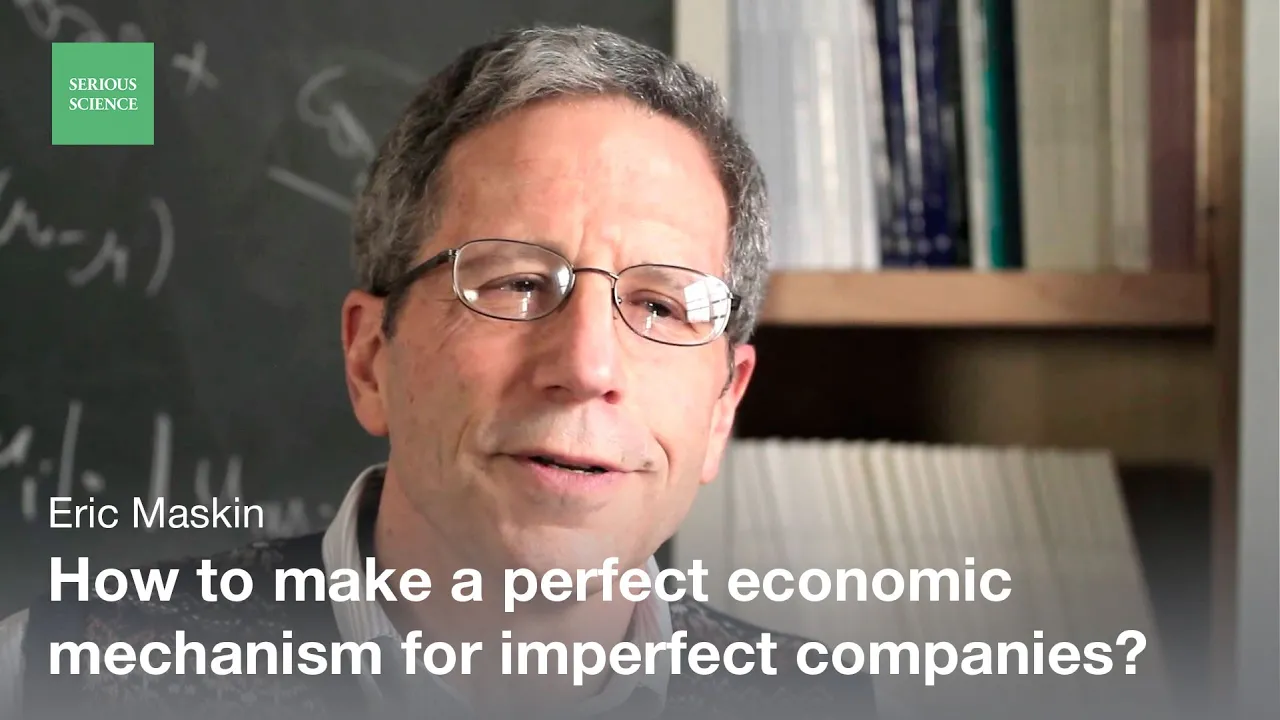
- Why this video: Nobel laureate Eric Maskin explains Mechanism Design theory, showing how designers can build game rules backward from a desired social outcome to align individual incentives with collective goals.
Knowledge Checkpoint
- Explain how asymmetric information can cause adverse selection and market unraveling.
- Define the Spence signaling condition, explaining why signals must be costly to be credible.
- Mathematically prove why truthful bidding is a dominant strategy in a Vickrey (Second-Price) auction.
- Compare the revenue outcomes of English auctions and Vickrey auctions under the Revenue Equivalence Theorem.
Course Map
This map outlines the structure of the course. Modules 1 through 3 build the foundational tools of strategic play, which then branch into evolutionary applications (Module 4) and mechanisms for handling asymmetric information (Module 5).
Key People Index
- John Nash: Princeton mathematician who extended game theory beyond zero-sum games. He proved that every finite game has at least one equilibrium in pure or mixed strategies, transforming modern economic theory.
- William Vickrey: Nobel laureate who pioneered auction theory. He designed the second-price sealed-bid auction (Vickrey auction) and developed the foundations for the Revenue Equivalence Theorem.
- Eric Maskin: Nobel laureate in Economics who helped establish modern Mechanism Design theory, showing how to design games and systems that achieve optimal outcomes despite private information.
- John Maynard Smith (Context from Module 4): Biologist who applied game theory to evolutionary systems. He formalized the concept of the Evolutionary Stable Strategy (ESS) and developed the Hawk-Dove game to analyze animal conflict.
Final Self-Assessment
Review this list after completing all modules. You should be able to confidently check off every item before applying these strategic models to practical scenarios.
- I can construct a complete payoff matrix from a text-based description of a strategic situation.
- I can find all pure strategy Nash equilibria in any simultaneous game.
- I can set up and solve the algebraic equations to calculate mixed-strategy Nash equilibria in games.
- I can construct a sequential game tree from a chronological description of a game.
- I can apply backward induction to identify the Subgame Perfect Nash Equilibrium (SPNE) in an extensive-form game.
- I can explain why some Nash equilibria are eliminated by subgame perfection because they rely on non-credible threats.
- I can use the two mathematical conditions of evolutionary stability to determine if a strategy is an ESS.
- I can model population strategy shifts over time using replicator dynamics.
- I can explain how asymmetric information leads to adverse selection and show how signaling can resolve this market failure.
- I can mathematically prove why bidding your true valuation is the dominant strategy in a Vickrey auction.