Generating Functions in Combinatorics: Recurrences & Partitions
Learning Goal: Master the theory and application of generating functions in discrete mathematics. By the end of this curriculum, you will be able to convert discrete counting problems and sequences into continuous algebraic models, solve linear homogeneous and non-homogeneous recurrence relations, model complex integer partitions using Euler's pentagonal and product identities, and apply exponential generating functions to solve labeled permutation problems.
Prerequisites
- Algebraic Proficiency: Comfort with polynomial factoring, fraction operations, and basic sequences.
- Calculus Basics: Familiarity with derivatives, limits, and basic concepts of infinite series convergence.
Course Information
- Estimated Total Study Time: 30 Hours
- Course Structure: 6 sequential, progressive modules combining video tutorials, deep-dive textbook analysis, and guided problem-solving.
Module 1: Foundations of Sequences and Power Series
This module establishes the foundational language of infinite series. You will learn to express sequences using compact sigma notation, analyze the algebraic manipulation of infinite geometric power series, and calculate the interval and radius of convergence—the crucial mathematical territory where our generating functions are analytically valid.
Recommended Videos

Why this video: This tutorial offers a direct, clear introduction to Sigma () notation. It breaks down the mechanical parts of a summation: the index, lower bound, upper bound, and general term. For students transitionally stepping from plain sequences to generating functions, masterfully unpacking sigma notation is the absolute first step.

Why this video: An elegant walkthrough of the infinite geometric series formula . Understanding that the sum converges only when the absolute value of the common ratio is strictly less than 1 () is critical. This formula is the workhorse of ordinary generating functions; you will utilize it to convert closed-form fractional functions back into infinite series.
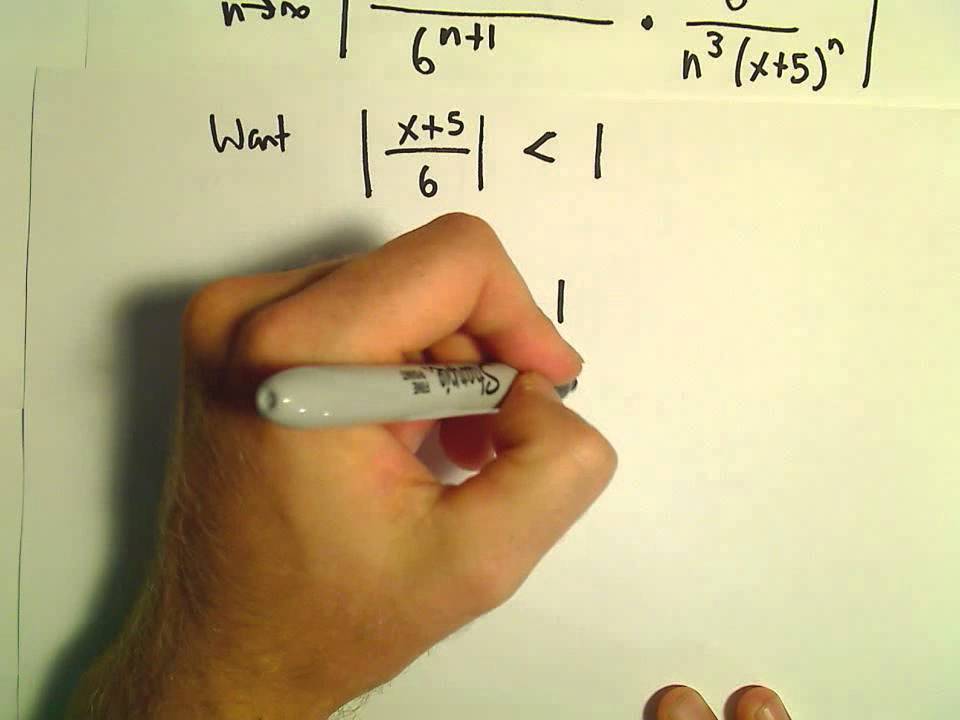
Why this video: This video demonstrates how to use the Ratio Test to compute the exact radius and interval of convergence of a power series. Generating functions are often treated as formal algebraic expressions (where convergence is ignored), but analyzing their analytic properties requires mastering convergence boundaries.
Knowledge Checkpoint
- Convert the sequence into sigma notation.
- Determine the sum of the infinite series and state its domain of convergence.
- Apply the Ratio Test to find the interval of convergence for a given power series .
- Explain why the identity requires the constraint .
Module 2: Combinatorics Foundations & Binomial Theorem
To count objects with generating functions, you must first master classical counting rules. This module covers permutations (order matters), combinations (order does not matter), and the Binomial Theorem. Crucially, we extend the Binomial Theorem to negative and fractional exponents, which enables the expansion of algebraic generating functions.
Recommended Videos
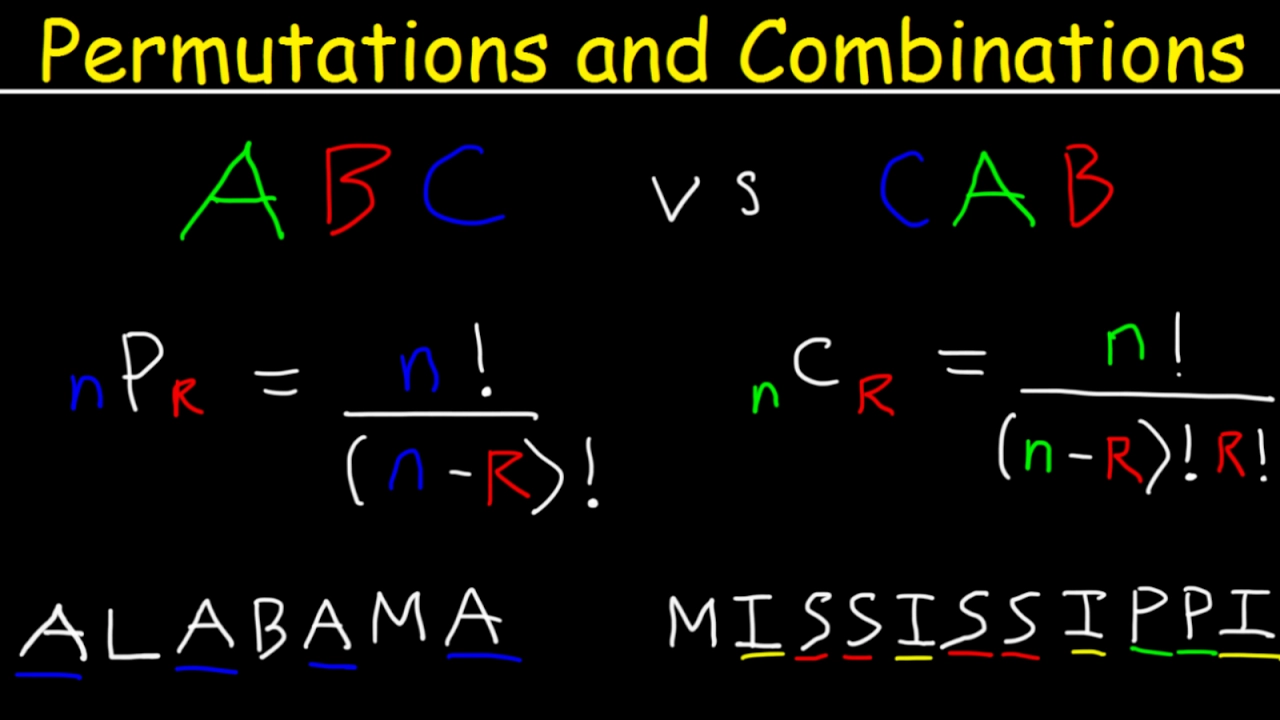
Why this video: A comprehensive tutorial on permutations and combinations. It provides standard formulas ( and ) and models realistic scenarios where order either does or does not matter. This combinatorial foundation prepares you to interpret the coefficients of your generating functions.

Why this video: This video teaches you how to expand binomial terms of the form when is negative or fractional. This is a critical skill for combinatorial analysis, as generating functions for selection problems frequently yield terms like . You will learn how to rewrite these terms into infinite positive power series.
Knowledge Checkpoint
- State the difference between (permutations) and (combinations) and compute both for .
- Solve basic combinatorics word problems using the product and sum rules of counting.
- Expand the expression using the negative binomial theorem and write it in sigma notation.
- Expand to find the coefficient of .
Module 3: Introduction to Ordinary Generating Functions (OGFs)
In this module, you will cross the bridge from discrete math to continuous algebra. You will learn the definition of an Ordinary Generating Function (OGF) as a formal power series where the coefficient of stores the -th term of a sequence. You will also practice converting word/counting problems into functional expressions.
Recommended Videos
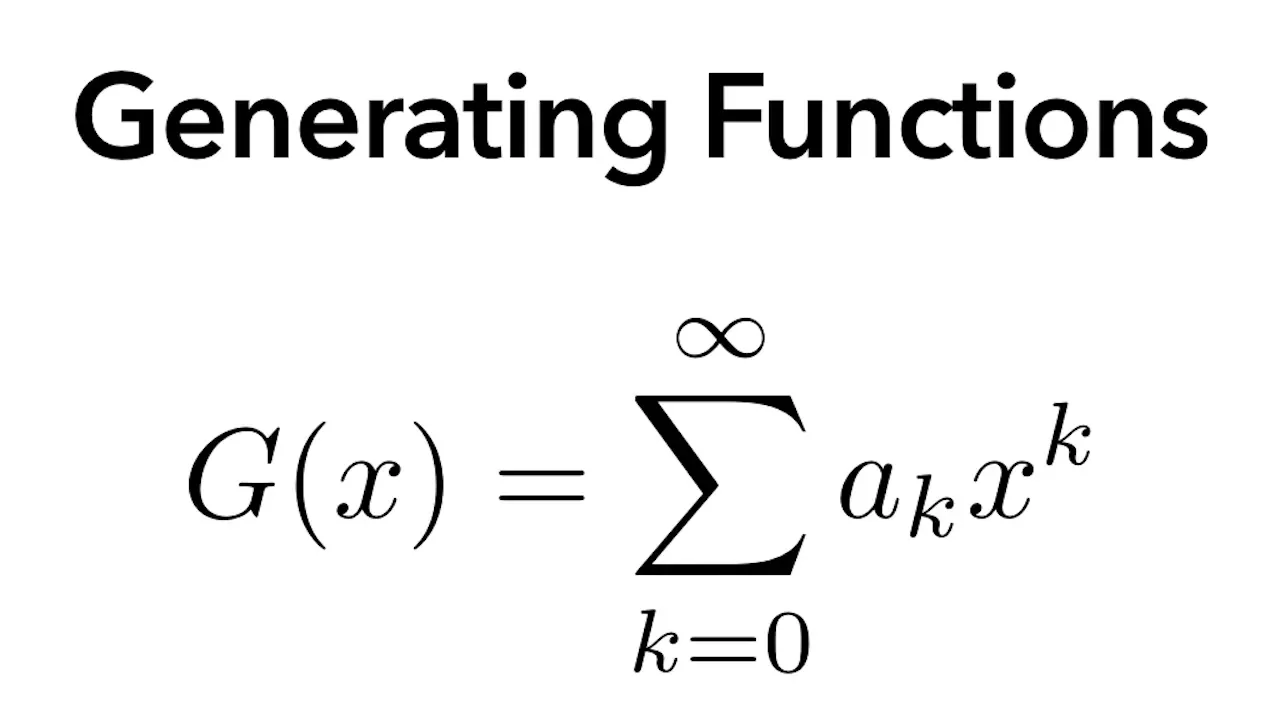
Why this video: This video is an accessible conceptual introduction to generating functions. It visualizes how an entire sequence of numbers or probability distributions can be neatly packaged into a single polynomial or power series.

Why this video: A rigorous academic lecture that dives deep into the algebraic mechanics of ordinary generating functions. This lecture explains how selection problems with specific constraints (such as "select items with at most repeats") translate directly into polynomial multiplication, laying down the core foundation of algorithmic counting.
Why this video: This video reinforces the foundational algebraic mechanisms of generating functions. It shows how the formal power series behaves under key operations like addition, multiplication, and shifting, showing how operations on sequences reflect as algebraic transformations on functions.
Knowledge Checkpoint
- Define what an Ordinary Generating Function (OGF) is for a sequence .
- Write down the OGF for the constant sequence and the shifting sequence .
- Construct the OGF for a selection problem (e.g., choosing apples and bananas with constraints) by modeling the choices as polynomial factors.
- Find the sequence corresponding to the closed-form generating function .
Module 4: Solving Recurrence Relations
One of the most powerful applications of generating functions is solving recurrence relations. In this module, you will learn how to transform a recursive equation (including both linear homogeneous relations and non-homogeneous relations) into an algebraic equation. You will solve this equation, apply partial fraction decomposition, and extract the closed-form formula for the general term of the sequence.
Recommended Videos
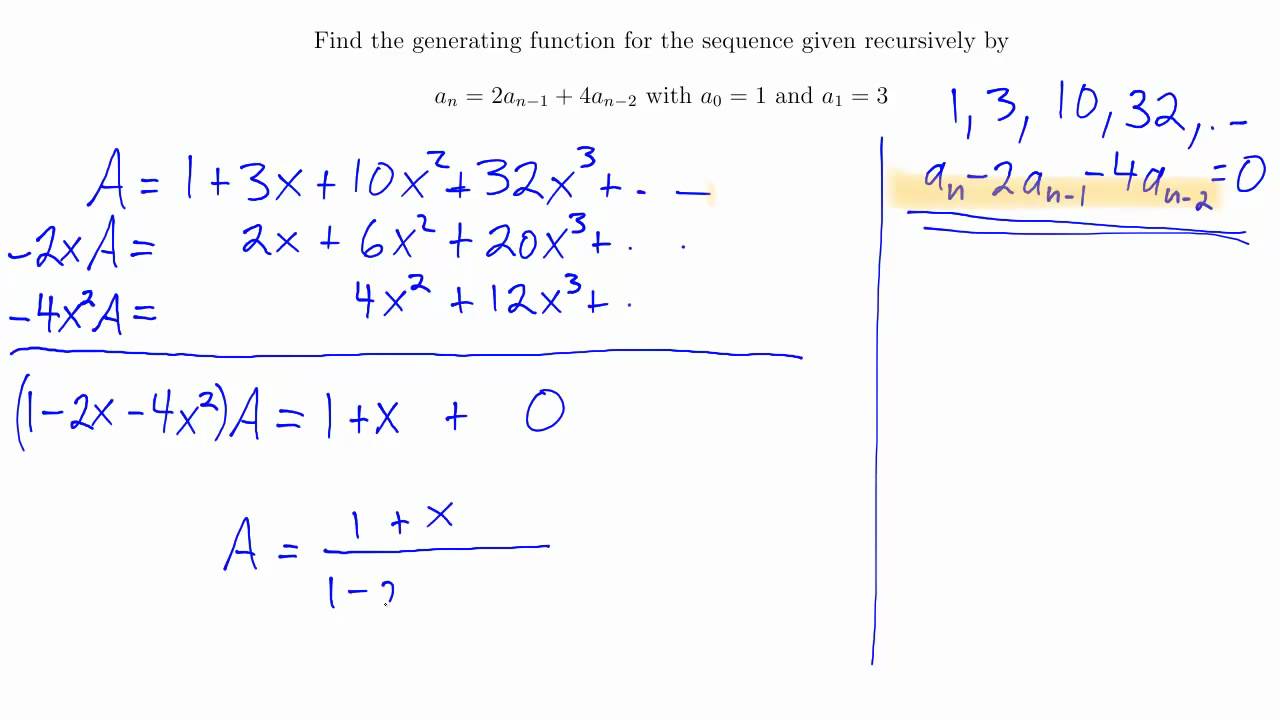
Why this video: This video teaches you the step-by-step process of converting a basic recurrence relation into a generating function equation. The instructor walks you through multiplying by , summing over all valid indices, adjusting terms to match initial conditions, and solving for .
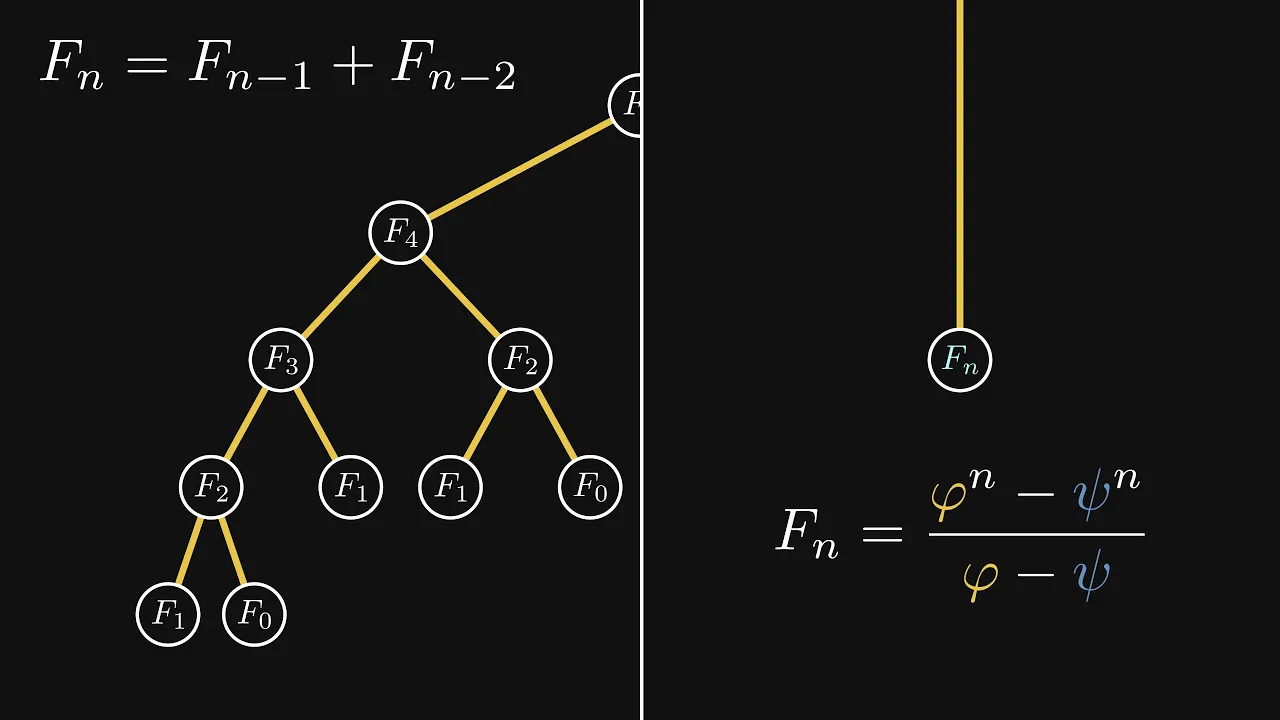
Why this video: This video derives the closed-form expression for the Fibonacci sequence (Binet's Formula) using generating functions. It is a classic showcase of how the Fibonacci recurrence turns into the algebraic relation and how partial fraction decomposition extracts the golden ratio roots.

Why this video: This video provides a detailed, calculation-heavy workspace. It walks through non-homogeneous recurrence examples, demonstrating how to handle extra functions of on the right side of your recurrence equation using generating functions.
Knowledge Checkpoint
- Outline the standard 4-step process for solving a recurrence relation via generating functions.
- Derive Binet's formula for the Fibonacci sequence using the generating function .
- Apply partial fraction decomposition to the function and find its power series coefficients.
- Solve the non-homogeneous recurrence relation with initial condition using generating functions.
Module 5: Modeling Integer Partitions
An integer partition of is a way of writing as a sum of positive integers, where the order of summands does not matter. This module shows how partitions can be beautifully represented and analyzed using infinite product generating functions, Ferrers diagrams, and Euler's identities.
Recommended Videos

Why this video: This video provides a clear explanation of how the partitions of correspond to terms in an infinite product. It walks through the proof of the standard partition generating function and introduces tracking of parts using multivariable indicators.

Why this video: This video focuses on restricted partitions (e.g., partitions where parts are less than or equal to ). This detailed tutorial helps you understand how restricting partition sizes modifies the factors of your generating function.

Why this video: This clip introduces Euler's analytical work with partition generating functions. It specifically highlights the algebraic beauty behind Euler's Partition Identity: proving that the number of ways to partition into distinct parts equals the number of ways to partition into odd parts.
Deep-Dive: Euler's Partition Identities
While videos offer excellent conceptual visualizations, proving partition identities requires algebraic rigor. Let's trace how the generating function for partitions into distinct parts, denoted , is equivalent to the generating function for partitions into odd parts, denoted .
The generating function for distinct parts does not allow any part to be repeated. Thus, for each integer , the choice is binary: either we do not include (), or we include exactly once (). This yields:
The generating function for odd parts allows only odd integers as parts, but they may be repeated infinitely. This yields:
To prove , we manipulate the product for using the algebraic identity :
Let's expand the first few terms of this fraction:
Notice that every even-powered term in the numerator perfectly cancels out with the corresponding even-powered term in the denominator. This leaves behind only the odd-powered terms in the denominator:
This beautiful algebraic cancellation proves that the number of distinct partitions of any integer is always exactly equal to its number of odd partitions.
Knowledge Checkpoint
- Write the generating function for unrestricted integer partitions of .
- Construct the generating function for partitions of where no part is repeated (distinct partitions).
- Use a Ferrers diagram to show that the number of partitions of into at most parts is equal to the number of partitions of with no part larger than .
- Algebraically prove that .
Module 6: Exponential Generating Functions (EGFs)
Ordinary generating functions are perfect for selection problems where order does not matter (unlabeled structures). However, when order matters (labeled structures like permutations or word formations), we must divide terms by factorials. This is where Exponential Generating Functions (EGFs) come in.
Recommended Videos

Why this video: This video introduces exponential generating functions (EGFs) and contrasts them directly with ordinary generating functions. It shows how the factorial terms in EGF denominators behave under binomial expansion, making them perfect for counting permutations.

Why this video: This video provides a quick, direct explanation of the mathematical definition of EGFs. It teaches you how to map sequences to the EGF and provides straightforward examples.

Why this video: A short, fast-paced conceptual showcase. This short illustrates how EGFs naturally encode structural patterns in discrete structures where sequences grow extremely rapidly (like factorial sequences), providing a window into advanced analytic combinatorics.
⚠️ Critical Search Engine Warning: Avoiding Skincare Clashes
When studying EGFs online, you will run into a major search engine collision. In biochemical and skincare fields, "EGF" stands for Epidermal Growth Factor. As a result, basic searches for "EGF" will be flooded with reviews of dark spot serums, K-beauty products, and cellular pathway diagrams.
To bypass this noise and find pure mathematical content, always use targeted academic keyword phrases:
- Instead of searching
EGF vs OGF, search:"exponential generating function" combinatorics discrete math - Instead of searching
EGF examples, search:"exponential generating function" permutations labeled structures
Analytical Guide: Ordinary vs. Exponential Generating Functions
To understand when to use OGFs versus EGFs, compare their definitions and algebraic mechanisms:
Why the Factorial Denominator Matters
When multiplying two ordinary generating functions, the coefficient of in the product is a basic convolution: This models ways to split a selection of unlabeled items into two piles of size and .
When multiplying two exponential generating functions, the product behaves differently because of the factorials:
To express as a standard EGF , we multiply and divide the coefficient by :
Notice that the term inside the summation is now multiplied by the binomial coefficient :
This binomial coefficient models the choice of selecting labeled elements out of total positions to be colored/structured according to , while the remaining elements are structured according to . Therefore, EGFs automatically track the order of choices and combinations of labeled sets.
Knowledge Checkpoint
- State the mathematical definitions of both OGFs and EGFs for a sequence .
- Determine the EGF for the sequence and explain its convergence properties.
- Find the EGF for the number of ways to form -letter words using only the letters 'A', 'B', and 'C' where 'A' must appear an even number of times.
- Explain why multiplying two EGFs introduces a binomial coefficient in the resulting sequence coefficient.
Course Map
Below is the recommended visual flowchart and dependency map for this curriculum. If you struggle with a topic, trace back along the arrows to review the prerequisite material.
Key People Index
Leonhard Euler (1707–1783)
A Swiss pioneer who revolutionized analysis and combinatorics. Euler introduced the concept of partition generating functions, proved the odd-distinct partition identity, and solved the famous Basel problem.
Abraham de Moivre (1667–1754)
A French mathematician who first introduced the concept of generating functions in 1718 to solve probability problems and analyze recurrences, laying the groundwork for analytic combinatorics.
Norman Macleod Ferrers (1829–1903)
An English mathematician who developed Ferrers diagrams—the intuitive, grid-of-dots representations of partitions. These diagrams turned partition theory into a highly visual, geometric study.
Final Self-Assessment
Test your understanding by completing this comprehensive checklist:
- Write the sequence corresponding to the Ordinary Generating Function up to the coefficient of .
- Find the interval of convergence for the classic geometric series .
- Expand using the negative Binomial Theorem to find the coefficient of .
- Write down the recurrences and initial conditions for the Fibonacci sequence, and explain how shifting indices is represented as multiplication by in generating functions.
- Transform the recurrence with into a generating function and solve for the closed form of .
- Show that the generating function for the number of partitions of into distinct parts is .
- Draw a Ferrers diagram for the partition , find its conjugate partition, and state the theorem of conjugate partitions.
- Explain why EGFs are preferred over OGFs when modeling labeled structures (such as permutation arrangements).
- Find the EGF for the sequence of the number of permutations of length (which is ).
- Solve the exponential recurrence relation of choosing colored objects where order matters, using EGF algebra.