Trademarks: Infringement, Dilution & Fair Use
Learning Goal: Analyzing the legal standards for trademark infringement, dilution, and fair use under the Lanham Act to protect brand identity and evaluate commercial disputes.
- Prerequisites: None (Introductory to Advanced levels included).
- Estimated Total Study Time: 9 Hours.
Module 1: Foundations of Trademark Law
This module covers the core concepts of trademark law under the Lanham Act. You will explore what constitutes a protectable trademark, how brands are built, and the famous spectrum of distinctiveness—from generic terms that receive no protection to highly protected fanciful and arbitrary marks.

Why this video: This WIPO-produced guide offers an excellent, intuitive introduction to trademarks. It explains how trade symbols, packaging, and colors serve as trust-anchors for consumers and highlights why commercial registration is vital to shield a business from unfair competition.
Knowledge Checkpoint:
- Define what a trademark is and what types of identifiers (sounds, shapes, words, logos) can be protected.
- Understand how a trademark acts as an indicator of source and origin for consumers.
- Distinguish between registered trademarks and common law trademark rights.
Why this video: This fast-paced lesson details the three core requirements for federal trademark protection: acceptability, use in interstate commerce, and source distinctiveness. It introduces how courts categorize names to determine their eligibility for registration.
Knowledge Checkpoint:
- List the three statutory criteria required to secure federal trademark protection.
- Define "interstate commerce" in the context of federal trademark applications.
- Explain how "secondary meaning" allows descriptive terms to obtain trademark protection over time.

Why this video: Attorney Jim Hart provides a deep-dive legal breakdown of the trademark distinctiveness spectrum. He explains the boundaries between fanciful, arbitrary, suggestive, descriptive, and generic marks.
Knowledge Checkpoint:
- Define and provide real-world examples of fanciful marks (e.g., Kodak, Exxon) and arbitrary marks (e.g., Apple).
- Differentiate between suggestive marks (which require consumer imagination) and descriptive marks (which simply define the product's attributes).
- Explain why generic terms can never be trademarked and how "genericide" can destroy an active trademark.
💡 Curriculum Gap Note: While these videos cover the distinctiveness spectrum conceptually, academic learners looking for deeper legal analysis of secondary meaning criteria should independently search for:
"Trademark distinctiveness spectrum legal explanation".
Module 2: Trademark Infringement & Consumer Confusion
This module focuses on the heart of commercial disputes: trademark infringement. You will learn the legal elements required to establish a claim, specifically focusing on the court-applied "likelihood of confusion" factors (often called the Polaroid or DuPont factors).

Why this video: This academic lecture provides a highly structured breakdown of judicial factors used to evaluate infringement claims. It focuses on the strength of the plaintiff's mark, product proximity, and similarity in sound, appearance, and meaning.
Knowledge Checkpoint:
- Identify the core judicial factors used by courts to analyze "likelihood of confusion."
- Explain how "proximity of goods" impacts the likelihood of confusion analysis.
- Describe how visual, phonetic, and conceptual similarities are weighed by a judge.
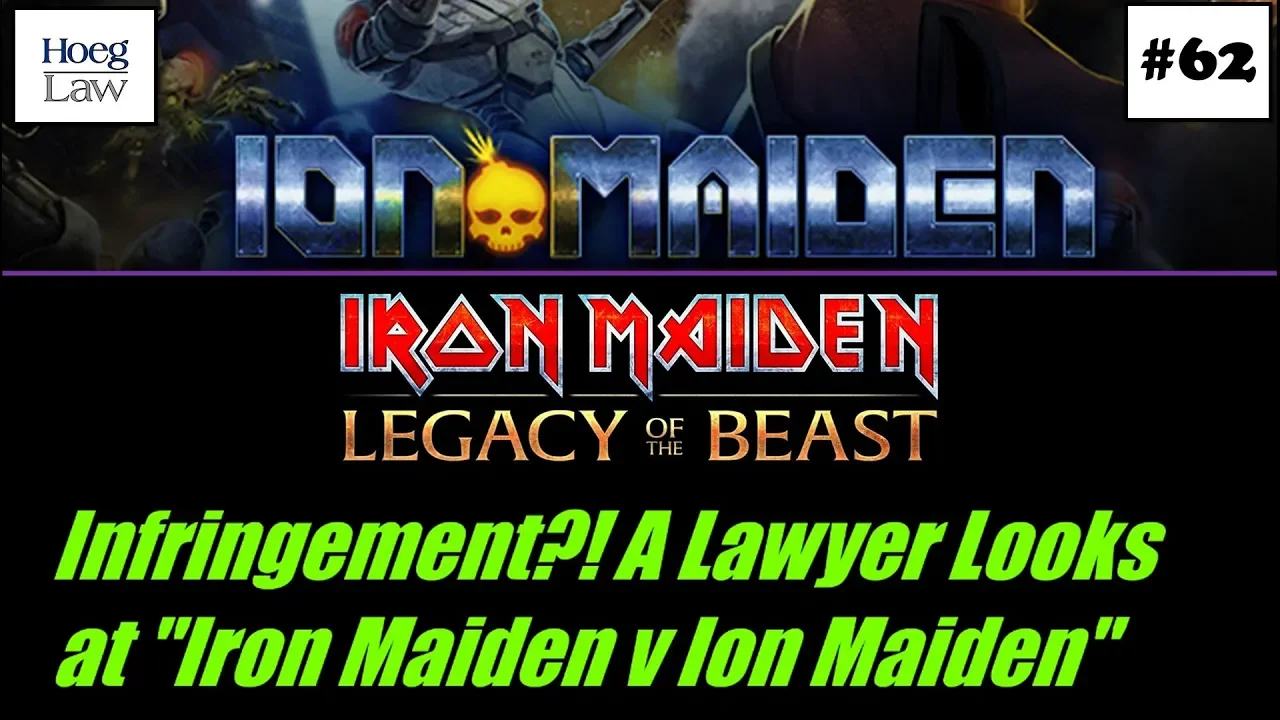
Why this video: Business attorney Richard Hoeg applies trademark infringement rules to a real-world dispute between the legendary band Iron Maiden and an indie game studio. It provides a practical, step-by-step application of the legal elements needed to prove a violation.
Knowledge Checkpoint:
- List the four necessary elements a plaintiff must show to establish trademark infringement.
- Explain how "priority of rights" is established and why it is critical in commercial litigation.
- Understand how a court evaluates whether an ordinary consumer would believe products share a common source, sponsorship, or licensing origin.
Why this video: This concise guide by a practicing IP attorney focuses on the consumer-centric standard of infringement under the Lanham Act, explaining how courts evaluate confusion from the perspective of an ordinary buyer.
Knowledge Checkpoint:
- Explain who the "ordinary consumer" is in an infringement analysis.
- Differentiate between confusion regarding the source of goods and confusion regarding sponsorship or approval.
💡 Curriculum Gap Note: To see a regional breakdown of these factors (such as the 9th Circuit's Sleekcraft factors vs. the 2nd Circuit's Polaroid factors), independently search for:
"Polaroid factors trademark likelihood of confusion test".
Module 3: Trademark Dilution: Blurring & Tarnishment
Unlike standard infringement claims, trademark dilution protects famous marks from unauthorized uses even when there is no likelihood of consumer confusion. This module breaks down the protections granted under the Federal Trademark Dilution Revision Act (TDRA), highlighting the mechanics of dilution by "blurring" and "tarnishment."

Why this video: This brief case summary introduces the landmark Supreme Court decision in Moseley v. V Secret Catalogue, Inc., which highlights the historically high standard of proving dilution before Congress updated the law.
Knowledge Checkpoint:
- Explain the original holding of the Moseley case regarding the standard of proof for dilution.
- Understand why this ruling led Congress to pass the Trademark Dilution Revision Act (TDRA) to lower the plaintiff's burden of proof.
Why this video: This legal overview clearly distinguishes trademark infringement (preventing consumer confusion) from trademark dilution (protecting the commercial value and uniqueness of a famous mark).
Knowledge Checkpoint:
- Differentiate between the consumer-protection goals of infringement law and the property-protection goals of dilution law.
- Define the statutory requirement of a "famous mark" and why typical local trademarks cannot claim dilution.
- Differentiate between dilution by blurring (weakening the distinctiveness of a mark) and dilution by tarnishment (harming the mark's reputation).

Why this video: Former Deputy District Attorney Emily D. Baker breaks down the high-profile Supreme Court battle in Jack Daniel’s Properties, Inc. v. VIP Products LLC. The case examines how a commercial parody dog toy ("Bad Spaniels") crossed the line from protected expression into trademark infringement and dilution.
Knowledge Checkpoint:
- Explain the legal tension between commercial parodies and trademark dilution under the TDRA.
- Analyze why the Supreme Court rejected a blanket First Amendment exclusion when a parody is used specifically as a trademark (a designation of source).
- Detail the arguments for tarnishment in the Jack Daniel's case (e.g., associating food-related items with dog excrement).
💡 Curriculum Gap Note: To review the precise six-factor test for dilution by blurring under the TDRA, independently search for:
"Trademark dilution blurring vs tarnishment TDRA".
Module 4: Defenses, Fair Use & Parody
Even when a mark is identical, defendants have powerful affirmative defenses. This module examines the legal protections for nominative fair use, descriptive fair use, artistic expression, and parodies under the First Amendment.
Why this video: In this creative short, Tom Scott demonstrates the concept of nominative fair use. He explains how and when one can legally use a brand name or trademarked term to refer to the actual trademarked entity without infringing on their rights.
Knowledge Checkpoint:
- Define "nominative fair use" and outline when it is legally permissible.
- Identify why descriptive or documentary referencing of a trademarked landmark or product is protected.
- List the three conditions required to prove nominative fair use (e.g., necessity, using only what is needed, and lack of implied sponsorship).

Why this video: This deep-dive analysis details the aftermath of the Jack Daniel's v. Bad Spaniels Supreme Court decision. It covers how the court balances the Rogers test (protecting artistic works under the First Amendment) with the core consumer confusion standard.
Knowledge Checkpoint:
- Explain the Rogers v. Grimaldi test and its purpose in protecting artistic expression from trademark claims.
- Describe how the Supreme Court limited the application of the Rogers test in cases where the parody is used as a brand identifier.
- Understand why "parody" is not a get-out-of-jail-free card if consumers are confused about licensing or sponsorship.

Why this video: This video analyzes a dispute where Domino's Pizza demanded a YouTuber modify his custom car project. It presents an exceptional practical application of how the fair use defense operates in real-world brand protection disputes.
Knowledge Checkpoint:
- Explain how non-commercial, transformative, or commentary uses of trademarked material can defeat an infringement claim.
- Evaluate how a creator's lack of commercial competition in the trademark holder's primary market supports a fair use defense.

Why this video: This video features actual Supreme Court oral arguments concerning the intersection of political speech, the First Amendment, and trademark registration. It demonstrates how the nation's highest court reviews disputes when brand identifiers and expressive speech clash.
Knowledge Checkpoint:
- Describe how the First Amendment intersects with the Lanham Act's source-identification mandates.
- Explain why the government has an interest in refusing registration for marks that may mislead or lack commercial use, even if they contain political commentary.
💡 Curriculum Gap Note: To fully understand the differences between utilizing a mark to describe your own goods (descriptive fair use) vs. referencing the competitor's goods (nominative fair use), search for:
"Nominative vs descriptive trademark fair use".
Module 5: Enforcement, Remedies & Dispute Resolution
The final stage of trademark management involves active enforcement. In this module, you will learn about the civil litigation process: from issuing cease and desist letters to seeking injunctive relief, damages, and statutory awards.

Why this video: This video provides a highly practical guide on how to assess and respond to a trademark Cease & Desist letter. It explains how to negotiate settlements without advancing to costly court litigation.
Knowledge Checkpoint:
- Explain the legal purpose of a Cease & Desist letter and its function as a notice of infringement.
- Identify key evaluation steps upon receiving a notice (e.g., verifying priority dates, checking registration status).
- List alternative dispute resolution options, such as rebranding agreements, phasing-out periods, or co-existence agreements.
Why this video: Using the Nintendo v. Storman case, this analysis highlights how damages and permanent injunctions are calculated and awarded in federal courts when willful infringement is proven.
Knowledge Checkpoint:
- Define "willful infringement" and explain how it impacts the calculation of damages.
- Explain how "statutory damages" are calculated under federal intellectual property laws.
- Understand the process of obtaining a permanent court injunction to shut down infringing operations.

Why this video: This industry breakdown of the Billion Dollar Beauty v. Anastasia Beverly Hills dispute illustrates how commercial brands seek injunctions to force competitors to halt product sales and recall infringing goods.
Knowledge Checkpoint:
- Explain the requirements for obtaining an injunction to prevent the ongoing sale of infringing goods.
- Describe how product recalls and packaging destruction are used as court remedies.
Why this video: This lecture maps out the chronological steps of civil litigation in intellectual property disputes. It covers the filing of complaints, discoveries, motion hearings, and settlements.
Knowledge Checkpoint:
- Detail the chronological stages of a trademark infringement lawsuit from complaint to trial.
- Understand why the vast majority of trademark disputes settle out of court.
- Identify the role of evidentiary discovery in proving consumer confusion.
💡 Curriculum Gap Note: While these case studies illustrate active disputes, statutory damages calculations and injunctive relief standards can vary by federal circuit. To learn more, independently search for:
"Trademark infringement remedies and damages litigation guide".
Course Map
Key People Index
- Edwin Land: Co-founder of Polaroid Corporation. Although known as an inventor, his company's landmark litigation historically established the Polaroid Factors—the gold-standard judicial test used by federal judges to analyze likelihood of confusion.
- Chief Justice John Roberts: Chief Justice of the United States. He has led the court through modern-era trademark rulings (e.g., Jack Daniel's Properties v. VIP Products), balancing First Amendment protections with the Lanham Act's source-identification frameworks.
- Emily D. Baker: Former Deputy District Attorney and legal analyst. She provides highly regarded public breakdowns of high-profile trademark litigation filings and intellectual property trials.
- Richard Hoeg: Founder of Hoeg Law and host of Virtual Legality. He specializes in commercial contract disputes, analyzing business-to-business IP enforcement and public trademark filings.
Final Self-Assessment
Test your mastery of trademark law under the Lanham Act by completing this comprehensive self-assessment checklist:
- I can categorize any brand mark into its correct position on the spectrum of distinctiveness (Fanciful, Arbitrary, Suggestive, Descriptive, Generic).
- I can list the four essential components required to prove trademark infringement in federal court.
- I can explain how the judicial "likelihood of confusion" test operates and list at least four of its common evaluation factors (e.g., mark similarity, product proximity).
- I can define the statutory difference between trademark infringement (confusion-based) and trademark dilution (fame-based).
- I can articulate the distinction between dilution by blurring and dilution by tarnishment under the Trademark Dilution Revision Act (TDRA).
- I can explain the difference between nominative fair use (identifying the trademark owner's actual product) and descriptive fair use (using a descriptive word to define one's own product).
- I can summarize the Supreme Court's Jack Daniel's v. VIP Products ruling and explain why parodic works are not exempt from infringement claims if they use a mark as a source-identifier.
- I can outline the steps a business should take when receiving a Cease & Desist letter to resolve the dispute without litigation.
- I can identify the various remedies available to a successful trademark litigant, including preliminary injunctions, product recalls, profits disgorgement, and statutory damages.