Forensic linguistics, the scientific analysis of language to identify authors and solve crimes, was successfully applied in the Unabomber case (1978-1995) to analyze the bomber's manifesto and letters, revealing linguistic patterns including regional terminology and word choices that helped investigators identify Ted Kaczynski as the perpetrator.
How Forensic Linguistics Caught the Unabomber: A Case Study
Added:Deep Dive
An introductory understanding of linguistics, specifically how syntax, morphology, and lexicon vary among different speakers.

FLC UNIT 1| MSU F.Y B.Com | COMPONENTS OF COMMUNICATION | MOST IMP QUESTION |
112
Language variants refer to the different forms of a language that develop based on regional, cultural, and social factors. Accent relates to pronunciation differences across regions - for example, Gujarati has different accents in Panchmahal, Godhra, Surat, and Ahmedabad. Lexicon refers to word choice variations, such as British English using 'film' while American English uses 'movie', or 'flat' versus 'apartment'. Syntax involves grammatical structure differences, like British English using 'team are' while American English uses 'team is'. These variations create linguistic diversity within the same language.
Click to watch →

SEMANA 1 INGLÉS
102
This comprehensive section introduces linguistics as the scientific study of language, covering its main branches: phonetics (study of sound articulation), phonology (study of sounds as a system), morphology (study of word formation using morphemes), syntax (study of sentence structure), semantics (study of meaning), and pragmatics (study of language use in context). The program focuses on phonetics, phonology, morphology, and syntax as the four principal branches. Key concepts include 'chunks' (groups of words used together in different contexts) and the distinction between free and bound morphemes. The section then explores syntax as the analysis of sentence structure, explaining that native speakers possess linguistic knowledge including a finite lexicon (dictionary in the head) and grammatical rules. Despite infinite possible utterances, speakers cannot store all expressions in their brains. Languages share grammatical categories (nouns, verbs, adjectives) but differ in rules like adjective position (before nouns in English, after nouns in Spanish).
Click to watch →
![[Syntax] Introduction and Glossing](https://i.ytimg.com/vi_webp/OBGA9DZT6Ns/maxresdefault.webp)
[Syntax] Introduction and Glossing
107.5K
Syntax is the study of how words group together in language, focusing on sentence structure and word combinations rather than word formation (which is morphology). Linguists are descriptive, not prescriptive, meaning they observe how people actually use language rather than imposing grammar rules. To analyze syntax across languages, linguists use a three-line glossing system: the literal sentence, a gloss line aligning words to their meanings with standardized abbreviations, and a translation line. Languages vary significantly in word order (such as English's SVO vs. Japanese's SOV), adjective placement (English adjectives before nouns vs. Spanish after), and morphological marking (like Icelandic fusing definite articles with nouns). These variations demonstrate that syntactic structures are not universal but reflect fundamental differences in how languages encode meaning.
Click to watch →

Research Spotlight: Dr Víctor Acedo-Matellán
395
Linguistics is the scientific study of human language, encompassing both empirical research and theoretical work. Theoretical linguistics focuses on syntax (sentence-building mechanisms) and morphology (word-building mechanisms), examining how these connect to meaning and how these connections vary across languages. A key example involves how different languages express motion: English combines manner and trajectory in one verb phrase ('danced into'), while French separates them (main verb for trajectory, gerund for manner). This systematic variation across language types prompts fundamental research questions about what causes such differences.
Click to watch →
Linguistics An introduction
153
Morphology and syntax are branches of linguistics concerned with the internal structure of words and sentences, and with word order. Morphology studies how words are formed and modified, including prefixes and suffixes that change meaning. Syntax studies the rules that govern how speakers organize words into sentences. Semantics is the study of meaning, examining the meaning of each word and each sentence. It includes lexical semantics (study of word meanings) and phraseology (study of fixed word combinations). Semantics also deals with resolving ambiguity in language, as human language can be unclear at certain levels.
Click to watch →
Deep Dive
The concept of an 'idiolect,' which refers to the unique and individual language system of a specific person.

B.ED LINGUISTICS Major English BY MT SIR , FINAL TU EXAM QUESTIONS SOLUTION ,First year
39.1K
An idiolect is a unique, individualized variety of language that is personal to a specific speaker. It may include distinctive features such as pronunciation patterns, vocabulary choices, and grammatical structures that are characteristic of that individual. Idiolects can be influenced by factors such as age, education, profession, and personal background.
Click to watch →
09 - Modelo teórico sobre la comunicación y autocríticas de Kerbrat Orecchioni
624
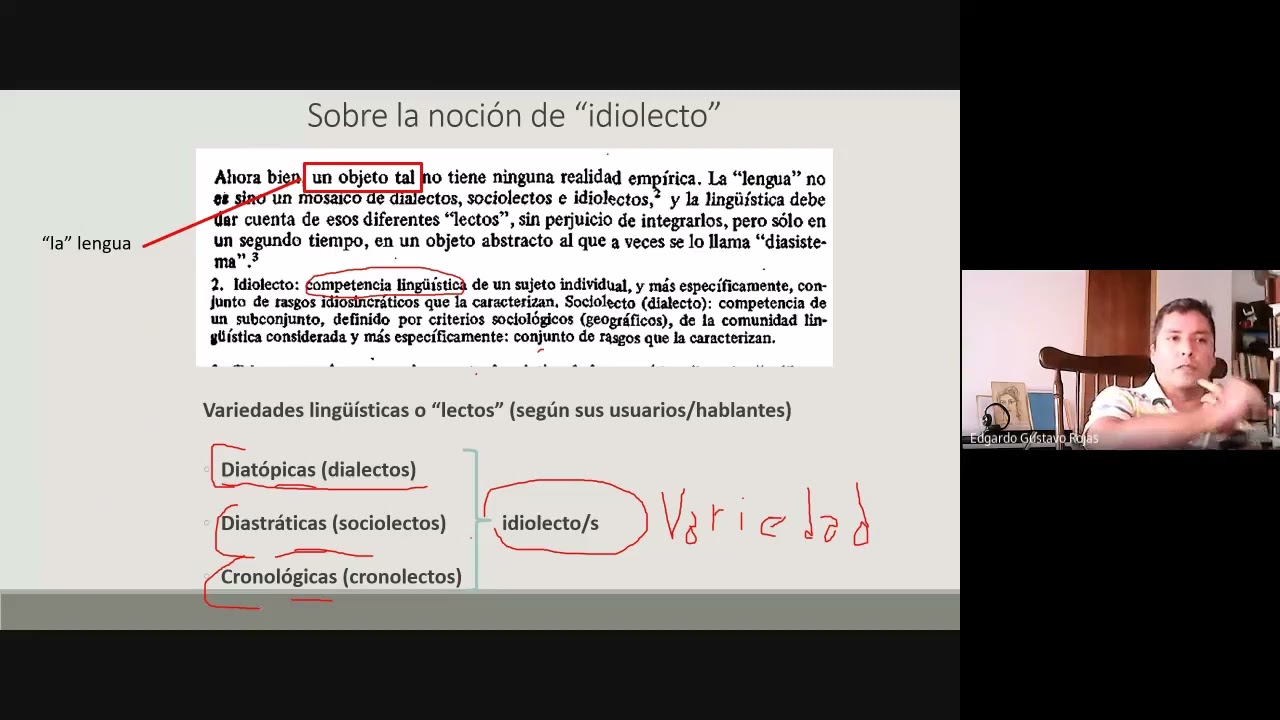
Idiolect is defined as an individual variety of language emerging from the crossing of collective varieties. It is not merely personal language but results from the intersection of multiple social varieties: regional varieties (dialects based on geographic location), social stratification varieties (based on class and economic status), and chronological varieties (based on historical periods). Each person's language reflects their specific combination of regional origin, social background, and historical period. The speaker explains that idiolect is adapted from sociolinguistics and represents how individual language emerges from collective linguistic varieties.
Click to watch →
Sociolinguistics: Definitions and Scopes / Language Variation
74.9K
Every person has their own unique way of speaking called an idiolect. Even within a language spoken natively by hundreds of millions of people (like English spoken by about 500 million people), there are approximately 500 million distinct idiolects. No two people speak a language in exactly the same way. This variation is related to physical features dependent on the speaker's vocal system physiology, including speech characteristics that are special to every individual speaker. Even people with disabilities affecting their vocal systems have their own unique idiolect.
Click to watch →

Dialect and Idiolect
364
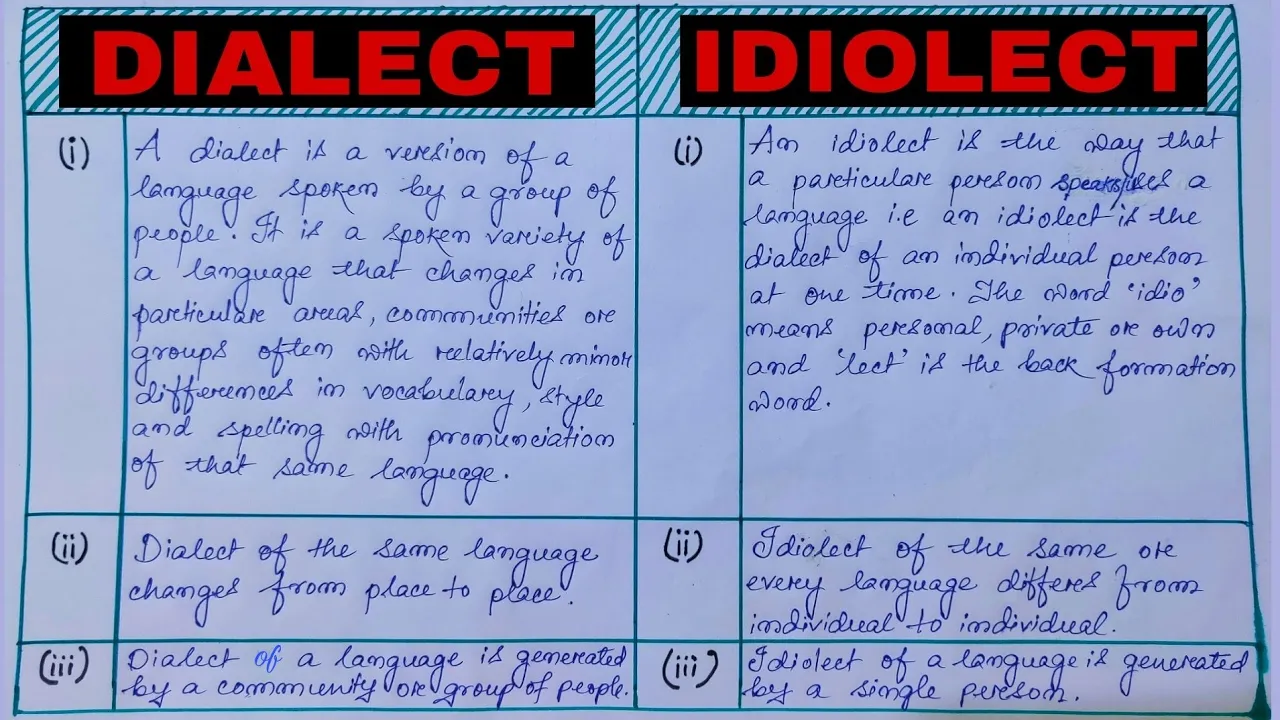
An idiolect refers to the variety of language particular to an individual at a particular point in time. Unlike dialects which refer to group-based language varieties, idiolect assumes that no two people speak exactly the same language or even the same dialect in identical ways. Each person's language undergoes modifications over time through acquisition of new words and usages. Changes in a person's language result from various conditions including geographical factors (rural vs urban differences) and social conditions (class and education). Even among people who speak the same dialect, their idiolects differ because each person's use of language is unique.
Click to watch →
What is Dialect & Idiolect ? Difference between Dialect & Idiolect 📚 English Literature with BIKRAM
5.9K
An idiolect is the way a particular person speaks and uses language, combining 'idio' (meaning personal, private, or one's own) with 'lect' (meaning speech or language). Unlike dialects, which are generated by communities and groups, an idiolect is generated by a single individual. No two people speak exactly the same way, even when using the same words, because each person has a unique speaking style, voice quality, and pronunciation pattern. This individual variation means the same word or sentence will sound different when spoken by different people, whether within the same language or across different languages.
Click to watch →
Deep Dive
The basic definition of stylometry, the statistical analysis of literary style used to determine authorship.

Qué es la estilometría, usos y aplicaciones
527
Stylistometry is the statistical analysis of literary style that uses computational methods to identify authorship, detect literary genres, and track stylistic evolution over time. The technique analyzes linguistic patterns such as word frequency, word length distribution, and grammatical word usage to reveal authorial fingerprints. Originally developed in the 1960s to solve the Federalist Papers authorship controversy, stylistometry has been applied to various fields including medieval literature analysis, political discourse examination, and television script analysis. The method works by identifying similarities and differences between texts and grouping them according to their linguistic characteristics, providing researchers with evidence-based insights into authorship questions that traditional methods cannot resolve.
Click to watch →

Les secrets de la communication non-verbale partagés par une sémiologue - Elodie Mielczareck
307.2K
Stylometry is a linguistic discipline that analyzes how words are organized within sentences to determine authorial style. It examines the distance between subject and verb, verb and complements, and other syntactic patterns. This technique has been used to identify authors of disputed works, such as determining whether Shakespeare or Molière wrote certain plays. Stylometry relies on computer analysis to measure these subtle patterns that reflect individual writing habits.
Click to watch →
Did Shakespeare Write His Plays? Stylometry Explained
1.1M
Stylometry is a linguistic technique that analyzes unique writing characteristics—such as average sentence length, word arrangement, and vocabulary patterns—to determine authorship, and when applied to Shakespeare's works, it confirms that Shakespeare wrote his own plays while also revealing evidence of collaborations with other playwrights like Christopher Marlowe.
Click to watch →

The Book of Mormon is a Literary Masterpiece | A Marvelous Work Episode 4
144.6K
Stylometry applies statistical analysis to literary style by examining function words (prepositions, conjunctions, pronouns) that serve as scaffolding for constructing meaning. Dr. Paul Fields' research visualized Book of Mormon speakers as spheres in multi-dimensional space, revealing 28 distinct authors ranging from Abinadi to Zeniff. Using approximately 250 dimensions projected into three visual axes, the analysis showed greater stylistic variation among Book of Mormon speakers than exists across eight novels by literary geniuses of their respective eras. This statistical distinction makes it highly improbable that one person (like Joseph Smith) could have produced such diverse voices spanning over a thousand years.
Click to watch →

Тысячеликий автор: что частотно-распределительный подход может рассказать о динамике стиля
140
Stylometry is a philological discipline that conceptualizes style as measurable linguistic parameters. The term existed in European languages in the 10th century and entered linguistics through Vincent Lutosławski. The discipline entered through classical philology for dating Plato's dialogues, then expanded through German and Russian traditions. In Russia, it entered through Nikolay Morozov in 1915, experienced a decline in the 1930s-1940s, and was revived in the 1960s. Mathematical linguistics and engineering linguistics represent a separate branch created by Raymond Genrich Piatrovsky. Two fundamental approaches exist: the rule-based approach (going from basic categories to general counts) and the statistical approach (going from counts to categories). Key challenges include defining what constitutes 'style' - lexicon or syntax, and whether to use lemmas, lexemes, or word forms. A comprehensive methodology involves multiple stages: the Delta measure for primary text clustering, the Zeta measure for contrastive analysis, and linguistic analysis of differentiating lexicon. Stylometry can objectively verify literary periodization, as demonstrated by case studies of Vargas Llosa's 19 novels and García Márquez's career evolution.
Click to watch →
Deep Dive
A general historical awareness of the Unabomber (Ted Kaczynski) investigation and the publication of his manifesto.

Ted Kaczynski, o Unabomber: a investigação mais longa da história do FBI
186.3K
Ted Kaczynski, known as the Unabomber, was a former mathematics professor at the University of California who became one of history's most notorious terrorists, responsible for 17 bombings between 1978 and 1995 that killed three people and injured 23; his transformation from a brilliant academic who skipped sixth grade at age 10 and earned his doctorate at 25 to a lone wolf terrorist was influenced by a traumatic psychological experiment at Harvard and his growing isolation, ultimately leading to his arrest in 1996 after his brother David Kaczynski recognized his writing style in the manifesto he published in 1995.
Click to watch →

Documental Ted Kaczynski - Unabomber
255.7K
Between 1978 and 1996, the FBI conducted the longest criminal investigation in American history, pursuing Ted Kaczynski, known as the Unabomber. Despite deploying hundreds of agents, SWAT teams, and military engineers, the FBI failed to capture him for nearly two decades. Kaczynski's homemade bombs killed three people and injured dozens more across the United States. Ted Kaczynski was a child prodigy with an IQ of 167 who skipped two grades and was admitted to Harvard at age 15. He earned a doctorate in mathematics from the University of Michigan, solving complex theorems that had baffled professors for years. Despite being offered a professorship at Berkeley, he chose to leave academia in 1971 to pursue his anti-technology campaign. He moved to Lincoln, Montana, where he built a small wooden cabin. Between 1979 and 1985, his bombing campaign evolved significantly in sophistication and lethality, progressing from simple devices using match heads and smokeless powder to more complex explosives using aluminum powder and sodium nitrate. In December 1985, he killed his first victim, IUCS Kraton, with a bomb disguised as a traffic obstacle. In 1988, he disappeared for six years, during which he stopped sending bombs. This period confused investigators, as serial killers typically burn out in their youth, commit suicide, or change their ways. Most agents believed the Unabomber had died accidentally or had abandoned his criminal activities. This inactivity period allowed Kaczynski to refine his techniques and plan his return. In 1993, he returned with a vengeful agenda, mailing devices made with highly sophisticated chemicals that severely injured two university scientists. In June 1995, the Unabomber sent a 56-page text titled 'The Industrial Society and Its Future' to the New York Times and Washington Post, known as the Unabomber Manifesto. He offered to stop his attacks if the document was published. The Manifesto was a 35,000-word invective against modern technology, describing society as an alcoholic with a barrel of wine. The FBI faced a dilemma: publishing the document might reveal the author's identity but would also encourage further attacks if the author was not caught. FBI counterespionage expert Kathy Baguette analyzed the Manifesto and discovered that the most common theme was children, particularly when they were mistreated or experienced something traumatic in society. She realized the author was speaking about himself, projecting his personal experiences onto the broader technological society. After extensive debate, the FBI decided to publish the Unabomber's Manifesto in the New York Times and Washington Post. After publication, the phone line for reporting Unabomber information received 20,000 calls. Neighbors, spouses, and acquaintances believed their husbands, boyfriends, or acquaintances were the Unabomber and wanted to claim the $1 million reward. Among the millions of readers was Linda Patrick, a philosophy professor at Union College and wife of David Kaczynski, Ted's younger brother. She recognized the angry tone of the Manifesto as similar to letters her husband had shown her written by her brother. When Ted was nine months old, he suffered a severe allergic reaction and was quarantined for nearly ten days. His mother told him that after leaving the hospital, he no longer smiled, laughed, or looked people in the eyes. This traumatic experience was believed to have contributed to his reclusive nature and eventual descent into violence.
Click to watch →

Секреты истории: Унабомбер
71K
In 1993, the Unabomber returned with a new wave of attacks, sending bombs made from complex chemicals that caused serious injuries to university scientists. The gases reached temperatures of 3,500 degrees Fahrenheit and exploded in one ten-thousandth of a second. In June 1995, he sent a 50-page document titled 'Industrial Society and Its Future' to the New York Times and Washington Post. This 35,000-word manifesto argued that humanity and its technology were like an alcoholic with a bottle of wine, and that it would be better to get rid of the entire system. The manifesto received widespread attention and sparked debate, giving the Unabomber a cult status. Among the millions who read the manifesto was Linda Patrick, a philosophy professor at Union College and wife of David Kaczynski, Ted's younger brother. The harsh tone of the manifesto reminded her of letters her husband had shown her, written by her brother's hand. She began to suspect that the Unabomber might be her brother. David recalled unpleasant incidents from his brother's life. Around age 7, Ted asked his mother why he had so few friends. His mother explained that there was nothing wrong with being different. However, this answer did not satisfy David. His mother then told him the story of what happened to his brother when he was an infant. When Ted was nine months old, he contracted a severe form of croup and spent almost 10 days in an isolation ward. His mother said that Ted was extremely traumatized by this event and, upon returning from the hospital, no longer laughed or smiled and even avoided looking directly in people's eyes.
Click to watch →

They Slept Through the Murders... | 3 True Cabin Horror Stories
3.2K
Ted Kaczynski, known as the Unabomber, was a certified genius with an IQ of 167 who entered Harvard at 16 and became the youngest tenure-track assistant professor at UC Berkeley's mathematics department. During his university years, he was a subject of the MKUltra program, the US government's mind control experiments. He abandoned academia and retreated to a cabin in the Montana wilderness, where his growing hatred for modern society transformed him into one of America's most notorious domestic terrorists. In 1971, he moved to a remote cabin near Lincoln, Montana, initially seeking a self-sufficient life. By 1975, he became angered by local development projects and began sabotage, setting fires and booby-trapping construction sites. In 1978, he attracted FBI attention after a homemade bomb exploded at a Chicago university. Over the next 17 years, he mailed increasingly sophisticated bombs to people and institutions he believed were advancing modern technology. Three people were killed, nearly two dozen others were injured. In 1995, he sent a 35,000-word manifesto offering to stop his bombing campaign if either the New York Times or Washington Post agreed to publish it. After the essay appeared in the Washington Post, thousands of readers contacted investigators with leads. One tip immediately stood out: the person who recognized the writing style was Ted's own brother, David Kaczynski, who provided letters, documents, and the location of his remote cabin. On April 3, 1996, investigators arrived at the property and arrested Ted. Inside the cabin, they found journals detailing his activities, bomb-making materials, and a live bomb ready to be mailed. A federal grand jury indicted him in June 1996 on 10 counts related to the transportation, mailing, and use of bombs. On January 22, 1998, he pleaded guilty to all charges and was sentenced to life in prison. Following his sentencing, Ted gifted the cabin to Charlotte Holman, an anti-death penalty activist who had helped prevent him from receiving the death penalty. The US government refused to allow her to keep it, and the cabin was auctioned off with proceeds going toward victims of his bombing campaign. Today, the cabin remains on display at the FBI Experience Museum at FBI headquarters in Washington, D.C. In 2023, Ted Kaczynski died after hanging himself in his prison cell with a shoelace.
Click to watch →
El Unabomber: El Genio Que Conmocionó a EEUU
101.8K
This section examines Kaczynski's manifesto, arrest, trial, and enduring influence. In 1995, he sent letters to media outlets stating he would cease his terrorist acts if a major newspaper published his 35,000-word essay titled 'The Industrial Society and Its Future.' The FBI Director and Attorney General agreed to publication in the New York Times, hoping readers might identify the author. The manifesto argued that the Industrial Revolution initiated a process suppressing human nature and fundamental freedoms, destroying ecology and small-scale community life. Kaczynski contended that humans had subjugated their minds and spirits to technology rather than subjugating technology to human needs. He predicted that society was heading toward increasing technological invasion and control over all domains of human life, with state and corporate power expanding without precedent. He condemned both left-wing and right-wing politics as manifestations of modern madness, arguing that technology was not neutral but had its own agenda to expand beyond human control. The FBI investigation was the most expensive in the agency's history, at one point employing 50 full-time personnel. Kaczynski's younger brother David read the manifesto a week after publication and suspected it was his brother, leading him to collaborate with authorities. Agents arrested Kaczynski at his cabin on April 3, 1996. Despite being sentenced to eight life sentences, he continued his philosophical work in prison, adding to his famous essay works including 'The Road to Revolution' (2008), 'Followed by Slavery' (2008), and 'The Antitechnological Revolution' (2020). His image persists in popular culture, and his intellectual work has attracted interest from diverse groups including anarchists, primitivists, conservative nationalists, and eco-fascists, as well as ordinary people who see a society 'sick in mind and spirit' alienated from a more dignified, healthy, and natural life.
Click to watch →
Prerequisite Knowledge
- Concept 01An introductory understanding of linguistics, specifically how syntax, morphology, and lexicon vary among different speakers.
- Concept 02The concept of an 'idiolect,' which refers to the unique and individual language system of a specific person.
- Concept 03The basic definition of stylometry, the statistical analysis of literary style used to determine authorship.
- Concept 04A general historical awareness of the Unabomber (Ted Kaczynski) investigation and the publication of his manifesto.
Subsequent Learning
- Step 01The use of modern computational linguistics, natural language processing (NLP), and machine learning in automated authorship attribution.
- Step 02The legal standards for admitting linguistic evidence in court, such as the Daubert standard for expert witness testimony.
- Step 03Case studies of other high-profile investigations utilizing forensic linguistics, such as the JonBenét Ramsey ransom note analysis.
- Step 04The role of dialectology and sociolinguistics in identifying regional or demographic profiles of anonymous writers.
Case Profile
Linguistic Breakthrough
Case Profile
0:00Playing Section
- 1
Forensic linguistics emerged during the Unabomber investigation.
- 2
Initial profiling relied on bombing patterns and victim selection.
- 3
Early suspect theories spanned education, gender, and occupation.
Overstating Linguistic Science: The Primacy of the Familial Tip-Off and Methodological Skepticism
While the Unabomber case is celebrated as a triumph for forensic linguistics, critics argue this narrative overstates the independent efficacy and scientific rigor of the field. First, linguistic analysis did not isolate Ted Kaczynski; rather, it was his brother, David, and sister-in-law, Linda, who recognized the manifesto's themes and phrasing and alerted the FBI. Without this familial intervention, the linguistic profile could not have identified Kaczynski from the general population. Second, legal and linguistic scholars caution that forensic stylometry in 1996 lacked standardized, quantitative baselines. They argue that the 'uniqueness' of Kaczynski’s writing style (such as his specific spelling variants and inversion of the phrase 'eat your cake and have it too') was largely validated post-hoc once a suspect was already identified. Had the case gone to trial, the scientific admissibility of this linguistic analysis would have faced severe challenges, suggesting the discipline served as an investigative guide rather than a definitive forensic science.
Deep Dive
The use of modern computational linguistics, natural language processing (NLP), and machine learning in automated authorship attribution.

Multiclass Classification Examples (Natural Language Processing at UT Austin)
1.9K
Authorship attribution determines text authors using stylistic features discarded in standard classification, such as stop word frequencies and function word patterns. Historical applications include resolving Shakespeare's authorship and Federalist Papers disputes. Modern approaches like Twitter authorship attribution use support vector machines with character and word n-grams (2-5 grams). Surprisingly, models achieve ~70% accuracy with only 50-100 tweets per author. Author signatures are distinctive n-grams appearing in specific percentages of an author's texts but not others, revealing that even random stylistic choices create identifiable patterns. This demonstrates why bag-of-words methods and linear classifiers can solve seemingly challenging authorship tasks.
Click to watch →

Art Bell's Dark Matter - Michael Heiser - Ufology & Et's
156.6K
Computational linguistics is a field that uses computer analysis to determine the authorship of documents. Dr. Carole Chaski, a computational linguist who developed her own authorship attribution program during her doctoral work at Brown University, has applied this methodology to test the authenticity of the Majestic documents. Her work has been used in numerous court cases to verify or rule out claimed authorship of documents. The method focuses on analyzing patterns in function words (conjunctions, prepositions, interjections) that reflect unconscious writing patterns unique to each author.
Click to watch →
Day 3: Computational Humanities: Determining Authorship Attribution
1.1K
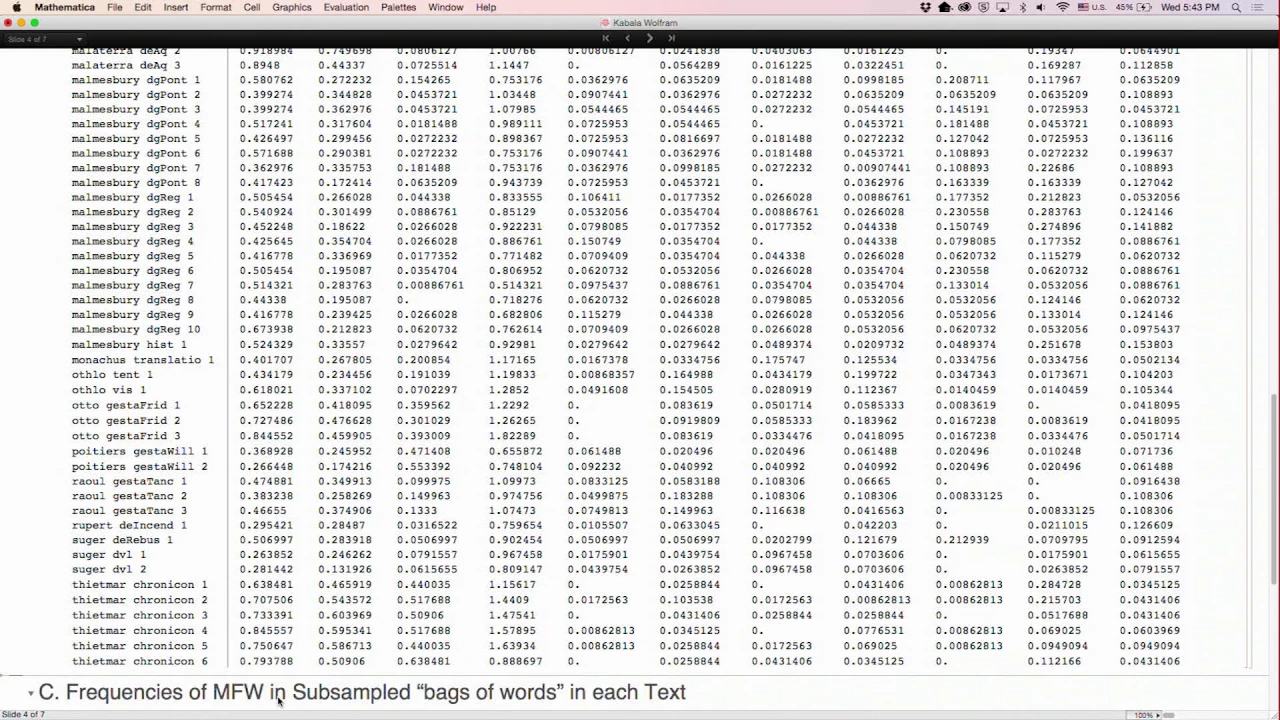
This section introduces machine learning as an alternative approach to authorship attribution. The method treats authors as classification classes and uses word frequency vectors as input features. Leave-one-out cross-validation trains classifiers by iteratively removing one text, building models from remaining texts, and testing on the removed text. Logistic regression proved particularly effective for multi-class authorship problems with many possible author categories. Results showed 83% accuracy on full texts and superior performance with bag-of-words subsampling compared to distance methods. The approach provides probabilistic classifications (e.g., 80% certainty) rather than strict clustering, offering more interpretable results for historical attribution questions.
Click to watch →

LANGUAGE, TECHNOLOGY AND THE DIGITAL DIVIDE | SCIENCE AGAINST CAPITALISM
799
Computational linguistics, also called natural language processing (NLP) or human language technology, is best understood as a subfield of artificial intelligence rather than linguistics. Language can be studied from eight perspectives: linguistics (systematic conventions), cognitive science (mental processing), computational linguistics (treating language as data), social linguistics (communication between people), and anthropological linguistics (worldview categorization). NLP applications include spell checking, speech recognition, sentiment analysis, document classification, hate speech detection, language documentation, speech synthesis, text summarization, question answering, intelligent assistance, and machine translation. Before the 21st century, NLP relied on brittle rule-based systems requiring expert-crafted rules. Around 20 years ago, machine learning transformed NLP by using massive data rather than hand-crafted rules, with modern systems using neural networks with billions of parameters that remain opaque even to developers.
Click to watch →

Stefan Th. Gries
1.7K
This section covers the complete methodology for authorship attribution using corpus and statistical methods. The process requires three components: texts to be attributed, training material from known authors, and distinguishing features. Effective features include punctuation patterns (particularly useful as unconscious habits), function word frequencies, and tag frequencies. Machine learning approaches like random forests often outperform regression models in predictive accuracy, though they sacrifice interpretability. A case study demonstrates 100% accuracy in identifying a plaintiff's authorship of defamatory online reviews, showing how unconscious writing patterns serve as reliable markers even when writers deliberately attempt to disguise their identity.
Click to watch →
Deep Dive
The legal standards for admitting linguistic evidence in court, such as the Daubert standard for expert witness testimony.

Is Judge Cannone Biased Against Karen Read?
120.8K
Under Daubert/Lanigan, expert testimony requires five foundational elements: (1) testimony assists trier of fact beyond common knowledge, (2) witness is qualified as expert, (3) opinion based on facts reasonably relied on by experts, (4) underlying theory is reliable, (5) theory applied to case facts reliably. The video shows Judge Kenon's orders applied these standards differently—Dr. Crosby's order was brief with minimal analysis, while Dr. Russell's order was three pages with detailed qualification and methodology analysis. This disparity demonstrates inconsistent application of the same legal standard.
Click to watch →

Breaking News: Fani Willis RESPONDS To DONALD TRUMP, Judge Rules On Nathan Wade's OBJECTION!
332.8K
The Daubert standard (from Daubert v. Merrell Dow Pharmaceuticals) establishes criteria for determining whether expert testimony is admissible. The standard requires that expert testimony be based on scientific, technical, or specialized knowledge that will help the trier of fact understand the evidence. The court must make specific findings that the testimony is based on sufficient facts or data, is the product of reliable principles and methods, and that the expert has reliably applied those principles to the facts of the case. Additionally, business records must be authenticated before admission, requiring sufficient notice to opposing parties to challenge authenticity. The distinction between lay testimony (limited to facts that ordinary people can perceive) and expert testimony (requiring specialized knowledge) is fundamental. When evidence from different sources conflicts, courts must determine which evidence is more reliable, with business records and objective data generally considered more reliable than subjective testimony.
Click to watch →

Baron Coleman Exposes Erika Kirk TPUSA Leadership Strategy
73.6K
Expert witness testimony and the Daubert standard are critical components of criminal trials that determine what scientific evidence can be presented to juries. The Daubert standard (from the Supreme Court case Daubert v. Merrell Dow Pharmaceuticals) requires that expert testimony be both relevant and accepted in the scientific community. In the Charlie Kirk investigation, Baron Coleman explained that defense attorneys must navigate this standard when presenting expert testimony about ballistics, wound analysis, or other scientific evidence. The standard requires judges to hold hearings (Daubert hearings) where both sides present their expert opinions, and judges must determine whether the expert's methodology is scientifically valid and whether the testimony will help the jury understand the evidence. The analysis requires understanding scientific methodology, peer review standards, and the legal standards for admissibility of expert testimony.
Click to watch →

MR DOCTOR - REACCIONANDO al VIDEO de la GRAFOLOGÍA en MÉXICO
70.4K
The Daubert standard establishes that not only must experts have certain credentials or official titles, but they must also be able to explain why they know what they know, what their knowledge is based on, and what hypothetical biases they may have when issuing reports. This standard also considers the validity of the science at the level of academic or professional organizations.
Click to watch →

Karen Read Trial: Judge Denies Motion to Exclude Expert Crosby, Invokes Natalie Evidence
55K
The Daubert standard requires courts to evaluate whether expert testimony is admissible by assessing the reliability of the expert's methodology, the validity of the principles and methods employed, and whether the testimony will assist the jury. The court must find that the evidence will assist the jury and that there is an appropriate basis for the expert's opinion in the record. When courts allow testimony that lacks proper qualifications or methodology, it violates this standard and undermines the integrity of the judicial process.
Click to watch →
Deep Dive
Case studies of other high-profile investigations utilizing forensic linguistics, such as the JonBenét Ramsey ransom note analysis.

EL IMPOSIBLE CASO DE JONBENÉT
812.9K
Linguistic profiling analyzes writing samples to determine the author's characteristics, including education level, age, and gender. The ransom note was analyzed and determined to have been written by someone with a high education level, age 30 or older, and likely female. This analysis ruled out Burke as the author, as his writing would not match the sophisticated language used. The analysis also indicated the author was likely someone close to the family, as the note was written using the mother's notebook. The Ramsey family was indicted on felony charges related to John Benet's death in 1998-1999. The family cooperated with prosecutors and gave sworn testimony to the Boulder Grand Jury. The father John Benet Ramsey was criticized for his calm demeanor during media interviews, which was interpreted as a psychological defense mechanism.
Click to watch →

part 4: JonBenét; the final chapter. Patsy coerced John into cooperation.
140.7K
Forensic analysis of the JonBenét ransom note reveals that Patsy Ramsey was the author, as evidenced by her behavioral patterns including inconsistent writing quality (shaky first paragraph, smooth last paragraph), specific misspellings (adding/removing 's' in words like 'business' and 'advice'), group mentality language that shifted to singular, and emotional word choices. The note's structure—demanding, hedging, and pleading—indicates Patsy was coercing John into cooperation, suggesting she had knowledge about him that gave her power to compel his involvement.
Click to watch →

SU CUERPO APARECIÓ EN EL SÓTANO DE SU CASA: JonBenét Ramsey, UN CASO IMPOSIBLE | Estela Naiad
146.8K
JonBenét Ramsey was born August 6, 1990, in Atlanta, Georgia, to John Bennett and Patricia Anne Ramsey. The family moved to Boulder, Colorado, where John founded Access Graphics, a computer services company. Patricia, a journalism graduate, won Miss Virginia Western in 1977. JonBenét was introduced to beauty pageants from a young age, winning hundreds of awards by age 6. On December 25, 1996, the family attended a Christmas party and returned home where JonBenét and her brother Burke fell asleep in the car. On December 26, Patricia discovered a handwritten kidnapping note with three pages threatening to kill JonBenét if authorities were called. Despite the threat, she called 911. John Ramsey found JonBenét's room empty. The Boulder Police arrived around 6 AM but failed to properly secure the crime scene. John Ramsey and Flet White returned later, and John discovered JonBenét's body in the wine cellar, exclaiming 'God, my baby.' Neither had seen the body during their earlier search. Forensic evidence revealed JonBenét was bound with complex rope knots and a wooden pole attached to her body, functioning as a garrote—a medieval torture method requiring rope expertise. The wooden pole was a paintbrush handle split asymmetrically. A nylon rope with a slip knot was around her neck. Fibers from the binding cord were found on her bed. Black tape with frayed ends indicated it came from a used roll. Unidentified shoe prints were found in the basement. A baseball bat with matching carpet fibers was discovered. A brown paper bag containing rope was found in the guest bedroom, with fibers in JonBenét's body and transport bag. The autopsy determined death by asphyxiation from strangulation with traumatic brain injury. JonBenét was alive before strangulation and fought her attacker. Sexual assault injuries were observed. A 20 cm skull fracture was found. DNA samples were taken from her fingernails, and blood stains were found on her underwear. A pubic hair was found on the sheet covering her body, not matching any Ramsey family member. The kidnapping note was one of the longest rescue notes in true crime history, demanding $18,000—exactly John Ramsey's bonus that year. The Ramseys voluntarily provided DNA samples, knowing they would be suspects.
Click to watch →

Legal Loophole in JonBenet Case: Donald Foster Analysis Part 2
58.1K
In criminal investigations, legal procedural limitations can prevent valuable forensic evidence from being used in court, even when that evidence strongly points to a suspect's guilt. In the JonBenet Ramsey case, linguist Donald Foster's analysis concluded that Paty Ramsey wrote the ransom note, but this evidence was deemed inadmissible because the search warrant for the family's computer only authorized examination for child pornography, not linguistic analysis. Additionally, Foster had previously written a letter to Paty Ramsey stating he believed she was innocent, which compromised his impartiality as an expert witness. This case illustrates how legal loopholes and procedural constraints can allow potentially exculpatory or incriminating evidence to be excluded from judicial proceedings.
Click to watch →

JonBenet Ramsey: Letters from a Convicted Predator, Is He The Killer? - The Interview Room
114.6K
This segment presents a detailed forensic psychological analysis of the ransom note. Dr. Brato identifies multiple psychological indicators suggesting the writer was not what they appeared to be: the note was unusually long for a typical ransom note; there were grammatical inconsistencies mixing sophisticated vocabulary with basic errors; the writer scratched out references to delivering JonBenet, indicating knowledge she was already dead; and the specific amount demanded ($118,000) was peculiar rather than a round number. These observations demonstrate how forensic linguistics can reveal hidden truths about perpetrators through careful examination of their written communications.
Click to watch →
Deep Dive
The role of dialectology and sociolinguistics in identifying regional or demographic profiles of anonymous writers.

Forensic Linguistic Profiling & What Your Language Reveals About You | Harry Bradford | TEDxStoke
80.7K
Forensic linguistics uses sociolinguistic analysis to identify individuals based on their unique language patterns, which are shaped by personal characteristics such as age, gender, race, education, and social environment; this technique can help de-anonymize online communications by analyzing vocabulary, formatting, and community-specific language features to reveal demographic information about anonymous writers.
Click to watch →

Sociolinguistics: Crash Course Linguistics #7
314.5K
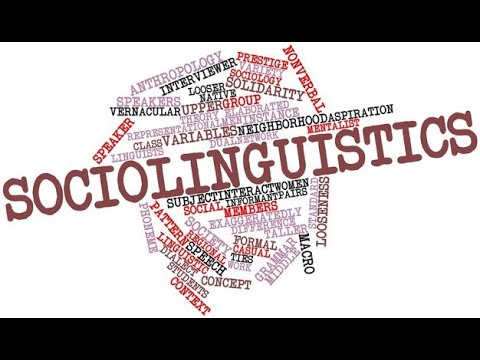
Sociolinguistics studies how language forms part of our identity and how social factors influence speech. Everyone has an accent shaped by who they grow up with and where they live. Dialectology maps regional language variations, revealing that denser linguistic variation occurs where communities have lived together longer. Languages spread through colonization show broader regional variation (Arabic, Chinese, English, Spanish), while isolated languages like Swiss or Papua New Guinean languages show village-level variation. Beyond geography, age, education, class, race, ethnicity, gender, and sexuality all influence how people speak and identify linguistically.
Click to watch →

العطاء الرقمي | لغويات جنائية: تحديد هوية كاتب النص المجهول من البصمة اللغوية
1.7K
Authorship attribution is the process of determining who wrote a given text by comparing unknown texts with known samples from potential authors. Forensic linguists provide probabilistic assessments rather than definitive conclusions, reflecting the scientific nature of the analysis. Sociolinguistic profiling extracts demographic information about unknown authors, including age, gender, education level, and social class based on linguistic markers. While gender analysis can be challenging, education level and social class are often easier to identify. Regional and dialectal features provide clues about geographic origin. Every individual has a unique linguistic fingerprint, even identical twins share different patterns. This uniqueness allows experts to identify authors based on distinctive linguistic characteristics across all languages.
Click to watch →
![The best trilled [r] video yet!](https://i.ytimg.com/vi/joVgJUO74Mg/maxresdefault.jpg)
The best trilled [r] video yet!
204.6K
To pronounce Spanish trilled r, start by positioning your tongue as you would for an English alveolar d sound (tip touching the gummy ridge above upper front teeth), then curl the tip of your tongue up and back slightly so that a spot just barely on the underside of the tip touches the alveolar ridge; once in this retroflex d position, create gentle air pressure in your mouth and add your voice to produce the trill, keeping the back of your throat open and allowing most of the tongue body to vibrate rather than just the tip.
Click to watch →

DIALETOLOGIA, DIALETO/ SOCIOLINGUÍSTICA DIALETOLÓGICA
558
Dialectology is a specialized area of sociolinguistics that studies dialects, which are regional varieties of a language characterized by phonetic, morphological, syntactic, and semantic variations that must be coherent across multiple linguistic levels to be identified as a true dialect. The primary entry point for dialectological study is regional variation (diatopic variation), which then leads to other perspectives including sociocultural factors (diaphasic variation), stylistic considerations, and generational changes (diachronic variation). The main branches of dialectology include historical dialectology (focusing on diachronic variation), social dialectology (examining diaphasic variation), geographical dialectology (studying diatopic variation), and multidimensional dialectology (integrating all aspects simultaneously), with Harold de Tum being the most recognized author in this field.
Click to watch →
Case Profile
Linguistic Breakthrough
Case Profile
0:00- 1
Forensic linguistics emerged during the Unabomber investigation.
- 2
Initial profiling relied on bombing patterns and victim selection.
- 3
Early suspect theories spanned education, gender, and occupation.
Overstating Linguistic Science: The Primacy of the Familial Tip-Off and Methodological Skepticism
While the Unabomber case is celebrated as a triumph for forensic linguistics, critics argue this narrative overstates the independent efficacy and scientific rigor of the field. First, linguistic analysis did not isolate Ted Kaczynski; rather, it was his brother, David, and sister-in-law, Linda, who recognized the manifesto's themes and phrasing and alerted the FBI. Without this familial intervention, the linguistic profile could not have identified Kaczynski from the general population. Second, legal and linguistic scholars caution that forensic stylometry in 1996 lacked standardized, quantitative baselines. They argue that the 'uniqueness' of Kaczynski’s writing style (such as his specific spelling variants and inversion of the phrase 'eat your cake and have it too') was largely validated post-hoc once a suspect was already identified. Had the case gone to trial, the scientific admissibility of this linguistic analysis would have faced severe challenges, suggesting the discipline served as an investigative guide rather than a definitive forensic science.
An introductory understanding of linguistics, specifically how syntax, morphology, and lexicon vary among different speakers.
The concept of an 'idiolect,' which refers to the unique and individual language system of a specific person.
The basic definition of stylometry, the statistical analysis of literary style used to determine authorship.
A general historical awareness of the Unabomber (Ted Kaczynski) investigation and the publication of his manifesto.
The use of modern computational linguistics, natural language processing (NLP), and machine learning in automated authorship attribution.
The legal standards for admitting linguistic evidence in court, such as the Daubert standard for expert witness testimony.
Case studies of other high-profile investigations utilizing forensic linguistics, such as the JonBenét Ramsey ransom note analysis.
The role of dialectology and sociolinguistics in identifying regional or demographic profiles of anonymous writers.
45.7K views476likes3:06@scrippsnewsOriginal Release: 2018-01-10
the scientific field of forensic linguistics was popularized and legitimized during the Unabomber case well before Ted Kaczynski was ever a household name 150 agents with the FBI Postal Service and ATF worked to figure out who he was and why was he killing seemingly random people across the country through the mail they didn't have any physical clues so they had to rely on others specifically the Bombers written words it all began in the 70s in 1978 a mysterious series of bombings across the country and killed three people and wounded 23 others the bomb on the Yale campus today blew up in the Computer Sciences Building yuuna bomb stands for university and airline bomb because the culprit initially targeted colleges and aircraft companies leading profilers to think he was probably a lower educated man who once worked for the airlines not ranked the bombs came disguised as ordinary packages addressed to anyone from professors to CEOs part of the terror derived from the unpredictability look at this BBC timeline there be a string of attacks May 1985 then June November December then silence until 1987 one dry spell lasted from 87 to 93 then he was back with a vengeance sending explosives to a computer scientist then an advertising exec and a timber industry lobbyists along the way the Unabomber sometimes sent typewritten letters allowing FBI teams to analyze them and build their own profile the bureau now admits his occupation proved more elusive with theories ranging from aircraft mechanic to scientist even the gender was not certain although investigators believe the bomber was most likely male they also investigated several female suspects then the turning point in the mid-90s a new FBI profiler named James Fitzgerald or fix basically started from scratch filled something brand new a picture that assumed the Unabomber held a doctorate was secluded and highly intelligent once a manifesto arrived in 1995 30 5,000 words long many of those assumptions were confirmed the bomber was a man using words like broad and chick he also used the phrase eat your cake in habit - according to an NPR interview this suggested the writer had his roots in Chicago Illinois because there was some terminology in there that was reflective of three or four newspapers in Chicago through the 30s 40s and 50s eventually the Washington Post published that full manifesto and Kozinski's sister-in-law recognized some of the language her husband came forward and the FBI found their guide the final step was getting a warrant to raid the Bombers rural cabin in Montana a federal judge for the first time in American history says Fitz approved the warrant thanks to forensic linguistics evidence that his team built clue by clue word by word
Up Next

23:26
JonBenét Ramsey Case: Forensic Linguistics Expert Analysis
@BUILDSeriesNYC
61.7K views•2016-09-19
36:52
Constraint Interaction in Optimality Theory: Epenthesis & Deletion
@Vidyamitra
180 views•2018-08-20

8:59
Forensic Linguistics: How Language Solves Crimes | PBS
@pbsstoried
1M views•2024-01-25

21:32
Accent Expert Explains U.S. Regional Dialects | Part 1
@WIRED
9.3M views•2021-01-21
Related Study Plans & Knowledge Roadmaps
Structured learning paths in Linguistics
linguistics
Optimality Theory: Tableaux & Constraints
01Phonological Basics: Sounds, Syllables & Rules
02Foundations of Optimality Theory: GEN, CON, and EVAL
03The Constraint Inventory: Markedness vs. Faithfulness
+ 2 more learning modules
15h5 modules
Explore Roadmap
linguistics
Morphosyntactic Alignment: S, A & P Systems
01Foundations of Syntax: Transitivity and Arguments
02The Linguistic Variables: Mapping S, A, and P
03Nominative-Accusative Alignment
+ 3 more learning modules
12h6 modules
Explore Roadmap
linguistics
Analyzing Sign Language: Phonology & Syntax
01Foundations of Sign Language Linguistics
02Phonology: The Five Parameters of a Sign
03Morphology: Word Formation and Classifiers
+ 2 more learning modules
14h5 modules
Explore Roadmap
linguistics
Pragmatics: Speech Acts, Grice & Politeness
01Introduction to Pragmatics: Meaning in Context
02Grice’s Cooperative Principle & Implicature
03Speech Act Theory
+ 2 more learning modules
14h5 modules
Explore Roadmap