SaaS Churn: Retention Strategies & Metrics
Learning Goal: Learn how to design, build, and execute a customer churn reduction and retention strategy specifically tailored for early-stage Software-as-a-Service (SaaS) businesses. This includes calculating core metrics, identifying activation opportunities, mapping onboarding friction, formulating proactive success programs, and preventing involuntary subscription cancellations.
- Prerequisites: Basic understanding of startup fundamentals and general business mechanics. No programming knowledge is strictly required, though familiarity with software tool configurations is helpful.
- Estimated Total Study Time: 14 Hours
Module 1: SaaS Foundations and the Churn Problem
Module Overview
This module introduces the core mechanics of the Software-as-a-Service (SaaS) business model, outlines how subscription products generate predictable recurring revenue streams, and explains why customer churn is the ultimate limiting factor for long-term startup growth.
Recommended Videos
Why this video
Rob Walling introduces SaaS metrics by framing churn as the "Achilles heel" of subscription software. This video sets up the core challenge of retention: if your churn is too high, it creates an absolute ceiling on growth, rendering standard marketing and acquisition efforts useless.
Knowledge Checkpoint
- Understand why low churn is a prerequisite for infinite growth potential.
- Explain the concept of the "leaky bucket" in SaaS dynamics.
- Define how churn acts as an exponential cap on your company's maximum achievable size.

Why this video
Before addressing churn, you must master the mechanics of the underlying delivery platform. This IBM guide unpacks how SaaS differs from traditional software licenses, illustrating why centralized hosting, browser-based access, and predictable recurring updates make the business model uniquely scalable.
Knowledge Checkpoint
- Contrast SaaS delivery with traditional on-premise software licensing models.
- Describe the cloud delivery infrastructure that enables multi-tenant SaaS architectures.
- Identify key user benefits of SaaS, including automatic upgrades and cross-platform accessibility.
Why this video
This deep dive explores the financial realities of SaaS failure. It walks through how early-stage startups can mask structural retention problems with high marketing spending, only to run out of capital once those customer acquisition channels reach diminishing returns.
Knowledge Checkpoint
- Explain why early-stage acquisition metrics can mask severe, underlying churn problems.
- Describe the correlation between early-stage product-market fit and long-term customer cohort retention.
- Analyze the balance between Customer Acquisition Cost (CAC) and Customer Lifetime Value (LTV) when retention rates fluctuate.
Module 2: Measuring Churn and Retention Metrics
Module Overview
This module covers how to calculate critical retention indicators. You will learn the formulas for logo versus revenue retention and run step-by-step cohort analyses to trace user longevity over time.
Recommended Videos

Why this video
This mathematical deep dive outlines the precise mechanics of tracking customer cohorts across varied renewal contracts. It breaks down how to set up calculations to model monthly and annual subscriber drop-off without distorting metrics.
Knowledge Checkpoint
- Calculate monthly and annual customer churn rates using starting and ending cohort structures.
- Outline how to set up a cohort modeling sheet in Excel to forecast long-term drop-offs.
- Explain how different contract lengths (e.g., monthly vs. annual prepays) impact immediate churn reporting.

Why this video
David Skok clarifies the crucial conceptual difference between Logo Churn (the raw percentage of accounts lost) and Revenue Churn (the percentage of cash flow lost). Understanding this distinction helps founders realize why they can lose customers while increasing revenue.
Knowledge Checkpoint
- Differentiate between Logo Churn and Revenue Churn.
- Explain how Net Revenue Retention (NRR) can exceed 100% (Negative Churn) through expansion, upselling, and cross-selling.
- Analyze a scenario where high logo churn is offset by expansion revenue, and discuss the long-term sustainability of this dynamic.

Why this video
This step-by-step SQL and visualization walkthrough demonstrates how to transition from raw transactional database rows to structured cohort curves. It provides a practical look at cohort aggregation and visualization.
Knowledge Checkpoint
- Group transactional data points into structured signup-date cohorts.
- Construct a cohort retention matrix displaying percentage changes over active monthly periods.
- Interpret cohort tables to pinpoint the specific usage intervals (e.g., Month 1 vs. Month 6) where drop-offs are most acute.
Module 3: Diagnosing Why Customers Churn
Module Overview
To fix a retention problem, you must first diagnose its root causes. This module covers how to configure customer feedback loops, track user activity, design in-app cancellation flows, and extract actionable insights from cancellation surveys.
Recommended Videos
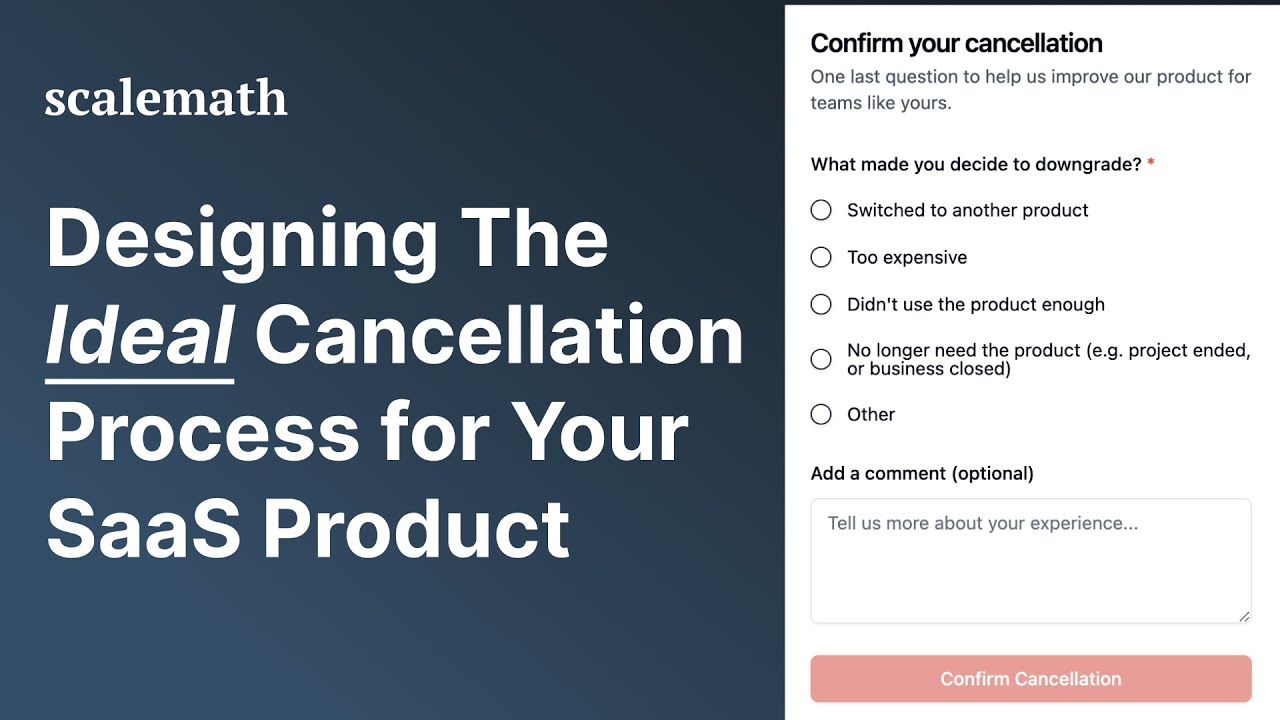
Why this video
This video bridges the gap in cancellation flow design. It highlights how to structure user-friendly cancellation experiences that gather actionable data, salvage accounts via targeted alternatives, and leave a positive lasting impression.
Knowledge Checkpoint
- Design a cancellation page that balances user friction with systematic win-back attempts.
- List alternative solutions to present inside a cancellation flow (e.g., account pauses, tier downgrades).
- Explain how to categorize and use exit-reason feedback to inform your product roadmap.

Why this video
Patrick Campbell reveals data-backed insights on cancellation flows, showing how two well-timed questions in the first 30 seconds of an offboarding sequence can significantly improve recovery rates and yield clean exit feedback.
Knowledge Checkpoint
- Implement the optimal two-step question format within an offboarding framework.
- Format the initial multiple-choice question to capture the primary reason for cancellation.
- Craft a follow-up qualitative text prompt that captures specific customer feedback without increasing friction.

Why this video
Alex Hormozi introduces "structural churn"—the natural customer loss built into specific target markets. This concept is critical for early-stage SaaS businesses, helping founders evaluate whether their churn stems from product flaws or from serving unstable customer segments.
Knowledge Checkpoint
- Define "structural churn" and identify its primary causes.
- Explain how your target audience selection (e.g., volatile SMBs vs. stable enterprises) impacts base retention rates.
- Evaluate your current user base to determine if churn is caused by poor product usability or structural market issues.
Module 4: User Onboarding and Early-Stage Activation
Module Overview
The fastest way to prevent long-term churn is to improve user activation during onboarding. This module explores how to reduce time-to-value, define and locate your product’s "Aha!" moment, and map out structured setup flows that guide new signups to reliable, active usage.
Recommended Videos

Why this video
This video offers a comprehensive masterclass in user onboarding UX. It outlines why heavy, unprompted product tours fail (noting that 60-70% of users skip them) and advocates for progressive profiling, personalized setups, and clear progress indicators.
Knowledge Checkpoint
- Critique traditional "product tours" and replace them with contextual, user-driven interactions.
- Implement personalized onboarding tracks based on self-selected user personas or goals.
- Apply design patterns like empty-state helpers and progress bars to maintain momentum during registration.

Why this video
Analyzing best practices across hundreds of top software apps, this video introduces a reliable four-step onboarding framework. It emphasizes matching your onboarding flow to user intent and designing friction points to ensure users take high-value setup actions.
Knowledge Checkpoint
- Categorize signups by intent and familiarity to tailor their onboarding experiences.
- Identify friction points that can be minimized (or strategically used) to boost early user investment.
- Design post-signup milestones that align with core user goals.

Why this video
This interview snippet highlights the direct link between a short "time-to-Aha!" and high retention. It challenges founders to rethink how quickly they deliver value, showing that minimizing early friction can double Day-30 signup-to-paid conversion rates.
Knowledge Checkpoint
- Define the "Aha!" moment for your specific SaaS product.
- Identify steps in your current onboarding flow that delay users from reaching this moment.
- Create a strategy to minimize the time-to-value for new users.

Why this video
Rick Kettner explains activation as a core growth engine. He details how to track onboarding progress and measure the exact moment a customer understands the value of their purchase and begins actively using the platform.
Knowledge Checkpoint
- Differentiate between a simple sign-up metric and a verified activation event.
- Develop tracking points for core activation behaviors inside your software.
- Explain how measuring early product activation helps predict long-term customer retention.
Module 5: Crafting Proactive Retention Strategies
Module Overview
To scale, a SaaS business must shift from reactive support to proactive retention. This module covers how to build a Customer Success (CS) framework, develop a custom customer health score, and run automated re-engagement campaigns for accounts showing signs of inactivity.
Recommended Videos

Why this video
This practical workshop explains how to build a customer health scoring system. You will learn how to gather signals like feature usage, login frequency, customer support tickets, and billing events into a single score that flags at-risk accounts before they cancel.
Knowledge Checkpoint
- Identify key user behaviors and business outcomes to include in a customer health score.
- Assign weight values to different usage signals based on how strongly they predict churn.
- Use customer health scores to trigger proactive interventions by your Customer Success team.
Why this video
This guide details how to build a Customer Success team from scratch on a budget. It covers common early-stage mistakes, such as trying to copy massive enterprise playbooks, and shares tips on prioritizing accounts, defining success milestones, and scaling your operations.
Knowledge Checkpoint
- Avoid key operational mistakes when rolling out an early-stage Customer Success framework.
- Segment your customer accounts to allocate personal support and automated resources effectively.
- Define key responsibilities for your first Customer Success hire.
Why this video
Dan Martell outlines the core responsibilities of a Customer Success Manager (CSM). He focuses on how CSMs can use user activity metrics to systematically guide customers toward key value milestones in their journey.
Knowledge Checkpoint
- List the primary day-to-day responsibilities of a SaaS Customer Success Manager.
- Monitor user activity to identify accounts that have stalled or stopped using key features.
- Set up automated check-ins and trigger-based emails to guide users back to active status.
Module 6: Involuntary Churn, Dunning, and Retention Tooling
Module Overview
Involuntary churn—when a customer’s subscription cancels due to credit card failures, expired cards, or billing issues—can account for 30% to 50% of your total churn. This module covers how to manage billing failures, configure Stripe retries, design automated dunning sequences, and organize your recovery tech stack.
Recommended Videos

Why this video
This video walks through the technical side of payment collection and handling failures. It explains how to build and connect webhook listeners (such as invoice.payment_failed) to update database records and trigger dunning workflows when a payment fails.
Knowledge Checkpoint
- Connect webhook notifications to handle transaction failures automatically.
- Build a database-driven system to track failed billing attempts and update account access.
- Explain how webhook management helps prevent involuntary user access issues during payment retries.

Why this video
This video explains how to configure recurring billing inside Stripe. It demonstrates how to create customer profiles, store credit cards, and set up recurring plans, providing the foundation needed to build automated retries and billing rules.
Knowledge Checkpoint
- Set up a Stripe billing workflow to charge recurring subscriptions automatically.
- Describe the security benefits of using secure payment gateways over self-hosted customer card storage.
- Set up default customer profiles to ensure smooth renewal billing.

Why this video
Dan Martell discusses how to build cancellation systems that turn potentially negative exits into valuable learning moments or saved accounts. This video helps you structure your billing, customer data, and cancellation flows into a single, cohesive retention workflow.
Knowledge Checkpoint
- Build a cancellation system that links billing status with customer feedback.
- Explain the "leaky bucket" problem and how cancellation systems help identify structural business gaps.
- Map out an automated offboarding flow that reduces customer friction while maximizing your chances of saving the account.
Note on Tooling & Independent Implementation
While this module covers the concepts behind webhooks and billing failures, building an advanced, automated dunning system requires direct configuration in your payment processor.
To build out a complete dunning framework, we recommend searching for these topics in your payment platform's documentation (e.g., Stripe, Braintree, Paddle):
- "How to set up Stripe billing retries and Smart Re-try schedules" (to use machine learning to retry card payments at optimal times).
- "Configuring customer emails for failed payments in Stripe Dashboard" (to automatically send secure billing update links when card charges fail).
- "Integrating third-party dunning software (e.g., Churnbuster, ProfitWell Retain, Baremetrics Recover)" (to run advanced SMS and email-based billing recovery campaigns).
Course Map
Key People Index
- Rob Walling (@RobWalling): Founder of MicroConf and TinySeed, author of multiple books on SaaS startups, and host of Startups for the Rest of Us. A leading expert on bootstrapping and early-stage SaaS metrics.
- David Skok: General Partner at Matrix Partners. Author of the seminal SaaS metric guide SaaS Metrics 2.0, which popularized key calculations for CAC, LTV, and Net Revenue Retention.
- Patrick Campbell: Founder of ProfitWell (acquired by Paddle). An expert on SaaS pricing, billing metrics, subscription dunning, and cancellation flow data.
- Dan Martell: Founder of SaaS Academy, active angel investor, and seasoned software entrepreneur. Author of retention strategies focused on user success and reducing cancellation rates.
- Alex Hormozi: Entrepreneur, investor, and founder of Acquisition.com. Well-known for his frameworks on customer acquisition, business metrics, and reducing market-level structural churn.
Final Self-Assessment
Complete this comprehensive self-assessment checklist before completing the course:
- SaaS Business Model: I can explain why high churn creates an absolute limit on SaaS growth, even when acquisition and marketing numbers are strong.
- Metric Calculations: I can calculate Logo Churn Rate, Gross Revenue Churn Rate, and Net Revenue Retention (NRR) using starting cohort datasets.
- Cohort Analysis: I can read a standard cohort retention matrix to find the specific months where user drop-off is highest.
- Cancellation Flows: I can design a user-friendly cancellation page that uses a two-step feedback survey and offers alternatives (such as account pauses or downgrades).
- "Aha!" Moment: I have defined the core value milestone ("Aha!" moment) for my SaaS product and mapped out an activation metric to track it.
- Onboarding UX: I can identify and remove unnecessary friction points in my onboarding flow (e.g., long, unprompted product tours) to help users find value faster.
- Customer Health Scoring: I can design a customer health score using weighted indicators (such as login frequency, support tickets, and feature usage) to spot at-risk accounts.
- Proactive Intervention: I can outline a basic playbook for Customer Success Managers to re-engage accounts whose health scores have dropped.
- Involuntary Churn Strategy: I understand how webhook notifications work for failed billing attempts (
invoice.payment_failed) and can connect them to database updates. - Dunning System Design: I can configure retry schedules and automated email alerts in Stripe (or similar dunning tools) to recover failed subscription payments.