Carbon Pricing: Tax vs Cap-and-Trade Systems
LEARNING GOAL: Evaluate the economic mechanisms, market outcomes, and implementation challenges of carbon pricing strategies, specifically comparing carbon taxes to cap-and-trade systems in modern economies.
- Prerequisites: Introductory Microeconomics (specifically supply and demand elasticity, welfare economics, and market failure theory).
- Estimated Study Time: 8 Hours
Module 1: Foundations of Environmental Economics
This module establishes the microeconomic foundation of environmental policy. You will study how markets fail to allocate resources efficiently when industrial production generates uncompensated costs for third parties (pollution). This module explores the divergence between private and social costs, the definition of negative externalities, and the quantitative role of the Social Cost of Carbon (SCC) in pricing environmental degradation.
Recommended Videos

- Why this video: This video provides a rigorous graphical and conceptual introduction to the welfare economics of negative externalities. It visually demonstrates why a free market overproduces goods that generate pollution by failing to reconcile Marginal Private Cost (MPC) with Marginal Social Cost (MSC), leading to deadweight loss.
- Knowledge Checkpoint:
- Define the difference between private costs and social costs.
- Explain why a free market equilibrium (where private demand equals private supply) leads to overproduction and allocative inefficiency in the presence of negative externalities.
- Graphically identify the area of deadweight loss (net welfare loss) caused by an unpriced negative externality.
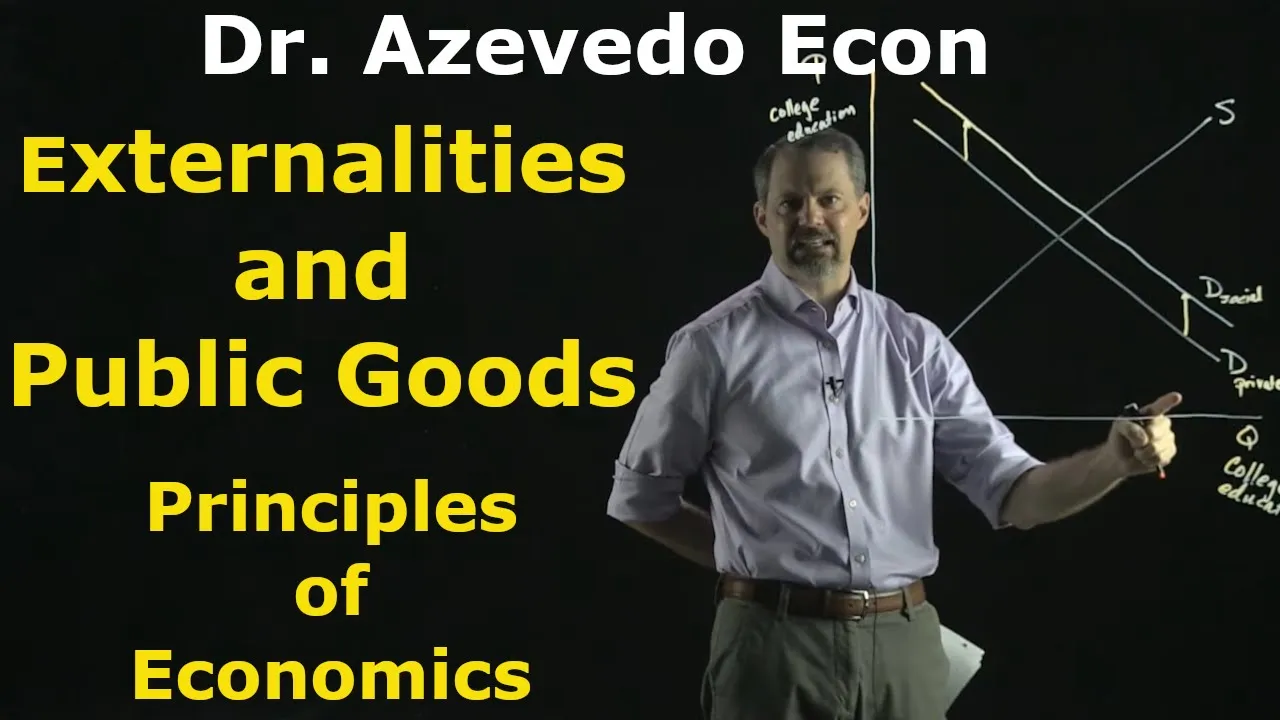
- Why this video: This academic lecture bridges the gap between general externality theory and public goods. It outlines why environmental resources (like clean air) are susceptible to the "Tragedy of the Commons" because they lack clearly defined property rights and suffer from non-excludability.
- Knowledge Checkpoint:
- Explain how the absence of property rights over the atmosphere leads to market failure.
- Differentiate between a negative production externality and a negative consumption externality.
- Identify why private actors have no market incentive to self-regulate emissions without policy intervention.

- Why this video: Featuring insights from MIT and prominent climate economists like Michael Greenstone, this short video introduces the Social Cost of Carbon (SCC). It explains how economists estimate the marginal future damage of releasing an additional ton of CO2, which forms the benchmark for efficient environmental pricing.
- Knowledge Checkpoint:
- Define the Social Cost of Carbon (SCC) in monetary and temporal terms.
- Explain how discount rates affect the calculation of the SCC over multi-generational horizons.
- Explain how estimating marginal climate damages helps policymakers set an economically optimal carbon price.
Module 2: The Mechanics of Carbon Taxes
This module introduces Pigouvian taxation as a direct pricing instrument. You will analyze how a fixed carbon tax internalizes external costs by shifting the marginal cost curve of emitting firms. Additionally, we will study the economic destiny of tax revenues, comparing progressive cash transfers (Fee-and-Dividend) to efficiency-focused revenue recycling (reducing distortionary labor or capital taxes).
Recommended Videos

- Why this video: This lesson explains the mathematical and graphical mechanics of a Pigouvian tax. It shows how imposing a per-unit tax equal to the marginal external damage shifts the private supply curve upward to align with the social cost curve, correcting market failure.
- Knowledge Checkpoint:
- Describe how a Pigouvian tax shifts the firm's private supply curve.
- Calculate the ideal rate of a Pigouvian tax relative to the marginal damage at the socially optimal quantity.
- Explain how this tax forces consumers and producers to share the burden of the external cost based on their relative price elasticities.
- Why this video: This video provides an overview of carbon tax revenue recycling options. It explores three primary strategies: progressive household rebates, labor income tax cuts, and capital income tax cuts, explaining the economic trade-offs of each.
- Knowledge Checkpoint:
- Contrast the economic efficiency of using carbon revenues to cut corporate/capital taxes versus distributing flat rebates to households.
- Explain the "double dividend" hypothesis of environmental taxation.
- Identify which revenue recycling strategies are most progressive (protecting lower-income households) versus those that are most growth-enhancing.

- Why this video: This animation focuses on the mechanics of the Carbon Fee-and-Dividend model. It details how fees collected at the source of fossil fuel extraction can be directly redistributed to citizens, shielding households from inflation while preserving price signals to reduce carbon consumption.
- Knowledge Checkpoint:
- Explain how a Fee-and-Dividend system protects low-income household purchasing power.
- Explain why the price signal to reduce emissions remains intact even when households receive their tax money back in a rebate.
- Identify the administrative steps required to collect fees at the wellhead or port and distribute dividends.
Module 3: Cap-and-Trade Systems and Carbon Markets
This module shifts from price-based regulation to quantity-based regulation. You will examine Emissions Trading Schemes (ETS), studying how a central authority sets an absolute emissions cap and issues a corresponding volume of tradable permits. We will analyze permit allocation methods (such as auctioning vs. grandfathering) and evaluate market pricing dynamics, using the European Union Emissions Trading System (EU ETS) as our primary case study.
Recommended Videos

- Why this video: Produced by the European Commission, this video explains the design and operational framework of the EU ETS, the world’s pioneer multi-national cap-and-trade system. It highlights how the emissions cap decreases annually to guarantee absolute reduction targets.
- Knowledge Checkpoint:
- Explain the "cap" and "trade" components of an ETS.
- Identify how an annual reduction factor in the cap drives long-term decarbonization.
- Describe what happens to firms that emit greenhouse gases without holding a matching volume of allowances.

- Why this video: This video goes deeper into the structural mechanics of carbon markets. It details which industries are covered (power, heavy industry, aviation), how the supply of permits is regulated, and how market participants trade allowances, which establishes a dynamic price for carbon.
- Knowledge Checkpoint:
- Identify the primary industrial sectors covered under the EU ETS and explain why some sectors (like agriculture or residential heating) are historically excluded.
- Explain how trading permits minimizes the economy-wide marginal abatement cost.
- Differentiate between free permit allocation (grandfathering) and competitive auctioning.
- Why this video: This detailed financial and economic discussion explores the institutional and macroeconomic forces that shape carbon credit pricing. It explains the "bucket" mechanism of finite permits and how policy interventions (like the EU's Market Stability Reserve) manage permit oversupply.
- Knowledge Checkpoint:
- Explain how a supply surplus in a cap-and-trade market can cause carbon prices to collapse, and how mechanisms like the Market Stability Reserve (MSR) mitigate this risk.
- Describe how financial speculation and investing in carbon compliance markets affect price volatility and liquidity.
- Explain why a structural, policy-driven decrease in permit supply creates upward pressure on prices over time.
Module 4: Direct Comparison: Tax vs. Cap-and-Trade
This module examines the core theoretical and practical trade-offs between carbon taxes and cap-and-trade systems. We will focus on the fundamental choice between price certainty and quantity certainty under market uncertainty, a concept formalized by Martin Weitzman.
Core Microeconomic Theory: Weitzman's Theorem (Prices vs. Quantities)
Under perfect information and certainty, a carbon tax and a cap-and-trade system are economically equivalent: setting the optimal tax rate yields the same emissions level , and setting the optimal cap yields the same market clearing price .
However, under uncertainty regarding the marginal costs of carbon abatement, this equivalence breaks down:
- Carbon Tax (Price Instrument): Fixes the price of carbon but leaves the absolute emission reduction quantity uncertain.
- Cap-and-Trade (Quantity Instrument): Fixes the absolute emissions quantity but leaves the compliance price uncertain.
According to Weitzman's (1974) theorem:
-
When the Marginal Benefit (MB) curve of abatement is steep relative to the Marginal Cost (MC) curve (e.g., when approaching a critical ecological tipping point or environmental threshold), quantity-based systems (Cap-and-Trade) are more efficient because exceeding the target causes catastrophic damage.
-
When the Marginal Benefit (MB) curve of abatement is flat relative to a steep Marginal Cost (MC) curve (e.g., when the short-run costs of rapid technological transition are high and variable, but the incremental environmental benefits of short-run reductions are steady), price-based systems (Carbon Tax) are more efficient because they protect the economy from extreme compliance cost spikes.
STEEP MB / FLAT MC (Tipping Point)           FLAT MB / STEEP MC (High Compliance Cost)
      Price/Cost                                  Price/Cost
        ^                                           ^            / MC (True)
        |       / MC (True)                         |           /
        |      /                                    |          /  / MC (Est.)
        |     /  / MC (Est.)                        |         /  /
Tax Err |..../.../                                  |        /  /
        |   /   /                                   |       /  /
        |  /   /   | MB (Steep)             Cap Err |....../../...  <-- Price Spike
        | /   /    |                                |     /  /   |
        +----------+------> Q                       +------------+------> Q
                 Target Q                                      MB (Flat)
Recommended Videos
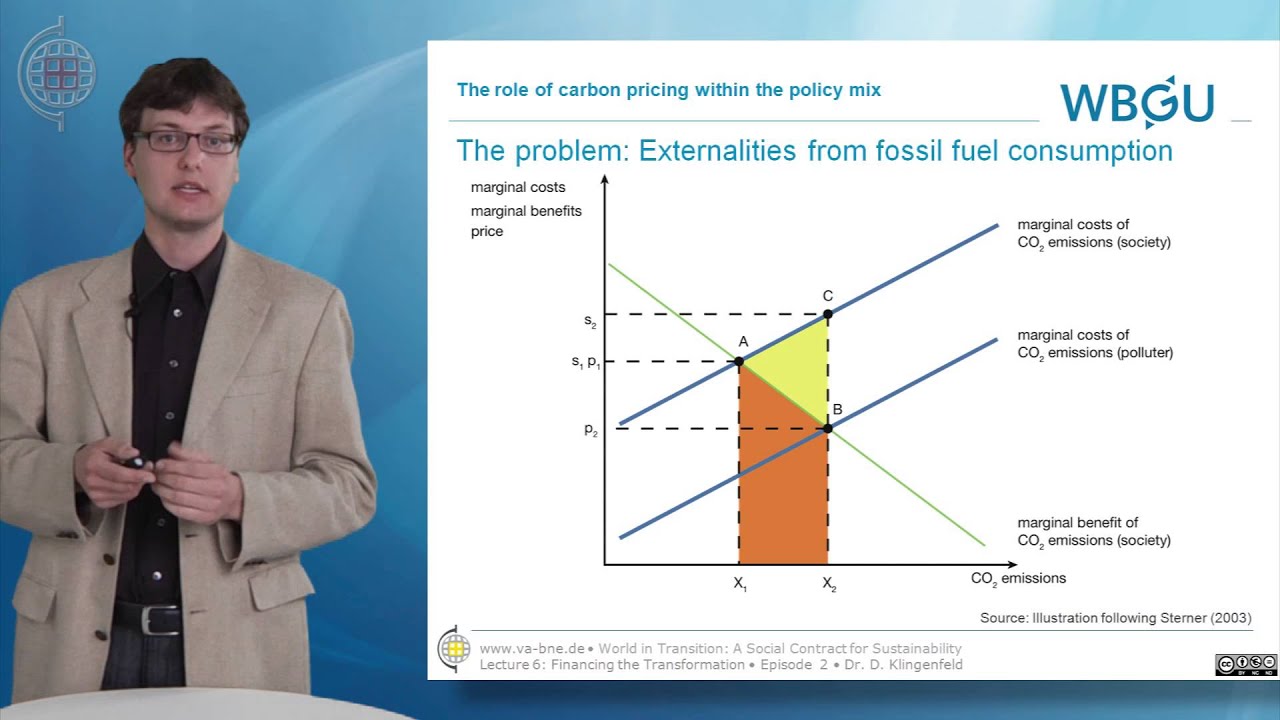
- Why this video: Dr. Daniel Klingenfeld outlines the theoretical equivalence of taxes and trading systems under perfect market certainty, and then explains how this relationship fractures under real-world conditions.
- Knowledge Checkpoint:
- Explain why a carbon tax and a cap-and-trade system yield identical economic outcomes under conditions of perfect information.
- Describe how asymmetric information between polluting industries and environmental regulators impacts the choice of policy instrument.
- Explain why a carbon tax provides higher investment planning security for businesses compared to a fluctuating cap-and-trade market.

- Why this video: This video compares both instruments on administrative simplicity, political feasibility, and economic efficiency. It contrasts the clear, visible price signal of a direct excise carbon tax with the market-driven, fluctuating price of a cap-and-trade program.
- Knowledge Checkpoint:
- Contrast the administrative complexity of collecting a carbon tax at source versus managing an allowance registry and compliance trading platform.
- Explain the risk of price volatility in cap-and-trade systems and identify policy tools (such as price floors or ceilings) used to address this risk.
- Compare the public visibility of costs in a direct carbon tax system with the indirect costs embedded in electricity and fuel prices under a cap-and-trade system.
Module 5: Implementation Challenges and Case Studies
This module covers real-world implementations, tracing the political and structural challenges of carbon pricing. You will analyze British Columbia's pioneering revenue-neutral carbon tax and examine how carbon leakage—where production moves to countries without carbon pricing—threatens global emissions targets. Finally, we will study Border Carbon Adjustments (such as the EU's CBAM) as an emerging mechanism to level the international playing field.
Real-World Case Studies and Policy Context
1. British Columbia’s Revenue-Neutral Carbon Tax (2008)
British Columbia (BC) implemented North America's first broad-based carbon tax in 2008. Designed by economists to be strictly "revenue-neutral," every dollar collected from the tax was returned to the economy through matching cuts to personal income taxes, corporate income taxes, and low-income tax credits.
- The Outcome: Between 2008 and 2012, BC's greenhouse gas emissions fell significantly faster than the Canadian average, while provincial GDP growth outpaced the rest of the country.
- The Transition: Under political pressure and shifting fiscal priorities, the absolute revenue-neutral design was eventually modified. This shift illustrates the classic tension between pure economic theory and real-world political constraints.
2. Carbon Leakage and Border Carbon Adjustments (BCA)
When a country implements a carbon price, it risks driving domestic carbon-intensive industries to relocate to trading partners with weaker or non-existent climate regulations. This phenomenon—carbon leakage—does not reduce global emissions; it simply moves them to other countries while harming the domestic economy.
To prevent this, countries are implementing Border Carbon Adjustment (BCA) mechanisms, most notably the European Union's Carbon Border Adjustment Mechanism (CBAM):
-
The Mechanism: An import tariff is levied on incoming carbon-intensive goods (e.g., steel, cement, aluminum, electricity, and fertilizer) entering a carbon-priced region.
-
The Calculation: The tariff is equivalent to the domestic carbon price, minus any carbon price already paid in the country of origin.
-
The Goal: This system prevents carbon leakage and encourages trading partners to establish their own domestic carbon pricing policies to keep tax revenues at home rather than paying them at the border.
 Domestic Market (With Carbon Price)          Foreign Market (No Carbon Price)
 +---------------------------------+          +-------------------------------+
 | Domestic Producer               |          | Foreign Producer              |
 | Production Cost + Carbon Price  |          | Production Cost Only          |
 +----------------+----------------+          +---------------+---------------+
                  |                                           |
                  | (Fair Competition)                        | (Underprices domestic goods)
                  v                                           v
 ==============================================================================
                          BORDER CARBON ADJUSTMENT (CBAM)
 ==============================================================================
                  |                                           |
                  v (No Change)                               v (Tariff Applied)
 +----------------+----------------+          +---------------+---------------+
 | Domestic Product sold at        | <======> | Foreign Product sold at       |
 | higher cost reflecting carbon   |  (Equal  | higher cost reflecting carbon |
 | price                           |  Prices) | tariff paid at border         |
 +---------------------------------+          +-------------------------------+
Recommended Videos

- Why this video: This video details British Columbia's 2008 progressive carbon tax. It explains how a predictable, rising price schedule (30/ton) allowed consumers and businesses to adjust their behavior over time.
- Knowledge Checkpoint:
- Describe how British Columbia's carbon tax was designed to be revenue-neutral.
- Explain why a predictable, gradually increasing price pathway is more effective than a high, static tax rate.
- Analyze why public support for the carbon tax shifted over its first decade of implementation.

- Why this video: Jeff Saviano details how the British Columbia carbon tax was structured to reduce emissions without sacrificing economic growth or political support, demonstrating the power of tax swaps.
- Knowledge Checkpoint:
- Define a "tax swap" and explain how it was used in BC to lower personal and corporate income taxes.
- Explain how a tax swap maintains the price signal on carbon while keeping the overall tax burden neutral.
- Discuss the political advantages of coupling carbon taxes with direct cuts to other common taxes.
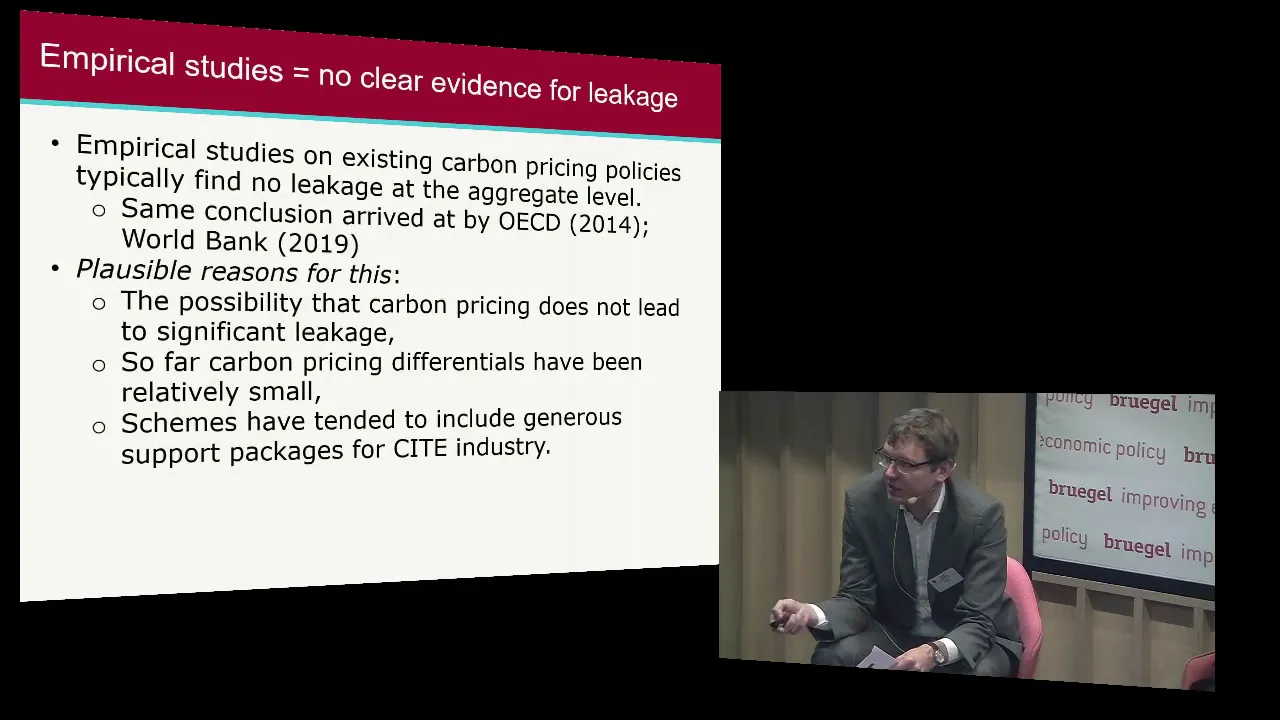
- Why this video: This lecture from the Bruegel think tank provides an academic analysis of carbon leakage and Border Carbon Adjustments (BCAs). It examines direct and indirect leakage, international trade flows, and the economic and legal challenges of implementing a BCA.
- Knowledge Checkpoint:
- Explain the difference between direct leakage (industrial relocation) and indirect leakage (changes in global energy prices).
- Explain how a Border Carbon Adjustment (BCA) levels the playing field for domestic industries subject to a carbon tax.
- Identify the challenges of aligning BCAs with World Trade Organization (WTO) rules on non-discrimination.
Course Map
This flowchart maps the recommended learning progression and shows module dependencies.
Key People Index
- Arthur Pigou (1877–1959): The British economist who formalized the concept of externalities and proposed corrective taxation (Pigouvian Taxes) to align private costs with social costs.
- Martin Weitzman (1942–2019): An environmental economist who published the seminal 1974 paper "Prices vs. Quantities," establishing the framework for comparing taxes and trading systems under uncertainty.
- Michael Greenstone (1968–Present): Milton Friedman Distinguished Service Professor in Economics at the University of Chicago; pioneer in refining empirical estimates of the Social Cost of Carbon (SCC).
- Jeff Saviano: Global Tax Innovation Leader and prominent policy speaker; known for explaining the structural and public-interest design of British Columbia's revenue-neutral tax system.
Final Self-Assessment
Complete this comprehensive self-assessment to verify your understanding of environmental economics and carbon pricing instruments.
- Externalities: Can you explain the difference between private costs and social costs, and explain why the free market overproduces goods with negative externalities?
- Social Cost of Carbon: Can you define the Social Cost of Carbon (SCC) and explain how discount rates affect its valuation over long-term planning horizons?
- Pigouvian Taxes: Can you explain how a carbon tax internalizes externalities by shifting the marginal cost curve of emitting firms?
- Revenue Recycling: Can you contrast the economic and distributional impacts of a "Fee-and-Dividend" system with "Revenue-Neutral" tax cuts?
- Cap-and-Trade: Can you explain how emissions caps are set, how carbon markets establish compliance prices, and how a trading system minimizes economy-wide abatement costs?
- Allocation Strategies: Can you evaluate the economic trade-offs between auctioning emissions allowances and grandfathering them to existing firms?
- Weitzman’s Theorem: Can you explain why a steep Marginal Benefit curve favors cap-and-trade, while a steep Marginal Cost curve favors a carbon tax under cost uncertainty?
- Case Studies: Can you describe the design, economic outcomes, and political history of British Columbia's 2008 carbon tax?
- Carbon Leakage: Can you explain how domestic carbon pricing can lead to carbon leakage, and evaluate its impact on global emission reduction efforts?
- Border Carbon Adjustments: Can you explain how Border Carbon Adjustments (like the EU's CBAM) work to prevent carbon leakage and incentivize trading partners to price carbon?