Analytic Number Theory: Primes & Zeta Function
Learning Goal: Explore the profound connections between prime numbers and mathematical analysis. Master the distribution of primes, arithmetic functions, Dirichlet convolutions, the structural foundations of Dirichlet series, and the properties, analytic continuation, and zeros of the Riemann Zeta function.
- Prerequisites: Single-variable calculus, introductory real analysis (sequences and infinite series convergence), and basic proof techniques (induction, contradiction). No prior complex analysis is strictly required, as foundational concepts are introduced in Module 2.
- Estimated Total Study Time: 30 Hours
Module 1: Foundations of Number Theory and Primes
This module establishes the foundational arithmetic structures required for analytic number theory. You will study divisibility, factorization, the unique properties of prime numbers as the fundamental "atoms" of multiplication, and the rigorous formulation and proof of the Fundamental Theorem of Arithmetic.
Recommended Videos

Why this video: Fields Medalist Richard Borcherds delivers a masterclass introduction to number theory. He contextualizes the field as the study of integers, Diophantine equations, and primes. This lecture bridges basic modular arithmetic and primes with the rigorous algebraic framing needed for analytic treatments.
- Define a prime number algebraically and distinguish it from a composite number.
- Understand Euclid's proof of the infinitude of primes.
- Understand the basic machinery of modular arithmetic and modular divisibility.
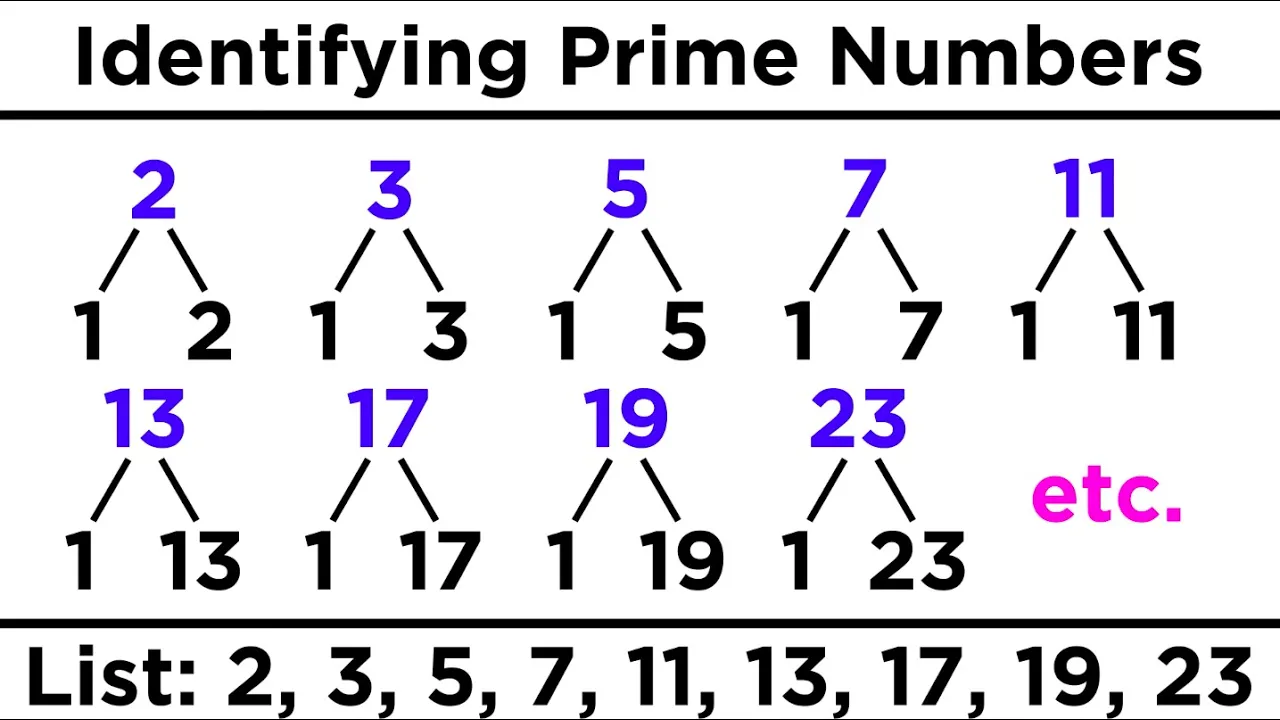
Why this video: This video offers a clear, highly visual intuition for integer division, factors, and prime factorization. It serves as an excellent refresher on the multiplicative structure of the integers.
- State the definition of divisibility and prime factorization.
- Factor any composite integer into its unique prime constituents.

Why this video: A conceptual visualization of prime numbers as the atomic building blocks of all whole numbers, setting up the fundamental intuition behind the Fundamental Theorem of Arithmetic.
- Explain why prime numbers are considered the "atoms" of mathematics.
- Understand why the number 1 is excluded from the definition of prime numbers.
Module 2: Mathematical Analysis & Complex Number Foundations
Analytic number theory transitions from discrete arithmetic to continuous analysis. This module introduces the core analytical tools: infinite series convergence tests, the geometry of the complex plane, and the magic of Euler's formula—which connects trigonometric rotation with complex exponentials.
Recommended Videos

Why this video: A thorough, tutorial-style guide to infinite series. It introduces the definition of convergence via partial sums and details the tests used to evaluate convergence (geometric series, divergence test, etc.). This is critical groundwork for understanding Dirichlet series behavior.
- Differentiate between a sequence and a series.
- Define convergence mathematically using the limit of partial sums .
- Identify and calculate the sum of a convergent geometric series.
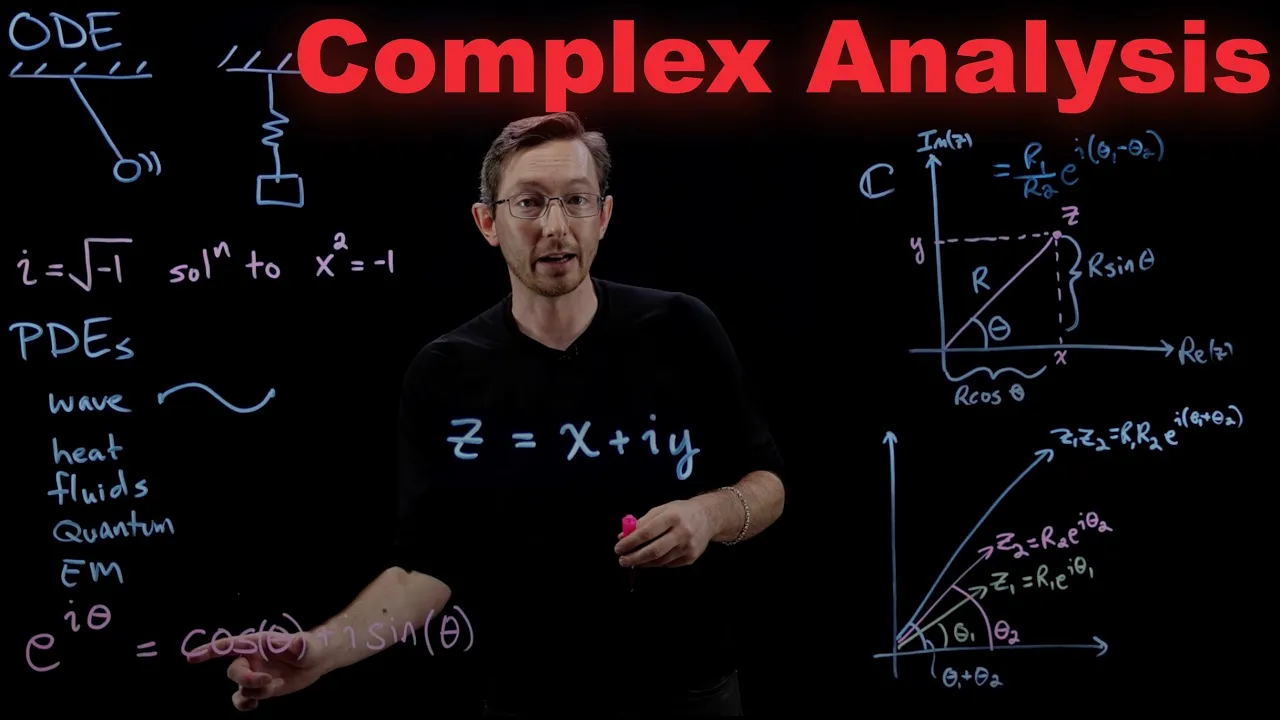
Why this video: Steve Brunton provides a superb applied overview of complex variables, polar coordinates, and Euler's formula. This bridges real analysis and the two-dimensional landscape of the complex plane, which is where the Riemann Zeta function lives.
- Represent a complex number in polar coordinates .
- State and apply Euler's Formula: .
- Perform complex multiplication and addition geometrically.
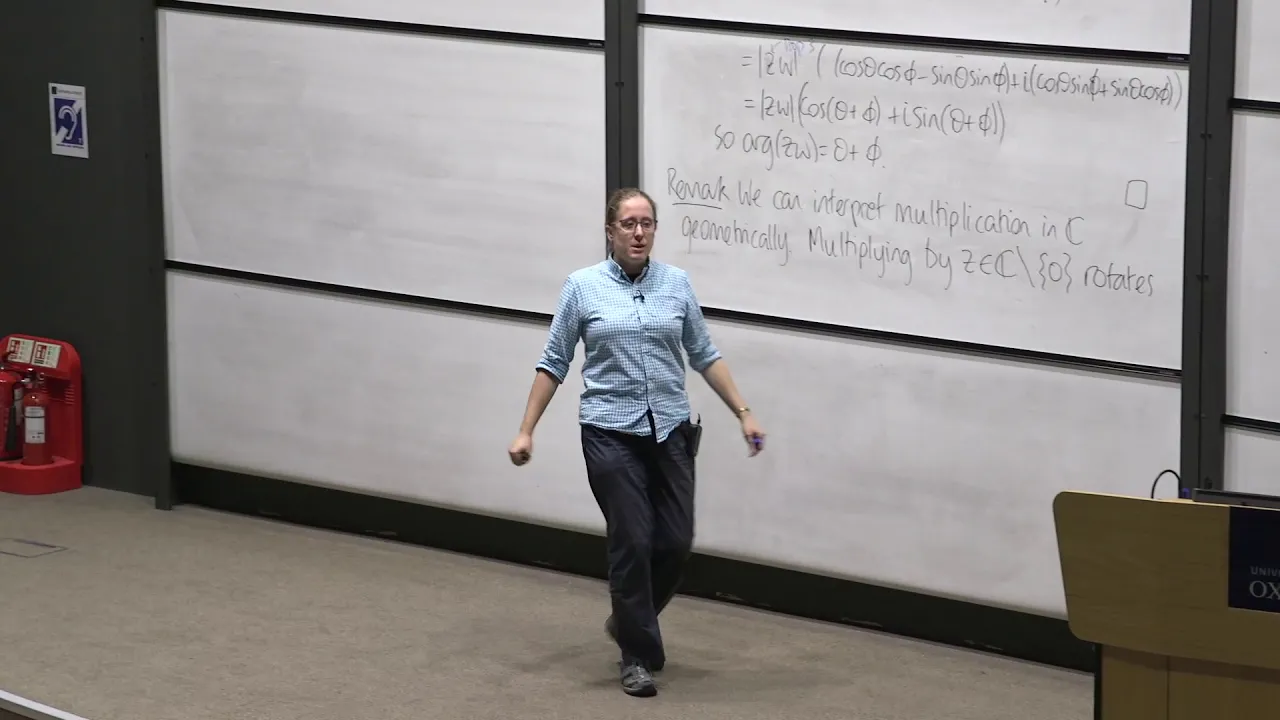
Why this video: An official lecture from Oxford University that dives deep into the unit circle, de Moivre's theorem, and roots of unity. This establishes algebraic rigor over the complex geometric operations first introduced in simpler overviews.
- State and prove de Moivre's Theorem using induction and Euler's identity.
- Find and graph the -th roots of unity in the complex plane.
Module 3: Arithmetic Functions, Dirichlet Convolution, and Series Foundations
This module explores number-theoretic arithmetic functions (such as Euler's totient , the Möbius function , and divisor functions). It introduces Dirichlet convolution, which endows these functions with a ring structure. Crucially, we introduce general Dirichlet series early, framing the Zeta function as a special case and discussing the concept of the abscissa of convergence.
Recommended Videos
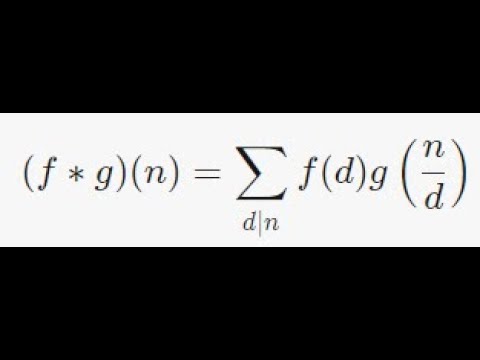
Why this video: This video provides a precise, step-by-step mathematical definition of Dirichlet convolution: . It explores how this binary operation establishes algebraic properties over arithmetic functions.
- Compute the Dirichlet convolution of simple arithmetic functions.
- Prove that Dirichlet convolution is commutative and associative.
- Define the multiplicative identity function under convolution.

Why this video: Michael Penn walks through the properties of the Möbius function and proves the critical Möbius Inversion Formula. This formula is one of the most powerful tools for manipulating arithmetic sums in number theory.
- Define the Möbius function for square-free and non-square-free integers.
- State and prove the Möbius Inversion Formula.
- Express Euler's totient function using Möbius inversion.

Why this video: Addresses a core curriculum gap. This video introduces general Dirichlet series and rigorously explains the domains of convergence, defining both the abscissa of convergence and the abscissa of absolute convergence .
- Write down the general form of a Dirichlet series.
- Define the abscissa of convergence and absolute convergence .
- Explain why the Riemann Zeta function is a specific Dirichlet series where for all .
Module 4: The Riemann Zeta Function and Euler Product
This module connects the additive structure of the integers to the multiplicative structure of the primes. You will study the Riemann Zeta function as a Dirichlet series and walk through the step-by-step mathematical derivation of the celebrated Euler Product Formula.
Recommended Videos
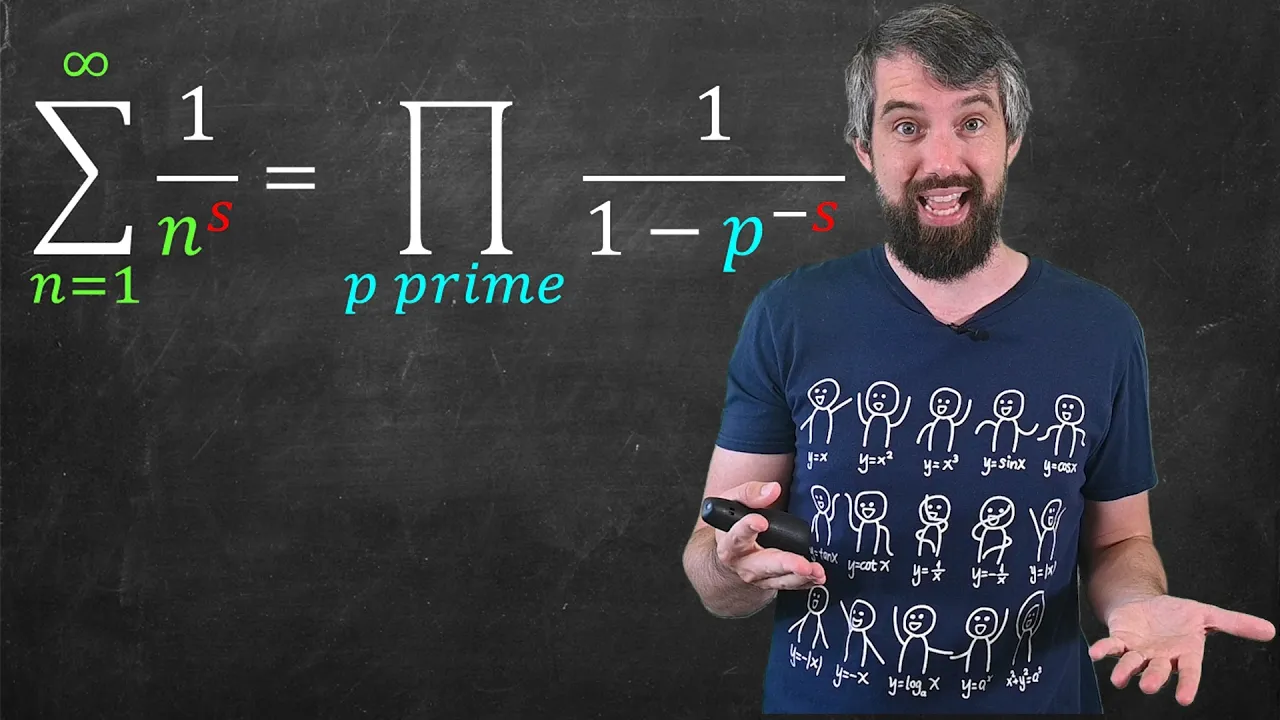
Why this video: Addresses a core curriculum gap. This video presents a rigorous, step-by-step mathematical derivation of the Euler Product Formula: . It explicitly links the identity to the Fundamental Theorem of Arithmetic.
- Derive the Euler Product Formula starting from the Dirichlet series representation of .
- Explain how the Fundamental Theorem of Arithmetic guarantees the uniqueness of the terms in the expansion.
- State the domain of complex numbers for which this product formula is valid.

Why this video: A highly creative visualization of the "sieving" process used to prove the Euler Product Formula. It provides strong algebraic intuition for how multiplying by prime-reciprocal factors systematically filters out composite denominators.
- Describe the sieving mechanism used to eliminate multiples of primes.
- Replicate the algebraic steps of the sieve of Eratosthenes as applied to the Zeta function.

Why this video: This video proves that the Riemann Zeta function converges absolutely for using the integral comparison test, reinforcing the analysis tools from Module 2.
- Prove convergence of the Zeta function for real using the integral test.
- Understand why absolute convergence holds for complex variables with .
Module 5: Prime Number Distribution and the Prime Number Theorem
How are prime numbers distributed across the number line? This module introduces the prime-counting function , the logarithmic integral approximation , and the Prime Number Theorem (PNT). We also study bounds on prime density and partial summation.
Recommended Videos

Why this video: This video introduces the prime counting function and details how prime density behaves asymptotically like . It shows why the logarithmic integral is a much tighter approximation than .
- Define the prime counting function and sketch its step-like graph.
- Write down the mathematical statement of the Prime Number Theorem.
- Explain why approximates better than .

Why this video: Professor Ram Murty introduces the essential tool of partial summation (Abel's summation formula) and shows how Chebyshev used elementary mathematical bounds (such as binomial coefficients) to bound prime distribution.
- Write down and apply Abel's partial summation formula.
- Explain how binomial coefficients (e.g., ) can be used to bound the product of primes up to .
- State Chebyshev's classic upper and lower bounds on the ratio .

Why this video: Richard Borcherds connects prime-counting functions to the behavior of the Zeta function. This video outlines the final steps of proving the Prime Number Theorem, linking Chebyshev-like bounds to the analytical properties of .
- Explain why the approximation holds, where is Chebyshev's second function.
- Understand the logical chain linking the non-vanishing of on the line to the Prime Number Theorem.
Gap Alert — Independent Study Recommendation: While the recommended videos explain Chebyshev's historical bounds and the logical structure of the PNT proof, the video pool lacks a dedicated visual explainer of Chebyshev's weighted prime-counting functions: the theta function and the psi function .
To fill this gap, we highly recommend searching YouTube for:
"Chebyshev prime theta psi functions number theory lecture"Focus on learning how these functions smooth out the step-like nature of to simplify the PNT proof.
Module 6: Advanced Zeta Properties, Analytic Continuation, and the Riemann Hypothesis
Our final module deals with the deep, complex analytical properties of the Zeta function. We cover the transition from the convergent half-plane () to the entire complex plane (analytic continuation), the functional equation, the critical strip, and the Riemann Hypothesis.
Recommended Videos
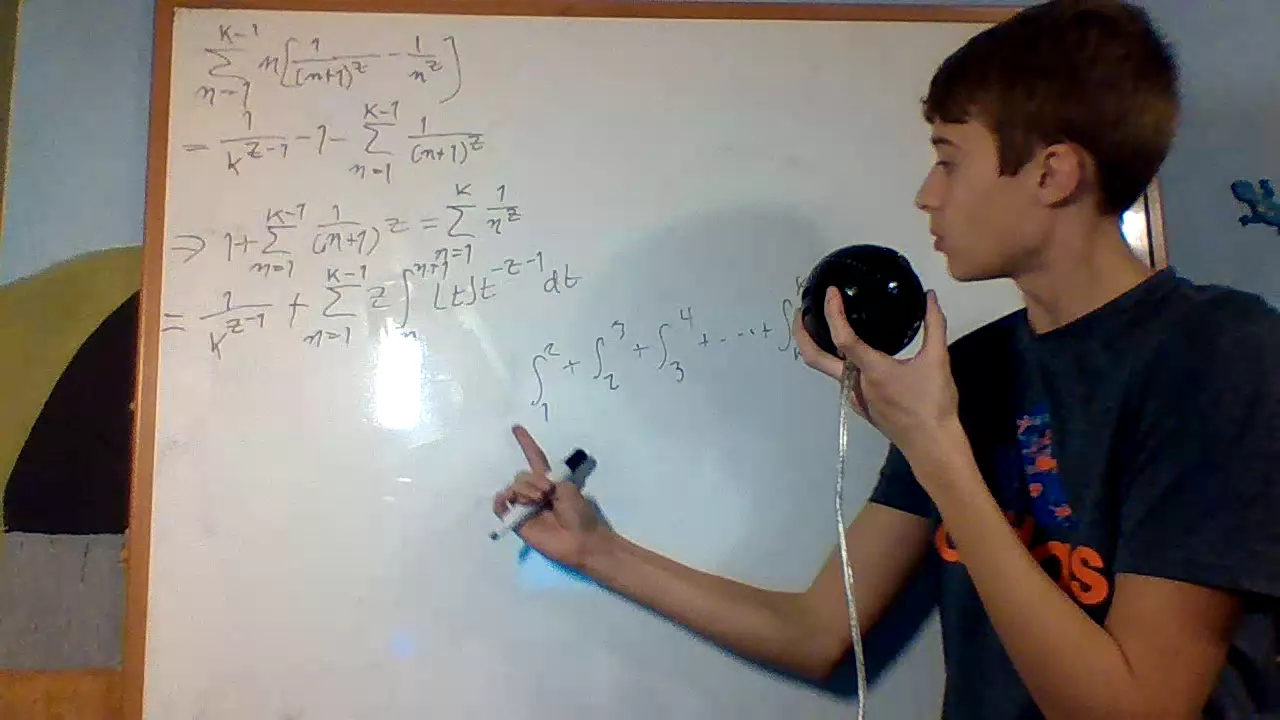
Why this video: An exceptional mathematical explanation of analytic continuation. It demonstrates how to extend from its convergent half-plane () to the domain using an integral formula involving the fractional/floor function .
- Define the concept of analytic continuation.
- Write down the continuation formula for on the domain .
- Identify where the single pole of the Riemann Zeta function is located and explain its residue.
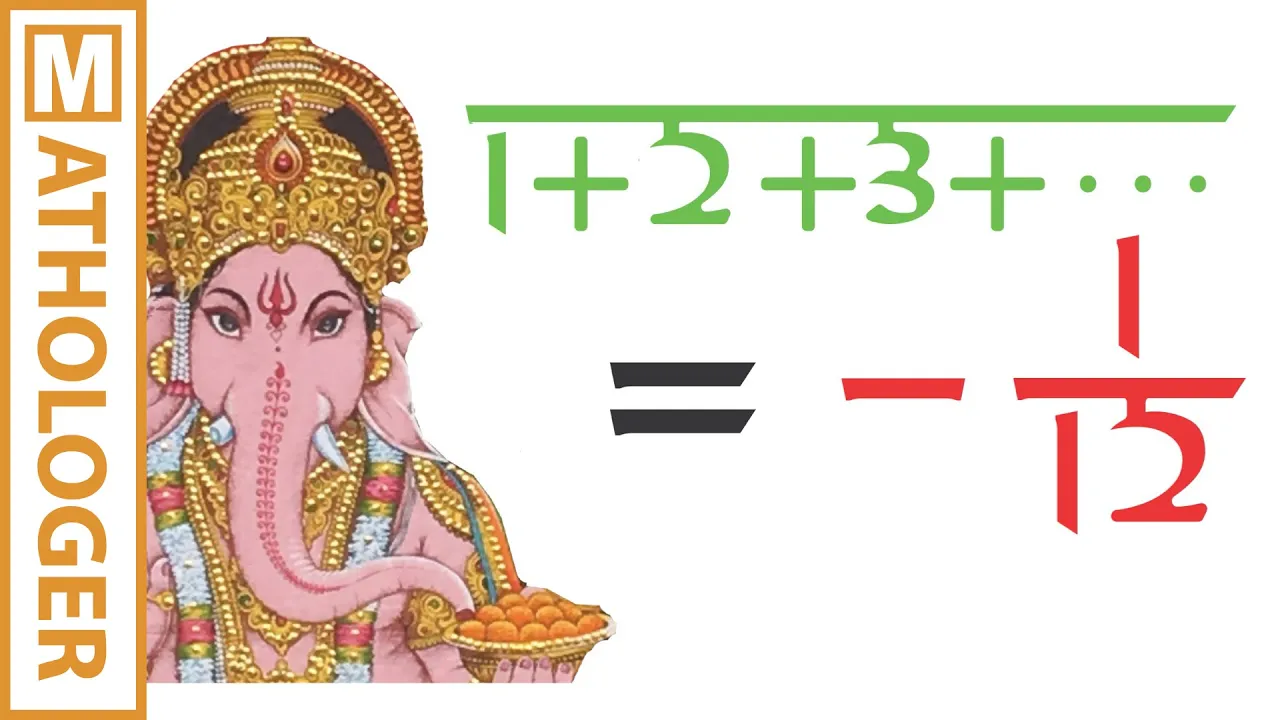
Why this video: This video explains how analytic continuation assigns finite values to otherwise divergent series. It demystifies Ramanujan's summation and the famous identity by using the Dirichlet eta function (alternating zeta function) as a bridge.
- Define the Dirichlet eta function and explain why its series converges for .
- Show the algebraic relationship between and .
- Rigorously justify the assignment without claiming that the divergent sum equals a negative fraction.
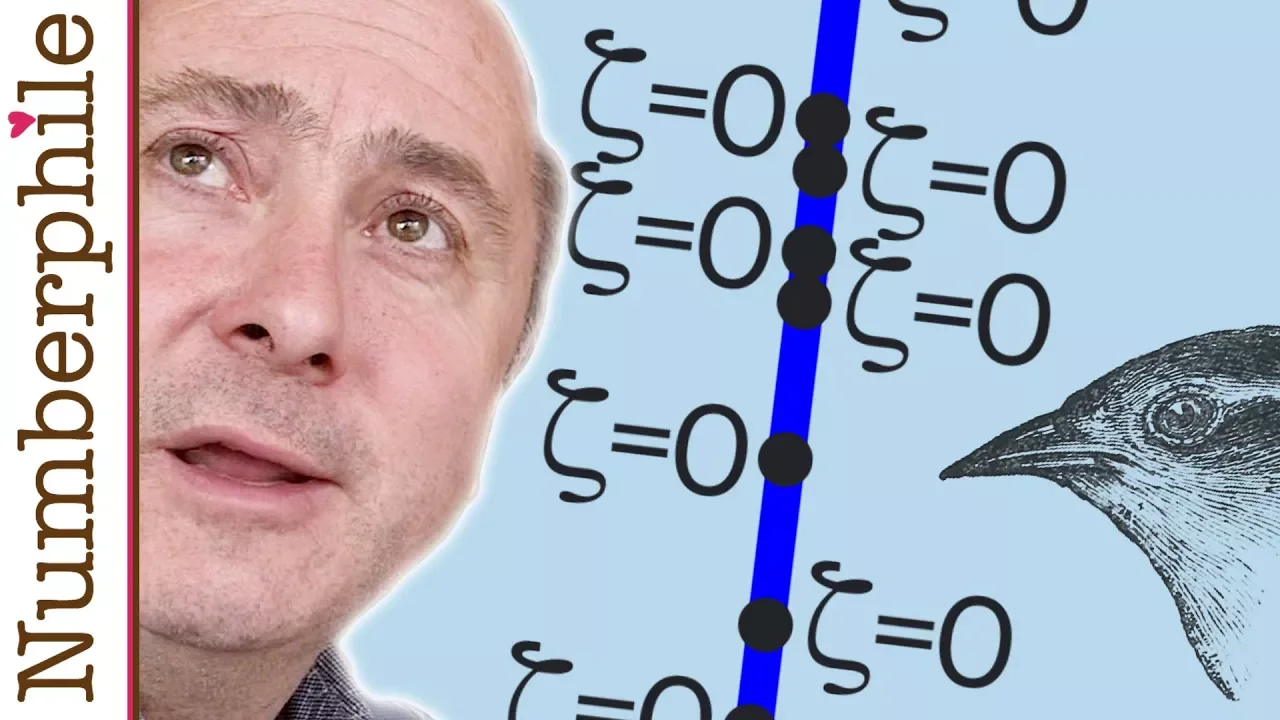
Why this video: This video introduces the functional equation of the Zeta function, reflecting values across the critical line . It explains the symmetry of the critical strip and states the Millennium Prize Problem: the Riemann Hypothesis.
- Define the "Critical Strip" () and the "Critical Line" ().
- Distinguish between the "trivial zeros" of and its "non-trivial zeros".
- State the Riemann Hypothesis in terms of the locations of the non-trivial zeros of .
Course Map
This flowchart maps the logical dependency of modules in the curriculum. Follow this sequence for the most effective learning experience.
Key People Index
- Leonhard Euler (1707–1783): Pioneered the study of the Zeta function for real numbers and discovered the profound Euler Product Formula (1737), which mathematically unified analysis with prime factorization.
- Peter Gustav Lejeune Dirichlet (1805–1859): Extended analytic methods by introducing general Dirichlet series and proved that there are infinitely many primes in arithmetic progressions.
- Pafnuty Chebyshev (1821–1894): Provided the first major quantitative bounds on the prime counting function , proving that if has a limit, that limit must be 1.
- Bernhard Riemann (1826–1866): Introduced complex variables into the study of the Zeta function . He formulated the functional equation, proved its analytic continuation, and proposed the celebrated Riemann Hypothesis regarding its non-trivial zeros.
- Richard Borcherds (1959–Present): Fields Medalist (1998) and Professor at UC Berkeley whose lectures provide modern algebraists and number theorists with clear, structurally sound pedagogical paths.
Final Self-Assessment
Use this rigorous checklist to verify that you have achieved the learning goals of this curriculum:
- State and prove the Fundamental Theorem of Arithmetic using mathematical induction.
- Show that the complex number equals using power series expansions.
- Evaluate the Dirichlet convolution for two arithmetic functions where and at .
- State the definition of the abscissa of convergence for a general Dirichlet series.
- Derive the Euler Product representation of for and explain why it converges absolutely in this region.
- Contrast the asymptotic behaviors of the functions and when approximating the prime counting function .
- Describe Chebyshev's inequality for prime bounds and outline how binomial coefficients help prove these bounds.
- Write down Riemann’s formula for the analytic continuation of to the strip .
- Explain why does not mean the divergent series sums to a negative fraction under standard arithmetic.
- State the exact location of the trivial zeros of the Riemann Zeta function.
- Formulate the Riemann Hypothesis and explain why its proof would yield the tightest possible error bounds for the Prime Number Theorem.