Philosophy of Science: Demarcation & Realism
Learning Goal: Critique the foundational debates in the philosophy of science, examining the demarcation problem, scientific realism versus instrumentalism, and Thomas Kuhn’s theory of paradigm shifts.
- Prerequisites: None (An open mind and basic familiarity with scientific inquiry are recommended).
- Estimated Total Study Time: 14 Hours
Module 1: Introduction to the Philosophy of Science
This module introduces you to the core tenets of the philosophy of science. You will explore what distinguishes scientific inquiry from other forms of human knowledge, how the scientific method has historically evolved, and why philosophical questioning is necessary to understand the foundations, assumptions, and limits of science.

Why this video: Professor Paul Hoyningen-Huene provides a robust, academic, university-level introduction to the discipline. He clarifies the dividing line between scientific practice and the philosophical analysis of that practice, focusing on what makes scientific knowledge distinctively systematic and reliable.
- Explain the primary difference between doing science and analyzing science philosophically.
- Describe the criteria that make scientific knowledge "distinctive" according to traditional philosophy.
- Discuss the limits of using purely empirical methodologies to define what is "true."
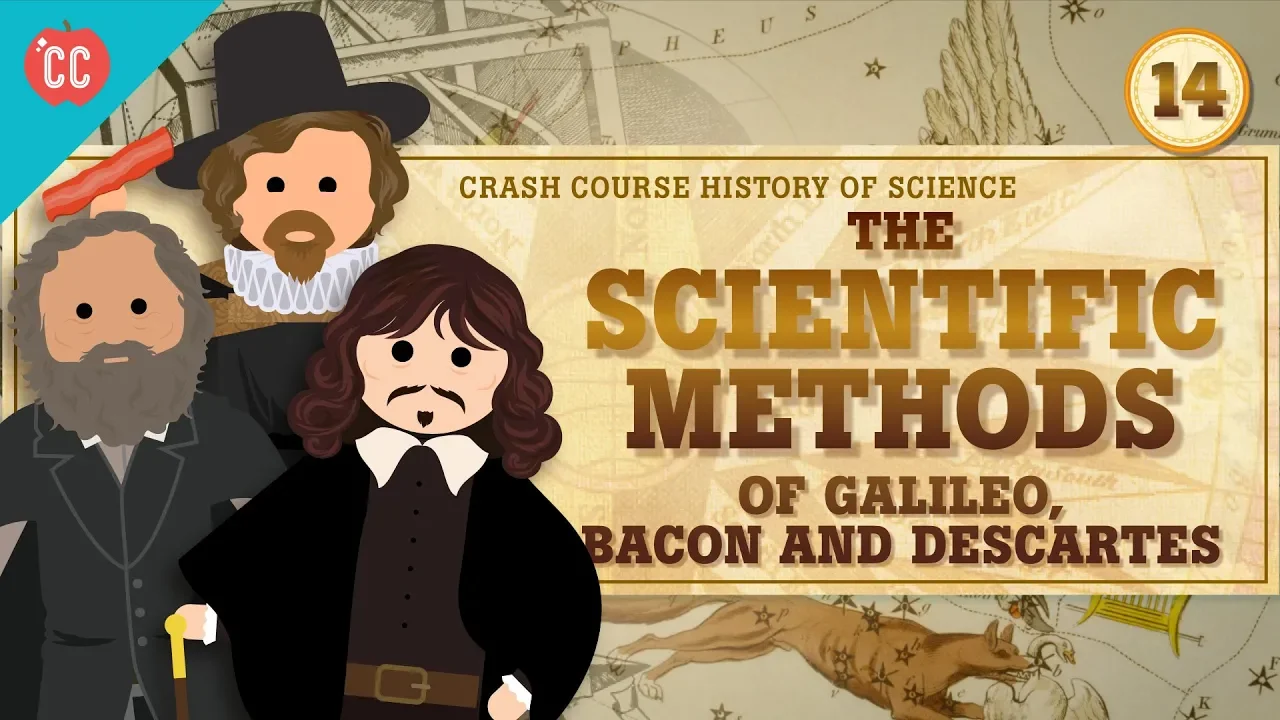
Why this video: This video traces the historic evolution of "the scientific method," demonstrating that it is not a singular, static formula but an evolving set of techniques shaped by historic giants like Galileo Galilei, Francis Bacon, and René Descartes.
- Identify how the definition of "scientific method" has shifted from the Renaissance to modern times.
- Define the roles of deduction and induction in historical scientific development.
- Critically evaluate the assertion that there is only one "scientific method."

Why this video: A concise overview explaining why science remains a deeply philosophical topic. While sciences like physics explain the physical properties of the universe, they cannot philosophically justify their own ontological assumptions—which is where the philosophy of science steps in.
- Explain why science itself cannot philosophically validate its own underlying assumptions.
- Define what makes scientific practice a subject of philosophical interest.
Module 2: The Demarcation Problem: Science vs. Pseudoscience
This module focuses on the historical search for a criterion to distinguish genuine science from non-science and pseudoscience. You will contrast the strict verificationism of early 20th-century Logical Positivism with Karl Popper's foundational challenge: Falsificationism.
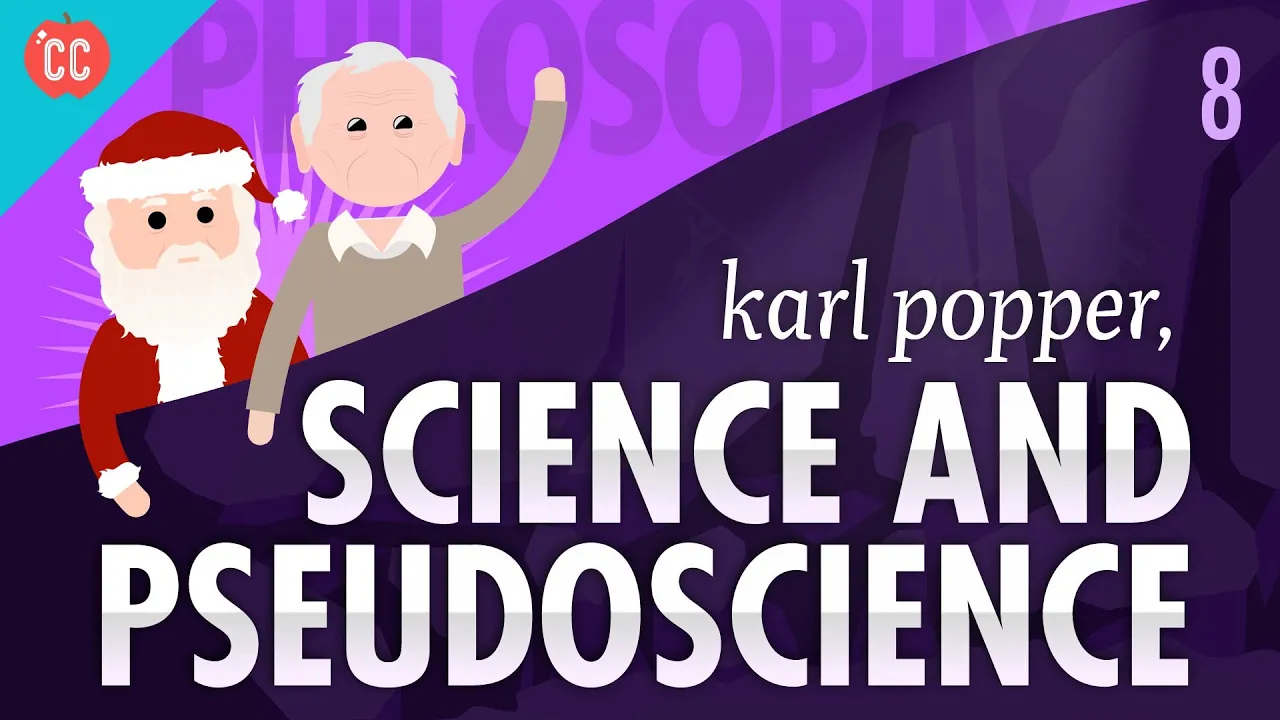
Why this video: This Crash Course episode is the gold standard for understanding Karl Popper’s core philosophy. It details his dissatisfaction with theories like psychoanalysis (which could explain away any result) and his admiration for Einstein's physics (which made risky, testable predictions).
- Define Karl Popper's concept of "falsifiability" as a demarcation criterion.
- Explain why Popper considered theories like astrology or Freudian psychoanalysis to be "pseudoscience" rather than "science."
- Differentiate between a theory that is "confirmed" versus one that has merely resisted falsification.

Why this video: This historic interview features A.J. Ayer, the prominent British philosopher who popularized Logical Positivism in the English-speaking world. Ayer directly details the radical aims of the Vienna Circle and critically reflects on why their verificationist criterion of meaning ultimately failed.
- Explain the Logical Positivist criterion of meaning (the Verification Principle).
- Describe how Logical Positivists attempted to eliminate metaphysics from philosophy and science.
- Analyze the self-referential incoherence that ultimately crippled the Verification Principle.

Why this video: This video offers a historical deep dive into the Vienna Circle—the group of thinkers including Moritz Schlick and Rudolf Carnap who formulated Logical Positivism. It explains their emphasis on math, logic, and empirical verification.
- Identify key historical members of the Vienna Circle and their goals for the "unity of science."
- Articulate the difference between analytic and synthetic propositions within positivist thought.
Curriculum Gap Alert: Highly-viewed, concise animated explainers focusing exclusively on the structural collapse of Logical Positivism are limited. For further research, we highly recommend independently searching for:
"Logical positivism and verificationism philosophy of science"to read about Willard Van Orman Quine’s critique of the analytic-synthetic distinction.
Module 3: Scientific Realism versus Instrumentalism
This module dives into the metaphysics of science: Do our best scientific theories describe mind-independent, objective reality (Realism), or are they merely highly sophisticated tools designed to make accurate predictions about observations (Instrumentalism/Anti-Realism)?
Why this video: Presented by philosopher Kane B, this lecture provides an exceptionally thorough overview of the realism vs. anti-realism debate. It meticulously outlines the epistemic, semantic, and metaphysical dimensions of both positions.
- Distinguish between the semantic, epistemic, and metaphysical claims of a scientific realist.
- Contrast Scientific Realism with Constructive Empiricism (as formulated by Bas van Fraassen).
- Discuss what it means for a theory to be "underdetermined" by empirical evidence.

Why this video: This video from the University of Edinburgh delivers an accessible explanation of the primary positive argument for scientific realism: Hilary Putnam's "No Miracles" Argument.
- Explain the premise of the "No Miracles" Argument (NMA).
- Explain how a realist uses the predictive success of unobservable entities (like electrons) to argue for their literal existence.
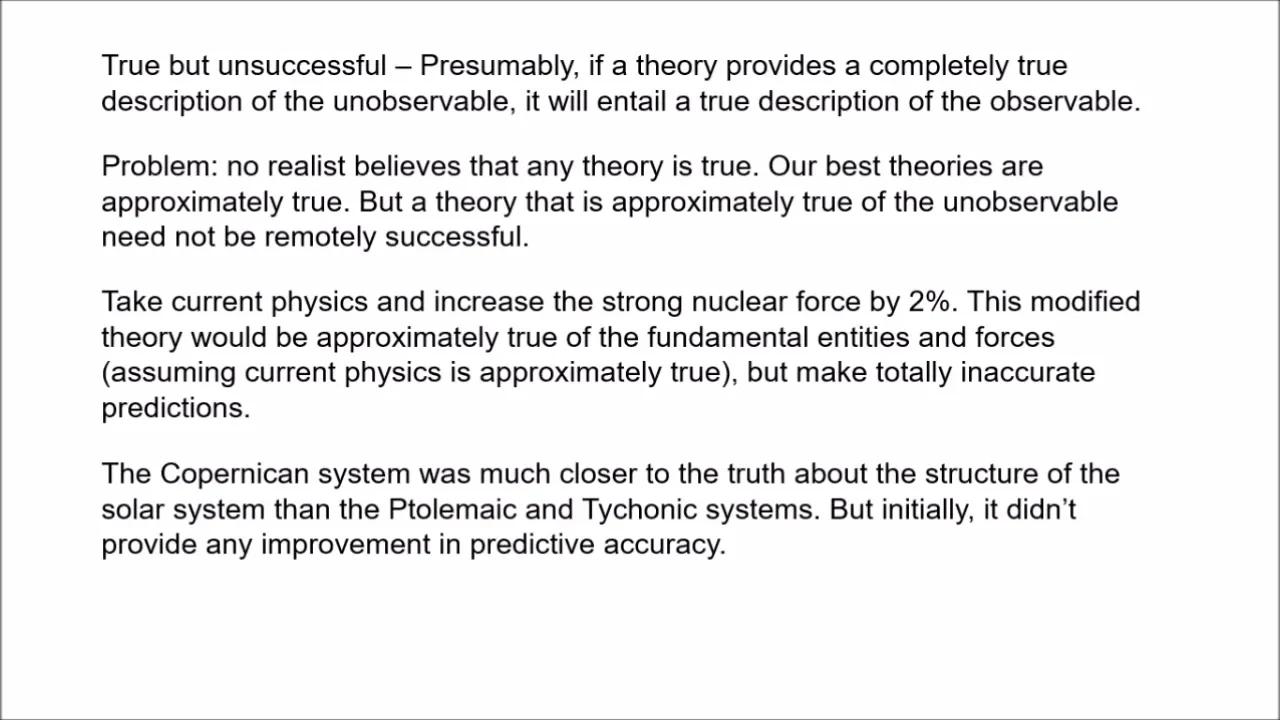
Why this video: In this video, Kane B outlines the primary anti-realist arguments, focusing heavily on the "Pessimistic Meta-Induction" (the historic record of discarded, once-successful scientific theories) and the structural critiques of the No Miracles Argument.
- Explain the "Pessimistic Meta-Induction" (PMI) argument and how it challenges Scientific Realism.
- Detail how historical theory-change (e.g., from phlogiston to oxygen, or caloric to thermodynamics) weakens the realist's claim that success implies truth.
- Outline the distinction between structural realism and entity realism.
Curriculum Gap Alert: Highly-viewed, short video explainers focusing strictly on the "No Miracles Argument" are sparse. To supplement this module, we recommend independently searching for:
"No Miracles Argument scientific realism explained"to read articles on Hilary Putnam's realism vs. Larry Laudan's counter-arguments.
Module 4: Thomas Kuhn and Paradigm Shifts
This module critiques Thomas Kuhn’s revolutionary 1962 book, The Structure of Scientific Revolutions. Kuhn argued that scientific progress is not a smooth, linear accumulation of facts but a series of peaceful periods ("Normal Science") interrupted by intellectual revolutions ("Paradigm Shifts").
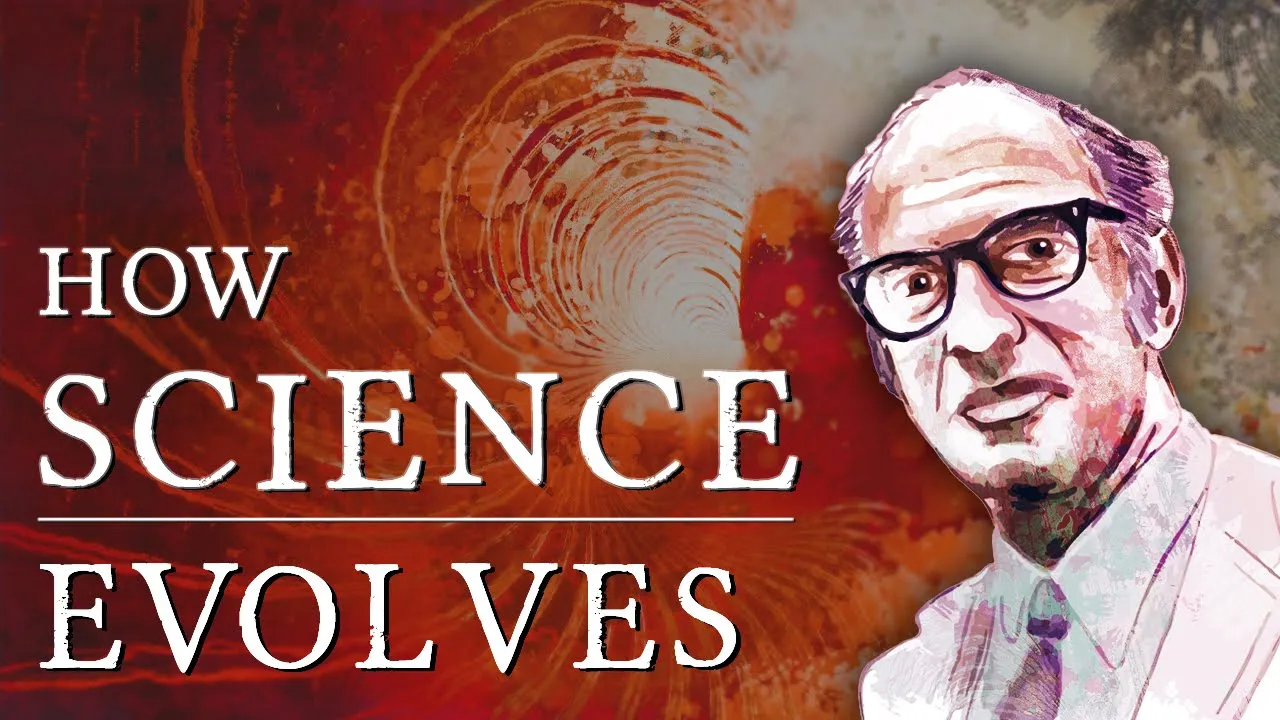
Why this video: This video provides an elegant, structured summary of Kuhn’s model of scientific progression, breaking it down into distinct stages: pre-paradigm science, normal science, crisis, and scientific revolution.
- Define a "paradigm" in the Kuhnian sense.
- Explain the cyclical stages of scientific progression as proposed by Kuhn.
- Describe the role of "anomalies" in destabilizing a dominant scientific paradigm.

Why this video: This lecture digs into the sociological aspects of Kuhn's work. It explains "Normal Science" as puzzle-solving, demonstrating how scientists are historically trained to work within an unquestioned framework rather than constantly attempting to falsify their theories.
- Explain what Kuhn meant by "puzzle-solving" during periods of normal science.
- Analyze why scientific communities resist paradigm shifts and how social factors play a role in maintaining consensus.
- Explain how a "crisis" is triggered when accumulated anomalies can no longer be ignored or accommodated.
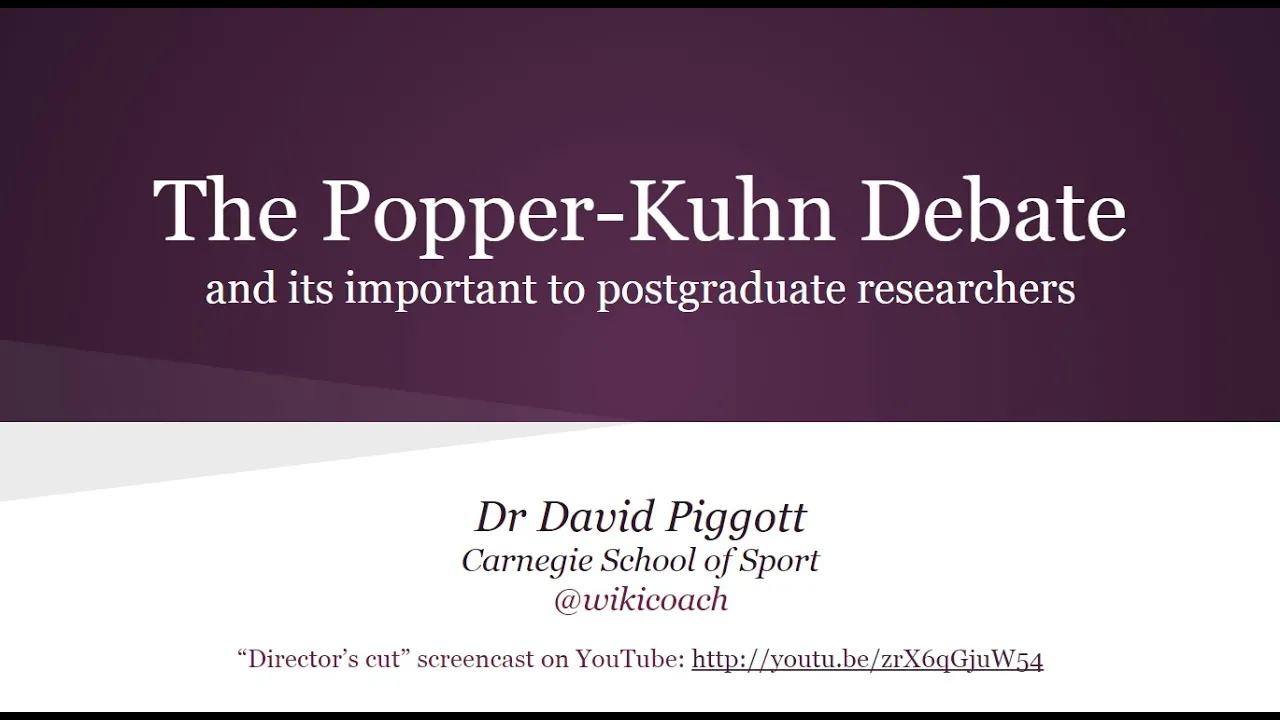
Why this video: This video examines the direct intellectual debate between Karl Popper and Thomas Kuhn. While Popper viewed science as an objective, logical enterprise of constant falsification, Kuhn viewed it as a heavily psychological and sociological activity bound to historic paradigms.
- Contrast Popper's view of scientific logic with Kuhn's sociological/psychological account of scientific changes.
- Explain the concept of "incommensurability" between different scientific paradigms.
- Critique whether paradigm shifts represent genuine, objective progress toward truth or merely shifts in perspective.
Module 5: Objectivity, Values, and the Social Dimensions of Science
This final module moves beyond logical structures to analyze the social realities of science. We will evaluate critiques of scientific objectivity, exploring how scientific models are shaped by social constructs, historical values, and power structures, with a particular focus on feminist epistemology.
Why this video: A brief, highly popular video that unpacks a commonly misunderstood phrase. It demonstrates how our scientific theories of gravity (Newtonian vs. Einsteinian) are human conceptual tools ("social constructs") built to describe a mind-independent physical reality.
- Distinguish between the ontological existence of natural phenomena (the world) and the social construction of scientific theories (our descriptions of the world).
- Explain how human values and historical contexts shape the formulation of scientific laws.

Why this video: This lecture analyzes the traditional ideal of "value-free science" (the belief that social, political, or ethical values should not influence scientific reasoning) and contrasts it with contemporary arguments that science is inherently value-laden.
- Define the "Value-Free Ideal" of science.
- Distinguish between epistemic values (e.g., accuracy, consistency) and non-epistemic values (e.g., social utility, moral values) in scientific practice.
- Evaluate how social values can legitimately or illegitimately affect hypotheses selection.

Why this video: Renowned philosopher Michela Massimi discusses modern perspectives on scientific models and reality. She touches upon "situated knowledge," a key concept originating from feminist epistemology, which posits that scientific claims are always produced from specific, socio-historically situated standpoints.
- Explain the concept of "situated knowledge" and how it challenges traditional claims of absolute, view-from-nowhere objectivity.
- Explain how integrating diverse standpoints (including marginalized perspectives) can lead to more robust scientific inquiry.
Curriculum Gap Alert: Highly-viewed, concise video introductions to Feminist Philosophy of Science and feminist critiques of traditional epistemology are rare on YouTube. To deepen your understanding of Sandra Harding's Standpoint Theory or Helen Longino's Social Value Management, search independently for:
"Feminist philosophy of science introduction"or"Feminist epistemology Stanford Encyclopedia of Philosophy".
Course Map
Key People Index
- Karl Popper (1902–1994): Austrian-British philosopher who rejected classical inductivist views of scientific method in favor of empirical falsification. He proposed that scientific progress occurs by systematically trying to prove existing theories false.
- Moritz Schlick & Rudolf Carnap (Vienna Circle): Leaders of the early 20th-century Logical Positivism movement. They sought to unite all sciences under a strict empirical verificationist standard of meaning, asserting that statements that cannot be verified empirically are literally meaningless.
- A.J. Ayer (1910–1989): British philosopher who popularized the Vienna Circle's logical positivism in the English-speaking world through his seminal book Language, Truth, and Logic.
- Hilary Putnam (1926–2016): Renowned American philosopher who formulated the "No Miracles" argument, stating that the incredible predictive success of modern science would be an inexplicable miracle if our scientific theories did not approximately describe reality.
- Bas van Fraassen (1941–Present): A leading anti-realist philosopher who pioneered Constructive Empiricism. He argues that science does not aim at truth regarding unobservables, but merely aims at "empirical adequacy" (making correct statements about what we can observe).
- Thomas Kuhn (1922–1996): Physicist and historian of science whose book The Structure of Scientific Revolutions introduced the concepts of "paradigms," "normal science," and "paradigm shifts," fundamentally transforming how we understand scientific change.
- Michela Massimi: A contemporary philosopher of science known for her work on perspectival realism, arguing that scientific knowledge is socially and historically situated but can still successfully track objective reality.
Final Self-Assessment
Test your mastery of the philosophy of science by checking off the following core competencies:
- Distinguish between the philosophical analysis of science (asking what justifies scientific claims) and actual scientific practice (conducting experiments within a paradigm).
- Contrast the verificationist criterion of meaning (Logical Positivism) with the falsificationist criterion of demarcation (Popper).
- Explain the logical flaw of induction and why Popper argued that science can never definitively "prove" a positive claim.
- Define Scientific Realism, highlighting its metaphysical, epistemic, and semantic commitments.
- Summarize the "No Miracles Argument" for realism and counter it using the "Pessimistic Meta-Induction" argument.
- Outline the stages of Kuhn's scientific cycle: Pre-paradigm science Normal science Anomalies Crisis Revolution New Normal Science.
- Define "incommensurability" and explain why it presents a challenge to the idea of linear, cumulative scientific progress.
- Critique the "Value-Free Ideal" of science, explaining the difference between epistemic and non-epistemic values.
- Analyze how "situated knowledge" from feminist epistemology argues that incorporating diverse human standpoints improves scientific objectivity rather than destroying it.