Green Chemistry: Principles & Synthesis
Learning Goal: Students will master the core principles of green chemistry, calculate advanced reaction efficiency metrics (Atom Economy, E-Factor, and Reaction Mass Efficiency), systematically evaluate solvents using selection frameworks, and design sustainable chemical processes utilizing renewable feedstocks and modern catalysis.
- Prerequisites: Introductory Organic Chemistry (functional groups, reaction mechanisms, stoichiometry) and basic thermodynamics.
- Estimated Study Time: 10 Hours
Module 1: Foundations of Green Chemistry
This module establishes the historical context and fundamental definition of Green Chemistry, contrasting it with traditional end-of-pipe waste management. You will explore the 12 Principles of Green Chemistry formulated by Paul Anastas and John Warner, and understand how hazard reduction at the molecular design level prevents pollution and minimizes risk.
Recommended Videos

- Why this video: This video features Paul Anastas himself, the "Father of Green Chemistry." It provides an invaluable conceptual introduction to why the field was created, moving chemical manufacturing away from legacy cleanup models and toward benign design.
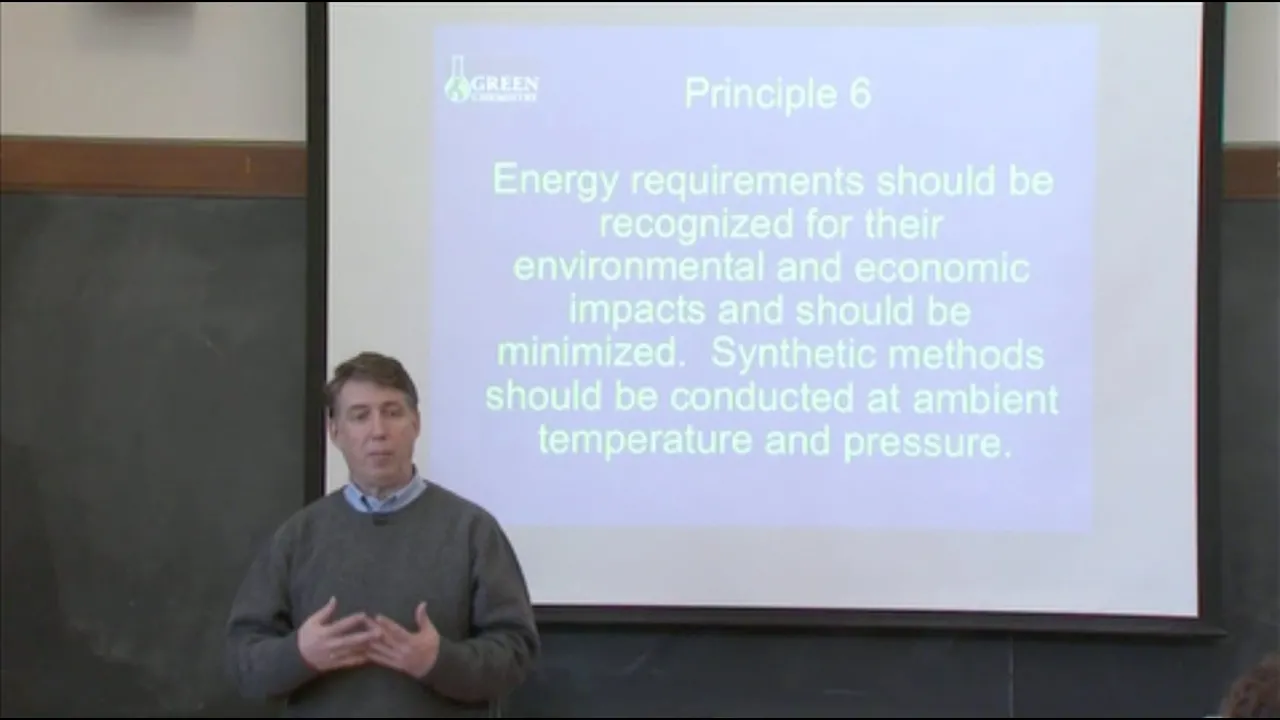
- Why this video: Part of the Yale-developed MoDRN (Molecular Design Research Network) series, this video walks systematically through the 12 Principles. It serves as the primary academic foundation for understanding resource conservation and hazard prevention.

- Why this video: This video offers a deeper interactive lecture on how green chemistry applies across various domains. It highlights how design choice impacts human and environmental safety using real-world chemical paradigms.
Knowledge Checkpoint
- Define the concept of "benign by design" and explain how it differs from traditional environmental remediation.
- List the 12 Principles of Green Chemistry from memory and group them into the sub-categories of "material efficiency," "energy efficiency," and "hazard reduction."
- Explain the hazard formula: , and describe why green chemistry focuses on minimizing the intrinsic hazard factor rather than just managing exposure.
Module 2: Efficiency Metrics: Atom Economy and E-Factor
Chemical efficiency has historically been measured solely by percentage yield. This module introduces quantitative metrics that account for all materials used in a chemical process. You will learn to calculate Atom Economy, Environmental Factor (E-Factor), and Reaction Mass Efficiency (RME), and understand how different industry sectors generate vastly different waste-to-product profiles.
Recommended Videos
- Why this video: A clear, step-by-step mathematical tutorial on how to compute atom economy. It teaches you how to balance chemical equations and use molecular weights to determine the theoretical percentage of reactant atoms converted into the desired product.
- Why this video: Explains the math behind E-factor calculations. While atom economy is a theoretical value calculated from a reaction equation, the E-factor accounts for the actual mass of waste generated in the laboratory or plant (including solvents and reagents), making it highly practical.
- Why this video: This video introduces Reaction Mass Efficiency (RME), which serves as a bridge between theoretical atom economy and practical yield metrics. It helps transition your thinking from ideal stoichiometric equations to real benchtop results.
🧪 Curriculum Gap Alert: Public video coverage of advanced Process Mass Intensity (PMI) calculations and complete multi-step E-Factor evaluations is relatively thin.
- Self-Directed Study Recommendation: Read up on the ACS Green Chemistry Institute's PMI Calculator tools. Learn how modern pharmaceutical companies track PMI (defined as total mass of materials used divided by mass of product) as their primary green efficiency metric.
Knowledge Checkpoint
- Calculate the theoretical Atom Economy of a given reaction using the formula:
- Calculate the E-Factor of a chemical synthesis given the raw mass input of reactants, solvents, catalysts, and the final purified product mass:
- Contrast percentage yield with atom economy. Explain how a reaction can have a yield but a very poor atom economy (e.g., Wittig reaction).
Module 3: Green Solvents and Alternative Reaction Media
Solvents account for the vast majority of auxiliary mass and waste in chemical syntheses. This module covers the environmental and safety hazards of legacy organic solvents (chlorinated hydrocarbons, aromatics) and details the frameworks used to select greener options. You will also study alternative reaction media including water, supercritical carbon dioxide (), and ionic liquids.
Recommended Videos

- Why this video: This is a rare and highly educational walkthrough of the CHEM21 solvent selection guide. It details how industrial chemists score solvents on safety, health, and environmental criteria using standardized hazard classifications.

- Why this video: Offers a visual and conceptual explanation of supercritical fluids, highlighting . It explains how modifying pressure and temperature can tune fluid properties to replace hazardous organic extraction solvents.

- Why this video: A comprehensive university-level seminar describing the chemical structure of room-temperature ionic liquids (RTILs). It shows how asymmetric cations and non-coordinating anions create liquid salts with non-volatile properties.
🧪 Curriculum Gap Alert: Comparative practical analysis videos between specific traditional solvents (e.g., DMF, THF) and green alternatives (e.g., 2-MeTHF, Cyrene) are limited.
- Self-Directed Study Recommendation: Search academic databases for the "Sanofi Solvent Selection Guide" or "GSK Solvent Selection Tool." Review their comparative color-coded matrices (Green/Amber/Red) to see how industrial solvents are replaced.
Knowledge Checkpoint
- State the three primary criteria (Safety, Health, Environment) used by the CHEM21 framework to classify a solvent as recommended, problematic, or hazardous.
- Describe the phase properties of a supercritical fluid and explain why is highly effective for industrial processes like decaffeination.
- Explain why the non-volatile nature of ionic liquids reduces inhalation risk, while acknowledging their potential aquatic toxicity and recycling challenges.
Module 4: Sustainable Synthesis Design and Catalysis
The ultimate goal of green chemistry is designing benign, efficient chemical synthesis pathways from scratch. This module covers the application of renewable bio-based feedstocks, biocatalysis (using enzymes), and transition-metal catalysis. You will analyze real industrial chemistry cases and explore how retrosynthetic pathways can be redesigned to eliminate steps, minimize solvent use, and reduce energy consumption.
Recommended Videos
- Why this video: Explains Principle #7 (Use of Renewable Feedstocks) with clear chemical context. It contrasts fossil-fuel derivation with biomass-derived raw materials like lignocellulose.

- Why this video: A thorough lecture on enzymes as biocatalysts. It covers their remarkable regioselectivity and stereoselectivity, their operation under mild aqueous conditions, and why they serve as a cornerstone of modern green pharmaceutical synthesis.
- Why this video: Re-evaluates catalysis through a green chemistry lens. It explains why catalytic pathways are thermodynamically and materially superior to stoichiometric reagents, preventing waste by lowering required temperatures and pressures.
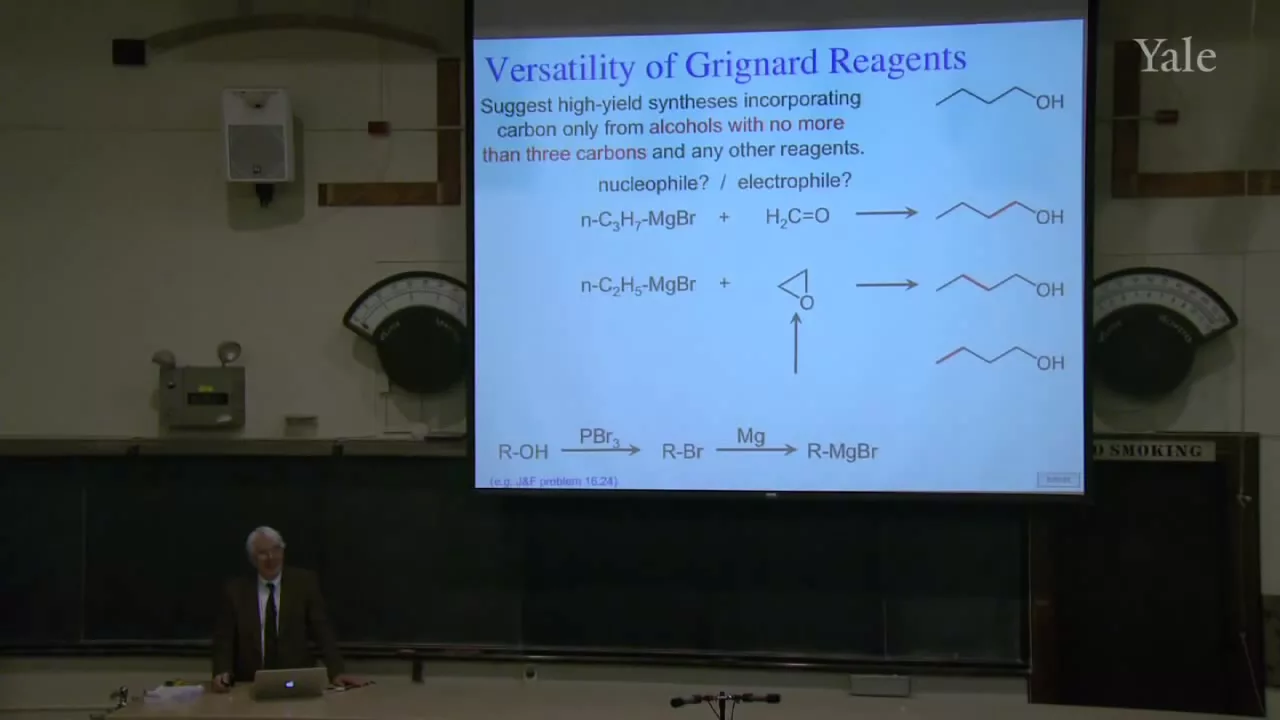
- Why this video: This Yale lecture integrates retrosynthetic design with green chemistry concepts. It discusses how organic syntheses (especially in pharma) can be planned to minimize step-count and replace toxic oxidants like periodate with catalytic alternatives.
🧪 Curriculum Gap Alert: Detailed case studies showing full chemical structures of "before" and "after" green syntheses are rarely presented in short videos.
- Self-Directed Study Recommendation: Research the green synthesis of Ibuprofen (the BHC process versus the Boots process) or the green synthesis of Sitagliptin (developed by Merck and Codexis). Analyze how these pathways dramatically reduce the E-factor using biocatalysts or optimized catalytic cycles.
Knowledge Checkpoint
- Compare biocatalysis with traditional transition-metal catalysis in terms of reaction conditions, selectivity, and environmental footprint.
- Explain how biomass valorization pathways convert biopolymers (like cellulose or chitin) into building-block platform chemicals (such as 5-HMF or levulinic acid).
- Describe how catalytic reactions improve overall energy efficiency (Principle #6) by decreasing activation energy barriers.
Course Map
This map outlines the recommended learning order and dependency structure for mastering the curriculum:
Key People Index
- Paul Anastas & John Warner: Co-authored Green Chemistry: Theory and Practice (1998), introducing the 12 Principles that defined the field. Anastas serves as the Director of Yale's Center for Green Chemistry and Green Engineering.
- Barry Trost: Stanford University professor who introduced the concept of "Atom Economy" in 1991, shifting the target of synthetic organic chemistry from pure yields to resource efficiency.
- Roger Sheldon: Developed the E-Factor concept in the early 1990s. His work highlighted the massive waste generated by the pharmaceutical industry compared to bulk oil refining and petrochemical manufacturing.
- Martyn Poliakoff: A pioneer in green chemistry based at the University of Nottingham. Known for his work in supercritical fluids, continuous flow chemistry, and global green chemistry education.
Final Self-Assessment
Complete this comprehensive checklist after finishing all modules to verify your mastery of Green Chemistry:
- 1. Can you define green chemistry and distinguish it from environmental chemistry?
- 2. Can you list the 12 principles of green chemistry and provide a practical lab example of each?
- 3. Can you explain the chemical difference between an end-of-pipe treatment and molecular hazard avoidance?
- 4. Given balanced chemical equations and product yields, can you calculate Atom Economy, Reaction Mass Efficiency, and E-Factor?
- 5. Can you explain why the pharmaceutical industry historically had a higher average E-Factor ( to ) compared to bulk oil refining ()?
- 6. Can you classify common solvents (e.g., water, toluene, hexane, ethanol, ethyl lactate) according to their safety, health, and environmental risk profiles?
- 7. Can you outline the key advantages and chemical limitations of using water or supercritical carbon dioxide as solvent alternatives?
- 8. Can you identify at least three platform chemicals derived from biomass feedstocks and explain how they replace petroleum feedstocks?
- 9. Can you explain how biocatalysts achieve superior chemo-, regio-, and stereoselectivity compared to standard stoichiometric reagents?
- 10. Can you redesign a hypothetical legacy multi-step reaction path to improve its efficiency metrics by replacing stoichiometric reagents with catalysts?